Links Between Theoretical and Effective
Differential Probabilities: Experiments on
PRESENT
C. Blondeau and B. G´erard
INRIA project-team SECRET, France {celine.blondeau, benoit.gerard}@inria.fr
Abstract. Recent iterated ciphers have been designed to be resistant to differential cryptanalysis. This implies that cryptanalysts have to deal with differentials having so small probabilities that, for a fixed key, the whole codebook may not be sufficient to detect it. The question is then, do these theoretically computed small probabilities have any sense? We propose here a deep study of differential and differential trail probabili-ties supported by experimental results obtained on a reduced version of PRESENT.
Keywords :differential cryptanalysis, differential probability, iterated
block cipher,
PRESENT.
1 Introduction
Differential cryptanalysis has first been applied to the Data Encryption Standard(DES) in the early 90’s by E. Biham and A. Shamir [BS91,BS93]. Since then, many ciphers have been cryptanalyzed using differential crypt-analysis or one of the large family of variants (truncated differential [Knu94], higher order differential [Knu94], impossible differential [BBS99], . . . ).
The basic differential cryptanalysis is based on a differential over r rounds of the cipher.
Definition 1. A r-round differential characteristic
A r-round differential characteristic is a couple (δ0, δr)∈ Fm2 ×Fm2 . The
probability of a differential (δ0, δr) is
p∗
def
= PrX[FKr(X)⊕FKr(X⊕δ0) =δr],
Then,r rounds of the cipher can be distinguished from a random permu-tation using this differential. To break r+ 1 rounds of the block cipher, we look for differentials on r rounds. Then, for all the possible subkeys for the last round, the attacker does a partial decryption of the ciphertext pairs and count the number of time δr appears. For a wrong candidate,
the probability thatδrappears is around 2−m and for the correct subkey,
this probability is aroundp∗+ 2
−m. It is widely accepted that the number
of pairs needed to distinguish those two probabilities is of orderp−1
∗ if the
so called signal-to-noise ratio is large enoughSN =
p∗
2−m
.
Recent ciphers, theAdvanded Encryption Standard (AES) for instance, have been designed to be resistant to the basic differential cryptanaly-sis. Nevertheless, when a new cipher is proposed, cryptanalysts try to mount the best possible linear and differential attacks. In the case of PRESENT[BKL+07], the cipher we used for the experiments, the actual best published differential attack is the one of Wang [Wan08]. But actu-ally, there is lacks in the data complexity estimate of this attack. First of all, an erroneous way of counting the number of subkey hits leads to a too optimistic signal-to-noise ratio of 17.63 and the use of the formula of Sel¸cuk [Sel08] for the success probability is not tight in the case of differential cryptanalysis. We are not going to discuss this here because it is out of the scope of this paper and it does not challenge the validity of the attack that still has a very high success rate when taking these remarks into account. The second point is that the probabilities p∗ of
the differentials may be underestimated because they are obtained taking into account only one way of going from the input difference to the output difference. This is discussed in Section 4.
Round keys of the block ciphers are derive from a master key and are generally not independant. Some work regarding the key dependency of a differential probability have been done in [DR05]. In this paper the aims is to show that the difference between the expected value of a differential and the value obtain by the mean over the keys is small. Here we study the key dependency of the probability of a differential for reduced version of PRESENT.
Contributions of this work.
classical way of estimating a trail probability relies on some hypotheses that are not true. Nevertheless, experiments show that this theoretical probability makes sense as an average of the probability over the keys. In Section 4 we recall that a differential probability is the sum of the corre-sponding trail probabilities. Then, we present some experiments about the key dependency of this differential probability and give a way of under-standing them. Finally, we conclude in Section 5 and sum-up the results as well as the problematics left as open questions.
2 PRESENT
To confirm our conjectures, we made experiments on a lightweight ci-pher presented in 2007 at CHES conference: PRESENT [BKL+07]. The structure of PRESENT is aSubstitution Permutation Network (SPN).
2.1 Reduced version of PRESENT: SMALLPRESENT-[s]
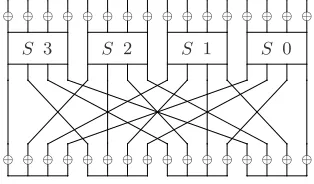
For the experiments to be meaningful, we need to be able to exhaustively compute the ciphertexts corresponding to all possible plaintexts for all possible keys. That is the reason why we chose to work on a reduced version of PRESENT named SMALLPRESENT-[s] [Lea10]. The family of SMALLPRESENT-[s] has been designed to be used for such exper-iments. The value of s indicate the number of Sboxes per round. The Sboxes of PRESENT are all the same and are defined inF42. This trans-formation is described in Table 1. The size of the message is then 4s. In this article we make experiments on SMALLPRESENT-[4] that is the version with 4 Sboxes. The full version of PRESENT has 16 Sboxes. One round of SMALLPRESENT-[4] and PRESENT are respectively depicted in Figure 8, Figure 9 (Appendix A).
2.2 Different key schedules for SMALLPRESENT-[4]
The problem with the reduced cipher presented in [Lea10] is the key sched-ule. Actually, in the whole PRESENT, most of the bits of a subkey are di-rectly used in the subkey of the next round. Since for SMALLPRESENT-[s], the number of key bits is always 80 but the state size is only 4·s, this is not true anymore for a small s. We decide to introduce two additional key schedules for our experiments.
2. 80-bits: This key schedule is the one used in the full version of PRESENT and proposed in [Lea10].
3. 20-bits: a homemade key schedule used with SMALLPRESENT-[4] similar to the one of the full version.
The master key is represented as K = k19k18. . . k0. At round i the 16-bits round key Ki =k19k18. . . k4 consists in the 16 left-most bits of the current content of register K. After extracting the round key Ki, the key register is updated as follows:
(a) [k19k18. . . k1k0] = [k6k5. . . k8k7] (b) [k19k18k17k16] =S[k19k18k17k16]
(c) [k7k6k5k4k3] = [k7k6k5k4k3]⊕roundcounter
The key is rotated by 13 bit positions to the left, the left most four bits are passed through the PRESENT Sbox, and theroundcounter value is exclusive-ored with bits k8k7k6k5k4. We keep the 5-bits counter version. But we only study less than 7 rounds of SMALLPRESENT-[4] so the counter can be represented in 3 bits.
3 Differential trail probability
3.1 Notation
Let us denote by K the master key. The round subkeys derived from K are denoted by K1, K2, . . . , Kr. Let FKi :F
m
2 7→ Fm2 be a round function of a block cipher. We will denote by FKr the application of r rounds of the block cipher.
FKr =FKr◦FKr−1◦ · · · ◦FK1.
In this section, we focus on differentials that have been defined in Definition 1. In general, there is not one but many ways to go from the input difference to the output difference of a differential characteristic. Such a way is called differential trail.
Definition 2. Differential trail
Adifferential trailof a cipher is a(r+ 1)-tuple(β0, β1,· · ·, βr)∈(Fm2 )r+1
of intermediate differences at each round. Theprobability of a differential trail β = (β0, β1,· · · , βr) of a fixed key is
PrX
∀i FKi (X)⊕FKi (X⊕β0) =βi.
Assumption
The sequence of differences at each round output forms a Markov chain. Assuming this, the theoretical probability of a trailβ = (β0, β1,· · ·, βr)
is computed as follow
ptβ =
r
Y
i=1
PrX[FKi(X)⊕FKi(X⊕βi−1) =βi].
But actually, this assumption is not true (at least for SPN ciphers). We give a counter example in the following subsection and focus on the key dependency of the probability of a trail.
3.2 Key dependency of a trail
The main difficulty in the pre-computation phase is the search of good differential trails. The computed value of the probability of a differential trail relies on the widely used aforementioned assumption. Thus, in some case the theoretical value of the probability of a differential trail does not match with reality. For one round it is easy to see that the theoretical value corresponds to the real one. But for more than one round it seems legitimate to wonder what does this theoretical probability mean. As we see below, the probability of a differential trail can be influenced by the choice of the master key used to encipher samples. Thus, we override the previous definition of a differential trial probability with the following one.
Definition 3. Differential trail probability
The probability of a differential trailβ = (β0, β1,· · ·, βr) is defined by
pβ def= PrX,K
∀i FKi (X)⊕FKi (X⊕β0) =βi
.
We now take into account the choice of the master key in the variable we use. For a r-round differential trailβ = (β0, β1,· · ·, βr), let us define
TKdef=
1
2#{X∈F
m
2|FKi (X)⊕FKi (X+β0) =βi ∀ 1≤i≤r},
T[j]def= #{K|TK =j}. (1)
Letnk be the number of bits of the master key. The real value of the
trail probability is
pβ = 2−m−1
X
K∈Fnk2
TK= 2−m−1−nk
X
j
T[j]·j.
Example of a trails with experimental probability not equal to the theoretical one
We illustrate this phenomena by a differential trail over 3 rounds on SMALLPRESENT - [4]: β = (0x1101,0xdd,0x30,0x220) (see Figure 1).
⊕ ⊕ ⊕ ⊕ ⊕ ⊕ ⊕ ⊕ ⊕ ⊕ ⊕ ⊕ ⊕ ⊕ ⊕ ⊕
S3 S2 S1 S0
⊕ ⊕ ⊕ ⊕ ⊕ ⊕ ⊕ ⊕ ⊕ ⊕ ⊕ ⊕ ⊕ ⊕ ⊕ ⊕ S3 S2 S1 S0
⊕ ⊕ ⊕ ⊕ ⊕ ⊕ ⊕ ⊕ ⊕ ⊕ ⊕ ⊕ ⊕ ⊕ ⊕ ⊕ S3 S2 S1 S0
⊕ ⊕ ⊕ ⊕ ⊕ ⊕ ⊕ ⊕ ⊕ ⊕ ⊕ ⊕ ⊕ ⊕ ⊕ ⊕
j 0 8 16
T[j] 131072 524288 393216
Fig. 1.Trailβ= (0x1101,0xdd,0x30,0x220) and the correspondingT[j]’s
First, we are going to compute the theoretical probability of this trail. Assuming that the rounds of SMALLPRESENT-[4] are independent we can easily compute the theoretical value of this differential trail.
– Round 1 3 S-boxes with input difference 0x1 and output difference 0x3.
– Round 2 2 S-boxes with input difference 0xd and output difference 0x2.
– Round 31 S-box with input difference0x3and output difference0x6.
We have 6-Sboxes with transition probability 2−2 therefore pt β = 2
−12. This means that the number of plaintext such that (X, X ⊕0x1101)
follows this trail for a fixed key should be 216−1 ·2−12 = 23. We made experiments to check this assumption. For a fixed key we computed the number of plaintexts that follows this trail. In Figure 1 are given the values taken by T[j] for all keys in F202 using the 20-bit key schedule. We can see that there are three kinds of key leading to three different values of T[j]. We found many of such trails on 3 rounds that split the space of keys.
of this trail probability. Experiments also show that for some keys the trail can be impossible. This can be of real significance because such phenomenon is also existing on 3 rounds of PRESENT. That means that, maybe, some differential trails used in a differential cryptanalysis may not have the expected probability for most of the keys.
Averaging the probabilities over the keys, we see that the effective probability of this differential trail is 2−11.6 (the theoretical one is 2−12). This difference between real and theoretical probabilities may weaken (or strengthen) some attacks. Does a lot of trails have such a difference between their theoretical value and the average probability? In the next subsection we will show that, most of the times, the theoretical value of a differential trail is close to the effective one (averaged over the keys).
3.3 Theoretical probability and average probability of a trail over the keys
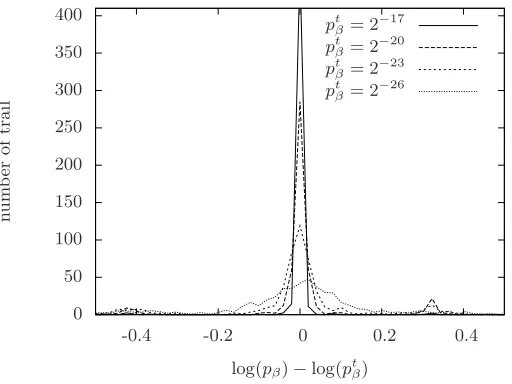
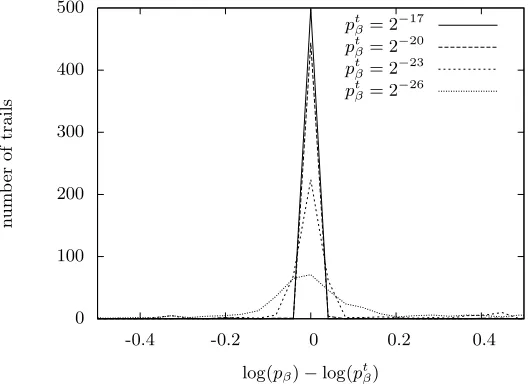
To understand this phenomenon, we made some experiments on PRESENT. We observed that the theoretical probability is likely to be the average of the trail probability over all the possible keys. We make experiments on SMALLPRESENT-[4] with different key schedules. Let us recall that the theoretical probability of the differential trailβ is denoted by ptβ and the effective one (averaged over the keys) is denoted by pβ. In Figure 2,
Figure 3 and Figure 4, we have computed the difference between log(ptβ) and log(pβ) for 500 random trails.
– In Figure 2 we assume that the round subkeys are derived from the 20-bits key schedule. We average the probabilities over the whole set of 220 keys to obtain the value pβ.
– In Figure 3 we assume that all the round subkeys are the same. We average the probabilities over the whole set of 216 keys to obtain the valuepβ.
– InFigure 4we assume that the round subkeys are derived from the 80-bits key schedule. Since we cannot average probabilities over the 280 possible master keys, the computed value is obtained by an average over 220 keys.
Remark:
0 50 100 150 200 250 300 350 400
-0.4 -0.2 0 0.2 0.4
n
u
m
b
er
o
f
tr
a
il
log(pβ)−log(ptβ)
ptβ= 2
−17
pt β= 2
−20
ptβ= 2
−23
pt β= 2
−26
Fig. 2.Number of trails as a function of log(pβ)−log(ptβ) with a sample of 500 trails
on 5 rounds and the 20-bits key schedule
Figure 4 where the 80-bits key schedule is used implying that all the key bits are used only once (on average). This remark has motivate the 20-bits key schedule we use in the following experiments that seems to be the most appropriate.
Experiments show that the average proportion of pairs satisfying a differential trail is close to the theoretical probability. We can observe that this behavior is getting worse as the probability is decreasing. Nevertheless, it seems to be some symmetry what leads to the idea that taking enough trails will correct this and give better results.
3.4 Automatic search of differential trails
0 50 100 150 200 250 300
-0.4 -0.2 0 0.2 0.4
n u m b er o f tr a il s
log(pβ)−log(pt β) ptβ = 2
−17
pt β = 2
−20
ptβ = 2 −23
pt β = 2
−26
Fig. 3.Number of trails as a function of log(pβ)−log(ptβ) with a sample of 500 trails
on 5 rounds and the same subkey for all rounds
0 100 200 300 400 500
-0.4 -0.2 0 0.2 0.4
n u m b er o f tr a il s
log(pβ)−log(pt β) ptβ = 2
−17
pt β = 2
−20
ptβ = 2 −23
pt β = 2
−26
Fig. 4.Number of trails as a function of log(pβ)−log(ptβ) with a sample of 500 trails
on 5 rounds and 220keys using the 80-bits key schedule
4 Differential probability
4.1 Differential probability and trail probabilities
The first thing to say here is that the probability of a differential is the sum of the probabilities of the corresponding differential trails.
Lemma 1. Let (δ0, δr) be a r-round differential characteristic. Then the
probability p∗ of this differential is
p∗=
X
β=(δ0,β1,...,βr−1,δr)
pβ.
Proof. This is essentially due to the fact that a pair that matches a trail cannot match any other (they are disjoint events) and thus Pr [∪iAi] =
P
iPr [Ai].
For a large number of rounds, it is impossible to compute the proba-bility of a differential (δ0, δr) because there is too much differential trails
that go from δ0 to δr. Actually, in differential cryptanalysis, one uses a
lower bound on the probability of the differential (δ0, δr) by considering
the sum of the likeliest trail probabilities.
In Section 3, we saw that the effective trail probability may not match with the theoretical one. Nevertheless, it seems to be some symmetry what leads to the idea that the sum of theoretical trail probabilities may give a good estimate of a differential probability (averaging over the key).
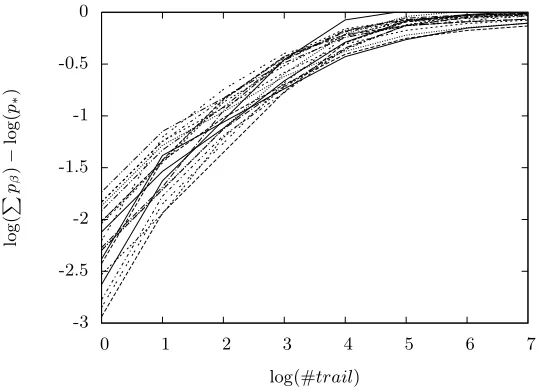
We made some experiments on 5 rounds of SMALLPRESENT-[4] with the 20 bits key schedule to see how many trails are required to get a good estimate of a differential probability. We computed the sum of the theo-retical probabilities of many trails corresponding to the same differential characteristic. Since the cipher is small we also have computed the ef-fective value of the differential by averaging over all plaintexts and all keys. In Figure 5 we have plotted the difference between both values for 20 differential characteristics. We can see that taking many trails give a better estimation of the differential probability.
-3 -2.5 -2 -1.5 -1 -0.5 0
0 1 2 3 4 5 6 7
lo
g
(
P
pβ
)
−
lo
g
(
p∗
)
log(#trail)
Fig. 5.Convergence of the sum of trails probabilities to the real value of the differential characteristic
Remark on Wang’s paper [Wan08]
In [Wan08], the target is the whole PRESENT (64 bits). The differential used is
(d0, d14) = (0x0700000000000700,0x0000000900000009)
on 14 rounds obtained by iterating 3 times a differential trail on 4 rounds and by adding one more round at the beginning and at the end.
We observe some things about this trail.
– This trail on 4 rounds is not one of the best since it has a probability equal to 2−18 and we found a lot of differential trails with probability
2−12. Nevertheless, it is the best iterative differential on 4 rounds. – There exists lots of differential trails on 14 rounds with probability
2−62and using algorithm given in Section??2−62seems to be the best value of the probability of a differential trail over 14 rounds. Therefore the trail taken by Wang is one of the best.
– We have theoretically computed all differential trails with input dif-ference d0, output difference d14 and probability greater than 2−73. We have sum-up the results in Figure 6. By taking the sum of the probabilities of the 2k best trails, we observe that the probability of
-62 -61 -60 -59 -58 -57
0 2 4 6 8 10 12
lo
g
(
P
β
pβ
)
log(#trails)
Fig. 6.Probability of the differential characteristic presented in [Wan08]as a function of the logarithm of the number of trails
4.2 Key dependency of a differential probability
We now consider a differential (δ0, δr) that is to be used in a differential
cryptanalysis. The attacker will get some samples enciphered with a fixed master key. Depending on this key, the real probability of the differential will be smaller/equal/larger than the theoretically computed value.
For a fixed keyK, let us denote by DK the number of pairs of
plain-texts with input difference δ0 that lead to an output differenceδr. Since
we do not want to count a pair twice, we introduce a 12 coefficient.
DK def=
1
2#{X|F
r
K(X) +FKr(X+δ0) =δr}.
We are going to study the distribution ofDK’s.
D[j]def= #{K|DK =j}.
Previous experiments showned that the theoretical value of a differen-tial probability (δ0, δr) obtained by summing the theoretical probabilities
of the corresponding trails is a good estimate of the proportion of pairs matching this differential averaged over the keys. Then, an intuitive way of looking at this problem is the following.
We look at the set of couples (X, K) ∈Fm2 ×Fn2k. The proportion of pairs (X, K) such that
isp∗ that we estimate summing the theoretical probabilities of the trails.
Then, fixing a key can be seen as taking simultaneously and at random 2m pairs. In this setting, the number of pairs fulfilling (2) is a random
variable that follows an hyper-geometric distribution with parameters (2m, p
∗,2m+nk). Since for cryptographic applications, m = O(nk) ≫ 1,
this distribution can be approximated by a binomial law of parameters (2m, p∗).
We made some experiments on 5 rounds of SMALLPRESENT-[4] to check this. Using the 20-bits key schedule we computed the repartition of the DK’s. In Figure 7, we see that the DK’s seems to follow a binomial
distribution as the intuition we got suggested.
0 50000 100000 150000 200000
0 5 10 15 20
D
[
j
]
j
Fig. 7.Distribution ofD[j]’s for 8 differentials over 5 rounds of SMALLPRESENT-[4]
This observation should be taken into account when computing the success probability of an attack. Let us denote bypt∗the theoretical
prob-ability of the differential characteristic used in a cryptanalysis. We recall that nk is the number of key bits. For K ∈Fn2k, the effective probability of the differential is DK
2m−1 whereDK is a random variable that follows a
binomial distribution of parameters (2m−1, pt
the success probability of a differential cryptanalysis using a differential witheffectiveprobabilityp∗(see [Sel08,BGT10]). Then the success
prob-ability of a differential cryptanalysis using a differential withtheoretical probability pt∗ is
PS =
2m−1
X
i=0 PS
i 2m−1
·
(pt∗)
i(1−pt ∗)
2m−1−i2m−1
i
. (3)
5 Conclusion
We have presented lots of experiments on differential cryptanalysis. The main teaching of this work is that claimed complexities of differential cryptanalyses on recent ciphers may be under/over-estimated.
The first point is the fact that estimating a differential probability with the probability of its main trail is really not suitable. To illustrate the first point, we estimated the probability of a differential used in [Wan08] to 2−57.53 while the author only takes into account the best trail and provides an estimate of 2−62.
The second point is the key dependency of a differential probability. The theoretical probability of a differential makes sense if we average effective probabilities over the keys. But, an attacker uses a differential to attack a cipher parameterized by a fixed key. Then, the fact that the differential probability depends on the key has to be taken into account. In Section 4, we propose a way to understand this dependency based on the hyper-geometric distribution and give a new formula for the success probability of a differential cryptanalysis.
This work give some elements for understanding differential cryptanal-ysis but it still remains some open questions. The two main problematics that seems to be of great interest are the following.
– The theoretical probability of a trail seems to be less meaningful as this probability decreases. How far does this theoretical value make sense?
– How can we get a good estimate of a differential probability without finding all the corresponding differential trails?
References
[BGT10] C. Blondeau, B. G´erard, and J.-P. Tillich. Accurate Estimates of the Data Complexity and Success Probability for Various Cryptanalyses .DCC special issue on Coding and Cryptography, 2010. To appear.
[BKL+
07] A. Bogdanov, L. R. Knudsen, G. Leander, C. Paar, A. Poschmann, M. J. B. Robshaw, Y. Seurin, and C. Vikkelsoe. PRESENT: An Ultra-Lightweight Block Cipher. InCHES ’07, volume 4727 ofLNCS, pages 450–466. SV, 2007. [BS91] E. Biham and A. Shamir. Differential Cryptanalysis of DES-like
Cryptosys-tems. Journal of Cryptology, 4(1):3–72, 1991.
[BS93] E. Biham and A. Shamir. Differential Cryptanalysis of the Full 16-round DES. InCRYPTO’92, volume 740 ofLNCS, pages 487–496. Springer–Verlag, 1993.
[DR05] Joan Daemen and Vincent Rijmen. Probability distributions of correla-tion and differentials in block ciphers. Cryptology ePrint Archive, Report 2005/212, 2005. http://eprint.iacr.org/.
[Knu94] L. R. Knudsen. Truncated and Higher Order Differentials. In FSE ’94, volume 1008 ofLNCS, pages 196–211. Springer–Verlag, 1994.
[Lea10] Gregor Leander. Small Scale Variants Of The Block Cipher PRESENT. Cryptology ePrint Archive, Report 2010/143, 2010. http://eprint.iacr.org/. [LMM91] X. Lai, J. L. Massey, and S. Murphy. Markov Ciphers and Differential
Cryptanalysis. InEUROCRYPT ’91, volume 547, pages 17–38, 1991. [Sel08] A. A. Sel¸cuk. On Probability of Success in Linear and Differential
Crypt-analysis. Journal of Cryptology, 21(1):131–147, 2008.
[Wan08] Meiqin Wang. Differential Cryptanalysis of Reduced-Round PRESENT. In
AFRICACRYPT ’08, volume 5023 ofLNCS, pages 40–49. SV, 2008.
A Characteristics of PRESENT
x 0 1 2 3 4 5 6 7 8 9 A B C D E F
S(x) C 5 6 B 9 0 A D 3 E F 8 4 7 1 2
⊕ ⊕ ⊕ ⊕ ⊕ ⊕ ⊕ ⊕ ⊕ ⊕ ⊕ ⊕ ⊕ ⊕ ⊕ ⊕
S 3 S 2 S 1 S 0
⊕ ⊕ ⊕ ⊕ ⊕ ⊕ ⊕ ⊕ ⊕ ⊕ ⊕ ⊕ ⊕ ⊕ ⊕ ⊕
Fig. 8.1 round of SMALLPRESENT-[4]
⊕ ⊕ ⊕ ⊕ ⊕ ⊕ ⊕ ⊕ ⊕ ⊕ ⊕ ⊕ ⊕ ⊕ ⊕ ⊕ ⊕ ⊕ ⊕ ⊕ ⊕ ⊕ ⊕ ⊕ ⊕ ⊕ ⊕ ⊕ ⊕ ⊕ ⊕ ⊕ ⊕ ⊕ ⊕ ⊕ ⊕ ⊕ ⊕ ⊕ ⊕ ⊕ ⊕ ⊕ ⊕ ⊕ ⊕ ⊕ ⊕ ⊕ ⊕ ⊕ ⊕ ⊕ ⊕ ⊕ ⊕ ⊕ ⊕ ⊕ ⊕ ⊕ ⊕ ⊕
S15 S14 S13 S12 S11 S10 S9 S8 S7 S6 S5 S4 S3 S2 S1 S0
⊕ ⊕ ⊕ ⊕ ⊕ ⊕ ⊕ ⊕ ⊕ ⊕ ⊕ ⊕ ⊕ ⊕ ⊕ ⊕ ⊕ ⊕ ⊕ ⊕ ⊕ ⊕ ⊕ ⊕ ⊕ ⊕ ⊕ ⊕ ⊕ ⊕ ⊕ ⊕ ⊕ ⊕ ⊕ ⊕ ⊕ ⊕ ⊕ ⊕ ⊕ ⊕ ⊕ ⊕ ⊕ ⊕ ⊕ ⊕ ⊕ ⊕ ⊕ ⊕ ⊕ ⊕ ⊕ ⊕ ⊕ ⊕ ⊕ ⊕ ⊕ ⊕ ⊕ ⊕
![Fig. 1. Trail β = (0x1101, 0xdd, 0x30, 0x220) and the corresponding T[j]’s](https://thumb-us.123doks.com/thumbv2/123dok_us/1872820.1243740/6.595.144.458.206.358/fig-trail-b-x-xdd-x-corresponding-t.webp)
![Fig. 6. Probability of the differential characteristic presented in [Wan08]as a functionof the logarithm of the number of trails](https://thumb-us.123doks.com/thumbv2/123dok_us/1872820.1243740/12.595.206.401.126.272/probability-dierential-characteristic-presented-functionof-logarithm-number-trails.webp)
![Fig. 7. Distribution of D[j]’s for 8 differentials over 5 rounds of SMALLPRESENT-[4]](https://thumb-us.123doks.com/thumbv2/123dok_us/1872820.1243740/13.595.172.446.312.508/fig-distribution-d-j-s-dierentials-rounds-smallpresent.webp)