936 |
P a g e
End to End Congestion Control Policies Behavior
Evaluation: An Experimental Study
Deepak Mehta
1, Dr. Yogesh Kumar Sharma
2, Dr. Chaman Verma
3Research Scholar, Deptt. of Computer Science, JJT University, Rajasthan (India)
Associate Prof., Deptt of CSE, JJT University, Rajasthan (India)
Assistant Professor, Deptt. of Computer Science, JCD Vidyapeeth, Sirsa, Haryana (India)
ABSTRACT
Due to compatibility of TCP with different congestion control techniques inspire the researcher to review
various alternative congestion control algorithms. One of them congestion control algorithm is slowly
responsive which can be characterized by slow response as against the behavior of tradition TCP congestion
control like Reno, New Reno etc. on single packet loss. Steady state in TCP compatible congestion control
algorithm described as static state on fixed loss. This article is going to investigate the dynamic behavior of
different slow responsive TCP compatible congestion control algorithms on the basis of performance metrics.
Keywords: AIMD, ECN, Slow-Response, Congestion, Steady-State
I. INTRODUCTION
Router role in any congestion control scenario is passive and they are literally only for indicating congestion by
losing packet or by coating mark of ECN. Routers do not take responsibility of bandwidth control but this is
done by end host. Overall responsibility is only of host that respond accordingly to these congestion signals,
thus active host and passive router collectively in tandem manner playing vital role in congestion management
asdiscussed by Jacobson(1988).The article discuss here the existenceof congestion control mechanisms which
customized for versatile applications requirement in TCP controlled world like TCP-Friendly Rate Control
(TFRC), equation based AIMD congestion control with TCP linear constants and binomial congestion control.
These congestion control mechanisms protocols characterized as slowly responsive and they do not halves their
transmission rate as like TCP congestion control like Reno, SACK on single packet loss alsodescribed by
Floydd S., Handley (2000) and Bansal and Hari Balkrishan (2001).In this article our objective is to make the
behavior evaluation of various slowly responsive TCP-Compatible Congestion control techniques on the basis
of static and dynamic condition by using various performance metrics like loss rate, fairness properties of long
and short –term, utilization of connection.
II. EXISTING CONGESTION CONTROL MECHANISMS
Mostly TCP connection in steady-state environment adopt two congestion control mechanism named Additive
self-937 |
P a g e
clocking which work on the packet conservation principle by taking control of transmission window size and
data transmission.
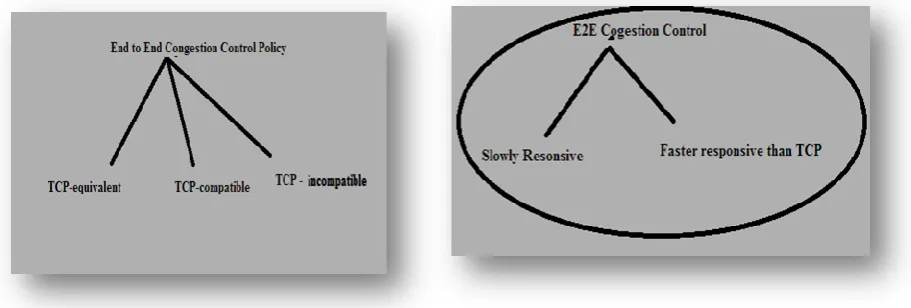
End-to-End congestion control mechanism based on steady-state environment can be categorized as
TCP-Compatible, TCP-equivalent and TCP-Incompatible congestion control. Other classification can be made on the
basis of transient state behavior are slowly-responsive congestion control protocolsand fast TCP congestion
control. This is also illustrates in below figures1 and 2.
Fig 1. E2 E Congestion Control based on steady-state
Fig 2 E2E Classification on transient response
In TCP-Equivalent policy, it usesadditive increase and multiplicative decrease (AIMD) method to dictate
transmission with increase and decrease aswork like in TCP variants case as discussed by Yang Richard (2000),
also Rate Adaption Protocol (RAP) which uses rate base equation without self-clocking
scheme.TCP-Compatible congestion control protocols are characterized by same throughput generation on different
round-trip time (RTT) in steady-state environment.
Slow Responsive congestion control mechanism can be defined in context of TCP as decreased transmission
rate on single-packet loss.As name implies reaction to congestion is small means less sensitive as compare to
TCP AIMD approach. If TCP-slow responsive mechanism compared to the faster TCP responsive policy,
response to individual packet drop is very slow and this will allow application to give benefit of smoother
sending rate. TFRC, AIMD with different increase and decrease TCP constants are slow-responsive congestion
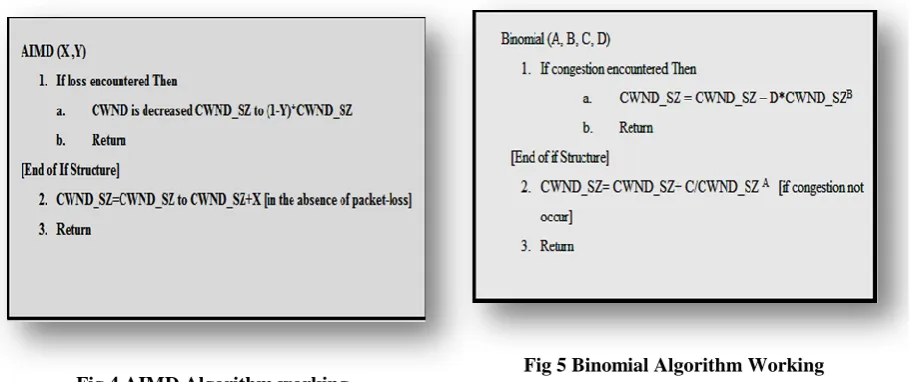
control policies. This can be understood with below described algorithm of AIMDin figure 4 which have two
parameters for dictating the size of window (X,Y). It can be TCP Compatible and slow-responsive depend on
the Y parameter value, if Y value is less than or equal to 0.5then it is both Slow-Responsive and TCP
Compatible else then it will be only TCP-Compatible.There isvariable called CWND_SZ for transmission
window and X value is 1 and Y value is considered as 0.5 provided without delayed acknowledgment in TCP. If
want to be TCP-compatible then X and Y value not treated independent and X value depend on the Y value by
following equation with Y value less than 0.5.This can be named with slowly responsive AIMD(Y) algorithm.
938 |
P a g e
Other class of congestion control algorithm is non-linear congestion control called binomial algorithms. It is
mostly found that application of streaming audio and video, transmission rate is reduced at extreme rate on the
occurrence of congestion in TCP which are problematic for users.Binomial algorithms generalize TCP AIMD
style policy. Increment is made on the inversely proportional to a power of I of the current window and
reduction is made also of power of J for TCP is 1 as discussed and described by Deepak Bansal and Hari
Balkrishan (2001). As it is binomial congestion control policies if I+J value not equal to 1 then it is in slow
responsive but if both parameter value addition equal to 1 then it comes under slow responsive TCP compatible
congestion control policies. RAP and TCP are both come under TCP-equivalent policies provided steady-state
environment is present.
Fig3 Relationship among E2E congestion policies
Fig 4 AIMD Algorithm working
Fig 5 Binomial Algorithm Working
Binomial congestion control algorithm is basically depend on four parameters named as by hypothetical manner
A,B,C,D and have property of non-linear generalization of AIMD algorithms. Its algorithm is illustrated in fig 5.
It is TCP-Compatible only when A+B =1 and B value is less than or equal to 1 and will be slowly responsive
only when B is less than 1.
IIAD (A=1 and B=0) and SQRT (A=1 and B=0.5) are famous studies Slowly-responsive TCP-Compatible
939 |
P a g e
value.Other method to deal with the loss event is respond to loss after some interval of time using TFRC CC
protocol. Floyd (2000)suggested making TFRC to TCP-Compatible by using the TCP’s sending rate function
which generates response of event rate of loss and RTT. TFRC(x) function estimates the loss event at average
rate with loss intervals of x over latest period of time.
III. EXPERIMENT EVALUATION OF SLOW CC ALGORITHMS
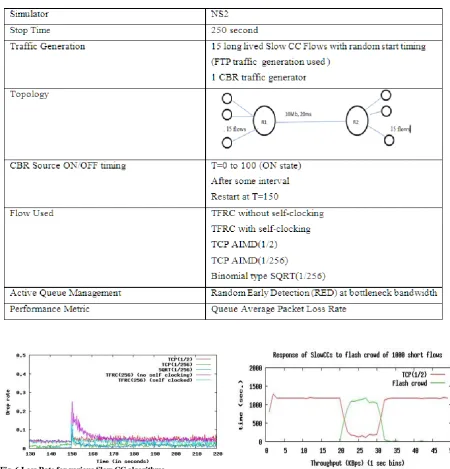
In experiment evaluation the present work going to investigate the performance various slow congestion control
(Slow CC) algorithms with NS2 simulator in the presence of sudden bandwidth reduction by introducing high
volume of traffic generated by sudden crowd of many flows of TCP and also CBR traffic generated at said
below intervals . Therefore it stimulates sudden increase in congestion impulse packet loss.
Table 1 Slow CC
Protocols Simulation Environment Parameters
Fig 6 Loss Rate for various Slow CC algorithms
940 |
P a g e
RED active queue management technique is used on bottleneck link. On the beginning of traffic generation of
all sources using 15 long lived flows and CBR traffic generators, all sources utilized the bandwidth. During idle
period of time between 100 to 130 drop rate is negligible but when CBR traffic generated next time i.e. on 150
the drop rate is increased of flows and end to end congestion control algorithms take advantages of this control.
As figure 6 and 7 illustrates all slow congestion control algorithms uses very slow response even packet loss
generation start at 130 but response to loss event taken them at 150.The present work also experimented with
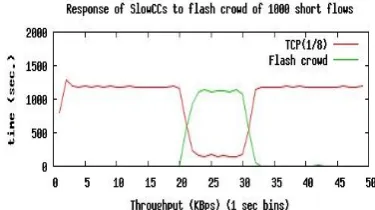
more real scenarios where intense bandwidth decrease is marked by sudden small HTTP traffic crowd
generations also call web transfer traffics with the new source of CBR. The web transfer traffic initialized at the
time 20 with short transfer streams of TCP (10 data packets) arriving at 100 flow/sec for 10 sec. All throughputs
estimating figures 8 to figure 14 illustrates the ideas of all slow CC algorithms. All below figures exhibits
aggregate throughput got by small and long live slow congestion control protocols. TCP (1/2), TCP (1/8), TCP
(1/256), TFRC (8), TFRC (256) without self-clocking, TFRC (256) with self-clocking, IIAD (8) and SQRT
(1/2) are the slow-congestion control examples with flash crowd traffic generated at 20.
Fig 8 Slow CC Responses to Flash Crowd 1000 Short flows with TCP (1/8)
Fig 9 Response Depiction Slow CC to Flash Crowd of 1000 Short Flows with TCP(1/256)
Fig 10 Response Depiction of Slow CC to Flash Crowds of 1000 short flows with TFRC(8)
941 |
P a g e
Figure 12 Response of Slow CC to Flash Crowds of 1000 shortFlows with TFRC(256)
Figure 13 Response of Slow CC to Flash Crowds of 1000
short flows with IIAD (1/2)
Figure 14 Slow CC Aggregate Throughput for long lived flows with SQRT (1/2)
From the above figures TFRC with self-clocking, SQRT and IIAD respond earlier to respond to flash FTP
traffics.
IV. CHALLENGES OF SLOW RESPONSE CONGESTION CONTROL ALGORITHMS
TCP-compatible slow CC algorithm not deployed in real world traffic due to it unfairness to other congestion
control protocols like TCP and do not support 100% utilization of bottleneck bandwidth. This can be proved by
long and short term fairness performance metrics in dynamic environment.
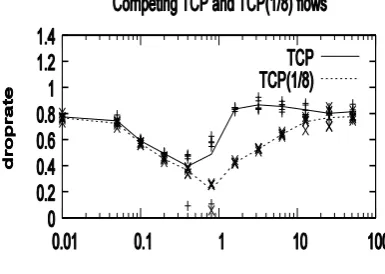
Fig 15 TCP and TCP (1/8) w.r.t simulation time
942 |
P a g e
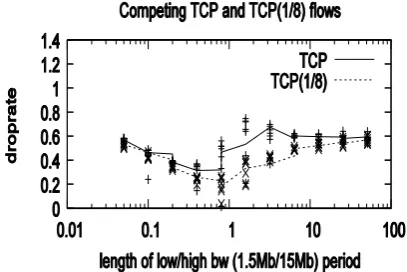
To verify the fairness of slow-congestion control algorithms in environment which is dynamic in nature
increases bandwidth periodically thrice of available bandwidth. Other parameters also have changed to
challenge the environment of execution as follows.
Table 7.2 Slow CC TCP and TCFRC Protocol With flows Simulation Parameters
Flow type TCP, TFRC
No. of Flows Total 14 flows 7 TCP 7 TFRC
Allotment of Bandwidth Total 15 Mbps
5 Mbps allotted to long-lived flow when CBR source is active
Here our purposed work makes use of an ON/OFF source of CBR with equal ON-OFF times exhibiting the
repeating Square Wave pattern from available of bandwidth used. These scenarios (Stress Tests) are not for
accurately model as real scenario but it is used to explore the benchmark of slow congestion control mechanism
in given environment.
In the figures 17 to figure 19 we are going to monitor the related fairness of TFRC and TCP as a period function
of source CBR. In figure 17, here column represent the result from simulation with single mark illustrating ten
flow throughputs by marking drop rate, if drop rate is low it will illustrate high throughput. X-axis displaying
combined high and low bandwidth period with second units’ length and throughput exhibit by y-axis of
available bandwidth which is normalized by fair share of single flow. Both lines display the usual throughput
got by TFRC and TCP flows. In below figures., when the CBR source period is at 0.2 second or can be said as
when RTT is 4 then total efficient use of bottleneck link is become high . When source of CBR lie between 1
and 10 sec the TCP flow receives high throughput and TFRC flows displayed dynamic environment in which
conditions of network that favors to TCP but not to TFRC. To find the situations or conditions in which TFRC
may compete for TCP unfairness and CBR sources include saw tooth pattern from where the sources of CBR
entered into and also in off period becoming less slow it transfer rate to an off period.
Fig 17 TCP and TFRC flows w.r.t Simulation Time over the length low/high Bandwidth
943 |
P a g e
Fig19 Low/High BW TCP and SQRT (1/2) flows w.r.t timeTherefore slow congestion control techniques includes the TFRC, AIMD with supportive and varied constants,
binomial techniques with experimented performance metrics evaluation promise for safe deployment with some
exceptional problems.
REFERENCES
1. Jacobson, Van.(1988). Congestion avoidance and control. In ACM SIGCOMM computer communication
review, vol. 18, no. 4, pp. 314-329. ACM, 1988.
2. Bansal, Deepak, and Hari Balakrishnan.(2001). Binomial congestion control algorithms. In Proc. Of
INFOCOM 2001. Twentieth Annual Joint Conference of the IEEE Computer and Communications Societies.
Proceedings. IEEE, vol. 2, pp. 631-640. IEEE, 2001.
3. Floyd, S. (1994). TCP and explicit congestion notification. ACM SIGCOMM Computer Communication
Review, 24(5), 8-23.
4. FLOYD, S., HANDLEY, M., PADHYE, J., AND WIDMER, J.(2000). Equation-Based Congestion Control
for Unicast Applications. In Proc. Of SIGCOMM Symposium on Communications Architectures and
Protocols (Stockholm, Sweden, August 2000), pp. 43–56.
5. Floyd, Sally, and Kevin Fall.(1999). Promoting the use of end-to-end congestion control in the Internet.
IEEE/ACM Transactions on Networking (ToN) 7.4 (1999): 458-472.
6. Floyd, Sally, Mark Handley, and Jitendra Padhye.(2000). A comparison of equation-based and AIMD
congestion control. (2000).
7. Handley, M., Floyd, S., Padhye, J., & Widmer, J. (2002). TCP friendly rate control (TFRC): Protocol
specification (No. RFC 3448).
8. Hassan, Suhaidi, and Mourad Kara.(2000). Simulation-based performance comparison of TCP-friendly
congestion control protocols. In Proc. of the 16th Annual UK Performance Engineering Workshop
(UKPEW2000). 2000.
9. Yang Richard, and Simon S. Lam. (2000). General AIMD congestion control. In Proc. 2000 International