431 | P a g e
DATA MINING DATA WAREHOUSING:
ANALYSIS OF APPLICATIONS
MEASURES OF MULTI DIMENSIONAL
MOVING DATA OBJECTS
THROUGH TRAJECTORY DATA WARE HOUSE
Halgare Nanasaheb Mahadev
1, Dr. Ali Akbar Bagwan
2 1,2Research Scholar, Kalinga University, Chhattisgarh, (India)
ABSTRACT
The key goals associated with this research includes to evaluate the assorted perspective of trajectory data
warehouse and its related aspects, to perform the implementation based on noveland effective approach on
trajectory data warehouse so that the effectual response can be achieved, to implement a novel or integrate the
metaheuristic based approach so that the soft computing based optimized results can be achieved and to
associate the applications of soft computing and related aspects so that the better results can be achieved. The
main objective of this research is to explain the concept of data mining and data warehousing and its
application measures of multi dimensional moving data object through trajectory data warehouse, to identify
the issues related to the data warehouse, and to suggest ways of resolving them. The main objective of study
includes to study the relationship between data mining and data warehousing, to study the design of schema for
trajectory data warehouses conceptual modeling, to study
different measures of trajectory data warehouse and to study SQL for determination of computed measures. The
motivation behind this work done is the realization that with increasing in the advance technologies like
location aware devices, traffic control, location based services, fleeting management-commerce these system
requires trajectory data warehouse of gliding object. Today’s applications have trajectory data warehouses of
gliding objects but it has limited measures, None of the present day stand-alone application measures that
predict average motion major direction of gliding objects which will help to location aware devices for decision
making.
Keywords: Data Mining Data Warehousing, Applications Measures of Multi Dimensional
Moving Data Objects, Trajectory Data Ware House
I. TRAJECTORY DATA WAREHOUSE AND CUTTING EDGE TECHNOLOGIES
Cutting edge area mindful gadgets and applications convey colossal amounts of spatiotemporal data concerning
moving items, which must be either rapidly techniques for continuous applications, similar to activity control
administration, or deliberately dug for complex, information finding undertakings. Regardless of the possibility
432 | P a g e
they should regularly be put away in total structure, without recognizable proof of the comparing moving items,
either for security reasons, or just for the sheer measure of data which ought to be kept online to perform
explanatory operations. Such a total is typically an unpredictable errand, and inclined to the presentation of
mistakes which are enhanced by resulting total operations. Consequently, we propose a way to deal with the
issue which depends on traditional Data Warehouse (DW) ideas, so we can receive a settled and concentrated on
data model, and inaddition the proficient devices and frameworks effectively created for such a model. Our DW
is gone for characterizing, as essential components of interest, not the perceptions of the moving articles, yet
rather their directions, so we can think about properties, for example, normal velocity, voyaged separation, most
extreme increasing speed, and nearness of unmistakable directions. We accept the granularity of the reality table
given by a consistent three-dimensional framework on the spatial and fleeting measurements, where the truths
are the arrangement of directions which cross every cell of the lattice, and the measures are properties identified
with that set. One of the principle issues to face is the productive populace of the Trajectory DW (TDW) from
surges of direction perceptions, touching base in an unusual and unbounded route, with various rates. The test is
to misuse a constrained measure of support memory to store a couple of approaching past perceptions, with a
specific end goal to accurately remake the different directions, and register the required measures for the base
cells, lessening however much as could reasonably be expected the approximations. The model of our TDW and
the relating stacking issues has been presented. In this study we talk about in point of interest the stacking and
calculation of an intricate total measure, the nearness, which can be characterized as the quantity of
unmistakable directions lying in a cell. Such a measure postures non paltry computational issues. On one hand,
in the stacking stage, just a limited measure of memory can be utilized for breaking down the information
streams. This suffices for direction remaking, however at times we may in any case tally an article, with
numerous perceptions in the same cell, more than once. Henceforth the measure nearness registered for base
cells is as a rule an estimate of the careful quality. A second estimate is presented in the move up stage. Truth be
told, following the move up capacity for the measure nearness is, as unmistakable tally, an all encompassing
capacity; it can't be figured utilizing a limited number of helper measures beginning from sub-totals. Our
proposition depends on a surmised, albeit extremely precise, nearness total capacity, which mathematically
consolidates a limited measure of other sub-total measures, put away in the base cells of the network. The study
gave an intensive examination of the aforementioned strategy, centering, specifically, on the mistakes presented
by the approximations. From our tests, our strategy ended up producing a blunder which is sensibly littler than
the one of an as of late proposed calculation [Tao et al. 2004], in view of representations, which are a surely
understood probabilistic including technique data bases applications. We additionally understood a model of our
TDW, so as to examine its plausibility when utilizing item warehousing apparatuses, similar to the Oracle one.
The principal test is the ETL strategy of DW: by abusing a couple of recollections, we need to change a flood of
direction perceptionson-the-fly and total them to upgrade the base cells of our spatio-transient 3D shape.
Utilizing aJava application, playing out the data change, and a particular stacking technique accessible in
theOracle suite, we ready to expand and stack around 7000 perceptions for every second. The othertest is the
productive calculation of our rough total capacity, used to move up the nearness measure.By studying all
literature mentioned above I inspired to find out one of the measure called asmajor direction this measure
433 | P a g e
II. TRAJECTORY SEGMENT
It is line segment represented as a pair of triplets((xs, ys, ts), (xE, yE, tE))
Where ((xS, yS, tS), (xE, yE, tE)) represent the start and end positions for the segment at times tS, tE
respectively.
III. TRAJECTORY OF MOVING OBJECT
It is defined as a finite sequence of trajectory segments (s1, s2, s3…. sn) such that
1. A moving object trajectory is continuous.
2. For every pair of consecutive segments si, si+1 the end points of si is the start point si+1 Trajectory of
moving object can be represented by a finite set of observations, that is. a finite subset of points taken from the
actual continuous trajectory. This finite set is called a sampling.
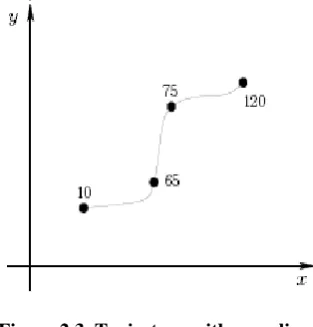
Figure 2.3. Trajectory with sampling
In The above Figure a trajectory of a moving object in a two dimensional space. Each point of the trajectory is
given by a tuple (id, x, y, t) corresponding to an object id in a position (x, y) at time t.There may be situations
where we have to reconstruct the trajectory of the moving object from its sampling, e. g., when one is interested
in computing the continuous increase in number of trajectories in a given area. To solve this problem there is
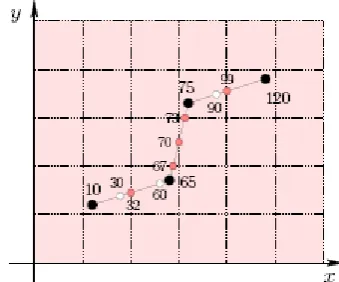
use of linear local interpolation for this assume the movement of the objects between the observed points having
constant speed, in a straight way. A Trajectory Data Warehouse (TDW) is to capable to store a stream of
samplings, process the data volume, compute and store the measures in order to provide an environment to
analyze the information about the objects.
434 | P a g e
Figure 2.5. Interpolated Trajectory with spatial and temporal pointsFigure 4. Dataset of 2000 objects
435 | P a g e
IV. CONCLUSION
The main objective of this research is to explain the concept of data mining and data warehousing and its
application measures of multi dimensional moving data object through trajectory data warehouse, to identify the
issues related to the data warehouse, and to suggest ways of resolving them. The main objective of study
includes to study the relationship between data mining and data warehousing, to study the design of schema for
trajectory data warehouses conceptual modeling, to study different measures of trajectory data warehouse and to
study SQL for determination of computed measures. The motivation behind this work done is the realization
that with increasing in the advance technologies like location aware devices, traffic control, location based
services, fleeting management-commerce these system requires trajectory data warehouse of gliding object.
Today’s applications have trajectory data warehouses of gliding objects but it has limited measures, None of the
present day stand-alone application measures that predict average motion major direction of gliding objects
which will help to location aware devices for decision making.
REFERENCES
[1] A.A. Vaisman and E. Zim_anyi. “What Is Spatio-Temporal Data Warehousing? In Proc. of DaWaK, volume
5691 of LNCS, pages 9{23. Springer, 2009.
[2] Arfaoui, N., and Akaichi, J. Modeling Herd Trajectory Data Warehouse. International Journal of
Engineering Trends and Expertise (2011)
[3] B.de Ville, (2001), Microsoft Data Mining: Integrated Business Intelligence for e- Commerce and
Knowledge Management, Boston: Digital press.
[4] Berry, M. J. A., and G. S. Linoff, Mastering Data Mining. New York: Wiley (2000). [5] Bogorny, V.,
436 | P a g e
bases using background knowledge: a summary of results', International Journal of Geographical
Information Science.
[6] Braz, F.: Trajectory Data Warehouses: Proposal of Intend and Application to Exploit Data. 9th GeoInfo,
Campos do Jordão, Brazil, 61-72 (2007)
[7] C.C.Aggarwal and P. Yu. Finding generalized projected clusters in high dimensional spaces. In Proceedings
of the ACM SIGMOD CONFERENCE on Management of Data, pages 70–81, Dallas, Texas, 2000.
[8] C.Giannella, J. Han, J. Peri, X. Yan, and P. Yu. Mining frequent patterns in data streams at multiple time
granularities. In NSF Workshop on Next Generation Data Mining, 2003.
[9] C.Silvestri and S. Orlando. Approximate Mining of Frequent Patterns on Streams. Int. Journal of Intelligent
Data Analysis, 11(1):49–73, 2007.
[10] Cabibbo, L., & Torlone, R. (2008). A Logical Approach to Multidimensional Data bases. In H. Schek, F.
Saltor, I. Ramos, G. Alonso (Eds.), Proceedings of 6th International Conference on Extending Data
basesExpertise; Vol. 1377, Lecture Notes of Computer Science (pp, 183-197). Valencia, Spain: Springer.
[11] Carmè, A., Mazón, J. N., & Rizzi, S. (2010). A Model-Driven Heuristic Approach for
Detecting Multidimensional Facts in Relational Data Sources. Proceedings of 12th International Conference on
Data Warehousing and Knowledge Discovery; Vol. 6263, Lecture Notes of Computer Science (pp, 13-24).