PERFORMANCE ANALYSIS OF SLB AND DLB
ALGORITHMS IN DISTRIBUTED COMPUTING
ENVIRONMENT
D.Sandhya Rani
1, D.Shalini
2, M.Suman Kumar
31
Computer Science & Informatics, University College of Engineering& Technology, MGU, (India)
2
Computer Science & Engineering, SRTIST, (India)
3
Electronics & Communication Engineering, GNIT, (India)
ABSTRACT
Distributed Systems are gradually being accepted as the dominant computing paradigm of the future. A
Distributed system is a software system in which components located on networked computers communicate and
co-ordinate their actions by passing messages. Load Balancing involves assigning tasks to each processor and
minimizing the execution time of the program. In this paper we present the performance analysis of various load
balancing algorithms based on different parameters considering two typically load balancing approaches static
and dynamic and also their merits and demerits and by comparision on certain parameters. The main purpose
of this paper is to help in design of new algorithms in future by studying the behaviour of various existing
algorithms.
Keywords: Distributed Computing, DLB, Load Balancing, SLB
I. INTRODUCTION
Processing speed of a system is always highly intended. In parallel and distributed systems more than one
processor process parallel programs. The amount of processing time needed to execute all processes assigned to
a processor is called workload of a processor. The amount of processing time needed to execute all processes
assigned to processor is called load of a processor. Recently distributed systems with several hundred powerful
processors have been developed. Distributed computing system provides high performance environment that are
able to provide huge processing power. The main goal is to distribute processes among processors to maximize
throughput, minimize communication delays, maximize resource utilization, maintain stability and fault
tolerant[1]. The distribution of loads to the processing elements is called load balancing problem. In a system
with multiple nodes there is a high chance that some nodes will be idle while the other will be overloaded. In
previous load balancing studies, a common approach is to use a simple model of the distributed system with
assumptions such as large communication bandwidth, negligible load balancing and to search for complex load
balancing algorithms whose viability is questionable and which might provide only little or no gain when
evaluated on realistic systems. In this paper, the goal of the load balancing algorithms is to maintain the load to
each processing element such that all processing elements become neither overloaded nor idle[2][ 3]. Therfore
II. LOAD BALANCING
Load Balancing is used to distribute work between two or more processors, computers, networks or memory
devices in order to channelize the resources in an efficient manner and to get optimized response times and
throughputs. Load balancing is the way of distributing load units across a set of processors which are connected
to a network which may be distributed across the globe. By load balancing it is possible to make every processor
equally busy and to finish the works approximately at same time.
2.1. Benefits of Load Balancing
a) Load Balancing improves the overall performance of each node and hence the overall system performance.
b) Load balancing reduces the job idle time.
c) Maximum utilization of resources.
d) Higher throughput.
e) Response time becomes shorter
f) Low cost but high gain
2.2 Static Load Balancing
In static load balancing algorithm the processes are assigned to the processors at the compile time according to
the performance of the node. Number of jobs in each node is fixed in static load balancing algorithm .The
assignment of jobs is done to the processing nodes on the basis of the following factors: incoming time, extent
of resources needed, mean execution time and inter process communication.
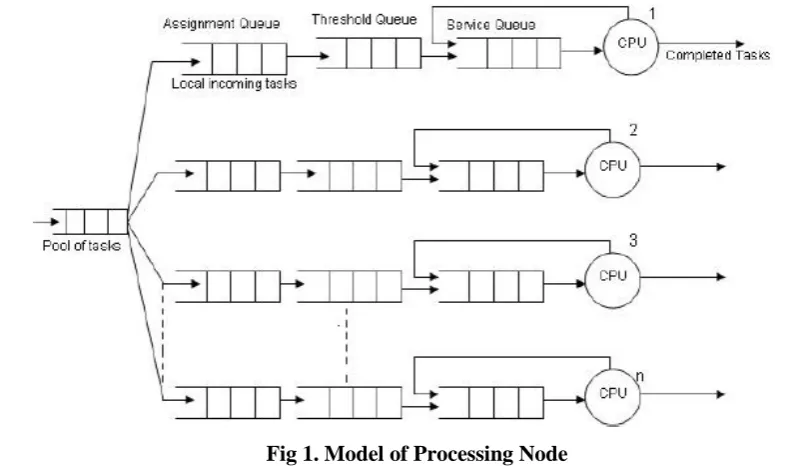
Fig 1. Shows the schematic diagram of static load balancing where local tasks arrive at the assignment queue. A
job either be transferred to a remote node or can be assigned to threshold queue from the assignment queue.
Once a job is assigned to threshold queue, it cannot be migrated to any node. A job arriving at any node either
processed by that node or transferred to another node for remote processing through the communication
network.
Static Load Balancing can be classified into two categories – optimal and sub-optimal.
2.2.1. Optimal SLB
When all the information regarding the state of the system as well as the resource needs is known an optimal
assignment can be made based on some criterion function. Examples of optimization measures are minimizing
total process completion time, maximizing utilization of resources in the system, or maximizing system
throughput. For example simulated Annealing (SA) and genetic algorithms (GA’s) are optimization techniques
2.2.2. Sub-Optimal SLB
When for some of computations, optimal solution does not exist then sub-optimal methods can be applied.
These methods rely on the rules-of-thumb and heuristics to guide a scheduling process. List scheduling is the
most popular technique despite of poor performance in high communication delay situations. Lot of static
algorithms, taking into account their optimal and sub-optimal nature, has been suggested by researchers so far.
This includes approximate algorithms like Solution space enumeration and search, Graph theoretic
approach[4][5] , Mathematical programming and queuing theoretic. Some other are round-robin algorithm,
recursive-bisection algorithm, heuristic algorithms and randomized algorithms.
2.3 Dynamic Load Balancing
Unlike static algorithms, dynamic algorithms allocate processes dynamically when one of the processors
becomes under loaded. Instead, they are buffered in the queue on the main host and allocated dynamically upon
requests from remote hosts.
2.3.1. Central Queue
It stores new activities and unfulfilled requests as a cyclic FIFO queue on the main host. Each new activity
arriving at the queue manager is inserted into the queue. Then, whenever a request for an activity is received by
the queue manager, it removes the first activity from the queue and sends it to the requester. If there are no ready
activities in the queue, the request is buffered, until a new activity is available. If a new activity arrives at the
queue manager while there are unanswered requests in the queue, the first such request is removed from the
queue and the new activity is assigned to it.
2.3.2. Local Queue
The basic idea of the local queue algorithm is static allocation of all new processes with process migration
initiated by a host when its load falls under threshold limit, is a user-defined parameter of the algorithm. The
parameter defines the minimal number of ready processes the load manager attempts to provide on each
processor.
A DLB algorithm considers following issues:
(1) Load estimation policy: which determines how to estimate the workload of a particular node of the
system.
(2) Process transfer policy: which determines whether to execute a process locally or remotely.
(3) State information exchange policy: which determines how to exchange the system load information among
the nodes.
(4) Priority assignment policy: which determines the priority of execution of local and remote processes at a
(5) Migration limiting policy: which determines the total number of times a process, can migrate from one
node to another
.
III. IDENTIFICATION OF COMPARATIVE PARAMETERS
1. Nature: This factor is related with determining the nature or behavior of load balancing algorithms, that is
whether the algorithm is of static or dynamic nature, pre-planned or no planning. SLB algorithms are of static
and planned nature as tasks are assigned statically i.e. at compile time in a planned manner at compile time to
processors and there will be no redistribution of tasks takes place afterwards and outcome of the algorithm is
deterministic as much of the job information is known a priori. DLB algorithms are of dynamic and no-planning
nature as tasks are assigned at run-time to processors and tasks redistribution can take place if task assignment
that was earlier done is not giving good performance (that is if proper balancing of load is not there). So their
behavior is totally nondeterministic and no initial planning is done for assigning load to hosts as this work is
done at run-time.
2. Overhead Associated : This factor is related with determining the amount of overhead involved while
implementing a load-balancing algorithm. It is composed of overhead due to movement (relocation) of tasks,
inter-processor communication, and inter-process communication. SLB algorithms incurs lesser overhead as
once tasks are assigned to processors, no redistribution of tasks takes place, so no relocation overhead. DLB
algorithms incur more overhead relatively as relocation of tasks takes place here.
3. Resource Utilization : This factor is used to check the resource utilization. SLB algorithms have lesser
resource utilization as static load balancing methods just tries to assign tasks to processors in order to achieve
minimize response time ignoring the fact that may be using this task assignment can result into a situation in
which some processors finish their work early and sit idle due to lack of work. DLB algorithms have relatively
better resource utilization as dynamic load balancing take care of the fact that load should be equally distributed
to processors so that no processors should sit idle.
4. Processor Thrashing: Processor thrashing occurs when most of the processors of the system are spending
most of their time migrating processes
5. Preemptiveness : This factor is related with checking the fact that whether tasks in execution can be
transferred to other nodes (processors) or not. SLB algorithms are inherently non-preemptive as no tasks are
relocated. DLB algorithms are both preemptive and non preemptive.
6. Predictability: This factor is related with the deterministic or nondeterministic factor that is to predict the
outcome of the algorithm. SLB algorithm’s behavior is predictable as most of the things like average execution
time of processes and workload assignment to processors are fixed at compile-time. DLB algorithm’s behavior
is unpredictable, as everything has been done at run time.
7. Adaptability :This factor is used to check whether the algorithm is adaptive to varying or changing situations
i.e. situations which are of dynamic nature. SLB algorithms are not adaptive towards all circumstances as this
method fails in dynamic or varying nature problems i.e. situation in which number of processes are not fixed,
also in situations which may require indeterminate steps towards solution. DLB algorithms are adaptive towards
8. Reliability: Which algorithm is more reliable in case of some host failure occurs. SLB algorithms are less
reliable because no task/process will be relocated / transferred to another host in case a node fails at run-time.
DLB algorithms are relatively more reliable as here processes can be transferred to other nodes in case of failure
of node occurs.
9. Response Time: How much time a distributed system using a particular load balancing algorithm is taking to
respond? SLB algorithms have shorter response time as one should not forget that in SLB there is lesser
overhead as discussed earlier so emphasis is totally on executing jobs in shorter time rather than optimally
utilizing the available resources. DLB algorithms may have relatively higher response time as sometimes
redistribution of processes takes place. Some time is being consumed during task migration
10. Stability : Stability can be related to the exchange of present workload state information among processors.
IV. COMPARISION
This comparison work in tabular form is shown below.
S.NO parameters Load Balancing
SLB Algorithm DLB algorithm
Nature Static i.e. workload is assigned
at compile time
Dynamic i.e. workload is assigned at
run time
1 Associated overhead Lesser overhead More overhead
2 Resource Utilization Lesser Utilization More Utilization
3 .Processor Thrashing No Thrashing Substantial Thrashing
4 Preemptiveness Non-preemptive Preemptive and Nonpreemptive
5 Predictability More Predictable Lesser predictable
6 Adaptability Less adaptive More Adaptive
7 .Reliability Less More
8 Response Time Less More
9 Stability More Less
V. CONCLUSION
Load balancing algorithms is totally dependent upon in which situations workload is assigned, during compile
time or execution time. The above comparison shows that static load balancing algorithms are more stable than
dynamic. But dynamic load balancing algorithms are always better than static as per as overload rejection,
reliability, adaptability, cooperativeness, fault tolerant, resource utilization, response & waiting time and
throughput is concert. The purpose of this paper was to compare these load balancing algorithms based on
REFERENCES
[1] Abhijit A. Rajguru, S.S. Apt” A Comparative Performance Analysis of Load Balancing Algorithms in
Distributed System using Qualitative Parameters” International Journal of Recent Technology and
Engineering (IJRTE) ISSN: 2277-3878, Volume-1, Issue-3, August 2012.
[2] Berenbrink P., Friedetzky T. and Steger A. “Randomized and Adversial Load Balancing”. CIteSeerx,1997
[3] Hamdi M. and Lin C.K. “Dynamic Load Balancing of Data Parallel Applications on a Distributed
Network”. In 9th International Conference on Supercomputing,ACM,170-179,1995.
[4] H.S. Stone. “Multiprocessor scheduling with the aid of network flow algorithms”. IEEE Trans of Software
Engineering, SE-3(1):95--93, January 1977.
[5] H.S. Stone, “Critical Load Factors in Two-Processor Distributed Systems,” IEEE Trans. Software Eng.,
vol. 4, no. 3, May 1978.
[6] Sandeep Sharma, Sarabjit Singh, and Meenakshi Sharma,” Performance Analysis of Load Balancing
Algorithms”, World Academy of Science, Engineering and Technology 38 2008
[7] Y.Wang and R. Morris, "Load balancing in distributed systems," IEEE Trans. Computing. C-34, no. 3, pp.