125 |
P a g e
A STUDY OF CLOUD MODELS & COMPARISON
BETWEEN DIFFERENT CLOUD PLATFORMS
Dr. Neenu Juneja
1, Krishan Tuli
2, Sarabjeet Kaur
3 1,2,3CBSA, Chandigarh Group of Colleges, Landran, Mohali (India)
ABSTRACT
The Cloud Computing is an emerging paradigm which believes in providing various services (both hardware and software) as a service to the user. It provides everything as a service. Various benefits are associated with cloud environment such as reliability, scalability, security etc. Cloud computing is a next generation computing truly based on service provisioning based on virtualization. It is fast growing technology. This paper illustrates various service models and cloud platform provided for the user’s requirement.
Keywords: Cloud Computing, Reliability, Scalability, Security, Virtualization.
I. INTRODUCTION
Cloud computing is the delivery of computing services both hardware (servers, storage, networking) and
software (applications, databases, analytics) over the Internet. Cloud computing is based on a group of many
new and old concepts of various areas like distributed computing, grid computing and virtualization. It has
grown so much in the last few years. Simply we can say, cloud computing is the computing that is based on
internet. Earlier, users download the application or software on a physical system, but with cloud computing,
users can access the same kind of application or software through the net.
NIST definition of cloud computing, “Cloud computing is a model for enabling convenient, on-demand network
access to a shared pool of configurable computing resources ( e.g., networks, servers, storage, applications, and
services) that can be rapidly provisioned and released with minimal management effort or service provider
interaction.
This paper is basically divided into four sections:
Section 1 gives a brief introduction about Cloud Computing.
Section 2 explains various service models deployed on cloud.
Section3 illustrates various platforms of cloud.
Section 4 compares and discuss about difference between various platforms of cloud.
126 |
P a g e
II. CLOUD COMPUTING- INTRODUCTION
The Cloud Computing has emerged as a latest domain in terms of technology as well as research interests.
Cloud computing is also known as fifth utility (along with water, electricity, gas and telephone) which is
available as per the demand of the user. Cloud Computing is based on pay as per the use model. In this, a cloud
computing model provides online computing service on demand as required by the user. Cloud computing is a
fifth generation computing truly based on service provisioning based on virtualization. The cloud computing
model believes in providing various benefits like fast deployment, pay-for-use, lower costs, scalability, rapid
provisioning, rapid elasticity, ubiquitous network access, greater resiliency. It also provides hypervisor
protection against network attacks, disaster recovery in minimal cost and various solutions to data storage,
on-demand security controls, and real time detection of system tampering and rapid re-constitution of services.
III. SERVICE MODELS
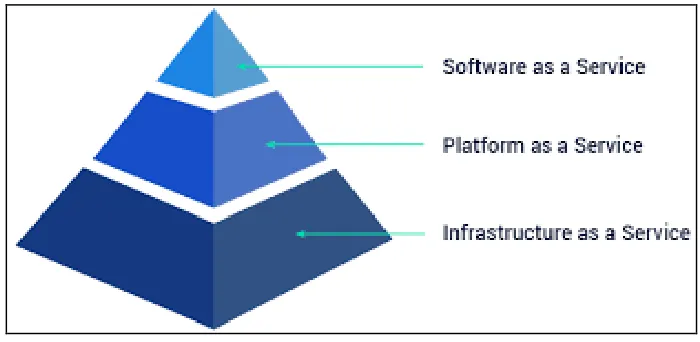
Broadly, the cloud architecture can be divided into three layers based on their functioning. These layers are:
SaaS (Software as a Service), PaaS (Platform as a Service) and IaaS (Infrastructure as service) as shown in
figure 1.
Figure 1: Service Models
3.1
Infrastructure as a Service
(IaaS)
Here, the user will be provided with virtual machines having storage blocks and other fundamental computing
resources. Instead of purchasing servers, space for data centers etc cloud completely outsource those facilities.
The consumer does not manage or control the underlying cloud infrastructure but has control over operating
systems, storage, and deployed applications; and possibly limited control of select networking components.
Some of the IaaS providers are Amazon web services by EC2 (Elastic Cloud 2) which can fulfill user‟s
requirements very easily.
127 |
P a g e
In this service, software is requested by the user as per his requirements; in return, a single instance of the
software runs in user‟s machine. This software will remain on user‟s system as long as required by the user. At
the end, user will have to pay only for those services as used by
him. The most software used a service
example if of
Salesforce.com. In this, a user in provided with the functionality of „customize with code‟ as he does not have to take overheads of coding. Other examples are Google docs, Google mail and so forth.3.3
PLATFORM AS A SERVICE
(PaaS)
In this kind of service, users are provided with API environments. By using these environments, user can
develop their own applications and can directly deploy them on the cloud. Application developers need not to
worry about the complexity of buying and managing the underlying cost of hardware and software. One of the
famous examples of PaaS is Google App Engine provided by Google Applications. Other example of PaaS is
VMware which provides virtual platform to the application developers
.
IV. CLOUD PLATFORMS
It has been evident from studies that cloud is growing with a pace. Many countries and their governments are
investing monetary values on various Cloud providing techniques. Following are the various cloud platform
provider available in the market nowadays:
4.1 Abicloud Platform
This platform manages the cloud in homogeneous manner. Also, its innovation can be used to building,
managing as well as integration in a homogenous environment a private and public cloud virtualized
infrastructure. It provides a feature called a web based management function which allows the user to use a
service just by dragging and dropping a virtual machine. In this, user need not to worry about remembering
commands as it does not work on command line interface. Flexible infrastructure is the facility which is
provided by Abicloud platform as a user once demanded can be increased further at any point of time. As
Abicloud is Java based, it is much easier to reinstall anywhere required. This type of cloud can be implemented
128 |
P a g e
Figure 2: AbiCloud Architecture
4. 2 Eucalptus Cloud Platform
Eucalyptus is a short form for “Elastic Utility Computing Architecture for linking your programs to useful systems”. It is Linux-based open source computing environment framework based on private cloud. It also
provides virtual network that isolates network traffic of various users. It has transformed and is currently run by
Eucalyptus Company.
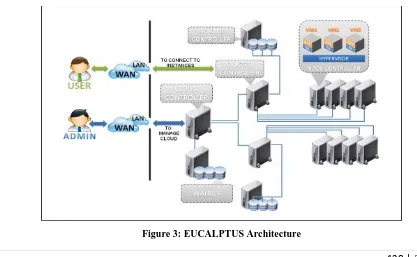
In eucalyptus architecture, there are five high-level components, each component has its own Web-service
interface that comprise a Eucalyptus installation i.e. node controller, cluster controller, storage controller, a
cloud controller and Walrus (put/get storage).
Node Controller: Handling of queries is done by node controller which runs on each and every node in
computing environment. It also controls the life cycle of instances. The node cluster interacts with operating
system.
129 |
P a g e
Cluster Controller: It executes on a cluster front-end machine generally. It controls all the nodes that are
interconnected form a virtual cluster, collects the information from VM and schedule its extension
.
Storage controller
: It implements block-accessed network storage. Images are stored with
the help of storage controller so that they can be access in future.
Cloud controller: It is the entry-point into the cloud for administrators, developers, project managers, and
end-users. It is the real manager of the cloud as it is responsible for all the queries done on cloud. It also monitors the
availability of resources of the cloud infrastructure.
Walrus (put/get storage): It allow users to store persistent material, organized as eventually-consistent buckets
and objects. It also allow the users to create, delete, list buckets, put, get, and delete objects, and set access
control policies.
4.3 Open Nebula Cloud Platform
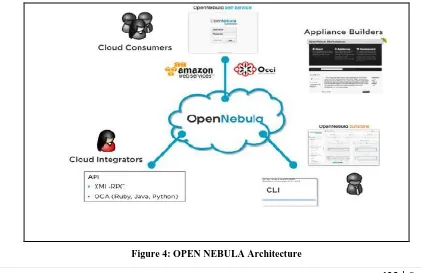
This platform can be used on private, public as well as hybrid cloud. It follows the framework of open source
cloud service. The biggest advantage of using Open Nebula platform is that it can dynamically extend the
infrastructure of any user i.e. the data centers or clusters can be set to make them their infrastructure property
flexible. Storage, network and virtual techniques can easily by synchronize. It basically includes three
technologies i.e. virtualization, storage and network. Open Nebula offers various advantages such as adjustable
platform meeting the dynamic requirements of the users, centralized management of virtually and physically
distributed infrastructure, efficient energy consumption, cost reduction and so on. It also manages the
heterogeneity and complexity of distributed large infrastructure.
130 |
P a g e
4.4 Nimbus Cloud Platform
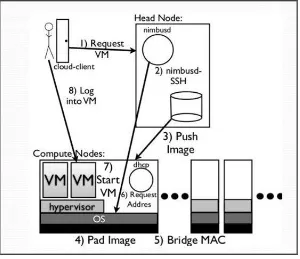
In this, clusters are converted into IaaS (Infrastructure as a Service). It permits the users for leasing remote
resources and building environment for computing. While deploying an application, Nimbus offers a “cloudkit”
which provides a manager and a repository of images. VWS (Virtual Workspace Services) is provided with it
which does the allocation of remote resources. Like eucalyptus, Nimbus platform also comprises of four
components
namely: Workspace service, Workspace control, Workspace resource management and Workspace pilot. Here, workspace service is web based which provides GSI authorization and authentication.Workspace control helps in controlling VM instances, reconstructing images and assigning IP and MAC
addresses to the virtual machines. The workspace resource management also manages the virtual machines over
the network. At last, workspace pilot handles the administration and the network signals. Nimbus cloud seems
more complicated than many cloud platforms as command line interface is used for command and results are
that makes nimbus more complex.
Figure 5: NIMBUS Architecture
4.5 Xen Cloud Platform (XCP)
Xen was launched in 2010 by Xen organization (Xen.org) for IaaS services. But it does not support full
architecture of cloud. It works as abstraction layer between hardware and OS. This platform is used by many
cloud vendors like Amazon EC2, Nimbus etc. In the architecture of XCP, there are XCP hosts that work behind
its working. These are used to host VM on server as well as sharing of resources. There is another host known as
131 |
P a g e
Figure 6: XCP Architecture
V. COMPARISON OF CLOUD PLATFORMS
Presently, a lot of cloud computing platform exist with different implementation, characteristics and varying
advantages. In order to have understanding of them, a comparison of four major platforms: Eucalyptus,
OpenNebula, Abicloud and Nimbus cloud are presented in table 1 below and some parameters used in the
analysis include: Platform type, cloud form, compatibility, deployment, deployment manner, Transplant ability,
VM support, Web Interface, structure, Reliability, OS support and development
.
TABLE 1: COMPARISON BETWEEN CLOUD PLATFORMS
Eucalyptus
OpenNebula
Abicloud
Nimbus
Cloud Type
Public
Private / Public
Private / Public
Private
Scalability
Scalable
Dynamic
/
Scalable
Scalable
Dynamic
/
Scalable
Cloud Form
IaaS
IaaS
IaaS
IaaS
Deployment
Dynamic
Deployment
Dynamic
Deployment
Pack
and
redeploy
Dynamic
Deployment
Deployment
manner
Command
line
Command line
Web
interface
drag
Command line
Compatibility
Support
EC2, S3
Open,
multiplatform
Not
supported
EC2
Support EC2
Transplant
ability
Common
Common
Easy
Common
Hypervisors
support
VMware,
Xen, KVM
Xen, VMware,
KVM
Virtual box,
Xen,
VMware,
KVM
Xen, KVM
Structure
Module
Module
Open
Platform,
encapsulate core
Lightweight
components
Reliability
--
Rollback
host
and VM
--
--
OS Support
Linux
Linux
Linux
Linux
Development
language
Java
Java
Ruby,
C++,
Python
132 |
P a g e
VI. CONCLUSION
This paper has presented the basic introduction to cloud, service models and various platforms of cloud. This
paper has also presented the work published by various journals on cloud computing. This paper explicated
fundamentals pertaining to the basic requirements of pursing research in the cloud computing. Various platforms
are already available in the market and also a lot of research has been in process so that more platforms can be
made available in the market. Now, the difference in the platform is becoming an issue in terms of
understanding and usage. Based on the analysis, users now have the opportunity to understand the features and
be able to make choices of cloud computing platform in respect to cloud modules.
REFERENCES
[1] White Paper: Introduction to Cloud Computing. http://www.thinkgrid.com/docs/computing-whitepaper.pdf
[2] OpenNebula Project, [URL]. http://www.opennebula.org/.
[3] S.Kumar, R.H. Goudar. “Cloud Computing- Reseaarch Issues, challenges, Platforms and Applications: A
Survey”, International Journal of Future Computer and Communications, Vol 1, No 4, December 2012.
[4] A. Singh, M. Malhotra, “Analysis for Exploring Scope of Mobile Agents in Cloud Computing”,
International Journal of Advancements in Technology, ISSN 0976-4860.
[5] NIST (2013) NIST Cloud Computing Standards Roadmap [online] http://www. boulder.nist.gov/itl/cloud/ up load/NIST_SP-500- 291_Version 2_2013_June 18_FINAL.pdf (accessed 30 July 2013).
[6] T. Cordeiro, D. Damalio, N. Pereira, P. Endo, A. Palhares, G. Gonçalves, D. Sadok, J. Kelner, B. Melander, V Souza,J.E. Mångs, “ Open source cloud computing platforms. In Grid andCooperative Computing (GCC)” , 2010 9th International Conference on (pp. 366-371). IEEE.
[7] S.Jaswal, “The Cloud Computing: A Review”, International Journal of Innovative Sciences, Engineering and Technology, Vol 0032 Issue 12, December 2015, Pg 373-377.
[8] H. Parmar, T.Champaneria, “ Comparative study of open nebula, eucalyptus, open stack and cloud stack”,
International Journal of Advanced Research in Computer Science and Software Engineering. 2014; 4(2): 714-721
[9] N. Khan, A. Noraziah, E. Ismail, M.M Deris, & T. Herawan, “Cloud computing: Analysis of various platforms”, International Journal of E-Entrepreneurship and Innovation (IJEEI), 3(2), 51-59.
[10]J.Peng, X. Zhang,Z. Lei, B. Zhang, “ Comparison of several cloud computing platforms”, Second International Symposium on Information Science and Engineering. 2009: 23-27.
[11]M. Cusumano “Cloud computing and SaaS as new computing platforms”, Communications of the ACM. 2010. 53(4): 27-29.
[12]P. Sempolinski, D.Thain, “ A comparison and critique of eucalyptus, open nebula and nimbus” IEEE International Conference on Cloud Computing Technology and Science. 2010: 417-426.
[13]H.Yang and M.Tate, "A descriptive literature review and classification of cloud computing research” http://aisel.aisnet.org/cais/vol31/iss1/2, 2012.
[14]M.Boniface, B.Nasser, J.Papay, S.C.Phillips, A.Servin, X.Yang, Z.Zlatev, S.V.Gogouvitis, G.Katsaros, K.Konstanteli, G.Kousiouris, A.Menychtas and D.Kyriazis, “Platform-as-a-Service Architecture for Real-Time Quality of Service Management in Clouds”, 5th International Conference on Internet and Web Applications and Services (ICIW), 2010.
133 |
P a g e
[16]W. Zeng, J. Zhao, & M. Liu, “ Several public commercial clouds and open source cloud computing software”. In Computer Science & Education (ICCSE), 2012 7th International Conference on (pp. 1130-1133). IEEE.
[17]X. Wen, G. Gu,Q. Li, Y. Gao, & X. Zhang, “Comparison of open-source cloud management platforms:
OpenStack and OpenNebula. In Fuzzy Systems and Knowledge Discovery (FSKD)” , 2012 9th International Conference on (pp. 2457-2461). IEEE.
[18]S. Wind, "Open source cloud computing management platforms: Introduction, comparison, and [25] recommendations for implementation," Open Systems (ICOS), 2011 IEEE Conference on, vol., no., pp.175, 179, 25-28 Sept. 2011.
[19]Amazon Elastic Compute Cloud, [URL]. http://aws.amazon.com/ec2/,2008.