184 | P a g e
Improved Framework of Workflow scheduling on Cloud Environment by
hybrid PSO and WCA
Meenakshi Sharma
1, Astha Gautam
21,2
Computer Science Engineering
1,2LR Group of Institute, Solan, India
Abstract
Cloud computing is a latest approach that is growing faster day by day due to its effective feature and security. Cloud computing provide a way to access the data from any place at any time. This feature makes it popular because it reduces the burden of the users. Cloud computing provides the services like infrastructure, platform and software as a service on it. Due to these feature the Size of data on cloud in increased and its effects on the efficiency of cloud. To overcome the problem like this scheduling of task on data is the best option. Workflow scheduling in scientific computing systems is one of the most challenging problems that focuses on satisfying user-defined quality of service requirements while minimizing the workflow execution cost. So to reduce the cost, cloud environment, has been deployed in cloud environment, resources will increase but its utilization is another challenge. To maintain & utilize resources in the cloud computing scheduling mechanism is needed. Many algorithms and protocols are used to manage the parallel jobs and resources which are used to enhance the performance of the CPU in the cloud environment. This work Particles swarm Optimization (PSO) and Grey Wolf Optimization (WCA) are used for effective scheduling. This work is based on the optimization of Total execution time and total execution cost. The results of the proposed approach are found to be effective in compare to existing methods. Intelligence optimization Particle Swarm optimization is used which is initialized by Pareto distribution. WCA is used to converge the decision of Virtual Machine (VM) migration by its convergence to minimize cost and time as illustrated by Total execution time (TET) and Total execution cost (TEC) .It is concluded that WCA performs better in compare to existing HGSA algorithm.
Keywords-Cloud Computing, Particles swarm Optimization, Grey Wolf Optimization.
I. INTRODUCTION
Cloud computing is a distributed design that brings together server resources on an acceptable stage in order to provide on request figuring resources and administrative data [1, 3]. A cloud specialist organization (CSP’s) provides the different stages to their customers to use the services and make the web administrative control. This service is similar to a broadband band connection offered by the service provider for the internet connection. Cloud computing provides the services through the internet, these service belongs to hardware and software both. Cloud computing concept
has high impact in researchdue to its service pay per usage concept. When cloud provides the service in the form of platform, it is called as Platform as a service model (PaaS) When cloud provides the hardware to the consumer, it is called as Infrastructure as a service (IaaS) model. When cloud provided the software services, it is also called as Software as s service [1,2,3].
1.1 Cloud Service Models
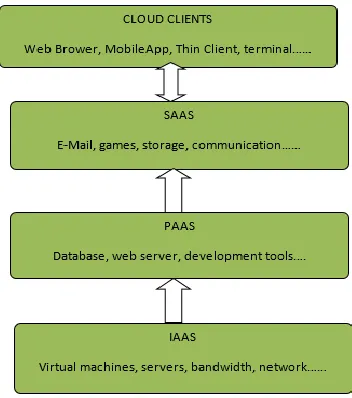
Cloud computing is categorized in IAAS, PAAS, SAAS. Cloud service model illustrated in fig. 1.1. Depending upon their particular needs an organization may acquire any gathering of these service models [3][7-9].
1. Software as a Service (SaaS): Over the web, the Software as a Service (SaaS) delineates any cloud organization where purchasers can get to programming applications. For both individuals and affiliations the applications are encouraged in "the cloud" and can be used for an expansive assortment of assignments. By techniques for any web engaged contraption the Twitter, Facebook and Flickr are all examples of SaaS, with customers prepared to get to the organizations [3].
2. Platform as a Service (PaaS): Using instruments given by the provider the Platform as Service licenses clients to make programming applications. Customers can subscribe to the Paas organizations can contain preconfigured fragments; while discarding those that don't they can combine the parts that meet their necessities.
185 | P a g e Figure 1 Cloud service Model [14]
1.2 Cloud Deployment Model
1. Private cloud (PC): The cloud foundation works in a particular union, and facilitated by the association or an untouchable notwithstanding whether it is found prelude or off reason. The motivation to build a private cloud inside an affiliation has two or three perspectives. Regardless, to strengthen and streamline the utilization of existing in-house assets. The second, security concerns includes information protection and trust in like way make PC a likelihood for a couple of affiliations. Third, information exchange passed on from near to IT foundation to a PC is still rather stunning. The fourth, affiliations reliably require full control over mission-basic exercises that stay back of the firewalls [1, 10].
2. Community cloud: A few affiliations usually make and have a relative cloud base and in like way diagrams, necessities, qualities, and concerns. The cloud bunch shapes into a level of gainful and free change.
3. Public cloud: This is the key sort of current Cloud managing sending model. People considering all things cloud is utilized by the general masses cloud customers and the cloud association supplier has the full duty as to open cloud with its own particular system, respect, and great position, costing, and charging model. Particular comprehended cloud affiliations are open mists including Amazon EC2, S3, and Force.com.
4. Hybrid cloud: The cloud base is a mix of no under two hazes (private, storing up, or open) that stay striking parts however are bound together by systematized or select development that pulls in information and application transportability (e.g., cloud influencing for weight changing between hazes). Affiliations utilize the cream cloud appear with a specific phenomenal concentration to push their advantages for build up their inside points of confinement by
margining out edges business limits onto the cloud while controlling spotlight rehearses on-premises through private cloud [4-6].
1.3 Cloud Applications
1. Development and Testing: Cloud plays an effective role as it is used for test and development. It saves the cost of setting up environment by setting up physically which includes the manpower and time. The installation and configuration of the software also take more time and this problem is also solved by using clod resources.
2. Big Data Analytics:Cloud is using the concept of big data and provides the effective data extraction of the business value. It provides the effective data to the retailers and suppliers by extracting the buying patterns of the consumers. The buying patterns of the consumers show their liking and disliking of the consumers to the product [11-13].
3. File storage: Cloud offers the facility of data storage, retrieval and access from any web- enabled interface. The user can access data anytime, anywhere with high speed and availability. The large organization stores their data on cloud and only pay for the storage of data and they do not worry about the daily maintenance of the storage system.
4. Disaster Recovery:Cloud provides the effective data recovery in case of disaster at very effective cost. Data recovery by traditional method is very expensive and slow [1-4].
5. Backup:Backing up data is always a complex and time consuming process. The backup includes the tapes and drives to collect the data manually and then dispatching them for backup. Cloud provides the data backup automatically and no need to worry if the data is deleted. By using cloud it is easy to recover the data.
1.4 Benefits of cloud computing
Cloud computing have some essential or unique characteristics as shown in Figure.2 is to provide qualitative services. These characteristics are as follows [2]
1. On-demand self-service:This self-advantage notification to the organization given by appropriated registering merchants that enables the course of action of cloud assets on ask for at whatever point they are required. In on-ask for self-advantage, the customer finds the opportunity to cloud benefits through an online control board.
2. Broad network access:Cloud computing isolates computing abilities from their consumers, with the goal that they don't need to keep up the capacities themselves. A consequence of this is the computing abilities are found somewhere else, and must be accessed over a network.
186 | P a g e
client's needs with no developments being clear to the client or end client. Occurrences of advantages combine stockpiling, arranging, memory, and framework data trade restrain.
4. Fast elasticity:It is described as the ability to modify resources both all over as required. To the buyer, the cloud has every one of the reserves of being immense, and the purchaser can purchase to such an extent or as pitiful enlisting power as they need.
5. Measured service:Cloud systems therefore control also, redesign asset use by utilizing a metering limit at some level of direction sensible to the sort of affiliation (e.g., dealing with, stockpiling, information transmission, and dynamic customer accounts).
Figure.2 Unique characteristics of cloud computing [15]
II. RELATED WORK
Zhang et al. [1] discussed the various cloud computing technologies and commercial products in detail. The commercial products have been compared on parameters like cloud provider, computing classes, target application, computation, auto scaling and storage. The research challenges presented in this work are service provisioning automation, server consolidation, virtual machine migration, energy management and data security.Vecchiola et al. [2] gave a comparison of computing solutions such as Amazon EC2, Google App Engine, and Microsoft Azure. The comparison is done on the basis of parameters like type of service, value added provider, if PaaS, ability to deploy on third party IaaS, platform, Virtualization, deployment Model and interface for user access. The aneka architecture, deployment model and application model are discussed in detail. Programming models like task model, map reduce model, thread model, parameter sweep model, workflow have been compared on the basis of execution services, applications and execution unit.Zhao et al. [3]illustrated many opportunities that the cloud has brought in, such as better utilization of resources, improved responsiveness thereby improving user experience, enabling a generation of collaborative scientific workflows and reducing the cost in challenges and opportunities in running scientific workflows on cloud. The challenges faced by the applications are architectural challenges, service challenges for integration tools, high-end
computing support language-conversion challenge, challenge in compute intensive applications, challenge for data management, service management challenge.Sonke et al. [4] highlighted a scientific application is executed on FutureGrid, Amazon EC2 cloud and NERSC’s Magellan in this paper. The result of this paper have been compared and analyzed to comprehend various challenges that came across during the process. In this work Pegasus workflow management system has been used to execute a scientific application which was used to process data from the Kepler project by NASA to find out planets similar to the earth.Pandey et al. [5] illustrated worked on reducing the computing cost of the application by using particle swarm optimization algorithm which is basically a meta-heuristic algorithm used for scheduling. PSO is used for calculating the fitness function. The total cost calculated is the cost of execution and the transfer cost of data. This algorithm ensures the cost of the highest task is reduced by heuristic scheduling. This algorithm helps to schedule the resources and mapping.AlexandruIosup et al. [6] explained the differences between the actual scope field of cloud and the requirements of scientific applications. It evaluates the cloud and check the capability of a cloud to run the applications efficiently. The evaluation is done by quantifying the number of users that require scientific computing services followed by evaluating four cloud services mostly used for scientific applications.Ostermann et al. [7] discussed the various features of cloud computing which help ease the execution of scientific applications. It evaluates these features by different workloads like SJSI, MJSI and SJMI on Amazon EC2 cloud platform. Different types of benchmarks like Lmbench, Bonnie, and HPC are used to evaluate the performance of EC2 cloud for scientific applications.EwaDeelman et al. [8] discussed dependency of cost on execution models in this work. In this work, the cost is calculated as a function of number of processors. The cost of executing montage workflow has been estimated by running simulation using GridSim tool. Three montage workflows have been Remote I/O, regular and dynamic cleanup. Three montage workflow that are executed are following montage degree 1, degree 2 and degree 4. The cost of running each of the data management models have been compared graphically. To maintain the trade-off between the number of processors and reduction in execution time.Christina Hoffa et al. [9] illustrated on four different workflows and four different environments in order to compare the performances. The tools like WMS, DAGman. GridFTP, condoe and GRAM are explained in detail. The different montage degree workflows are executed on local machines and cluster and multiple virtual clusters.
187 | P a g e
for scientific workflow scheduling in cloud computing. The proposed approach employs the four meta-heuristic algorithms which are based on the population. It helps in reducing cost and time of the service providers. The execution timeand cost are reduced as compared to existing approaches.Anubhav et al. [12] introduced a gravitational search algorithm for workflow scheduling in the cloud environment. The optimizations in workflow reduce the cost and makespan. In this process, two algorithms are hybridized GSA and HEFT for workflow scheduling. The performance evaluation is done on the basis of two metrics that are monetary cost ratio and schedule length ratio. The validation of result is also tested by ANOVA test and it shows that the proposed approach outperforms.Sagnika et al. [13] proposed HGSA algorithm for workflow scheduling in cloud computing which helps to handle the large size of data. The scheduling process decides that which task is executed first and which is last according to their requirement of the resources. It manages the resources according to the task size and execution time. The result of the proposed algorithm is compared with particle swarm optimization algorithm and Cat swarm optimization
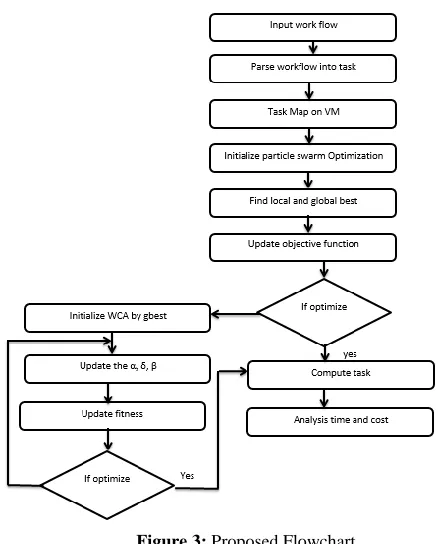
III. THE PROPOSED METHOD 3.1Proposed Methodology Step1:It involves the following:
(a) Initialize the workflow-CloudSim package by creating the datacenter, broker, virtual machines and cloudlets (b) Initialize the virtual machines list.
(c) Initialize the workflows and it is following type
SIPHT: It is used to automate the search for untranslated RNA for bacterial replicons in the NCBI database.
CYBERSHAKE: This workflow is used by the California to characterize the earthquake hazards in a region
Ligo: It is used to generate and analyze gravitational waveforms from data collected during coalescing of compact binary system.
Montage: It is created byNASA/IPAC together input image to create custom mosaics of the sky.
Genome: It is created by USC Epigenome center and used to automate various operation in genome sequence processing.
Step2: Parse the workflows according to levels and maintain pareto distribution
Step3: Apply VM mapping by FCFS algorithm then apply following optimization.
3.2 Proposed methodology: Flowchart
Figure 3: Proposed Flowchart
3.3 Algorithm Used
Particle Swarm Optimization:PSOstands for particle swarm optimization. PSO is a stochastic optimization algorithm which is based on the behavior of birds. It works similar to the genetic algorithm. In PSO is initialized with a group of random particles. In every iteration, each particle is updated by the two "best" values. The first best solution shows the fitness of the particles and this called as pbest. The second best value is tracked by the optimizer is the best value. This value is called as global best (gbest).When a particle takes part of the population as its topological neighbors; the best value is a local best and is called lbest.
188 | P a g e IV. RESULT ANALYSIS
4.1 Simulator Used
The proposed work is done on the CloudSim simulator for using virtually cloud environment workflows. CloudSim provides a platform for modeling, simulation and experimentation of cloud computing. This simulator provides the user cloud system and investigated without concerning the low level details.
4.2Result Analysis
Table.1: Comparison table of HGSA and PSO_WCA using SIPHT
RESULTS OF HGSA AND PSO_WCA USING -SIPHT
Ensemble HGSA PSO_WCA
Size TET TEC TET TEC
2 23.06 5620.855 5.59 4550.063 4 41.16 10009.35 12.26 8603.69 6 38.05 13456.19 14.13 12125.43 8 52.98 13523.39 34.83 14265.19 10 87.61 17540.09 29.77 16958.17 12 62.5 20456.6 32.34 19965.58 14 52.64 21665.64 33.06 22432.37 16 62.21 25785.99 55.59 30112.12 18 93.3 33482.56 75.36 33230.33 20 72.04 34112.99 62.55 33012.34 In given Table.1 and Figure 4 show the behavior of SIPHT workflows in different number of workflows and Virtual machines which represent by ensemble size. In results, show the HGSA and hybridization of particle swarm optimization and WCA on total execution time, total execution cost and time delay.
ALGORITHM USED PSO_WCA Step 1: Input the mammographic images. Step 2: Apply Gray Scale on the images. Step 3: Edge detection by using the Prewitt Filter. Step 4: For optimization input in the PSO model.
Step 5: Apply the loop in PSO model. for each particle n in S do Step6 : for each dimension d in D do
Step7: //initialize each particle’s position and velocity Step8: yp,q= min)
Step9: = /3 , /3) Step10: end for
Step11: //initialize particle’s best position and velocity (l+1) = (l) + (l)) + (G- (l)) New velocity
(l+1) = (l) + (l+1) Where
p denotes the particle index l denotes discrete time index zp denotes velocity of n
th
particle ypdenotes position of n
th
particle
pn denotes best position found by nth particle(personal best)
J denotes best position found by swarm(global best, best of personal bests)
J(1,2)i- random number on the interval[0,1]applied to the nth particle
Step12: =
// update global best position Step13: if ) <
Step 14: Step15: end if end for
Input the optimized output into WCA.
Step16:Initialize WCA (i=1, 2, …n) Initialize x, X, and Y
Step 1 :Calculate fitness function for every search agent best search agent
second beat search agent Third best search agent While (T<Max iterations)
For ( in every pack)
Update current position of wolf by eq. (1) Update x, X and Y
Calculate the fitness function for all search agents Update , , and
End for
For best pack insert migration ( )
Evaluate fitness function for new individuals selection of best pack
New random individuals for migration End if
189 | P a g e Figure 4: Comparison graph of TET of HGSA and PSO_WCA using
SIPHT
In figure 4 and 5, line graph analysis these parameter PSO_WCA total execution time and cost perform well in cost and time parameter because of PSO_WCA searching time decide by two time decision one by PSO if optimize or otherwise WCA optimize the decision and VM task migration depend on Transient problem but in HGSA is depend on candidate solution and which is static but PSO_WCA initialization is depend on pare to distribution which is depend on normal distribution.
Figure 5: Comparison graph of TEC of HGSA and PSO_WCA using SIPHT
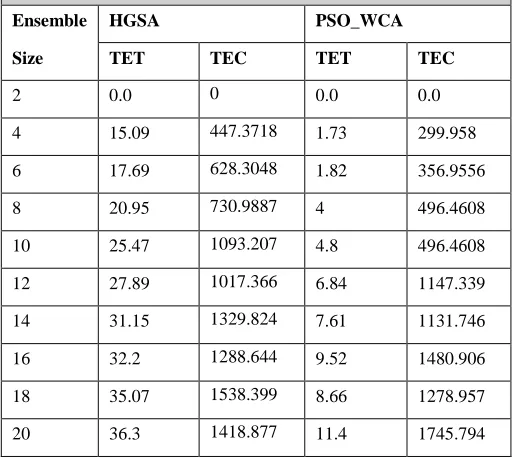
Table.2: Comparison table of HGSA and PSO_WCA using MONTAGE
RESULTS OF HGSA AND PSO_WCA USING –MONTAGE
Ensemble HGSA PSO_WCA
Size TET TEC TET TEC
2 0.0 0 0.0 0.0 4 15.09 447.3718 1.73 299.958 6 17.69 628.3048 1.82 356.9556 8 20.95 730.9887 4 496.4608 10 25.47 1093.207 4.8 496.4608 12 27.89 1017.366 6.84 1147.339 14 31.15 1329.824 7.61 1131.746 16 32.2 1288.644 9.52 1480.906 18 35.07 1538.399 8.66 1278.957 20 36.3 1418.877 11.4 1745.794
0
20
40
60
80
100
2'
6' 10' 14' 18'
TE
T
Ensemble Size
HGSA
190 | P a g e
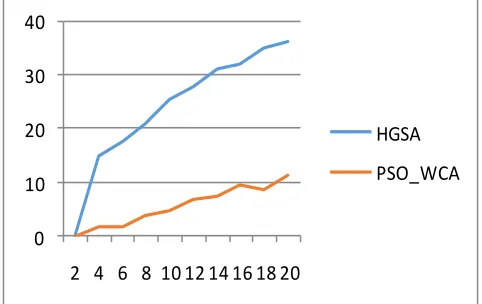
In below given Table 2 and Figure 6show the behavior of MONTAGE workflows in different number of workflows and Virtual machines which represent by ensemble size. In results, show the HGSA and PSO_WCA on total execution time, total
execution cost and time delay.
Figure 6: Comparison graph of TET of HGSA and PSO_WCA using MONTAGE
In figure6 and 7,MONTAGE work flow analysis on different number of virtual machine. In analysis use two metrics first TET in figure 4.3 and TEC in figure 7. These analysis on HGSA and hybrid of two optimization PSO_WCA.
Figure 7: Comparison graph of TEC of HGSA and PSO_WCA using MONTAGE
In figure 7 analysis these parameter PSO_WCA perform well in cost and time parameter because of ant colony searching time decide by adaptive pheromones and VM task migration depend on Transient problem but in genetic algorithm both is depend on candidate solution and which is static but APSO_WCA initialization is depend on pare to distribution which is depend on normal distribution. However, time delay of Genetic algorithm is better than PSO_WCA because of pare to distribution take more time for mapping of VM by task.
Table.3: Comparison table of HGSA and PSO_WCA using CYBERSHAKE
RESULTS OF HGSA AND PSO_WCA USING -CYBERSHAKE
Ensemble size
HGSA PSO_WCA
TET TEC TET TEC
2 0 0 0 0
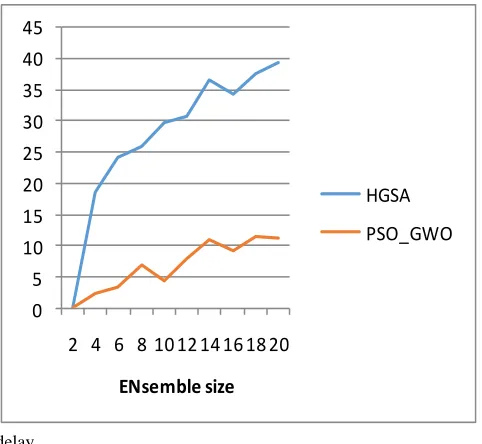
4 18.57 822.6585 2.4 687.9981 6 24.25 1136.987 3.36 950.981 8 26.05 1545.962 6.92 1518.366 10 29.85 1883.18 4.50 1689.733 12 30.78 1729.39 8.08 1724.117 14 36.80 2530.267 10.96 2463.681 16 34.34 2106.646 9.25 2731.877 18 37.77 2311.253 11.58 1989.96 20 39.50 2541.908 11.42 1982.903
0
10
20
30
40
2 4 6 8 10 12 14 16 18 20
HGSA
191 | P a g e
In below given Table3 &4 and Figure 8 & 9show the behaviorof CYBERSHAKE and LIGO workflows in different number of workflows and Virtual machines which represent by ensemble size. In results, show the Ant colony optimization and genetic algorithm optimization on total execution time, total execution cost and time
delay.
Figure 8: Comparison graph of TET of HGSA and PSO_WCA using CYBERSHAKE
In figure 8 analysis these parameter PSO_WCA perform well in cost and time parameter because of Particle swarm optimization searching time decide by adaptive pheromones and VM task migration depend on Transient problem but in genetic algorithm both is depend on candidate solution and which is static but PSO_WCA initialization is depend on pare to distribution which is depend on normal distribution.
Figure 9: Comparison graph of TEC of HGSA and PSO_WCA using CYBERSHAKE
In figure 9 time delay of HGSA is better than ACO because of pare to distribution take more time for mapping of VM by task. It will effect on Total cost execution because pare to VM mapping but TET always significance improve.
Table.4: Comparison table of HGSA and PSO_WCA using LIGO
RESULTS OF HGSA and PSO_WCA USING -LIGO
Ensemble HGSA PSO_WCA
size TET TEC TET TEC
2 0.0 0.0 0.0 0.0 4 44.91 2762.633 6.61 1467.243 6 65.89 4191.678 24.09 4022.422 8 35.66 4883.178 45.34 5699.963 10 68.82 5304.774 15.98 4708.369 12 102.39 7331.103 26.65 6271.538 14 58.96 7729.967 33.7 7550.524 16 151.28 10608.93 49.58 9948.208 18 87.77 11384.08 71.95 11188.03 20 153.22 13094.86 90.9 12582.79
In table.4, LIGO on TET and TEC parameter in different virtual machine or ensemble size. In this paper, we use two to twenty ensembles size and optimize by genetic algorithm and ant colony optimization. In experiment results, PSO_WCA reduces the average TET and TEC in different workflow. Therefore, we concluded that PSO_WCA optimize and converge workflow scheduling in cloud scenario.
0
5
10
15
20
25
30
35
40
45
2 4 6 8 10 12 14 16 18 20
ENsemble size
HGSA
PSO_GWO
0
500
1000
1500
2000
2500
3000
2 4 6 8 101214161820
Ensemble size
HGSA
192 | P a g e Figure 10: Comparison graph of Time delay of HGSA and
PSO_WCA using LIGO
In figure 10 and 11 result analysis, find that time delay of PSO_WCA is more as compare to HGSA in local simulation. Hence, in-order to reduce time delay of PSO_WCA, it can be executed in real-time cloud environment using SLA. In addition, this work can be extended for multi-objective algorithm to get solution for load balancing and task failures.
Figure 11: Comparison graph of Time delay of HGSA and PSO_WCA using LIGO
Table.5: Comparison table of HGSA and PSO_WCA using GENOME
RESULTS OF HGSA and PSO_WCA USING -Genome
Ensemble HGSA PSO_WCA
size TET TEC TET TEC
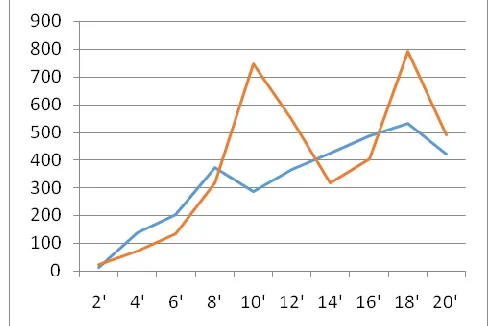
2 12.23 8825.232 23.2 9915.513 4 137.78 7549.552 73.24 27030.74 6 201.57 42511.93 133.83 42569.68 8 370.15 28155.45 315.65 41656.28 10 284.46 58872.21 745.24 86234.89 12 365.5 77034.56 546.78 88012.68 14 423.76 66004.98 317.76 93654.41 16 486.7 82720.56 401.95 106579.9 18 530.13 113448.6 791.04 123916.8 20 419.1 119935.5 491.21 139920
In below given Table 5 and Figure 12show the behavior of GENOME workflows in different number of workflows and Virtual machines which represent by ensemble size. In results, show the Ant colony optimization and genetic algorithm optimization on total execution time, total execution cost and time delay.
Figure 12: Comparison graph of TET of HGSA and PSO_WCA using GENOME
0
2000
4000
6000
8000
10000
12000
14000
2
6
10 14 18
HGSA
193 | P a g e
In figure 12 and 13 analysis these parameter PSO_WCA perform well in cost and time parameter because of ant colony searching time decide by adaptive pheromones and VM task migration depend on Transient problem but in genetic algorithm both is depend on candidate solution and which is static but PSO_WCA initialization is depend on pare to distribution which is depend on normal distribution. However, time delay of HGSA is not better than PSO_WCA because of pare to distribution take more time for mapping of VM by task. It will effect on Total cost execution because pare to VM mapping but TET always have significance improve.
Figure 13: Comparison graph of TEC of HGSA and PSO_WCA using GENOME
IV CONCLUSION
In this work, we proposed the scheduling mechanism for execution of the sensible forms on the IaaS clouds. The main issue in the cloud computing while decreasing makespan is execution cost. This issue is solved by using Hybrid PSO with WCA. The tests were directed by mimicking four surely understood work processes (Cybershake, Ligo, Genome, Montage) on Cloudsim, which demonstrates that our answer has a general more beneficial execution than other existing algorithms.
In above given graphs and tables, represented a comparative analysis of TET and TEC parameters on the basis of Bio inspired optimization (HGSA) and Particle Swarm optimization (PSO) with Grey Wolf Optimization. In experiment, we used workflow scheduling in cloud environment with the utilization of different type of scientific workflow.
In our analysis, total cost and execution time are improved by optimization but optimization also
dependent on initializing factors. In the proposed approach, we use Pareto distribution instead of random initialization.
If random distributions are used, more time will be taken to converge and sometime enforces the convergence by iteration but enforcing of convergence will increase the computation and execution time therefore does not meet the deadline condition.
So, task initialization is an important task as defined in this paper. Another thing represented in these graphs and tables is that PSO_WCA performs better in comparison to HGSA for reduction of cost and time because of the random crossover.
The worthy results are achieved because PSO (particle swarm optimization) play important role in global optimization and WCA optimize locally and we have merge the two algorithms by taking the best out of them. With the proposed approach in most of the work processes we can deliver bring down cost efficient schedule then additionally decreasing the time delay.
V REFERENCES
[1]Zhang, Qi, Lu Cheng, and RaoufBoutaba. "Cloud computing: state-of-the-art and research challenges." Journal of internet
services and applications 1.1 (2010): 7-18.
[2]Vecchiola, Christian, Suraj Pandey, and RajkumarBuyya. "High-performance cloud computing: A view of scientific applications." Pervasive Systems, Algorithms, and Networks
(ISPAN), 2009 10th International Symposium on. IEEE, 2009.
[3]Zhao, Yong, XuboFei, IoanRaicu, and Shiyong Lu. "Opportunities and challenges in running scientific workflows on the cloud." In Cyber-Enabled Distributed Computing and
Knowledge Discovery (CyberC), 2011 International
Conference on, pp. 455-462. IEEE, 2011.
[4]Vöckler, Jens-Sönke, Gideon Juve, EwaDeelman, Mats Rynge, and Bruce Berriman. "Experiences using cloud computing for a scientific workflow application." In Proceedings of the 2nd
international workshop on Scientific cloud computing, pp.
15-24. ACM, 2011.
[5]Pandey, Suraj, Linlin Wu, SiddeswaraMayura Guru, and RajkumarBuyya. "A particle swarm optimization-based heuristic for scheduling workflow applications in cloud computing environments." In Advanced information networking and applications (AINA), 2010 24th IEEE
international conference on, pp. 400-407. IEEE, 2010.
[6]Iosup, Alexandru, Simon Ostermann, M. NezihYigitbasi, RaduProdan, Thomas Fahringer, and Dick Epema. "Performance analysis of cloud computing services for many-tasks scientific computing." IEEE Transactions on Parallel and
Distributed systems 22, no. 6 (2011): 931-945.
194 | P a g e performance analysis of EC2 cloud computing services for
scientific computing." In International Conference on Cloud
Computing, pp. 115-131. Springer, Berlin, Heidelberg, 2009.
[8]Deelman, Ewa, Gurmeet Singh, MironLivny, Bruce Berriman, and John Good. "The cost of doing science on the cloud: the montage example." In High Performance Computing, Networking, Storage and Analysis, 2008. SC 2008.
International Conference for, pp. 1-12. Ieee, 2008.
[9]Hoffa, Christina, Gaurang Mehta, Tim Freeman, EwaDeelman, Kate Keahey, Bruce Berriman, and John Good. "On the use of cloud computing for scientific workflows." In 2008 IEEE
fourth international conference on eScience, pp. 640-645.
IEEE, 2008.
[10] Callaghan, S., Deelman, E., Gunter, D., Juve, G., Maechling, P., Brooks, C., Vahi, K., Milner, K.,Graves, R., Field, E. and Okaya, D., 2010. Scaling up workflow-based applications. Journal of Computer and System Sciences, 76(6), pp.428-446.
[11] Alkhanak, EhabNabiel, and Sai Peck Lee. "A hyper-heuristic cost optimisation approach for Scientific Workflow Scheduling in cloud computing." Future Generation Computer Systems(2018)
[12] Choudhary, Anubhav, Indrajeet Gupta, Vishakha Singh, and Prasanta K. Jana. "A GSA based hybrid algorithm for bi-objective workflow scheduling in cloud computing." Future
Generation Computer Systems 83 (2018): 14-26.
[13] Sagnika, Santwana, SaurabhBilgaiyan, and Bhabani Shankar Prasad Mishra. "Workflow Scheduling in Cloud Computing Environment Using HGSA Algorithm." Proceedings of First International Conference on Smart System, Innovations and Computing. Springer, Singapore, 2018.
[14] Service Models. [Online]. Available at: http://www.ques10.com/p/3971/enlist-and-explain-various-service-model-and-dep-1/
[15] Cloud Computing Characteristivs. [Online]. Available at: https://www.researchgate.net/figure/Essential-characteristics-of-cloud-computing-16_fig1_310477656