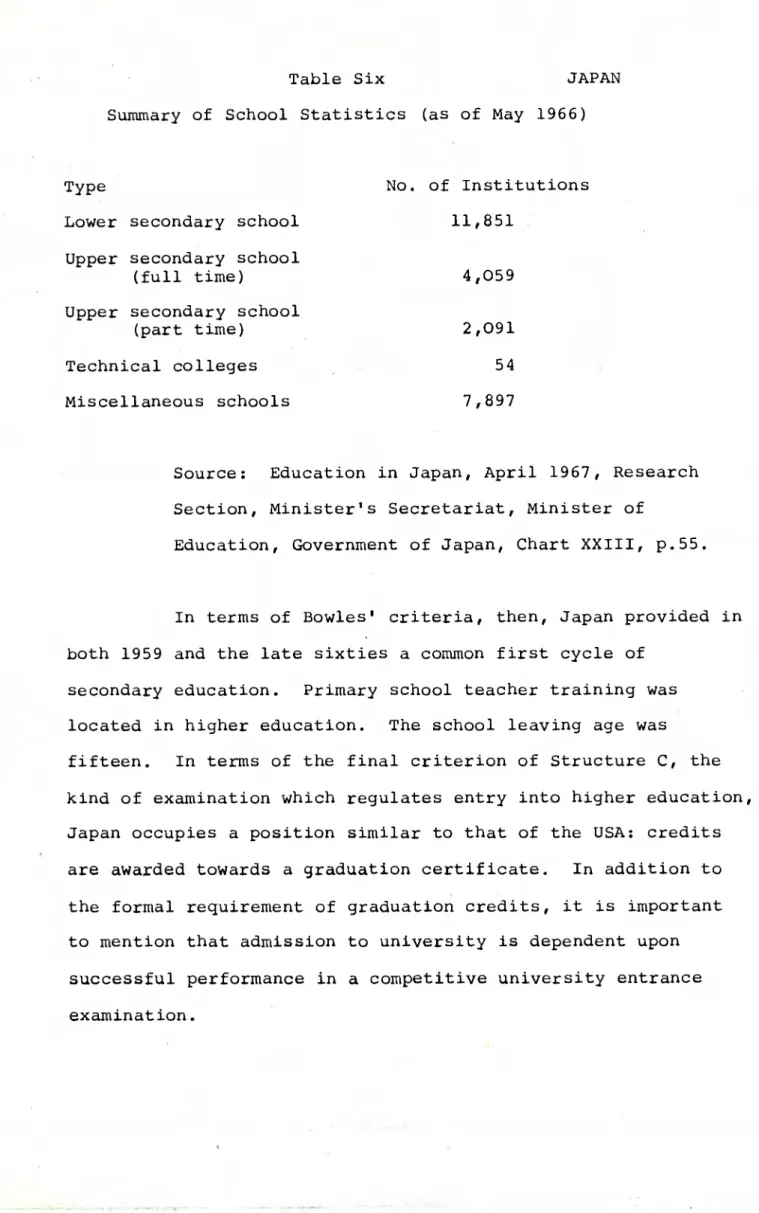
MASS AND ELITE ASPECTS OF EDUCATIONAL SYSTEMS: A COMPARATIVE ANALYSIS
by
Robert Cowen
THESIS
SUBMITTED TO THE UNIVERSITY OF LONDON FOR THE DEGREE OF
Ph.D. 1981
UNIVERSITY OF LONDON INSTITUTE OF EDUCATION
ABSTRACT
MASS AND ELITE ASPECTS OF EDUCATIONAL SYSTEMS: A COMPARATIVE ANALYSIS
Chapter One identifies areas of actual and potential confusion in the analysis of 'mass' and 'elite' education systems. It attempts to clarify the area of enquiry. The chapter concludes with a statement of a 'problem'. The problem is the relation
between rapidly changing types of school and higher education institutions, and 'theories of general education'.
Chapter Two continues the task of clarification by
selecting and explaining the techniques of enquiry which are used to clarify the problem in England. The techniques are reviewed and the tradition within which the analysis is located is briefly identified. This chapter concludes the initial phase of problem analysis.
Chapter Three undertakes the identification of the problem in different contexts, i.e. in four countries. It notes variations in the patternings of the problem. It considers
selected aspects of the internal dynamics of educational systems in their relation to the problem.
Chapter Four is a short abstract statement of the ways in which theories in general education are sustained; and thus potentially changed.
ACKNOWLEDGEMENTS
I have been fortunate. In my formal education, I have been taught by four remarkable teachers. Of these, two have been Professor and Head of the Comparative Education Department at the University of London Institute of Education.
The impact of these two men, Professor Lauwerys and
Professor Holmes on comparative education students, for a period of time which is now approaching forty years, has been extensive and intensive. Extensive, in that their students are now teachers of comparative education all over the world. Intensive, in that the intellectual attraction of their teaching has often been so strong as to change the ways in which individuals see their lives. They had this effect on me. I thank them for their teaching.
4
CONTENTS Page
Chapter One: Confusions in search of a problem 6 equality of educational opportunity 14
mass and elite 19
the problem 47
England: the problem refined 58
England 58
comparative theories of general
education 69
England 89
concluding reflections and summary 108
The problem located 115
Identification 115
USA 116
Japan 125
USSR 138
France 143
Analysis in Context 147
concluding reflections and summary 162 Towards a theory of exclusion 169 selected implications and applications 206 Solutions: toward inclusion 218
A Review 218
England: specific initial conditions 227
The Solutions 235
Schools: England and Wales 61 Schools: England and Wales 61 Schools: England and Wales 62
Schools: USA 117
Schools: Japan 127
Schools: Japan 128
Higher Education: Japan 130
Chapter Two: Chapter Three: Section One: Section Two: Chapter Four: Chapter Five:
Page
Diagram One Hilker-style diagram 103
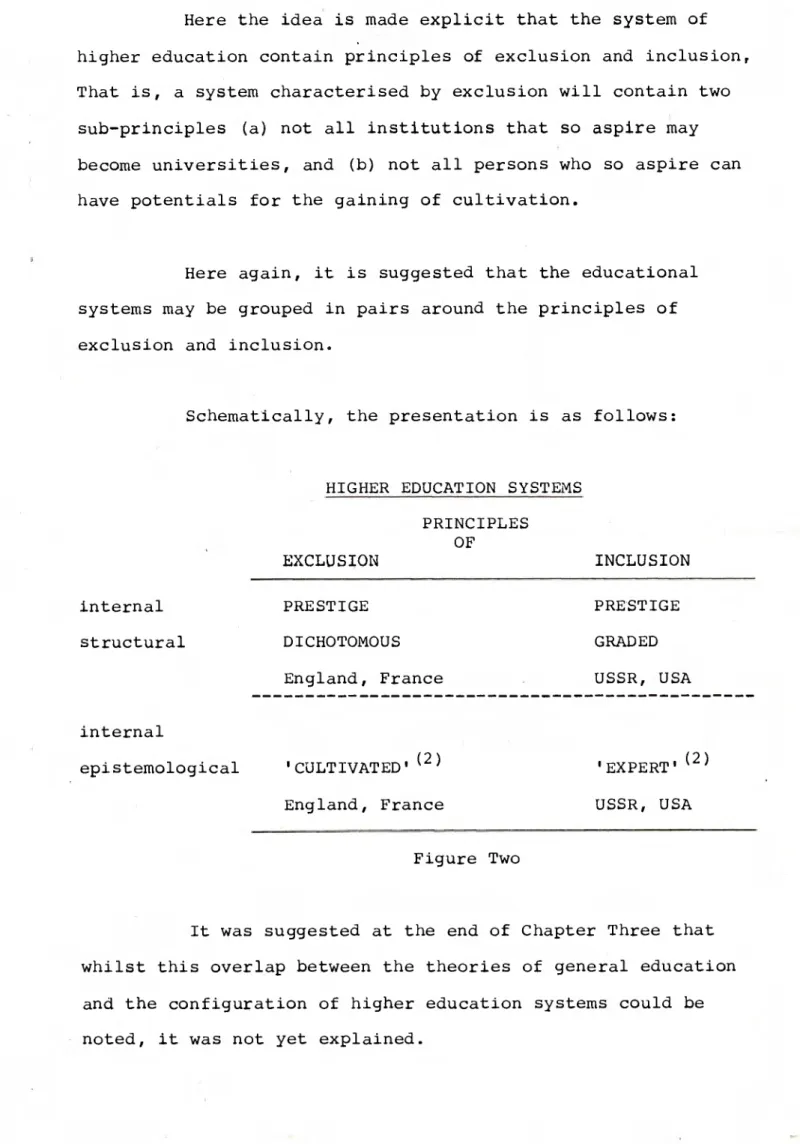
Figure One Theories of General Education 176 Figure Two Higher Education Systems 178
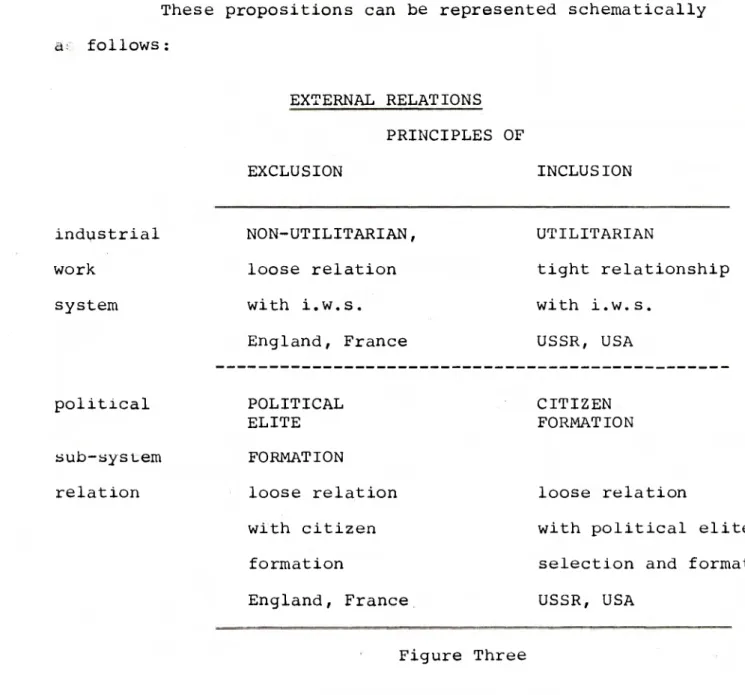
Figure Three External Relations 185
Figure Four General Theories and Structures 189
Footnotes 248
Bibliography 291
Footnotes
CHAPTER ONE. Confusions in search of a problem.
Problems require explanations; explanations require assumptions or models and hypotheses derived from such models; hypotheses, which are always, by implication, predictions as well as explanatory propositions, require testing by further facts; testing often generates new problems. (1)
R. Dahrendorf Dahrendorf's description of intellectual work covers much of what follows. A problem is identified. Some attempt is made to explain through models and hypothetical propositions. Some testing by facts is undertaken. The testing leads to new problems, rather than the definitive solution of the first problem.
The intellectual frame within which the work proceeds is the Holmesian problem-solving approach. An attempt is made to (2) state a Holmesian problem; to suggest an initial solution; to
clarify the problem; and to give some further analysis of contexts in which the problem occurs. The work is, generally, an exercise in reflective thinking. More specifically, it is an enquiry
framed by a particular methodology in comparative education.
However, the full logic of the Holmesian problem approach is not exemplified. The final steps in the methodology are under-played. There is a discussion of the educational policies
(solutions) which should be adopted in England and Wales, given
certain specific initial conditions, but the solutions are not quite at the status of policy proposals. Nor is there detailed antici-pation of the probable consequences expected to attend such
There is, however, a consistent emphasis in the work on the intellectual operations suggested by the Holmesian methodo-logy. An effort is made to see a problem clearly. Paradoxically, this involves giving considerable attention to the 'stage of
confusion'. Then the effort is to state, to clarify and
to locate in context an example of asynchronous change in education, and to clarify this problem through cross-national analysis.
The problem is already, embryonically, present in the literature. However, its statement is confused and its theory inchoate. To state clearly the nature of the problem is already to move beyond the literature. To go further yet, and to re-order the problem theoretically may help to improve the
literature. On the Dahrendorf thesis, new 'problems' may or may not be generated.
It will have been noted that Dahrendorf's sentence
contains an imprecision which the Holmes problem approach does not permit. Whilst Dahrendorf comes close to the Holmesian position in his views on the tentative nature of hypotheses, on the role of testing, and on•explanation by prediction, he uses the word
This meaning is not, however, acceptable if the Holmes methodology is taken, as it has been, as the starting point and broad frame of the analysis. A Holmesian problem is only
incidentally a puzzle. Nor is the statement of a Holmesian problem, in its major meanings, a direct question to answer or something
which is hard to understand, in the sense of 'to grasp mentally'. (3) On the contrary. The statment of a Holmesian problem is a point of clarity. Phenomena have been understood sufficiently clearly to be identified in a technical statement: 'x' has changed faster than 'y'; and both 'x' and 'y' can be located taxonomically (as norms, institutions or environmental circumstance). Thus a
Holmesian problem stated, is already a puzzle partially resolved.
The Dahrendorf concept of problem is more correctly located within the Holmes approach in that stage which precedes problem-statements: the stage of confusion. This usage is not perjorative (either here or in the methodology of the problem approach). The stage of confusions is a legitimate and explicit part of the problem approach, borrowed and extended from John Dewey's view of the processes of reflective thinking. For (4) the individual, an experience occurs which produces doubt,
In formal methodological terms, then, a state of
confusion will be identified. Considerable emphasis is given here to this stage of the problem approach because what is judged to be confusing is important: the selection of problem begins in selection of confusions; and continues through the gradual ordering of those confusions.
Unless the trap of reification is accepted, only indivi-duals can be confused. Thus the statment of a problem begins in the condition of anxiety of an individual experiencing confusions. As, however, the problem approach is a methodological position in a field of study there is some limitation on what it is legitimate to be confused about. Normally, the individual investigator in a professional role will be confused about some aspect of education; and resolution of the confusions will be undertaken within a
comparative perspective.
Thus although confusions begin in the minds of investiga-tors, there is an initial limitation, imposed by professional role, on what will be studied. There is a further caveat. Some (5)
problems are more important than others. The problem approach as stated does not lend itself to the study of picayune issues.
The point of departure in this work, the psychological source of intellectual irritation, is two policy initiatives by the British government in education: the acceptance of the Robbins Report by the government, and the issuance of Circular 10/65 which outlined a pattern of comprehensive schools. These were at the time seen as major reforms, though one was more contested than the other. Both were acts of policy to be understood in a context of raised aspirations: the educational system of England and Wales would become more 'democratic'. Each child would soon receive an education more fitted to his or her age, ability and aptitude.
The increased numbers of children and students demanding and taking up education seemed to confirm this belief.
There would, no doubt, be difficulties. Money would have to be found. More teachers trained. New schools built.
Academics were concerned whether 'more' would mean 'worse'. There would be difficulties of transition from the traditional patterns of education to the patterns promised by the reforms.
However, these difficulties would be eased by the growing power to explain and guide which the expanding research capacities of educational studies could provide. Sociologists
and psychologists had carefully analysed some of the inefficiencies and injustices of English education. Several of them had been
influential in moving professional opinion toward the idea of reform. The comparative educationists knew something of the
already begun on some of the reform processes being discussed in England. In the mid-sixties, comparative educationists were rapidly increasing their knowledge as they studied the impact of increased student numbers, world-wide, and the world-wide efforts to 'democratise' educational systems. It was likely then that the English difficulties would be overcome, the kinds of educa-tional policies represented by the Robbins dcc,ument and Circular 10/65 would be successfully implemented, and this would be in part because powerful explanatory theories were available from
the professional students of education, including the comparativists.
This optimism 'in the mind of the investigator'
(though perhaps the optimism was widely shared' turned, relatively rapidly, into a state of confusion 'in the mind of the investigator' (though perhaps the confusion was widely shared). The public and professional debate about educational reform in England seemed both confused, and occasionally bitter. The patterns of the higher education system which had emerged, post-Robbins, seemed non-novel: there was indeed more, but it seemed just more of the same. In the same fashion, impressionistic and cursory at first, it seemed that the literature in comparative education held
The state of confusion thus took shape in response to two phenomena: new policies in English education affecting the secondary schools and the higher education system, especially the universities; and the new explanations offered in some of the comparative education literature.
At one level of complexity and in policy terms, what was to be understood was clear enough: how might equality of educational opportunity be achieved, and in particular, within the context of increased students numbers of the mid-sixties, how might educational systems be adapted to absorb the numbers
demanding 'the right' to education? Very crudely put, in England the comprehensive school was to be the policy answer to the first question; the social demand principle of the Robbins Report (i.e. higher education to be expanded to absorb all qualified students seeking admission) exemplified a policy answer to the second.
At one level of complexity and in theory terms, what was to be understood was clear enough: what instruction did the cross-national analysis of educational systems offer concerning the achievement of equality of educational opportunity, and in
particular, in what ways did the example of other nations assist in defining a comparatively based theory of the expansion of educational systems? Very crudely put, comparative research
The puzzles had received initial answers. But there were puzzles and confusions remaining. Some puzzles could be simply phrased but were difficult to answer. The debate to introduce and to sustain the comprehensive school into English education had been both lay and politicised. International
examples of comprehensive school systems were quoted. Often those in favour of comprehensive education cited Sweden; those against, the United States. The English were, then, in their educational (6) system borrowing or copying or adapting something foreign. How would 'English traditions' (to use a loose term deliberately here) affect the new comprehensive school? The numbers of students in higher education were to be expanded. How would 'English
traditions' affect the expansion?
There were also puzzles and confusions remaining which could not be simply phrased. On reflection, at least one of these puzzles seemed to conceal such a degree of confusion as to be
seriously misleading. This puzzle was equality of educational opportunity and intellectual approaches to it.
Equality of educational opportunity
For example, the issue of corporal punishment in schools from time to time reaches a level of visibility and publicity which permits it to be termed a social problem whose focus is the educational system. A treatment of corporal punish-ment as a social problem allows a number of studies to be made. Its incidence by school or geographic region, its distribution to pupils classified by age, sex, social class, and ethnic
status, the legal position and privileges of those administering it, the attitudes towards corporal punishment held by concerned groups, can all be researched. Redefining the social problem of corporal punishment as a theoretical problem within sociology directs attention to theories .of the social order; perhaps even a particular theory such as Durkheim's theories of retribu-tive and restituretribu-tive punishment. Redefining what is problematic suggests different empirical sutides (e.g. the complete social ordering of the school is now a more logical object of investiga-tion): what constitutes relevant evidence is thus redefined.
Deciding whether to accept a social-problem definition of what is to be investigated is therefore an important intellec-tual operation. It is also one which the Holmes methodology enforces. ( )
place, the framing of the social problem may mean emphasis on
elementary education; elsewhere on secondary or tertiary education. But the conventional question, once equality of educational
opportunity is a taken for granted social problem is, how much equality of education is there?
This is a legitimate question, and one to which, for certain purposes, it is necessary to know the answer. However, it is a Dahrendorf puzzle and not a Holmesian problem. Worse, the answer directs attention to. certain classes of data and not others. It direct attention to the question of 'how much' and away from the dynamics of educational systems. It directs
attention to the 'causes' of inequality of educational opportunity. Tht, question has produced a massive literature.(8)
Typically the answer given to the question establishes that certain categories of children leave the educational system
Jailtel tnan others; and/or that, whilst in the educational system, they do less well on tests of attainment than other children at the same level of the educational system, with measured ability (perhaps as defined by I.Q. or non-verbal tests) held, as far as possibl , constant. The social characteristics of the relatively less successful children are investigated. These vary, but may include social class position, rural background, tribal or
policies are undertaken, the amount of educational equality may after an appropriate period of time be remeasured.
The question, then,.takes its answer in the form of empirical sociology. Its intellectual direction comes from the tradition of social accounting which has underpinned much of British sociology since its genesis. (10) With the question answered, much new data has been added to our description of the social universe. The policy answer is a matter of logic.
Typically it is to intervene in educational and social policy to reduce the effects of social and economic background. Scholarships for needy students may be created, or programmes such as the
American Head Start initiative may be undertaken. In this fashion the 'causes' of inequality in education will be removed, or their effects modifiE-1. Attention is directed away from the educational system to the social and economic causes of relative lack of
educational suc- ess; and towards social and economic buttressing of the educat _Inal system.
This logical sequence begins in accepting the social-prt'.em definition of equality of educational opportunity as a
pazzle. The focus of attention also produces a second consequence.. Attentic:n is primarily directed, in such sociological research,
proposed are likely to be simplistic. Thus a comprehensive school policy may be favoured on the grounds of ideology rather than analysis; although the social accounting research provides a legitimation for action, it does not analytically establish
that it is the comprehensive school solution (rather than alternative solutions) which should be adopted.
There is a comparative argument which accepts both a social-problem definition of equality of educational opportunity and which, in its general form, seems to suggest particular
solutions. The abstract argument is: (i) cross-national comparison indicates that country 'a' achieves a higher level of educational opportunity in its formal educational systems than country 'b'; (ii) country 'b', given its stated educational aims, should
therefore borrow or adapt educational policies similar to country 'a'; (iii) these educational policies will provide a similar
degree of success to that which country 'a' has produced in improving equality of educational opportunity. An alternative formulation would read as follows: (i) in countries 'a
'c' and 'd' where policies 'W', 'X', 'Y' and 'Z' are present in education, equality of educational opportunity is high as
Such a formulation is unfortunate. It accepts that the social-problem of equality of educational opportunity is similar in different cultures. It confuses correlations with causes. It ignores the question of whether the internal dynamics of educa-tional systems are similar in different nations. It glosses over the issue of cross-national transfer. It compounds error: it
transforms a. 'how much' question too casually into an illegitimate answer to the question 'how to change'.(11)*
Unease and further confusion, then, were generated by the ways in which the problematic was being framed in both
educational action in England and in the sociological and compara-tive education literature. It was not only that there were a number of puzzles (and no Holmesian problem). It was also that the way in which the puzzles had been taken up - through equality of educational opportunity as a social-problem - was constraining the ways in which the problematic might be
perceived. How might the problematic be reconceptualised? In particular, was there some way of progressing,beyond the social accounting questions, to address puzzles posed by the internal dynamics of education systems; of taking the educational system
itself as problematic? Perhaps in such a framing of the puzzle a better understanding of educational action might be gained and an alternative theoretical grasp, on what was at issue, generated.
of educational opportunity than to the specific issue of educa-tional change under the pressure of student numbers. As such, it focussed attention on the dynamics of education, taking the
educational system itself as problematic. The literature had the advantage of being explicitly comparative, i.e. written by
comparativists. This literature was the 'mass' and 'elite' literature of the sixties and early seventies.
The confusions might be reduced, the puzzles clarified, by some of the literature.(12) Where this did not occur directly, processes of reflective thinking, stimulated by the confusions which the literature itself contained, might clarify issues sufficiently for a Holmesian problem to be stated.
The specialist comparative educationists who had used, by the late sixties, the terms 'mass' and 'elitist' to describe educational systems included George Z.F. Bereday, Frank Bowles, Nigel Grant, Brian Holmes, Torsten Husen and Joseph A. Lauwerys. Mass and elite analysis
Bereday identified "... the modern ideal of total mass education for all youth up to graduation level.n(13) Bowles wrote that when the English, German and French educational systems
served as 'world models' they "... were starkly elitist in nature, and through their imitators they became models for
systems of elitist education which exist throughout the world."(14) With reference to the USSR, Grant suggested that what can be
observed "... will usually have been consciously planned for the purpose of running a system of mass education designed for the
(15)
offered the comparative judgement that 'tight control' is "one of the most prominent features of Soviet education, which high-lights its differences from other large scale systems of mass education ..."(16) Torsten Husen argued that in expanding
economies "... the major problem facing educational planners is the need to structure the educational system so as to provide mass education beginning with the secondary level, but followed rapidly at university level..(17) Holmes wrote of this
expansion as a fact. "State legislation and the growth of mass education at the secondary level have created pressures on the
universities which in some countries have been difficult to resist"(18) Lauwerys pointed out that "... this is an age of mass education"(19)and went on to provide a definition of mass education in terms of changed selection policies in education. "Secondary schools and colleges draw recruits from all levels of the population, from crowded working class homes poor in cultural resources, as well as professional and upper class ones..(20)
The terms were used without obvious hesitation or lengthy explicit definition. The use of the terms was also quite
wide-spread, as measured by the geographic locations of the authors. There are, in turn, three implications of such non-explicit and widespread use of the terms. One implication is that the
meanings were clear and shared by all authors; therefore no defini-tion needed stating. A second implicadefini-tion is that the widespread use indicated that a new classificatory system was available and being used in cross-national comparative research work in
1960s, on a world scale, had produced phenomena that the terms mass and elitist could describe in a taken-for-granted fashion. Thus, explicit definition and systematic classification were unnecessary, such was the salience of the world-wide phenomena. The educational referents were so obvious, that the meanings of the terms mass and elitist could be left as 'obvious' also. How 'obvious' were the meanings of the terms, how clear was the implicit classification system? What problematic was being addressed?
The contextual usage of the two terms covered a range of meanings, some of which the authors shared. Other meanings were singular to a particular author. The range of meanings and the assumptions made to utilise the terms as adjectives included, collectively, the following:
(a) elitist and mass attributes are sequential.
Chronologically, elitist characteristics occur first, and mass characteristics in certain circumstances supplant elitist characteristics;
(b) elitist and mass attributes are dichotomous and oppositional. Elitist characteristics are not
merely different from mass; elitist characteristics are cancelled out by mass characteristics;
(c) the change from elitist to mass characteristics in educational systems will probably require the
and will probably meet opposition. The shifts
from elitist to mass characteristics will be marked in other words by reform proposals and
institu-tionalisation;
(d) there is no short-term determinism about such a shift. Different societies debate elitist and mass characteristics of educational systems at
different times. Opposition to particular 'reforms' may prevail;
(e) substantively, a mass educational system is dis-tinguishable from an elitist educational systems by the size of its student body. Increased student enrollment and longer enrollment (i.e. higher
retention rates) are characteristics of a mass
system. Some authors add the idea of enrollment of more students from low status social categories.
The adjectives 'mass' or 'elitist' in the literature of the sixties, then, were used by the authors in two ways. One use, outlined in (e) above, delimited the condition or state of an educational system. An educational system was mass or
elitist in terms of the numbers of its student body. The second use, outlined in (a) to (d) above, described a process: a
Propositions (a) to (e) were embedded in the contextual usage by the authors of the terms mass and elitist. How closely are the condition (mass/elitist) and the process (elitist to mass) specified by context? In other words, do the authors' contexts establish an agreed, or at least lowest-common-denominator, conceptual framework which might sustain further comparative analysis?
All authors agreed on proposition (e) - that a mass system of education is characterised by a larger number of students (than an elitist system). No author provided a
numerical definition of the condition. There was in other words a general consensus on meaning but no operational definition of the parameter (numbers) by which meaning was attributed.
and the USSR. For Bereday, the general time frame included Meiji Japan, but his particular time frame was post W.W.II.
Similarly his space frame included Colombia and Denmark, but the immediate referents of his phrase 'mass education' were Japan, the USA and the Soviet Union. For Husen the space frame was most generally developing and developed countries and more particularly the countries of N.W. Europe, and the USA and Japan. Whilst his time frame had references within it to the nineteenth century, the analysis was heavily of contemporary (i.e. 1960s) data. Bowles' time frame was primarily post-1945, though he made extended reference to America in the 1930s and brief reference to Europe in its industrialisation phase. Bowles' space frame concentrated on the USA, France, England and the 'Russian'
system as well as various other high per capita/income countries; but reference was also made to the Caribbean, Central and South America, Africa, Asia and the Middle East - where countries had had difficulty with 'democratisation'.
Some consensus is apparent. In terms of a space frame the USA, the USSR and Japan were frequently invoked as examples of mass systems. In terms of a time frame, there was consensus that the nineteenth to the twentieth century is a period in which there was a shift from elitist to mass systems. There was also consus that the post-1945 period has within it examples of a shift from elitist to mass systems.
examples of dualistic or tripartite systems - and thus elitist; for Bowles in the same period (i.e. holding time frame constant) France and England provided examples of 'democratisation'.
The authors' contexts leave it unclear how educational systems which in one time frame (the nineteenth to the twentieth century) move from elitist to mass and then move again from elitist to mass in the post-1945 period. It can also be noted that the lack of common operational definitions (especially of an elitist system) allow Bereday and Bowles to disagree about the classifi-cation of the condition of France and England.
Thus, whilst there is some consensus in the 1960s literature on both the time and space frames through which an analysis of mass and elitist systems might be conducted, the time and space frames are sufficiently unclear, ambiguous and
idiosyncratic to be subject to re-examination before a sustained analysis is attempted.
The authors' contextual specification of the process also produces difficulties in an area other than space and time frames. Among the conventional categories of eudcational analysis (primary, secondary, tertiary education, teacher education,
Grant's educational referents in immediate context were too nebulous to be useful here. However Holmes' educational
referents made it clear that a shift of an educational system to mass characteristics in one area (e.g. secondary) is likely to
have consequences for a subsequent stage (e.g. university education). Lauwerys addressed himself to curriculum, in particular to nation-specific conceptions of a legitimate general education. At its broadest the question he asked was what might constitute an
appropriate 'general education' in a time of mass education. His other educational referents, whilst by no means pointed, included
both secondary schools and universities. Bereday analysed the structural patterns of second level schooling.(21) The language of this analysis referred to 'dual', 'tripartite' and 'open'
second level structures. It was this last term, 'open' which was the structural version of "... the modern ideal of total mass education for all youth up to graduation level..(22) The
intellectual point of Bereday's argument was that open structures at the second level produced a larger graduation cohort than dual systems. The immediate referent for mass education was for
Bereday a certain kind of second level school structure. Husen's concern was with social class bias in the identification and
retention of talent. Dualistic school systems where selection for an academic high school took place early (i.e. Bereday's dual and tripartite system) showed more social class bias than
'unified' school systems.(23) Husen's preference was for the
optimal identification, retention and utilisation of talent through 'flexible' school systems, i.e. "... where a definitive choice
possible ...'"(24) Thus Husen's educational referent, his
'conventional category' of analysis for elitist education, was similar to Bereday's. He used certain kinds of secondary school structures. But a vital part of his analysis was the tension between social class bias and talent criteria in selectivity. His intellectual and explicit empirical point, was that within an enlarged graduation cohort a lessened amount of social class bias in the graduation group was produced by 'flexible' second level school structures.
Second level schooling was thus a common point of change for three of the authors (Holmes, Bereday and Husen). Each took change at this level as significant. However, it should also be noted that the analyses immediately diverged. For Holmes, in his particular context, the point was relationships with
universities; for Bereday the point was the particular structure at the second level which affected the size of the graduation group; and for Husen the point was the structures and the
relationship between social class bias and talent bias which were significant in the analysis.
Historically, elitist systems served well in countries where educational demands were simple and easily
classified. In such countries a small group of university graduates supplied professional services and made whatever national and professional management decisions were needed. Administrative chores were left to less well-educated,
but well-trained, functionaries, and no attention was paid to the apprentice system which trained workers and craftsmen or to the functional illiteracy of the
peasantry. Such a system was not costly; it suited a stable society and in fact contributed to its stability.
(25)
How, according to Bowles, an elitist educational system is structured by the division of labour in a 'stable' society is clear. It is less evident what the attributes of an elitist
system might be in terms of educational referents, such as first, second, and third level structures, examinations, etc.
Under the impact of industralisation, according to Bowles, elitist systems expand. This, for Bowles, was a distinct phase
in the shift away from elitist systems towards 'democratisation'. In this expansionist phase, the educational referents are clearer. They were "overcrowded secondary schools, high rates of failure in examinations at the end of secondary school and high drop out rates (26) These referents marked the pathologies of an
elitist educational system. For the pathologies of the expansionist phase, the solution which Bowles preferred was 'democratisation'. but an interim solution, of varied permanence, might be
'modernisation' of the educational system.
specialists, the old system heavily geared to the traditional professions being no longer adequate; and the articulation and development of educational research for the alteration of educa-tional practice.(27) The conventional category educational
referents are here fairly clear. One referent was curriculum -a theme simil-ar to L-auwerys' focus on gener-al educ-ation. A
second referent was higher education, and the need to devise new institutional patterns - unlike European university patterns - for the tiaining of specialists. The third referent was educa-tional research which must continuously inform educaeduca-tional practice. Here, Bowles provided no specific institutional or organisational recommendations.
For Bowles, 'democratisation' of education is, however, a more significant reform than mere modernisation. Democratisa-tion of educaDemocratisa-tion "... is the process of assuring equality of opportunity for educational achievement throughout a given society..(28) Accordingly:
... democratisation is not confined just to assuring equality of schooling. This is attainable by
standardising the schools, a condition that now
exists in most countries. Standardisation, however, does not equalise opportunities for achievement unless the pupils are also standardised. If they are not, a variety of opportunities must be created.
(29)
Democratisation is a larger idea, based on a belief that in individuals at all social levels there are untapped potentials for development which are not reached by the conventional educational system. To tap the potentials requires new insights and new institutions. Democratisation, then, instead of being simply more of the same, is a new order of applied educational thought... Democratisation involves a large-scale effort to teach and to understand the riddles of individual and group differences and then to ensure that, besides
achieving the common learning of the time - a task that every system must accept - all students are permitted, if they choose, to develop their own competencies and achieve their own individualities.
(30)
These extensive definitions of democratisation are statements of educational goals. However, "... five European countries have initiated educational change on a scale that can be called democratisation"(31)
It might thus be expected that Bowles who immediately proceeded to comment on each country in turn would provide rather pointed educational referents. This was not the case. The
English example was "wellknown"(32) , the Swedish reform was "well under way"(33) and the Russian (sic) educational system "... offers further opportunity to those who seek it and encouragement and
reward to those who will follow it."(34) The Italian case was exemplified only by the use of school television.(35) The French case had the longest set of educational referents: the removal of "... the failure points where marginal students were diverted into terminal programmes";(36). "... new programmes at the
secondary and higher levels and particularly in technical fields
• • • "$37)and "an emphasis on guidance and orientation for each (38)
category educational referents (of democratisation) may be identified. Japan, post-1945, had seen "a great extension of opportunity for secondary education, including imaginative use of radio and correspondence courses for students unable to continue formal schooling..(39) In the USA in the 1930s its "first major democratisation" meant "... broadening the secondary curriculum and launching a vast expansion in facilities,.(40) whilst at the time of Bowles' essay "... another democratisation is being
undertaken in the United States at the level of post-secondary education, with the rapid development of tax-supported community colleges."(41)
Thus Bowles' analysis of democratisation of educational systems is not much advanced by his particular conventional
category referents. His statement of democratisation as an ideal, or as a principle of policy, is both extensive and clear. His comparative examples might, on closer analysis than he provides, be taken as instances of the implementation of democratisation. As he outlines the examples, however, they are (with the possible exception of the French case) as much examples of efforts to deal with modernisation (or the pathologies of 'expansion') as democra-tisation.
The issue remains: through what conventional categories of educational analysis did Bowles describe the shift away from elitist education, and how far was there contextual consensus among the writers of the sixties about the educational referents in which the shift is to be described?
Bowles' educational referents were, for the process of democratisation at least, frequently unspecified, and where
specified, eclectic and national-specific. His conventional category educational referents for elitist education have to be guessed at by the reader. His referents for exapnded systems were negative, i.e. they described the pathologies of a disintegrating elitist educational system. (Bereday and Husen may be also writing about this phase, but Bowles does not provide a sufficiently
detailed positive description of the expansionist phase for such a surmise to be checked). The most focussed of Bowles'
educational referents were to a 'modernising' system.
Bowles highlights the confusion of the 1960s literature. In so far as a case could be made that there was agreement among the authors of the 1960s about the nature of the shift from
elitist to mass attributes of educational systems, it would be that an important locus of change was the second level of educa-tional systems. The next question is what particular educationa-referents are used to delineate the process in that sector?
authors use to mark the shift. Like Lauwerys, Bowles had
curriculum as one referent for the shift. Like Holmes, Bowles was aware of the impact of an expanded secondary system on the nature of an (unchanged) higher education system. Like Grant, Bowles was conscious that the 'Russian' system (which Bowles called democratised, and Grant called mass) has "... expanded greatly over half a century."(44) Like Bereday and Husen, Bowles accorded significance to expanded graduation cohorts at the
secondary level, though his references to social classes and social background were casual. Bowles, of course, added further educational referents, such as the organisation of educational research and the nature of higher education to the analysis.
The point is not that individual authors were confused in their own writing in the 1960s. Holmes' intellectual point was quite clear in the context of his pages. Similarly, within their own terms of reference, Lauwerys' and Husen's essays for example were clear about the parameters in which they analysed the shift.
Such a varied range of educational referents meant that neither the process nor the condition (of mass and elitist educational systems) was clear and consensual in the literature of the sixties. There was no consensus on the substance of the process. Thus there was no new classificatory system (defined by educational referents) in the literature of the sixties which outlines elite to mass process; only a series of personal
classifications created by individual authors and usage of the same vocabulary by several authors.
To make this point of course is not the same as saying that no author had classified. Obviously several had. Nor is it to suggest that the puzzle disappears because some of the authors were relatively imprecise. There are sufficient indica-tions to suggest that the authors, with their time, space and expansion themes, were working hard to analyse similar phenomena.
It remains legitimate therefore to put one more major question to this literature which includes the terms 'mass' and 'elite'. Granted that in some societies, educational systems were changing in ways that were difficult to identify clearly, what social forces did the authors judge to be important, and by extension, were any theories of social change stated which might assist in limiting the nature of the puzzle?
Grant's context provided a number of assertions about significant social pressures. "The mass character of Soviet education is, clearly, a reflection of its social aims.fi(46)
Political aims, too, have influenced the growth of mass education: The Soviet regime ... aims higher than mere passive
acquiescence, so that for positive political commitment among the masses, mass education is again imperative. 'An illiterate person,' Lenin remarked, 'stands
outside; he must first be taught the ABC. Without this there can be no politics; without this, there are only rumours, gossip, tales, prejudices, but no politics'
Literacy and the highest development of general education are thus regarded as a political necessity for the
government and a civic duty for the individual. It is for this reason that although much has been done in the field of vocational and specialist education, the
authorities and, to all appearances, public opinion -insist on the system's retaining its mass character. Reforms may bring in more diverse courses for senior pupils, special schools may cater for artists and ballet dancers, but underlying the variations is the stress on providing a basic general education, covering the same ground and on the same terms for all, regardless of background or future occupation. A more diversified and selective system would be regarded with grave suspicion as a barrier to the realisation of the political aims of Soviet education ...
(47)
The fact that Grant was writing an area- specific text means, of course, it is unwise to assume that he would have
invoked the same variables for a comparative analysis of a shift to mass educational systems. Nevertheless, the idiographic
contribution on what are significant social forces in the USSR is clear.
Husen was in no doubt about the general influence of extra-educational forces on educational systems. "One cannot view the school structure and/or the curriculum as if they
close relation between them." (48) Substantively, "... the rapidly growing need for trained manpower and the increasing
"consumption of education," reflected in the so-called educational explosion, conflict with a school organisation and a curriculum designed for a static economy and a society characterised by a rather rigid social structure."(49) The most general forces making for some kind of transformation of educational systems so that they might better produce trained personnel were, according to Husen, "scientific progress, the transformations that technology has brought to industry, business, and our daily lives, and the expansions of trade and communications ... during the last few decades ..."(50) Fortunately, this kind of writing, taken from the conclusion of the essay, is not typical of Husen. His
theoretical view was that there is a correlation between certain types of economies and class structures, and certain types of educational structure:
Until recently both the occupational status structure and the social class system in many economically deve-loped countries could be symbolised by a pyramid. In all sections of the economy the base of the pyramid was formed by a mass of unskilled or semiskilled manual workers. Most of these had a modest formal education provided by a compulsory elementary school. The next level consisted mainly of white collar workers ... The formal education required in most cases exceeded
elementary school by a few years, in many cases by some kind of middle school with graduation at fifteen or sixteen - a schooling that did not qualify for university entrance. The middle schools either were separate
establishments or consisted of the lower section of the pre-university school and/or the university.
contrast there were other kinds of economies and social patterns, which were correlated with different kinds of
ek,ucatj,nal provision:
In developed countries with highly advanced economies, the qualification and social status structure of the occupational universe now increasingly resembles the shape of an egg. At the bottom of the status hierarchy is a diminishing number of occupations that require a modest amount of formal schooling and vocational training over a considerable time. In the middle a rapidly
increasing number of occupations require formal education to the age of sixteen to eighteen after which a
specialised vocational training is being sought. At the top, finally, the number of persons with higher educa-tional and professional occupations also increases rapidly.
(52)
The extra-educational variables which Husen stressed thus the level of development of the conomy and the nature
social class/status system as a functiop of occupational =L.ructure. These variables were correlated with certain basic Kinds of educational provision. The thrust of the analysis was tnaL economic change and development slowy produced educational .,/stems which allowed "the resrves of talent" in national
dations to be mobilised.
There was little pn the sgnificance of
However, it is possible to suggest that Husen did accord, in principle, significance to political and social aims, whilst reserving the main body of his initial analysis of extra-educa-tional variables for tradiextra-educa-tional socio-economic arguments. The point is a matter of interpretation. Consider the following passage:
In the developing and the developed countries alike, two major forces lie behind attempts to reform the school structure, particularly of secondary education. One is the democratisation of secondary and higher education in order to broaden opportunities for young people from all walks of life and especially for
talented students from the lower social classes. The other is the need to provide an expanding economy with a sufficient supply of trained manpower at various qualification levels.
(53)
The category of the second major force is clear: it is economic. The first 'major force' is identified in such a way as to come close to being a tautology: 'one major force behind attempts to reform the school structure ... is ... the democratisation of secondary and higher education'. i.e. one major force behind attempts to reform the school structure is one kind of reform of schools. It seems likely that the weight of Husen's intended meaning was on the phrase"... in order to broaden opportunities for young people from all walks of life..." Broadening of
is one of interpretation. Husen did not directly mention
political and social aims as relevant extra-educational forces. It may be, however, that his intention was to acknowledge them in the post-war context as an obvious aspect of larger effort to broaden opportunities for the young.
Bereday's essay contained acknowledgement of the signi-ficance of extra-educational variables: "a reorganisation of the (educational) systems follows at its own pace - a much slower pace and often a reluctant one - other changes in society.u(54) Even in the cases of strong political leadership (as in Ataturk's Turkey or de Gaulle's France), or reform after wars (as in Japan or West Germany), "the new school systems have managed to resemble ... the slowly moving traditional patterns."(55) So two sets of forces were acknowledged, by Bereday, as effective in producing alterations in educational systems: (unspecified) 'changes in society', and certain immanent forces, (unspecified) 'traditional patterns', in educational systems.
School systems ... should be regarded as the given, though it would be nice if this were not so. Let us say that the schools of the sons must in at least half of the cases resemble the schools of their fathers. An effective change of educational patterns can be
accomplished only by evolution over three generations. Efforts to harness education in the service of
development cannot afford to ignore these persistent social laws.
(56)
The 'persistent social laws' were not specified in the next
paragraph, and were thus presumably stated in the quoted paragraph. Law-like statements, that (i) schools should be regarded as given, (ii) that 50% of schools do not change in one generation and
(iii) that evolution over three generations is required before effective change in educational patterns can occur, may (or may not) be true; but they do not extend (or confirm) the list of social forces suggested as significant by Grant and Husen.
Lauwerys offered a more detailed definition of signifi-cant extra-educational variables: "the problems of modern civili-sation and modern education are much the same everywhere -
urbanisation, impact of the new technology, the explosion of knowledge, increased geographical and social mobility, rising standards of aspiration and so on..(57) Reform proposals in education, especially in curriculum, would show similarities 11 ... as a result of the growing resemblances between the great
urban centres which increasingly dominate the life of nations."(58) However, it was clear to Lauwerys that there would also be
have combined to affect and modify the formulation of the problems and the shape of the answers given..(59) So although, for
Lauwerys, the most general extia-edur - ional variables were in the 1960s similar between nations__!1.„,_1.Yferences in style and
approach (in education) remiat , he assumptions made are themselves the outcome of cult. ,(60)
Lauwerys continued • • e s.gnificance of social forces in his concludinc
In each of 1.r.e ...dered, sustained and
vigorous efro_t-, are :heive :i.€ .oimprove the systems f aduc;Itioh, Ae =.7 -lhols, the methods
cf teaching. The ..-weral: ',L)dernsation; that is tLe a,:ljusciaent of o the - ,eeds of the present
lnri the foreseeaWe ;. .ititif= 30 that -0. may serve to
imr cve ma,_eria:,'ct, and the ,....altural and spiritual as A.catns of the.
i7 • be responsi vrnds (-)f s')ci,-.1. forces:
4ha is needed is a reinterpretation
,3f the central meani,_, general education
j_ri the light of tnhnological,
ecunomic and politc: char: it was Aapted to the nets of a 6C:1 sharply stratified
into social classes, each with t - ,s own rights and duties. gher education had cc c3ev.::. insights and qualities
*rf leadership in a „stkall elitrich wielded power and
cied on culture. (7,yieral'aton was concerned
,;_cA maintaining a common universe of discourse among is elite. Science, we ri understand the term,
was not an essentiai part of the common culture, nor
did it play an important role in the production and tribution of material goods.
economic development as significant social forces. He shared
these general categories with.,...araxit and Husen. He added of course in his analysis the forces of urbanism, geographbal and social mobility, the social and economic role of science, and placed an especial emphasis upon. the significance of cultural history. The substantive significance of Lauwerys' analysis will be considered later. Sufficient here to notice that Lauwerys included in his analysis the themes posited by Grant and Husen - and extended the categories of variables used. (-:,(Tlain shifts in
educational systems.
Bowles stressed the of industrialisation which proded
tAlre quite sep73,-_ sults. i st, incomes were raised in all occupations .. and this brouyhtadvanced education in '..)::)iL2' view s a piort of a general rise
in expectatIons Second, industrialisation created a demand for trained wn7'.ch the elitist systems could not meet. Thi-td, it brought to the fore the inadequacy of elite•par of the educational system
as a preparation for tne nanagement of industrialisation. (63)
These results of industrialisation not according to Bowles produce change; they laid the groundwork ]or change. Change occurred when demands for change were made articulate at the national political level and became part of governmental policy. Even then, with opposition from universities and sometimes
governments had espoused equality of educational opportunity as a policy and his conclusion was that "... educational democrati-sation is tied to industrialidemocrati-sation ..."(64) The cases of the Danish folk high school and the American land grant colleges meant that democratisation might in certain circumstances occur in an agricultural economy; but "... the fact nonetheless remains that present preoccupations are with industrialisation and the democratisation of education will take place in relation to industrialisation."(65)
Bowles' treatment of extra-educational variables was, however, more subtle than this heavy emphasis on industrialisation might initially imply. Democratisation of education is both
expensive and results in high educational productivity. High euucational productivity ( if it could be afforded in a non-industrialised economy) would produce persons who could not be
absorbed easily by the occupational structure. Too early a democratisation of education might be socially disruptive: "... there are many nations whose governing groups see no early prospect of industrialisation and actively resist democratisation as
un-necessary and probably dangerous."(66) Thus democratisation of education has tended to be successful only:
... in nations where the process of industrialisation has created a need for educational expansion, and where there is a broad political base which gives the electorate the opportunity to record its educational demands through political channels. In countries where one but not both of these conditions exists, partial moves have been made toward democratisation. In countries where neither
condition exists, there is little recognition of the problem of democratisation.
Bowles thus produces a clear statement of the social forces he considered to be significant in producing shifts in educational systems. The categories, stressing both political aims and economic development, agreed broadly with the categories utilised by Husen and Grant, and some of the categories suggested by Lauwerys. Like Husen, Bowles accorded considerable substantive stress to economic variables, but Bowles was far more explicit about the significance of political forces than Husen. Bowles' overlap with Lauwerys is more difficult to interpret. It could be argued - and it is a matter of judgement - that many of the particular social forces suggested by Lauwerys, such as urbanisa-tion, or the impact of new technology, are contained within Bowles' concept of 'industrialisation'; and that other of Lauwerys' social forces, such as rising standards of cultural and spiritual aspira-tions, are causes or functions of Bowles' category 'a broad
political base'. However, Lauwerys with his concept of cultural history was more explicit than Bowles (or Husen or Grant for that matter) about one aspect of what Bowles termed 'local
circumstances'.
Despite the differences it is clear that all authors judge that shifts in the (elitist-mass) nature of educational systems are multi-relationship phenomena, and all accepted the importance of social forces. Secondly, among the substantive analyses of Grant, Husen, Lauwerys and Bowles there was some consensus on the categories of social forces relevant to an analysis of shifts in the configuration of educational systems. Indeed it is possible to suggest that there was rather more
the categories ('the educational referents') in which the elite-mass educational shifts were described. In this sense the extra-educational classification system of elite-mass process was more developed by the authors than the intra-educational classification system of elite-mass process.
It is possible (and not merely by extension) to identify at least one very clear theory of social change in the analyses. Bowles and Husen both gave emphasis to economic development, in the form of industrialisation, in producing alterations in the
configurations of educational systems. Of the two theories Husen's was the most blunt; Bowles gave more stress to intervening political variables. It will be recalled that Husen's analysis laid great stress on the significance of certain kinds of economy, termed 'highly advanced' and 'economically developed'. Highly advanced economies are the ones with egg-shaped qualification and status structures. Economically developed economies are the ones with pyramid-like occupational status, and social class structures.
'Maximisation of talent', which in the substance of Husen's analysis means reducing social class bias, becomes important as the nature of the economy changes from 'economically developed' to 'highly advanced' as the pyramid shape gives way to the metaphorical egg. As the economy changes towards an egg-shaped qualification
structure, so there is a tendency for certain kinds of 'flexible' educational structure to develop. Such flexible educational
in the educational systems (Husen's proposition is a comparative one) is the nature of the economy.
As a comparative hypothesis, Husen's theory of change has an attractive simplicity. Identify the condition of a given national economy, and perhaps its speed of change, and as a
correlate the structural condition of a given educational system is either described, or what its condition ought to be is known.
Husen's thesis is a particular example of convergence theory: the proposition that industrialised and post-industrialised societies (or educational systems) are growing increasingly alike. Occasionally the two theses are combined in the form: because
the demands of technical, industrial society for educated talent are similar, and a function of industrialisation, educational
systems in certain kinds of society will become increasingly alike. Thus:
Education is a crucial type of investment for the
exploitation of modern technology. This fact underlies recent educational development in all the major
technical societies. Despite idiosyncracies of national history, political structure, and social
traditions, in every case the development of education bears the stamp of a dominant pattern imposed by the new and often conflicting pressures of technological and economic change.
(68)
It is moot whether the confidence of this statement is matched by its accuracy. It is moot whether Husen is right or
wrong.(69) The more important point in the logic of the discussion is that the social change theories assist in the reduction of
The problem
A review of the discussion themes permits some recon-ceptualisation and, in that synthesis and rejection and reconcep-tualisation, a Holmesian problem statement will be framed.
Equality of educational opportunity as a social-problem and as a research problem (in one of its major definitions in the literature) was shown to direct attention to certain kinds of data rather than others. Acceptance of the social-problem definition tended to direct attention to questions of how much and to the search for the social causes of inequality. In turn this tended to lead to policies of social and economic intervention to reduce the effects of these 'causes' in the educational system - taking attention away from the internal dynamics of educational systems. Equally worrying was one particular way of treating the puzzle of equality of educational opportunity in the technical literature of comparative education. Although this did direct attention to the internal dynamics of educational systems, unease was expressed about the methodological and epistemological legitimacy of this mode of analysis.
Framing the issue of investigation in either of these ways is therefore rejected.
explosion of demand for education and more slowly changing
educational structures. In doing so it directed attention away from the immediate question of 'how much equality of educational opportunity is there' and towards the question 'how to change'. The expectation was that educational systems ought to change; in various ways they had not. In particular certain forms of
secondary education had not been changed; nor had secondary
education expanded fast enough. Blockages were occurring in the absorption of numbers of students. The structures were not
'flexible' enough (Husen), or they were inappropriately dual track systems (Bereday) or elitist or modernising (Bowles). For Bowles and Lauwerys, the question of what to change included the issue of common learning; indeed for Lauwerys the question of a proper 'general education' was the central issue. In these ways, the
issue not only of 'how to change' but of what to change
(and why) was more tightly linked to the question being asked. Policies proposed might stand in logical relation to the
analysis. No doubt ideological elements in the analysis can be identified (e.g. in the social change theories); but the
ideological element was recessive rather than dominant. It should further be noted that the choice of countries for analysis of the issue was rather similar. In general, the USA, Japan, the USSR and the European countries (of north-west Europe) were seen as illustrating different aspects of the puzzle. Along with these, however, it should be noted that Bowles' personal list was extremely extensive, at one point being .a world-wide survey, with the
This reconceptualisation of the issues by the mass-elite literature is valuable and assists intellectual choice. An asynchronous base of a Holmesian problem could, for example, be located in the explosion of demand for education in the mid-sixties. This would be legitimate and indeed Holmes identifies three major kinds of social explosion as problem-creating changes in the post-war period.(70) To incorporate the mid-sixties
explosion of demand into a problem statement would require that the explosion be classified. Treated as an explosion in educa-tional demography, it could be taken as a rapidly changing environmental circumstance. It could also be conceptualised,
normatively, as indicating an aspirational change. Against one of these relatively rapid changes, a relatively non-rapid change in educational structures (institutions) could be identified. It might indeed be suggested that some of the mass elite literature covered these themes, but kept moving uneasily between the two potential Holmesian problems.
There is, however, a severe surface distractor to con-ceptualising the Holmesian problem in this fashion. The
mid-sixties numbers explosion which assisted in directing the intellec-tual attention of comparative educationists to the mass-elite
problem partly through explosion of educational demand, in the mid-sixties. A Holmesian problem can still be conceptualised, and alternative current policies compared.(71)
However, it is not necessary to establish the problem in this way and it is convenient to accept the surface distractor so that the elite-mass puzzle can be conceptualised as a structural, sociological issue which is equally important in times of a
contraction in the number of potential educands; to suggest that the theoretical and policy issues remain regardless of numbers (which are then not treated as if epiphenomena but as part of the specific initial conditions in which solutions will produce
consequences).
What can and will be done is to accept the policy
responses in education in the mid-sixties into the initial state-ment of the problem. That is, the explosion of numbers in the late fifties and early sixties produced, causally or coinciden-tally, educational reactions, including reactions from national governments. Some of these reactions included reforms of
secondary school structures and institutions of higher education. These reforms drew the attention of the mass-elite analysts, and Husen,Bereday and Bowles in different ways addressed this set of puzzles.
perplexing issues they raised were questions about the appro-priate configuration of second and third level educational struc-tures in several countries. This problem-creating change
attracted educational policy initiatives for its resolution. The educational policies were intended to be problem-solving.
Some of the results of these educational policies will be incorporated into a problem-statement, as part of a problem creating change. Which in turn requires solution.
The first half of the problem statement is thus: in England in the mid-sixties relatively rapid change occurred in the redefinition and reorganisation of the types of secondary school and higher education institution.
Against what non-change, or relatively slower change, may this part of the problem-statement be located, and in the light of what theory of social change?
Convergence theory will be used. Its 'forces of social change' are taken as an assumption; but the predicted consequences are rejected and indeed inverted. The counter-assertion is: even if and when the pressures to change educational systems everywhere are the same in a certain class of societies, the responses made to these pressures, by individuals, groups and thus societies,
More specifically and more importantly, certain
'idiosyncracies' in the internal dynamics of educational systems are likely to be important filters. In particular, from the mass-elite literature, Lauwerys' conception of cultural history and Holmes' analysis of the multi-relationships in which universi-ties stand, should be noted. Both analyses point up the possible importance of widely held beliefs about what ought to be the
case. Such widely held beliefs would presumably be part of 'national idiosyncracies'.
In his analysis Holmes is discussing universities and Lauwerys is discussing secondary school curricula. The details, then, are different; and the details are important. But there is a theme of unity between the two analyses: Holmes gives part of his analysis over to the norms which inform the university
including the kind of knowledge which it should seek. Lauwerys, of course deals with the kind of knowledge which ought to be offered in schools to all. Holmes comes close to uniting the two themes in his own text:
Relationships within education are, of course, important. For example in Europe at least the
universities have tended to dominate the rest of the educational sector. Not only have they helped to
establish and maintain the aims of secondary schooling, but they have powerfully influenced what has been
taught and how. For many centuries they formed a closely integrated system with the academic secondary schools of Europe. Since the school feeding the
universities enjoy the highest prestige, attempts have been made by other schools to copy them. Of course, university domination should nOt be accepted simply as a fact under all circumstances, but should be
From this literature and from the earlier Bowles' analysis there is thus suggested an area of non-change, which can be placed in the statement of the Holmesian problem as follows: in England in the mid-sixties relatively less rapid
change occurred in redefining theories of 'general education'.
Asynchronous change in education has now been suggested and can be incorporated into a statement of a Holmesian problem:
In England in the mid-sixties, relatively rapid change occurred in the redefinition and reorganisation of the types of secondary school and higher education institution; relatively less rapid change occurred in redefining theories of 'general education'.
The problem-statement is classifiable, in the technical terms suggested by Holmes. The first part of the statement directs attention to institutional changes in education; the second
half, to a particular type of normative non-change in education.
The verbal simplicity of the problem statement should not be permitted to conceal its intellectual function, which is that it both accepts and rejects. It rejects many lines of
possible investigation sketched in the 'stage of confusion'. It forces some issues into the status of assumptions, as is always necessary so that enquiry can proceed. As a matter of logic, it immediately subordinates analysis of 'elite' and 'mass' configu- rations of educational systems to its own framing. (73) It