COMPRESSED AIR ENGINE: A REVIEW
Swapnil C. Patil
1, Pradeep N. Mane
1, Ajinkya D. Patil
1, Sudhir M. Arali
2 1Student, Department of Mechanical Engineering, AITRC, Vita. (India)
2
Assistant Professor, Department of Mechanical Engineering, AITRC, Vita. (India)
ABSTRACT
Now a days fuels like diesel, petrol, CNG, LPG, other natural gases,etc. are the most demandable energy sources which has been covering the need of huge amount of energy in transportation as well as industries.But we know that emissions from these energy sources are harmful and dangerous for human being as well as environment. The major global problems like acid rains, greenhouse effect, ozone layer depletion, and pollution are occurs due to ignition of such fuels. Hence it is required to find out any alternative fuel or technology which brings out the solutions to these problems. Compressed air technology does notrequire any of the known fuels such as diesel,petrol, CNG, LPG, hydrogen etc. This technology works using only compressed air. This will permanently solve the problems ofpollution as its exhaust is clean cold air. For thisengine, there is no need to provide separate cooling system and itresult in reduced cost of vehicle.
This paperreviews the advantages, disadvantages of the compressed air engine. Also modification requires in single cylinder SI engine for convert it into compressed air engine is the main objective of study.
Keywords: Alternative fuel, camshaft modification, compressed air, compressed air technology,
single cylinder engine
.
I. INTRODUCTION
Non-Renewable energy sources which meet most of the world’s energy demand today they are on the way of
depletion. Also combustion product of these sources causing problems like pollution, greenhouse effect and
ozone layer depletion. To avoid human being from hazardous effect of these sources engineers are trying to
develop such vehicle which cause less harm to human being and also to the environment [1].
Any alternative technology solves this problem will considered as a better. Also, while considering alternate
fuels, some factors are to be considered like availability, economy and environment friendliness, etc. There
comes need to think about alternatives such as biodiesel and natural gas, electric cars, hybrid cars, hydrogen fuel
cells but these alternative fuels also have some drawbacks. One possible alternative fuel is the compressed air
[2].
II. RELEVANCE
Compared to batteries, compressed air is favourable because of a high energy density, low toxicity, fast filling at
low cost and long service life. These issues make it technically challenging to design air engines for all kind of
environmental consciousness, people are in the search for the clean car with zero emissions. It is hard to believe
that compressed air can be used to drive vehicles [3].
Compressed air is a safe and reliable power source that is widely used throughout industry. In fact,
approximately 70% of all companies use compressed air for some aspect of their operations. Compressed air
vehicle engine offers higher efficiency than most electric vehicle. Its only emission is cold air.
Instead of going to development of a whole new pneumatic system to run the engine, which requires high capital
cost and research, making modifications in existing four stroke petrol engine and make it suitable for
compressed air so it can run on compressed air.[1]
III. REVIEW WORK CARRIED OUT
Rohamare R. V. [1], In this paper effort is made to study various modification, actual working and merits &
demerits of compressed air engine.
Compressed air is having less energy density as compressed to conventional fuels & rechargeable batteries. But
it is possible to increase energy density of air by with greater storage tank pressure. A test is carried out on four
stroke single cylinder petrol engine made by Hero-Honda Private Limited. The engine is tested at majorly two
pressures at 4 bar and 3 bar respectively without load. The pressure required to start the engine is 4 bar while
engine will be shut off below pressure 1.5 bar.
It gives 1600-1650 rpm for 3 and 4 bar respectively. Even though the engines running on the compressed air
seem to compare little bit poorly to gasoline engine in driving range and power it may be an ideal mode of
transportation once enough research and analysis are put in the field.
Chih-Yung Huang[2], This study presents an experimental investigation of a piston engine driven by
compressed air. In this paper, the compressed air engine was a modified 100 cc I.C. engine. The test conducted
by varying pressures from 5 to 9 bar (absolute pressure). The engine was modified from a 4-stroke to a 2-stroke
engine using a cam system. The highest power output of 0.95 KW was obtained at 9 bar and 1320 rpm. The
highest torque of 9.99 N-m occurred at the same pressure, but at 465 rpm.
The power output is not as much as that of conventional IC engines using gasoline fuel, the torque generated
from the compressed air engine is greater than that obtained from an IC engine. The air consumption (flow rate)
of current air engine is low, the overall power performance and torque output could be further improved by
adopting a larger intake and exhaust valve openings.
Gaurav Kumar Tandan[3], In this paper author has introduced two technologies i.e. single energy compressed
air engines and dual energy i.e. compressed air plus fuel.
The single energy engines have been conceived for city use, where the maximum speed is 50 km/h and where
MDI believes polluting will soon be prohibited with use of compressed air technology. The dual energy engine,
on the other hand, has been conceived as much for the open road. The engines will work exclusively with
compressed air while it is running under 50 km/h in urban areas. But when the car is used outside urban areas at
speeds over 50 km/h, the engines will switch to fuel mode. The engine will be able to use gasoline, gas oil,
With the incorporation of bi-energy (compressed air + fuel) the CAT Vehicles have increased their driving
range to close to 2000 km with zero pollution in cities and considerably reduced pollution outside urban areas.
NitinParashar[4], In this paper, working of four stroke engine as well as two stroke compressed air engine is
explained in detail. A test is carried out on 100 cc engine of ‘Hero Honda Passion Pro.
By doing some modifications like removing of spark plug, carburettor and modifying the camshaft with two
additional lobes, engine started to work as a compressed air engine. A metallic cylinder of 152.4 cm and 30.48
cm was taken. Inside pressure was 9.65 bar in half and 21.69 bar in remaining.
Engine run for 8-10 km depending upon the conditions. On an average, engine covers 1km distance in 0.627
paisa.
Ruchil A. Patel[5], It explains the behaviour of compressed air engine, comparative study of working of
4-stroke S.I. engine and compressed air engine, comparison of design of cam and merits of compressed air
vehicle.
Atmospheric air can be mechanically compressed by compressor at 1 bar up to 414 bar. According to Boyle’s
law, volume decrease during compression then pressure increase. As per Charle’s law volume is directly proportion to temperature. As conclusion of these laws; pressure, temperature and volume are in proportionality
relation, changes of one, and makes other change. A compressed air engine involves total 4 lobes on camshaft
whereas a cam of conventional engine involves only 2 lobes on camshaft.
AmbaleSwapnil[6], In this study they have discussed on modified and conventional camshaft, valve timing
diagram for 4 stroke and 2 stroke compressed air engine.
A test is carried out on 97.2 cc engine modified as compressed air engine at different working pressures. For
adjusting the quantity of air flow control valve is placed. Graphs of obtained results were plotted. From graph,
we observed that, as pressure increases, parameters like engine speed, torque also get increases linearly.
Yuan-Wei Wang[7], This study presents the applications of piston type compressed air engine on a small size
motor vehicle and testing is carried out in 100 cc four stroke engine. The intake system for the engine is
examined for different valve timings.
A compressed air was stored in two tanks(9 L×2) at 250 bar. Lowering the supply pressure(at 5 bar) can travel a
distance (2.5 km) at a speed of 28.9 km/hr. By supplying higher pressure (at 9 bar) increases maximum speed
(36.5 km/hr) and reduces a travel distance(1.7 km). The maximum distance and maximum speed can be
improved by changing the reduction ratio.
Compressed air engine demonstrates the feasibility of vehicle applications; however, it also shows the problem
of short range with limited air supply and also due to the low energy density of compressed air.
Bilal Abdullah Baig[8],It explains the behaviour of compressed air, working of compressed air engine.
Experimental test on 100 cc I.C. engine is carried out. Modification of conventional engine is possible by two
ways. By replacing the camshaft having four lobes on it or by keeping the same number of tooth on both
camshaft sprocket and crankshaft sprocket. The performance characteristics like brake power, mechanical
The maximum efficiency of 26.85%,torque 5.08 N-m, brake power of 0.48 KW and indicated power of 1.78
KW were measured at 3100 rpm of engine. Tank having length 42 inch and 14 inch dia.at pressure was 7 bar
was used.
3.1 Discussion on Literature Review:
Now aday’s conventional I.C. engines are used worldwide. If we are able to convert 4 stroke petrol engines into
compressed air engine at minimum cost, which will give nearly same results as the I.C. engine and which is
eco-friendly then it will be make revolution in automobile industry.
In standard SI engine power stroke is obtained for every alternate cycle. Movement of piston is caused by
burning fuel in power stroke. This energy is sufficient to rotate crankshaft twice. In case of CAE no burning of
fuel takes place; hence it is required to strike compressed air for every cycle. This can be achieved by changing
inlet and exhaust valve timing by redesigning valve cam system.
IV. WORKING PRINCIPLE OF COMPRESSED AIR ENGINE:
In Gasoline fuel engines, like petrol or diesel engines combustion of fuel causes displacement of piston. In
compressed air engine potential energy of a pressurized air is used to displace the piston. In CAE air tank is the
energy storage device as the fuel tank in gasoline operated vehicles. Energy density of air is low as compared to
conventional fuels and batteries. It is possible to increase the energy density of compressed air by storing at
higher pressures.[1]
1.1 Working of 4 stroke engine[4]
Working of conventional four stroke engine involves following four strokes:
1] Intake/suction stroke: Mixture of air and fuel(petrol) in case of petrol engine and only air, in case of diesel
engine is entered from inlet manifold to combustion chamber. Vacuum is created in cylinder as piston moves
from TDC to BDC. Only inlet valve is open during suction stroke.
2] Compression Stroke: In this stroke, piston moves from BDC to TDC. Charge (fuel) is compressed in
combustion chamber. Both inlet and exhaust valves are closed in this condition.
3] Expansion/Power stroke: At the end of compression stroke spark is provided to ignite the air fuel mixture.
Power is produced due to sudden combustion of charge. This causes displacement of the piston towards BDC. In
case of CI engine fuel is sprayed over highly compressed air, which is sufficient to ignite the fuel.
4] Exhaust stroke: In this stroke, product gases are escape out to the atmosphere. Only exhaust valve is opened
fig.1.
4.2 Working of CAE[4]:
Detailed working of compressed air engine is shown in fig 2. The modified compressed air engine has two
strokes i.e. intake/power and exhaust.
1] Intake/Power stroke: In CAE only one valve is open at a time, there is no scavenging.in power stroke of CAE
,high pressurized air from pressure vessel is entered in cylinder through the intake valve/manifold which causes
displacement of piston from TDC to BDC. No combustion of fuel takes place in case of CAE. The pressure
required to start the engine is 4bar and the engine is shut off below 1.5 bar. [1]
2]Exhaust stroke: In exhaust stroke inlet valve is closed and exhaust valve opens. Piston travels from BDC to
TDC. As no combustion takes place inside the combustion chamber it escapes only cold air.
Temperature of exhaust air measured practically as low as 17.0c is less than atmospheric temperature.[5]
Fig.2.
V. MODIFICATIONS REQUIRED TO CONVERT CONVENTIONAL ENGINE INTO CAE:
Several modifications are required to convert conventional 4 stroke petrol engine into Compressed Air Engine,
5.1Carburettor:
The function of carburettor in conventional 4 stroke petrol engine is to mix air and fuel. In case of compressed
air engine, only compressed air is used as a fuel. Hence no need of carburettor in compressed air engine.
5.2 Spark Plug:
No need of spark plug because combustion does not takes place.
5.3 Valve timing:
In standard SI engine power stroke generated by combustion of fuel. Therefore inlet and exhaust valves operate
alternative 7200. But here no combustion of fuel takes place hence valves should operates alternatively at 3600
for better efficiency and economy.
Power stroke for every 360 degreeof crankshaft revolution can achieve by two methods:
5.4 Modification in only camshaft:
In order to run conventional four stroke engine on compressed air, it is required to change the cam position. The
modification of this cam shaft has been altered to run the original four-stroke engine as a two-stroke. The
camshaft of conventional engine has one lobe for operate each valve i.e. inlet valve and exhaust valve to
perform all four stroke in 720 degree revolution of crankshaft. A new set two lobed cams has been mounted for
operating the inlet and exhaust valves of the modified engine. Both the exhaust and inlet cams are symmetric
about the centre line of the cam shaft.
5.5 Modification in sprocket on camshaft and cam position:
For operating cam, motion is given to camshaft by crankshaft through chain drive. Generally the teeth on
sprocket of camshaft are double than the teeth on crankshaft sprocket. Hence for every revolution of crankshaft,
camshaft rotates half. Power stroke can be obtained for every 360 degree revolution of crankshaft if number of
teeth on both crankshaft and camshaft sprockets are same.
For this difference of phase of inlet and outlet cam lobe should be 180 degree i.e. exactly opposite to each other.
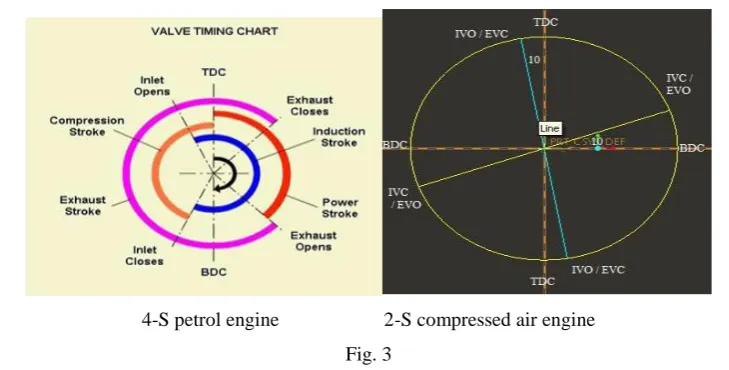
VI. VALVE TIMING DIAGRAM:[6]
Valve timing diagram for four stroke engine and two strokeCompressed Air Engine are given in fig. 3
4-S petrol engine 2-S compressed air engine
Valve timing diagram as shown in fig. 3 for Two Stroke Compressed Air Engine indicates revolution of
camshaft. In case of compressed air engine inlet valve should open exact when exhaust valve get closed and vice
versa.
VII. ADVANTAGES OF COMPRESSED AIR ENGINE:
1. Compressed air used as a fuel which is non-flammable, abundant, economical, transportable, storable
etc.
2. Capital cost of compressed air engine is less as there is no spark plug and carburettor.
3. As no combustion inside the cylinder, it emits only air having temperature less than atmospheric
temperature.
4. Instead of manufacturing a new compressed air engine, conversion of conventional engine into CAE is
possible at lower cost.
2.
Disadvantages of Compressed Air Engine:
1. Refilling of compressed air by using conventional air compressor may take a long time.
2. Tank gets hot when refilled rapidly.
3. Limiting capacity of storage tank hence cover lesser distance.
4. Higher power output is possible only at starting period. As time passes pressure inside air tank may get
varied.
VIII. CONCLUSION
Now a day’s conventional I.C. engines are used worldwide. If we are able to convert 4 stroke petrol engine into
compressed air engine at minimum cost, which will give nearly same results as the I.C. engine and which is
eco-friendly then it will be make revolution in automobile industry.
REFERENCES
[1] Prof.Rohamare R. V. et.al., “Conversion of 4 Stroke Petrol Engine into CAE”, International Journal Of Informative And Futuristic Research,Volume 2, Issue 2, (October, 2014).
[2] Chih-Yung Huang et.al, “Experimental Investigation on the Performance of a Compressed-Air Driven
Piston Engine”Doi: 10.3390/en6031731, (March 2013).
[3] Gaurav Kumar Tandan, “A Review Paper on Study and Development of Compressed Air Engine and
There Power Source” in International Journal of Science, Engineering and Technology Research (IJSETR), Volume 4, Issue 11, (November 2015).
[5] Ruchil A. Patel, “A Study on Compressed Air Engine Technology: A Review”, International Journal of Advanced Technology in Engineering and Science www.ijates.com, Volume 03, Special Issue 01, (April 2015).
[6] AmbaleSwapnil et.al., “Compressed Air Driven Vehicle”,International Journal Of Technology Enhancements And Emerging Engineering Research, VOL 3, ISSUE 06 ISSN 2347-4289, (2015)
[7] Yuan-Wei Wang et.al., “The Applications of Piston Type Compressed Air Engines on Motor Vehicles” in 37th National Conference on Theoretical and Applied Mechanics, (2013).