OPTIMIZATION OF MOBILE APPLICATIONS AND
FEATURES THROUGH CLOUD COMPUTING
Shashank Jindal
1Dr. Vineet Richariya
2Dr. Suneel Phulre
3 1Computer Science & Engineering, Lakshmi Narain College of Technology, Bhopal, (India)
2
HOD Computer Science & Engineering, Lakshmi Narain College of Technology, Bhopal, (India)
3
Professor, Computer Science & Engineering, Lakshmi Narain College of Technology,Bhopal,(India)
ABSTRACT
Implementation of cloud computing with mobile applications has become trend of recent years. It combines both
mobile as well as cloud computing thereby returns optimum services for mobile users. Before the end of 2016
there will be more than 10 thousand mobile applications that will be executed through cloud computing. That
equilibrium will push the income of mobile cloud computing to $5.2 billion. Here in this work, it has been given
an outline of distributed computing its definitions, constituting components (that are cloud stage and cloud
applications) lastly talked about the difficulties of executing cloud computing in mobile applications. In the last
offloading has been implemented for both environments and then comparison has been done. The whole
simulation has been done in JAVA to show the results of proposed technique. It has been found out that cloud
computing model has better results for applications with respect to mobile users.
Keywords: Cloud computing, Mobile applications, offloading
I. INTRODUCTION
Cloud computing has been suggested to improve mobile phones in various ways, but common area is
complexity reduction. The cloud has historically been used as a metaphor for the Internet and is commonly used
in network diagrams to represent connections between entities, connected through the Internet [1].
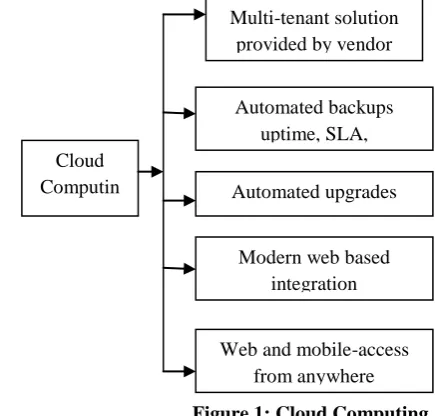
Figure 1: Cloud Computing
Cloud Computin
g
Multi-tenant solution provided by vendor
Automated backups uptime, SLA,
Maintenance
Automated upgrades
Modern web based integration
Cloud computing comes into focus only when you think about what IT always needs: a way to increase capacity
or capabilities needed without investing in new infrastructure, training new personnel, or licensing new
software. Cloud computing is a general term for anything that involves delivering hosted services over the
Internet. These services are broadly divided into three categories: Infrastructure-as-a-Service (IaaS),
Platform-as-a-Service (PaaS) and Software-Platform-as-a-Service (SaaS). The name cloud computing was inspired by the cloud
symbolthat's often used to represent the Internet in flowcharts and diagrams. Widespread use of the cloud may
also encourage open standards for cloud computing that will establish baseline data security features common
across different services and providers. Mobile phone is the primary computing platform for many users. The
issues of mobile phones are somewhat intertwined; CPU performance is related to energy consumption, size, as
well as amount of memory. The increased usage of multimedia through the mobile network creates increased
traffic load on the base station, which needs to be handled.
A cloud computing mobile phone application can be downloaded in the same way as a local mobile phone
application but would execute on a server instead of on the mobile phone. Mobile phones are set to become the
universal interface to online services and cloud computing applications. Developments in mobile hardware and
software have enabled users to perform tasks that were once only possible onpersonal computers and other
devices like digital cameras and GPS navigation systems. Migrating computing and major data processing tasks
to the cloud can fill the gap between resource demand and supply in mobile devices. Definitions of mobile
cloud computing can be classified into two categories. The first one denotes carrying out data storage and
processing outside mobile devices. Mobile devices tasks are reduced because the storage and computing
processes take place in the cloud. The second category refers to mobile cloud computing as an extension of
cloud computing in which foundation hardware consists at least partly of mobile devices.The problem of this
research paper is to compare the execution pattern and time at jobs both at the cloud and mobile devices.
This paper is divided into five sections. Introduction chapter is defined above following the related work.
Simulation work with the working methodology is defined after that. In the fourth section, results and analysis
is described with the conclusion.
Web 2.0 Portal
Device Mgmt
Data Adapters Sync Engine
Sync Push
Aggreg iation
Conflict resolution
Billion of mobile phones and
wireless devices
Social networks, email systems,
II. RELATED WORK
AttaurRehman proposed that hardware level changes alone may not enable smartphones to achieve true
unlimited computational power. Therefore, software-level changes are more effective, where computation is
performed on remote resources with partial support of a smartphone’s hardware.Computation offloading is a
procedure that migrates resource-intensive computations from a mobile device to the resource-rich cloud, or
server (called nearby infrastructure).Cloud based computation offloading enhances the applications
performance, reduces battery power consumption, and execute applications that are unable to execute due to
insufficient smartphone resources [2].TayyibaNaeem and SarmadSadiksaid that emphasis is to improve and
optimize the performance and fault tolerance characteristics of mobile applications by method of replicating
their resources or computation on cloud platform at back end. As a proof of concept, a prototype will be
developed. It will be designed for managing and transporting the necessary contents of mobile application from
mobile phone/tablets to cloud based platform. This framework or middleware will be responsible for offloading
thecomputation intensive code on the cloud resources as well as adaptive or dynamic replication of data on the
cloud resources [3].Ibrahim A Elgendy, Mohamed El-kawkagy, ArabiKeshk introduce a novel framework
which improves the performance of mobile applications and saves battery consumption of mobile is
presented. This framework has dynamic off loader module which decides dynamically atruntime whether the
application's methods run locally on mobile device or will be offloaded to the cloud. The framework applied
only on Android applications. (Android applications are written in the Java language and can be written using
any Development tool)[4].Mostafa A. Elgendy, Ahmed Shawish, and Mahmoud I. Moussa1 saidit would be
more efficient to execute the application locally on the Smartphone rather than offloading it on the Cloud. In
this paper, we propose a new framework to support offloading heavy applications in low bandwidth network
case, where a compression step is proposed for the favor of minimizing the offloading size and time. In this
framework, the mobile application is divided into a group of services, where execution-time is calculated for
each service apart and under three different scenarios. An offloading decision is then smartly taken based on
real-time comparisons between being executed locally, or compressed and then offloaded, or offloaded directly
without compression [5].
A.Methodology:
CloudSim Toolkit 3.0 released at Jan 13, 2012. CloudSim provides a generalized and extensible simulation
framework that enables modeling, simulation, and experimentation of emerging Cloud
computinginfrastructures and application services..It is built at the Cloud Computing and Distributed Systems
(CLOUDS) Laboratory.In the Melbourne, University CloudSim is used in the research and academia and
become one of the most popular open source cloud simulators which are completely written in Java. Cloud has
been extended by independent researchers after developed as a stand-alone simulator. CloudSimconsists of one
datacenter, one host and one cloudlet. They all work one certain policies.Datacentre works on VM Allocation
Policy. Host works on VM Scheduler Poliy.VM works on Cloudlet Scheduler Policy.CloudSim contains Cloud
Information Service (CIS) having some hosts which together form as datacenter and each host contains virtual
machines. These Virtual Machines are assigned cloudlets. Broker provide task to datacenter and it is called
datacenter broker class. Broker has certain characteristics and tasks which are in CloudSim framework and it is
1) CloudSim Feature :
Support for modeling and simulation of large scale Cloud computing data centers
Energy-aware computational resources
Support for data center network topologies and message-passing applications
Support for dynamic insertion of simulation elements, stop and resume of simulation
Support for user-defined policies for allocation of hosts to virtual machines and policies for allocation of host resources to virtual machines
2) Reasons for Learning CloudSim
Cloud resource provisioning
Energy-efficient management of data center resources
Optimization of cloud computing
Research activities
Limitation: No Graphical User Interface (GUI)
III. SIMULATION MODEL
The proposed algorithm evaluates jobs at both the cloud and the mobile devices to check how efficient both the
platform is in a order to successfully execute the jobs. The cloud network three types of networks namely: 2 G,
3G and 4G and three vary with some speed. The algorithm structure of the entire work is as follows:
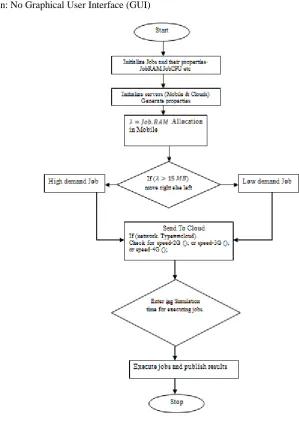
1. Start
2. J=Job to be executed
Job properties
RAM required executing a job
CPU required executing a job
Minimum time of a job for execution
2.1CS=Cloud servers or total number of cloud servers present in the network
CS.Speed=Speed which is supported by the cloud network (2G/3G/4G)
Jobc.RAM provided by the cloud server
Jobc.CPU= CPU utilization of the cloud servers
Jobc.time= Time required to execute the job
Once the entire environment has been initialized, it would put all together at XEN cloud which is a supported
framework by the CloudSim. The framework details are as follows:
3. Central cloud name=XEN cloud
Central Cloud type=Hybrid
Central Cloud Max RAM=3GB
Maximum supported array value=10,000
4. Divide jobs according to RAM requirement as high demand and low demand jobs
Job.Ram allocation in mobile
End
5. Assign job to cloud and mobile device separately as follows:
a. Put one low demanding job in the mobile
b. One executed (a) , put a high demanding job in the queue of some cloud/mobile device
6. With a given time interval execute job parallel at cloud server as well as at mobile server
7. Publish results.
Formulas:-
Suppose the time required to transfer file from mobile to cloud isT.
T depends on speed of 2G, 3G, 4G networks.
4G>3G>2G
Ratio taken for 2G,3G and 4G Speeds
If 4G takes t seconds to transfer a file.
Then 3G takes 10*t seconds to complete the file transfer process.
CS.Speed=Speed which is supported by the cloud network (4G)
Jobc.Total = Jobc.time+CS.Speed (t/10*t/100*t)
Jobc.Total=total time required to execute the job on cloud.
IV.SIMULATION RESULTS
Below are the results for cloud and mobile applications. Three Operations has been considered for cloud and
mobile applications. In Cloud operations the operations were considered to perform in 2g, 3g and 4g network.
Round 1- Read Operation
0 300 600 900 1200 1500
100 KB 1 MB 10 MB 100 MB
Ti
m
e
in
S
ec
o
n
d
s
READ OPERATION
EXECUTION TIME
Mobile 2G 3G 4G
In above figure it has been seen that the execution time of the mobile for reading 100 kb file is less than ofa
second .In the cloud execution time depends on two factorsone the time spend in transferring file from mobile to
cloud (CS.Speed) and the other one is processing time(Jobc.time). For example at 4G speed for 10 MB file
CS.Speed = 10 seconds and Jobc.time=2.2 seconds. Jobc.Total=Jobc.time+CS.Speed=12.2 seconds as compare
to mobile it takes 68.2 seconds to complete.
0 25 50 75 100 125 150
100 KB 1 MB 10 MB 100 MB
P
erc
en
ta
ge
%
READ OPERATION
RAM USAGE
In above figure it has been seen that the ram usage of the mobile has been increased tremendouslyas compare to
cloud side. It has been discovered that ram usage at mobile side is about 23 to 100 percent whereas at cloud
side it remains 13 to 70 percent
.
In above figure it has been seen that the cpu utilization in the mobile is better than cloud due to the limited
functionality of mobile. It has been discovered that mobile applications not to deal with multitasking capabilities
whereas cloud has to do multiple work together.
Round 2 – Write Operation
0 100 200 300 400 500
100 KB 1 MB 10 MB 100 MB
Tim
e
in
S
e
co
n
d
s
WRITE OPERATION
EXECUTION TIME
Mobile 2G 3G 4G
In above figure it has been seen that the execution time of the mobile and for cloud at 4G speed reading 100 kb
file is less than of a second .In the cloud execution time depends on two factors one the time spend in
transferring file from mobile to cloud (CS.Speed) and the other one is processing time(Jobc.time). For example
at 4G speed for 10 MB file CS.Speed = 10 seconds and Jobc.time=2.55 seconds.
Jobc.Total=Jobc.time+CS.Speed=12.55 seconds as compare to mobile it takes 31.1 seconds to complete where
0 20 40 60 80 100
100 KB 1 MB 10 MB 100 MB
P
e
rc
e
nt
ag
e
%
WRITE OPERATION
RAM CONSUMED
Mobile 2G 3G 4G
In above figure it has been seen that the ram usage of the mobile has been increased tremendously as compare to
cloud side. It has been discovered that ram usage at mobile side is about 33 to 80 percent whereas at cloud side
it remains 6 to 20 percent. Here value for mobile at 100 MB file is not shown because mobile not supports more
than 15 MB.
0 20 40 60 80 100
100 KB 1 MB 10 MB 100 MB
P
e
rc
e
nt
ag
e
%
m
H
z
WRITE OPERATION
CPU UTILIZATION
Mobile 2G 3G 4G
In above figure it has been seen that the CPU utilization in the mobile is better than cloud due to the limited
functionality of mobile. It has been discovered that mobile applications not to deal with multitasking capabilities
whereas cloud has to do multiple work together.
Round 3- Database Operation
0
100
200
300
400
500
10 R
100 R 1000 R 5000 R
T
im
e
in
S
ec
o
n
d
s
DATABASE
OPERATION - INSERT
EXECUTION TIME
Mobile
2G
3G
4G
In above figure it has been seen that the insertion of10,100, 1000, and 5000 Records in database and execution
time calculated. It has been discovered that 2G and 3G at Cloud side takes more time than 4G at cloud and
mobile.
0 8 16 24 32 40
10 R 100 R 1000 R 10000 R
P
er
cen
ta
ge
%
DATABASE OPERATION
-INSERT
RAM CONSUMED
Mobile 2G 3G 4G
In above figure it has been seen that the insertion of 10,100, 1000, and 5000 Records in database .The ram usage
decreased as bandwidth or speed increased at cloud side. The faster the data reaches to cloud lesser the resources
0
12
3
45
6
789
10
10 R
100 R 1000 R 5000 R
P erc en t a g e % m H z
DATABASE OPERATION
- INSERT
CPU UTILIZATION
Mobile
2G
3G
4G
In above figure it has been seen that the CPU utilization in the mobile is very high because of mobile limited
configuration than cloud. It has been discovered that mobile applications not deal with complex data task
efficientlyas compared to cloud.
Round 3- Database Operation
b. Update .
0
100
200
300
400
500
600
700
800
900
1000
10 R
100 R 1000 R 5000 R
T im e in S ec o n d s
DATABASE OPERATION
- UPDATE …
Mobile 2G 3G 4G
In above figure it has been seen that the insertion of 10,100, 1000, and 5000 Records in database and execution
time calculated. It has been discovered that 2G and 3G at Cloud side takes more time than 4G at cloud and
mobile.
0 10 20 30 40
10 R 100 R 1000 R 5000 R
P
e
rc
e
nt
ag
e
%
DATABASE
OPERATION - UPDATE
RAM CONSUMED
Mobile 2G 3G 4G
In above figure it has been seen that the insertion of 10,100, 1000, and 5000 Records in database .The ram usage
decreased as bandwidth or speed increased at cloud side. The faster the data reaches to cloud lesser the resources
used.
0 5 10 15 20 25 30
10 R 100 R 1000 R 5000 R
P
erc
en
ta
ge
%
m
H
z
DATABASE
OPERATION - UPDATE
CPU UTILIZATION
Mobile 2G 3G 4G
In above figure it has been seen that the CPU utilization in the mobile is very high because of mobile limited
configuration than cloud. It has been discovered that mobile applications not deal with complex data task
Round 3- Database Operation
c. Delete
In above figure it has been seen that the insertion of 10,100, 1000, and 5000 Records in database and execution
time calculated. It has been discovered that 2G and 3G at Cloud side takes more time than 4G at cloud and
mobile
In above figure it has been seen that the insertion of 10,100, 1000, and 5000 Records in database .The ram usage
decreased as bandwidth or speed increased at cloud side. The faster the data reaches to cloud lesser the resources
used.
In above figure it has been seen that the CPU utilization in the mobile is very high because of mobile limited
configuration than cloud. It has been discovered that mobile applications not deal with complex data task
efficiently as compared to cloud
Round 4- Database Operation
d. Fetch
0 100 200 300 400 500 600 700 800 900 1000
10 R 100 R 1000 R 5000 R
Ti
m
e
in
Se
conds
DATABASE
OPERATION - FETCH
EXECUTION TIME
Mobile 2G 3G 4G
In above figure it has been seen that the insertion of 10,100, 1000, and 5000 Records in database and execution
time calculated. It has been discovered that 2G and 3G at Cloud side takes more time than 4G at cloud and
In above figure it has been seen that the CPU utilization in the mobile is very high because of mobile limited
configuration than cloud. It has been discovered that mobile applications not deal with complex data task
efficiently as compared to cloud.
0 20 40 60 80 100 120 140
10 R 100 R 1000 R 5000 R
P
erc
en
ta
ge
%
m
H
z
DATABASE OPERATION
- FETCH
CPU UTILIZATION
Mobile 2G 3G 4G
In above figure it has been seen that the CPU utilization in the mobile is very high because of mobile limited
configuration than cloud. It has been discovered that mobile applications not deal with complex data task
V. CONCLUSION
In proposed work, the main aim is to create a load balancing algorithm and offloading algorithm based on the
availability of RAM, by assigning the jobs to the mobile devices and then to cloud side environment in such a
manner that all high demanding job or low demandingjob to balance the system and in the end compare the
performance of cloud and mobile devices. So, to implement this, the proposed algorithm evaluates read, write
and database applications at both the cloud and the mobile devices to check how efficient both the platform is in
order to successfully execute the jobs. The cloud network utilized three type networks i.e. 2 G, 3G and 4G and
three vary with some speed. From results it has been concluded that cloud model has good rate of parameter
values with respect to mobile model on the basis of three metrics like execution time, cpu utilization and ram
usage but cannot denying the factors that at some stages mobile give better performance than cloud due to
limited bandwidth availability and security concerns. When it comes cloud side there is a drastic change in
performing the operation as data available to cloud comes through the 2g, 3g and 4g channels. The above work
also proposed that low end jobs like reading, writing of 100kb, 1 mb files and database operations insert, fetch,
delete and update of 10 records to 100 records give better results on mobiles where as high end jobs like
reading, writing of 10 mb, 100 mb files and database operations insert, fetch, delete and update of 10 records to
100 records give better results on cloud.
REFERENCES
[1] S. Albers, “Energy-efficient algorithms,” Communications of the ACM, vol. 53, no. 5, pp. 86–96, 2010.
[2] Atta urRehman Khan, Mazliza Othman, Sajjad Ahmad Madani, IEEE Member, and SameeUllah Khan,
IEEE Senior Member ,“A Survey of Mobile Cloud Computing Application0rModels,”IEEE
COMMUNICATIONS SURVEYS &TUTORIALS, VOL. 16, NO. 1, FIRST QUARTER 2014
[3] TayyibaNaeem and SarmadSadik, “Optimizing Performance and Fault Tolerance throughCloud based
Adaptive Replication for MobileApplications,” 2014 2nd International Conference on Systems and
Informatics (ICSAI 2014).
[4] Ibrahim A Elgendy, Mohamed El-kawkagy, ArabiKeshk, “Improving the Performance of Mobile
Applications using Cloud Computing,”The 9th International Conference on INFOrmatics and Systems
(INFOS2014) – 15-17 December Parallel and Distributed Computing Track.
[5] Mostafa A. Elgendy1, Ahmed Shawish2, and Mahmoud I. Moussa1, “Enhancing Mobile Devices
Capabilitiesin Low Bandwidth Networks with Cloud Computing,” A.E. Hassanien et al. (Eds.): AMLTA