406 |
P a g e
SIMULATION OF BLACK HOLE ATTACK USING
OPNET ON MANETS USING DIFFERENT MANET
ROUTING PROTOCOLS (AODV & OLSR)
1
Manish Pandey, Dr. Sanjay Kumar Sharma
2 1Department of Electronics and Communication, Research Scholar, UIT-RGPV-Bhopal, M.P, (India)
2
Department of Electronics and Communication, Professor, UIT-RGPV-Bhopal, M.P, (India)
ABSTRACT
Wireless networks are gaining popularity to its peak today, as the users want wireless connectivity irrespective
of their geographic position. There is an increasing threat of attacks on the Mobile Ad-hoc Networks (MANET).
Black hole attack is one of the security threat in which the traffic is redirected to such a node that actually does
not exist in the network. It’s an analogy to the black hole in the universe in which things disappear. The node
presents itself in such a way to the node that it can attack other nodes and networks knowing that it has the
shortest path.
The scope of this thesis is to study the effects of Black hole attack in MANET using both Proactive routing
protocol i.e. Optimized Link State Routing (OLSR) and Reactive routing protocol Ad Hoc on Demand Distance
Vector (AODV). Comparative analyses of Black hole attack for both protocols were taken into account. The
impact of the attack on the performance of MANET is evaluated finding out which protocol is more vulnerable
to the attack and how much is the impact of the attack on both protocols. The measurements were taken in the
light of throughput, end to end delay and network load. Simulation is done in Optimized Network Engineering
Tool (OPNET).
Keywords: MANET, Black Hole, Routing protocols.
.
I.INTRODUCTION
MANET is a wireless network that allows user to communicate and transfer information withoutusing any
infrastructure and irrespective of their location. They are very useful for home uses,for military uses etc. Though
they are very useful in day to day life, major threats are also thereto attack over it; some of them are wormhole
attack, denial of service, eavesdropping etc. BlackHole attack is one of the major attacks on MANET. In this
research paper, the effect of blackhole over the network is evaluated by varying certain values of the network
like number ofnodes, pause time, area and speed. This paper shows that despite of presence of black hole inthe
network, the increment and decrement of certain values also affect the performance ofMANET. For this, a table
407 |
P a g e
by variations among the several values. Before andafter values are stored which are afterwards will use for the
analysis of the performance of theprotocol. The protocol used in this paper is AODV (Ad-Hoc on Demand
Distance Vector)protocol.
MANET work without a centralized administration where node communicates with each other on the base of
mutual trust. This characteristic makes MANET more vulnerable to be exploited by an attacker from inside the
network. Wireless links also makes the MANET more susceptible to attacks which make it easier for the
attacker to go inside the network and get access to the ongoing communication . Mobile nodes present within
the range of wireless link can overhear and even participate in the network.
MANETs must have a secure way for transmission and communication and this is quite challenging and vital
issue as there is increasing threats of attack on the Mobile Network. Security is the cry of the day. In order to
provide secure communication and transmission engineer must understand different types of attacks and their
effects on the MANETs. Wormhole attack, Black hole attack, Sybil attack, flooding attack, routing table
overflow attack, Denial of Service (DoS), selfish node misbehaving, impersonation attack are kind of attacks
that a MANET can suffer from. MANET is more open to these kinds of attacks because communication is based
on mutual trust between the nodes, there is no central point for network management, no authorization facility,
vigorously changing topology and limited resources. Security is a prime importance in scenarios of deployment
such as battlefield in an ad hoc network. Since MANET has multi hop links, it is venerable against several
attacks like black hole attack, Byzantine attack, wormhole attack etc.
II BLACK HOLE ATTACK IN MANET
MANETs face different securities threats i.e. attack that are carried out against them to disrupt the normal
performance of the networks. These attacks are categorized in previous chapter “security issues in MANET” on
the basis of their nature. In these attacks, black hole attack is that kind of attack which occurs in Mobile ad hoc
networks (MANET). This chapter describes Black Hole attack and other attacks that are carried out against
MANETs.
Black hole attack in AODV
Two types of black hole attack can be described in AODV in order to distinguish the kind of black hole attack.
Internal Black hole attack
This type of black hole attack has an internal malicious node which fits in between the routes of given source
and destination. As soon as it gets the chance this malicious node make itself an active data route element. At
this stage it is now capable of conducting attack with the start of data transmission. This is an internal attack
because node itself belongs to the data route. Internal attack is more vulnerable to defend against because of
difficulty in detecting the internal misbehaving node.
408 |
P a g e
External attacks physically stay outside of the network and deny access to network traffic or creating congestion
in network or by disrupting the entire network. External attack can become a kind of internal attack when it take
control of internal malicious node and control it to attack other nodes in MANET. External black hole attack can
be summarized in following points
1.
Malicious node detects the active route and notes the destination address.2.
Malicious node sends a route reply packet (RREP) including the destination address field spoofed to anunknown destination address. Hop count value is set to lowest values and the sequence number is set to the
highest value.
3.
Malicious node send RREP to the nearest available node which belongs to the active route. This can also besend directly to the data source node if route is available.
4.
The RREP received by the nearest available node to the malicious node will relayed via the established inverseroute to the data of source node.
5.
The new information received in the route reply will allow the source node to update its routing table.6.
New route selected by source node for selecting data.7.
The malicious node will drop now all the data to which it belong in the route.III RESEARCH METHODOLOGY
Research methodology defines how the development work should be carried out in the form of research activity.
Research methodology can be understand as a tool that is used to investigate some area, for which data is
collected, analyzed and on the basis of the analysis conclusions are drawn. There are three types of research i.e.
quantitative, qualitative and mixed approach as defined in.
3.1 Quantitative Approach
This approach is carried out by investigating the problem by means of collecting data, experiments and
simulation which gives some results, these results are analyzed and decisions are made on their basis. This
approach is used when the researchers’ wants verify the theories they proposed, or observe the information in
greater detail.
C
E
B
D
F
A
RRE P
RREP
D A
TA
DATA
DATADROPPED
409 |
P a g e
3.2 Qualitative Approach
This approach is usually involves the knowledge claims. These claims are based on a participatory as well as /
or constructive perspectives. This approach follows the strategies such as ethnographies, phenomenology and
grounded theories. When the researcher wants to study the context or focusing on single phenomenon or
concepts, they used qualitative approach to achieve their desired goals.
3.3 Mixed Approach
Mixed approach glue together both quantitative and qualitative approaches. This approach is followed when the
researchers wants to base their knowledge claims on matter of fact grounds. Mixed approach has the ability to
produce more complete knowledge necessary to put a theory and practice as it combined both quantitative and
qualitative approaches.
3.4 Author’s Approach
Author’s approach towards the thesis is quantitative. This approach starts by studying the elated literature
specific to security issues in MANETs and MANETs. Literature review is followed by simulation modeling.
The results are gathered and analyzed and conclusions are drawn on the basis of the results obtained from
simulation.
3.5 Research Design
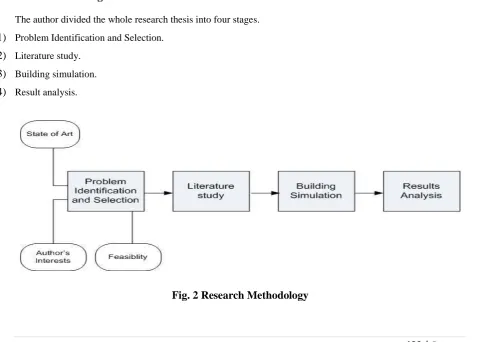
The author divided the whole research thesis into four stages.
1)
Problem Identification and Selection.2)
Literature study.3)
Building simulation.4)
Result analysis.410 |
P a g e
3.6 Simulation Tool
OPNET tool is selected to carry out the simulation. OPNET provide technologies, protocols, communication
devices for academic research, assessment and improvement.It is efficient, robust and highly reliable which
grant the user the ease of graphical interface, developing and running the simulation and validation of the
results.
IV PERFORMANCE ANALYSIS
This chapter explains the various performance metrics required for evaluation of protocols. To reiterate the
black hole attack, we begin with the overview of performance metrics that includes End to End delay,
Throughput and Network load. These matrices are important because of it performance analysis of network.
Furthermore implementation of the simulation setup, tools and its design are explained.
4.1 Performance Metrics
The performance metrics chosen for the evaluation of black hole attack were packet end to end delay, network
throughput and network load.
The packet end-to-end delay is the average time in order to traverse the packet inside the network. This includes
the time from generating the packet from sender up till the reception of the packet by receiver or destination and
expressed in seconds. This includes the overall delay of networks including buffer queues, transmission time
and induced delay due to routing activities.
4.2 Modeling of Network
At first network is created with a blank scenario using startup wizard. Initial topology is selected by creating the
empty scenario and network scale is chosen by selecting the network scale. In our case we have selected campus
as our network scale. Size of the network scale is specified by selecting the X span and Y span in given units.
We have selected 1000 * 1000 meters as our network size. Further technologies are specified which are used in
the simulation. We have selected MANET model in the technologies. After this manual configuration various
topologies can be generated by dragging objects from the palette of the project editor workspace. After the
design of network, nodes are properly configured manually.
4.3 Collection of Results and Statistics
Two types of statistics are involved in OPNET simulation. Global and object statistics, global statistics is for
entire network’s collection of data. Whereas object statistics involves individual nodes statistics.
4.4 Simulation Setup
Figure 1 employs the simulation setup of a single scenario comprising of 30 mobile nodes moving at a contact
speed of 10 meter per seconds. Total of 12 scenarios have been developed, all of them with mobility of 10 m/s.
411 |
P a g e
1000 meters. Packet Inter Arrival Time (sec) is taken exponential (1) and packet size (bits) is exponential
(1024).
SIMULATION PARAMETERS
Examined protocols AODV and OLSR
Simulation time 1000 seconds
Simulation area (m x m) 1000 x 1000
Number of Nodes 16 and 30
Traffic Type TCP
Performance Parameter Throughput,delay,Network Load
Pause time 100 seconds
Mobility (m/s) 10m/s
Packet Inter-Arrival Time (s) exponential(1)
Packet size (bits) exponential(1024)
Transmit Power(W) 0.005
Mobility Model Random waypoint
V. RESULTS
This chapter focuses on result and its analysis based on the simulation performed in OPNET modeler 14.5. Our
simulated results are provided in Figures (6.1-6.12) gives the variation in network nodes while under Black Hole
attack. To evaluate the behavior of simulated intrusion based black hole attack we considered the performance
metrics of packet end to end delay, throughput and network load. These parameters are already defined in
chapter 6 “Performance analysis”.
412 |
P a g e
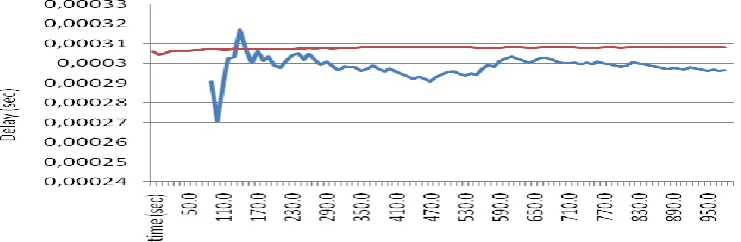
Fig. 3 End to End delay of OLSR and AODV with vs. without attack for 16 nodes
Fig. 4 End to End delay for OLSR with vs. without attack for 30 nodes
Fig. 3 and Fig. 4 show the average packet end-to-end delay in presence of a malicious node only.
413 |
P a g e
Fig. 6. End to End delay 30 nodes AODV vs. OLSR with attack
5.2 Throughput
Fig. 7 Throughput of OLSR and AODV with vs. without attack for 16 nodes
Fig. 8 Throughput of OLSR and AODV with vs. without attack for 30 nodes
414 |
P a g e
Fig. 10 Throughput 30 nodes AODV vs. OLSR with attack
5.3 Network Load
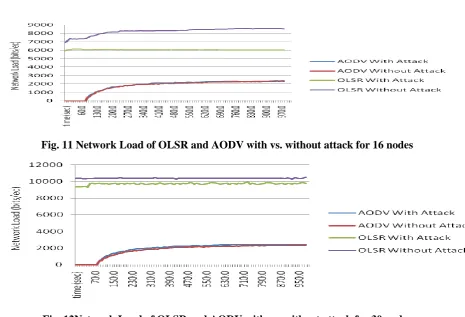
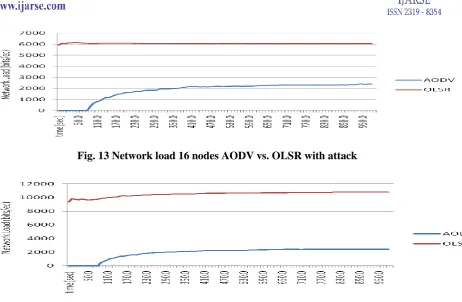
The network load of OLSR is much high as compare to AODV. In case of attack OLSR has less network load
as compare to without attack. In case of 16 nodes the network load of OLSR is 3 times higher in case of without
attack which implies that it is actually routing its packet to the entire destination properly. But under attack it
cannot send its packet i.e. packet discarding leads to a reduction of network load.
In case of 30 nodes there is a slight variation in between OLSR with and without attack. This is due to the high
number of nodes which leads to more increase in routing traffic. However AODV show no changes in both
cases of 16 and 30 number of nodes.
Fig. 11 Network Load of OLSR and AODV with vs. without attack for 16 nodes
415 |
P a g e
Fig. 13 Network load 16 nodes AODV vs. OLSR with attack
Fig. 14 Network load 30 nodes AODV vs. OLSR with attack
VI CONCLUSIONS
Mobile Ad Hoc Networks has the ability to deploy a network where a traditional network infrastructure
environment cannot possibly be deployed. With the importance of MANET comparative to its vast potential it
has still many challenges left in order to overcome. In our study we analyzed that Black Hole attack with four
different scenarios with respect to the performance parameters of end to end delay, throughput and network
load. In a network it is important for a protocol to be redundant and efficient in term of security. We have
analyzed the vulnerability of two protocols OLSR and AODV have more severe effect when there is higher
number of nodes and more route requests. The percentage of severances in delay under attack is 2 to 5 percent
and in case of OLSR, where as it is 5 to 10 percent for AODV. The throughput of AODV is effected by twice as
compare of OLSR. In case of network load however, there is effect on AODV by the malicious node is less as
compare to OLSR. Based on our research and analysis of simulation result we draw the conclusion that AODV
is more vulnerable to Black Hole attack than OLSR.
REFERENCES
[1]http://en.wikipedia.org/wiki/Personal_area_network , last visited 12, Apr, 2010.
[2]http://en.wikipedia.org/wiki/Mobile_ad_hoc_network, last visited 12, Apr, 2010.
[3]C.E.Perkins and E.M.Royer, “Ad Hoc on Demand Distance Vector Routing,” Proceedings of the 2nd IEEE
416 |
P a g e
[4]C.M barushimana, A.Shahrabi, “Comparative Study of Reactive and Proactive Routing Protocols
Performance in Mobile Ad Hoc Networks,” Workshop on Advance Information Networking and
Application, Vol. 2, pp. 679-684, May, 2003.