Weighted Rational Transductions and their Application to Human
Language Processing
Fernando Pereira
Michael Riley
Richard Sproat
A T & T B e l l L a b o r a t o r i e s 6 0 0 M o u n t a i n Ave. M u r r a y Hill, N J 0 7 9 7 4
A B S T R A C T
We present the concepts of weighted language, ~ansduction and au- tomaton from algebraic automata theory as a general framework for describing and implementing decoding cascades in speech and lan- guage processing. This generality allows us to represent uniformly such information sources as pronunciation dictionaries, language models artd lattices, and to use uniform algorithms for building de- coding stages and for optimizing and combining them. In particular, a single automata join algorithm can be used either to combine in- formation sources such as a pronunciation dictionary and a context- dependency model during the construction of a decoder, or dynam- ically during the operation of the decoder. Applications to speech recognition and to Chinese text segmentation will be discussed.
1. I n t r o d u c t i o n
As is well known, many problems in human language process- ing can be usefully analyzed in terms of the "noisy channel" metaphor: given an observation sequence o, find which in- tended message w is most likely to generate that observation sequence by maximizing
P(w, o) = P(olw)P(w),
where
P(olw )
characterizes the transduction between in- tended messages and observations, andP(w)
characterizes the message generator. More generally, the transduction be- tween messages and observations may involve several inter- mediate stagesP( so, sk )= P( sk
Iso)P(so)P(sklso)=~,,
... ,~_,P(sklsk-X)'"P(sllso)
(1)
where
P(sk Iso)
is the probability of transducing so to sk through the intermediate stages, assuming that each step in the cascade is conditionally independent from the previous ones. Eachs t
is a sequence of units in an appropriaterepresentation. For instance, in speech recognition some of the intermediate stages might correspond to sequences of units like phones or syllables. A stralghtforwardbut useful observation is that any such a cascade can be factored at any intermediate stageP(sils~)
= ~ P(s~lsk)P(skls.i)
(2)
Sk
For computational reasons, sums and products in (1) are often replaced by minirnizations and sums of negative log probabil-
ities, yielding the approximation
P(s0,sk) = P(sklso) + P(s0)
(3)
P(s ls0)
rain,,
... , ~ _ , E l < j _ < k P ( s ~ l s j = l )where X = - log X. In this formulation, assuming the ap- proximation is reasonable, the most likely message so is the one minimizing P(s0, sk).
Finally, each transduction in such a cascade is often modeled by some finite-state device, for example a hidden Markov model.
Although the above approach is widely used in speech and language processing, usually the elements of the transduction cascade are built by "ad hoc" means, and commonalities be- tween them are not exploited. We will here outline how the theory of weighted rational languages and transductions can be used as a general framework for transduction cascades. This theoretical foundation provides a rich set of operators for combining cascade elements that generalizes the standard operations on regular languages, suggests novel ways of com- bining models of different parts of the decoding process, and supports uniform algorithms for transduction and search at all levels in the cascade. In particular, we developed a generic
join
algorithm for combining any two consecutive levels of a cascade, a generic best-path search algorithm, and a generic interleaving of join and search for building pruned joins. In addition, general finite-state minimization techniques are also applicable to all levels of a cascade.The notion of weighted rational transduction arises from the combination of two ideas in automata theory: rational trans- ductions, used in many aspects of formal language theory [2], and weighted languages and automata, developed in pattern recognition [5, 6] and algebraic automata theory [7, 8, 9]. Ordinary (unweighted) rational transductions have been suc- cessfully applied by researchers at Xerox PARC [10] and at the University of Paris 7 [11], among others, to several prob- lems in language processing, includifig morphological anal- ysis, dictionary compression and syntactic analysis. Hidden Markov Models and probabilistic finite-state language mod- els can be shown to be equivalent to WFSAs. In algebraic automata theory, rational series and rational transductions [8] are the algebraic counterparts of WFSAs and WFSTs and give the correct generalizations to the weighted case of the standard algebraic operations on formal languages and trans- ductions, such as union, concatenation, intersection, restric- tion and composition. We believe the work presented here is among the first to apply these generalizations to human- language processing.
Our first application is to speech recognition decoding. We show that a conventional HMM decoder can be naturally viewed as equivalent to a cascade of weighted transductions, and that our approach requires no modification whatsoever when context dependencies cross higher-level unit boundaries (for instance, cross-word context-dependent models).
Our second application is to the segmentation of Chinese text into words, and the assignment of pronunciations to those words. In Chinese orthography, most characters represent (monosyllabic) 'morphemes', and as in English, 'words' may consist of one or more morphemes. Given that Chinese does not use whitespace to delimit words, it is necessary to recon- struct the grouping of characters into words. This reconstruc- tion can also be thought of as a transduction problem.
2.
Theory
In the transduction cascade (1), each step corresponds to a mapping from input-output pairs (r, s) to probabilities P ( s l r ) . More formally, steps in the cascade will be
weighted trans-
ductions
T : 27 x F* ~ K where 27 and F* the sets of strings over the alphabets Z and F, and K is an appropriate set of weights, for instance the real numbers between 0 and 1 in the case of probabilities. We will denote byT - 1 the inverse
of T defined byT(t, s) = T(s, t).
The right-most step of (1) is not a transduction, but rather an information source, in that case the language model. We will represent such sources as
weighted languages
L : Z* ~ K .Given two transductions S : Z* x F* ~ K and T : F* x A* ---~ K , we can define their
composition S o T
by(S o T)(r, t) = E S(r, s)T(s, t)
(4)sEI"*
For example, i f S represents
P(sk Isj) and T P(sj
Isi) in (2),Figure 1: Recognition Cascade
is is clear that S o T represents
P(sk
Isi).A weighted transduction S : Z* × F* --. K can be
applied
to a weighted language L : Z* ~ K to yield a weighted language over F. It is convenient to abuse notation somewhat and use M o S for the result of the application, defined as(L o S)(t) = E L(s)S(s,t)
(5)
sEF °
Furthermore, if M is a weighted language over F, we can
reverse apply S
to M, written S o M = M o ( S - : ) . For example, i f S representsP(sk
[so) and M representsP(so)
in (1), then S o M representsP(po, pk).
Finally, given two weighted languages M, N : Z* ~ K we define their
intersection,
also by convenient abuse of notation written M o N as:(M o N)(t) ='M(s)N(s)
(6)In any cascade R1 o . . . o Rm, with the Ri for 1 < i < m appropriate transductions and R1 and Rm transductions or languages, it is easy to see that the order of association of the o operators does not matter. For example, if we have L o S o T o M , we could either apply S to L, apply T to the result and intersect the result with M, or compose S with T, reverse apply the result to M and intersect the result with L. We are thus justified in our use of the same symbol for composition, application and intersection, and we will in the rest of the paper use the term "(generalized) composition" for all of these operations.
For a more concrete example, consider the transduction cas- cade for speech recognition depicted in Figure 1, where A is the transduction from acoustic observation sequences to phone sequences, D the transduction from phone sequences to word sequences (essentially a pronunciation dictionary) and M a weighted language representing the language model. Given a particular sequence of observations o, we can represent it as the trivial weighted language O that assigns 1 to o and 0 to any other sequence. Then O o A represents the acoustic likeli- hoods of possible phone sequences that generate o, O o A o D the aeoustic-lexical likelihoods of possible word sequences yielding o, and O o A o D o M the combined acoustic-lexical- linguistic probabilities of word sequences generating o. The word string w with the highest weight
(0 o A o D o M)(w)
is precisely the most likely sentence hypothesis generating o. [image:2.612.331.554.44.87.2]Language Transduction singleton
scaling sum
concatenation power
closure
{u}(v) = I i f f u = v
(kL)(u) = kL(u)
(L + M)(u) = L(u) + M ( u ) ( L M ) ( w ) = ~uv=~o L ( u ) M ( v )
L°(e) = I L°(u ~ e) = 0 L n+l = LL"
L* = ~ k > o Lk
{(u, v)}(w,z) = 1 i f f u = w a n d v = z
(kT)(u,
= kT( , v)
(S + T)(u, v) = S(u, v) + T(u, v) (ST)(t, w) : E , , : t , ~ . = w S(r, u)T(s, v)
T°(e, e) = 1
= 0
Tn + 1 : T T n
T* = ~ k > o Tk
Table 1: Rational Operations
in that case the string w with the lowest weight (O o A o D o
M)(w) 'would the best hypothesis. More generally, the sum and product operations in (4), (5) and (6) can be replaced by any two operations forming an appropriate semiring [7, 8, 9], of which numeric addition and multiplication and numeric minimum and addition are two examples 1
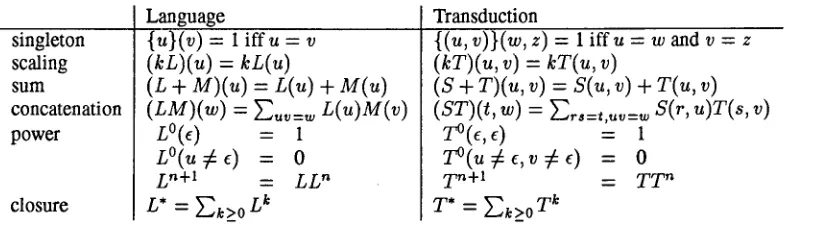
Generalized composition is thus the main operation involved in the construction and use of transduction cascades. As we will see in a moment, for rational languages and transductions, all instances of generalized composition are implemented by a uniform algorithm, the join of two weighted finite automata. In addition to those operations, weighted languages and trans- ductions can be constructed from simpler ones by the opera- tions shown in Table 1, which generalize in a straightforward way the regular operations well-known from traditional au- tomata theory [1]. In fact, the rational languages and trans- ductions are exactly those that can be built from singletons by applications of scaling, sum, concatenation and closure.
For example, assume that for each word w in a lexicon we are given a rational transduction D,o such that D~ (p, w) is the probability that w is realized as the phone sequence p. Note that this crucially allows for multiple pronunciations for w. Then the rational transduction ( ~ D,o) * gives the probabil- ities for realizations of word sequences as phone sequences (ignoring possible cross-word dependencies, which will be discussed in the next section).
Kleene's theorem states that regular languages are exactly those representable by finite-state acceptors [1]. Its gener- alization to the weighted case and to transducers states that weighted rational languages and transducers are exactly those that can be represented by finite automata [8]. Furthermore, all the operations on languages and transductions we have discussed have finite-automata counterparts, which we have implemented. Any cascade representable in terms of those operations can thus be implemented directly as an appropri- ate combination of the programs implementing each of the operations.
lAdditional conditions to guarantee the existence of certain infinite sums
may be necessary for certain semirings, for details see [7] and [8].
In the present setting, a K-weighted finite automaton.,4 con- sists of a finite set of states Q a and a finite set Aa of transitions
s//~ ql
q --, between states, where x is an element of the set of transition labels AA and k E K is the transition weight. An associative concatenation operation u • v must defined be- tween transition labels, with identity element ect. As usual, each automaton has an initial state iA and a final state as-
signment, which we represent as column vector of weights FA indexed by states:. A K-weighted finite automaton with AA = Z* is just a weighted finite-state acceptor (WFSA). On the other hand, ifAA = Z* x F* with concatenation defined by (r, s ) . (u, v) = (ru, sv), we have a weightedfinite-state transducer (WFST).
As usual, we can define a path in an automa- ton .,4 as a sequence of connected transitions /3 = (q0, xl, kl, ql), • •., (qra-1, Xm, kin, qm). Such a path has la- bel LA(p) = xl . . . z,~, weight Wa(15) = k l ' ' "krn and
final weight W~ (p) = WA(pP)FA(qm). F - We call ff reduced if
it is the empty path or i f x l # e, and we write p ~,~ p' if k is the sum of the weights of all reduced paths with label u from q to q~.
The language of automaton .,4 is defined as
f~I~(~)
where I.a(u) is the set of paths in .,4 with label u that start in the initial state i.d. Obviously, if .,4 is an acceptor, [.A] is a weighted language, and i f A is a transducer [,4]] is a weighted transduction. The appropriate generalization of Kleene's the- orem to weighted acceptors and transducers states that under mild conditions on the weights (which for instance are satis- fied by the rain, sum semiring), weighted rational languages and transductions are exactly those defined by weighted au- tomata as outlined here [8].
Weighted acceptors and transducers are thus faithful imple- mentations of rational languages and transductions, and all
2The usual notion of final state can be encoded this way by setting
[image:3.612.116.532.44.161.2](a) ~ 1 ~ = ~ . . "
o . ~
(b)
oi:E/pi Oi:e../pi O/:Jpi
(d) o ~ ~ - , ' ( ~ )
Figure 2: Models as Automata
the operations on these described above have corresponding implementations in terms of algorithms on automata. In par- ticular, generalized composition corresponds to the join of two automata.
Given two automata ..4 and B and a new label set J , and a partial label j o i n function ~ : A~ x An ~ J, we define
their j o i n by t~ as a new automaton C with label set J , states
Qc = Q ~ x Qt~, initial state ic = (i.a, it3), final weights
Fc(q, q') = F~(q)Ft3(q) and transitions
(p,p')
(q, q')iff k =
ab
(7)
~ = y ~ z ,p ~.~q ,p' ~bq ~
Different choices of t~ correspond to the instances of gen- eralized composition: for intersection, Aa = An = Z*, z = V ~ z i f f z = y = z; for composition, AA = Z* x F*, At3 = F* x A* and (z, z) = (z, y) ~ (y, z); and for appli- cation = AaZ*, As = Z* x F* and y = z ~ (z, y). Thus join is the automata counterpart of generalized composition, and we will use the composition symbol indiferently in what follows to represent either composition or join.
The operation between automata thus defined has a direct dynamic-programming implementation in which reachable join states (q, q') are placed in a queue and extended in turn u s n g (7). By organizing this queue according to the weights of least-weight paths from the start state, we can combine join computation with search for lowest-weight paths, and subau- tomata of the join with states reachable by paths with weights within a beam of the best path.
3. Speech Recognition
In our first application, we elaborate on how to describe a speech recognizer as a transduction cascade. Recall we de- compose the problem into a language, O, of acoustic observa- tion sequences, a transduction, A, from acoustic observation
sequences to phone sequences, a transduction, D, from phone sequences to word sequences and a weighted language, M , specifying the language model (see Figure 1). Each of these can be represented as a finite-state automaton (to some ap- proximation).
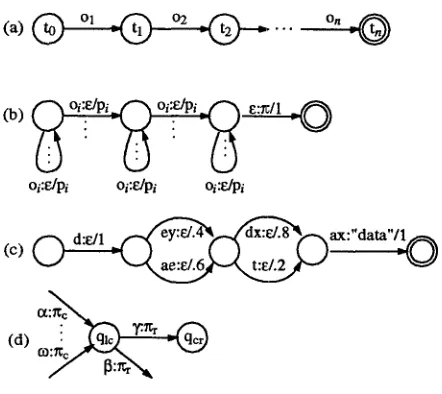
The trivial automaton for the acoustic observation language, O, is defined for a given utterance as depicted in Figure 2a. Each state represents a fixed point in time ti, and each transi- tion has a label, oi, drawn from a finite alphabet that quantizes the acoustic waveform between adjacent time points and is as- signed probability 1.0.
The automaton for the acoustic observation sequence to phone sequence transduction, A, is defined in terms of phone models. A phone model is defined as a transducer from a subsequence of acoustic observation labels to a specific phone, and assigns to each subsequence a likelihood that the specified phone produced it. Thus, different paths through a phone model correspond to different acoustic realizations of the phone. Figure 2b depicts a common topology for such a phone model. A is then defined as the closure of the sum ofthephone models.
The automaton for the phone sequence to word sequence trans- duction, D, is defined similarly to that for A. We define a word model as a transducer from a subsequence of phone labels to a specific word, which assigns to each subsequence a like- lihood that the specified word produced it. Thus, different paths through a word model correspond to different phonetic realizations of the word. Figure 2c depicts a common topol- ogy for such a word model. D is then defined as the closure of the sum of the phone models.
Finally, the language model, M, is commonly an N-gram model, encodable as a WFSA. Combining these automata,
( 0 o A o D o M ) ( w ) is thus an automaton that assigns a
probability to each word sequence, and the highest-probability path through that automaton estimates the most likely word sequence for the given utterance.
The finite-state modeling for speech recognition that we have just described is hardly novel. In fact, it is equivalent to that presented in [12], in the sense that it generates the same weighted language. However, the transduction cascade ap- proach presented here allows one to view the computations in new ways.
For instance, because composition, o, is associative, we see that the computation of max,o(O o A o D o M ) ( w ) can be organized in several ways. A conventional integrated-search, speech recognizer computes maxw(O o ( A o D o M ) ) ( w ) .
[image:4.612.70.291.43.240.2]nition). 'This lattice is in turn transduced into a word lattice (word recognition), which is then joined with the language model (language model application) [13].
The best approach may depend on the specific task, which determines the size of intermediate results and the whether finite-state minimization is fruitful. By having a general package to manipulate these automata, we have been able to experiment with various alternatives. For many tasks, the complete; network, O o A o D o M, is too large to compute explicitly, regardless of the order in which the operations are applied. The solution that is usually taken is to interleave the best path computation with the composition operations and to retain only a portion of the intermediate results by discarding unpromising paths.
So far, our presentation has used context-independent phone models. In other words, the likelihoods assigned by a phone model in A assumed conditional independence from neigh- boring phones. However, it has been shown that context- dependent phone models, which model a phone in the context of its adjacent phones, are very effective for improving recog- nition performance [14].
We can include context-dependent models, such as triphone models, in our presentation by expanding our 'atomic models' in A to one for every phone in a distinct triphonic context. Each model will have the same form as in Figure 2b, but will have different likelihoods for the different contexts. We could also try to directly specify D in terms of the new units, but this is problematic. First, even if each word in D had only one phonetic realization, we could not directly substitute its spelling in terms of context-dependent units, since the cross-word units must be specified (because of the closure operation). In this case, a common approach is to either use left (right) context-independent units at the word starts (ends), or to build a fully context-dependent lexicon, but have special computations that insure the correct models are used at word junctures. In either case, this disallows use of phonetic networks as in Figure 2c.
There is, however, a natural solution to these problems using a a finite-state transduction. We leave D as defined before, but interpose a new transduction, C, between A and D, to convert between context-dependent and context-independent units. In other words, we now compute maxw (O o A o C o D o M) (w).
The form of C for triphonic models is depicted in Figure 2d. For each context-dependent phone model, 7, which corre- sponds to the (context-independent) phone 7re in the context of 7q and 7rr, there is a state qle in C for the biphone 7rlre, a state qcr for 7rcTr~ and a transition from qtc to q~ with input label 7 and output label 7rr. We have constructed such a transducer and have been able to easily convert context-independent pho- netic networks into context-dependent networks for certain tasks. In those cases, we can implement full-context depen- dency with no special-purpose computations.
4. Chinese Text Segmentation
Our second application is to text processing, namely the to- kenization of Chinese text into words, and the assignment of pronunciations to those words. In Chinese orthography, most characters represent (monosyllabic) morphemes, and as in English, words may consist of one or more morphemes. Given that Chinese does not use whitespace to delimit words, it is necessary to 'reconstruct' the grouping of characters into words. For example, we want to say that the sentence [] 3~ l ~ , ~ g ~ - ~ "How do you say octopus in Japanese?", con- sists of four words, namely [] 3~ ri4-wen2 'Japanese', ~ ,
zhangl-yu2 'octopus', ~ g ~ zen3-mo 'how', and -~ shuol
'say'. The problem with this sentence is that [] ri4 is also a word (e.g. a common abbreviation for Japan) as are 3~
Y~ wen2-zhangl 'essay', and ~, yu2 'fish', so there is not a unique segmentation.
The task of segmenting and pronouncing Chinese text is nat- urally thought of as a transduction problem. The Chinese dictionary s is represented as a WFST D. The input alphabet is the set of Chinese characters, and the output alphabet is the union of the set of Mandarin syllables with the set of part- of-speech labels. A given word is represented as a sequence of character-to-syllable transitions, terminated in an e-to-part- of-speech transition weighted by an estimate of the negative log probability of the word. For instance, the word ~ , 'oc- topus' would be represented as the sequence of transductions
~:zhangllO.O ~:yu210.O c:noun/13.18. A dictionary in this form can easily be minimized using standard algorithms.
An input sentence is represented as an unweighted acceptor S, with characters as transition labels. Segmentation is then ac- complished by finding the lowest weight string in S o D*. The result is a string with the words delimited by part-of-speech labels and marked with their pronunciation. For the example at hand, the best path is the correct segmentation, mapping the input sequence [] 3~ c ~ ~, c ~ F~ c-~ ~ to the sequence
ri4 wen2 noun zhangl yu2 noun zen3 mo adv shuo l verb.
As is the case with English, no Chinese dictionary covers all of the words that one will encounter in Chinese text. For example, many words that are derived via productive mor- phological processes are not generally to be found in the dic- tionary. One such case in Chinese involves words derived via the nominal plural affix r~l -men. While some words in ~I will be found in the dictionary ( e . g . , / ! ! ~ tal-men 'they';
~ ren2-men 'people'), many attested instances will not: for example, ~ f ~ jiang4-men '(military) generals', ~
qingl-wal-men 'frogs'. Given that the basic dictionary is represented as a finite-state automaton, it is a simple matter to augment the model just described with standard techniques from finite-state morphology ([15, 16], inter alia). For in-
3We are currently using the 'Behavior Chinese-English Electronic Dic- tionary', Copyright Number 112366, from Behavior Design Corporation, R.O.C.; we also wish to thank United Informaties, Inc., R.O.C. for providing us with the Chinese text corpus that we used in estimating lexieal probabil- ities. Finally we thank Dr. Jyun-Sheng Chang for kindly providing us with
stance, we can represent the fact that f ] attaches to nouns by allowing e-transitions from the final states of noun entries, to the initial state of a sub-transducer containing f ] . However, for our purposes it is not sufficient merely to represent the morphological decomposition of (say) plural nouns, since we also want to estimate the cost of the resulting words. For derived words that occur in our corpus we can estimate these costs as we would the costs for an underived dictionary en- try. So, ~ ]
jiang4-men
'(military)generals' occurs and we estimate its cost at 15.02; we include this word by allow- ing an e-transition between ~ and f~, with a cost chosen so that the entire analysis o f ~ ] ends up with a cost of 15.02. For non-occurring possible plural forms (e.g., ~ / / ~ f ]nan2-
gual-men
'pumpkins') we use the Good-Turing estimate (e.g. [ 17]), whereby the aggregate probability of previously unseen members of a construction is estimated asN1/N,
where N is the total number of observed tokens and N1 is the number of types observed only once; again, we arrange the automaton so that noun entries may transition to f ] , and the cost of the whole (previously unseen) construction comes out with the value derived from the Good-Turing estimate.Another large class of words that are generally not to be found in the dictionary are Chinese personal names: only famous names like ~ j , ~ 'Zhou Enlai' can reasonably be expected to be in a dictionary, and even many of these are missing. Full Chinese personal names are
formally
simple, being always of the form FAMILY+GIVEN. The FAMILY name set is re- stricted: there are a few hundred single-character FAMILY names, and about ten double-character ones. Given names are most commonly two characters long, occasionally one- character long: there are thus four possible name types. The difficulty is that GIVEN names can consist, in principle, of any character or pair of characters, so the possible GIVEN names are limited only by the total number of characters, though some characters are certainly far more likely than others. For a sequence of characters that is apossible
name, we wish to assign a probabilityto that sequencequa
name. We use a vari- ant of an estimate proposed in [18]. Given a potential name of the form F1 G1 G2, where F1 is a legal FAMILY name and G1 and G2 are Chinese characters, we estimate the probabil- ity of that name as the product of the probability of findingany
name in text; the probability of F1 as a FAMILY name; the probability of the first character of a double GIVEN name being G1; the probability of the second character of a double GIVEN name being G2; and the probability of a name of the ftyrm SINGLE-FAMILY+DOUBLE-GIVEN. The first proba- bility is estimated from a count of names in a text database, whereas the last four probabilities are estimated from a large list of personal names. This model is easily incorporated into the segmenter by building a transducer restricting the names to the four licit types, with costs on the transitions for any particular name summing to an estimate of the cost of that name. This transducer is then summed with the transducer implementing the dictionary and morphological rules, and the transitive closure of the resulting transducer computed.References
1. M. A. Harrison, Introduction to Formal Language Theory.
Reading, Massachussets: Addison-Wesley, 1978.
2. J. Berstel, Transductions and Context-Free Languages. No. 38 in LeitF~iden der angewandten Mathematik and Mechanik LAMM, Stuttgart, Germany: Teubner StudienbOcher, 1979.
3. R. Teitelbaum, "Context-free error analysis by evaluation of algebraic power series," in Proc. Fifth Annual A CM Symposium
on Theory of Computing, (Austin, Texas), pp. 196-199, 1973.
4. B. Lang, "A generative view of ill-formed input processing,"
in ATR Symposium on Basic Research for Telephone Interpre-
tation, (Kyotu, Japan), Dec. 1989.
5. A. Paz, Introduction to Probabilistic Automata. Academic, 1971.
6. T. R. Booth and R. A. Thompson, "Applying probability mea- sures to abstract languages," IEEE Trans. Computers, vol. C-22, pp. 442--450, May 1973.
7. S. Eilenberg, Automata, Languages, andMachines, vol. A. San Diego, California: Academic Press, 1974.
8. W. Kuich and A. Salomaa, Semirings, Automata, Languages.
No. 5 in EATCS Monographs on Theoretical Computer Sci- ence, Berlin, Germany: Springer-Verlag, 1986.
9. J. Berstel and C. Reutenauer, Rational Series and Their Lan-
guages. No. 12 in EATCS Monographs on Theoretical Com-
puter Science, Berlin, Germany: Spnnger-Verlag, 1988. 10. R. M. Kaplan and M. Kay, "Regular models of phonological
rule systems;' Computational Linguistics, 1994. To appear.
11. E. Roche, Analyse Syntaxique Transformationelle du Francais
par Transducteurs et Lexique-Grammaire. PhD thesis, Univer-
sit6 Paris 7, 1993.
12. L. R. Bahl, E Jelinek, and R. Mercer, "A maximum likeli- hood approach to continuous speech recognition;' 1EEE Trans.
PAMI, vol. 5, pp. 179-190, Mar. 1983.
13. A. Ljolje and M. D. Riley, "Optimal speech recognition us- ing phone recognition and lexical access;' in Proceedings of
ICSLP, (Banff, Canada), pp. 313-316, Oct. 1992.
14. K.-E Lee, "Context dependentphonetic hidden Markov models for continuous speech recognition," IEEE Trans. ASSP, vol. 38, pp. 599--609, Apr. 1990.
15. K. Koskenniemi, Two-LeveI Morphology: a General Computa-
tional Model for Word.Form Recognition and Production. PhD
thesis, University of Helsinki, Helsinki, 1983.
16. E. Tzoukermann and M. Liberman, "A finite-state morpholog- ical processor for Spanish:' in COLING-90, Volume 3, pp. 3: 277-286, COLING, 1990.
17. K. W. Church and W. Gale, "A comparison of the enhanced Good-Turing and deleted estimation methods for estimating probabilities of English bigrams," Computer Speech and Lan-
guage, vol. 5, no. 1, pp. 19-54, 1991.
18. J.-S. Chang, S.-D. Chen, Y. Zheng, X.-Z. Liu, and S.-J. Ke, "Large-corpus-based methods for Chinese personal name recognition. (In Chinese]);' Journal of Chinese Information