QUANTITATIVE MODELING OF SEGMENTAL DURATION
J a n P. H . v a n S a n t e n
A T & T B e l l L a b o r a t o r i e s 6 0 0 M o u n t a i n A v e n u e
M u r r a y Hill, N J 0 7 9 7 4 - 0 6 3 6 , U . S . A .
A B S T R A C T
In natural speech, durations o f p h o n e t i c s e g m e n t s are strongly de-
pendent on contextual factors. Quantitative descriptions of these contextual effects have appfications in text-to-speech synthesis and in automatic speech recognition. In this paper, we describe a speaker- dependent system for predicting segmental duration from text, with emphasis on the statistical methods used for its construction. We also report results of a subjective listening experiment evaluating an implementation of this system for text-to-speech synthesis purposes.
1. I N T R O D U C T I O N
This paper describes a system for prediction of segmental duration from text. In most text-to-speech synthesizer ar- chitectures, a duration prediction system is embedded in a sequence of modules, where it is preceded by modules that compute various linguistic features ~ from text. For example, the word "unit" might be represented as a sequence of five feature vectors: (< At/, word - initial, monosyllabic,... , >) • " (< / t / ~ r s t , w o r d - final, monosyllabic, . . . , >). In automatic speech recognition, a (hypothesized) phone is usu- ally annotated only in terms of the preceding and following phones. If some form of lexical access is performed, more complete contextual feature vectors can be computed.
Broadly speaking, construction of duration prediction systems has been approached in two ways. One is to use general- purpose statistical methods such as CART 2 or neural nets. In CART, for example, a tree is constructed by making binary splits on factors that minimize the variance of the durations in the two subsets defined by the split [2]. These methods are called "general purpose" because they can be used across a variety of substantive domains.
There also exists an older tradition exemplified by Klatt [3, 4, 5] and others [6, 7, 8, 9] where duration is computed with duration models, i.e., simple arithmetic models specifically designed for segmental duration. For example, in Klatt's
lWe define a factor, FFi, to be a partition of mutually exclusive and ex- haustive possibilities such as {1-stressed, 2-stressed, unstressed}. A feature is a "level" on a factor such as 1-stressed. The feature space F is the product space of all factors: Fl × -. - × Fn. Because of phonotactic and other con- straints, only a small fraction of this space can actually occur in a language; we call this the linguistic space.
2Classification and Regression Trees [1 ].
model the duration for feature vector f E F is given by
DUR(f) =
Sl,l(fl) X "'" X Sl,n-I-I(A-.I-I) -'[- S2,n+l(j~+1)- ( i )
Here, fj is the j-th component s of the vector f, the second subscript (j) in s~,j likewise refers to this component, and the first subscript (i) refers to the fact that the model consists of twoproduct terms numbered 1 and 2. The parameters si,./are called f a c t o r scales. For example, Sl,l ( s t r e s s e d ) = 1.40. All current duration models have in common that they (1) use factor scales, and (2) combine the effects of multiple factors using only the addition and multiplication operations. The general class of models defined by these two characteristics, sums-of-productsmodels, has been found to have useful math- ematical and statistical properties [10].
Briefly, here is how these two standard approaches compare with ours. We share with general-purpose statistical methods the emphasis on formal data analysis methods, and with the older tradition the usage of sums-of-products models. Our approach differs in the following respects. First, although we concur with the modeling tradition that segmental duration data - and in particular the types of interactions one often finds in these data - can be accurately described by sums-of- products models, this class of models is extremely large so that one has to put considerable effort in searching for the most appropriate model. 4 The few models that this tradition has generated make up a vanishingly small portion of a vast space of possibilities, and because they have not been system- atically tested against these other possibilities [11] we should consider the search for better models completely open. Sec- ond, in contrast with the general-purpose methods approach, the process by which we construct our prediction system is not a one-step procedure but is a multi-step process with an important role being played by various forms of exploratory data analysis.
3In its original form, the Klatt model uses p for the phonetic segment factor where we use fn+l.
4For example, for two factors there are already five models: 81,1 x 81,2, 81,1 + 82,2~ 81,1 X 81,2 --1- 82,1, 81,1 X 81,2 + 82,2, and
2. PROPERTIES OF SEGMENTAL
DURATION DATA
In this section, we first discuss properties of segmental dura- tion data that pose serious obstacles for prediction, and next properties that may help in overcoming these obstacles.
2.1. Interactions between contextual factors
A first reason for duration prediction being difficult is that segmental duration is affected by many interacting factors. In a recent study, we found eight factors to have large effects on vowel duration [12], and if one were to search the literature for all factors that at least one study found to have statistically significant effects the result would be a list of two dozen or more factors [13, 14, 15].
Segment
/ s / 149
/ f / 126
/t/b~,~,t 71
/P/bu,.,* 61
/d/bu~t 12
/b/bur,t 9
/t/closure
75Iplczo,u,o
90
/ n / 63
/ m / 75
Unstressed/ Stressed/ Stressed Unstressed
Differ- ence
112 37
101 26
9 62
18 43
7 5
8 1
20 55
68 22
39 24
62 14
Percent
33 25 716 238 67 12 274 33 62 22
Table 1: Durations (in ms) of intervocalic conso- nants in two stress conditions: unstressed~stressed and stressed~unstressed.
These factors interact in the quantitative sense that the mag- nitude of an effect (in ms or in percent) is affected by other factors. Table 1 shows durations of intervocalic consonants in two contexts defined by syllabic stress: preceding vowel unstressed/following vowel stressed (Ifl in "before"); and: preceding vowel stressed/following vowel unstressed (/f/in "buffer"; It/is usually flapped in this context). The Table shows that the effects of stress are much larger for some con- sonants than for others: a consonant × stress interaction. Other examples of interactions include postvocalic conso- nant x phrasal position and syllabic stress × pitch accent [121.
These interactions imply that segmental duration can be de- scribed neither by the additive model [9] (because the differ- ences vary) nor by the multiplicative model [7] (because the percentages vary)) In contrast, the Klatt model was specif-
5In the a d d i t v e model D U R ( f ) = al,l ( f l ) + "'" +
Sn,n(fn);
in the mulfiplicadve model D U R ( f ) = sl,l ( f l ) × "'" × Sl,n ( f n ) .ically constructed to describe certain interactions, in particu- lar the postvocalic consonant × phrasal position interaction. However, in an effort to use the Klatt model for text-to-speech synthesis it became clear that this model needed significant modifications to describe interactions involving other factors [5]. Recent tests further confirmed systematic violations of the model [11].
Thus, the existence of large interactions is undeniable, but current sums-of-products models have not succeeded in cap- turing these interactions. General-purpose prediction systems such as CART, of course, can handle arbitrarily intricate in- teractions [16].
2.2. Lopsided sparsity
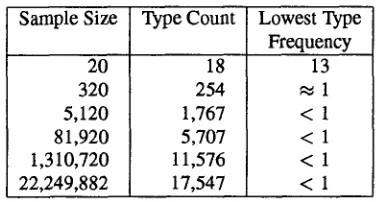
Because there are many factors - several of which have more than two values - the feature space is quite large. The statis- tical distribution of the feature vectors exhibits an unpleasant property that we shall call "lopsided sparsity". We mean by lopsided sparsity that the number of very rare vectors is so large that even in small text samples one is assured to en- counter at least one of them.
Sample Size Type Count Lowest Type Frequency 20
320 5,120 81,920 1,310,720 22,249,882
18 254 1,767 5,707 11,576 17,547
13
< 1 < 1 < 1 < 1
Table 2: Type counts and lowest type frequencies (per million) of contextual vectors for various sample sizes.
Table 2 illustrates the concept. We analyzed 797,524 sentences, names, and addresses (total word token count: 5,868,172; total segment count 22,249,882) by computing for each segment the feature vector characterizing those as- pects of the context that we found to be relevant for segmental duration. This characterization is relatively coarse and leaves out many distinctions (such as - for vowel duration- the place of articulation of post-vocalic consonants). Nevertheless, the total feature vector type count was 17,547. Of these 17,547 types, about 10 percent occurred only once in the entire data base and 40 percent occurred less than once in a million.
[image:2.612.60.311.247.396.2] [image:2.612.347.536.330.431.2]larger than that. The third column shows that even in samples as small as 320 segments (the equivalent of a small paragraph) one can be certain to encounter feature vectors that occur only once in a million segment tokens.
It is often suspected that general-purpose prediction systems can have serious problems with frequency imbalance in the training set, in particular when many feature vectors are out- right missing. Experiments performed with CART confirmed this suspicion. In a three-factor, 36-element feature space, with artificial durations generated by the Klatt model, we found that removing 66 percent of the feature vectors from the training set produced a CART tree that performed quite poorly on test data. Similarly, neural nets can have the property that decision boundaries are sensitive to relative frequencies of feature vectors in the training sample (e.g., [17]), thereby leading to poor performance on infrequent vectors.
The key reason for these difficulties is that the ability to ac- curately predict durations for feature vectors for which the training set provides few or no data points is a form of interpo- lation, which in turn requires assumptions about the general form of the mapping from the feature space onto durations (the response surface). Precisely because they are general- purpose, these methods make minimal assumptions about the response surface, which in practice often means that the dura- tion assigned to a missing feature vector is left to chance. For example, in CART an infinitesimal disturbance can have a ma- jor impact on the tree branching pattern. Even when this has little effect on the fit of the tree to the training data, it can have large effects on which duration is assigned to a missing fea- ture vector. In subsection 2.4, we will argue that the response surface for segmental duration can be described particularly well by sums-of-products models, so that these models are able to generate accurate durations for (near-) missing feature vectors.
It should be noted that for certain applications, in particu- lar automatic speech recognition, poor performance on in- frequent feature vectors need not be critical because lexical access can make up for errors. Current implementations of text-to-speech synthesis systems, however, do not have error correction mechanisms. Having a seriously flawed segmental duration every few sentences is not acceptable.
2.3. Text-independent variability
A final complicating aspect of segmental duration is that, given the same input text, the same speaker (speaking at the same speed, and with the same speaking instructions) pro- duces durations that are quite variable. For example, we found that vowel duration had a residual standard deviation of 21.4 ms, representing about 15 percent of average duration. This means that one needs either multiple observations for each feature vector so that statistically stable mean values can
be computed, or data analysis techniques that are relatively insensitive to statistical noise.
In large linguistic spaces, text-independent variability implies that training data may require tens of thousands of sentences, even if one uses text selection techniques that maximize cov- erage such as greedy algorithms[20]. And even such texts will still contain serious frequency imbalances.
2.4. Ordinal patterns in data
A closer look at the interactions in Table 1 reveals that they are, in fact, quite well-behaved, as is shown by the following patterns:
Pattern 1. The durations in the first column are always larger than those in the second column.
Pattern 2. The effects of stress - whether measured as differ- ences or as percentages - are always larger for alveolars than for labials in the same consonant class (i.e., having the same manner of production and voicing feature).
Pattern 3. Within alveolars and labials, the effects of stress (measured as differences) have the same order 6 over conso- nant classes (voiceless stop bursts largest, voiced stop bursts smallest).
Pattern 4. However, the order of the durations of the con- sonants is not the same in the two stress conditions. For example, It/is longer than In/in the first column, but much shorter in the second column.
This pattern of reversals and non-reversals, or ordinal pattern, can be captured by the following sums-of-product model:
D U R ( C , P, S) =
.~,,(c)
x *~,2(e) x .~,3(s) + .2,~(c) x .2,2(P) (2)Here, C is consonant class, P place of articulation, and S stress condition; it is assumed that factor scales have positive values only. It is easy to show that this model implies Patterns 1-3 (for differences). Pattern 4 is not in any way implied by the model, but can be accommodated by appropriate selection of factor scale values. This accommodation would not be possible if the second term had been absent.
There are many other factors that exhibit similarly regular or- dinal patterns [11, 12, 18]. In general, factors often interact, but the interactions tend to be well-behaved so that the re- sponse surface can be described by simple sums-of-products models.
Now, showing that an ordinal pattern can be captured by a sums-of-products model does not imply that there aren't many other types of models that can accomplish the same.
Intuitiw~ly, it would appear that ordinal patterns are not terribly constraining. However, there exist powerful mathematical results that show this intuition to be wrong [19]. For example, there are results showing that if data exhibit a certain ordinal pattern then we can be assured that the additive model will fit. Similar results have been shown for certain classes of sums-of-products models (see [19], Ch. 7). Taken together these results make it quite plausible that when data exhibit the types of ordinal patterns often observed in segmental duration, some sums-of-products model will fit the data.
To really make the case for the importance of ordinal patterns, we must make the further key assumption that the ordinal pat- terns of the response surface discovered in the training data base can be feund in the language in general (restricted to the same speaker and speaking mode). This is based on the belief that the structure discovered in the data is the result of stable properties of the speech production apparatus. For example, the non-reversal of the syllabic stress factor can be linked to the supposition that stressed syllables are pronounced with more subglottai pressure, increased tension of the vocal chords, and larger articulatory excursions than unstressed syllables. A systematic by-product of these differences would be a differ- ence in timing.
3. SYSTEM CONSTRUCTION
We now describe construction of a duration prediction system based on sums-of-products models.
3.1. Training data
The data base is described in detail elsewhere [12]. A male American English speaker read 2,162 isolated, short, meaningful sentences. The utterances contained 41,588 seg- ments covering 5,073 feature vector types. Utterances were screened for disfluencies and re-recorded until none were ob- served. The database was segmented manually aided by soft- ware which displays the speech wave, spectrogram, and other acoustic representations. Manual segmentation was highly reliable, as shown by an average error of only 3 ms (this was obtained by having four segmentors independently segment a set of 38 utterances).
3.2. Category structure
First, we have to realize that modeling segmental duration for the entire linguistic space with a single sums-of-products model is a lost cause because of the tremendous heterogeneity of this space in terms of articulatory properties and phonetic and prosodic environments. For example, the factor "stress of the surrounding vowels" was shown to be a major factor affecting durations of intervocalic consonants; however, this factor is largely irrelevant for the - barely existing - class of intervocalic vowels. Thus, we have to construct a cate- gory structure, or tree, that divides the linguistic space into
categories and develop separate sums-of-products models for these categories. In our system, we first distinguish between vowels and consonants. Next, for consonants, we distinguish between intervocalic and non-intervocalic consonants. Non- intervocalic consonants are further divided into consonants occurring in syllable onsets vs. non-phrase-final syllable co- das vs. phrase-final syllable codas. Finally, all of these are split up by consonant class. Note that construction of this category structure is not based on statistical analysis but on standard phonetic and phonological distinctions.
3.3. Factor relevance and distinctions
For each category (e.g., non-intervocalic voiceless stop bursts in syllable onsets), we perform a preliminary statistical analy- sis to decide which factors are relevant and which distinctions to make on these factors (see [12] for details).
3.4. Model selection
We already hinted that the number of distinct sums-of- products models increases sharply with the number of fac- tors; for example, for five factors there are more than 2 billion sums-of-products models, and for the eight factors we used for modeling vowel duration there are more than 1 0 7 6 models. 7 Thus, in cases with more than three or four factors it is com- putationally unattractive to fit all possible models and select the one that fits best. Fortunately, there are methods that allow one to find the best model with far less computational effort [10, 11] - requiring only 31 analyses (each the computational equivalent of an analysis of variance) for five factors.
These
methods are "diagnostiC' because they can detect trends in the data that eliminate entire classes of sums-of-products models from consideration.
3.5. Parameter estimation
Once a sums-of-products is selected, parameters are esti- mated with a weighted least-squares method using a simple parameter-wise gradient technique.
4. RESULTS
4.1. Statistical fit
Forty-two sums-of-products models were constructed - one for each "leaf" of the category tree. Overall, 619 parameters were estimated (32 for vowels, 196 for intervocalic conso- nants, and 391 for non-intervocalic consonants). On average, each parameter was based on eight data points.
The overall correlation (over all 41,588 segments) between observed and predicted durations was 0.93 (0.90, 0.90, and 0.87, when computed separately for vowels, intervocalic con-
sonants, and non-intervocalic consonants, respectively).
When we computed average durations for each feature vec- tor in two equal-sized subsets of the data base, and estimated parameters for the sums-of-products model for vowels sep- arately on each subset, the durations predicted from the two parameter sets correlated 0.987. Similarly, when we estimated parameters from data obtained on a second (female) speaker, male durations (feature vector means) were predicted with a correlation of 0.96.
In addition to these correlational findings, we also found that the key interactions were mimicked closely by the predicted durations (e.g., see Figs. 14-16 in [12]).
4.2. Text-to-speech synthesizer evaluation
A new duration module for the AT&T Bell Laboratories text- to-speech synthesizer was written based on the 42 sums-of- products models and their parameter estimates. We then com- pared the durations generated by the new module with those generated by the old module in a subjective listening exper- iment using naive listeners (see [20] for details). The old module consists of a list of several hundred duration rules similar to, but somewhat simpler than, the Klatt rules [5]. In the experiment, a listener heard two versions of the same sen- tence, selected the preferred version, and indicated strength of choice on a 1---6 scale (where 1 denotes complete indiffer- ence and 6 the strongest possible preference). All listeners preferred the new version. Across listeners, the new version was preferred on 73 percent of the presentations (80 percent for strength ratings of three or more). On only one of the 200 sentences was there a statistically significant majority of listeners preferring the old version; on 81 percent of the sen- tences listeners preferred the new version- on 60 percent with a statistically significant majority.
5. DISCUSSION
The approach taken in the paper raises some general issues that we want to briefly touch upon here.
5.1. "With Enough Data"
A general theme in our approach to modeling segmental du- ration is that this domain has properties distinguishing it from other domains and that this requires special-purpose methods. However, the ever-increasing amount of data that can be col- lected, processed, and stored, may lead one to believe that in the near future general-purpose prediction systems will be able to outperform any special-purpose system - the "With Enough Data" argument. We submit that this may rest on a misappreciation of the magnitude of sparsity encountered in certain linguistic spaces. When a training set does not provide a good number of data points for every feature vector in the linguistic space, it is unclear how general-purpose methods
can be called upon to fill in the holes in the response surface without making explicit assumptions about the phenomena being modeled, or, in other words, without de facto being a special-purpose system.
5.2. Manually vs. automatically generated seg-
ment boundaries
Although manually generated phoneme boundaries have some degree of arbitrariness, there is enough overlap between var- ious conventions to produce a remarkable degree of consen- sus between durational findings obtained in different studies. However, automatic speech recognition systems often pro- duce phoneme boundaries that do not correspond to those produced manually, which may lead to very different dura- tional behavior. For example, we found in a sub-word unit based system that vowels followed b y / z / w e r e quite short, whereas in manually segmented data such vowels tend to be long [12]. Apparently, the training algorithm achieved higher likelihoods by putting the boundary well into the vowel. Mis- matches such as these make duration models based on manu- ally segmented data irrelevant for speech recognition. Thus, either one has to develop models for these automatically gen- erated segment durations, or one has to constrain training al- gorithms to produce boundaries that correspond more closely to those generated manually.
5.3. Segments vs. other units
The final issue concerns the use of segments vs. larger units, in particular syllables. It has been suggested that not segments but syllables should play a central role in duration prediction [21, 22], the hypothesis being that speakers control durations of syllables more carefully than the durations of the segments that make up a syllable. However, the following three consid- erations make this proposal somewhat less appealing. First, in our factorial characterization of context, the role of the syllable is as important as that of the segment or the word. To illustrate, we define within-word position in terms of syl- lables (and segments, but only to distinguish between open vs. closed syllables), and within-phrase position in terms of words, syllables, and segments.
Third, il; is not clear how to explain the well-documented fact that phrasal position amplifies the effects of post-vocalic voic- ing on 'vowel duration. In Campbell's [21] approach, each segment is characterized by a mean duration and an "elas- ticity" (variance) parameter to allow for some segments to be stretched more than others when a syllable is stretched by extra-syllabic factors. Because elasticity is assumed to be a context-independent segmental parameter, it cannot explain the amplification effect o f phrasal position. Al- though syllable-based conceptualizations other than Camp- bell's might be able to address this problem, the challenge of how to specify sub-syllabic timing within a syllabic frame- work is clearly a serious one.
A possible resolution of the unit issue is that it may not need to be resolved. The timing pattern of speech might be viewed as the resultant of multiple constraints - some computable locally and others, say, at the paragraph level; some being inescapable consequences of the physiology of the vocal tract and others under voluntary control. These constraints could be embedded in a multi-level model where no unit or level is more central than others, but where timing is computed on a sub-segmental scale.
It should also be understood that the very concept of unit tacitly makes the concatenative assumption. This assumption is not shared by approaches based on asynchronous entities such as feature bundles [26] or formant control parameters [27]. In these systems, at any point in time more than one entity can be "on" and their on- and offsets need not coincide.
References
1. Breiman, L., Friedman, J. H., Olshen, R. A., and Stone, C. J.,
Classification and regression trees. Wadsworth & Brooks, Monterey, CA, 1984.
2. Riley, M. D., "Tree-based modeling for speech synthesis", In G. Bailly, C. Benoit, and T.R. SawaUis, editors, Talking Ma- chines: Theories, Models, and Designs, pp. 265-273, Elsevier, Amsterdam, 1992.
3. Klatt, D. H., "Linguistic uses of segmental duration in English: Acoustic and perceptual evidence", Journal of the Acoustical Society ofAmerica, Vol. 59, 1976, pp. 1209-1221.
4. Klatt, D. H. , "Review of text-to-speech conversion for En- glish", Journal of the Acoustical Society of America, Vol. 82(3), 1987, pp. 737-793.
5. Allen, J., Hunnicut, S., and Klatt, D. H., From Text to Speech: The MITalk System. Cambridge University press, Cambridge, U.K., 1987.
6. Coker, C. H., Umeda, N., and Browman, C. P., "Automatic synthesis from ordinary English text", IEEE Transactions on Audio and Electroacoustics, AU-21 (3), 1973, pp. 293-298. 7. Lindblom, D . , and Rapp, K., "Some temporal properties of
spoken Swedish", PILUS, Vol. 21, 1973, pp. 1-59.
8. Carlson, R. , "Duration models in use", In Proceedings of the XIIth Meeting, Aix-en-Provence, France. International Congress of Phonetic Sciences, 1991.
9. Kaiki, N., Takeda, K., and Sagisaka, Y., "Statistical analysis for segmental duration rules in Japanese speech synthesis", In
Proceedings ICSLP '90, 1990, pp. 17-20.
10. van Santen, J. P. H., "Analyzing n-way tables with sums-of- products models", Journal of Mathematical Psychology, Vol. 37, 1993 (In press).
11. van Santen, J. P. H., and Olive, J. P., "The analysis of con- textual effects on segmental duration", Computer Speech and Language, Vol. 4, 1990, pp. 359-391.
12. van Santen, J. P. H., "Contextual effects on vowel duration",
Speech Communication, Vol. 11, 1992, pp. 513-546.
13. Crystal, T. H. , and House, A. S . , "Segmental durations in connected-speech signals: Current results", Journal of the Acoustical Society of America, Vol. 83, 1988a, pp. 1553-1573. 14. Crystal, T. H. , and House, A. S . , "Segmental durations in connected-speech signals: Syllabic stress", Journal of the Acoustical Society of America, Vol. 83, 1988b, pp. 1574--1585. 15. Crystal, T. H. , and House, A. S. , 1990. "Articulation rate and the duration of syllables and stress groups in connected speech", Journal of the Acoustical Society of America, Vol. 88, 1990, pp. 101-112.
16. Hasfie, T. J., and Tibshirani, R. J., GeneralizedAdditive Mod-
e/s. Chapman and Hall, London, 1990.
17. Sabourin, M., and Mitiche, A., "Optical character recognition by a neural network", Neural Networks, Vol. 5, 1992, pp. 843- 852.
18. van Santen, J. P. H., "Deriving text-to-speech durations from natural speech", In G. Bailly and C. Benoit, editors, Talking Machines: Theories, Models, and Designs, pp. 275-285, Else- vier, Amsterdam, 1992.
19. Krantz, D. H . , Lute, R. D. , Suppes, P. , and Tverskky, A. ,
Foundations of Measurement, Vol. L Wiley, New York, 1971. 20. van Santen, J. P. H. , "Perceptual experiments for diagnos-
tic testing of text-to-speech systems", Computer Speech and Language, Vol. 7, 1993 (In press).
21. Campbell, W. N. , "Syllable-based segmental duration", In G. Bailly, C. Benoit, and T.R. Sawallis, editors, Talking Ma- chines: Theories, Models, and Designs, pp. 211-224, Elsevier, Amsterdam, 1992.
22. Collier, R., "A comment on the prediction of prosody", In G. Bailly, C. Benoit, and T.R. Sawallis, editors, Talking Ma- chines: Theories, Models, and Designs, pp. 205-207, Elsevier, Amsterdam, 1992.
23. Gay' Th" ' "Effect °f speaking rate °n diphth°ng f°rmant m°ve- ments", Journal of the Acoustical Society of America, Vol. 44, t968, pp. 1570-1573.
24. Hertz, S. R., "Streams, phones and transitions: toward a new phonological and phonetic model of formant timing", Journal of Phonetics, Vol. 19, 1991, pp. 91-109.
25. van Santen, J. P. H., Coleman, J. C., and Randolph, M. A . , "Effects of postvocalic voicing on the time course of vowels and diphthongs", J. Acoust. Soc. Am., Vol. 92(4, Pt. 2), 1992, pp. 2444.
26. Coleman, J.S., "Synthesis-by-rule" without segments of rewrite-rules", In G. Bailly, C. Benoit, and T.R. Sawallis, ed- itors, Talking Machines: Theories, Models, and Designs, pp. 43-60, Elsevier, Amsterdam, 1992.