Lexical cltoice in context: generating procedural texts
Agn6s Tntin l, Richard Kitu-edge l)6partetnent tie lingnislique,
Universit6 de Montrdal C.I'. 6128, Sacc "A", Montrdal P.Q. If3C 3J7 Canada
Abstract
This paper shows how lexical choice during text generation depemls on linguistic context. We argue that muking c(Irrect lexieal choice in rite textual context requires distinguishing properties of concepts, which are ntme or less independent of file language, from language-specific representations of text where lexemes and their semantic and symantic relations are represented. In particular, l.exical Fnnctions are well-suited to tormalizing anaphoric lexical links in text, including the introduction of superordinates. This sheds new light on the notion of "basic level", which has recently been applied to lexieM selection in genaration. Some consh'aints governing rite generation of lexical nnd grammatical anaphora are proposed for procedural text, using examples front tim sublanguage of recipes.
O. Introduction
Lexical choice cannot be m a d e dining text generation wifltottt taking into account the linguistic context, both the lexical context of inmmdiately surrounding words and rite larger textual context.
a) Lexical context consists of the words (or lather, the lexicnl specifications of nascent words) that enter into syntactic relations with the lexical item being generated. This intrn-clausal context is crncial lor lk)rmnlating collocational constraints, w h i c h restrict w a y s o f expressing a p r e c i ~ meaning to certain lexical items, lot e x a m p l e as in expressions like pay attention, receive a t t e n t i o n or narrow escape. T h e i m p o r t a n c e o f eollocational constraiuts hlts IR3en emphasized in the literature on text generation aud inachine translation ( B a t e m a n & W a n n e r 1990, lordanskaja et al. 1991, Nirenbnrg & Nirenbnrg 1988, Held & Raab 1989). b) T e x t u a l c o n l e x t consists of the linguistic content of previous and subsequent clauses. This context is tile scope for cohesive links (ttalliday & Hasan 1976) with the lexical items m be generated in the current clause.
The gn'eat majority of cohesivc links are anaphoric in nature 2. A textnal element T is an attaphor with reslmct to an antecexlent A (previtmsly introdacexl in the text) if the semantic or referential interpretation of T ~ depends on the interpretation of A. When genmating auallhttrs, it is Iberefot~ the previotts context that ntust bc taken inlo acconn[, ItS ill:
I) Now in Centre National d'Etudes des T61dcommunications, LAA/SLC]AIA, Route de Trdgnstel BP 40 22301 l..unifion Cddex, Frmice.
2) In the case of ca!alphorn, as in rite following sentence,
If you want to, peel and chop the lualatoes.
tile subsequent context mr,st be taken into account.
3) Reference of a textual elemeut is file association betwean n textual eleme, nt and extra-linguistic reality.
(1) ihel)am tile carrots, the celery mid the asparagus. Cook tile vegetables in I~iling wat,~" for ten minutes.
T w o textual clement are coreferential if they t-eli:r to the s a m e exlralinguistic reality. Coreierential elentenls in our examples are often written ill italics, or indicated by identical snbsctipts.
Faihue Rt ch~.R)se all appropriate anaphoric expression d a r i n g g e n e r a t i o n typically lcads to a w k w a r d or nnacceptable text such as (2):
(2) a. l:'repme the t:aTmts, the celery and the asparagus. b. Cook tile caners, the celcly and tile aslmragos in N)iling wateL
c. Take tile carrots, tile celery and the asparagus otlt at'tel tell ninltltes.
Ill this paper, we e x a m i n e the m e c h a n i s m s required fox' m a k i n g natural lexical choice as a lunetion of preceding text tlud its reference to extralingttistic objtx:ls or concepts. In particular, we are interested ill lexical anal)hera, wllere open-class lexical items or exl)ressions provide a coroference link to one or nlore snch items ill preceding clanses. For example, ill (1) vegetables is a lexicat corefercntial anaphor of the carrots, the celery and the asparagus..
ht what fallows, we ainl to s h o w that correct lexicalization in context reqnires access to both the ctntcepnml r e l m e n c e and the linguistic prolmrties of preceding text. For it pipelined generation architcctmc which [naps froln abstract representation levels towards text, this implies distinguishing at conceptual level, more or less independent of the language, ti'oln language- specific representation levels which encode lexemes and the grammatical relation between thenl. In particular, we illustrate the paradignlatic Lexical l'unctkms (hereafter l,Fs) o f M e l ' c n k ' s E x p l a n a t o r y C o m b i n a t o r i a l Dictionary (hereafter F, CD) (Mel%nk et al. 1988; Mel',Suk & Polgn~re 1987).
1. Varieties of
lexical anapbora
Beft)re reviewing conshaints on tile introduction of lexical anal)hera during generation, we give examples of inlportant tYlmS o f cm'eferential anaphoric links 4.
W e consider an anallher 10 13(3 lexical only if we can establish a semantic link between the attaphor and its antecedent. Therefore, in the following example:
(3) Edith Cresson arrived Monday ut 9:00. At 11:00, the Prbne Miniater of France gave a pxess conference.
4) We will not treat here non -comlErantial anaphora like: Marie threw away all her old d r e ~ e s because she wanted to buy lleV¢ Ollt2S.
Prime Minister of France is a cognitive coreferential anaphor o f Edith Cresson, but not a lexical one because the coreferential link between the two phrases is based on world knowledge, and not on linguistic semantics.
One type of coreferential lexical anaphora is called "reiteration" by Halliday & H a s a n (1976) with three subtypes: exact repetition, illusWated by (4b), synonym substitution (4b'), and superordinate substitution (4b"). W e can add to this group partial repetition (4b"'):
(4) a. 1 bottle of light red bordeaux. b. Pour the light red bordeaux on the meat. b'. Pour the lieht red bordeaux wine on the meat. b". Pour the ~ oct the meat.
b'". Pour the ~ on the meat.
Nominalization provides another way of introducing a coreferential link to a previous verb:
(5) Cook the rabbit for two hours.
Ten minutes before the end of cooking, add the spices.
Coreferential lexical links can also be established between an action and its result.
(6) Meanwhile. mix the egg yolki with the sugarj. Pour the milk on the mixturei+ j.
In this example, mixture has no direct semantic link with its antecedents egg yolk and sugar. T h e link appears indirectly through the verb mix.
Another type o f lexical anaphora occurs with nouns denoting typical actants of an antecedent verb:
(7) Marga i was lecturing to third year students k. The lecturer i was very interesting and the audience k quite attentive.
In this case, lecturer is linked coreferentially with Marga because it is the "agent noun" of lecture, while audience is the corresponding "patient noun", and is coreferential with third year students.
T h e s e examples illustrate s o m e o f the diversity o f lexico-semantic resources needed to build coreferential links in text. Text generation therefore requires a lexicon which gives access to the full range of such resources from the "viewpoint" o f the antecedent lexeme. As seen in the next section, LFs provide an appropriate access mechanism for choosing the correct anaphor.
2. Lexical Functions of the ECD for creating
lexical anaphora
Lexical Functions of the E C D provide a formalism representing m a n y c o m m o n instances of coreferential anaphora. Formally defined, a Lexical Function f is a correspondence between a lexical item L, called the key word o f f, and a set of lexical items f(L) - the values of f ( M e l ' ~ u k & Z h o l k o v s k i j 1970, M e l ' ~ u k 1988b). Approximately sixty standard Lexical Functions h a v e been defined (for a recent description of LFs in the ECD in English, see Mel'~uk & Polgu~re 1987). They can be d i v i d e d into two subsets: s y n t a g m a t i c L F s and p a r a d i g m a t i c L F s .
- S y n t a g m a t i c o r c o l l o c a t i o n a l L F s are used to link unpredictable lexical cooccurrences in texts between the key w o r d and its values through a specific semantic relation. Typical examples of syntagmatic LFs are Oper i
(semantically e m p t y verb which takes the i-th arrant 5 of the key w o r d as its subject and the key word as its direct object), like Operl(attention) = pay, Oper2(attention) = receive or Magn(escape) = narrow. These examples show that these LFs convey eooccurrence relations. - P a r a d i g m a t i c L F s are used to express semantic relations in the lexicon between the key word of the LF and its values, but not cooccurrence relations. Typical examples are Sl(lecture ) = lecturer ( S l : N o u n o f the first typical actant), Sloc (box) = ring (Sloc: Noun of typical place), So(buy) = purchase (So: Derived noun). S o m e paradigmatic LFs can be used to analyse or generate lexical coreference relations:
- Syn: synonym - ConvUkl: conversive - aener: generic word - St: typical noun for the i-th actant - Slratr: noun for typical instrument - Sm~: noun for typical means - Site: noun for typical place - Sr~: noun for typical result - Stood: noun for typical mod~ - S a : name of action
Syn(callhlg) = vocation Conv32 t 4(sell) = buy Gener(apple) = fruit
SI (lecture) = lecturer Sinsn(palnt) = brush Smed(ltolsalt ) = salt Slo~(box) ~ ring S~(mix) = mixture Stood(write) = writing S0(buy ) = purchase
Relations encoded by these LFs can appear in d i r e c t e o r e f e r e n t i a l r e l a t i o n s in texts when the value of the function and the key w o r d m a i n t a i n a s e m a n t i c relationship directly formalizable through a LF such as Sres, Gener, Syn and Convijkl, as in:
(8) Gener(lamb) = meat
Buy lamb. Be sure the meat is very fresh.
LFs can be used to f o r m a l i z e i n d i r e c t iexieal c o r e f e r e n c e when coreference exists between lexical items and a dependent. The dependent m a y be an actant as in (7) (lecturer, the Sl(lecture) is coreferential with the fn'st actant Marga o f lecture whereas audience, the S2(lecture) is coreferential with the second actant o f lecture), or an adverbial, as in the following example:
(9) Sloc(patiner ) = patinoire
Marguerite et Jean ant patin6 sur le canali Rideau. Cene patinoire i fait 8km de long.
[Marguerite end Jean skated on the Rid~au Canal. This "skating rink" is 8 km long.]
In (9), p a t i n o i r e , Sloc(patiner) is coreferential with canal Rideau.
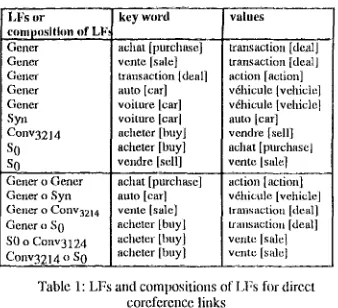
Moreover, LFs can be combined, as w e see in the following table:
5)In the ECD, lecture will be described as a noun which has three syntactic actants: X's (actant I) lecture to Y (arrant II) on Z (arrant III), for example Jean's (actant I) lecture to third year students (actant II) on semantic causality (actant I1]).
k e y w u r d values
LFs or eumposlthmnf Lb' Gener
Gener Oeller Gener Gener S3m ConY3214 SO SO Geuer o Gener GeIler o Syn Gener o Conv3214 Gener o S O SO o Conv3124 ConY3214 oS0
achat [lmrclu~se] vente Isale] transaction Ideal] auto [car] voiture lear] voiture lcarl acheter [buy] acheter [buy] vendre lsell] achat [purchase] auto [carl vente [sale] acheter [buy] achetcr [buy] acheter [buy]
transaction [deal] transaction Ideal] action [action] v6hicule [vehicle] v6hicule [vehicle] auto tear] v enth'e [sell] achat [purchase] vente lsale] action [acthl(li vghicule [vehicle] trm~sactiou Ideal] uausaction Ideal] vente I sale] vente [s~de]
=
Table 1: LFs aud compositions of LFs fltr direct coreference links
The following facts should be notcxl about compositions: C o m p o s i t i o n is not c o m m u t a t i v e . T h u s , So(Conv3214(aeheter)) = Conv3214(So(acheter)) = vente but Gener(So(acheter)) ~ S 0 ( G e n e r ( a c h e t e r ) ) because Gener(acheter) does not have a value. - Some compositions are reducible. For example, the LF Syn plays a transparent role in composition.
In the perspective o f text generation, this formalism appears v e r y interesting for building coreferential expressions. T o point b a c k to a r e f e r e n t a l r e a d y introduced, LFs and compositions of I,Fs offer m a n y possible w a y s for lexicalizing a given relerent. For example, let us s u p p o ~ that after having introduced the following sentence,
(10) a. L~fisser &uver laviande. [Let the meat stema.]
we have to refer again to the action la viande Ftuve. We could try to use a noutinalization (So). But, as fltere is no nominalization for the verb Ftuver, we could use instead t h e n o m i n a l i z a t i o n o f t h e g e n e r i c t e r m , So(Gener(dtuver)) = cuisa~n. W e could thus produce the following sentence:
(11 ) b. A la fin de la cuisson, ajouter les cpiees [At tile end of cooking, add the spices]
In the next section, we will e x a m i n e the case o f a complex lexical anaphor: file superordilmte term.
3. S u p e r o r d i n a t e s a n d b a s i c n o u n s
The use o f superordinate terms as anaphors raises several interesting questions.
First, to the extent that a generic concept (for two or m o r e specific concepts) has a simple expression in a language, this is not necessarily the s a m e term as the superordinate term (for the term corresponding to the specific concepts). For example, from a conceptual point of view, knife and scissors are "cutting instruments". Nevertheless, it is not possible to naturally stthstitute cutting instrument for knife and scissors, as in:
(12) a. Use a knife mid scissors to cut up the duck, b.? If you don't have these cutting instruments, pull the
duck apart.
ACIES DE COLING-92, NANTES, 23-28 AO~f 1992 7 6 5
There is no consistently used term 12tr expressing tile generic concept of knife or scissors. ~lltis can be cutting instruments as well as instruments for cutting or cutting utensils. Whether or uot s u c h a teNll exisLs varies among lauguages. For example, in Mandarin Chinese, file term d~o is fidly accepted as a superordinate term to point to the Chinese equivalents o f knife aml s c i s s o r s . Ill English, a term like vegetable is the superordiuate of carrot, tomalo Or cucumber because it is consistently used for tlte~ previous words in texts.
This entails that choice of snperordinate terms as lexical auaphors cannot be m a d e at tile conceptual level alone.
Moreover, saperordinate terms call often bc: lnorc easily nsed to lexiealize reference to a uon-homegeueous set of elements than for reference to a single element or homogcueous ~ t , as illustrated in (13) and (14):
(13) a. Put tile carrots ill to boiling water. b. ? Remove the vegetables after l0 mimnes. (14) a. Throw the carrots, the leeks altd Ihe lx~tatoes in to
boiling water.
b. Remove tile vegetables after l0 minutes.
H o w e v e r , the ease with which a snperordinale can be used depends ou rite particular noun. For example, in French, viande [meatl can be snbsituted for bleuf Ibeefl even ill singular:
(15) a. Menre le b~euf h cuire dmls l'eau I~ouillante. IPut the t~_ef in the I~iling waterl b. Retirer la viande ml bout de 20 minutes. [Remove the meat aftc'r 20 minutes]
This somewhat suri)rising i)henomenon can be analysed with the help of the notion of basic level object proposed by Roseh et al. (1976). The imlx)rtance of the basic level distinction for text generation has recently been shown by Reiter (1990). Rosch et al. demonstrated that the t a x o n o m y o f concepts could be o r g a n i z e d using a stnlcture with three levels: superordiuate, haste and subordinate. They define the basic level as follows: "basic objects a~e the most inclusive categories whose members: (a) possess significant numbers of attributes in c m m n o n , (b) have motor programs which are similar to one another, (c) have similar shapes, and (d) can be identified from a v e r a g e d shapes o f m e m b e r s o f the class" (Rosch et al. 1976: 382)
It has been shown that lexemes correspomling to basic level objects seem to be the most natural terms to introduce referents already idcntified. For example, if one wants to refer to s o m e champignons de Paris [button mushrootos], one w o u l d prctk:r to call them champignons [nmshrooms], provided that there is no potcntial a m t t i g u i t y with auy other m u s h r o o m s . Champignons de Paris would sccm too specific in this context and vegetables would seem too vague. This choice is not m a d e randomly: champignon is the noun corresponding to the highest basic level coucept to designate these objects. This would explain why in (15), one can refer to b~eufwith the superordinate viande.
Nevertheless, rite notion of basic level object does not always seem well suited to explain phenomena such as that observed in (15). For example, it seems that the concept "volatile" ["fowl"] fits perfectly the four criteria given by Rosch. But, volatile [fowll does not seem a
[image:3.432.42.211.29.183.2]natural F r e n c h term for referring to a chicken, particularly in the sublangtmge of recitees.
It is also problematic that the naming of basic level objects varies a great deal among languages. For example, in Mandarin Chinese, the most natural term to designate a knife when there is no ambiguity is the term d~o , which corresponds to "cutting instrument" in English. We could argue that conceptual representation differs with the mother tongue of the speaker (which is plausible, without joining the debate about language and thought) and that the lexicon reflects the conceptual views. Nevertheless, this position does not solve the problem of terms like volaille, a unuatural term for a basic level object.
It is significant that this position creates practical p r o b l e m s for text g e n e r a t i o n : if c o n c e p t u a l representation is reflected too closely in the choice of lexemes, this representation cannot be used as an interliugua for multilingual generation or machine translation.
In the light of this evidence, we have decidcd in favor of a strict theoretical separation between conceptual representation and lexical representation. We believe that an appropriate couceptual representation can be used for multilingual generation because it is a non linguistic g e n e r a l i z a t i o n above specific lexical representations. We therefore distinguish the notion of basic level object, which belongs to cognitive science, from the notion of basic noun, which is a linguistic notion 6. We consider "viande" and "volatile" to be basic level objects while only viande is a basic noun.
For lexical choice in text generation, we thus have to distinguish two very different processes:
- Superordination should be used to introduce a noun which points back to a set of different nouns. This is the case in {carrots, leeks, cucumber} --> vegetables. This process obeys a principle of economy.
- Basic denomination is used to introduce the most natural term for a given referent or a set of referents. This process obeys a principle of "naturalness": it introduces the most closely basic noun that corresponds to the concept to be lexicalized. Basic denomination is often used in texts like recipes: objects are first introduced with extreme precision and subsequently referred to with the basic term.
4 . K n o w l e d g e s o u r c e s f o r d e t e r m i n i n g l e x i c a l a n a p h o r s
In the course of our work, we have proposed a series of algorithms for generating grammatical and lexical anaphora in procedural texts (Turin 1992). Contrary to lexical anaphora, grammatical anaphora makes use of closed lexical classes (determiners, pronouns and a few special verbs) as well as ellipsis.
These algorithms are derived from an empirical study of French recipes, using a representative corpus of over 16,000 words. Recipes serve as a good prototype of procedural texts for assembling complex objects from parts. Even this modest corpus presents a wide variety of lexical and grammatical anaphora which are typical of assembly instructions.
6) Wierzbicka (1985) has shown in lexicographic descriptions that the nantes of (words for) basic level objects have special semantic properties.,
We describe below some of the knowledge sources and organization needed to generate lexical and grammatical anaphora. For lack of space, however, we leave out the model of state change management (needed to describe recipe ingredients being mixed together and transformed (Kosseim 1992)), a~ld the focus model used.
4.1 Input
We limit our scope to the linguistic part of generation; therefore, we assume that onr input is the ontput of a text planner, which has already grouped actions into discourse structures as proposed by Grosz and Sidner (1986) and (Dale 1988), The input is thus a sequence of actions and states in which participants (ingredients, instruments and agent) are represented by indices.
4.2 Dictionary of c o n c e p t s
The dictionary of concepts has been inspired by Nirenburg and Raskin 1987; concepts are mainly subdivided into actions or objects. We have added a category of properties, needed to describe relations between concepts (e.g., temporal limit) or attributes (e.g. size).
Relations between concepts are isa, part-o fo r result, the latter one useftd in a domain where state changes are frequent. Thus, one can relate the action "cut" to the concept "piece" which is the result of "cut". The dictiouary of concepts is not a copy of the language and there are Concepts w i t h o u t a n y c o r r e s p o n d i n g lexicalization. Taxonomic organization is fimetional and depends greatly on the field for which it has been established. In other words, our description of concepts has limited value outside the domain of recipes.
4.3 D i c t i o n a r y o f l e x i c a l e n t r i e s
The representation of lexical entries is strongly infhlenced by tile ECD (Mel'~uk & Folgu&e 1987, M e l ' ~ u k et al. 1988). T w o parts of tile entry are particularly interesting for our topic: the semantic zone and the LF zone.
The semantic zone contains four types of information: - Tile semantic field to which the lexeme belongs. For example, the verb simmer would have feature/cook/. - The mass/count feature.
- The "basicness" feature, if the lexical item is a noun, indicates whether or not the noun is a basic noun. - The key word(s) for which the lexeme can be a value. For example, for the lexeme mixture, it will be stated that it is the Sres of mix.
In the LF :,.one, we simply enumerate the values of the lexical item as a key word. For example, the entry for the verb hacher [chop] may contain, a m o n g many o t h e r s , hachis ( S r e s ( h a c h e r ) ) and h a c h o i r (Smed(hacher) ).
5, C o n s t r a i n t s f o r g e n e r a t i n g a n a p h o r s
We now turn to the constraints which apply to the choice of grammatical or lexical anaphors during text generation. Our aim here is to generate the most appropriate anaphor with respect to the textual context. To determine what is appropriate, we have used an empirical approach, rather than appeal to general principles such as Gricean conversational maxims (see Reiter 1990a & Dale 1988 for use of these notions for lexical choice in text generation). A detailed
examinatiou of our corpus of cooking recipes has sttowu that anaphora is not governed so muct, by sU'ict rnlcs as by tendencies. Thus, in a given context, a set of possible anaphors can "compete" for selection. When choosing from multiple possibilities we flavor ttte m o s t "economical" anaphor, i.e., the due which conveys the least information 7.
Space limitations prevent a complete discussion of all factors required for an anaphor choice algorithm (see Tutin 1992). Here we give the most ilnporfant constrai,~ts on choice among the principal anaphoric devices s.
The selection of an anaphoric device Ires two slages: • First, at choice is made among of grammatical devices (e.g. personal pronoun, verb complement ellipsis, coreferential definite NP, demonstrative NP).
• Then, if a lexical NP has been chosen, the corrcct lexical eataphor is determined.
5.1 G r a m m a t i c a l a n a p h n r n
The introduction of a given grammatical anaphor depends mainly on 4 kinds of paranmtcrs: a) the conceptual nature of referents, b) distance In antecedent and discourse structure, c) focaliz~'~tion and d) potential ambiguity.
We briefly review these different parameters tor each type o f g r a m m a t i c a l anaphor: verbal complement ellipsis, persomtl prolmml, d e m o n s t r a t i v e NP, corefereutial definite NP.
Verbal complement ellipsis as in the following exaraple is very widespread in recipes, and characteristic of procedural instructions in general.
(16) Prepare the carrots, the celery and the asparagus. Cook in the boiling water and take O out after 10 minutes.
Verbal c o m p l e m e n t ellipsis is generally used to designate a heterogeneous .set of objects, coutrary to personal pronouns. "llm distance from the antecedent can be quite far bat focalization coustraints, in particular global focus - defined as the subset of the most salient items - play a determining role for the production of this anaphor.
A personal prononn must nalne an object or a set of s i m i l a r objects. It is governed by very strong locality constraints (Hobbs 1978) and, as previously noted ill the literature, personal pronouns often mainlain the tlmntatic continuity (Van Dijk & Kintseh 1983), i.e. pronoun is the local focus (what the clause is about) of both the previous and the current clauses. In fact, local focus generally supplies enough information for the healrer to correctly interpret the pronoun (as emphasized by Grosz, Joshi & Weinstein 1983), even if it is morphologically ambiguous.
Choice of a demonstrative NP does not depend ou the conceptual nature of the referent, which may be either the local focus or the global focus. Its contrastive functions with respect to personal pronouns and definite NPs are rather complex. Since demonstratives are
7) Anaphoric devices thus have a default (strict) order of priority for application.
8) We omit the realization constraints, such as the fact that certain verbs do not allow their complements to be pronominalized.
infrequent in onr corpus, lbey are not treated furllter here.
Fur a definite NP, there is no conceptual iestriction on the refm'ent. A definite NP can be introduced at substaulial distance from its textual antecedent, and typically dnes not occl,r in the following clan.~, especially if the antecedent was the local focus of its clause and there is no potential ambiguity 9 .
For each NP to be generated, potential ambiguity must be taken into account. This has to tlo with lexieal choice. For example, choice of an anlbignons NP such as & vin [the wiue] must be blocked if there is white wine and red wine in the context. The context in which the anaphoric NP must be distinctive depends on the annphor chosen: it is tile preceding sentence for demonstrative NP while, for definite NP, a larger context nmst be taken in account lO,
5.2 Lexical amlphoru
We now tun, to the constraints on choice of lexical anaphoL When the grammatical mechanism chosen tklr exprc.ssing atnaphora involves a corellareutial (definite or den:tonstrative) lcxical NP, these c(mstraiuts conic into play to pick the most appropriate lexical form. The anaphoric lexical devices presented here for recipes constitute only a subset of those that conld appear in the language as a whole. Nevertheless, we hylX)thesize that the COl)ceptual and linguistic constraints governing their usage are generalizable to other kinds of text. Lexical a n a p h o r a differs significantly on this point from grammatical anaphora, whnse constraints, like discourse structure or focalization, vary greatly according to rite kiud of text. Therefilrc, while a giveu kind of text might use only a subset of possible lexieal auaphoric devices, these devices are governed by the mtme constraints in all kinds of texts. For exautple, typical result mention (m/x - -> m i x t u r e ) is widespread in procedural texts but constradltS governing thCnl a r e tile s a m e ill ally kind o f lext. lu contrast, it appears that tile constraints governing usage of granlmalical anaphoric devices, anti even the devices thenlselves, are much more depenttent on the variety of text.
Given that a lexica] NP has been chosen, as the general type of anaphoric device, two kinds of constraints, conceptual and linguistic, apply to select the the specific kind(s) of lexical aUalthora which may be nsed. In case of anthiguity, i.e. if file NP produced is not distinctive, addilional processing will t'.c requirexl.
Conceptual Cmlslraittts concern mainly:
The state of the object . l,'or example, all object whose state is being transfonued by an action should be relcrenced via its resulting state.
- Groupings of ohjects: is the referent to be generated a set o f identical objects, a heterogenous set, a homogenous sct or a single element? A heterogenons set is composed of elements which just have no close
9) For example, die definite NP hi file second clause is ra)t very natural in French:
Marie a rencontr6 un charcufier. ~ _ ¢ I f~it on tr~s bun pht&
[Marie met a porkbutcher. ~ I i ~ makes very go~,d l ~ . l
10) For recipes, we use Date's (1988) proposal to take the whole text as context, since it is usually short. This would of CoIIrSe not he satisfactory hlr longer texts,
g e n e r i c c o n c e p t s in c o m m o n , s u c h as, { "salt" ,"knife" ,"table"}.
L i n g u i s t i c c o n s t r a i n t s involve mostly the lexical f o r m and relative order o f the coreferential NPs that h a v e been lexicalized in the preceding text. Therefore, w e do take advantage of referents already lexiealized in the previous context (which must be stacked for being available when lexicalizing).
The following properties are examined:
- T h e linguistic form of antecedent NP: is it a single noun, a compound noun or a complex NP?
- The existence of a lexico-semantic association for the antecedent like the generic term or the typical result (which can mostly be formalized through a LF). - The "basicness" of the head word o f the antecedent NP.
A m b i g u i t y c o n s t r a i n t s are used to check if the lexicalization is not ambiguous.
If a unique object or a set of identical objects can not be lexicalized in a non ambiguous way, w e lexicalize it
the same way it has been first introduced in the text (Initial strict repetition). W e use this ad hoc strategy because first mention o f a referent is generally the most accurate. O f course, this would not a l w a y s b e the minimal distinguishing description (Dale 1988), but as Reiter (1990a) points out, d e t e r m i n i n g a m i n i m a l distinguishing description m a y require overly complex processing.
In c a s e o f p o t e n t i a l a m b i g u i t y for a set o f heterogeneous objects, we use "complex coordination". W i t h this process, we r e g r o u p first the first level superordinates and apply the other d e v i c e s to the remaining list of objects 11.
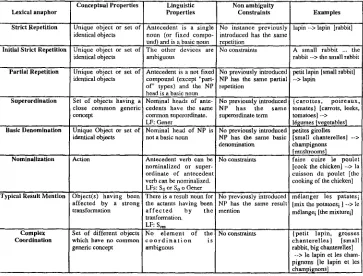
Table 2 shows several important kinds o f lexical anaphoric devices, with their associated conceptual, linguistic and non ambiguity conditions.
Concepicual Properties Linguistic Non ambiguity "
Lexleal anaphor Properties Constraints Examples
Unique object'or set of Antecedent is a 'single No instance previously lapin-->lapin [rabi~it] Strict Repetition
Initial Strict Repetition
identical objects
Unique object or set of
noun (or fixed compo- und) and is a basic noun
introduced has the same repetition
No constraints
Tile other devices are A small rabbit ... the
identical objects ambiguous rabbit --> the small rabbit
Partial Repetition Unique object or set of Antecedent is a not fixed No previously introduced petit lapin [small rabbit] identical objects compound (except "part- NP has the same partial --> lapin
of" types) and the NP repetition head is a basic nt~un
Superordlnatlon Set' of objects having a[ Nominal heads of ante- No previously introduced {carottes, poireaux, close common genericl cedents have the same NP has the same
concept common superordinate, supemrdinate term LF: Gener
Basic Denomination Umque Object or set of Nominal head of NP is No previously introduced identical objects not a basic noun NP has the same basic
denomination
N°mlnallzatl°n Action '" No constraints
Object(s) having been , affected by a strong
transformation
Set of different objects which have no common genetic concept Typical Result Mention
Antecedent verb can be nominalized or super- ordinate of antecedent verb can be nominalized. LFs: S o or S O o Gener There is a result noun for file actants having been a f f e c t e d by the tranformation. LF: S,,~
No element of the c o o r d i n a t i o n is ambiguous
Complex Coordination
No previously introduced NP has tbe same result mention
No constraints
tomates} [carrots, leeks, tomatoes] --> 16~umes [vegetables] petites girolles [small chanterellesl --> ehampignons [mushrooms] faire cuire le poulet [cook the chicken] --> la cuisson du poulet [the cooking of the chicken]
mtlanger les patates i [mix the potatoes i ] --> le mtlange i [the mixmrei]
{petit lapin, grosses chanterelles } [small rabbit, big chanterelles]
[image:6.432.38.401.185.461.2]--> le lapin et les cham- pignons [le lapin et les champignons]
Table 2: Constraints governing the introduction of lexical anaphora
11) We choose here to apply supe~ordination separately to each instance: we do not allow regroupings of elements for superordinatinn or typical result mendon because, as Kosseim has noticed, we would have to process all the subsets to generate correct lexicalizatinns.
Conclusion
In this tmper, we have described some of the problems raised making lexical choice in textual context, in particular for coreferential lexical anaphora. We have showed that paradigmatic Lexical Functions are well suited for creating lexical coreferential links. We have also distinguished the selection tff superordinate term, which is used to point back to a set of different words, from selection of basic denomination, which is usetl to name in the most natural way a concept already introduced by a previous noun.
A series of constraiuts has been formulated which can be implemented in an algorithm for selecting among natural grammatical and lexical anaphors in procedural texts. Most of these algorithms have been implemented by Kosseim 1992. The generator uses Prolog anti specifically Definite Clause Grammar (DCG) to produce text.
We find that determination of grammatical anaphom is more dependent on the genre and sublanguage than is lexical anaphora, which appears governed by fairly general constraints. However, morn work needs to be done to check these results in other precedural texts, and then more broadly in less similar text types, Also, it would be interesting to see to what extent anaphoric expressions share common constraints with deictic expressions for which the context of interpretation is not the previous text, but the extra-linguistic context~
Acknowledgements
We would like to thank Guy Lapalme, Igor Mel'~uk, Alain Polgu~re, Marga Alonso Ramos and Xiaobo Ren for fruitful discussions and helpful suggestions. Special thanks to Le'fla Kosseim, who collaborated in this research and with whom we shared many interesting discussions. The work reported in this paper was supported by a Government of Canada Award.
References
Bateman J. A. & L.Wanner (1990). Lexical Cooccurrence Relations in Text Generation, in Proceedings of the Fifth International Workshop on Natural Language Generation, Dawson, Pennsylvania, 31-38.
Dale, R. (1988). Generating Referring Expressions in a Domain of Objects and Processes, Ph..D. thesLs, University of Edinburgh.
Dtcary M. & G. Lapalme (1990). An Editor for the Explanatory Dictionary of Contemporary French (DECFC), ComputationalLinguistics, 16, 3, 145-154.
Grosz B.J., Joshi A., Weinstein S. (1983). Providing a Unified Account of Definite Noun Phrases in Discourse, in Proceedings of the 21st Annual Meeting of the ACL, MIT, Cambridge, Mass., 15-17 june, 1983, 44,49.
Grosz B.J. & C. Sidner (1986). Attention, Intentions and the Structure of Discourse, Computational Linguistics, 12, 175- 204.
Halliday M.A.K & R. Hasan (1976). Cohesion in English London, Longman.
Heid U. & S. R ~ b (1989). Collocations in Multilingual Generation, in Proceedings of FACL, 130-136.
Hobbs J. (1978). Resolving Pronoun References, Lingua, 44, 311-338.
Iordanskaja L., R. Kittredge & A. Polgu[re (1991). Lexical Selection and Paraphrase in a Meaning-Text Generation Model in C.L. Paris, W. R. Swartout & W.C. Mann eds.,Natural
Language Generation in Artificial Intelligence and Computational Linguistics, 293 -312.
Kosseim L. (1992), G~n~.ration automatique de proc~dgs coh~sifv darts les recettes de cuisine, M.Sc. thesis, Dtpartement d'informatique et de recherche op&ationnalle, tJniversit6 de Monutal.
McDonald D. (1991). On the Place of Words In lhe Generation Process in C.L. Paris, W. R. Swastout & W.C. Mann eds.,Natural Language Generation in Artificial Intelligence arm Computational Linguistics, 229-247.
Mel'fiuk LA. et al. (1988a). Dictionnaire Explicatif et Combinatoire du Franga~ Conternporain. Recherches Lexico- sbnantiques. 11. Montrtal, Presses de l'Universit~ de Montrtal. Mel'~'uk I. (1988b). Paraphrase et lexique dans la Thtorie Sens-Texte, Cahiers de Lexicologie LII, 5-50 et LIlI, 5-53.
Mel'c'uk I. & A. Polgu&e (1987) A Formal Lexicon ill the Meaning-Text Theory (or how to do Lexica with Words), Computational Linguistics, 13, 3"4, 1987, 261-275.
Mel'cuk 1. & Zholkovsky, D (1970). Sur la synthtse s6mmltique, TA. Informationa', 2, 1-85.
Nirenbnrg S. & I. Nirenburg (1988). A Framework for Lexical Selection in Natural Language Generation, in Proceedings of COLING 88, Budapest, 471 "475.
Nirenburg S. & V. Raskin (1987). The Subworld Concept Lexicon and the Lexicon Management System, Computational Linguistics, 13,3"4, 276-289.
Reiter E.B. (1990a). Generating Appropriate Natural Language Object Descriptions, Ph.D. Thesis., llarvard University.
Reiter E.B. (1990b) A New Model for Lexical Choice for Open-Class Words, in Proceedings of the Fifth haernatio~gd Workshop on Natural Language Generation, Linden Hall Conference Center, Dawson, Pennsylvania, 23-30.
Rosch E., C. B. Mervis, W. 1). Wayne, D. M. Jolmson & P. Boyes-Braen (1976). Basic Objects in Natural Categories, Cogr,;tive Psychology 8, 382,439.
Sidner C. (1983). Focusing in the Comprehension of Definite Anaphora, in M. Brady & R. Berwick eds.,Computational Models of DL~course, Cambridge (UK.), Cambridge University Press, 267-33f).
Tutin A. (1992) Etude des anaphores grammaticales et lexicales dane la perspective de la g~t~ration automatique darts des textes de procedures, Ph.D. Thesis, IMpartement de linguistique, Universit6 de Montrtal.
Wierzbicka A. (1985). Lexicography and conceptual analysis, Ann Arbor (Mich.), Keroma Publishers inc.