A N e w Strategy for Providing Definitions
In Task-Oriented Dialogues
Margaret H. SARNER Department of Computer Science
University of Delaware Newark, Delaware 19716 U.S.A.
Sandra CARBERRY Department of Computer Science
University of Delaware Newark, Delaware 19716 U.S.A.
Abstract
Definitions may be made up of one or more components, which correspond to strategic predicates. The selection of which components to use in giving a definition in a task-oriented dialogue depends heavily on the needs of the user. The selection strategy we present involves weighting possible strategic predicates and the propositiomL used to fill them at multiple points throughout an ongoing dialogue and at the actual time of giving the definition. Weighting will he influenced by a model of the user's domain kimwl- edge~ task-related plans and goals, and receptivity to the different kinds of intormation that could he presented. An utteraalce can then be produced that incorporates the most important informa- tion while adhering to common rhetorical practices.
1
I n t r o d u c t i o n
In the course of ongoing task-oriented expert-consultation dialogues, m a n y occasions arise in which the expert must provide a definition. In this paper we will present a new strategy for a computer expert to use in giving definitions in a way that is most helpful to the individual user.
The strategy relies on a dynamically inferred model of the user's dom~dn knowledge, task-related plans and goals, and recep- tivity to different kinds of information. It constructs a definition by weighting both the strategic predicates that might comprise a def- inition and the propositions that might be used to fill the strategic predicates. These weights are used to order what migh t be said ac- cording to its anticipated usefulness to the user. Rules can then be used to produce an utterance that incorporates the most important informatlo~t while adhering to common rhetorical practices. This strategy rellects our overall hypothesis that beliefs about the appro- priate content of a definition should guide selection of a rhetorical strategy, instead of the choice of a rhetorical strategy determining content.
Section 2 describes situations in task-oriented dialogues in which definitions are called for. Section 3 identifies three charac- teristics that differentiate definitions provided by experts during task-oriented dialogues from those provided in response to isolated requests for definitions, and argues that the choice of a rhetorical strategy should be made on the basis of being able to include in the definition those features deemed most important. Section 4 proposes a Principle of Usefulness as a guideline for selecting infor- mation to include in definitions. Section 5 discusses strategic pred- icates. Section 6 presents an overview of our strategy for weighting predicates and propositions and then ranking what might be said according to its usefulness to the user.
2
Definition Situations
In its simplest form, a definition-giving dialogue consists of an information-seeker asking "What i s a n Xf" and an information- provider saying "An X / s a . . . . " In actual practice, however, there are m a n y ways a definition can he requested and many ways the request cmt be responded to by the information-provider. In or- der to identify the characteristics of definitign-giving dialogues, we
have analyzed transcripts of novice-expert dialogues from a variety of domains, including student/advisor dialogues, recipe-providing dialogues, taxpayer/tax-agent dialogues, and radio talk shows in !which callers 8ought expert advice on investments and real estate. 1 This section describes definition-glving situations identified in this study.
An expert may give a definition either in response to a user's request or spontaneously. Occasions for providing definitions arise most obviously when the user asks a question of the form "What is ... ?" or " W h a t is the significance o f . . . ? " The question doesn't have to be explicit, however, as illustrated in the exchange below, which is an excerpt from a money-management talk show tran- script:
E: "I'd llke to see you put that into two different South- ern utilities."
U: "Southern utilities?"
As shown in [Carberry 1985], such elliptical fragments are often intended to elicit clarification and explanation of the repeated term.
In addition to giving definitions in response to a request by the user, the expert may provide a definition as part of correcting a user misconception [McCoy 1986], or may generate definitions spontaneously. There are several reasons an expert may give spon- taneous definitions. He may provide additional definitional infor- mation to justify use of a concept, tie may think it likely that the user doesn't know about the entity being introduced. The expert may want to ensure that he and the user are working with the same definition. The statement below is an example of a spontaneous definition from a recipe-giving dialogue:
E: "You use a spring-form pan - - the kind that ,allows you to separate the bottom and the sides once you have prepared your dish."
3 D e f i n i t i o n s i n T a s k - O r i e n t e d D i a l o g u e s
McKeown [McKeown 1985] studied definitions in the cou- text of requests for information about the objects modeled by a database system. She claimed that humans have mutually known conventions for organizing information and providing definitions, and that a natural language system should make use of these strate* gies in producing explanations. Given a definition request, her T E X T system selected a rhetorical strategy based on the infor- mation available. The rhetorical strategy was then responsible for selecting the information to he incorporated into the definition. T E X T treated requests for definitions as isolated queries, whereas we are interested in definitions generated in the course of ongoing task-oriented dialogues.
Our analysis of transcripts of naturally occurring interac- tions indicates that definitions generated in task-oriented dialogues differ significantly .from those generated statically or as a result of isolated definition requests. The differences appear to be the result of several factors:
1. In task-oriented dialogues, the information-provider knows something about what the information-seeker is trying to ac- complish, and will generate definitions that help the informa- tion-seeker achieve his goals. For example, the first response below would be an appropriate definition of baking soda if the information-seeker is baking a cake, whereas the second would be appropriate if he is trying to relieve indigestion.
E: "Baking soda is an ingredient that, when heated, releases carbon dioxide, thereby caus- ing the mixture to expand in size."
E: "Baking soda is a substance that, when dis- solved in water,produces a chemically basic so- lution that will counteract acidity."
2. Whereas static definitions or responses to one-shot requests for defiuit|ons must assume a generic model for the informa- tion-seeker, responses to definition requests during an ongo- ing dialogue can take into account acquired beliefs about the information-seeker's specific domain knowledge. For exam- ple, the information-provider might include an analogy to an entity that the information-seeker is already familiar with, as in the following definition of the course CS106:
E: "CS106 is like CS105, except that it uses For- tran instead of Pascal and emphasizes scientific applications of computing."
3. Whereas static definitions and responses to one-shot requests for definitions must be generated all at once, dialogue allows the information-provider to produce what he thinks will be an acceptable definition and analyze the information-seeker's response to determine whether t o elaborate on the definition. For example, in the following dialogue with a veterinarian about treating a cat with a hyperthyroid condition, the vet- erinarian (E) provides a definition that he believes will Sat- isfy the information-seeker's needs, then must elaborate on it when the information-seeker's response reveals multiple goals: to improve the condition of the cat and to have medication that is easy to administer.
E:
"Tapazole is a drug that decreases the function of the thyroid."U: "How large are the pills?" "
H a system carrying on a task-oriented dialogue is te be viewed by the information-seeker as cooperative, intelligent, and natural, it must take the above factors into account. Otherwise, it will not appear to be directed toward the user's goals (uncoopera- tive), will not appear to make use of what the user already knows (unintelligent), and will not appear to take advantage of the fact that the interaction is ongoing, as opposed to one-shot (unnatural). Our hypothesis is that, instead of using a rhetorical strategy to determine the content of a definition, the system should reason about the user's plans and goals and speclli£ domain knowledge to decide the importance of incorporating individual propositions into the final definition. For this purpose a user model, preferably a dynamically constructed user model, is essential. T h e choice of a rhetorical strategy should be made on the basis of being able to include into the definition those features deemed most important. Thus beliefs about the appropiiate content of the definition should guide selection of a rhetorical strategy, instead of the choice of a rhetorical strategy determining content.
McKeown, Wish, and Matthews [McKeown et al. 1985] ad- dressed some of these issues in their work on an expert lystem that could provide explanations tailored to users. They described a method for using a model of the user's goals along with p ~ b u i l t perspectives on the knowledge base to generate appropriate expla- nations. While they touched on some of the issues that concern us, they took a different approach from the one we are proposing.
Their perspectives were built into the domain knowledge base, and their system did not make much use of informaticm available from the system's model of the user's plans and goals. Also, they were concerned with answering can and should questions, whereas we are interested in definition explanations.
4
A p p r o p r i a t e C o n t e n t o f a D e f i n i t i o n
Our analysis of naturally occurring consultation dialogues indicates that definitions can take many forms. They may be made up of one or more of a set of components, which correspond to rhetorical predicates described in [Grimes 1975, Williams 1893, McKeown 1985]. These predicates will be discussed further in Sec- tion 5.
Since we are studying cooperative dialogues in which the ex- pert's goal is to help the information-seeker solve his problem, we hypothesize that the expert's overriding concern in selecting the information to include is that the response be as useful as possi- ble to the individual user. Intuitively, to be truly useful to the user, the information must be something he doesn't already know but something relevant that he can understand. Our hypothesis, which appears to explain the definitions occurring in our dialogue transcripts, suggests the following Principle of Usefulness:
P r i n c i p l e o f U s e f u l n e s s
1. The response should be made at a high enough level that it is meaningful to the user.
(a) Don't say something the user won't understand. (b) Don't give information that addresses more detailed as-
pects of the user's task-related plan than is appropriate for his current focus of attention.
2. The response should be made at a low enough level that it is helpful to the user.
(a) Don't inform the user of something he already knows. (b) Don't give information that is unrelated to the user's
goals and task-related plan, or is too general for his cur- rent focus o f attention in the plan.
Grice [(]rice 1975] stated that contributions should be as informative as required for the exchange, but not more informative than required. Paris [Paris 1988] suggested that an answer to a question should be both informative and understandable to the user, based on the user's level of knowledge about the domain of discourse. The Principle of Usefulness formalizes and extends these guidelines for definitions by selecting the appropriate level both in knowledge-related issues (la, 2a) and in plans and goals (lb, 2b). This Principle will be used whenever a selection of appropriate level of information to fill a predicate is called for.
For example, consider a plant classification hierarchy.
THING [ isa PLANT
] isa FLOWERING PLANT
[
isa ARUM[
isa CUCKOOPINTThe term rhetorical predicate has taken on several mean lugs in the literature of linguistics and coutputationM linguistics. It ha.s been used to describe relationships ranting from structural to conceptual in uature. Grinms [Grimes 1.975] described rhetorical predicates i.hat "relate ~he kinds of informatio~t communica*ed i~t discourse with each other." One of his predicates was ~he Attribu tive predica.te which "adds qualities or color to sa~other predicaie as center." Ilobbs [tIobbs 1979] chose to use the term coherence *~.
lution in pn;ference to rhetorical predicate to place tile emphasis on
the coherence between sentential units. McKeown's description of rhetoricM vredicatcs [McKeown 1985] imtdied ~ut association with sentential s~ructure, but ia practice the predicates she used, such a~ Constitsency, dealt more with conceptuM relationships.
Wc :n'e using predicates to chara£terize the componeni;s of defiuitio~s i~a terms of relationships between conceptual uuits. Our predicates relate information M)out the entity being defined to the entity itself. This relationship is datuMs-independent mid content- independent. For exarnple, our Identification predicate is instanti- axed by fiuding iu a generalization hierarchy an entity which is art ancestor of the entity being defined. This usage is close to MeKe. own's, but because of the apparent ambiguity of the term rhctori..
cal pmdicales, we prefer to call the predicates strttte#ic predicates,
putting emghasis on the motivation of g~fining ant end (in this case, conveying useful information to the user) ratber than on style.
l,¥om our study of definitions occurring in actual dialogues, we have identified fourteen distiuct predicates that relate to deft-- nixies content. Each predicate corresponds to a different type of iah)rntatio~ that can be put into a definition. Although we do not claim lltat the list is complete or unique, we do believe it is sutllcient to generate appropriate definitions in an expert consul- tatlon system. Some of our predicates (ldeutification, Properties, Analogy, Components) are similar to McKeowu's. Others (Effect, Prerequisites) are paxticular to a task--orieuted environment.
Associated witit each predicate alie semantics ~hat indicate how to inst ~utiate it. Foc example, efl~ct information will i~e tbund iu the system's library of plans ~ud ,,~o'ds, aud property information will be f~a,~d ill the generalization bieliarchy. [a either case, the ~;ystem mm;t *'casaba about, the p a F t i c H ] a r _ ' usea++s plans mid goals in ,~rder to deternfinc a propositiou's relewntce to what the user is ~xyiug h) a.:contplish. When au occasion !br a definition a~iscs, a given predicate laity be lilled one or c, tore times. The propositiotm tiros prod,~ced at'e caudidates for inclusion in the detluitio~,. Siuce our goal i.~ to selecl; !~he informatiou thai; i~; l,tost important to t h , 'user, we as~;ociate a me'tsnrc at" signiftcauce with each proposition~
The sigailia:aa:ce metrics will be described in Section 6.
In the rent,-finder o[" this sectiou we will look at three, types of definitio:,t components in some detail to illustrate how the user model influences selection.
,%1 :tfde~tifieation
Many naturally occurring definitions contain au Identifi- cation component, identification consists (ff ideutifying the entity beiug described as a member (d a generic class in a hierarchicMly structured knowledge base ~- for example,
E: "Amaretto is a liqueur."
Th~ system's model of the user dictates what superclass from the generalizaLioa hierarchy to use ia au identification. In order tbr identificati,m to I)e h@fful to the user, it is necessary that the user have knowledge of the pareut category used in making the identitication. Ttds condition corresponds to the first part of tile Prirtcipk ~, ,,; Usefldness. Knowledge of a parent category may not be suhici,mt, however, to cause that parent category to be given in the definition. If the systemh beliefs indicate that the pareut category is w.lated ~,.~ the u~er's pin, Is end goals, then there is stronger reason to mention it. In t],e cane iu which the entity ha8 severM parents that the n~:e~" haJ; kuowledge of, plans and goals should be u.qed to ~elect the one (or ones) most appropriate lo mention. Suppose, lbr exampl% that a digital systems course is cross-listed as both a Cmapu*er Science and an Elec~ricM Engineering course.
U: "What is Digital Systems?"
E: "It is a Computer Science course . . . "
o r
F,: "It is an F, lectrieal Engineering course . . . "
The choice of answer depends on whether tim user model indicates that the user is trying to satisfy Coolputer Science or Eleetricefl Fingineering requirements. A third ~dternative is
F: "It is both a Computer Scieu(:e course mid an Electrical Engineering course . . . "
This response might be given if the model indicates laoth parent categories play a role in tim user's plans and goals.
Following tile Principle of Usefulness, the appropriate super. class is the lowest level parent category that would have meaning to the user and be relevant to what the system believes al.Ie the user's plans and goals.
I
D
I
X
The user knows what A, B, C are
Tim user doesn't know about i)
Tim user asks "What i.~ X ?"
]n the cm;e illustrated above, the expert's taleutification a:n.sw~r migllt be " X is a C." The efl'eci; of an.uwering " X is a D" wo01d be to caaJse the user to ask " W h a t is a D?" . r give up withottt get- ting meaningful info~'mation. The an~Jwm' "X i'.~ a 11" would miss tile distinguishing features shared lay C :uld ;( but not lay B. If the~e distinguishing features ~Lre not important to the tJ.~el ~ii[1 wol.l!d [;i-V(! the false impression that tlle system believes they are. a<W(~v:;~i t~ tile user's task, however~ a higher hwel thnu C shouhi b.'~ selected.
5 . 2 P r o p e r t i e s
A Properties response consists o! naminv~ characteristics of tile entity. These are often expl~ssed i, descriptions Kiwm by humans a~q "adjectival phrases attached to the ldentitlcati(m of the entity.
E: "A no-load fired is a mutual fired with no sales charge."
E: "Amaretti are crisp Italian almond-flavored macaroons."
5.3 O p e r a t i o n
An Operation response consists of a description of how something works. Paris [Paris 1988] has demonstrated that expla- nations given novices in a domain often take the form of process traces. An Operation definition may take the form of process infor- mation or steps in implementation. The difference between the two is that the process information is essentially a chain of cause-and- effect occurrences, while the steps in implementation are sequential, but not necessarily causal, as is shown in the example:
U: "Can yon tell me what the money market is?"
E: " A money market fund is a group of people getting together - - put their money together in a pool and it is invested by professional investors."
As with the Properties predicate, the system's beliefs about the user's plans and goals must be taken into consideration. The expert might identify the need for an Operation explanation in a task-oriented dialogue when the entity being explained appears in a step in a plan the user must carry out to meet a goal. For example, if the user is a traveler asking the expert for help planning a car trip and the expert advises the user to follow a "Trip Tik," the expert should explain how a Trip Tik works if the model of the user indicates lack of familiarity with it. The definitions of baking soda given earlier illustrate a case in which the appropriate Operation explanation depends on the use to which the entity will be put by t h e information-seeker.
6
S e l e c t i n g D e f i n i t i o n C o n t e n t
Our strategy assumes a knowledge base consisting of a gen- eralization hierarchy containing domain knowledge, a plan library, and a lexicon. The user model has three components:
1. a model of the user's domain knowledge in the form of mark- ings on the knowledge base showing the pieces with which the user is familiar [Kass 1987],
2. a model of the user's underlying t/ak-related plan and cur- rent focus of attention in the plan, given by a context tree [Carberry 1988],
3. a model of how receptive the user is to various kinds of infor- mation, given by weightings on strategic predicates.
The first two components will be dynamically updated during the dialogue as shown in [Kass 1987] and [Carberry 1988]. The third component will also be updated dynamically in response to the user's receptivity to types of definitions and his own usage of strate- gic predicates.
6.1 W e i g h t i n g P r e d i c a t e s
When a definition occasion arises, a local predicate recep- tivity model is created. Starting with a copy of the current global weights representing the user's general receptivity to the kinds of in- formation represented by the strategic predicates, as inferred from the preceding dialogue, further adjustments may be made to reflect the appropriateness of the predicates in the particular situation.
The question itself and the level of local domain expertise may cause further weighting of predicates. For example, if the user asks "What is XP' where X is an object, the Identification predicate would be more heavily weighted. If X is an action, the Operation predicate would be more heavily weighted. The level of local do- main expertise can be ascertained when a definition is requested by looking at the parts of the plan library and generalization hierarchy that contain references to the entity in question. If they are heavily marked with things the user knows, the user can be considered to have a high level of expertise; otherwise, the user will be considered to be a novice. The weights for predicates that have been deter- mined to be appropriate for expert and novice users will then be increased [Paris 1988].
hO.
, 8 -
, 6 -
,4- I
13
"
'2
d "''+
Figure 1: Graph of Relevance Formula
6.2 w e i g h t i n g P r o p o s i t i o n s
After predicate weighting has been determined, predicates are filled with information from the knowledge base (generaliza- tion hierarchy, lexicon, plans and goals) relevant to the concept being defined. The semantics of each individual predicate dictate where to find the information to fill the predicate. For instance, the Identification and Properties predicates are filled with information found in the generalization hierarchy, and Necessity propositions are drawn from the plans of the user. Some predicates may pro- duce several propositions. For example, an entity may have several properties. For others there might not be any corresponding propo- sitions available.
Selection of propositions depends on both the weights of the possible predicates and a measure of significance of the informa- tion that could be used to fill them. Significance reflects where the proposition fits into the system's model of the user's goals and possible plans for accomplishing them (relevance) and what infor- mation in the generalization hierarchy has been marked as known by the user (familiarity).
The system's beliefs about the user's underlying task-related plan, as dynamically inferred from the preceding dialogue, are rep+ resented in a tree structure called a context model [Carberry 1988]. Each node in this tree represents a goal that the user has investi- gated achieving. Except for the root, each goal in the context model is a descendant of a higher-level goal whose associated plan, found in the system's plan library, contains the lower-level goal. One node in the tree is marked as the current focus of attention and indicates that aspect of the task on which the user's attention is currently centered. The context model may be expanded to arbitrarily ma~y levels of detail by repeatedly replacing non-prlmitive suhgoals with associated plans which themselves contain constituent subgoals.
If pursuing a subgoal in a plan represents a significant shift in focus, it is marked in the plan library as introducing a new focus domain~;~, Within the context model, a focus domain of subgoals that are at approximately the same level of focus is generated by expanding'the plan associated with a subgoai that introduces the focus domain. As long as this plan is expanded by substituting plans for just those subgoals that do not introduce another new focus domain, the subgoals appearing in the expanded plan are part of the same focus domain.
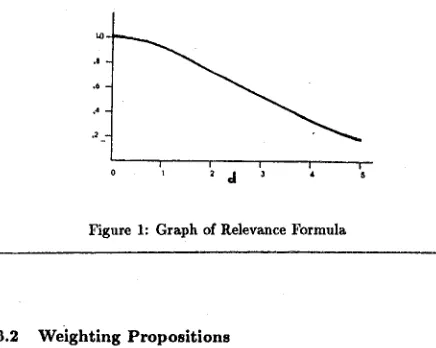
Our estimate of relevance is based on distance of the part of the context model in which the definition information is found from the current focus of attention in the context model. This distance is measured as the number of shifts in focus domains. If the plan is at the focus of attention, the information derived from it is of very high relevance. If it is in the immediately surrounding focus domain (one shift), the information is still of high relevance. As the number of focus domain shifts increases, the relevance of information in the plans begins to fall off, but as long as a plan has been activated the information found in it is of some relevance. This situation in which relevance remains high close to the focus of attention, but drops off more rapidly as the distance increases, is modeled by an inverse exponential function, as shown in Figure 1. The equation
d2 r = e - ( , ) ,
[image:4.612.329.547.49.223.2]i ...
13
Figure 2: Graph of Familiarity Formula
Currently, our relevance metric treats all shifts ~xaong focus domains equally. It may be the case, however, that information in a higber-level plan h t h a t led to the current focus of attention is more appropriate to include in a'defiuition t h a n is information extracted from a subplan s appearing in an expansion of the current focused plan, even if the two plans, h and s, represent the same number of shifts from the current focus of attention in the context model. The current f e c u n d plan is part of an expansion of h, so we know that the user is concerned with accomplishing h; therefore, information relevant to h may be more significant to the user t h a n information relevant to details of carrying out the current focused plan. This is an issue that we plan to investigate further.
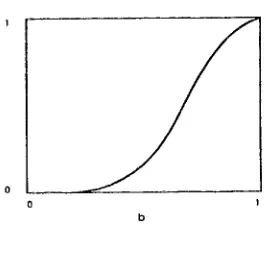
Our measure of familiarity is based on the knowledge the expert believes the user has about the objects, properties, or con- cepts that could be used in a definition. We are assuming a variant of the user modeling system described by Kass [Kass&Fiuin 1987], modified so that each node in the knowledge base is marked with a bellef factor~ ranging in value from O to 1, giving the system's level of belief t h a t the user is familiar with the entity. Because of the importance of giving a definition in terms of something the person receiving the. definition will understand, an entity known to have meaning to the user (belief factor = 1) should be treated as poten- tially useful to include, even if it is not germane to the hypothesized goals. If it is not believed strongly that the person is fandllar with the entity, however, it is less useful to tie the definition to that en- tity. Note that since the dialogues under consideration are ongoing, as opposed to one-shot, a definition can include items t h a t the sys- tem believes the user is probably familiar with, mad the system can wait for the user's response to decide whether the definition was successful. T h e heuristic described here is modeled by the function shown in Figure 2. The formula
e 6b(2-b) - - 1
f = e e - 1 '
where f is the familiarity rating and b is the belief factor, exhibits an appropriate amount of curvature to reflect the rapid drop-off in usefulness a~ the belief factor decreases.
The ]ast step in computing a measure of significance for a piece of information is to form a weighted combination of the rele- vance rating and the familiarity rating. Since our primary goal is to provide information that will help the user accomplish a task, our ibrmula for combining the two measures weights significance twice as heavily ~ familiarity. Our significance metric, then, is
2r + f . 3
where S is significance, r is the relevance rating, and f is the famil- iarity rating.
The following example from a hypothetical travel domain ifiustrates how propo~itions are weighted according to significance. The dialogue pertains to planning a trip abroad.
U: "I need to have enough money with me to pay for anything I buy."
E: "You can carry as much as you like in travelers checks."
U: "Travelers checks?"
The first statement causes the have-money plants beinfocas. The have-moneyplan has subgoals
have-convartlble-funda ((_agent: person) (_amountl: funds))
h a r t _ c u r r e n c y ( ( _ a g e n t : p e r s o n ) ( _ c o u n t r y : c o u n t r y )
(_amount2: funds)).
Suppose that the user's elliptical fragment is interpreted as a re- quest for a definition. Figure 3 shows part of the context model. As a result of the expert's preceding response, the focus of attention is now on the have-convertible-funds plan. Suppose further that the other plans shown are in a focus domain at a distance of 1 from the focus of attention.
Figure 3: A Portion of the Context Model
The Operation predicate produces the candidate proposition formed from components of the use-travelers-checks subplazt (not shown) equivalent to t h e statement
"You can buy travelers checks at a bank here and cash them in the currency of the country."
The information comes from the body of the use*travelers-checks subplan, which is at distance d = l from the focus of attention. As- suming t h a t the expert believes that the user is familiar with the concepts of buying, banks, currency, and cashing things in, we have
r = e - ( } ) 2 = e-('z) 2 -- .939
e ~ ( 2 - b ) - - 1 e s ( 1 ) - - 1
J
- e s _ ~ - e S _ l = 1 [image:5.612.111.244.56.187.2] [image:5.612.324.531.316.469.2]The Analogy predicate is filled by a reference to a sibling with similar properties, equivalent to
"Travelers checks are like personal checks."
Suppose the belief factor for personal checks is .9 - - that is, the expert believes it very likely but is not absolutely certain that the user knows about personal checks. Suppose further that the prop- erties of travelers checks t h a t are similar to those of personal checks appear in plans at a distance of two shifts of focus domain from the focus of attention. Iu this case we compute
r = e - ( ~ ) 2 - - e-(~) 2 = .779 e sb(2-b) -- 1 e s'4(l't) -- 1 f = e 6 -- -1 -- e 6 -- 1 .942
S - 2 r + f _ . 8 3 3 3
The fact that the first definition component has higher com- puted significance than the second does not necessarily mean that it will be preferred, however. Recall that weights of candidate propo- sitions must reflect both significance of the information and predi- cate receptivity.
Once weights have been assigned to the candidate proposi- tions, they are then ranked according to weight and put into cate- gories. There are four categories:
Must Say Say if Convenient
Say if Needed for Coherence Do Not Say
The higher weight categories receive the higher-weighted propo- sitions; the lower-weighted propositions go into the lower weight categories. Some categories may be empty.
When all category assignments have been made, the result- ing four groups of propositions axe passed to an answer generator. Construction of this answer generator is a future project. The gen- erator will take the classes of propositions, find a way to say all of the Must Say propositions a~ld as m a n y as possible of the Say if Convenient propositions, using Say if Needed for Coherence propo- sitions whenever they help the construction of the response. We propose to do this task using rules of combination developed to produce an utterance that adheres to common rhetorical practices that people appear to follow.
7
A Comparison
Our strategy will produce different responses tban would current definition systems. For example, consider a request for a definition of amaretti. McKeown's T E X T system would identify the entity and include all based database and distinguishing database attributes, and would produce a definition resembling
"Amaretti are macaroons. They are made from apricot ker- nels, have ahnond flavor, are of Italian origin, and have crisp texture. The most popular brand is made by Lazzaroni and Company."
Our definition module would attempt to pick information appro- priate to the individual user. If the user is selecting food items to sell in an international bazaar, it would say
"Amaretti are Italian macaroons. The most popular brand is made by Lazzaxoni and Company."
If the user is making Amaretti Amaretto Chocolate Cheesecake, for which amaretti are an ingredient, however, it would say
"Amaretti are crisp almond-flauored macaroons."
8
. F u t u r e W o r k
Our continuing research will work out additional details of our strategy for providing definitions in task-oriented dialogues. We need to investigate a strategy for dynamically weighting strategic predicates according to the user's perceived receptivity to different kinds of information, and putting this weighting together with ore' measure of significance for propositions. An answer generator that combines propositions, giving emphasis to including those proposi.. tions deemed most important to say, must be designed. This task includes ranking the candidate propositions by weight and combin- ing the most heavily weighted ones in a way that will produce a coherent utterance. Finally, the system must be implemented to test and demonstrate the utility of our definition strategy.
9
Summary
We claim that determining the most important things to say for the individual user is the most significant task in providing definitions in task-oriented dialogues. In thls paper we prasent a new strategy for generating definitions, using a weighting strategy that draws on a dynamically inferred model of the user's domain knowledge, task-related plans, and receptivity to different kinds of information. This strategy reflects our over-all hypothesis that beliefs about the appropriate content of a definition should guide selection of a rhetorical strategy, instead of the choice of a rhetor- ical strategy determining content. This approach will produce a system that exhibits cooperative, intelligent behavior by providing definitions tailored to the needs of the individual user.
R e f e r e n c e s
Carberry, Sa~dra. 1985. A Pragmatics Based Approach to Understanding Intersentential Ellipsis. In: t'roceedings of the 23rd Annual Meeting of the Association for Computation Lin.. gaistics, 188'-197.
Carberry, Sandra. 1988. Modeling the User's Plans and Coals.
Computational Linguistics Journal, To Appear.
Grice, H. Paul. 1975. Logic and Conversation. In: P. Cole and J. L. Morgan, Eds., Syntax and Semantics II[: Speech Acts, Academic Press, N.Y.: 41-58.
Grimes, J. E. 1975. The Thread of Discourse. Mouton.
lIobbs, Jerry R. 1979. Coherence and Coreferenee. Cognitive Science, 3:67-90.
Kass, Robert. 1987. Implicit Acquisition of User Models in Cooperative Advisory Systems. Technical Report MS-CIS-87- 05, Department of Computer and Information Science, Uni- versity of Pennsylvania, Philadelphia, PA.
Kass, Robert and Finin, Tim. 1987. Rules for the Implicit Acquisition of Knowledge About the User. Proceedings of the Sixth National Conference on Artificial Intelligencc, 295-30{}.
McCoy, Kathleen F. 1986. The ROMPEI~ System: Respond- ing to Object-Related Misconceptions Using Perspective. Pro~. ceedings of the 24th Annual Meeting of the Association for Computational Linguistics, 97-105.
McKeown, Kathleen IL 1985. Text Generation. Cambridge University Press.
McKeown, K., Wish, M., and Matthews, K. 1985. l~lorirlg Explanations for the User. In: Proceedings of the 1985 Con.- ference, Int'l Joint Conference on Artificial Intelligence, Los
Angeles CA.
Paris, Cecile L. 1988. Tailoring Object Descriptions to a User's Level of Expertise. Computational Linguistics Journal.