Proceedings of the IJCNLP-08 Workshop on NLP for Less Privileged Languages, pages 91–98,
Morphology Driven Manipuri POS Tagger
Thoudam Doren Singh
Sivaji Bandyopadhyay
Computer Science Department
Computer Science & Engineering Department
St. Anthony’s College
Jadavpur University
Shillong-793001, Meghalaya, India
Kolkata – 700 032, India
Abstract
A good POS tagger is a critical component of a machine translation system and other related NLP applications where an appropriate POS tag will be assigned to individual words in a collection of texts. There is not enough POS tagged corpus available in Manipuri language ruling out machine learning approaches for a POS tagger in the language. A morphology driven Manipuri POS tagger that uses three dictionaries containing root words, prefixes and suffixes has been designed and implemented using the affix information irrespective of the context of the words. We have tested the current POS tagger on 3784 sentences containing 10917 unique words. The POS tagger demonstrated an accuracy of 69%. Among the incorrectly tagged 31% words, 23% were unknown words (includes 9% named entities) and 8% known words were wrongly tagged.
1 Introduction
Manipuri (Meiteilon or Meiteiron) belongs to the Tibeto-Burman language family and is highly agglutinative in behavior, monosyllabic, influenced and enriched by the Indo-Aryan languages of Sanskrit origin and English. The affixes play the most important role in the structure of the language. A clear -cut demarcation between morphology and syntax is not possible. In Manipuri, words are formed in three processes called affixation, derivation and compounding (Thoudam, 2006). The majority of the roots found in the language are bound and the affixes are the determining factor of the class of the words in the language. Classification of words using the role
of affix helps to implement the tagger for a resource poor language like Manipuri with high performance.
There are many POS taggers developed using different techniques for many major languages such as transformation-based error-driven learning (Brill, 1995), decision trees (Black et al., 1992), Markov model (Cutting et al., 1992), maximum entropy methods (Ratnaparkhi, 1996) etc for English. Decision trees are used to estimate marginal probabilities in a maximum entropy model for predicting the parts-of-speech of a word given the context in which it appears (Black et al., 1992). The rules in a rule-based system are usually difficult to construct and typically are not very robust (Brill, 1992). Large tables of statistics are not needed for the rule-based tagger. In a stochastic tagger, tens of thousands of lines of statistical information are needed to capture the contextual information (Brill, 1992). For a tagger to function as a practical component in a language processing system, a tagger must be robust, efficient, accurate, tunable and reusable (Cutting, 1992).
2 Previous work on Manipuri POS tagger
Morphology based POS tagging of some languages like Turkish (Oflazer and Kuruoz, 1994), Czech (Hajic, et al., 2001) has been tried out using a combination of hand-crafted rules and statistical learning. A Marathi rule based POS tagger used a technique called SRR (suffix replacement rule) (Burange et al., 2006) with considerable accuracy. A POS tagger for Hindi overcomes the handicap of annotated corpora scarcity by exploiting the rich morphology of the language (Singh et al., 2006). To the best of our knowledge, there is no record available of work done on a Manipuri POS tagger. A related work of word class and sentence type identification in a Manipuri Morphological Analyzer
is found in (Thoudam and Bandyopadhyay, 2006) where the classification of few word categories and sentence type identification are discussed based on affix rules.
3 Manipuri Morphemes
There are free and bound roots in Manipuri. All the verb roots are bound roots. There are also a few bound noun roots, the interrogative and demonstrative pronoun roots. They cannot occur without some particle prefixed or suffixed to it. The bound root may form a compound by the addition of another root. The free roots are pure nouns, pronouns, time adverbials and some numerals. The bound roots are mostly verb roots although there are a few noun and other roots. The suffixes, which are attached to the nouns, derived nouns, to the adjectives in noun phrases including numerals, the case markers and the bound coordinators are the nominal suffixes. In Manipuri, the nominal suffixes are always attached to the numeral in a noun phrase and the noun cannot take the suffixes. Since numerals are considered as adjectives, the position occupied by the numerals in Manipuri may be regarded adjective position (Thoudam, 2006). There are a few prefixes in Manipuri. These prefixes are mostly attached to the verb roots. They can also be attached to the derived nouns and bound noun roots. There are also a few prefixes derived from the personal pronouns.
In this agglutinative language the numbers of verbal suffixes are more than that of the nominal suffixes (Singh, 2000). New words are easily formed in Manipuri using morphological rules. Inflectional morphology is more productive than derivative morphology (Chelliah, 1997). There are 8 inflectional (INFL) suffixes and 23 enclitics (ENC). There are 5 derivational prefixes out of which 2 are category changing and 3 are non-category changing. There are 31 non-category changing derivational suffixes and 2 category changing suffixes. The non-category changing derivational suffixes may be divided into first level derivatives (1st LD) of 8
suffixes, second level derivatives (2nd LD) of 16
suffixes and third level derivatives (3rd LD) of 7
suffixes. Enclitics in Manipuri fall in six categories: determiners, case markers, the copula, mood markers, inclusive/exclusive and pragmatic peak markers and attitude markers. The categories are
determined on the basis of position in the word (category 1 occurs before category 2, category 2 occurs before category 3 and so on).
4 Dictionaries
Three different dictionaries namely prefix which contains prefix information, suffix which contains suffix information and root containing 2051 entries are used for the system. The format of root is <root><category>.
A bilingual dictionary consisting of Manipuri word and its corresponding pronunciation, POS, 1st
English (Eng1) word meaning, 2nd English (Eng2)
word meaning (if any), 3rd English (Eng3) word
meaning (if any), a Manipuri sentence or phrase using the word and corresponding English meaning has been developed based on the work of Manipuri to English Dictionary (Imoba, 2004). The bilingual parallel dictionary is used for testing POS tagger and later on will be used for EBMT system. The Manipuri sentences/phrases using a particular word are used as the input to the POS tagger thus enabling to sort out words with multiple meaning.
5 Morphological analysis of Major Lexical
categories
2006) Some of the generalized handcrafted rules to identify the lexical are given as below.
5.1 Nouns
Nouns can be distinguished from other lexical categories on morphological grounds. Unlike verbs, nouns can be suffixed by gender, number or case markers. Proper nouns and common nouns are free standing forms.
The following is the list of word structure rules for nouns (Chelliah, 1997)
N Æ Root INFL (ENC) Root Æ Root (2nd LD)
Root Æ Root (1st LD)
Root Æ (prefix) root (root)
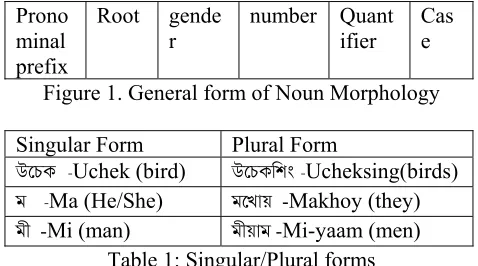
Figure 1 shows the general form of noun morphology in Manipuri. Examples of some singular/plural noun forms are listed in Table 1.
Prono minal prefix
Root gende r
number Quant ifier
Cas e
Figure 1. General form of Noun Morphology
Singular Form Plural Form
=ä»JôEõ
-
Uchek (bird)=ä»JôEõ×`e
-
Ucheksing(birds)]
-
Ma (He/She)]ãFçÌ^
-Makhoy (they)]Ý
-Mi (man)]ÝÌ^ç]
-Mi-yaam (men) Table 1: Singular/Plural formsAlthough case markers are functionally inflectional, they exhibit the clitic like characteristic of docking at the edge of a phrase. The word structure of rules of verbs and nouns are identical except for the category of the word level node, the possible terminal elements of the derivational and inflectional categories and the lack of the third level nominal derivation. Two examples to demonstrate the noun morphology are given below:-
]JôçXÇYÝ×`eXç
(mə-ca-nu-pi-siŋ-nə) ’by his/herdaughters’
]JôçXÇYç×`eXç
(mə-ca-nu-pa-siŋ- nə) ’by his/her sons’The
]
-
mə ‘his/her’ is the pronominal suffix andJôç
-ca ‘child’is the noun root. TheX
Ç -
nu ‘human’ is suffixed byYÝ
-pi to indicate a female human andYç
–pa to indicate a male human.×`e
–siŋ oråFç+
-khoy orÌ
^ç]
– yaam can be used to indicate plurality. -siŋcannot beused with pronouns or proper nouns and -khoy
cannot be used with nonhuman nouns.
Xç
-nə meaning ‘by the’ is the instrumental case marker.5.2 Pronouns
The singular personal pronouns are
B
-əy ‘I’,Xe
-nəŋ‘you’ and
]ç
-ma ‘he/she’. Possessive pronouns areformed through the suffixation of
×Eõ
-ki ‘genitive’ on these personal pronouns. Indefinite pronouns are also lexicalized forms that consists of a question word which may be followed byaÇ
-su ‘also’ or the sequenceEÇõ¶‘ö
-kumbə composed ofEÇõ]
–kum, ‘like’, ‘kind of’ and[ý
–bə ‘nominalizer’. The strategy for creating relative clause in Manipuri is to place the relativized noun directly after a normalized clause; there is no relative pronoun to mark the relative clause. The determiner may occur either as an independent pronoun or encliticized on the noun phrase with no difference in meaning. The determiners×a
–si ‘proximate’ andTÇ
–tu ‘distal’ are stems that function as enclitics.×a
–si indicated that the object or person being spoken of is near or currently seen or known to be near., even if not viewable by the speaker, or is currently the topic of conversation;TÇ
ö
-tu signifies something or someone not present at the time of speech or newly introduced in the conversation. Possessive pronominal prefix may be affixed to the root`ç
sa ‘body’ to form pronouns emphasizing that the subject of the verb is a particular person or thing and no one or nothing else:+`çXç
isanə ‘by myself’X`çXç
nəsanə ‘by yourself’ and]`çXç
məsanə ‘by him/her/itself/. The set of Manipuri Pronominal prefixes differ for different persons (+
{I} for 1st person,X
{Na} for 2ndperson and
]
{Ma} for 3rd person) while the set ofpronominal suffixes differ only on gender (
Yç
–pa for masculine gender,YÝ
-Pi for feminine gender).5.3 Verbs
Verbs roots are in the actual lexicon and are bound forms. A verb may be free standing word if it is minimally suffixed by an inflectional marker. The verb root may also be followed by one of the enclitics. Three derivational categories may optionally precede the final inflectional suffix. The 1st LD suffixes signal adverbial meanings, the 2nd LD
a verb, or the number of persons performing the action and the 3rd LD suffixes signal aspect and
mood. Verb roots may also be used to form verbal nouns, adjectives and adverbs. Verbal nouns are formed through the suffixation of the nominalizer
Yç
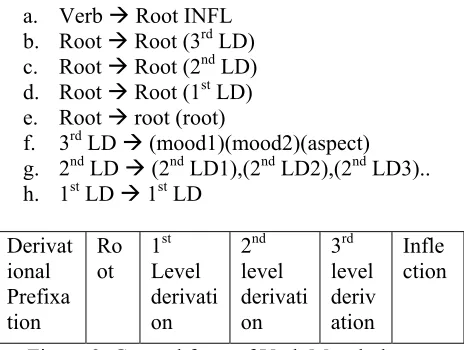
–pə to the verb root.The following is the list of word structure rules for verbs (Chelliah, 1997)
a. Verb Æ Root INFL b. Root Æ Root (3rd LD)
c. Root Æ Root (2nd LD)
d. Root Æ Root (1st LD)
e. Root Æ root (root)
f. 3rd LD Æ (mood1)(mood2)(aspect)
g. 2nd LD Æ (2nd LD1),(2nd LD2),(2nd LD3)..
h. 1st LD Æ 1st LD
Derivat ional Prefixa tion
Ro ot
1st
Level derivati on
2nd
level derivati on
3rd
level deriv ation
Infle ction
Figure 2. General form of Verb Morphology
There are 3 categories (mood1, mood2, and aspect) belonging to the third level derivational (3rd
LD) markers. The general form of verb morphology is shown in figure 2.
The sub-categorization frames of affixes will restrict that only nominal affixes occur with a noun and verbal affixes occur with a verb root. The derivational suffix order of the word
æ»JôEõFç+Ì[ýhõ×X
is given below:-æ»JôEõ Fç+Ì Ì[ýEõ E ×X
cek –khay -rək -kə -ni crack -totally affect -distal -potential –copula (1st LD) (2nd LD) (3rd LD)
The
Ì[ýEõ
-rək has allomorph_Eõ
-lək.Ì[ýEõ
-rək occurs after vowels while_Eõ
-lək occurs after consonants. Such allomorph is an example of orthographic change and it is taken care by the system by making individual entries into the dictionary.»
JôçÌ[ýEõA
–ca-rək-y (ate there and came here)»
Jôç¶ÚöEõA
– cam-lək-y (washed there and came here)The formation of verb can be of the form
Verb stem + aspect/mood Æ verb
UEõ
-thək (drink) +ã_
-le-ÆUEõã_
thəkle (has drunk)The verbal noun is formed with the rule as given as
Verb Stem + Nominalizer Æ Verbal noun
åUçe
-thong (cook)+[ýç
-ba ÆåUçe[ýçý
thongba (to cook)5.4 Adjectives
An adjective is derived through the affixation of the attributive, derivational prefix
%
ə- to a verbal noun. e.g.%
-ə + Verbal noun Æ Adjective%
-ə +×a
-si (die) +[ýç
-ba–>%×a[
ýç əsiba (somethingdead)
Adjectives may appear before or after the nouns they modify. Possessive adjectives are formed through the suffixation of the genitive marker
×Eõ
–ki to the possessor of a noun.5.5 Adverbs
Manner adverbs are formed through suffixation of
Xç
–nə ‘adverbial’ to a verb root. e.g.å_çÌ^Xç
loynə ‘completely, all’ from loy ‘complete,finish’. e.g.,Stem +
Xç
-na Æ AdverbEõY
-Kəp(cry)+Xç
- na –>EõYXç
-kəp-na(cryingly)Locative adverbs are derived through the prefixation of
]
mə ‘noun marker’ to a noun or verb roots. e.g.]Fç
məkha ‘below, underneath’ fromFç
kha ‘south’6 Morphological analyses of some minor
lexical categories
6.1 Quantifiers
Most quantifiers in Manipuri are lexicalized forms consisting of the unproductive prefix khV- (where the vowel can be a, i, u). These are
FÌ[ýç
-khəra ‘some’ which indicates an indeterminate amount;×FTe
-khitəŋ ‘ever so little, a particle’ of some tangible material.These quantifiers can be combined as in<×`e FÌ[ýç ×FTöe YÇÌ[ýEõ=.
Ishiŋ khəra khitəŋ purək-u
‘Bring me just a little bit of water’.
6.2 Numerals
The numerals are nouns. Ordinal numerals are adjectives, derived through the affixation of the attributive prefix
%
–ə and the nominalizer[ýç
–bə to any numeral with£
–su ‘also’: thus%×X£[ýç
ənisubə ‘second one’.6.3 Interjections
The lexical items of this category which is defined on the semantic similarity of its members, all express strong emotion. Some of these are composite forms where one syllable is identifiable as the exasperative enclitic
åc÷
–he and the second syllable is not identifiable as a productive affix or stem.7 Manipuri Tagset
The basic Manipuri POS tag set used in the POS tagger is listed below.
EÇõyÇÔ EÇõyÇÔ
kukru kukru (a pigeon’s cry) is ideophone.TÇö
tu ‘that’ is a determiner.c÷çÌ^[ý×`
haybasi is a determiner complementizer.Sl. No. Category
name
Tag
1 adjective ADJ
2 adverb ADV
3 conjunction CONJ
4 complementizer CMP
5 determiner DET
6 ideophone IDEO
7 interjection INTJ
8 noun N
9 pronoun PN
10 quantifier QU
11 verb VB
12 Verbal noun VN
13 Unknown UNK
Table 2. Manipuri POS tagset
8 Design of Manipuri POS tagger
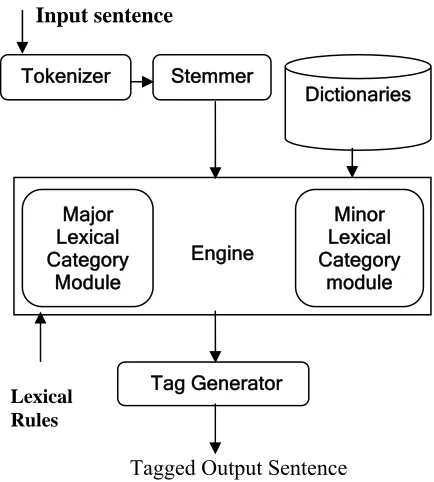
In Manipuri, the basic POS tags are assigned to the words on the basis of morphological rules. Figure 3 shows the system diagram of Manipuri POS tagger.
Input sentence
Lexical Rules
Tagged Output Sentence
Figure 3. System Diagram
The different parts involved in the system are:-
a. Tokenizer: Words are separated based on
the space given between consecutive words.
b. Stemmer: It separates the prefixes and
suffixes from the words.
c. Engine: Different analysis and treatment of
different words are performed based on the category.
d. Tag Generator: Tags are assigned to the
words in the sentence input based on the tagset and morphology rules.
e. Dictionaries: Prefix, suffix and word
dictionary along with sentences using the words are maintained.
Tokenizer Stemmer
Engine Major
Lexical Category
Module
Minor Lexical Category
module Dictionaries
8.1 Algorithm of POS tagging
Algorithm used for tagging is as follows:-
1. Input the Manipuri input texts to the Tokenizer.
2. Repeat steps 3 to 6 until the end of the texts for each token.
3. Feed the tokens to the stemmer.
4. Check the patterns and order of the different morphemes by looking at the stem category. 5. Apply the handcrafted morphological rules
for identifying the category using the engine. 6. Generate the POS tags using Tag generator. 7. End.
The Visual C++, MsAccess and GIST SDK are used to develop the system. The Manipuri words are entered into the dictionary using Bengali script (BN1 TTBidisha font).
9 Evaluation
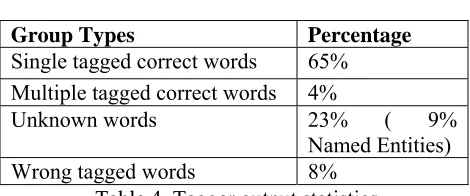
In Manipuri, word category is not so distinct except Noun. The verbs are also under bound category. Another problem is to classify basic root forms according to word class although the distinction between the noun class and verb classes is relatively clear, the distinction between nouns and adjectives is often vague. Distinction between a noun and an adverb becomes unclear because structurally a word may be a noun but contextually it is adverb. Thus, the assumption made for word categories are depending upon the root category and affix information available from the dictionaries. At the moment, we use a sequential search of a stem from the root dictionary in alphabetical order. It is found to be suitable for small size dictionary. Further a part of root may also be a prefix which leads to wrong tagging. The verb morphology is more complex than that of noun. A comparative study on the number of words tagged by the system and manually tagged had been carried out. The inputs of 3784 Manipuri sentences of 10917 unique words as input to the tagger engine. Sometimes two words get fused to form a complete word. Handling such collocations is difficult. Conjuncts require a separate dealing using a table. Verbs, nouns and noun phrases, subordinate sentences, and root sentences can be affixed by enclitics. Table 4 shows the percentage statistics of tagging output based on the actual and correctly
tagged words. The accuracy of tagging can be further improved by populating more root morphemes to the root dictionary.
No. of single correct tags
Accuracy percentage= X 100
Total no. of tokens
Group Types Percentage
Single tagged correct words 65% Multiple tagged correct words 4%
Unknown words 23% ( 9%
Named Entities)
Wrong tagged words 8%
Table 4. Tagger output statistics
The unknown words are the words which could not be tagged based on the linguistic rules and unavailability of entries mainly in root dictionary. In the process of word formation, only affixation: prefixing, suffixing or compounding takes the role of formation of new words in this language. Due to the fact that new words are easily formed in Manipuri, thus the number of unknown words (out of vocabulary) is relatively large (Sirajul et al., 2004).
10 Challenges for future work
The noun group words handling are not incorporated. For example
%FçEõ %Ì[ýçC
(pronounced as əkhak əraw) meaning thunderbolt,%Iø] %Ì[ýç+ FIøV[ýç
(pronounced as əŋam əray khəŋdəba) meaning wanton are noun group words and are not tagged by the POS tagger correctly. The Noun-Adjective ambiguity disambiguation scheme is required as a separate module and implementations are to be included in the future work. The Manipuri tagging is very much dependent on the morphological analysis and lexical rules of each category. There is a cleaning process of all word and morphemes specially the spelling to ensure that the lexical rules are implemented. This has not yet been implemented. Collocations handling and more disambiguation rules will be developed in further phases of the work. The output of the POS tagger will be used in a Manipuri-English machine translation system.
References
with parts of speech. In DARPA Workshop on Speech and Natural Language. San Mateo, CA, 1992, Morgan Kaufman.
Eric Brill. 1992. A simple rule-based part of speech tagger. In Proceedings Third Conference on Applied Natural Language Processing, ACL, Trento, Italy.
Eric Brill. 1995. Transformation-Based Error Driven Learning and Natural Language Processing: A case study in Parts-Of-Speech tagging. Computational Linguistics 21(94): pp 543-566.
Sachin Burange, Sushant Devlakar, Pushpak Bhattacharyya. 2006. Rule Governed Marathi POS Tagging. In Proceeding of MSPIL, IIT Bombay, pp 69-78.
Shobhana L. Chelliah. 1997. A Grammar of Meithei. Mouton de Gruyter, Berlin, pp 77-92.
Sirajul Islam Choudhury, Leihaorambam Sarbajit Singh, Samir Borgohain, P.K. Das. 2004. Morphological Analyzer for Manipuri: Design and Implementation. In Proceedings of AACC, Kathmandu, Nepal, pp 123-129.
D. Cutting. 1992. A practical part-of-speech tagger. In Proceeding of third conference on Applied Natural Language Processing. ACL, 1992. pp 133-140.
J. Hajic, P. Krbec, P. Kveton, K. Oliva, V.Petkevic, 2001. A Case Study in Czech Tagging. In proceedings of the 39th Annual Meeting of the ACL.
S. Imoba. 2004. Manipuri to English Dictionary. S. Ibetombi Devi, Imphal.
K. Oflazer, I Kuruoz. 1994. Tagging and morphological disambiguation of Turkish text. In Proceedings of 4th ACL conference on Applied Natural Language Processing Conference.
A. Ratnaparakhi. 1996. A maximum entropy Parts-Of-Speech Tagger. In Proceedings EMNLP-ACL. pp 133-142.
Smriti Singh, Kuhoo Gupta, Manish Shrivastava, Pushpak Bhattacharya. 2006. Morphological Richness offsets Resource Demand – Experiences in constructing a POS tagger for Hindi. In Proceedings of COLING-ACL, Sydney, Australia.
Ch. Yashawanta Singh. 2000. Manipuri Grammar. Rajesh Publications, New Delhi.
P.C. Thoudam. 2006. Problems in the Analysis of Manipuri Language. www.ciil-ebooks.net, CIIL, Mysore.