Improving Part-of-speech Tagging for Context-free Parsing
Xiao Chen and Chunyu Kit
Department of Chinese, Translation and Linguistics City University of Hong Kong
Tat Chee Avenue, Kowloon, Hong Kong SAR, P. R. China {cxiao2,ctckit}@cityu.edu.hk
Abstract
In this paper, we propose a factored pars-ing model consistpars-ing of a lexical and a constituent model. The discriminative lex-ical model allows the parser to utilize rich contextual features beyond those encoded in the context-free grammar (CFG) in use. Experiment results reveal that our parser achieves statistically significant improve-ment in both parsing and tagging accuracy on both English and Chinese.
1 Introduction
Part-of-speech (POS) tagging, or tagging for short, is usually considered a front-end preparation for parsing. Folk wisdom holds that accurate tagging result is helpful to alleviate the syntactic ambigu-ity problem in parsing, motivating a huge amount of research on perfecting tagging techniques.
In the past two decades, most POS tagging systems were based on a sequential classifica-tion approach, decomposing a sequence label-ing task into a series of classification subtasks. The state of the art of tagging was achieved by virtue of well-developed machine learning meth-ods, e.g. the Maximum Entropy model as in Rat-naparkhi (1996) and the Support Vector Machine as in Gimenez and Marquez (2003). All these techniques boosted the performance of POS tag-ging significantly. The error rate of the best En-glish POS tagger is less than 3% (Ratnaparkhi,
1996; Toutanova et al., 2003; Shen et al., 2007), very close to the inter-annotator discrepancy of the Penn Treebank (Marcus et al., 1993).
For a long time, however, parsing seems to have been evolving in parallel to tagging with-out much interaction with each other. Generative parsers (Collins, 1997; Charniak, 2000; Charniak and Johnson, 2005; Petrov and Klein, 2007), ow-ing to their generative nature, all include a
lexi-cal probability model in the formP(w|t). The in-formation used to predict the POS tag of a word mainly comes from the word itself and/or the an-cestors that derive this word in a tree. Local con-text, which is proved to be the most useful in-formation source for tagging (Ratnaparkhi, 1996; Toutanova and Manning, 2000), is not efficiently utilized by these parsers. Another noticable fact is that these high-performance parsers cannot do a better job of POS tagging than most of the state-of-the-art taggers (see Section 4 for a comparison). This is quite against our intuition that a parser hav-ing access to syntactic and contextual information from all over an input sentence should outperform a tagger that is limited to utilizing only local con-text and sequential dependency. This is an obser-vation in Charniak et al. (1996). But their explana-tion is that a parser is built to find phrase markers, not tags. Then an interesting question arises: if a parser cannot tag words better, how can we expect it to do better on phrases?
Driven by this question, our research is in-tended to explore an approach to integrating pars-ing with the strength of successful taggpars-ing, in the hope of improving both. Firstly, we factor the conventional PCFG-based parsing into a lexical and a constituent model. Then, two candidate lexical models are formulated to incorporate en-riched contextual features and sequential depen-dency into the parsing, with an averaged percep-tron algorithm for parameter estimation. Our ex-periments on English and Chinese treebanks show that this approach achieves a significant perfor-mance enhancement in both parsing and tagging over the baseline Berkeley parser.
2 A Factored Parsing Model 2.1 POS Tagging in Parsing
For PCFG-based parsing, the joint probability P(T, S)for a parse treeT of a sentenceS is
ally defined as the product of the probability of every CFG ruleRinvolved inT:
P(T, S) = Y R∈T
P(R)|R| (1)
where|R|is the number of occurrences ofRinT.
In a CFG, such as the one induced from the Penn Treebank, there are usually two types of grammar rules:lexical rule, e.g.NN→consumer, to indi-cate a possible POS-tag for a word, andconstituent rule, e.g. PP→ IN NP, to indicate the composi-tion of a constituent.
Letr denote a lexical rule andR a constituent
rule, the probability defined in (1) can be rewritten as
P(T, S) = Y
R∈T
P(R)|R|Y
r∈T
P(r)|r| (2)
Accordingly, the parsing model can be decom-posed into two factors:
P(T, S) =P(C, S)P(L, S) (3)
whereP(C, S) =QR∈T P(R)|R|is a constituent
model and P(L, S) = Qr∈T P(r)|r| a lexical model. The best parse is then selected by the joint inference with these two submodels. This factored-out lexical model provides the flexibility of integrating various well-developed POS tagging techniques into parsing, and it is also easier for op-timization, in contrast to a complex joint model. It is reasonable that a better lexical model is ex-pected to have better effects on parsing.
2.2 Product of Experts
The two separated models may score in different magnitudes, even if they are all properly normal-ized. Usually, when combining two heterogeneous models, a weighting scheme is needed to balance their unequal effect. For this, we introduce another parameterλto our factorized parsing model as
P(T, S) =P(L, S)λP(C, S) (4)
This is known as a product-of-experts (Hinton, 2002; Cohen and Smith, 2007), where a combined distribution is defined by multiplying several com-ponent distributions and renormalizing them. The parameter λ can be tuned with the Gold Section
Search algorithm (Press et al., 2007) on a devel-opment set, using the F-measure of PARSEVAL (Black et al., 1991) as objective function for train-ing.
3 Lexical Model 3.1 Model I
Sequential dependency and local context have shown their strength in tagging disambiguation (Ratnaparkhi, 1996; Toutanova and Manning, 2000; Toutanova et al., 2003). However, in the high-performance PCFG-based parsers (Collins, 1997; Charniak, 2000; Petrov and Klein, 2007), none of these features can be used due to the gen-erative nature of these parsing models.
To address this problem and incorporate the ad-vantages of POS tagging technique into parsing, we propose a discriminative lexicon model follow-ing the global linear model (Collins, 2002). Let
τ = {t0, t1, t2...tn} be a tag sequence for a
sen-tenceS={w0, w1, w2...wn}, we define the score
of a tagged sequence to be
SCORE(τ, S) =θ·f(τ, S) =
n
X
i=1
θ·f(τi, S) (5)
where f(τ, S) is a global feature vector and θ a
vector of associated weights. A global feature is defined through a collection of local features
f(τi, S). We trainθon a treebank using an
aver-aged perceptron algorithm similar to the one pre-sented in Collins and Duffy (2002) and Collins (2002). The number of iterations needed is opti-mized on the development set.
However, introducing sequential dependency into this lexical model would cause a severe ef-ficiency problem with the joint inference for pars-ing. When the Viterbi algorithm is used to search for the best parse tree, its efficiency relies heav-ily on tree structure. The interdependency of adja-cent POS tags actually changes the structure of the parse under operation. For example, to determine the best sub-tree for a non-terminalXPcovering a span of words[wi...wj], we need to calculate the
score for wi’s tag, which may largely depend on
wi−1’s tag. Unfortunately, such information is not
available from the current word span under pro-cessing. The inference algorithm thus has to keep all possible sub-trees in memory, resulting in an intractable inference problem.
To deal with this joint inference problem, we approximate the lexical model in a unigram-factored form:
P(L, S) =P(L|S)P(S)∝ Y
i∈[0,n]
whereP(S)is the probability of a given input sen-tence, a constant that can be dropped if search only for the best parse, and ti a candidate tag for wi.
The conditional distribution P(ti|S) can be
esti-mated by
P(ti|S) =
P
τ∈T(ti)exp (SCORE(τ, S))
P
τ0∈Texp (SCORE(τ0, S)) (7)
whereTis the set of all possible tag sequences for
S, and T(ti) a subset of T, consisting of all tag
sequences that contain ti. The numerator is the
sum of scores for all possible tag sequences with
tiforwi. The denominator is the total score of all
possible tag sequences of the input sentence. For efficient calculation, we also adopt variants of the forward and backward algorithm, which are sim-ilar to those for HMM (Baum and Eagon, 1967; Baum and Sell, 1968). Different from the conven-tional tagging systems, our lexical model does not generate the best tag sequence for the whole sen-tence, but a lattice of tags, on which the joint infer-ence with the constituent model can be performed. In our model, feature functions fm(τi, S) are
primarily binary, each of which maps the local context to 1 if its feature exists, or to 0 other-wise. The only exception is the first one. Using a similar design as in discriminative re-scoring pars-ing models (Collins, 2000; Charniak and Johnson, 2005; Huang, 2008), we have the first featuref0to
be the logarithm of the probability oftibeingwi’s
tag inS, as proposed in Petrov and Klein (2007),
which isf0(τi, S) = logq(ti, S).1
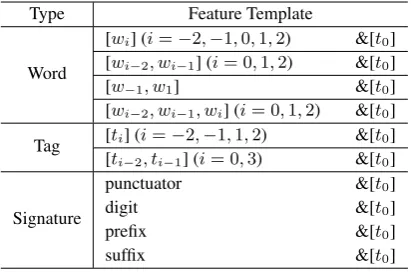
Beside f0(τi, S), all other features are similar
to those in the previous works (Ratnaparkhi, 1996; Toutanova et al., 2003; Shen et al., 2007), as listed in Table 1.
The signature featuresprefixandsuffix, as used in Toutanova et al. (2003), each return a sub-string of certain length from the current word. In our experiments, this length ranges from 1 to 8. Since these prefix and suffix features are blindly extracted with templates that can be ap-plied to any language, our lexical model is more
1In the lexical model, fort
i=A(a non-terminal symbol),
the scoreq(ti, S)is calculated by:
q(ti, S) = P
xO(Ax, i, i+ 1)P(Ax→wi)
I(ROOT,0,|S|) (8)
wherexis the latent variable (Petrov et al., 2006), andI(·)
andO(·)areinsideandoutsidescores. For more details of q(ti, S), please refer to Figure 3 in Petrov and Klein (2007).
Type Feature Template
Word
[wi] (i=−2,−1,0,1,2) &[t0] [wi−2, wi−1] (i= 0,1,2) &[t0] [w−1, w1] &[t0] [wi−2, wi−1, wi] (i= 0,1,2) &[t0] Tag [ti] (i=−2,−1,1,2) &[t0] [ti−2, ti−1] (i= 0,3) &[t0]
Signature
punctuator &[t0]
digit &[t0]
prefix &[t0]
suffix &[t0]
Table 1: Feature templates of lexical model
language-independent than those using a prede-fined language-specific affix list.
For feature selection, we also follow other re-searchers’ previous works to use a simply cut-off threshold. During the process to generate features for each word in the training treebank, a feature is not included in the final model if its count falls be-low a predefined threshold. We set the threshold to 2 for word and tag features, and to 35 for signature features.
3.2 Model II
The lexical model I enables the parsing to utilize a large variety of features other than those encoded in the CFG in use. However, the computation of forward/backward variables is expensive in both time and space. This inefficiency is practically more severe in training, which requires repetitive computation of these values for many times. Lex-ical model II is proposed as an aggressive approx-imation of model I, aimed at improving its effi-ciency at the least cost of performance.
The inefficiency of model I is primarily due to the complexity of the forward/backward proce-dure. For model II, we propose a lazy procedure as a simple approximation, which calculates the conditional probabilityP0(ti|S)deterministically
from left to right. As the procedure proceeds, all features that contain a preceding tag are instanti-ated with the best predicted tags for those previ-ously processed words. For the features that con-tain a succeeding tag, we use the tag with the high-est score byf0(τi, S). This lazy procedure traces
only one arbitrary best tag sequence. Its time com-plexity is linear in the length of input sentence.
distribu-tionP0(ti|S)is estimated as
P0(ti|S)∝
exp (θ·f(τi∗, S))
P
j∈[0,n−1], tj∈E(S)
exp (θ·f(τ∗
j, S))
(9)
where τi∗ is the arbitrary best tag sequence and E(S) the collection of all possible POS tags for
every word inS. The denominator is introduced for two reasons. Firstly, it is used to map the score of everytito the interval[0,1], so as to make the
lexical model to have the similar magnitude as the constituent model. Secondly, we deliberately let it not to be a local normalizer. This allows some confident tags to vote stronger than others in the joint inference.
4 Experiments
We implement a parser for experiments with nec-essary support from the open source Berkeley parser. To evaluate the performance of this pars-ing model across languages, we conduct a number of experiments on both English and Chinese tree-banks, using the WSJ section of Penn Treebank 3.0 (LDC99T42) and the Chinese Treebank 5.1 (LDC2005T01U01). Since both the constituent and lexical models use the PCFG-LA trained with the Berkeley parser,2 we take it as the baseline
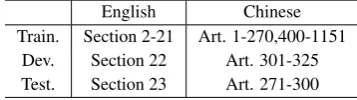
for our evaluation. For comparison purpose, we use exactly the same splits of the treebanks as in Petrov and Klein (2007), as listed in Table 2.
English Chinese Train. Section 2-21 Art. 1-270,400-1151
Dev. Section 22 Art. 301-325 Test. Section 23 Art. 271-300
Table 2: Experiment Setup
As mentioned in Section 3, the parameter es-timation for the lexical model requires reparsing the training treebank in use for calculatingq(ti, S)
with the PCFG-LA trained with the Berkeley parser. In order to obtain a representative set of training examples, the PCFG-LA is expected to create as much noise as it does in testing. For this, the training set for each language is divided into 20
2The version released in September, 2009. The option “-Chinese” is not used for parsing Chinese, for it does not give the best parsing performance. All the PCFG-LA men-tioned in this paper are trained with this version of the Berke-ley parser with default settings.
folds as in Collins (2000) and Charniak and John-son (2005). Each fold is reparsed with the PCFG-LA trained on the other 19 folds. The number of split-and-merger iterations is set to 6 for the train-ing of all these grammars on the treebanks of both languages.
To examine how much the rich contextual fea-tures introduced into the lexical model improve parsing performance, the tagging accuracy of our parser is compared with the state-of-the-art tag-gers, e.g. the open source Stanford tagger. Al-though this tagger was developed several years ago, its performance on English is still in the lead according to Spoustov´a et al. (2009). We train and test this tagger on the same datasets as for pars-ing, using the default parameter settings for each language.
All parsing results are evaluated with the stan-dard evalb. It is noteworthy that the tags are not counted as part of parsing output. The tag-ging accuracy has to be evaluated with our own program, for evalb eliminates some DELETE LABELs when evaluating tagging.
4.1 Tagging Helps Parsing
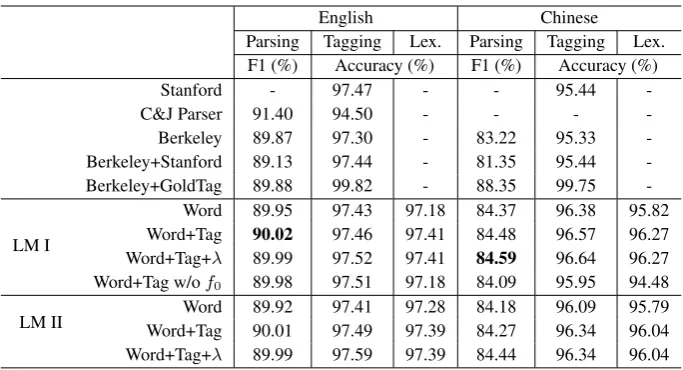
Table 3 compares the performance of our parser and other baseline systems. When trained on the same data set, the Stanford tagger indeed out-performs the Berkeley parser and the re-scoring parser3on POS tagging for both languages. Then,
we impose various tagging results into parsing to see how they affect parsing performance. Both the gold POS tags and the output of the Stanford tag-ger are submitted to the Berkeley parser, using the “-goldPOS” option. The results are presented in Table 3, denoted asBerkeley+GoldTagand Berke-ley+Stanfordrespectively.4 Surprisingly, however
a significant loss of parsing performance is caused by imposing the better yet non-perfect tagging output of the Stanford tagger onto the Berkeley parser. We can see that better tagging does not necessarily improve parsing if the two separate systems work in the conventional “tag then parse” order.
The two lexical models are tested in the other experiments. We use all features as listed in Table
3C&J Parser: the open source re-scoring parser of Char-niak and Johnson (2005)
English Chinese
Parsing Tagging Lex. Parsing Tagging Lex. F1 (%) Accuracy (%) F1 (%) Accuracy (%)
Stanford - 97.47 - - 95.44
-C&J Parser 91.40 94.50 - - -
-Berkeley 89.87 97.30 - 83.22 95.33
-Berkeley+Stanford 89.13 97.44 - 81.35 95.44 -Berkeley+GoldTag 89.88 99.82 - 88.35 99.75
-LM I
Word 89.95 97.43 97.18 84.37 96.38 95.82 Word+Tag 90.02 97.46 97.41 84.48 96.57 96.27 Word+Tag+λ 89.99 97.52 97.41 84.59 96.64 96.27 Word+Tag w/of0 89.98 97.51 97.18 84.09 95.95 94.48 LM II Word+TagWord 89.9290.01 97.4197.49 97.2897.39 84.1884.27 96.0996.34 95.7996.04 Word+Tag+λ 89.99 97.59 97.39 84.44 96.34 96.04
Table 3: Results on English and Chinese testing sets (all sentences).
1 for English. For Chinese, however, we select a smaller subset of it by removing word trigram tem-plates and all tag temtem-plates that contain any tag to the right of the current word.5 We find that using
such tags as features cause a loss of performance, which is consistent with the default setting of the Stanford tagger for Chinese. Another difference in feature design for these two languages is the length of prefix and suffix. The max length of affix is set to 6 for English and 3 for Chinese. This is because the average word length is different in the two lan-guages. And we use no specific Chinese characters for the feature templates ofpunctuatoranddigit, in order to maintain the language independency of our models as much as possible.
As presented in Table 3, our parser with both candidate lexical models performs significantly better than the baseline Berkeley parser.6 For
Chi-nese, the best labelled F-score 84.59% is 1.3% be-yond the baseline 83.22%. For English, our best result 90.02% is even better than 89.88% using gold POS tags. It is evident that our enhanced lex-ical model can effectively help parsing. With its help, our parser also outperforms both the Berke-ley parser and the Stanford tagger on tagging. The observation that the improvement on English looks not as much as that on Chinese could be ex-plained by the fact that the tagging accuracy of En-glish is very close to the inter-annotator discrep-ancy of the Penn Treebank, leaving a too tiny room for further improvement. According to Dalrymple
5Specifically, tag templates withi >0are removed for experiments on Chinese.
6All results are tested with Dan Bikel’s Randomized Parsing Evaluation Comparator (http://www.cis.upenn.edu/ ∼dbikel/download/compare.pl), resulting inp <0.05.
(2006), parsing ambiguity in about 30% sentences cannot be reduced even by a perfect tagger, imply-ing that improvimply-ing taggimply-ing may only have a lim-ited influence on parsing.
We also examine the effect of different feature set in both lexical models. With only word fea-tures, the parser already achieves some improve-ment on both parsing and tagging, in consistence with the findings in Toutanova et al. (2003). The surrounding words provide most information for the disambiguation for tagging. However, the weight parameter λseems not as effective as
ex-pected for English. This might be caused by the overfitting when it is tuned it on the development set. We also try to remove the feature f0 from
the model (w/of0). Then, the performance is still
higher than the baseline Berkeley parser, indicat-ing that the effectiveness of our lexical model does not rely on this feature too much. More interest-ingly, the approximate deterministic lexical model II achieves a similar performance as the complex lexical model I. In practice, model II is a better choice with a lower computational complexity.
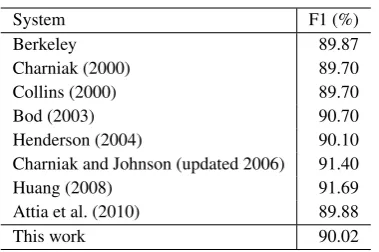
System F1 (%)
Berkeley 89.87
Charniak (2000) 89.70
Collins (2000) 89.70
Bod (2003) 90.70
Henderson (2004) 90.10
Charniak and Johnson (updated 2006) 91.40
Huang (2008) 91.69
Attia et al. (2010) 89.88
This work 90.02
Table 4: Comparison with other parsers on English testing set
System F1 (%)
Berkeley 83.22
Burkett and Klein (2008) 84.24
This work 84.59
Table 5: Comparison with other parsers on Chi-nese testing set
4.2 Comparison with Previous Work
Table 4 and 5 compare the performance of our parser with other high-performance parsers. Those parsers using self-training or parser com-bination methods are not included in this compari-son, because they use extra resources or more than one parsing model.
For English, our parser outperforms all genera-tive parsers (Collins, 1997; Charniak, 2000). But there is still a gap to the discriminative re-scoring methods (Charniak and Johnson, 2005; Huang, 2008). Given that our parser only improves the lexical model, the re-scoring method using a va-riety of subtree features indeed has some advan-tages. For Chinese, our parser has achieved the best performance so far on this data set. It is even better than the one that employs additional knowl-edge from the Chinese-English Parallel Treebank (Burkett and Klein, 2008).
5 Analysis
The experiments reported in the previous section seems to give a positive answer to the question: whether tagging can help parsing. However, sev-eral other questions follow: How does tagging af-fect paring? Why can this independently opti-mized lexical model improve parsing? We will look into these issuess in this section.
5.1 Profiling the Improvement of Tagging We firstly divide the word/tag pairs in the testing data into to two groups: known v.s. unknown,
ac-English Chinese Known Unk. Known Unk. Stanford 98.09 77.33 96.47 72.02 Berkeley 97.93 76.13 96.91 59.23 This work 98.09 80.04 97.59 73.81
Table 6: Tagging accuracy (%) for known and un-known word/tag pairs
cording to the definition in Jin and Chen (2009). The tagging performance of our parser and the two baseline systems are compared in Table 6.
It is evident that our parser outperforms the Berkeley parser on both groups. The contrast on unknown tags is more significant, especially for Chinese. Since our parser uses the same con-stituent model as the Berkeley parser, this differ-ence has to be explained by a better lexical model. A similar case can also be observed when our parser is compared against the Stanford tagger. Since our lexical model uses a very similar feature set as the Stanford tagger, the difference in per-formance should be attributed to the constituent model, which provides more detailed contextual information from the whole sentence to facilitate guessing unknown POS tags.
5.2 Profiling the Improvement of Parsing In order to profile the parsing errors that can be fixed by better tagging, we count the number of correct constituents in the output of our parser and the other systems for a comparison under a variety of partition schemes, as shown in Table 7 and 8. The span length of a constituent is the number of words in it. Usually, a longer span correlates with a higher position near the root in a parse tree.
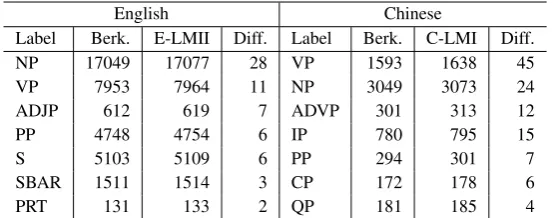
Table 7 shows that correct constituents increase in number in almost all types. Without any feature designed for a specific POS tag (such asIN), our lexical model brings about a general improvement to the parsing of both languages. Interestingly, however, the comparison in Table 8 presents a dif-ferent view. The improvement mainly takes place in the constituents of span length≤ 4, especially
English Chinese
Label Berk. E-LMII Diff. Label Berk. C-LMI Diff.
NP 17049 17077 28 VP 1593 1638 45
VP 7953 7964 11 NP 3049 3073 24
ADJP 612 619 7 ADVP 301 313 12
PP 4748 4754 6 IP 780 795 15
S 5103 5109 6 PP 294 301 7
SBAR 1511 1514 3 CP 172 178 6
PRT 131 133 2 QP 181 185 4
Table 7: Correct constituents by constituent label
English Chinese
Span Gold C&J. Berk. E-LMII Diff. Span Gold Berk. C-LMI Diff.
1 6543 6034 5995 6015 20 1 2951 2594 2645 51
2 7645 7186 7159 7173 14 2 1385 1210 1221 11
3 5633 5237 5181 5188 7 3 844 679 699 20
4 3509 3183 3172 3175 3 4 528 433 452 19
≥5 20852 18385 17947 17970 23 ≥5 2819 2234 2257 23
Table 8: Correct constituents by span length
statistics, about 34% of the constituents in the Chi-nese testing data are base-level ones. This explains why the impact of tagging to parsing for Chinese is much stronger than that for English. Since there are other languages that share similar characteris-tics with Chinese, our method should be also help-ful in parsing these languages.
Currently, tagging and parsing are treated equally in a unified framework of parsing. How-ever, our experiments show that our independently defined and optimized lexical model performs bet-ter than the one integrated into the Berkeley parser, especially for the recognition of the base-level constituents mentioned above. This is mostly at-tributable to the nature of a generative parsing model, for its lexical model can only use the fea-tures encoded in the grammar in use, which is never enough for accurate parsing. In fact, the research on POS tagging and chunking shows that the most important information for disam-biguation at this level comes from local context (Toutanova et al., 2003), especially the surround-ing words. Our current work is an attempt to fill this gap between tagging and parsing, by the way of enabling a parser to use rich contextual features in its lexical model.
6 Related Work
Most successful parsing models are generative models. Therefore, a large portion of previous re-lated work did not change the generative nature of the lexical models involved (Goldberg et al.,
2009; Huang and Harper, 2009; Attia et al., 2010). The key idea of these approaches is basically to advance smoothing techniques for the distribution P(w|t). Goldberg et al. (2009) adopt a trigram
HMM tagging model trained on unannotated data to help prediting tags of rare words, but only the emission probabilities are used in parsing. Huang and Harper (2009) propose a better way to smooth the lexical model in a PCFG-LA parser similar to the Berkeley parser. Some morphological features are also used to handle unknown words in Chi-nese. In their evaluation, however, they exclude all unary rules that cause one of the major difficulties in parsing this language, according to our exper-iments. Their experiment settings obstruct com-paring their results with others’. Attia et al. (2010) head in the same direction extending this method to other languages. Their experiment results are compared with ours in Table 4. The comparison shows that our method is more sophisticated in uti-lizing the sequential dependency between tags.
and non-local features, so as to boost the perfor-mance. Interestingly, however, the comparison in Table 3 shows that the parser of Charniak and Johnson (2005) achieves the highest parsing per-formance with the lowest tagging accuracy. This parser seems to select the parse trees that contain correct constituents with relatively poor POS tags. This controversial result raises at least two ques-tions: (a) Why correct constituent structures can be built on incorrect POS tags? (b) Does tag-ging have any effect on parsing? The first ques-tion points to the too strong generative capacity of the CFG in use. Note that without seman-tic and/or pragmaseman-tic knowledge as constraints, a CFG induced from a treebank usually can gener-ate many possible but implausible structures for an input sentence. For the second question, the con-troversial result indeed gives us an impression that tagging has no effect on parsing, strongly against our intuition. Since tagging and parsing are uni-fied into the same framework as a parser, it is rea-sonable to expect the correct tag sequence for a sentence to appear in the theoretically best parse tree. If a parser has to sacrifice tagging for pars-ing, it is suspectable that the re-scoring does not help the parser to reach its maximum capacity yet. Besides, the re-scoring method should have sub-sumed our current work. In fact, incorporating the sequential dependency between adjacent tags into the forest re-scoring model will also cause the ef-ficiency problem in the inference as mentioned in Section 3. Given that no feature for tagging has been adopted in the forest re-scoring method so far, our current work is certainly a complement to this part.
The recent work of Rush et al. (2010) inte-grates parsing and tagging under the framework of dual-decomposition. This approach has the advan-tage to combine heterogeneous models, and solves the complex combinatory optimization problem via Lagrangian relaxation. However, it has a in-evitable defect of inefficiency, since it requires to parse and tag the input sentence repetitively (usu-ally 10 times for each sentence). Comparatively, our approach is more efficient. Note that lexical model II takes only a linear time in the length of input sentence. Without systematic comparison, however, it is difficult to tell which approach can provide a better performance. We will keep this for our future research.
7 Conclusion
In this work, we have proposed a parsing model which is factored into a lexical and a constituent model, in the hope of enabling the beneficial in-teraction between tagging and parsing. The rel-atively independent discriminative lexical model allows our parser to incorporate rich contextual features and even sequential dependency. Our ex-periments show that our lexical models can help parsing. With access to the syntactic knowledge from all over an input sentence, this parser out-performs the state-of-the-art POS tagging system in terms of tagging accuracy. Moreover, tagging should be an organic part of a parsing model to bring in a mutual positive effect for both parsing and tagging through joint inference. The conven-tional notion of tagging-parsing pipeline seems to leave no room for this possibility of enhancement. Finally, individual words in an input sentence are found to be very useful in the disambiguation for POS tagging and even for recognizing base-level constituents. However, the structural param-eterization of conventional parsing models cannot incorporate and utilize them effectively. Neverthe-less, how to make use of all sorts of information available to enhance parsing is still a challenging research topic.
Acknowledgement
The research described in this paper was par-tially supported by the Research Grants Council (RGC) of HKSAR, China, through the GRF grant 9041597.
References
Mohammed Attia, Jennifer Foster, Deirdre Hogan, Joseph Le Roux, Lamia Tounsi, and Josef van Gen-abith. 2010. Handling unknown words in statistical latent-variable parsing models for Arabic, English and French. InNAACL HLT 2010, pages 67–75.
Leonard E. Baum and J. A. Eagon. 1967. An in-equality with applications to statistical estimation for probabilistic functions of Markov processes and to a model for ecology. Bull. Amer. Math. Soc., 73(3):360–363.
Leonard E. Baum and George R. Sell. 1968. Growth transformations for functions on manifolds. Pacific J. Math., 27(2):211–227.
San-torini, and T. Strzalkowski. 1991. A procedure for quantitatively comparing the syntactic coverage of English grammars. In Proceedings of DARPA Speech and Natural Language Workshop, pages 306–311.
Rens Bod. 2003. An efficient implementation of a new dop model. InEACL 2003, pages 19–26.
David Burkett and Dan Klein. 2008. Two lan-guages are better than one (for syntactic parsing). In
EMNLP 2008, pages 877–886.
Eugene Charniak and Mark Johnson. 2005. Coarse-to-fine n-best parsing and MaxEnt discriminative reranking. InACL 2005, pages 173–180.
Eugene Charniak, Glenn Carroll, John Adcock, An-thony Cassandra, Yoshihiko Gotoh, Jeremy Katz, Michael Littman, and John McCann. 1996. Taggers for parsers. Artif. Intell., 85:45–57.
Eugene Charniak. 2000. A maximum-entropy-inspired parser. InNAACL 2000, pages 132–139.
Shay B. Cohen and Noah A. Smith. 2007. Joint morphological and syntactic disambiguation. In
EMNLP-CoNLL 2007, pages 208–217.
Michael Collins and Nigel Duffy. 2002. New ranking algorithms for parsing and tagging: kernels over dis-crete structures, and the voted perceptron. InACL 2002, pages 263–270.
Michael Collins. 1997. Three generative, lexicalised models for statistical parsing. In ACL 1997, pages 16–23.
Michael Collins. 2000. Discriminative reranking for natural language parsing. In ICML 2000, pages 175–182.
Michael Collins. 2002. Discriminative training meth-ods for hidden Markov models: Theory and experi-ments with perceptron algorithms. InEMNLP 2002, pages 1–8.
Mary Dalrymple. 2006. How much can part-of-speech tagging help parsing? Nat. Lang. Eng., 12(4):373– 389.
Jesus Gimenez and Lluis Marquez. 2003. Fast and accurate part-of-speech tagging: The SVM approach revisited. InProceedings of the Fourth RANLP.
Yoav Goldberg, Reut Tsarfaty, Meni Adler, and Michael Elhadad. 2009. Enhancing unlexicalized parsing performance using a wide coverage lexicon, fuzzy tag-set mapping, and EM-HMM-based lexical probabilities. InEACL 2009, pages 327–335.
James Henderson. 2004. Discriminative training of a neural network statistical parser. In ACL 2004, pages 95–102.
Geoffrey E. Hinton. 2002. Training products of ex-perts by minimizing contrastive divergence. Neural Computation, 14(8):1771–1800.
Zhongqiang Huang and Mary Harper. 2009. Self-training PCFG grammars with latent annotations across languages. InEMNLP 2009, pages 832–841.
Liang Huang. 2008. Forest reranking: Discriminative parsing with non-local features. InACL-HLT 2008, pages 586–594.
Guangjin Jin and Xiao Chen. 2009. The fourth inter-national chinese language processing bakeoff: Chi-nese word segmentation, named entity recognition and Chinese POS tagging. InIJCNLP 2009, pages 69–81.
Mitchell P. Marcus, Mary Ann Marcinkiewicz, and Beatrice Santorini. 1993. Building a large anno-tated corpus of English: the Penn Treebank. Com-put. Linguist., 19(2):313–330.
Slav Petrov and Dan Klein. 2007. Improved inference for unlexicalized parsing. In HLT-NAACL 2007, pages 404–411.
Slav Petrov, Leon Barrett, Romain Thibaux, and Dan Klein. 2006. Learning accurate, compact, and in-terpretable tree annotation. InCOLING-ACL 2006, pages 433–440.
William Press, Saul Teukolsky, William Vetterling, and Brian Flannery. 2007. Numerical Recipes: the art of scientific computing. Cambridge University Press, 3rd edition.
Adwait Ratnaparkhi. 1996. A maximum entropy part-of-speech tagger. InEMNLP 1996, pages 133–142. Alexander M Rush, David Sontag, Michael Collins,
and Tommi Jaakkola. 2010. On dual decomposi-tion and linear programming relaxadecomposi-tions for natural language processing. InEMNLP 2010, pages 1–11.
Libin Shen, Giorgio Satta, and Aravind Joshi. 2007. Guided learning for bidirectional sequence classifi-cation. InACL 2007, pages 760–767.
Drahom´ıra “johanka” Spoustov´a, Jan Hajiˇc, Jan Raab, and Miroslav Spousta. 2009. Semi-supervised training for the averaged perceptron POS tagger. In
EACL 2009, pages 763–771.
Kristina Toutanova and Christopher D. Manning. 2000. Enriching the knowledge sources used in a maximum entropy part-of-speech tagger. In SIG-DAT EMNLP 2000, pages 63–70.