Building Systematic Reviews Using Automatic Text Classification
Techniques
Oana Frunza, Diana Inkpen, and Stan Matwin School of Information Technology and Engineering
University of Ottawa
{ofrunza,diana,stan}@site.uottawa.ca
Abstract
The amount of information in medical publications continues to increase at a tremendous rate. Systematic reviews help to process this growing body of informa-tion. They are fundamental tools for evi-dence-based medicine. In this paper, we show that automatic text classification can be useful in building systematic reviews for medical topics to speed up the review-ing process. We propose a per-question classification method that uses an ensem-ble of classifiers that exploit the particular protocol of a systematic review. We also show that when integrating the classifier in the human workflow of building a re-view the per-question method is superior to the global method. We test several evaluation measures on a real dataset.
1 Introduction
Systematic reviews are the result of a tedious process which involves human reviewers to ma-nually screen references of papers to determine their relevance to the review. This process often entails reading thousands or even tens of thou-sands of abstracts from prospective articles. As the body of available articles continues to grow, this process is becoming increasingly difficult.
Common systematic review practices stipu-late that two reviewers are used at the screening phases of a systematic review to review each ab-stract of the documents retrieved after a simple query-based search. After a final decision is made for each abstract (the two reviewers decide if the abstract is relevant or not to the topic of
review), in the next phase further analysis (more strict screening steps) on the entire article is done. A systematic review has to be complete, articles that are published on a certain topic and are clinically relevant need to be part of the re-view. This requires near-perfect recall since the accidental exclusion of a potentially relevant ab-stract can have a significantly negative impact on the validity of the overall systematic review (Co-hen et al., 2006). Our goal in this paper is to pro-pose an automatic system that can help human judges in the process of triaging articles by look-ing only at abstracts and not the entire docu-ments. This decision step is known as the initial screening phase in the protocol of building sys-tematic reviews, only the abstracts are used as source of information.
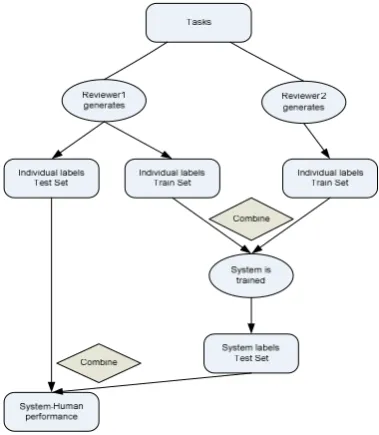
One reviewer will still read the entire collec-tion of abstracts while the other will benefit from the help of the system; this reviewer will have to label only the articles that will be used to train the classifier (ideally a small proportion for workload reduction), the rest of the articles will be labeled by the classifier.
Figure 1. Embedding automatic text classification in the process of building a systematic review.
The task that needs to be solved in order to help the systematic review process is a text classifica-tion task intended to classify an abstract as rele-vant or not relerele-vant to the topic of review.
The hypothesis that guides our research is that it is possible to save time for the human re-viewers and obtain good performance levels, similar to the ones obtained by humans. In this current study we show that we can achieve this by building a classification model that is based on the natural human workflow used for building systematic reviews. We show, on a real data set, that a human-machine system obtains the best results when an ensemble of classifiers is used as the classification model.
2 Related Work
The traditional way to collect and triage the ab-stracts from a systematic review consists in using simple query search techniques based on MeSH1 or keywords terms. The queries are usual Boo-lean-based and are optimized either for precision or for recall. The studies done by Haynes et al. (1994) show that it is difficult to obtain high per-formance for both measures.
The research done by Aphinyanaphongs and Aliferis (2005)is probably the first application of automatic text classification to the task of
1
http://www.nlm.nih.gov/mesh/
ing systematic reviews. In that paper the authors experimented with a variety of text classification techniques using the data derived from the ACP Journal Club as their corpus. They found that support vector machine (SVM) was the best clas-sifier according to a variety of measures. Further work for systematic reviews was done by Cohen et al. (2006). Their work is mostly focused on the elimination of non relevant documents. As their main goal is to save work for the reviewers in-volved in systematic review preparation, they define a measure, called work saved over sam-pling (WSS) that captures the amount of work that the reviewers will save with respect to a baseline of just sampling for a given value of recall. The idea is that a classifier returns, with high recall, a set of abstracts, and only those ab-stracts need to be read to weed out the non-relevant ones. The savings are measured with respect to the number of abstracts that would have to be read if a random baseline classifier was used. Such baseline corresponds to uni-formly sampling a given percentage of abstracts (equal to the desired recall) from the entire set. In Cohen etal. (2006),the WSS measure is applied to report the reduction in reviewer's work when retrieving 95% of the relevant documents; the precision was very low.
We focus on developing a classifier for sys-tematic review preparation, relying on character-istics of the data that were not included in the Cohen et al.’s (2006), because the questions asked in the preparation of the reviews are not available, Therefore we cannot perform a direct comparison of results here. Also, the data sets that they used in their experiments are signifi-cantly smaller than the one that we used.
3 The Data Set
A set of 47,274 abstracts with titles were col-lected from MEDLINE2 as part of a systematic review done by the McMaster University’s Evi-dence-Based Practice Center using TrialStat Corporation’s Systematic Review System3, a web-based software platform used to conduct systematic reviews.
The initial set of abstracts was collected using a set of Boolean search queries that were run for
2
http://medline.cos.com 3
the specific topic of the systematic review: “the dissemination strategy of health care services for elderly people of age 65 and over”.
In the protocol applied, two reviewers work in parallel. They read the entire collection of 47,274 abstracts and answer a set of questions to deter-mine if an abstract is relevant or not to the topic of review. Examples of questions present in the protocol: Is this article about a dissemination strategy or a behavioral intervention?; Is this a primary study?; Is this a review?; etc. An ab-stract is not considered to pass to the next screen-ing phase, when the entire article is available, if the two reviewers respond negative to the same question for a certain abstract. All other cases of possible responses suggest that the abstract will be part of the next screening phase. In this paper we focus on the initial screening phase, the only source of information is the abstract and the title of the article, with the main goal to achieve an acceptable level of recall not to mistakenly ex-clude relevant abstracts.
From the entire collection of labeled ab-stracts only 7,173 are relevant. Usually in the process of building systematic reviews the num-ber of non-relevant documents is much higher than the number of relevant ones. The initial re-trieval query is purposefully very broad, so as not to miss any relevant papers.
4 Methods
The machine learning techniques that could be used in the process of automating the creation of systematic reviews need to take into account some issues that can arise when dealing with such tasks. Imbalanced data sets are usually what we deal with when building reviews, the proportion of relevant articles that end up being present in the review is significantly lower com-pared with the original data set. The benefit of doubt will affect the quality of the data used to train the classifier, since a certain amount of noise is introduced: abstracts that are in fact non-relevant can be labeled as being non-relevant in the first screening process. The relatively high num-ber of abstracts involved in the process will make the classification algorithms deal with a high number of features and the representation tech-nique should try to capture aspects pertaining of the medical domain.
4.1 Representation Techniques
In our current research, we use three representa-tion techniques: bag-of-words (BOW), concepts from the Unified Medical Language System (UMLS), and a combination of both.
The bag-of-words representation is com-monly used for text classification and we have chosen to use binary feature values. Binary fea-ture values were shown to out-perform weighted values for text classification tasks in the medical domain as shown by Cohen et al. (2006) and bi-nary values tend to be more stable in results than frequency values for a task similar to ours, as shown by Ma (2007).
We considered feature words delimitated by space and simple punctuation marks that ap-peared at least three times in the training data, were not part of a stop words list4, and had a length greater than three characters. 30,000 word features were extracted. No stemming was used.
UMLS concepts which are part of the U.S. National Library of Medicine5 (NLM) knowl-edge repository are identified and extracted form the collection of abstracts using the MetaMap6 system. This conceptual representation helped us overcome some of the shortcomings of BOW representation, and allowed us to use multi-word features, medical knowledge, and higher-level meanings of words in context. As Cohen (2008) shows, multi-word and medical concept repre-sentations are suitable to use.
4.2 Classification Algorithms
As a classification algorithm we have chosen to use the complement naive Bayes (CNB) (Frank and Bouckaert, 2006) classifier from the Weka7 tool. The reason for this choice is that the CNB classifier implements state-of-the-art modifica-tions of the standard multinomial naïve Bayes (MNB) classifier for a classification task with highly skewed class distribution (Drummond and Holte, 2003). As the systematic reviews data usually contain a large majority of not relevant abstracts, resulting in a skewness reaching even below 1%, it is important to use appropriate clas-sifiers. Other classifiers, such as decision tress,
4
http://www.site.uottawa.ca/~diana/csi5180/StopWords 5http://www.nlm.nih.gov/pubs/factsheets/umls.html 6
http://mmtx.nlm.nih.gov/ 7
support vector machine, instance-based learning, and boosting, were used but the results obtained with CNB were always better.
4.3 Global Text Classification Method
The first method that we propose in order to solve the text classification task that is intended to help a systematic review process is a straight-forward machine learning approach. We trained a classifier, CNB, on a collection of abstracts and then evaluated the classifier’s performance on a separate test data set. The power of this classifi-cation technique stands in the ability to use a suitable classification algorithm and a good rep-resentation for the text classification task; Cohen et al. (2006) also used this approach. We ran-domly split the data set described in Section 3, into a training set and a test set. The two possible classes are Included (relevant) or Excluded (non relevant). We decided to work with a train-ing set smaller than the test set because ideally good results need to be obtained without using too much training data. We have to take into consideration that training a classifier for a par-ticular topic, human effort is required for annota-tion.
Table 1 presents a summary of the data along with the class distribution in the training and test data sets. We randomly sampled the data to build the training and test data sets, and the original distribution of 1:5.6 between the two classes holds in both sets.
Data
Table 1. Training and test data sets.
4.3.1 Feature Selection
Using the global method, we performed experi-ments with several feature selection algorithms. We used only the BOW representation.
Chi2 is a measure that evaluates the worth of an abstracts that are classified as Included) and the top k2 CHI
2
features that are exclusively excluded
(appeared only in the training abstracts that are classified as Excluded) and used them as a rep-resentation for our data set. We varied the k1
pa-rameter from 10 to 150 and k2 from 5 to 150 We used a minimum of 20 features and a maximum of 300.
InfoGain evaluates the worth of an attribute by measuring the information gain with respect to the class. We run experiments when we varied the number of selected features from 50 to 500. We used a number of 50, 100, 150, 250, 300 and 500 top features.
Bi-Normal Separation (BNS) is a feature se-lection technique that measures the separation between the threshold occurrences of a feature in one of the two classes. The latter measure is de-scribed in detail in Forman (2002). We used a ratio of features that varies from 10 to 150 for the most representative features for the Included class and from 5 to 150 for the Excluded class. For some experiments the number of features for the Included class is higher than the number of features for the Excluded class. We have chosen to do so because we wanted to re-balance the imbalance of classes in the training data set. Af-ter selecting the number of Included and Ex-cluded features, we used the combination to rep-resent our entire collection of abstracts.
We used the implementation from the Weka package for the Chi2 and InfoGain and the BNS implementation done by Ma (2007).
4.4 Per-Question Classification Method
The second method that we propose for solving the task takes into account the specifics of the systematic review process. It takes advantage of the set of questions the reviewers use in the proc-ess of deciding if an abstract is relevant or not. These questions are created in the design step of the systematic review and almost all systematic reviews have them. By using these questions we better emulate how the human judges work when building systematic reviews.
have answers for all the questions; therefore the training set sizes differ for each question). Table 2 presents the questions and data sets used.
When we created a training data set for each question we removed the abstracts for which we had a disagreement between the human experts – two different answers for a specific question, they represent noise in the training data. For each of the questions from Table 2, we trained a CNB classifier on the corresponding data set.
Question
(Training : Included class : Excluded class)
Q1 - Is this article about a dissemination strat-egy or a behavioural intervention? (14,057:1,145: 12,912)
Q2 - Is the population in this article made of indi-viduals 65-year old or older or does it comprise individuals who serve the elderly population needs (i.e. health care providers, policy makers, organi-zations, community)? (15,005:7,360:7,645)
Q3 - Is this a primary study? (8,825:6,895:1,930)
Q4 - Is this a review? (6,429:5,640:789)
Table 2. Data sets for the per-question classification method.
We used the same representation for the per-question classifiers as we did for the global clas-sifier: BOW, UMLS (the concepts that appeared only in the new question-oriented training data sets), and the combination BOW+UMLS. We used each trained model to obtain a prediction for each instance from the test set; therefore each test instance was assigned four prediction values of 0 or 1. To assign a final class for each test in-stance, from the prediction of all four classifiers, the class of a test instance is decided according to one of the following four schemes:
1. If any one vote is Excluded, the final class of a test instance is Excluded. This is a 1-vote scheme.
2. If any two votes are Excluded, the final class of a test instance is Excluded. This is a 2-vote scheme.
3. If any three votes are Excluded, the final class of a test instance is Excluded. This is a 3-vote scheme.
4. If all four votes are Excluded, the final class of a test instance is Excluded. This is a 4-vote scheme.
When we combined of the classifiers, we gave each classifier an equal importance.
5 Evaluation Measures and Results
When performing the evaluation for the task of classifying an abstract into one of the two classes Included (relevant) or Excluded (non rele-vant), two objectives are of great importance: Objective 1 - ensure the completeness of the sys-tematic review (maximize the number of relevant documents included); Objective 2 - reduce the reviewers' workload (maximize the number of irrelevant documents excluded).
We observe that objective 1 is more impor-tant than objective 2 and this is why we decided to report recall and precision for the Included class. We also report F-measure, since we are dealing with imbalanced data sets.
Besides the standard evaluation measures, we report WSS8 measure as well in order to give a clearer view of the results we obtain.
As baseline for our methods we consider: two extreme baselines and a random-baseline classifier that takes into account the distribution of the two classes in the training data set. The baselines results are: Include_All – a baseline that classifies everything in the majority class: Recall = 100%, Precision = 15%, F-measure = 26.2%; WSS = 0% Exclude_All – a baseline that classifies everything as Excluded: Recall = 0%, Precision = 100%, F-measure = 64.2%; WSS = 0% Random baseline: Recall = 8.9%, Precision = 15.4%, F-measure = 67.8%; WSS = 0.23%.
5.1 Results for the Global Method
In this subsection, we present the results obtained using our global method with the three represen-tation techniques and CNB as classification algo-rithm. To get a clear image of the results we show the confusion matrix in Table 3 for the reader to better understand the workload reduc-tion when using classifiers to help the process of building systematic reviews.
BOW features were identified following the guidelines presented in Section 3.4 and a number of 23,906 features were selected. UMLS con-cepts were identified using the MetaMap system.
8
BOW UMLS BOW+UMLS
True Inc. 2,692 2,793 2,715
False Inc. 5,022 8,922 5,086
True Exc. 18,135 14,235 18,071
False Exc. 1,425 1,324 1,402
Recall 65.3% 67.8% 65.9%
Precision 34.9% 23.8% 34.8%
F-measure 45.5% 35.2% 45.5%
WSS 37.1% 24.9% 37.3%
Table 3. Results for the global method.
From the whole training abstracts collection, a number of 459 UMLS features were identified. Analyzing the results from Table 5, in terms of recall, the UMLS representation obtained the best recall results, 67.8% for the global method but much lower precision, 23.8% than BOW rep-resentation, 34.9%. The hybrid reprep-resentation, BOW+ UMLS features had similar results with the BOW alone. Recall increased a bit for the hybrid representation compared to BOW alone, 0.6% but its value is still not acceptable. We conclude that the levels of recall, our main objec-tive for this task, were not acceptable for a classi-fier to be used as replacement of a human judge in the workflow of building a systematic review. The levels of precision that we obtained with the global method are acceptable but they cannot substitute the low level of recall. Since our major focus is recall, we investigated more and we fur-ther improved our precision scores with the per-question classification method.
5.1.1 Results for Feature Selection
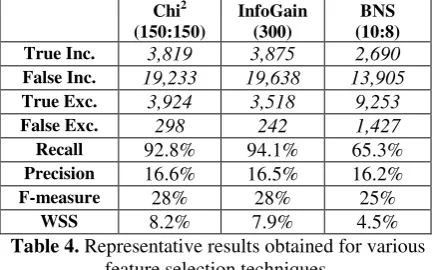
Table 4 presents the results obtained with our feature selection techniques. We decided to re-port only representative results using CNB as a classifier and a specific representation setting. The number of features used in the experiment is presented in the round brackets. The first number represents the number of features extracted from the Included class data set while the second from the Excluded class data set.
Similar experiments were performed when using Naïve Bayes as classifier. The results ob-tained were opposite to ones obob-tained for CNB, all abstracts were classified as Excluded. We believe that this is the case because the CNB classifier tries to compensate for the class imbal-ance and gives more credit to the minority class,
Chi2 (150:150)
InfoGain (300)
BNS (10:8)
True Inc. 3,819 3,875 2,690
False Inc. 19,233 19,638 13,905
True Exc. 3,924 3,518 9,253
False Exc. 298 242 1,427
Recall 92.8% 94.1% 65.3%
Precision 16.6% 16.5% 16.2%
F-measure 28% 28% 25%
WSS 8.2% 7.9% 4.5%
Table 4. Representative results obtained for various feature selection techniques.
while the Naïve Bayes classifier will let the ma-jority class overwhelm the classifier.
Besides the results presented in Table 4, we also tried to boost the representative features for the Included class hoping to re-balance the im-balance present in the training data set. To per-form these experiments we selected the top k CHI2 word features and then added to this set of features the top k1 CHI
2
representative features only for the Included class. The parameter k var-ied from 50 to 100 and the parameter k1 from 30
to 70. We performed experiments when using the original imbalanced training data set and using a balanced data set as well, with both CNB and Naïve Bayes classifier. The results obtained for these experiments were similar to the ones when we used the previous feature selection tech-niques. There was no significant difference in the results compared to the ones in Table 5.
5.2 Results for the Per-Question Method
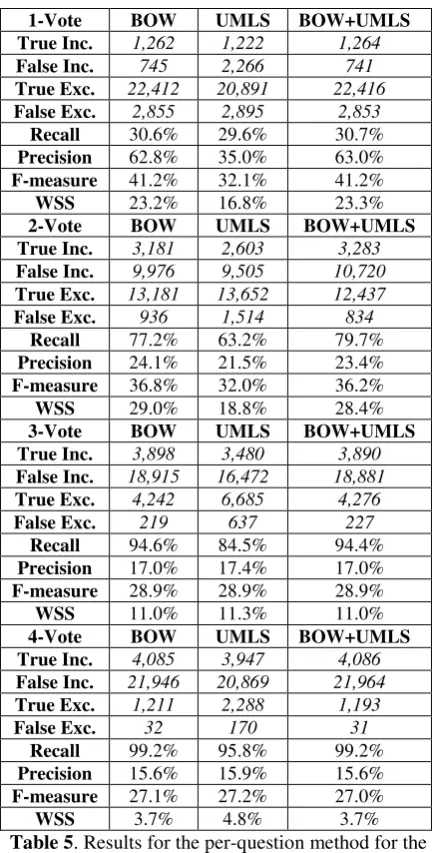
The results for our second method using the four voting schemes are presented in Table 5.
Compared with the global method the results obtained by the per-question method, especially the ones for 2 votes are the best so far in terms of the balance between the two objectives. A large number of abstracts that should be excluded are classified as Excluded whereas wrongly exclud-ing very few abstracts that should have been in-cluded (a lot fewer than in the case of the global classification method).
prediction is higher; a balance between excluding an article and keeping it as relevant is achieved. When using the classifiers for 3 or 4 questions the performance goes down in terms of precision; a higher number of abstracts get classified as In-cluded - some abstracts do not address all target question of the review topic.
1-Vote BOW UMLS BOW+UMLS
True Inc. 1,262 1,222 1,264
False Inc. 745 2,266 741
True Exc. 22,412 20,891 22,416
False Exc. 2,855 2,895 2,853
Recall 30.6% 29.6% 30.7%
Precision 62.8% 35.0% 63.0%
F-measure 41.2% 32.1% 41.2%
WSS 23.2% 16.8% 23.3%
2-Vote BOW UMLS BOW+UMLS
True Inc. 3,181 2,603 3,283
False Inc. 9,976 9,505 10,720
True Exc. 13,181 13,652 12,437
False Exc. 936 1,514 834
Recall 77.2% 63.2% 79.7%
Precision 24.1% 21.5% 23.4%
F-measure 36.8% 32.0% 36.2%
WSS 29.0% 18.8% 28.4%
3-Vote BOW UMLS BOW+UMLS
True Inc. 3,898 3,480 3,890
False Inc. 18,915 16,472 18,881
True Exc. 4,242 6,685 4,276
False Exc. 219 637 227
Recall 94.6% 84.5% 94.4%
Precision 17.0% 17.4% 17.0%
F-measure 28.9% 28.9% 28.9%
WSS 11.0% 11.3% 11.0%
4-Vote BOW UMLS BOW+UMLS
True Inc. 4,085 3,947 4,086
False Inc. 21,946 20,869 21,964
True Exc. 1,211 2,288 1,193
False Exc. 32 170 31
Recall 99.2% 95.8% 99.2%
Precision 15.6% 15.9% 15.6%
F-measure 27.1% 27.2% 27.0%
WSS 3.7% 4.8% 3.7%
Table 5. Results for the per-question method for the
Included class.
For the per-question technique the recall value peaked at 99.2% with the 4-vote method BOW and BOW+UMLS representation technique. In the same time the lowest values of precision for the per-question technique, 15.6% is obtained with the same experimental setting. It is impor-tant to aim for a high recall but not to dismiss the precision values. The difference of even less than
2% in precision values can cause the reviewers to read additional thousands of documents, as ob-served in the confusion matrices for 2-vote, 3-vote and 4-3-vote methods in Table 5.
From the confusion matrix in Table 5 for the 2-vote method and the 3- and 4-vote method we observe the high difference in the number of documents a reviewer will have to read (the falsely included documents). The difference in precision from 24.1% for the 2-vote method to 15.6% for the 4-vote method makes the reviewer go through 11,988 additional abstracts.
The best value for the WSS measure for the per-question method is achieved by the 2-vote scheme. The result is lower than the one obtained by the global method but the recall level is higher therefore, we still keep as a potential winner the 2-vote scheme.
5.3 Results for Human-Machine Workflow
In Figure 1, we envisioned the way we can use the automatic classifier in the workflow of build-ing a systematic review. In order to determine the performance of the human-machine workflow that we propose we computed the recall values when the human reviewer’s labels are combined with the labels obtained from the classifier. The same labeling technique is applied as for the hu-man-human workflow: if at least one decision for an abstract is to include it in the systematic re-view, then the final label is Included.
that the extra effort spent in identifying the most suitable methodology pays off.
The fact that we keep a human in the loop makes our method acceptable as a workflow for building a systematic review.
Method BOW UMLS BOW+
UMLS
Global 17.9/87.7% 17.0/88.6% 17.9/87.7%
1-Vote 17.1/75.3% 16.5/74.8% 17.1/75.4%
2-Vote 17.1/91.6% 16.4/86.6% 17.1/92.7%
3-Vote 15.8/97.9% 15.8/94.2% 15.8/97.8%
4-Vote 15.3/99.6% 15.4/98.3% 15.3/99.6%
Table 6. Precision/recall results for the human-classifier workflow for the Included class.
6 Discussion
The global method achieves good results in terms of precision while the best recall is obtained by the per-question method.
The best results for the task were obtained using the per-question method with the 2-vote scheme with or without UMLS features. The 3-vote scheme with UMLS representation is close to the 2-vote scheme but looking at F-measure and WSS results the 2-vote scheme is better. The clear distinction between the methods comes when we combined the classifiers with the hu-man judge in the workflow of building reviews.
The per-question technique is more robust and it offers the possibility to choose the desired type of performance. If the reviewers are willing to read almost the entire collection of documents, knowing that the recall is high, then a 3 or 4-vote scheme can be the set-up (though the 3 or 4-vote method is not likely to achieve 100% recall be-cause it is very rare that an abstract contain an-swers to three or four of the questions associated with the systematic review). If the reviewers will like to read a small collection being confident that almost all the abstracts are relevant, then a 1-vote scheme can be the set-up required. The per-question method confirms the fact that an en-semble of classifiers is better than one classifier; (Dietterich, 1997).
When we combine the human and the system results we obtain a major improved in terms of recall. We base our discussion for the human-machine results for the experiment that obtained the best results, the 2-vote scheme with a BOW+UMLS representation technique. When combining the human and classifier decisions,
the precision level decreased a bit compared to the one that the machine obtained. We believe that this is the case because some of the abstracts that the classifier excluded were included by the first human reviewer and, with this decision process in place, the level of precision dropped.
Our goal of improving the recall level from the first level of screening is achieved, since when both the classifier and the human judge are integrated in the workflow, the recall level jumps from 79.7% to 92.7%.
We believe that the low level of precision that is obtained for the human reviewer, for the human-classifier workflow, and for the classifier, is due to the fact that we are running experiments for the first screening phase when we use only the abstracts as source of information and not the entire articles.
We believe that further investigations are re-quired to fully replace a human reviewer with an automatic classifier but the results obtained with the per-question method encourage us to believe that this is a suitable solution for reaching our final goal.
7 Conclusions and Future Work
In this paper, we looked at two methods by which we envision the way automatic text classi-fication techniques could help the workflow of building systematic reviews.
The first method is a straight-forward appli-cation of the representations and learning algo-rithms that capture the specifics of the data: med-ical domain, huge number of features, misclassi-fication, and imbalanced classes.
We showed that the specifics of the human protocol in which systematic reviews are built have a positive effect when deployed in an auto-matic way. We believe that the tedious process that is currently used for building systematic re-views can be lightened by the use of a classifier in combination with only one human judge. By having a human judge in the loop, we ensure that the workflow is reliable and that the system can be easily integrated in the workflow.
References
Aphinyanaphongs Y. and Aliferis C. Text Categoriza-tion Models for Retrieval of High Quality Articles.
Journal of the American Medical Informatics As-sociation 2005; 12:207-216.
Cohen A.M. Optimizing Feature Representation for Automated Systematic Review Work Prioritization.
Proceedings of the AMIA Annual Symposium 2008; 6:121-126.
Cohen A.M., Hersh W.R., Peterson K., Yen P.Y. Re-ducing Workload in Systematic Review Prepara-tion Using Automated CitaPrepara-tion ClassificaPrepara-tion.
Journal of the American Medical Informatics As-sociation 2006; 13:206-219.
Dietterich, T. Machine-Learning Research: Four
Current Directions. Artificial Intelligence
Maga-zine. 18(4): 97-136 (1997)
Drummond C. and Holte R.C. C4.5, Class Imbalance, and Cost Sensitivity: Why Under-Sampling beats
Over-Sampling. Proceedings of the Twentieth
In-ternational Conference on Machine Learning: Workshop on Learning from Imbalanced Data Sets (II), 2003.
Forman G. Choose Your Words Carefully: An Empiri-cal Study of Feature Selection Metrics for Text
Classification. In the Joint Proceedings of the 13th
European Conference on Machine Learning and the 6th European Conference on Principles and Practice of Knowledge Discovery in Databases (ECML/PKDD), 2002.
Frank E. and Bouckaert R.R. Naive Bayes for Text
Classification with Unbalanced Classes. In the
Proceedings of the 10th European Conference on Principles and Practice of Knowledge Discovery in Databases, Berlin, Germany, 2006, pp. 503-510.
Haynes R.B., Wilczynski N., McKibbon K.A., Walker C.J., Sinclair J.C. Developing optimal search strat-egies for detecting clinically sound studies in
MEDLINE. Journal of the American Medical
In-formatics Association 1994; 1:447-58.
Kohavi R. and ProvostF. Glossary of Terms. Editorial for the Special Issue on Applications of Machine Learning and the Knowledge Discovery Process 1998; 30:271-274.