Morphological analysis can improve a
CCGparser for English
Matthew Honnibal, Jonathan K. Kummerfeld and James R. Curran School of Information Technologies
University of Sydney
{mhonn,jono,james}@it.usyd.edu.au
Abstract
Because English is a low morphology lan-guage, current statistical parsers tend to ignore morphology and accept some level of redundancy. This paper investigates how costly such redundancy is for a lex-icalised grammar such asCCG.
We use morphological analysis to split verb inflectional suffixes into separate to-kens, so that they can receive their own lexical categories. We find that this im-proves accuracy when the splits are based on correctPOStags, but that errors in gold
standard or automatically assigned POS
tags are costly for the system. This shows that the parser can benefit from morpho-logical analysis, so long as the analysis is correct.
1 Introduction
English is a configurational language, so gram-matical functions are mostly expressed through word order and function words, rather than with inflectional morphology. Most English verbs have four forms, and none have more than five. Most of the world’s languages have far richer inflectional morphology, some with millions of possible in-flection combinations.
There has been much work on addressing the sparse data problems rich morphology creates, but morphology has received little attention in the En-glish statistical parsing literature. We suggest that English morphology may prove to be an under-utilised aspect of linguistic structure that can im-prove the performance of an English parser. En-glish also has a rich set of resources available, so an experiment that is difficult to perform with an-other language may be easier to conduct in glish, and a technique that makes good use of
En-glish morphology may transfer well to a morpho-logically rich language. under-exploited in En-glish natural language
In this paper, we show how morphological information can improve an English statistical parser based on a lexicalised formalism, Com-binatory Categorial Grammar (CCG, Steedman,
2000), using a technique suggested for Turkish (Bozsahin, 2002) and Korean (Cha et al., 2002). They describe how a morphologically rich lan-guage can be analysed efficiently with CCG by
splitting off inflectional affixes as morphological tokens. This allows the affix to receive a cate-gory that performs the feature coercion. For in-stance,sleepingwould ordinarily be assigned the categoryS[ng]\NP: a sentence with the[ng] fea-ture requiring a leftwardNP argument. We split the word into two tokens:
sleep -ing
S[b]\NP (S[ng]\NP)\(S[b]\NP) The additional token creates a separate space for inflectional information, factoring it away from the argument structure information.
Even with only 5 verb forms in English, we found that accurate morphological analysis im-proved parser accuracy. However, the system had trouble recovering from analysis errors caused by incorrectPOStags.
We then tested how inflection categories in-teracted with hat categories, a linguistically-motivated extension to the formalism, proposed by Honnibal and Curran (2009), that introduces some sparse data problems but improves parser effiency. The parser’s accuracy improved by 0.8% when gold standard POStags were used, but not
with automatic POStags. Our method addresses
problems caused by even low morphology, and future work will make the system more robust to
2 Combinatory Categorial Grammar
Combinatory Categorial Grammar (CCG,
Steed-man, 2000) is a lexicalised grammar, which means that each word in the sentence is associated with a category that specifies its argument structure and the type and features of the constituent that it heads. For instance,inmight head aPP-typed constituent with oneNP-typed argument, written asPP/NP. The/operator denotes an argument to the right; \ denotes an argument to the left. For example, a transitive verb is a function from a rightward NP to and a leftwardNP to a sen-tence,(S\NP)/NP. The grammar consists of a few schematic rules to combine the categories:
X/Y Y ⇒> X
Y X\Y ⇒< X
X/Y Y/Z ⇒>B X/Z Y\Z X\Y ⇒<B X\Z Y/Z X\Y ⇒<B
× X/Z
CCGbank (Hockenmaier and Steedman, 2007) extends this grammar with a set of type-changing rules, designed to strike a better balance between sparsity in the category set and ambiguity in the grammar. We mark such productionsTC.
In wide-coverage descriptions, categories are generally modelled as typed feature structures (Shieber, 1986), rather than atomic symbols. This allows the grammar to include head indices, and to unify under-specified features. In our nota-tion features are annotated in square-brackets, e.g. S[dcl]. Head-finding indices are annotated on categories as subscripts, e.g. (NPy\NPy)/NPz.
We occasionally abbreviate S\NP as VP, and S[adj]\NP asADJ.
2.1 StatisticalCCGparsing and morphology In CCGbank, there are five features that are largely governed by the inflection of the verb:
writes/wrote (S[dcl]\NP)/NP (was) written (S[pss]\NP)/NP (has) written (S[pt]\NP)/NP (is) writing (S[ng]\NP)/NP (to) write (S[b]\NP)/NP
The features are necessary for satisfactory anal-yses. Without inflectional features, there is no
way to block over-generation likehas runningor was ran. However, the inflectional features also create a level of redundancy if the different in-flected forms are treated as individual lexical en-tries. The different inflected forms of a verb will all share the same set of potential argument struc-tures, so some way of grouping the entries to-gether is desirable.
Systems like thePET HPSGparser (Oepen et al.,
2004) and theXLE LFGparser (Butt et al., 2006)
use a set of lexical rules that match morphologi-cal operations with transformations on the leximorphologi-cal categories. For example, a lexical rule is used to ensure that an intransitive verb like sleeping re-ceives the same argument structure as the base form sleep, but with the appropriate inflectional feature. This scheme works well for rule-based parsers, but it is less well suited for statistical parsers, as the rules propose categories but do not help the model estimate their likelihood or assign them feature weights.
Statistical parsers for lexicalised formalisms such as CCGare very sensitive to the number of
categories in the lexicon and the complexity of the mapping between words and categories. The sub-task of assigning lexical categories, supertag-ging(Bangalore and Joshi, 1999), is most of the parsing task. Supertaggers mitigate sparse data problems by using a label frequency threshold to prune rare categories from the search space. Clark and Curran (2007) employ a tag dictionary that re-stricts the model to assigning word/category pairs seen in the training data for frequent words.
The tag dictionary causes some level of under-generation, because not all valid word/category pairs will occur in the limited training data avail-able. The morphological tokens we introduce help to mitigate this, by bringing together what were distinct verbs and argument structures, using lem-matisation and factoring inflection away from ar-gument structures. The tag dictionaries for the in-flectional morphemes will have very high cover-age, because there are only a few inflectional cat-egories and a few inflectional types.
3 Inflectional Categories
be −ing good and do −ing good (S[b]\NP)/ADJ (S[ng]\NP)\(S[b]\NP) ADJ conj (S[b]\NP)/NP (S[ng]\NP)\(S[b]\NP) NP
<B× <B×
(S[ng]\NP)/ADJ (S[ng]\NP)/NP
> >
S[ng]\NP S[ng]\NP
<Φ>
(S[ng]\NP)\(S[ng]\NP)
<
S[ng]\NP
Figure 1: A single inflection category (in bold) can serve many different argument structures. (Bozsahin, 2002; Cha et al., 2002). The inflected
form is broken into two morphemes, and each is assigned a category. The category for the inflec-tional suffix is a function from a category with the bare-form feature[b]to a category that has an in-flectional feature. This prevents verbal categories from having to express their inflectional features directly. Instead, their categories only have to ex-press their argument structure.
The CCGcombinators allow multiple argument
structures to share a single inflectional category. For instance, the (S[ng]\NP)\(S[b]\NP) cate-gory can supply the[ng]feature to all categories that have one leftward NP argument and any number of rightward arguments, via the gener-alised backward composition combinator. Fig-ure 1 shows this category transforming two dif-ferent argument structures, using the backward crossed composition rule (<B×).
Table 1 shows the most frequent inflection cat-egories we introduce. The majority of inflected verbs in the corpus have a subject and some num-ber of rightward arguments, so we can almost assign one category per feature. The most fre-quent exceptions are participles that function as pre-nominal modifiers and verbs of speech.
Table 2 shows the inflectional token types we introduce and which features they correspond to. Our scheme largely follows the Penn Treebank tag set (Bies et al., 1995), except we avoided dis-tinguishing past participles from past tense (-en vs-ed), because this distinction was a significant source of errors for our morphological analysis process, which relies on the part-of-speech tag.
3.1 Creating Training Data
We prepared a version of CCGbank (Hocken-maier and Steedman, 2007) with inflectional to-kens. This involved the following steps:
CorrectingPOStags:Our morphological
anal-Freq. Category Example
32.964 (S[dcl]\NP)\(S[b]\NP) He ran
11,431 (S[pss]\NP)\(S[b]\NP) He was run down 11,324 (S[ng]\NP)\(S[b]\NP) He was running
4,343 (S[pt]\NP)\(S[b]\NP) He has run 3,457 (N/N)\(S[b]\NP) the running man 2,011 S[dcl]\S “..”, he says
1,604 (S[dcl]\S)\(S[b]\S) “..”, said the boy 169 (S[dcl]\ADJ)\(S[b]\ADJ) Here ’s the deal
55 (S[dcl]\PP)\(S[b]\PP) On it was a bee Table 1: The inflectional categories introduced.
Token POS Feat Example
-es VBZ dcl He write -es letters
-e VBP dcl They write -e letters
-ed VBD dcl They write -ed letters
-ed VBN pt They have write -ed letters
-ed VBN pss Letters were write -ed
-ing VBG ng They are write -ing letters Table 2: The inflectional token types introduced.
ysis relies on the part-of-speech tags provided with CCGbank. We identified and corrected words whosePOStags were inconsistent with their
lexical category, as discussed in Section 3.2. Lemmatising verbs and removing features: We used the morphy WordNet lemmatiser imple-mented inNLTK1 to recover the lemma of the
in-flected verbs, identified by their POS tag (VBP,
VBG, VBN or VBZ). The verb’s categories were updated by switching their features to[b].
Deriving inflectional categories: The gener-alised backward composition rules allow a func-tor to generalise over some sequence of ar-gument categories, so long as they all share the same directionality. For instance, a func-tor (S\NP)\(S\NP) could backward cross-compose into a category ((S\NP)/NP)/PP to its left, generalising over the two rightward ar-guments that were not specified by the functor’s argument. It could not, however, compose into a category like((S\NP)\NP)/PP, because the two arguments (NP andPP) have differing
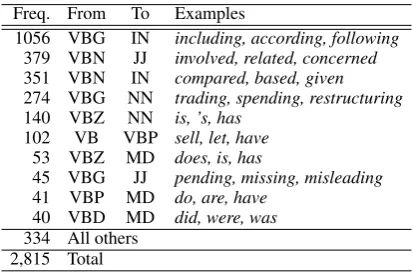
Freq. From To Examples
1056 VBG IN including, according, following
379 VBN JJ involved, related, concerned
351 VBN IN compared, based, given
274 VBG NN trading, spending, restructuring
140 VBZ NN is, ’s, has
102 VB VBP sell, let, have
53 VBZ MD does, is, has
45 VBG JJ pending, missing, misleading
41 VBP MD do, are, have
40 VBD MD did, were, was
334 All others 2,815 Total
Table 3:The most frequentPOStag conversions.
tionalities (leftward and rightward).
Without this restriction, we would only require one inflection category per feature, using inflec-tional categories likeS[ng]\S[b]. Instead, our in-flectional categories must subcategorise for every argument except the outermost directionally sistent sequence. We discard this outermost con-sistent sequence, remove all features, and use the resulting category as the argument and result. We then restore the result’s feature, and set the argu-ment’s feature to[b].
Inserting inflectional tokens: Finally, the in-flectional token is inserted after the verb, with a new node introduced to preserve binarisation.
3.2 POStag corrections
Hockenmaier and Steedman (2007) corrected sev-eral classes ofPOStag errors in the Penn Treebank
when creating CCGbank. We follow Clark and Curran (2007) in using their correctedPOSlabels,
but found that there were still some words with in-consistentPOStags and lexical categories, such as building|NN|(S[dcl]\NP)/NP.
In order to make our morphological anal-ysis more consistent, we identify and correct such POS tagging errors as follows. We
use two regular expressions to identify ver-bal lexical categories and verver-bal POS tags:
ˆ\(*S\[(dcl|pss|ng|pt|b)\] and
AUX|MD|V.. respectively. If a word has a verbal lexical category and non-verbal POS, we
correct itsPOStag with reference to its suffix and
its category’s inflectional feature. If a word has a verbalPOStag and a non-verbal lexical category,
we select thePOStag that occurs most frequently
with its lexical category.
The only exception are verbs functioning as nominal modifiers, such asrunninginthe running man, which are generallyPOStagged VBG but
re-ceive a lexical category ofN/N. We leave these
POS tagged as verbs, and instead analyse their
suffixes as performing a form-function transfor-mation that turns them fromS[b]\NP verbs into N/N adjectives —(N/N)\(S[b]\NP).
Table 3 lists the most common before-and-afterPOS tag pairs from our corrections, and the
words that most frequently exemplified the pair. When compiling the table some clear errors came to light, such as the ‘correction’ of is|VBZ to
is|NN. These errors may explain why the POS
tagger’s accuracy drops by 0.1% on the corrected set, and suggest that the problem of aligningPOS
tags and supertags is non-trivial.
In light of these errors, we experimented with an alternate strategy. Instead of cor-recting the POS tags, we introduced null
inflectional categories that compensated for bad morphological tokenisation such as
accord|VBG|(S/S)/PP -ing|VIG|-. The null inflectional category does not interact with the rest of the derivation, much like a punc-tuation symbol. This performed little better than the baseline, showing that thePOStag corrections
made an important contribution, despite the problems with our technique.
3.3 Impact on CCGbank Lexicon
Verbal categories in CCGbank (Hockenmaier and Steedman, 2007) record both the valency and the inflectional morphology of the verb they are as-signed to. This means v ×i categories are
re-quired, wherevandiare the number of distinct
ar-gument structures and inflectional features in the grammar respectively.
The inflectional tokens we propose allow in-flectional morphology to be largely factored away from the argument structure, so that roughlyv+i
verbal categories are required. A smaller category set leads to lower category ambiguity, making the assignment decision easier.
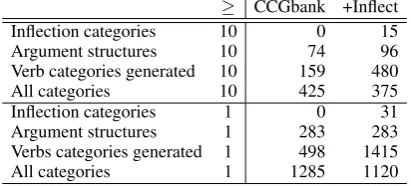
consists of all categories that occur at least 10 times. The frequency cut off is used because the model will not have sufficient evidence to assign the other 861 categories that occur at least once, and their distribution is heavy tailed: together, they only occur 1,426 times. We refer to the fre-quency filtered set as the lexicon. The parser can-not assign a category outside its lexicon, so gaps in it cause under-generation.
The CCGbank lexicon includes 159 verbal cat-egories. There are 74 distinct argument structures and 5 distinct features among these verbal cate-gories. The grammar Clark and Curran (2007) learn therefore under-generates, because 211 of the 370 (5×74) argument structure and feature combinations are rare or unattested in the training data. For instance, there is a (S[dcl]\NP)/PP category, but no corresponding (S[b]\NP)/PP, making it impossible for the grammar to generate a sentence like I want to talk to you, as the cor-rect category fortalkin this context is missing. It would be trivial to add the missing categories to the lexicon, but a statistical model would be un-able to reproduce them. There are 8 occurrences of such missing categories in Section 00, the de-velopment data.
The reduction in data sparsity brought by the in-flection categories causes 22 additional argument structures to cross the frequency threshold into the lexicon. A grammar induced from this cor-pus is thus able to generate 480 (96×5) argument structure and feature combinations, three times as many as could be generated before.
We introduce 15 inflectional categories in the corpus. The ten most frequent are shown in Table 1. The combinatory rules allow these 15 inflection categories to serve 96 argument structures, reduc-ing the number of verbal categories in the lexicon from 159 to 89 (74 + 15).
The statistics at frequency 1 are less reliable, because many of the categories may be linguisti-cally spurious: they may be artefacts caused by annotation noise in the Penn Treebank, or the conversion heuristics used by Hockenmaier and Steedman (2007).
≥ CCGbank +Inflect Inflection categories 10 0 15 Argument structures 10 74 96 Verb categories generated 10 159 480
All categories 10 425 375
Inflection categories 1 0 31 Argument structures 1 283 283 Verbs categories generated 1 498 1415
All categories 1 1285 1120
Table 4: Effect of inflection tokens on the category set for categories with frequency≥10and≥1
3.4 Configuration of parsing experiments We conducted two sets of parsing experiments, comparing the impact of inflectional tokens on CCGbank (Hockenmaier and Steedman, 2007) andhat CCGbank (Honnibal and Curran, 2009). The experiments allow us to gauge the impact of inflectional tokens on versions of CCGbank with differing numbers of verbal categories.
We used revision 1319 of the C&C parser2
(Clark and Curran, 2007), using the best-performing configuration they describe, which used the hybrid dependency model. The most important hyper-parameters in their configuration are theβ andK values, which control the work-flow between the supertagger and parser. We use the Honnibal and Curran (2009) values of these parameters in our hat category experiments, de-scribed in Section 5.
Accuracy was evaluated using labelled depen-dencyF-scores (LF). CCGdependencies are
la-belled by the head’s lexical category and the ar-gument slot that the dependency fills. We evalu-ated the baseline and inflection parsers on the un-modified dependencies, to allow direct compari-son. For the inflection parsers, we pre-processed the POS-tagged input to introduce inflection
to-kens, and post-processed it to remove them. We follow Clark and Curran (2007) in not evaluating accuracy over sentences for which the parser returned no analysis. The percentage of sentences analysed is described as the parser’s coverage(C). Speed (S) figures refer to sentences
parsed per second (including failures) on a
dual-CPUPentium 4 Xeon with 4GBof RAM.
4 Parsing Results on CCGbank
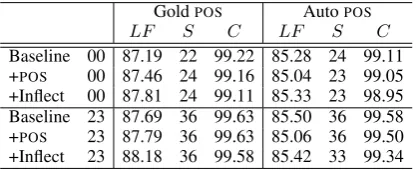
Table 5 compares the performance of the parser on Sections 00 and 23 with and without inflection tokens. Section 00 was used for development ex-periments to test different approaches, and Section 23 is the test data. Similar effects were observed on both evaluation sections.
The inflection tokens had no significant impact on speed or coverage, but did improve accuracy by 0.49% F-measure when gold standard POS
tags were used, compared to the baseline. How-ever, some of the accuracy improvement can be attributed to the POStag corrections described in
Section 3.2, so the improvement from the inflec-tion tokens alone was 0.39%.
The POStag corrections caused a large drop in
performance when automaticPOStags were used.
We attribute this to the imperfections in our cor-rection strategy. The inflection tokens improved the accuracy by 0.39%, but this was not large enough to correct for the drop in accuracy caused by thePOSchanges.
Another possibility is that our morphological analysis makes POS tagger errors harder to
re-cover from. Instead of an incorrect feature value,
POStag errors can now induce poor
morphologi-cal splits such asstarl|VBG -ing|VIG.POS
tagging errors are already problematic for theC&C
parser, because only the highest ranked tag is forwarded to the supertagger as a feature. Our morphological analysis strategy seems to exacer-bate this error propagation problem. Curran et al. (2006) showed that using a beam of POS tags as
features in the supertagger and parser mitigated the loss of accuracy fromPOStagging errors.
Un-fortunately, with our morphological analysis strat-egy, POS tag variations change the tokenisation
of a sentence, making parsing more complicated. Perhaps the best solution would be to address the tagging errors in the treebank more thoroughly, and reform the annotation scheme to deal with particularly persistant error cases. This might im-provePOStag accuracy to a level where errors are
rare enough to be unproblematic.
Despite the limited morphology in English, the inflectional tokens improved the parser’s accuracy when gold standard POStags were supplied. We
GoldPOS AutoPOS
LF S C LF S C
Baseline 00 87.19 22 99.22 85.28 24 99.11 +POS 00 87.46 24 99.16 85.04 23 99.05 +Inflect 00 87.81 24 99.11 85.33 23 98.95 Baseline 23 87.69 36 99.63 85.50 36 99.58 +POS 23 87.79 36 99.63 85.06 36 99.50 +Inflect 23 88.18 36 99.58 85.42 33 99.34
Table 5: Effect ofPOSchanges and inflection tokens on accuracy (LF), speed (S) and coverage (C) on 00 and 23.
attribute the increase in accuracy to the more ef-ficient word-to-category mapping caused by re-placing inflected forms with lemmas, and feature-bearing verb categories with ones that only refer to the argument structure. We examined this hypoth-esis by performing a further experiment, to inves-tigate how inflection tokens interact withhat cat-egories, which introduce additional verbal cate-gories that represent form-function discrepancies.
5 Inflection Tokens and Hat Categories
Honnibal and Curran (2009) introduce an exten-sion to theCCGformalism, hat categories, as an
alternative way to solve the modifier category pro-liferation (MCP) problem. MCP is caused when
a modifier is itself modified by another modi-fier. For instance, in the sentence he was in-jured running with scissors, with modifies run-ning, which modifiesinjured. This produces the category((VP\VP)\(VP\VP))/NP forwith, a rare category that is sensitive to too much of the sentence’s structure.
Hockenmaier and Steedman (2007) address
MCPby adding type-changing rules to CCGbank.
These type-changing rules transform specific cat-egories. They are specific to the analyses in the corpus, unlike the standard combinators, which are schematic and language universal. Honnibal and Curran’s (2009) contribution is to extend the formalism to allow these type-changing rules to be lexically specified, restoring universality to the grammar — but at the cost of sparse data problems in the lexicon. Figure 2 shows how a reduced rel-ative clause is analysed using hat categories. The hat category(S[pss]\NP)NP\NP is subject to the unhatrule, which unarily replaces it with its hat, NP\NP, allowing it to function as a modifier.
The company bought by Google last year is profitable
NP/N N (S[pss]\NP)NP\NP (VP
\VP)/NP NP NPVP\VP/N N (S[dcl]
\NP)/ADJ ADJ
> > > >
NP VP\VP NPVP\VP S[dcl]\NP
<
(S[pss]\NP)NP\NP
<
(S[pss]\NP)NP\NP
H
NP\NP
<
NP
<
S[dcl]
Figure 2:CCGderivation showing hat categories and the unhat rule.
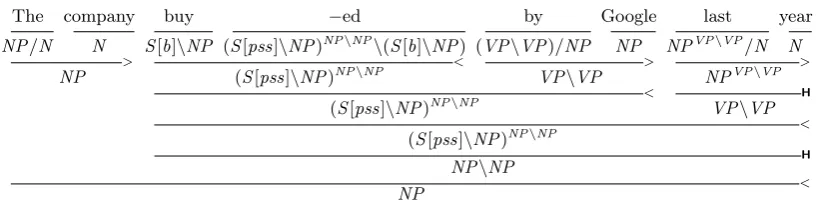
The company buy −ed by Google last year
NP/N N S[b]\NP (S[pss]\NP)NP\NP\(S[b]\NP) (VP\VP)/NP NP NPVP\VP/N N
> < > >
NP (S[pss]\NP)NP\NP VP
\VP NPVP\VP
< H
(S[pss]\NP)NP\NP VP
\VP
<
(S[pss]\NP)NP\NP
H
NP\NP
<
NP
Figure 3:CCGderivation showing how inflectional tokens interact with hat categories.
and Joshi, 1999), such as the C&C system (Clark
and Curran, 2007). By replacing type-changing rules with additional lexical categories, more of the work is shifted to the supertagger. The su-pertagging phase is much more efficient than the chart parsing stage, so redistribution of labour makes the parser considerably faster.
Honnibal and Curran (2009) found that the parser was 37% faster on the test set, at a cost of 0.5% accuracy. They attribute the drop in ac-curacy to sparse data problems for the supertag-ger, due to the increase in the number of lexical categories. We hypothesised that inflectional cate-gories could address this problem, as the two anal-yses interact well.
5.1 Analyses with inflectional hat categories Using hat categories to lexicalise type-changing rules offers attractive formal properties, and some practical advantages. However, it also misses some generalisations. A type-changing operation such as S[ng]\NP → NP\NP must be avail-able to any VP. If we encounter a new word,The company is blagging its employees, we can gen-eralise to the reduced relative form,She works for that company blagging its employeeswith no ad-ditional information.
This property could be preserved with some
form of lexical rule, but a novel word-category pair is difficult for a statistical model to assign. Inflection tokens offer an attractive solution to this problem, as shown in Figure 3. Assigning the hat category to the suffix makes it available to any verb the suffix follows — it is just another func-tion the inflecfunc-tional suffix can perform. This gen-erality also makes it much easier to learn, because it does not matter whether the training data hap-pens to contain examples of a given verb perfom-ing that grammatical function.
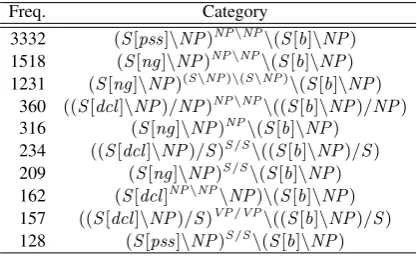
We prepared a version of the Honnibal and Curran (2009) hat CCGbank, moving hats on to inflectional categories wherever possible. The hat CCGbank’s lexicon contained 105 hat cate-gories, of which 77 were assigned to inflected verbs. We introduced 33 inflection hat cate-gories in their place, reducing the number of hat categories by 27.9%. Fewer hat categories were required because different argument struc-tures could be served by the same inflection cat-egory. For instance, the(S[ng]\NP)NP\NP and
Freq. Category 3332 (S[pss]\NP)NP\NP
\(S[b]\NP) 1518 (S[ng]\NP)NP\NP
\(S[b]\NP) 1231 (S[ng]\NP)(S\NP)\(S\NP)
\(S[b]\NP) 360 ((S[dcl]\NP)/NP)NP\NP
\((S[b]\NP)/NP) 316 (S[ng]\NP)NP
\(S[b]\NP) 234 ((S[dcl]\NP)/S)S/S
\((S[b]\NP)/S) 209 (S[ng]\NP)S/S
\(S[b]\NP) 162 (S[dcl]NP\NP
\NP)\(S[b]\NP) 157 ((S[dcl]\NP)/S)VP/VP
\((S[b]\NP)/S) 128 (S[pss]\NP)S/S\(S[b]\NP)
Table 6:The most frequent inflection hat categories.
5.2 Parsing results
Table 7 shows the hat parser’s performance with and without inflectional categories. We used the values for the β and K hyper-parameters
de-scribed by Honnibal and Curran (2009). These hyper-parameters were tuned on Section 00, and some over-fitting seems apparent. We also fol-lowed their dependency conversion procedure, to allow evaluation over the original CCGbank de-pendencies and thus direct comparison with Table 5. We also merged the parser changes they de-scribed into the development version of the C&C
parser we are using, for parse speed comparison. Interestingly, incorporating the hat changes into the current version has increased the advantage of the hat categories. Honnibal and Curran re-port a 37% improvement in speed for the hybrid model (which we are using) on Section 23, using gold standard POS tags. With our version of the
parser, the improvement is 86% (36 vs. 67 sen-tences parsed per second).
With gold standard POStags, the inflection
to-kens improved the hat parser’s accuracy by 0.8%, but decreased its speed by 24%. We attribute the decrease in speed to the increase in sentence length coupled with the new uncertainty on the inflectional tokens. Coverage increased slightly with gold standard POS tags, but decreased with
automatic POStags. We attribute this to the fact
that POS tagging errors lead to morphological
analysis errors.
The accuracy improvement on the hat corpus was more robust to POS tagging errors than the
CCGbank results, however. This may be be-cause POS tagging errors are already quite
prob-lematic for the hat category parser. POS tag
fea-GoldPOS AutoPOS
LF S C LF S C
Hat baseline 00 87.08 32 99.53 84.67 34 99.32 Hat inflect 00 87.85 37 99.63 84.99 30 98.95 Hat baseline 23 87.26 67 99.50 84.93 53 99.58 Hat inflect 23 88.06 54 99.63 85.25 43 99.38
Table 7: Effect of inflection tokens on accuracy (LF), speed (S) and coverage (C) on Sections 00 and 23.
tures are more important for the supertagger than the parser, and the supertagger performs more of the work for the hat parser.
6 Conclusion
Lexicalised formalisms like CCG (Steedman,
2000) and HPSG (Pollard and Sag, 1994) have
led to high-performance statistical parsers of En-glish, such as the C&C CCG parser (Clark and
Curran, 2007) and the ENJU HPSG (Miyao and
Tsuji, 2008) parser. The performance of these parsers can be partially attributed to their theoret-ical foundations. This is particularly true of the
C&C parser, which exploits CCG’s lexicalisation
to divide the parsing task between two integrated models (Clark and Curran, 2004).
We have followed this formalism-driven ap-proach by exploiting morphology for English syn-tactic parsing, using a strategy designed for mor-phologically rich languages. Combining our tech-nique with hat categories leads to a 20% improve-ment in efficiency, with a 0.25% loss of accuracy. If thePOStag error problem were addressed, the
two strategies combined would improve efficiency by 50%, and improve accuracy by 0.37%. These results illustrate that linguistically motivated solu-tions can produce substantial practical advantages for language technologies.
Acknowledgments
We would like to thank the anonymous reviewers for their feedback, and the members of the CCG
-technicians mailing list for discussion about some of our analyses. Matthew Honnibal was supported by Australian Research Council (ARC) Discovery
Grant DP0665973. James Curran was supported byARCDiscovery grant DP1097291 and the
References
Srinivas Bangalore and Aravind Joshi. 1999. Su-pertagging: An approach to almost parsing. Computational Linguistics, 25(2):237–265. Ann Bies, Mark Ferguson, Karen Katz, and
Robert MacIntyre. 1995. Bracketing guidelines for Treebank II style Penn Treebank project. Technical report, MS-CIS-95-06, University of Pennsylvania, Philadelphia, PA, USA.
Cem Bozsahin. 2002. The combinatory mor-phemic lexicon. Computational Linguistics, 28(2):145–186.
Miriam Butt, Mary Dalrymple, and Tracy H. King, editors. 2006. CSLI Publications, Stan-ford, CA.
Jeongwon Cha, Geunbae Lee, and Jonghyeok Lee. 2002. Korean Combinatory Categorial Grammar and statistical parsing. Computers and the Humanities, 36(4):431–453.
Stephen Clark and James R. Curran. 2004. The importance of supertagging for wide-coverage CCG parsing. InProceedings of 20th Interna-tional Conference on ComputaInterna-tional Linguis-tics, pages 282–288. Geneva, Switzerland. Stephen Clark and James R. Curran. 2007.
Wide-coverage efficient statistical parsing with CCG and log-linear models. Computational Linguis-tics, 33(4):493–552.
James R. Curran, Stephen Clark, and David Vadas. 2006. Multi-tagging for lexicalized-grammar parsing. In Proceedings of the Joint Conference of the International Committee on Computational Linguistics and the Association for Computational Linguistics, pages 697–704. Sydney, Austrailia.
Julia Hockenmaier and Mark Steedman. 2007. CCGbank: a corpus of CCG derivations and dependency structures extracted from the Penn Treebank. Computational Linguistics, 33(3):355–396.
Matthew Honnibal and James R. Curran. 2009. Fully lexicalising CCGbank with hat cate-gories. InProceedings of the 2009 Conference on Empirical Methods in Natural Language Processing, pages 1212–1221. Singapore.
Yusuke Miyao and Jun’ichi Tsuji. 2008. Feature forest models for probabilistic HPSG parsing. Computational Linguistics, 34(1):35–80. Stepan Oepen, Daniel Flickenger, Kristina
Toutanova, and Christopher D. Manning. 2004. LinGO Redwoods. a rich and dynamic treebank for HPSG.Research on Language and Compu-tation, 2(4):575–596.
Carl Pollard and Ivan Sag. 1994. Head-Driven Phrase Structure Grammar. The University of Chicago Press, Chicago.
Stuart M. Shieber. 1986. An Introduction to Unification-Based Approaches to Grammar, volume 4 of CSLI Lecture Notes. CSLI Pub-lications, Stanford, CA.