Automatic Treebank Conversion via Informed Decoding
Muhua Zhu
Natural Language Processing Lab. Northeastern University
Jingbo Zhu
Natural Language Processing Lab. Northeastern University
Abstract
In this paper, we focus on the challenge of automatically converting a constituency treebank (source treebank) to fit the stan-dard of another constituency treebank (tar-get treebank). We formalize the conver-sion problem as an informed decoding procedure: information from original an-notations in a source treebank is incorpo-rated into the decoding phase of a parser trained on a target treebank during the parser assigning parse trees to sentences in the source treebank. Experiments on two Chinese treebanks show significant im-provements in conversion accuracy over baseline systems, especially when training data used for building the parser is small in size.
1 Introduction
Recent years have seen extensive applications of machine learning methods to natural language processing problems. Typically, increase in the scale of training data boosts the performance of machine learning methods, which in turn en-hances the quality of learning-based NLP systems (Banko and Brill, 2001). However, annotating data by human is time consuming and labor inten-sive. For this reason, human-annotated corpora are considered as the most valuable resource for NLP.
In practice, there often exist more than one cor-pus for the same NLP tasks. For example, for constituent syntactic parsing (Collins, 1999; Char-niak, 2000; Petrov et al., 2006) for Chinese, in
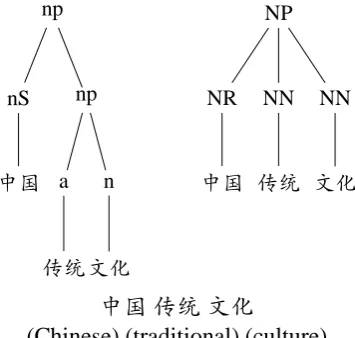
ad-dition to the most popular treebank Chinese Tree-bank (CTB) (Xue et al., 2002), there are also other treebanks such as Tsinghua Chinese Tree-bank (TCT) (Zhou, 1996). For the purpose of full use of readily available human annotations for the same tasks, it is significant if such cor-pora can be used jointly. Such attempt is es-pecially significant for some languages that have limited size of labeled data. At first sight, a di-rect combination of multiple corpora is a way to this end. However, corpora created for the same NLP tasks are generally built by different orga-nizations. Thus such corpora often follow dif-ferent annotation standards and/or even difdif-ferent linguistic theories. We take CTB and TCT as a case study. Although both CTB and TCT are Chomskian-style treebanks, they have annotation divergences in at least two dimensions: a) CTB and TCT have dramatically different tag sets, in-cluding parts-of-speech and grammar labels, and the tags cannot be mapped one to one; b) CTB and TCT have distinct hierarchical structures. For ex-ample, the Chinese words “中国 (Chinese) 传统 (traditional) 文化(culture)” are grouped as a flat noun phrase according to the CTB standard (right side in Fig. 1), but in TCT, the last two words are instead grouped together beforehand (left side in Fig. 1). The differences cause such treebanks of different annotation standard to be generally used independently.
np
nS
中国
np
a
传统 n
文化
NP
NR
中国
NN
传统 NN
文化
中国传统文化
[image:2.595.92.270.72.241.2](Chinese) (traditional) (culture)
Figure 1: Example tree fragments with TCT (left) and CTB (right) annotations
fit the standard of another treebank (target tree-bank). To this end, we propose a language in-dependent approach called informed decoding 1, in which a parser trained on a target treebank au-tomatically assigns new parse trees to sentences in a source treebank with the aid of informa-tion derived from annotainforma-tions in the source tree-bank. We conduct experiments on two open Chi-nese treebanks2: CTB and TCT. Experimental re-sults show that our approach achieves significant improvements over baseline systems, especially when training data used for building the parser is small in size.
The rest of the paper is structured as follows. In Section 2 we describe previous work on treebank conversion. In Section 3, we describe in detail the informed decoding approach. Section 4 presents experimental results which demonstrate the effec-tiveness of our approach. Finally, Section 5 con-cludes our work.
2 Related Work
Previous work on treebank conversion can be grouped into two categories according to whether grammar formalisms of treebanks are identical. One type focuses on converting treebanks of dif-ferent grammar formalisms. Collins et al. (1999)
1
The terminology decoding is referred to the parsing phase of a parser.
2Note that although we use Chinese treebanks, our
ap-proach is language independent.
addressed constituent syntactic parsing on Czech using a treebank converted from a Prague depen-dency treebank, where conversion rules derived from head-dependent pairs and heuristic rules are applied. Xia and Palmer (2001) compared three algorithms for conversion from dependency struc-tures to phrase strucstruc-tures. The algorithms ex-panded each node in input dependency structures into a projection chain, and labeled the newly in-serted node with syntactic categories. The three algorithms differ only in heuristics adopted to build projection chains. Xia et al. (2008) auto-matically extracted conversion rules from a tar-get treebank and proposed strategies to handle the case when more than one conversion rule are ap-plicable. Instead of using conversion rules, Niu et al. (2009) proposed to convert a dependency treebank to a constituency one by using a parser trained on a constituency treebank to generate k-best lists for sentences in the dependency tree-bank. Optimal conversion results are selected from the k-best lists. There also exists work in the reverse direction: from a constituency treebank to a dependency treebank (Nivre, 2006; Johansson and Nugues, 2007).
3 Treebank Conversion via Informed Decoding
The task of treebank conversion is defined to con-vert parse trees in a source treebank to fit the stan-dard of a target treebank. In the informed de-coding approach, treebank conversion proceeds in two steps: 1) build a parser on a target treebank; 2) apply the parser to decode sentences in a source treebank with the aid of information derived from the source treebank. For convenience, parse trees in a source treebank are referred to as source trees and corresponding, trees from a target treebank are referred to as target trees. Moreover, a parser built on a target treebank is referred to as target parser. In the following sections, we first describe motivation of our work and then present details of the informed decoding approach.
3.1 Motivation
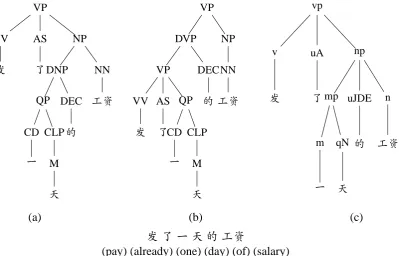
We use the example in Fig. 2 to illustrate why original annotations in a source treebank can help in treebank conversion. The figure depicts three tree fragments for the Chinese words发(pay)了 (already)一 (one)天(day) 的(of)工资(salary), among which Fig. 2(a) and Fig. 2(b) are tree frag-ments of the CTB standard and Fig. 2(c) is a tree fragment of the TCT standard. From the fig-ure, we can see that these Chinese words actu-ally have (at least) two plausible interpretations of the meaning. In Fig. 2(a), the words mean pay salary for one-day work while in Fig. 2(b), the words mean spend one day on paying salary. If Fig. 2(c) is a source tree to be converted into the CTB standard, then Fig. 2(b) will be rejected since it conflicts with Fig. 2(c) with respect to tree structures. Note that structures reflect underlying sentence meaning. On the other hand, although Fig. 2(a) also has (minor) differences in tree struc-tures from Fig. 2(c), it is preferred as the conver-sion result3. From the example we can get in-spired by the observation that original annotations in a source treebank are informative and necessary to converting parse trees in the source treebank.
In general, conversion like that from Fig. 2(c)
3
Note that we don’t deny existence of annotation distinc-tions between the treebanks, but we aim to make use of what they both agree on. We assume that consensus is the major-ity.
to Fig. 2(a) requires sentence-specific conversion rules which are difficult to obtain in practice. In order to make use of information provided by original annotations in a source treebank, Wang et al. (1994) proposed a selecting-from-k-best ap-proach where source trees are used to select one “optimal” parse tree from each k-best list gener-ated by a target parser. In this paper, we instead in-corporate information of original annotations into the parsing phase. The underlying motivation is two-fold:
• The decoding phase of a parser is essentially a search process. Due to the extreme mag-nitude of searching space, pruning of search paths is practically necessary. If reliable in-formation is provided to guide the pruning of search paths, more efficient parsing and bet-ter results are expected.
• Selecting-from-k-best works on the basis of k-best lists. Unfortunately, we often see very few variations in k-best lists. For exam-ple, 50-best trees present only 5 to 6 varia-tions (Huang, 2008). The lack of diversi-ties in k-best lists makes information from the source treebank less effective in selecting parse trees. By contrast, incorporating such information into decoding makes the infor-mation affect the whole parse forest.
3.2 Formalization of Information from Source Treebank
In this paper, information from a source treebank translates into two strategies which help a target parser to prune illegal partial parse trees and to rank legal partial parse trees higher. Following are the two strategies:
VP
VV
发
AS
了
NP
DNP
QP
CD
一 CLP
M
天 DEC
的
NN
工资
VP
DVP
VP
VV
发 AS
了 QP
CD
一 CLP
M
天 DEC
的 NP
NN
工资
vp
v
发
uA
了
np
mp
m
一 qN
天 uJDE
的 n
工资
(a) (b) (c)
发了 一天的工资
[image:4.595.100.500.71.327.2](pay) (already) (one) (day) (of) (salary)
Figure 2: tree fragments of words发了 一天的工资: (a) and (b) show two plausible tree fragments of the words using the CTB standard; (c) shows a tree fragment of the TCT standard which has the same interpretation as (a).
6
4
1
5
2 3
[1,3],[2,3],[1,1]
[1,1]
[2,3],[2,2],[3,3]
[1,1]
[2,2]
[image:4.595.99.262.404.532.2][3,3]
Figure 3: Constituent set of a synthetic parse tree
• Rescoring strategy: in practice, decoding is often a local optimal search process. In some cases even if a correct parse tree exits in the parse forest, parsers may fail to rank it to the top position. Rescoring strategy is used to increase scores for partial parse trees which are confidently thought to be valid.
3.2.1 Pruning Strategy
The pruning strategy used in this paper is based on the concept of conflict which is defined in two
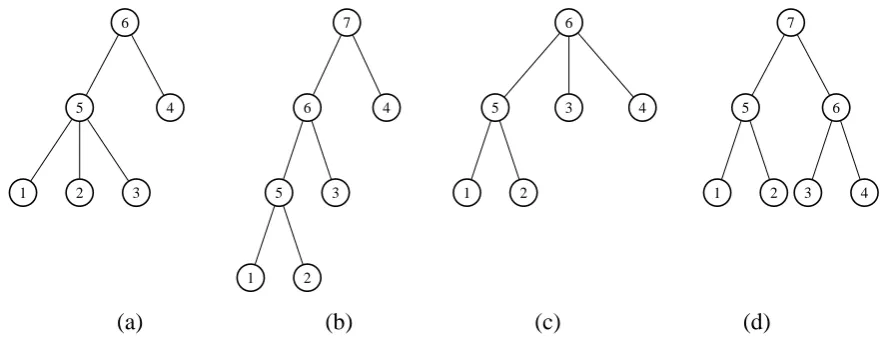
dimensions: structures and grammar labels. Since a tree structure can be equivalently represented as its span (interval of word indices) set, we can check whether two trees conflict by checking their spans. See Fig. 3 for an illustration of spans of a tree. Following are criteria determining whether two trees conflict in their structures.
• If one node in tree A is raised to be a child of the node’s grandfather in tree B, and the grandfather has more than two children, then tree A and tree B conflict in structures.
• If tree A has a span [a, b] and tree B has a span [m, k]and these two spans satisfy the condition of eithera < m ≤b < korm < a ≤ k < b, then tree A and B conflict in structures.
6
5
1 2 3
4
7
6
5
1 2
3 4
6
5
1 2
3 4
7
5
1 2
6
3 4
[image:5.595.74.516.67.238.2](a) (b) (c) (d)
Figure 4: Illustrating example of the concept of conflict: (a) and (b) are compatible (not conflict); (a) conflicts with (c) (condition 1) and (d) (condition 2)
For the dimension of grammar labels, we manu-ally construct a mapping between label sets (POS tags excluded) of source and target treebanks. Such a mapping is frequently a many-to-many mapping. Two labels are said to be conflicting if they are from different label sets and they cannot be mapped.
By combining these two strategies, two parse trees (of different standards) which yield the same sentence are said to be conflicting if they conflict in both structures and labels. Note that we de-scribe pruning strategy for the case of two parse trees. In informed decoding process, this strategy is actually applied to every partial parse tree gen-erated during decoding.
3.2.2 Rescoring Strategy
As mentioned above, despite that the pruning strategy helps in improving conversion accuracy, we are faced with the problem of how to rank valid parse trees higher in a parse forest. To solve the problem, we adjust the scores of those partial parse trees that are considered to be confidently “good”. The criteria which is used to judge “good-ness” of a partial parse are listed as follows:
• The partial parse tree can find in the source tree a constituent that has the same structure as it.
• When the first criterion is satisfied, gram-mar categories of this partial parse should not
conflict with the grammar categories of its counterpart.
In practice, we use a parameter λ to adjust the score.
Pnew(e) =λ∗P(e) (1)
Hereerepresents any partial tree that is rescored, and P(e) and Pnew(e) refer to original and new scores, respectively.
3.3 Parsing Model
Theoretically all parsing models are applicable in informed decoding, but we prefer to adopt a CKY-style parser for two reasons: CKY CKY-style parsers are dynamically bottom-up and always have edges (or parsing items) belonging to the same span stacked together in the same chart4 cell. The property of CKY-style parsers being dynamically bottom-up can make the pruning strategy efficient by avoiding rechecking subtrees that have already been checked. The property of stacking edges in the same chart cell makes CKY-style parsers eas-ily portable to the situaiton of informed decod-ing. In this paper, Collins parser (Collins, 1999) is used. Algorithm 1 presents the extended ver-sion of the decoding algorithm used in Collins parser. What the algorithm needs to do is to generate edges for each span. And before edges are allowed to enter the chart, pruning conditions
4Data structure used to store paring items that are not
Algorithm 1 CKY-style decoding Argument: a parsing decoder
a sentence to be parsed and corresponding source tree
Begin Steps:
1. initialization steps
2. for span from 2 to sentence length do
for start from 1 to (sentence length-span+1) do end := (start + span - 1)
for each edgeefor span [start, end] do generate(e, start, end)
prune(e, start, end) rescore(e, start, end) add edge(e, start, end) End
Subroutine:
generate: generates an edge which belongs to the span [start, end].
prune: apply pruning strategy to check whether the edge should be pruned.
rescore: apply rescoring strategy to weight the edge. add edge: add the edge into chart.
should be checked in prune subroutine and rescor-ing should be conducted in rescore subroutine with respect to the corresponding source tree.
4 Experiments
4.1 Experimental Setup
In this paper, we conduct two groups of experi-ments in order to evaluate 1) treebank conversion accuracy and 2) how much newly generated data can boost syntactic parsing accuracy. For the ex-periments of treebank conversion, Penn Chinese Treebank (CTB) 5.1 is used as the target treebank. That is, the CTB standard is the one we are inter-ested in. Following the conventional data split-ting of CTB5.1, articles 001-270 and 400-1151 (18,100 sentences, 493,869 words) are used for training, articles 271-300 (348 sentences, 8,008 words) are used as test data, and articles 301-325 (352 sentences, 6,821 words) are used as devel-opment data 5. Moreover, in order to directly evaluate conversion accuracy, we randomly sam-pled 150 sentences from the CTB test set and have three annotators manually label sentences of these parse trees according to the standard of Tsinghua Chinese Treebank (TCT). Thus each of the 150 sentences has two parse trees, following the CTB
5Development set is not used in this paper.
and TCT standard, respectively. For convenience of reference, the set of 150 parse trees of the CTB standard is referred to as Sample-CTB and its counterpart which follows the TCT standard is referred to as Sample-TCT. In such setting, the ex-periments of treebank conversion is designed to use the informed decoding approach to convert Sample-TCT to the standard of CTB and conver-sion results are evaluated with respect to Sample-CTB. The CTB training data (or portion of it) is used as target training data on which parsers are trained for conversion.
For the experiments of syntactic parsing, the TCT corpus is used as the source treebank. The TCT corpus contains 27,268 sentences and 587,298 words, which are collected from the lit-erature and newswire domains. In this group of experiments, the CTB training data is again used as target training data and the whole TCT cor-pus is converted using the informed decoding ap-proach. The newly-gained parse trees are used as additional training data for syntactic parsing on the CTB test data. One thing worth noting in the experiments is that, using Collins parser to con-vert the TCT corpus requires Part-of-Speech tags of the CTB standard be assigned to sentences in TCT ahead of conversion being conducted. To this end, instead of using POS taggers, we use the la-bel correspondence learning method described in (Zhu and Zhu, 2009) in order to get high POS tag-ging accuracy.
For all the experiments in this paper, bracketing F1 is used as the performance metric, provided by the EVALB program6.λin Eq.1 is set to 3.0 since it provides best conversion results in our experi-ments.
4.2 Experiments on Conversion
The setup of conversion experiments is described above. In the experiments, we use two representa-tive baseline systems. One, named directly ing (DP) converts Sample-TCT by directly pars-ing uspars-ing Collins parser which is trained on tar-get training data, and the other is the method pro-posed in (Wang et al., 1994) (hereafter referred to as Wang94). For the latter baseline, we use Berkeley parser (Petrov et al., 2006) instead of
Ratio 20% 40% 60% 80% 100% DP 73.19 75.21 79.43 80.64 81.40 Wang94 75.00 76.82 78.08 81.50 82.47 This paper 82.71 83.00 83.37 84.80 84.34
Table 1: Conversion accuracy with varying size of target training data
Collins parser. The reason is that we want to build a strong baseline since Berkeley parser is able to generate better k-best lists than Collins parser does (Zhang et al., 2009). In detail, Wang94 pro-ceeds in two steps: 1) use Berkeley parser to gen-erate k-best lists for sentences in Sample-TCT; 2) select a parse tree from each k-best list with re-spect to original annotations in Sample-TCT. Here we set k to 50. Table 1 reports F1 scores of the baseline systems and our informed decoding ap-proach with varying size of target training data. The first row of the table represents fractions of the CTB training data which are used as target training data. For example, 40% means 7,240 parse trees (of 18,100) in the CTB training data are used. To relieve the effect of ordering, we randomly shuffled parse trees in the CTB training data.
From the table, we can see that our ap-proach performs significantly better than DP and Wang94. In detail, when100%CTB training data is used as target training data,2.95%absolute im-provement is achieved. When the size of target training data decreases, absolute improvements of our approach over baseline systems are further en-larged. More interestingly, decreasing in target training data only results in marginal decrement in conversion accuracy of our approach. This is of significant importance in the situation where tar-get treebank is small in size.
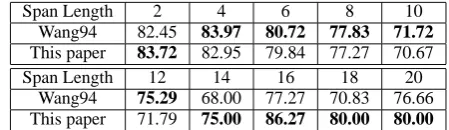
In order to evaluate the accuracy of conversion methods on different span lengths, we compare the results of Wang94 and informed decoding pro-duced by using100%CTB training data. Table 2 shows the statistics.
From the results we can see that our ap-proach performs significantly better on long spans and achieves marginally lower accuracy on small ones. But notice that the informed decoding ap-proach is implemented on the base of Collins
Span Length 2 4 6 8 10 Wang94 82.45 83.97 80.72 77.83 71.72 This paper 83.72 82.95 79.84 77.27 70.67 Span Length 12 14 16 18 20
Wang94 75.29 68.00 77.27 70.83 76.66 This paper 71.79 75.00 86.27 80.00 80.00
Table 2: Conversion accuracy on different span lengths
Category ADJP VCD CP DNP ADVP Wang94 79.62 57.14 65.43 84.76 91.73 This paper 88.00 66.67 71.60 88.31 93.44
Table 3: Conversion results with respect to differ-ent grammar categories
parser and that Wang94 works on the basis of Berkeley parser. Taking the performance gap of Collins parser and Berkeley parser, we actually can conclude that on small spans, our approach is able to achieve results comparable with or even better than Wang94. We can also infer from the observation that our approach can outperform Wang94 when converting parse trees which yield long sentences.
Another line of analysis is to compare the results of Wang94 and our approach, with re-spect to different grammar categories. Table 3 lists five grammar categories in which our ap-proach achieves most improvements. For cat-egories NP and VP, absolute improvements are 1.1% and 1.4% respectively. Take into account large amounts of instances of NP and VP, the im-provements are also quite significant.
4.3 Experiments on Parsing
data cannot replace the CTB training data thor-oughly, we would like to use it as additional train-ing data besides the CTB traintrain-ing data. Followtrain-ing experiments aim to examine effectiveness of the newly-gained data when used as additional train-ing data.
In the first parsing experiment, the TCT cor-pus is converted using portions of the CTB train-ing data. As in the conversion experiments, parse trees in the CTB training data are randomly or-dered before splitting of the training set. For each portion, newly-gained data together with the por-tion of the CTB training data are used to train a new parser. Evaluation results on the CTB test data are presented in Table 4.
Ratio 20% 40% 60% 80% 100% Collins 75.74 77.65 79.43 81.22 82.04 Collins+ 78.86 79.52 80.06 81.77 82.38
Table 4: Parsing accuracy with new data added in
Here in Table 4, the first row represents ratios of parse trees from the CTB training data. For example, 40%means the first40%parse trees in the CTB training data are used. The Collins row represents the results of only using portions of the CTB training data, and the Collins+ row contains the results achieved with enlarged training data. From the results, we find that new data indeed provides complementary information to the CTB training data, especially when the training data is small in size. But benefits of Collins parser gained from additional training data level out with the in-crement of the training data size. Actually if tech-niques like corpus weighting (Niu et al., 2009) are applied to weight differently training data and the additional data, higher parsing accuracy is reason-ably expected.
Another obversion from Table 4 is that the parser trained on 40% CTB training data plus additional training data achieves higher accuracy than using 60% CTB training data. We incre-mentally add labeled training data and automatic training data respectively to 40% CTB training data. The purpose of this experiment is to see the magnitude of automatic training data which can achieve the same effect as labeled training data does. The results are depicted in Table 5.
# of Added Data 2k 4k 6k 8k Labeled Data 78.51 79.52 80.01 81.37
Auto Data 78.23 79.11 79.85 79.67
Table 5: Parsing accuracy with new data added in
From the results we see that accuracy gaps be-tween using labeled data and using automatic data get large with the increment of added data. One possible reason is that more noise is taken when more data is added. This observation further veri-fies that refining techniques like corpus weighting are necessary for using automatically-gained data.
5 Conclusions
In this paper we proposed an approach called in-formed decoding for the task of conversion be-tween treebanks which have different annotation standards. Experiments which evaluate conver-sion accuracy directly showed that our approach significantly outperform baseline systems. More interestingly we found that the size of target train-ing data have limited effect on the conversion ac-curacy of our approach. This is extremely impor-tant for languages which lack enough treebanks in whose standards we are interested.
We also added newly-gained data to target training data to check whether new data can boost parsing results. Experiments showed additional training data provided by treebank conversion could boost parsing accuracy.
References
Banko, Michele and Eric Brill. 2001. Scaling to very very large corpora for natural language dis-ambiguation. In Proc. of ACL 2001, pages 26-33.
Charniak, Eugene. 2000. A Maximum-Entropy-Inspired Parser. In Proc. of NAACL 2000, pages
132-139.
Collins, Michael. 1999. Head-driven statistical
mod-els for natural language parsing. Ph.D. thesis,
Uni-versity of Pennsylvania.
Collins, Michael, Lance Ramshaw, Jan Hajic, and Christoph Tillmann. 1999. A Statistical Parser for
Czech. In Proc. of ACL 1999, pages 505-512.
Charniak, Eugene. 2000. A maximum-entropy-inspired parser. In Proc. of NAACL 2000, pages
Huang, Liang. 2008. Forest reranking:
Discrimina-tive parsing with non-local features. In Proc. of ACL 2008, pages 586-594.
Johansson, Richard and Pierre Nugues. 2007.
Ex-tended constituent-to-dependency conversion for English. In Proc. of NODALIDA 2007, pages
105-112.
Nivre, Joakim. 2006. Inductive Dependency Parsing. In Springer, Volume 34.
Niu, Zheng-Yu, Haifeng Wang, Hua Wu. 2009.
Ex-ploiting heterogeneous treebanks for parsing. In Proc. of ACL 2009, pages 46-54.
Petrov, Slav, Leon Barrett, Romain Thibaux, and Dan Klein. 2006. Learning accurate, compact, and
in-terpretable tree annotation. In Proc. of
COLING-ACL 2006, pages 433-440.
Xue, Nianwen, Fu dong Chiou, and Martha Palmer. 2002. Building a large-scale Annotated Chinese corpus. In Proc. of COLING 2002, pages 1-8.
Wang, Jong-Nae, Jing-Shin Chang, and Keh-Yih Su. 1994. An automatic treebank conversion algorithm
for corpus sharing. In Proc. of ACL 1994, pages
248-254.
Xia, Fei, Rajesh Bhatt, Owen Rambow, Martha Palmer, and Dipti M. Sharma. 2008. Towards a
Multi-Representational Treebank. In Proc. of the
7th International Workshop on Treebanks and Lin-guistic THeories, pages 159-170.
Zhang, Hui, Min Zhang, Chew Lim Tan, and Haizhou Li. 2009. K-best combination of syntactic parsers. In Proc. of EMNLP 2009, pages 1552-1560.
Zhou, Qiang. 1996. Phrase bracketing and annotating
on Chinese language corpus. (in Chinese) Ph.D.
thesis, Beijing University.
Zhu, Muhua and Jingbo Zhu. 2009. Label