Using Decision Tree Induction
Myung-Seok Choi, Chul Su Lim, and Key-Sun Choi
Korea Advanced Institute of Science and Technology, 373-1 Guseong-dong, Yuseong-gu, Daejeon 305-701, Republic of Korea
{mschoi, cslim}@kaist.ac.kr [email protected]
Abstract. Partial parsing techniques try to recover syntactic
informa-tion efficiently and reliably by sacrificing completeness and depth of anal-ysis. One of the difficulties of partial parsing is finding a means to extract the grammar involved automatically. In this paper, we present a method for automatically extracting partial parsing rules from a tree-annotated corpus using decision tree induction. We define the partial parsing rules as those that can decide the structure of a substring in an input sentence deterministically. This decision can be considered as a classification; as such, for a substring in an input sentence, a proper structure is chosen among the structures occurred in the corpus. For the classification, we use decision tree induction, and induce partial parsing rules from the decision tree. The acquired grammar is similar to a phrase structure grammar, with contextual and lexical information, but it allows building structures of depth one or more. Our experiments showed that the pro-posed partial parser using the automatically extracted rules is not only accurate and efficient, but also achieves reasonable coverage for Korean.
1
Introduction
Conventional parsers try to identify syntactic information completely. These parsers encounter difficulties when processing unrestricted texts, because of un-grammatical sentences, the unavoidable incompleteness of lexicon and grammar, and other reasons like long sentences. Partial parsing is an alternative technique developed in response to these problems. This technique aims to recover syn-tactic information efficiently and reliably from unrestricted texts by sacrificing completeness and depth of analysis, and relying on local information to resolve ambiguities [1].
Partial parsing techniques can be roughly classified into two groups. The first group of techniques involves partial parsing via finite state machines [2,3,9,10]. These approaches apply the sequential regular expression recognizer to an in-put sentence. When multiple rules match an inin-put string at a given position,
This research was supported in part by the Ministry of Science and Technology, the Ministry of Culture and Tourism, and the Korea Science and Engineering Foundation in Korea.
R. Dale et al. (Eds.): IJCNLP 2005, LNAI 3651, pp. 143–154, 2005. c
the longest-matching rule is selected. Therefore, these parsers always produce a single best analysis and operate very fast. In general, these approaches use a hand-written regular grammar. As would be expected, manually writing a grammar is both very time consuming and prone to have inconsistencies.
The other group of partial parsing techniques is text chunking, that is, recog-nition of non-overlapping and non-recursive cores of major phrases (chunks), by using machine learning techniques [4,7,8,13,15,17]. Since Ramshaw and Mar-cus [15] first proposed formulating the chunking task as a tagging task, most
chunking methods have followed thisword-taggingapproach. In base noun phrase
chunking, for instance, each word is marked with one of three chunk tags: I (for a word inside an NP), O (for outside of an NP), and B (for between the end of
one NP and the start of another) as follows1:
In ( early trading ) in ( Hong Kong ) ( Monday ), ( gold ) was quoted at ( $ 366.50 ) ( an ounce ).
InO earlyI tradingI inO HongI KongI MondayB ,O goldI wasO quotedO
atO $I 366.50I anB ounceI .O
With respect to these approaches, there have been several studies on automat-ically extracting chunking rules from large-scale corpora using transformation-based learning [15], error-driven pruning [7], the ALLiS top-down inductive sys-tem [8]. However, it is not yet clear how these approaches could be extended beyond the chunking task.
In this paper, we present a method of automatically extracting partial pars-ing rules from a tree-annotated corpus uspars-ing the decision tree method. Our goal is to extract rules with higher accuracy and broader coverage. We define the partial parsing rules as those that can establish the structure of a substring in an input sentence deterministically. This decision can be considered as a classifi-cation; as such, for a substring in an input sentence, a proper structure is chosen
among the structures occurred in the corpus, as extended from theword-tagging
approach of text chunking. For the classification, we use decision tree induction with features of contextual and lexical information. In addition, we use negative evidence, as well as positive evidence, to gain higher accuracy. For general re-cursive phrases, all possible substrings in a parse tree are taken into account by extracting evidence recursively from a parse tree in a training corpus. We induce partial parsing rules from the decision tree, and, to retain only those rules that are accurate, verify each rule through cross-validation.
In many cases, several different structures are assigned to the same substring in a tree-annotated corpus. Substrings for coordination and compound nouns are typical examples of such ambiguous cases in Korean. These ambiguities can pre-vent us from extracting partial parsing rules that cover the substrings with more than one substructure and, consequently, can cause the result of partial parsing to be limited to a relatively shallow depth. In this work, we address this problem by merging substructures with ambiguity using an underspecified representation.
1
This underspecification leads to broader coverage without deteriorating either the determinism or the precision of partial parsing.
The acquired grammar is similar to a phrase structure grammar, with con-textual and lexical information, but it allows building structures of depth one or more. It is easy to understand; it can be easily modified; and it can be selectively added to or deleted from the grammar. Partial parsing with this grammar pro-cesses an input sentence deterministically using longest-match heuristics. The acquired rules are then recursively applied to construct higher structures.
2
Automatic Rule Acquisition
To start, we define the rule template, the basic format of a partial parsing rule, as follows:
lef t context|substring|right context−→substructure
This template shows how thesubstring of an input sentence, surrounded by the
left context and the right context, constructs the substructure. The left context
and theright contextare the remainder of an input sentence minus thesubstring.
For automatic learning of the partial parsing rules, the lengths of theleft context
and the right context are restricted to one respectively. Note that applying a
partial parsing rule results in a structure of depth one or more. In other words, the rules extracted by this rule template reduce a substring into a subtree, as opposed to a single non-terminal; hence, the resultant rules can be applied more specifically and strictly.
c4.5
tree-annotated corpus
partial parsing rules
rule candidate extraction
tree underspecification contextualization
& lexicalization verification refinement
Fig. 1.Procedure for extracting partial parsing rules
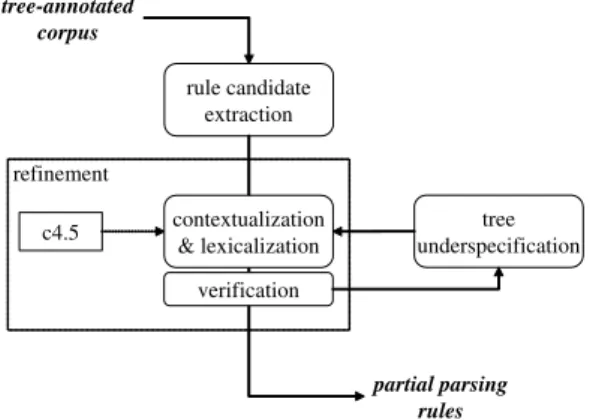
to their respective substrings. Next, using the decision tree method, these candi-dates are enriched with contextual and lexical information. The contextualized and lexicalized rules are verified through cross-validation to retain only those rules that are accurate. The successfully verified accurate rules become the final partial parsing rules. Remaining rules that cannot be verified are forwarded to the tree underspecification step, which merges tree structures with hard ambi-guities. As seen in Fig. 1, the underspecified candidates return to the refinement step. The following subsections describe each step in detail.
2.1 Extracting Candidates
From the tree-annotated corpus, we extract all the possible candidates for partial parsing rules in accordance with the rule template. Scanning input sentences an-notated with its syntactic structure one by one, we can extract the substructure corresponding to every possible substring at each level of the syntactic
struc-ture. We define level 0 as part-of-speech tags in an input sentence, and level n
as the nodes whose maximum depth isn. If no structure precisely corresponds
to a particular substring, then a null substructure is extracted, which represents negative evidence.
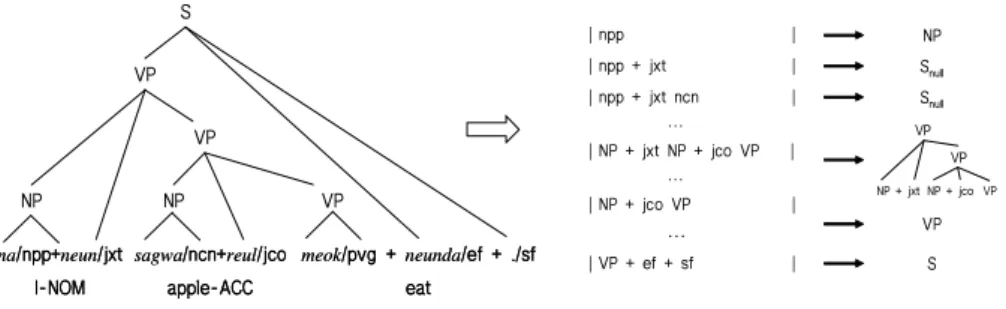
Figure 2 shows an example sentence2with its syntactic structure3and some
of the candidates for the partial parsing rules extracted from the left side of the example. In this figure, the first partial parsing rule candidate shows how
the substring ‘npp’ can be constructed into the substructure ‘NP’. Snull denotes
negative evidence.
The extracted rule candidates are gathered and grouped according to their
respective substrings. Figure 34 shows the candidate groups. In this figure, G
1
and G2 are the group names, and the number in the last column refers to the
frequency that each candidate occurs in the training corpus. Group G1 and G2
have 2 and 3 candidates, respectively. When a particular group has only one candidate, the candidate can always be applied to a corresponding substring
2 ‘NOM’ refers to the nominative case and ‘ACC’ refers to the accusative case. The
term ‘npp’ denotes personal pronoun; ‘jxt’ denotes topicalized auxiliary particle; ‘ncn’ denotes non-predicative common noun; ‘jco’ denotes objective case particle; ‘pvg’ denotes general verb; ‘ef’ denotes final ending; and ‘sf’ denotes full stop symbol. For a detailed description of the KAIST corpus and its tagset, refer to Lee [11]. The symbol ‘+’ is not a part-of-speech, but rather a delimiter between words within a word phrase.
3 In Korean, a word phrase, similar to bunsetsu in Japanese, is defined as a spacing unit
with one or more content words followed by zero or more functional words. A content word indicates the meaning of the word phrase in a sentence, while a functional word—a particle or a verbal-ending—indicates the grammatical role of the word phrase. In the KAIST corpus used in this paper, a functional word is not included in the non-terminal that the preceding content word belongs to, following the restricted representation of phrase structure grammar for Korean [12]. For example, a word
phrase “na/npp +neun/jxt” is annotated as “(NP na/npp ) +neun/jxt”, as in
NP NP VP VP
VP S
na/npp+neun/jxt I-NOM
na/npp+neun/jxt I-NOM
sagwa/ncn+reul/jco apple-ACC
sagwa/ncn+reul/jco apple-ACC
meok/pvg + neunda/ef + ./sf eat
meok/pvg + neunda/ef + ./sf eat
|npp |
|npp + jxt |
|npp + jxt ncn |
…
|NP + jxt NP + jco VP |
…
|NP + jco VP | …
|VP + ef + sf |
Snull Snull
NP + jxt NP + jco VP
VP VP
NP
VP
S
Fig. 2.An example sentence and the extracted candidates for partial parsing rules
|etm nbn + jcs paa |
Snull
AUXP
G1
G2
|VP + ecs VP + ecs VP|
Snull 66 151 123 170 487 freq.
VP + ecs VP + ecs VP
VP VP
VP + ecs VP + ecs VP
VP VP
VP + ecs VP + ecs VP
VP VP
VP + ecs VP + ecs VP
VP VP
Fig. 3.Groups of partial parsing rules candidates
deterministically. In contrast, if there is more than one candidate in a particular group, those candidates should be enriched with contextual and lexical informa-tion to make each candidate distinct for proper applicainforma-tion to a corresponding substring.
2.2 Refining Candidates
This step refines ambiguous candidates with contextual and lexical information to make them unambiguous.
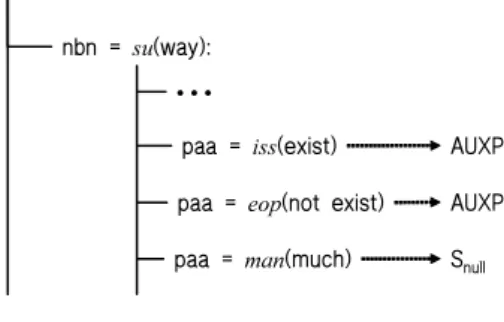
First, each candidate needs to be annotated with contextual and lexical in-formation occurring in the training corpus, as shown in Fig. 4. In this figure, we
can see that a substring with lexical information such as ‘su/nbn’
unambigu-ously constitutes the substructure ‘AUXP’. We use the decision tree method, C4.5 [14], to select the important contextual and lexical information that can facilitate the establishment of unambiguous partial parsing rules. The features used in the decision tree method are the lexical information of each terminal or
4
sal/pvg + |r/etmsu/nbn +ga/jcsiss/paa |+da/ef →AUXP
i/jp + |r/etmsu/nbn +ga/jcseop/paa |+da/ef →AUXP
nolla/pvg + |n/etmjeok/nbn +i/jcsiss/paa |+da/ef →Snull
wanjeonha/paa +|n/etmgeot/nbn +i/jcseop/paa |+go/ecc→Snull
kkeutna/pvg + |n/etmgeut/nbn +i/jcsani/paa |+ra/ecs→Snull
ik/pvg + |neun/etmgeut/nbn +i/jcsjot/paa |+da/ef →Snull
ha/xsv + |r/etmnawi/nbn +ga/jcseop/paa |+da/ef →Snull
Fig. 4.Annotated candidates for the G1 group rules
nbn = su(way):
paa = iss(exist)
paa = eop(not exist)
paa = man(much) Snull AUXP
AUXP
• • •
Fig. 5.A section of the decision tree
non-terminal for thesubstring, and the parts-of-speech and lexical information
for theleft contextand theright context. Lexical information of a non-terminal
is defined as the part-of-speech and lexical information of its headword. Figure 5 shows a section of the decision tree learned from our example sub-string. The deterministic partial parsing rules in Fig. 6 are extracted from the decision tree. As shown in Fig. 6, only the lexical entries for the second and the fourth morphemes in the substring are selected as additional lexical informa-tion, and none of the contexts is selected in this case. We should note that the rules induced from the decision tree are ordered. Since these ordered rules do not interfere with those from other groups, they can be modified without much difficulty.
| etmsu/nbn + jcsiss/paa | −→ AUXP
| etmsu/nbn + jcseop/paa | −→ AUXP
| etmsu/nbn + jcsman/paa| −→ Snull
After we enrich the partial parsing rules using the decision tree method, we verify them by estimating the accuracy of each rule to filter out less deterministic rules. We estimate the error rates (%) of the rule candidates via a 10-fold cross validation on the training corpus. The rule candidates of the group with an error
rate that is less than the predefined threshold,θ, can be extracted to the final
partial parsing rules. The candidates in the group G2 in Fig. 3 could not be
extracted as the final partial parsing rules, because the estimated error rate of
the group was higher than the threshold. The candidates in G2 are set aside
for tree underspecification processing. Using the thresholdθ, we can control the
number of the final partial parsing rules and the ratio of the precision/recall trade-off for the parser that adopts the extracted partial parsing rules.
2.3 Dealing with Hard Ambiguities: The Underspecified Representation
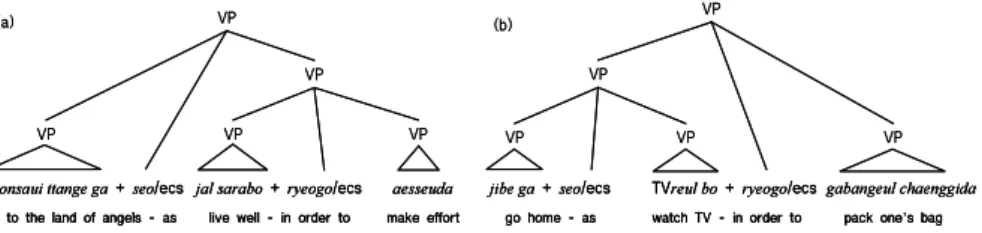
The group G2in Fig. 3 has one of the attachment ambiguities, namely,
consecu-tive subordinate clauses. Figure 7 shows sections of two different trees extracted
from a tree-annotated corpus. The two trees have identicalsubstrings, but are
an-alyzed differently. This figure exemplifies how an ambiguity relates to the lexical association between verb phrases, which is difficult to annotate in rules. There are many other syntactic ambiguities, such as coordination and noun phrase bracketing, that are difficult to resolve with local information. The resolution usually requires lexical co-occurrence, global context, or semantics. Such am-biguities can deteriorate the precision of partial parsing or limit the result of partial parsing to a relatively shallow depth.
Rule candidates with these ambiguities mostly have several different struc-tures assigned to the same substrings under the same non-terminals. In this
paper, we refer to them as internal syntactic ambiguities. We manually
exam-ined the patterns of the internal syntactic ambiguities, which were found in the KAIST corpus as they could not be refined automatically due to low estimated accuracies. During the process, we observed that few internal syntactic ambigu-ities could be resolved with local information.
In this paper, we handle internal syntactic ambiguities by merging the candi-dates using tree intersection and making them underspecified. This underspeci-fied representation enables an analysis with broader coverage, without
deterio-VP
VP VP
cheonsaui ttange ga+ seo/ecs
go to the land of angels - as
jal sarabo+ ryeogo/ecs
live well - in order to
aesseuda make effort VP VP (a) VP VP VP
cheonsaui ttange ga+ seo/ecs
go to the land of angels - as cheonsaui ttange ga+ seo/ecs
go to the land of angels - as
jal sarabo+ ryeogo/ecs
live well - in order to jal sarabo+ ryeogo/ecs
live well - in order to
aesseuda make effort aesseuda make effort VP VP (a)
jibe ga+ seo/ecs
go home - as
TVreul bo+ ryeogo/ecs watch TV - in order to
gabangeul chaenggida
pack one’s bag
VP
VP VP
VP
VP (b)
jibe ga+ seo/ecs
go home - as jibe ga+ seo/ecs
go home - as
TVreul bo+ ryeogo/ecs watch TV - in order to TVreul bo+ ryeogo/ecs watch TV - in order to
gabangeul chaenggida
pack one’s bag
gabangeul chaenggida
pack one’s bag
VP
VP VP
VP
VP (b)
G2
|VP + ecs VP + ecs VP|
Snull VP
Fig. 8.Underspecified candidates
rating the determinism or the precision of partial parsing. Since only different structures under the same non-terminal are merged, the underspecification does not harm the structure of higher nodes. Figure 8 shows the underspecified
can-didates of group G2. In this figure, the first two rules in G2 are reduced to the
merged ‘VP’. Underspecified candidates are also enriched with contextual and lexical information using the decision tree method, and they are verified through cross-validation, as described in Sect. 2.2. The resolution of internal syntactic ambiguities is forwarded to a module beyond the partial parser. If necessary, by giving all possible structures of underspecified parts, we can prevent a later processing from re-analyzing the parts. Any remaining candidates that are not selected as the partial parsing rules after all three steps are discarded.
3
Experimental Results
We have performed experiments to show the usefulness of automatically ex-tracted partial parsing rules. For our evaluations, we implemented a naive par-tial parser, using TRIE indexing to search the parpar-tial parsing rules. The input of the partial parser is a part-of-speech tagged sentence and the result is usually the sequence of subtrees. At each position in an input sentence, the parser tries to choose a rule group using longest-match heuristics. Then, if any matches are found, the parser applies the first-matching rule in the group to the correspond-ing substrcorrespond-ing, because the rules induced from the decision tree are ordered.
In our experiments, we used the KAIST tree-annotated corpus [11]. The training corpus contains 10,869 sentences (289,362 morphemes), with an average length of 26.6 morphemes. The test corpus contains 1,208 sentences, with an average length of 26.0 morphemes. The validation corpus, used for choosing the
threshold,θ, contains 1,112 sentences, with an average length of 20.1 morphemes,
and is distinct from both the training corpus and the test corpus.
The performance of the partial parser was evaluated using PARSEVAL mea-sures [5]. The F measure, a complement of the E measure [16], is used to combine precision and recall into a single measure of overall performance, and is defined as follows:
Fβ=
(β2+ 1)∗LP∗LR
β2∗LP+LR
In the above equation,β is a factor that determines the weighting of precision
and recall. Thus, β <1 is used to weight precision heavier than recall, β >1
is used to weight recall heavier than precision, and β = 1 is used to weight
Table 1.Precision/Recall with respect to the threshold,θ, for the validation corpus
θ# of rules precision recall Fβ=0.4
6 18,638 95.5 72.9 91.6
11 20,395 95.1 75.1 91.7
16 22,650 94.2 78.0 91.6
21 25,640 92.6 83.3 91.2
26 28,180 92.0 84.7 90.9
Table 2.Experimental results of the partial parser for Korean
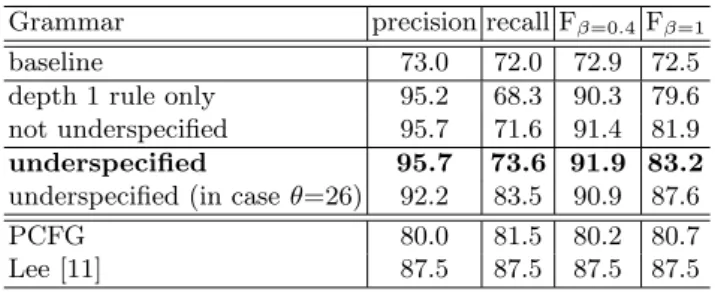
Grammar precision recall Fβ=0.4 Fβ=1
baseline 73.0 72.0 72.9 72.5
depth 1 rule only 95.2 68.3 90.3 79.6
not underspecified 95.7 71.6 91.4 81.9
underspecified 95.7 73.6 91.9 83.2
underspecified (in caseθ=26) 92.2 83.5 90.9 87.6
PCFG 80.0 81.5 80.2 80.7
Lee [11] 87.5 87.5 87.5 87.5
The parsing result can be affected by the predefined threshold,θ (described
in Sect. 2.2), which can control both the accuracy of the partial parser and the number of the extracted rules. Table 1 shows the number of the extracted rules and how precision and recall trade off for the validation corpus as the
threshold, θ, is varied. As can be seen, a lower threshold, θ, corresponds to a
higher precision and a lower recall. A higher threshold corresponds to a lower precision and a higher recall. For a partial parser, the precision is generally
favored over the recall. In this paper, we used a value of 11 for θ, where the
precision was over 95% andfβ=0.4 was the highest. The value of this threshold
should be set according to the requirements of the relevant application.
Table 2 presents the precision and the recall of the partial parser for the test
corpus when the threshold, θ, was given a value of 11. In the baseline
the “depth 1 rule only” grammar. This indicates that increasing the depth of a rule is helpful in partial parsing, as in the case of a statistical full parsing, Data-Oriented Parsing [6]. Comparing the “underspecified” grammar with the “not underspecified” grammar, we can see that underspecification leads to broader coverage, that is, higher recall. The precision of the “underspecified” grammar was above 95%. In other words, when a parser generates 20 structures, 19 out of 20 structures are correct. However, its recall dropped far beyond that of the
statistical full parser [11]. When we set θ to a value of 26, the underspecified
grammar slightly outperformed that of the full parser in terms offβ=1, although
the proposed partial parser does not always produce one complete parse tree5.
It follows from what has been said thus far that the proposed parser has the potential to be a high-precision partial parser and approach the performance
level of a statistical full parser, depending on the thresholdθ.
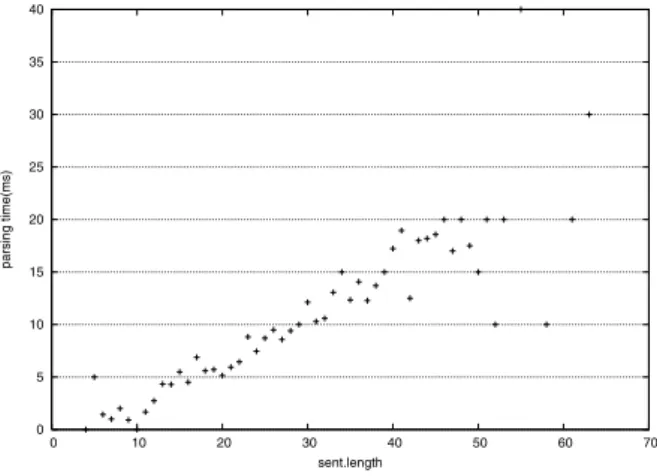
The current implementation of our parser has a O(n2m
r) worst case time
complexity for a case involving a skewed binary tree, where n is the length of
the input sentence and mr is the number of rules. Becausemr is the constant,
much more than two elements are reduced to subtrees of depth one or more in each level of parsing, and, differing from full parsing, the number of recursions
in the partial parsing seems to be limited6, we can parse in near-linear time.
Figure 9 shows the time spent in parsing as a function of the sentence length7.
0 5 10 15 20 25 30 35 40
0 10 20 30 40 50 60 70
parsing time(ms)
sent.length
Fig. 9.Time spent in parsing
Lastly, we manually examined the first 100 or so errors occurring in the test corpus. In spite of underspecification, the errors related to conjunctions and
5 In the test corpus, the percentage that our partial parser (θ=26) produced one
complete parse tree was 70.9%. Whenθ=11, the percentage was 35.9%.
6
In our parser, the maximum number of recursion was 10 and the average number of recursion was 4.47.
7
attachments were the most frequent. The errors of conjunctions were mostly
caused by substrings not occurring in the training corpus, while the cases of
attachments lacked contextual or lexical information for a givensubstring. These
errors can be partly resolved by increasing the size of the corpus, but it seems that they cannot be resolved completely with partial parsing. In addition, there were errors related to noun phrase bracketing, date/time/unit expression, and either incorrectly tagged sentences or inherently ambiguous sentences. For date, time, and unit expressions, manually encoded rules may be effective with partial parsing, since they appear to be used in a regular way. We should note that many unrecognized phrases included expressions not occurring in the training corpus. This is obviously because our grammar cannot handle unseen substrings;
hence, alleviating the sparseness in thesequenceswill be the goal of our future
research.
4
Conclusion
In this paper, we have proposed a method of automatically extracting the par-tial parsing rules from a tree-annotated corpus using a decision tree method. We consider partial parsing as a classification; as such, for a substring in an input sentence, a proper structure is chosen among the structures occurred in the cor-pus. Highly accurate partial parsing rules can be extracted by (1) allowing rules to construct a subtree of depth one or more; (2) using decision tree induction, with features of contextual and lexical information for the classification; and (3) verifying induced rules through cross-validation. By merging substructures with ambiguity in non-deterministic rules using an underspecified representation, we can handle syntactic ambiguities that are difficult to resolve with local infor-mation, such as coordination and noun phrase bracketing ambiguities. Using a
threshold,θ, we can control the number of the partial parsing rules and the ratio
of the precision/recall trade-off of the partial parser. The value of this thresh-old should be set according to the requirements of the relevant application. Our experiments showed that the proposed partial parser using the automatically extracted rules is not only accurate and efficient, but also achieves reasonable coverage for Korean.
References
1. Abney, S.P.: Part-of-speech tagging and partial parsing. Corpus-Based Methods in Language and Speech. Kluwer Academic Publishers (1996)
2. Abney, S.P.: Partial parsing via finite-state cascades. Proceedings of the ESSLLI ’96 Robust Parsing Workshop (1996) 8–15
3. A¨ıt-Mokhtar, S., Chanod, J.P.: Incremental finite-state parsing. Proceedings of Applied Natural Language Processing (1997) 72–79
4. Argamon-Engelson, S., Dagan, I., Krymolowski, Y.: A memory-based approach to learning shallow natural language patterns. Journal of Experimental and
5. Black, E., Abney, S., Flickenger, D., Gdaniec, C., Grishman, R., Harrison, P., Hindle, D., Ingria, R., Jelinek, F., Klavans, J., Liberman, M., Marcus, M., Roukos, S., Santorini, B., Strzalkowski, T.: A procedure for quantitatively comparing the syntactic coverage of English grammars. Proceedings of the DARPA Speech and Natural Language Workshop (1991) 306–311
6. Bod, R.: Enriching Linguistics with Statistics: Performance Models of Natural Language. Ph.D Thesis. University of Amsterdam (1995)
7. Cardie, C., Pierce, D.: Error-driven pruning of treebank grammars for base noun phrase identification. Proceedings of 36th Annual Meeting of the Association for Computational Linguistics and 17th International Conference on Computational Linguistics (1998) 218–224
8. D´ejean, H.: Learning rules and their exceptions. Journal of Machine Learning
Re-search 2(2002) 669–693
9. Hindle, D.: A parser for text corpora. Computational Approaches to the Lexicon. Oxford University (1995) 103–151
10. Hobbs, J.R., Appelt, D., Bear, J., Israel, D., Kameyama, M., Stickel, M., Tyson, M.: Fastus: A cascaded finite-state transducer for extracting information from natural-language text. Finite-State Language Processing. The MIT Press (1997) 383–406 11. Lee, K.J.: Probabilistic Parsing of Korean based on Language-Specific Properties.
Ph.D. Thesis. KAIST, Korea (1998)
12. Lee, K.J., Kim, G.C., Kim, J.H., Han, Y.S.: Restricted representation of phrase structure grammar for building a tree annotated corpus of Korean. Natural
Lan-guage Engineering3(2) (1997) 215–230
13. Mu˜noz, M., Punyakanok, V., Roth, D., Zimak, D.: A learning approach to shallow
parsing. Proceedings of the 1999 Joint SIGDAT Conference on Empirical Methods in Natural Language Processing and Very Large Copora (1999) 168–178
14. Quinlan, J.R.: C4.5: Programs for Machine Learning. Morgan Kaufmann Publish-ers (1993)
15. Ramshaw, L.A., Marcus, M.P.: Text chunking using transformation-based learning. Proceedings of Third Wordkshop on Very Large Corpora (1995) 82–94
16. van Rijsbergen, C.: Information Retrieval. Buttersworth (1975)
17. Tjong Kim Sang, E.F.: Memory-based shallow parsing. Journal of Machine