A Classification-based Algorithm for Consistency Check of
Part-of-Speech Tagging for Chinese Corpora
Hu Zhang Jia-heng Zheng
School of Computer & Information Technology
Shanxi University Taiyuan, Shanxi 030006, China
Ying Zhao
Department of Computer Science University of Minnesota Minneapolis, MN 55455, USA
Abstract
Ensuring consistency of Part-of-Speech (POS) tagging plays an important role in constructing high-quality Chinese corpora. After analyzing the POS tag-ging of multi-category words in large-scale corpora, we propose a novel con-sistency check method of POS tagging
in this paper. Our method builds a
vector model of the context of
multi-category words, and uses thek-NN
al-gorithm to classify context vectors con-structed from POS tagging sequences and judge their consistency. The ex-perimental results indicate that the pro-posed method is feasible and effective.
1 Introduction
Constructing high-quality and large-scale corpora has always been a fundamental research area in the field of Chinese natural language process-ing. In recent years, the rapid development in the fields of machine translation (MT), phonetic recognition (PR), information retrieval (IR), web text mining, and etc., is demanding more Chinese corpora of higher quality and larger scale. En-suring consistency of Part-of-Speech (POS) tag-ging plays an important role in constructing
high-quality Chinese corpora. In particular, we
fo-cus on consistency check of the POS tagging of multi-tagging words, which consist of same Chinese characters and are near-synonymous, but
To whom correspondence should be addressed.
have different grammatical functions. No mat-ter how many different POS tags a multi-category words may be tagged, ensuring consistency of POS tagging means to assign the multi-category word with the same POS tag when it appears in similar context.
Novel approaches and techniques have been proposed for automatic rule-based and statistics-based POS tagging, and the “state-of-the-art” ap-proaches achieve a tagging precision of 89% and 96%, respectively. A great portion of the words appearing in Chinese corpora are multi-category words. We have studied the text data from the 2M-word Chinese corpus published by Peking University, and statistics show that multi-category words cover 11% of the words, while the percent-age of the occurrence of multi-category words is as high as 47%. When checking the POS tags, human experts may have disagreements or make mistakes in some cases. After analyzing 1,042
sentences containing the word “Ā催ā”, which are
extracted from the 2M-word Chinese corpus of Peking University, the number of incorrect tags
for the word “Ā催ā” is 15, which accounts for around
1.3%.
con-sistency with methods based on rules and statis-tics. Qian and Zheng (Qian and Zheng, 2003; Qian and Zheng, 2004) introduced a rule-based consistency check method that obtained POS tag-ging knowledge automatically from processed corpora by machine learning (ML) and rough set (RS) methods. For real corpora, Du and Zheng (Du and Zheng, 2001) proposed a rule-based con-sistency check method and strategy to identify the inconsistency phenomena of POS tagging. How-ever, the algorithms and techniques for automatic consistency check of POS tagging proposed in (Qu and Chen, 2003; Qian and Zheng, 2003; Qian and Zheng, 2004; Du and Zheng, 2001) still have some insufficiencies. For example, the assign-ment of POS tags of the inconsistent POS tagging that are not included in the instance set needs to be conducted manually.
In this paper, we propose a novel classification-based method to check the consistency of POS tagging. Compared to Zhang et al. (Zhang et al., 2004), the proposed method fully considers the mutual relation of the POS in POS tagging sequence, and adopts transition probability and emission probability to describe the mutual
de-pendencies andk-NN algorithm to weigh the
sim-ilarity. We evaluated our proposed algorithm on our 1.5M-word corpus. In open test, our method achieved a precision of 85.24% and a recall of 85.84%.
The rest of the paper is organized as follows. Section 2 introduces the context vector model of POS tagging sequences. Section 3 describes the proposed classification-based consistency check algorithm. Section 4 discusses the experimental results. Finally, the concluding remarks are given in Section 5.
2 Describing the Context of Multi-category Words
The basic idea of our approach is to use the context information of multi-category words to judge whether they are tagged consistently or not. In other words, if a multi-category word ap-pears in two locations and the surrounding words in those two locations are tagged similarly, the multi-category word should be assigned with the same POS tag in those two locations as well. Hence, our approach is based on the context of multi-category words and we model the context
by looking at a window around a multi-category word and the tagging sequence of this window. In the rest of this section, we describe our vector rep-resentation of the context of multi-category words and how to determine various parameters in our vector representations.
2.1 Vector Representation of the Context of Multi-category Words
Our vector representation of context consists of three key components: the POS tags of each word in a context window (POS attribute), the impor-tance of each word to the center multi-category word based on distance (position attribute), and the dependency of POS tags of the center multi-category word and its surrounding words
(Depen-dency Attribute).
Given a multi-category word and its context
window of size l, we represent the words in
se-quential order as (w
1 ;w
2 ;:::;w
l
) and the POS
tags of each word as (t
1 ;t
2 ;:::;t
l
). We also
re-fer to the latter vector as POS tagging sequence.
In practise, we choose a proper value of l so
that the context window contains sufficient num-ber of words and the complexity of our algorithm remains relatively low. We will discuss this mat-ter in detail lamat-ter. In this study, we set the value of
lto be 7.
2.1.1 POS Attribute
The POS tagging sequence contains informa-tion of the POS of each preceding (following) word in a POS tagging sequence as well as the position of each POS tag. The POS of surround-ing words may have different effect on determin-ing the POS of the multi-category word, which we refer to as POS attribute and represent it using a matrix as follows.
Suppose we have a tag set of size m
( 1
; 2
;:::; m
), given a multi-category word with
a context window of sizel(w
1 ;w
2 ;:::;w
l
)and its
POS tagging sequence, the POS attribute matrix
Y is anlbymmatrix, where the rows indicate the
POS tags of the preceding words, multi-category word, and the following words in the context win-dow, while the columns present tags in the tag set.
Y i;j
=1iff the POS tag ofw iis
j.
For example, consider the the POS attribute
matrix of “Ā催ā” in the following sentence:
As we letl =7, we look at the word “Ā催ā” and
its 3 preceding and following words. Hence, the POS tagging sequence is ( a, n, u, a, n, d, v ). In our study, we used a standard tag set that consists of 25 tags. Suppose the tag set is ( n, v, a, d, u, p, r, m, q, c, w, I, f, s, t, b, z, e, o, l, j, h, k, g, y), then
the POS attribute matrix of “Ā催ā” in this example
is:
2.1.2 Position Attribute
Due to the different distances from the multi-category word, the POS of the word before (after) the multi-category word may in a POS tagging se-quence have a different influence on the POS tag-ging of the multi-category word, which we refer to as position attribute.
Given a multi-category word with a
con-text window of size l, suppose the number of
preceding (following) words is n (i.e., l =
2n + 1), the position attribute vector V
X of
the multi-category word is given by V
X
value of the position attribute of the
multi-category word and d
n+1 i ( d
n+1+i) is the value
of the position attribute of the ith preceding
(following) word. We further require that 8i
d n+1 i
= d
n+1+i and d
We choose a proper position attribute vector so that the multi-category word itself has the high-est weight, and the closer the surrounding word , the higher its weight is. If we consider a context window of size 7, based on our preliminary exper-iments, we chose the following position attribute
values: d
1
nal position attribute vector used in our study can be written as follows:
V
Note that if the POS tag in the POS tagging se-quence is incorrect, the position attribute value of
the corresponding position should be turned into a negative value, so that when the incorrect POS tag appears in a POS tagging sequence, this at-tribute can correctly show that the incorrect POS tag has negative effect on generating the final con-text vector.
2.1.3 Dependency Attribute
The last attribute we focus on is dependency
attribute, which corresponds to the fact that there
are mutual dependencies on the appearance of ev-ery POS in POS tagging sequences. In particular, we use transition probability and emission
prob-ability in Hidden Markov Model (HMM) (Leek,
1997) to capture this dependency.
Given a tag set of size m (
transition probability tableT is anmbym
ma-trix and given by:
T
appears after the POS tag
i in the entire corpus;
f( i
)is the frequency of the POS tag
iappears in
the entire corpus; andP
T
is the transition
proba-bility.
emission probability tableE is anmbymmatrix
and given by:
E
appears before the POS tag
jin the entire corpus;
f( j
)is the frequency of the POS tag
j appears
in the entire corpus; andP
E
is the emission
prob-ability.
Note that bothT andE are constructed from
the entire corpus and we can look up these two ta-bles easily when we consider the POS tags appear in POS tagging sequences.
Now, when we look at a context window of size
7 (w
) and its POS tagging sequence
(t
), there are three types of
probabili-ties we need to take into account.
The first one is the probability of the
appear-ance of the POS tagt
4of the multi-category word,
which we can write as follows:
where f(w 4
) is the frequency of the appearance
of the multi-category wordw
4in the entire corpus
and f(w
4
istaggedast 4
) is the frequency of the
appearance where the wordw
4 is tagged as
t 4 in
the entire corpus.
The second one is transition probability, which is the probability of the appearance of the POS tag
t
i+1 in the
i+1position after the POS tag t
i in
theiposition and shown in Eqn. 2:
P The last last is emission probability, which is the probability of the appearance of the POS tag
t
i 1in the
i 1position before the POS tagt
iin
theiposition and shown in Eqn. 3:
P According to the above three probability for-mulas we can build a seven- dimensional vector, where each dimension corresponds to one POS tag, respectively.
Given a multi-category word with a context window of size 7 and its POS tagging sequence,
the dependency attribute vector V
P of the
multi-category word is defined as follows:
V
2.1.4 Context Vector of Multi-category Words
Now we are ready to define the context vector of multi-category words.
Given a multi-category word with a context
window of sizeland its POS attribute matrixY,
position attribute vectorV
X, and dependency
at-tribute vector V
P, the context vector
V
S of the
multi-category word is defined as follows:
V
whereand are the weights of the position
at-tribute and the dependency atat-tribute, respectively.
Note that we require+=1, and their
opti-mal values are determined by experiments in our study.
2.2 Experiment on the Size of the Context Window
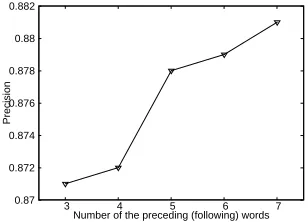
Context vectors can be extended by using 4 to 7 preceding (following) words to substitute 3 pre-ceding (following) words in context windows and POS tagging sequences. We conducted experi-ments with a context window of size 3 to 7 on our sampled 1M-word training corpus and performed closed test. The experimental results are evalu-ated in terms of both the precision of consistency check and algorithm complexity simultaneously. We plot the effect on precision in Figure 1.
0.87
Number of the preceding (following) words
Figure 1: Effect on precision of the number of preceding (following) words.
2.3 Effect on consistency check precision of
and
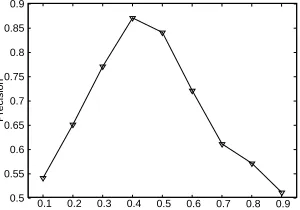
When using our sampled 1M-word training cor-pus to conduct closed test, we found that consis-tency check precision changes significantly with
the different values of and. Figure 2 shows
the trend whenvaries from 0.1 to 0.9. We used
=0:4and =0:6in our experiments.
0.5 0.55 0.6 0.65 0.7 0.75 0.8 0.85 0.9
0.9 0.8 0.7 0.6 0.5 0.4 0.3 0.2 0.1
Precision
α
Figure 2: Effect on consistency check precision
ofand.
3 Consistency Check of POS Tagging
Our consistency check algorithm is based on clas-sification of context vectors of multi-category
words. In particular, we first classify context
vectors of each multi-category word in the train-ing corpus, and then we conduct the consistency check of POS tagging based on classification re-sults.
3.1 Similarity between Context Cectors of Multi-category Words
After constructing context vectors for all multi-category words from their context windows and POS tagging sequences, the similarity of two con-text vectors is defined as the Euclidean Distance between the two vectors.
d(x;y)=kx yk= "
n X
i=1 (x
i y
i )
2 #
(1=2)
; (5)
wherexandyare two arbitrary context vectors of
ndimensions.
3.2 k-NN Classification Algorithm
Classification is a process to assign objects that need to be classified to a certain class. In this pa-per, we used a popular classification method: the
k-NN algorithm.
Suppose we have classes and a class
(! i
(i = 1;2;:::;)) has N
i samples (
x (i) j
(j = 1;2;:::;N
i
)). The idea of the k-NN algorithm
is that for each unlabeled object x, compute the
distances between xand all samples whose class
is known, and selectksamples (knearest
neigh-bors) with the smallest distance. This object x
will be assigned to the class that contains the most
samples in theknearest neighbors.
We now formally define the discriminant
func-tion and discriminant rule. Supposek
1 ;k
2 ;:::;k
are the numbers of samples in theknearest
neigh-bors of the object x that belong to the classes
! 1
;! 2
;:::;!
, respectively. Define the
discrimi-nant function of the class !
i as d
i
(x) = k i
;i =
1;2;:::;: Then, the discriminant rule of
deter-mining the class of the object x can be defined
as follows:
d m
x= max i=1;2;:::;
d i
(x))x2! m
3.3 Consistency Check Algorithm
In this section, we describe the steps of our classification-based consistency check algorithm in detail.
Step1: Randomly sampling sentences containing multi-category words and checking their POS tagging manually. For each multi-category word, classifying the context vec-tors of the sampled POS tagging sequences, so that the con-text vectors that have the same POS for the multi-category word belong to the same class.
Step2: Given a context vectorxof a multi-category word
, calculating the distances betweenxand all the context
vectors that contains the multi-category wordin the
train-ing corpus, and selecttrain-ingkcontext vectors with smallest
dis-tances.
Step3: According to thek-NN algorithm, checking the
classes of theknearest context vectors and classifying the
vectorx.
Step4: Comparing the POS of the multi-category word
in the class that thek-NN algorithm assignsxto and the POS
tag of. If they are the same, the POS tagging of the
multi-category wordis considered to be consistent, otherwise it
is inconsistent.
The major disadvantage of this algorithm is the
difficulty in selecting the value of k. If kis too
small, the classification result is unstable. On the
other hand, ifkis too big, the classification
devi-ation increases.
3.4 Selectingkin Classification Algorithm
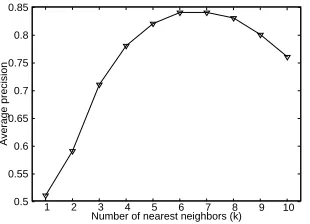
Figure 3 shows the consistency check precision
values obtained with various k values in the k
Table 1: Experimental Results
Number of Number of Number of
Test Test multi-category the true the identified Recall Precision corpora type words inconsistencies inconsistencies (%) (%) 1M-word closed 127,210 1,147 1,219 (156) 92.67 87.20 500K-word open 64,467 579 583 (86) 85.84 85.24
test results on our 1M-word training corpus, and
were obtained by using = 0:4and = 0:6in
the context vector model.
0.5 0.55 0.6 0.65 0.7 0.75 0.8 0.85
10 9 8 7 6 5 4 3 2 1
Average precision
Number of nearest neighbors (k)
Figure 3: Effect on precision of k in the k-NN
algorithm.
As shown in Figure 3, whenkcontinues to
in-crease from 6, the precision remains the same.
When when k reaches to 9, the precision starts
declining. Our experiment with other and
values also show similar trends. Hence, we chose
k=6in this paper.
4 Experimental Results
We evaluated our consistency check algorithm on our 1.5M-word corpus (including 1M-word train-ing corpus) and conducted open and closed tests. The results are showed in Table 1.
The experimental results show two
interest-ing trends. First, the precision and recall of
our consistency check algorithm are 87.20% and 92.67% in closed test, respectively, and 85.24% and 85.84% in open test, respectively. Compared to Zhang et al. (Zhang et al., 2004), the precision
of consistency check is improved by 23%, and
the recall is improved by 10%. The experimental results indicate that the context vector model has great improvements over the one used in Zhang et al. (Zhang et al., 2004). Second, thanks to the great improvement of the recall, to some extent, our consistency check algorithm prevents the hap-pening of events with small probabilities in POS
tagging.
5 Conclusion and Future Research
In this paper, we propose a new classification-based method to check consistency of POS tag-ging, and evaluated our method on our 1.5M-word corpus (including 1M-1.5M-word training corpus) with both open and closed tests.
In the future, we plan to investigate more types of word attributes and incorporate linguistic and mathematical knowledge to develop better con-sistency check models, which ultimately provide a better means of building high-quality Chinese corpora.
Acknowledgements
This research was partially supported by the Na-tional Natural Science Foundation of China No. 60473139 and the Natural Science Foundation of Shanxi Province No. 20051034.
References
Y. Du and J. Zheng. 2001. The proofreading method study on consistence of segment and part-of-speech. Computer
Development and Application, 14(10):16–18.
T. R. Leek. 1997. Information extraction using hidden Markov models. Master’s thesis, UC San Diego.
Y. Qian and J. Zheng. 2003. Research on the method of automatic correction of chinese pos tagging. Journal of
Chinese Information Processing, 18(2):30–35.
Y. Qian and J. Zheng. 2004. An approach to improving the quality of part-of-speech tagging of chinese text. In
Pro-ceedings of the 2004 IEEE International Conference on Information Technology: Coding and Computing (ITCC 2004).
W. Qu and X. Chen. 2003. Analysing on the words classi-fied hard in pos tagging. In Proceedings of the 9th
Na-tional ComputaNa-tional Linguistics (JSCL’03).
H. Xing. 1999. Analysing on the words classified hard in pos tagging. In Proceedings of the 5th National
Compu-tational Linguistics (JSCL’99).
H. Zhang, J. Zheng, and J. Liu. 2004. The inspecting method study on consistency of pos tagging of corpus.