A Methodology for Extrinsic Evaluation of Text Summarization:
Does ROUGE Correlate?
Bonnie J. Dorr and Christof Monz and Stacy President and Richard Schwartz
†and David Zajic
Department of Computer Science and UMIACS
University of Maryland
College Park, MD 20742
{
bonnie,christof,stacypre,dmzajic
}
@umiacs.umd.edu
†
BBN Technologies
9861 Broken Land Parkway
Columbia, Maryland 21046
[email protected]
Abstract
This paper demonstrates the usefulness of sum-maries in an extrinsic task of relevance judgment based on a new method for measuring agree-ment, Relevance-Prediction, which compares sub-jects’ judgments on summaries with their own judg-ments on full text docujudg-ments. We demonstrate that, because this measure is more reliable than previ-ous gold-standard measures, we are able to make stronger statistical statements about the benefits of summarization. We found positive correlations be-tween ROUGE scores and two different summary types, where only weak or negative correlations were found using other agreement measures. How-ever, we show that ROUGE may be sensitive to the choice of summarization style. We discuss the im-portance of these results and the implications for fu-ture summarization evaluations.
1
Introduction
People often prefer to read a summary of a text document, e.g., news headlines, scientific abstracts, movie previews and reviews, and meeting minutes. Correspondingly, the explosion of online textual material has prompted ad-vanced research in document summarization. Although researchers have demonstrated that users can read sum-maries faster than full text (Mani et al., 2002) with some loss of accuracy, researchers have found it difficult to draw strong conclusions about the usefulness of summa-rization due to the low level of interannotator agreement in the gold standards that they have used. Definitive con-clusions about the usefulness of summaries would pro-vide justification for continued research and development of new summarization methods.
To investigate the question of whether text summariza-tion is useful in an extrinsic task, we examined human performance in a relevance assessment task using a hu-man text surrogate (i.e. text intended to stand in the place
of a document). We use single-document English sum-maries as these are sufficient for investigating task-based usefulness, although more elaborate surrogates are possi-ble, e.g., those that span more than one document (Radev and McKeown, 1998; Mani and Bloedorn, 1998).
The next section motivates the need for develop-ing a new framework for measurdevelop-ing task-based useful-ness. Section 3 presents a novel extrinsic measure called
Relevance-Prediction. Section 4 demonstrates that this is
a more reliable measure than that of previous gold stan-dard methods, e.g., the LDC-Agreement method used for SUMMAC-style evaluations, and that this reliability al-lows us to make stronger statistical statements about the benefits of summarization. We expect these findings to be important for future summarization evaluations.
Section 5 presents the results of correlation between task usefulness and the Recall Oriented Understudy for Gisting Evaluation (ROUGE) metric (Lin and Hovy, 2003).1 While we show that ROUGE correlates with task usefulness (using our Relevance-Prediction measure), we detect a slight difference between informative, extractive headlines (containing words from the full document) and less informative, non-extractive “eye-catchers” (contain-ing words that might not appear in the full document, and intended to entice a reader to read the entire document).
Section 6 further highlights the importance of this point and discusses the implications for automatic eval-uation of extractive summaries. To evaluate non-extractive summaries reliably, an automatic measure may require knowledge of sophisticated meaning units.2 It is our hope that the conclusions drawn herein will prompt investigation into more sophisticated automatic metrics as researchers shift their focus to non-extractive sum-maries.
1
ROUGE has been previously used as the primary automatic evaluation metric by NIST in the 2003 and 2004 DUC Evalua-tions.
2
The content units proposed in recent methods (Nenkova and Passonneau, 2004) are a first step in this direction.
2
Background
In the past, assessments of usefulness involved a wide range of both intrinsic and extrinsic (task-based) mea-sures (Sparck-Jones and Gallier, 1996). Intrinsic evalu-ations focus on coherence and informativeness (Jing et al., 1998) and often involve quality comparisons between automatic summaries and reference summaries that are pre-determined to be of high quality. Human intrinsic measures determine quality by assessing document accu-racy, fluency, and clarity. Automatic intrinsic measures such as ROUGE use n-gram scoring to produce rankings of summarization methods.
Extrinsic evaluations concentrate on the use of sum-maries in a specific task, e.g., executing instructions, in-formation retrieval, question answering, and relevance assessments (Mani, 2001). In relevance assessments, a user reads a topic or event description and judges rele-vance of a document to the topic/event based solely on its summary.3 These have been used in many large-scale ex-trinsic evaluations, e.g., SUMMAC (Mani et al., 2002) and the Document Understanding Conference (DUC) (Harman and Over, 2004). The task chosen for such eval-uations must support a very high degree of interannota-tor agreement, i.e., consistent relevance decisions across subjects with respect to a predefined gold standard.
Unfortunately, a consistent gold standard has not yet been reported. For example, in two previous studies (Mani, 2001; Tombros and Sanderson, 1998), users’ judgments were compared to “gold standard judgments” produced by members of the University of Pennsylva-nia’s Linguistic Data Consortium. Although these judg-ments were supposed to represent the correct relevance judgments for each of the documents associated with an event, both studies reported that annotators’ judgments varied greatly and that this was a significant issue for the evaluations. In the SUMMAC experiments, the Kappa score (Carletta, 1996; Eugenio and Glass, 2004) for in-terannotator agreement was reported to be 0.38 (Mani et al., 2002). In fact, large variations have been found in the initial summary scoring of an individual participant and a subsequent scoring that occurs a few weeks later (Mani, 2001; van Halteren and Teufel, 2003).
This paper attempts to overcome the problem of in-terannotator inconsistency by measuring summary effec-tiveness in an extrinsic task using a much more consistent form of user judgment instead of a gold standard. Us-ing Relevance-Prediction increases the confidence in our results and strengthens the statistical statements we can make about the benefits of summarization.
The next section describes an alternative approach to measuring task-based usefulness, where the usage of ex-ternal judgments as a gold standard is replaced by the
3
A topic is an event or activity, along with all directly re-lated events and activities. An event is something that happens at some specific time and place, and the unavoidable conse-quences.
user’s own decisions on the full text. Following the lead of earlier evaluations (Oka and Ueda, 2000; Mani et al., 2002; Sakai and Sparck-Jones, 2001), we focus on rele-vance assessment as our extrinsic task.
3
Evaluation of Usefulness of Summaries
We define a new extrinsic measure of task-based useful-ness called Relevance-Prediction, where we compare a summary-based decision to the subject’s own full-text de-cision rather than to a different subject’s dede-cision. Our findings differ from that of the SUMMAC results (Mani et al., 2002) in that using Relevance-Prediction as an al-ternative to comparision to a gold standard is a more re-alistic agreement measure for assessing usefulness in a relevance assessment task. For example, users perform-ing browsperform-ing tasks must examine document surrogates, but open the full-text only if they expect the document to be interesting to them. They are not trying to decide if the document will be interesting to someone else.
To determine the usefulness of summarization, we fo-cus on two questions:
• Can users make judgments on summaries that are consistent with their full-text judgments?
• Can users make judgments on summaries more quickly than on full document text?
First we describe the Relevance-Prediction measure for determining whether users can make accurate judgments with a summary. Following this, we describe our exper-iments and results using this measure, including the tim-ing results of summaries compared to full documents.
3.1 Relevance-Prediction Measure
To answer the first question above, we define a mea-sure called Relevance-Prediction, where subjects build their own “gold standard” based on the full-text docu-ments. Agreement is measured by comparing subjects’ surrogate-based judgments against their own judgments on the corresponding texts. The subject’s judgment is as-signed a value of 1 if his/her surrogate judgment is the same as the corresponding full-text judgment, and 0 oth-erwise. These values were summed over all judgments for a surrogate type and were divided by the total num-ber of judgments for that surrogate type to determine the effectiveness of the associated summary method.
Formally, given a summary/document pair (s, d), if subjects make the same judgment onsthat they did on d, we say j(s, d) = 1. If subjects change their judg-ment betweensandd, we sayj(s, d) = 0. Given a set of summary/document pairsDSiassociated with eventi, the Relevance-Prediction score is computed as follows:
Relevance-Prediction(i) =
P
s,d∈DSij(s, d) |DSi|
other individuals. Specifically, Relevance-Prediction is more helpful in illuminating the usefulness of summaries for a real-world scenario, e.g., a browsing environment, where credit is given when an individual subject would choose (or reject) a document under both conditions. To our knowledge, this subject-driven approach to testing usefulness has never before been used.
3.2 Experiment Design
Ten human subjects were recruited to evaluate full-text documents and two summary types.4 The original text documents were taken from the Topic Detection and Tracking 3 (TDT-3) corpus (Allan et al., 1999) which contains news stories and headlines, topic and event de-scriptions, and a mapping between news stories and their related topic and/or events. Although the TDT-3 collec-tion contains transcribed speech documents, our investi-gation was restricted to documents that were originally text, i.e., newspaper or newswire, not broadcast news.
For our experiment we selected three distinct events and related document sets5from TDT-3. For each event, the subjects were given a description of the event (writ-ten by LDC) and then asked to judge relevance of a set of 20 documents associated with that event (using three different presentation types to be discussed below).
The events used from the TDT data set were events from world news occurring in 1998. It is possible that the subjects had some prior knowledge about the events, yet we believe that this would not affect their ability to complete the task. Subjects’ background knowledge of an event can also make this task more similar to real-world browsing tasks, in which subjects are often familiar with the event or topic they are searching for.
The 20 documents were retrieved by a search engine. We used a constrained subset where exactly half (10) were judged relevant by the LDC annotators. Because all 20 documents were somewhat similar to the event, this approach ensured that our task would be more difficult than it would be if we had chosen documents from com-pletely unrelated events (where the choice of relevance would be obvious even from a poorly written summary).
Each document was pre-annotated with the headline associated with the original newswire source. These headlines were used as the first summary type. We re-fer to them as HEAD (Headline Surrogate). The average length of the HEAD surrogates was 53 characters. In ad-dition, we commissioned human-generated summaries6 of each document as the second summary type; we refer
4
We required all human subjects to be native-English speak-ers to ensure that the accuracy of judgments was not degraded by language barriers.
5The three event and related document sets contained
enough data points to achieve statistically significant results.
6
The human summarizers were instructed to create a sum-mary no greater than 75 characters for each specified full text document. The summaries were not compared for writing style or quality.
to this as HUM (Human Surrogate). The average length of the HUM surrogates was 72 characters. Although nei-ther of these summaries was produced automatically, our experiment allowed us to focus on the question of sum-mary usefulness and to learn about the differences in pre-sentation style as a first step toward experimentation with the output of automatic summarization systems.
Two main factors were measured: (1) differences in judgments for the three presentation types (HEAD, HUM, and the full-text document) and (2) judgment time. Each subject made a total of 60 judgments for each pre-sentation type since there were 3 distinct events and 20 documents per event. To facilitate the analysis of the data, the subjects’ judgments were constrained to two possibil-ities, relevant or not relevant.7
Although the HEAD and HUM surrogates were both produced by humans, they differed in style. The HEAD surrogates were shorter than the HUM surrogates by 26%. Many of these were “eye-catchers” designed to en-tice the reader to examine the entire document (i.e., pur-chase the newspaper); that is, the HEAD surrogates were not intended to stand in the place of the full document. By contrast, the writers of the HUM surrogates were in-structed to write text that conveyed what happened in the full document. We observed that the HUM surrogates used more words and phrases extracted from the full doc-uments than the HEAD surrogates.
Experiments were conducted using a web browser (In-ternet Explorer) on a PC in the presence of the experi-menter. Subjects were given written and verbal instruc-tions for completing their task and were asked to make relevance judgments on a practice event set. The judg-ments from the practice event set were not included in our experimental results or used in our analyses. The written instructions were given to aid subjects in deter-mining requirements for relevance. For example, in an Election event documents describing new people in of-fice, new public officials, change in governments or par-liaments were suggested as evidence for relevance.
Each of the ten subjects made judgments on 20 doc-uments for each of three different events. After reading each document or summary, the subjects clicked on a ra-dio button corresponding to their judgment and clicked a submit button to move to the next document descrip-tion. Subjects were not allowed to move to the next sum-mary/document until a valid selection was made. No backing up was allowed. Judgment time was computed as the number of seconds it took the subject to read the full text document or surrogate, comprehend it, compare it to the event description, and make a judgment (timed up until the subject clicked the submit button).
7If we allowed subjects to make additional judgments such
3.3 Order of Document/Surrogate Presentation
One concern with our evaluation methodology was the issue of possible memory effects or priming: if the same subjects saw a summary and a full document about the same event, their answers might be tainted. Thus, prior to the full experiment, we conducted pre-experiments (us-ing 4 participants) with an extreme form of influence: we presented the summary and full text in immediate suc-cession. In these experiments, we compared two docu-ment presentation approaches, termed “Drill Down” and “Complete Set.” In the “Drill Down” document presen-tation approach all three presenpresen-tation types were shown for each document, in sequence: first a single HEAD sur-rogate, followed by the corresponding HUM sursur-rogate, followed by the full text document. This process was re-peated 10 times.
In the “Complete Set” document-presentation ap-proach we presented the complete set of documents ing one surrogate type, followed by the complete set us-ing another surrogate type, and so on. That is, the 10 HEAD surrogates were displayed all at once, followed by the corresponding 10 HUM surrogates, followed by the corresponding 10 full-text documents.
The results indicated that there was almost no effect between the two document-presentation approaches. The performance varied only slightly and neither approach consistently allowed subjects to perform better than the other. Therefore, we determined that the subjects were not associating a given summary with its corresponding full-text documents. This may be due, in part, to the fact that all 20 documents were related to the event—and ac-cording to the LDC relevance judgments half of these were actually about the same event.
Given that the variations were insignificant in these pre-experiments, we selected only the Complete-Set ap-proach (no Drill-Down) for the full experiment. How-ever, we still needed to vary the ordering for the two sur-rogate presentation types associated with each full-text document. Thus, each 20-document set was divided in half for each subject. In the first half, the subject saw the first 10 documents as: (1) HEAD surrogates, then HUM surrogates and then the full-text document; or (2) HUM surrogates, then HEAD surrogates, and then the full-text document. In the second half, the subject saw the alter-native ordering, e.g., if a subject saw HEAD surrogates before HUM surrogates in the first half, he/she saw the HUM surrogates before HEAD surrogates for the sec-ond half. Either way, the full-text document was always shown last so as not to introduce judgment effects asso-ciated with reading the entire document before either sur-rogate type.
In addition to varying the ordering for the surrogate type, the ordering of the surrogates and full documents within the events were also varied. The subjects were grouped in pairs, and each pair viewed the surrogates and documents in a different order than the other pairs.
3.4 Experimental Hypotheses
We hypothesized that the summaries would allow sub-jects to achieve a Relevance-Prediction rate of 70–90%. Since these summaries were significantly shorter than the original document text, we expected that the rate would not be 100% compared to the judgments made on the full document text. However, we expected higher than a 50% ratio, i.e., higher than that of random judgments on all of the surrogates. We also expected high performance be-cause the meaning of the original document text is best preserved when written by a human (Mani, 2001).
A second hypothesis is that the HEAD surrogates would yield a significantly lower agreement rate than that of the HUM surrogates. Our commissioned HUM surro-gates were written to stand in place of the full document, whereas the HEAD surrogates were written to catch a reader’s interest. This suggests that the HEAD surrogates might not provide as informative a description of the orig-inal documents as the HUM surrogates.
We also tested a third hypothesis: that our Relevance-Prediction measure would be more reliable than that of the LDC-Agreement method used for SUMMAC-style evaluations (thus providing a more stable framework for evaluating summarization techniques). LDC-Agreement compares a subject’s judgment on a surrogate or full text against the “correct” judgments as assigned by the TDT corpus annotators (Linguistic Data Consortium 2001).
Finally, we tested the hypothesis that using a text sum-mary for judging relevance would take considerably less time than using the corresponding full-text document.
4
Experimental Results
Table 1 shows the subjects’ judgments using both Relevance-Prediction and LDC-Agreement for each of three events. Using our Relevance-Prediction measure, the HUM surrogates yield averages between 79% and 86%, with an overall average of 81%, thus confirming our first hypothesis.
However, we failed to confirm our second hypothe-sis. The HEAD Relevance-Prediction rates were between 71% and 82%, with an overall average of 76%, which was lower than the rates for HUM, but the difference was not statistically significant. It appeared that subjects were able to make consistent relevance decisions from the non-extractive HEAD surrogates, even though these were shorter and less informative than the HUM surrogates.
A closer look reveals that the HEAD summaries some-times contained enough information to judge relevance, yielding almost the same number of true positives (and true negatives) as the HUM summaries. For example, a document about the formation of a coalition government to avoid violence in Cambodia has the HEAD surrogate
Cambodians hope new government can avoid past mis-takes. By contrast, the HUM surrogate for this same event
was Rival parties to form a coalition government to avoid
Surrogate EVENT 1 EVENT 2 EVENT 3 Overall Avg Avg Time LDC RP LDC RP LDC RP LDC RP (seconds)
HEAD 67% 76% 66% 71% 70% 82% 67% 76% 4.60 HUM 69% 80% 73% 86% 62% 79% 68% 81% 4.57
[image:5.612.140.474.55.106.2]DOC — — — — — — — — 13.38
Table 1: Relevance-Prediction (RP) and LDC-Agreement (LDC) Rates for HEAD and HUM Surrogates for each Event
uses words that do not appear in the original document (hope and mistakes), the subject may infer the relevance of this surrogate by relating hope to the notion of forming a coalition government and mistakes to violence.
On the other hand, we found that the lower degree of informativeness of HEAD surrogates gave rise to over 50% more false negatives than the HUM summaries. This statistically significant difference will be discussed fur-ther in Section 6.
As for our third hypothesis, Table 1 illustrates a substantial difference between the two agreement mea-sures. For each of the three events, the Relevance-Prediction rate is at least five percent higher than that of the LDC-Agreement approach, with an average of 8.8% increase for the HEAD summary and a 13.3% aver-age increase for the HUM summary. The averaver-age rates across events show a statistically significant difference between LDC-Agreement and Relevance-Prediction for both HUM summaries with p<0.01 and HEAD sum-maries with p<0.05. This significance was determined through use of a single factor ANOVA statistical analysis. The higher Relevance-Prediction rate supports our state-ment that this approach provides a more stable framework for evaluating different summarization techniques.
Finally, the average timing results shown in Table 1 confirm our fourth hypothesis. The subjects took 4-5 sec-onds (on average) to make judgments on both the HEAD and HUM summaries, as compared to about 13.4 seconds to make judgments on full text documents. This shows that it takes subjects almost 3 times longer to make judg-ments on full text docujudg-ments as it took to make judgjudg-ments on the summaries (HEAD and HUM). This finding is not surprising since text summaries are an order of magnitude shorter than full-text documents.
5
Correlation with Intrinsic Evaluation
Metric: ROUGE
We now turn to the task of correlating our extrinsic task performance with scores produced by an intrinsic evalu-ation measure. We used the Recall Oriented Understudy for Gisting Evaluation (ROUGE) metric version 1.2.1. In previous studies (Dorr et al., 2004) ROUGE was shown to have a very low correlation with the LDC-Agreement measurement results of the extrinsic task. This was at-tributed to low interannotator agreement in the gold stan-dard. Our goal was to test whether our new Relevance-Prediction technique would allow us to induce higher cor-relations with ROUGE.
5.1 Extrinsic Agreement Data
To reduce the effect of outliers on the correlation between ROUGE and the human judgments, we averaged over all judgments for each subject (20 judgments×3 events) to produce 60 data points. These data points were then par-titioned into either 1, 2, or 4 partitions of equal size. (Par-titions of size four have 15 data points, par(Par-titions of size two have 30 data points, and partitions of size one have 60 data points per subject—or a total of 600 datapoints across all 10 subjects). To ensure that the correlation did not depend on a specific partition, we repeated this same process using 10,000 different (randomly generated) par-titions for each of the three partition sizes.
Partitioned data points of size four provided a high de-gree of noise reduction without compromising the size of the data set (15 points). Larger partition sizes would result in too few data points and compromise the statis-tical significance of our correlation results. In order to show the variation within a single partition, we used the partitioning of size 4 with the smallest mean square er-ror on the human headline compared to the other parti-tionings as a representative partition. For this represen-tative partitioning, the individual data points P1–P15 of that partition are shown for each of the two agreement measures in Tables 2 and 3. This shows that, across parti-tions, the maximum and minimum Relevance-Prediction rates for HEAD (93% and 60%) are higher than the cor-responding LDC-Agreement rates (85% and 50%). The same trend is seen with the HUM surrogates: Relevance-Prediction maximum of 98%, minimum of 68%; and LDC-Agreement maximum 88%, minimum of 55%.
5.2 Intrinsic ROUGE Score
To correlate the partitioned agreement scores above with our intrinsic measure, we first ran ROUGE on all 120 rogates in our experiment (i.e., the HUM and HEAD sur-rogates for each of the 60 event/document pairs) and then averaged the ROUGE scores for all surrogates belong-ing to the same partitions (for each of the three partition sizes). These partitioned ROUGE values were then used for detecting correlations with the corresponding parti-tioned agreement scores described above.
Table 4 shows the ROUGE scores, based on 3 ref-erence summaries per document, for partitions P1–P15 used in the previous tables.8 For brevity, we include
8
Surrogate P1 P2 P3 P4 P5 P6 P7 P8 P9 P10 P11 P12 P13 P14 P15
[image:6.612.72.549.55.89.2]HEAD 80% 80% 85% 70% 73% 60% 80% 75% 60% 75% 88% 68% 80% 93% 83% HUM 83% 88% 85% 68% 75% 75% 93% 75% 98% 90% 75% 70% 80% 90% 78%
Table 2: Relevance-Prediction Rates for HEAD and HUM Surrogates (Representative Partition of Size 4)
Surrogate P1 P2 P3 P4 P5 P6 P7 P8 P9 P10 P11 P12 P13 P14 P15
HEAD 70% 73% 85% 70% 63% 60% 60% 85% 50% 73% 70% 78% 65% 63% 73% HUM 68% 75% 58% 68% 75% 70% 68% 80% 88% 58% 63% 55% 55% 60% 78%
Table 3: LDC-Agreement Rates for HEAD and HUM Surrogates (Representative Partition of Size 4)
Surrogate P1 P2 P3 P4 P5 P6 P7 P8 P9 P10 P11 P12 P13 P14 P15 Avg
[image:6.612.353.494.253.444.2]HEAD .10 .23 .13 .27 .20 .24 .26 .22 .13 .08 .30 .16 .26 .27 .30 .211 HUM .16 .22 .17 .23 .19 .36 .39 .29 .28 .25 .37 .22 .22 .39 .27 .269
Table 4: Average Rouge-1 Scores for HEAD and HUM Surrogates (Representative Partition of Size 4)
only ROUGE 1-gram measurement (R1).9 The ROUGE scores for HEAD surrogates were slightly lower than those for HUM surrogates. This is consistent with our statements earlier about the difference between non-extractive “eye-catchers” and informative headlines. Be-cause ROUGE measures whether a particular summary has the same words (or n-grams) as a reference summary, a more constrained choice of words (as found in the ex-tractive HUM surrogates) makes it more likely that the summary would match the reference.
A summary in which the word choice is less constrained—as in the non-extractive HEAD surrogates—is less likely to share n-grams with the reference. Thus, we may see non-extractive summaries that have almost identical meanings, but very different words. This raises the concern that ROUGE may be sensitive to the style of summarization that is used. Section 6 discusses this point further.
5.3 Intrinsic and Extrinsic Correlation
To test whether ROUGE correlates more highly with Relevance-Prediction than with LDC-Agreement, we cal-culated the correlation for the results of both techniques using Pearson’s r (Siegel and Castellan, 1988):
Pn
i=1(ri−r¯)(si−s¯)
pPn
i=1(ri−r¯)2pP n
i=1(si−s¯)2
whereri is the ROUGE score of surrogatei,r¯is the av-erage ROUGE score of all data points, si is the agree-ment score of summaryi(using Relevance-Prediction or LDC-Agreement), ands¯is the average agreement score. Pearson’s statistics is commonly used in summarization and machine translation evaluation, see e.g. (Lin, 2004; Lin and Och, 2004).
As one might expect, there is some variability in the correlation between ROUGE and human judgments for
9
We also computed ROUGE 2-gram, ROUGE L and ROUGE W, but the trend for these did not differ from ROUGE-1.
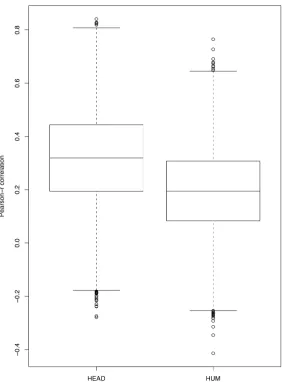
Figure 1: Distribution of the Correlation Variation for Relevance-Prediction on HEAD and HUM
the different partitions. However, the boxplots for both HEAD and HUM indicate that the first and third quartile were relatively close to the median (see Figure 1).
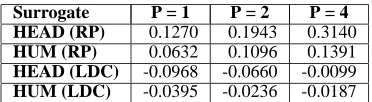
Table 5 shows the Pearson Correlations with ROUGE-1 using Relevance-Prediction and LDC-Agreement. For Relevance-Prediction, we observed a positive correlation for both surrogate types, with a slightly higher corre-lation for HEAD than HUM. For LDC-Agreement, we observed no correlation (or a minimally negative one) with ROUGE-1 scores, for both the HEAD and HUM surrogates. The highest correlation was observed for Relevance-Prediction on HEAD.
Surrogate P = 1 P = 2 P = 4 HEAD (RP) 0.1270 0.1943 0.3140
HUM (RP) 0.0632 0.1096 0.1391
HEAD (LDC) -0.0968 -0.0660 -0.0099
[image:7.612.93.279.53.104.2]HUM (LDC) -0.0395 -0.0236 -0.0187
Table 5: Pearson Correlations with ROUGE-1 for Relevance-Prediction (RP) and LDC-Agreement (LDC), where Partition size (P) = 1, 2, and 4
were attributed to low interannotator agreement rates.
6
Discussion
Our results suggest that ROUGE may be sensitive to the style of summarization that is used. As we observed above, many of the HEAD surrogates were not actually summaries of the full text, but were eye-catchers. Of-ten, these surrogates did not allow the subject to judge relevance correctly, resulting in lower agreement. In ad-dition, these same surrogates often did not use a high per-centage of words that were actually from the story, result-ing in low ROUGE scores. (We noticed that most words in the HUM surrogates appeared in the corresponding stories.) There were three consequences of this difference between HEAD and HUM: (1) The rate of agreement was lower for HEAD than for HUM; (2) The average ROUGE score was lower for HEAD than for HUM; and (3) The correlation of ROUGE scores with agreement was higher for HEAD than for HUM.
A further analysis supports the (somewhat counterin-tuitive) third point above. Although the ROUGE scores of true positives (and true negatives) were significantly lower for HEAD surrogates (0.2127 and 0.2162) than for HUM surrogates (0.2696 and 0.2715), the number of false negatives was substantially higher for HEAD sur-rogates than for HUM sursur-rogates. These cases corre-sponded to much lower ROUGE scores for HEAD sur-rogates (0.1996) than for HUM (0.2586) sursur-rogates.
A summary of this analysis is given in Table 6, where true positives and negatives are indicated by Rel/Rel and NonRel/NonRel, respectively, and false positives and negatives are indicated by Rel/NonRel and NonRel/Rel, respectively.10 The numbers in parentheses after each ROUGE score refer to the standard deviation for that
10
We also included (average) elapsed times for summary judgments in each of the four categories. One might expect a “relevant” judgment to be much quicker than a “non-relevant” judgment (since the latter might require reading the full sum-mary). However, it turned out non-relevant judgments did not always take longer. In fact, the NonRel/NonRel cases took con-siderably less time than the Rel/Rel and Rel/NonRel cases. On the other hand, the NonRel/Rel cases took considerably more time—almost as much time as reading the full text documents— an indication that the subjects may have re-read the summary a number of times, perhaps vacillating back and forth. Still, the overall time savings was significant, given that the vast major-ity of the non-relevant judgments were in the NonRel/NonRel category.
score. This was computed as follows:
Std.-Dev.=
s PN
i=1(xi−x¯)2 N
whereNis the number of surrogates in a particular judg-ment category (e.g.,N = 245for the HEAD-based Non-Rel/Rel judgments),xi is the ROUGE score for theith surrogate, andr¯is the average of all ROUGE scores in that category.
Although there were very few false positives (less than 6% for both HEAD and HUM), the number of false nega-tives (NonRel/Rel) was particularly high for HEAD (50% higher than for HUM). This difference was statistically significant at p<0.01 using the t-test. The large number of false negatives with HEAD may be attributed to the eye-catching nature of these surrogates. A subject may be misled into thinking that this surrogate is not related to an event because the surrogate does not contain words from the event description and is too broad for the subject to extract definitive information (e.g., the surrogate There
he goes again!). Because the false negatives were
associ-ated with the lowest average ROUGE score (0.1996), we speculate that, if a correlation exists between Relevance-Prediction and ROUGE, the false negatives may be a ma-jor contributing factor.
Based on this experiment, we conjecture that ROUGE may not be a good method for measuring the useful-ness of summaries when the summaries are not extrac-tive. That is, if someone intentionally writes summaries that contain different words than the story, the summaries will also likely contain different words than a reference summary, resulting in low ROUGE scores. However, the summaries, if well-written, could still result in high agreement with the judgments made on the full text.
7
Conclusion
We have shown that two types of human summaries, HEAD and HUM, can be useful for relevance assessment in that they help a user achieve 70-85% agreement in rel-evance judgments. We observed a 65% reduction in judg-ment time between full texts and summaries. These find-ings are important in that they establish the usefulness of summarization and they support research and devel-opment of additional summarization methods, including automatic methods.
We introduced a new method for measuring agree-ment, Relevance-Prediction, which takes a subject’s full-text judgment as the standard against which the same subject’s summary judgment is measured. Be-cause Relevance-Prediction was more reliable than LDC-Agreement judgments, we encourage others to use this measure in future summarization evaluations.
Judgment HEAD HUM
(Surr/Doc) Raw R1-Avg Avg Time Raw R1-Avg Avg Time
Rel/Rel 211 (35%) 0.2127 (±0.120) 4.6 251 (42%) 0.2696 (±0.130) 4.2
Rel/NonRel 27 (5%) 0.2115 (±0.110) 7.1 35 (6%) 0.2725 (±0.131) 4.6
NonRel/Rel 117 (19%) 0.1996 (±0.127) 8.5 77 (13%) 0.2586 (±0.120) 13.8
NonRel/NonRel 245 (41%) 0.2162 (±0.126) 2.5 237 (39%) 0.2715 (±0.131) 1.9
[image:8.612.92.522.53.128.2]TOTAL 600 (100%) 0.2115 (±0.124) 4.6 600 (100%) 0.2691 (±0.129) 4.6
Table 6: Subjects’ Judgments and Corresponding Average ROUGE 1 Scores
negative correlations were found using LDC-Agreement scores. We found that both the Relevance-Prediction and the ROUGE-1 scores were higher for human-generated summaries than for the original headlines. It appears that most of the difference is induced by surrogates that are eye-catchers (rather than true summaries), where both agreement and ROUGE scores are low.
Our future work will include further experimentation with automatic summarization methods to determine the level of Relevance-Prediction. We aim to determine how well automatic summarizers help users complete tasks, and to investigate which automatic summarizers perform better than others. We also plan to test for correlations between ROUGE and human task performance with auto-matic summaries, to further investigate whether ROUGE is a good predictor of human task performance.
Acknowledgements
This work was supported in part by DARPA TIDES Cooperative Agreement N66001-00-2-8910.
References
James Allan, Hubert Jin, Martin Rajman, Charles Wayne, Daniel Gildea, Victor Lavrenko, Rose Hoberman, and David Caputo. 1999. Topic-based Novelty Detection. Technical Report 1999 Summer Workshop at CLSP Final Report, Johns Hopkins, Maryland.
Jean Carletta. 1996. Assessing Agreement on Classification Tasks: The Kappa Statistic. Computational Lingusitics,
22(2):249–254, June.
Bonnie J. Dorr, Christof Monz, Douglas Oard, Stacy President, and David Zajic. 2004. Extrinsic Evaluation of Automatic Metrics for Summarization. Technical report, University of Maryland, College Park, MD. LAMP-TR-115, CAR-TR-999, CS-TR-4610, UMIACS-TR-2004-48.
Barbara Di Eugenio and Michael Glass. 2004. Squibs and Dis-cussions - The Kappa Statistic: A Second Look.
Computa-tional Linguistics, pages 95–101.
Donna Harman and Paul Over. 2004. Proceedings of the DUC
2004. Boston, MA.
Hongyan Jing, Regina Barzilay, Kathleen McKeown, and Michael Elhadad. 1998. Summarization evaluation meth-ods: Experiments and analysis. In Proceedings of the AAAI
Symposium on Intelligent Summarization, Stanford
Univer-sity, CA, March 23-25.
Chin-Yew Lin and Eduard Hovy. 2003. Automatic Evaluation of Summaries Using N-gram Co-Occurrence Statistics. In
Proceedings of HLT-NAACL 2003 Workshop, pages 71–78,
Edmonton Canada, May-June.
Chin-Yew Lin and Franz Joseph Och. 2004. ORANGE: a Method for Evaluating Automatic Evaluation Metrics for Machine Translation. In Proceedings of the 20th
Interna-tional Conference on ComputaInterna-tional Linguistics (COLING 2004), Geneva, Switzerland, August 23–27.
Chin-Yew Lin. 2004. ROUGE: a Package for Automatic Eval-uation of Summaries. In Proceedings of the Workshop on
Text Summarization Branches Out (WAS 2004), Barcelona,
Spain, July 25–26.
I. Mani and E. Bloedorn. 1998. Summarizing Similarities and Differences Among Related Documents. Information
Re-trieval, 1(1):35–67.
Inderjeet Mani, Gary Klein, David House, and Lynette Hirschman. 2002. SUMMAC: a text summarization eval-uation. Natural Language Engineering, 8(1):43–68. Inderjeet Mani. 2001. Summarization Evaluation: An
Overview. In Proceedings of the NAACL 2001 Workshop on
Automatic Summarization.
Ani Nenkova and Rebecca J. Passonneau. 2004. Evaluating Content Selection in Summarization: The Pyramid Method. In Proceedings of the NAACL 2004, Boston, MA.
Mamiko Oka and Yoshihiro Ueda. 2000. Evaluation of Phrase-Representation Summarization Based on an Information Re-trieval Task. In Proceedings of the ANLP/NAACL 2000
Workshop on Automatic Summarization, pages 59–68, New
Brunswick, NJ.
Dragomir Radev and Kathleen McKeown. 1998. Generat-ing Natural Language Summaries from Multiple On-Line Sources. Computational Linguistics, pages 469–500. Tetsuya Sakai and Karen Sparck-Jones. 2001. Generic
Sum-maries for Indexing in Information Retrieval - Detailed Test Results. Technical Report TR513, Computer Laboratory, University of Cambridge.
Sidney Siegel and N. John Castellan, Jr. 1988. Nonparametric
Statistics for the Behavioral Sciences. McGraw-Hill, New
York, second edition.
Karen Sparck-Jones and J.R. Gallier. 1996. Evaluating
Natu-ral Language Processing Systems: An Analysis and Review.
Springer, Berlin.
Anastasios Tombros and Mark Sanderson. 1998. Advantages of query biased summaries in information retrieval. In
Pro-ceedings of the 21st Annual International ACM SIGIR Con-ference on Research and Development in Information Re-trieval, pages 2–10.
Hans van Halteren and Simone Teufel. 2003. Examining the Consensus Between Human Summaries: Initial Experiments with Factoid Analysis. In Proceedings of the HLT-NAACL
03 Text Summarization Workshop.