243
Design and Static Analysis of Four Wheeler Suspension
System
Rakesh Kumar Sahu
1, Abinash pattanayak
2, Prangya Dash
3, Bhola Ram Modi
4Department of Mechanical Engineeringt1, 2, 3, 4, Gandhi Institute of Engineering & Technology, Gunupur 1, 2, 3, 4 Email: [email protected]1, [email protected]2
Abstract- Spring is a mechanical element which absorbs the shock and stores in terms of strain energy. It then
released when the load is removed. Springs in some places used as an energy reservoir and in some cases it is used for absorbing the shock. Normally in the vehicles it is used to absorb the shock. Here an attempt is made by taking two different type of springs i.e. helical and Leaf spring and analyzed the stress carrying capacity and the deflection for a specific load and deflection value. Static analysis determines the safe stress and corresponding pay load of both leaf and helical compression spring. The present work attempts to analyze the safe load of the both type of spring and the best alternative out of the two considering cases. Here the attempt is made by designing both type of springs by analytical method and then the model is prepared by CATIA and then the model is analysed by the licenced package of ANSYS for Maximum principal stress, Equivalent stress, Shear stress, Maximum principal strain, Equivalent strain and total deformation and compared with each other.
Index Terms- Suspension System, Helical Spring, Leaf Spring, Four wheeler, Static analysis
1. INTRODUCTION:
It is always the demand of customers for vehicle suitable for both on and off road driving with superior performance. The main goal of an engineer is to isolate the driver and vehicle from road irregularities such as a bumps, pot holes, unpaved surfaces and to maximize its road holding performance.
In suspension system vibration isolation plays an important role. Rapid technological development in these fields has increased the need for higher-performance vibration isolation systems. There are two kinds of vibration that must be reduced by a vibration isolation system. They are
• Vibration transmitted from the ground through the suspension (spring) and
• Vibration caused by disturbances acting on an isolation table directly (direct disturbance).
Vibration more than 10 Hz frequencies is harmful to humans. These vibrations due to long time affect humans and have a greater impact on residential areas. A suspension with less stiffness is better for reducing the former because dynamic coupling between the vibration source and the isolation table is weakened; thus, zero stiffness is ideal in this case. However, higher stiffness is better for suppressing the latter because it reduces displacement of the isolation table from its desired position; thus, infinite stiffness is ideal in this case. In conventional passive-type vibration isolation systems, a trade-off between lower and higher stiffness is inevitable, so that performance is limited. Suspensions with springs of variable
sign-changing stiffness (SCS-springs) have proven most promising for providing infra and low frequency vibration isolation at a reasonable cost. Such springs can operate in parallel with supporting springs or (in some cases) independently to control and minimize the total stiffness kSkS of a suspension.
Generally suspension system consists of Elastic element (transmit vertical loads and lower level of dynamic loads).
• Lateral stabilizer
• Guide (transmits forces to the load carrying system and distributes moments between the wheel and body).
• Damper (during damping the mechanical energy of vibration changes into heat energy).
• Elastic Elements
Metallic Nun-metallic
Leaf spring, Helical springs, Torsion bars
Rubber, Air, Hydraulic
244 Historically speaking, the steel multi-leaf
spring is one of the oldest and most widely used spring designs in suspension systems. The advantages of the leaf spring are many, not only because it acts as a spring, but also because it attaches the axle directly to the chassis. Leaf springs are normally long and flat and made up of a number of thin strips of metal. These layers together offer a flexible but strong resistance to bumps and are designed more for load-bearing than shock resistance. This type of suspension is commonly used in passenger cars and your everyday saloons, which have weight spread across their entire chassis. Some modern vehicles use a combination of both leaf and coils springs to combine load bearing with comfort.
Sometimes known as helical springs, coil springs use compression around their ‘coil’ to soften the bumps and bounces of the road below a car. They are designed to offer resistance against this compression and, as they become more difficult to compress the more they are compressed, they offer a softening and gradual flexibility to the vehicle’s ride. Coils are largely used in isolation, so rigged to the front and back of a car which is the opposite of their counterpart technology.
So here in this paper we present an vibrational analysis of suspension springs. How they isolate vibration and feel comforts to the passenger. By considering different materials of suspension springs we analyse their vibration and deflection.
2. PROBLEM DEFINATION:
In the present time world is moving towards progress. People can able to afford their own vehicles. Thus usage of transport is increasing day by day on road. The number increase due to the royal life style of people those usually choose to use their own vehicle than public transport with more comfort. But this increase in number of vehicles increases the pollution as well as utilizes a huge amount of fuel.
Without hampering the comfortness of people if by any means the utilization of fuel can be reduced then it is a good benefit for human society. Here an attempt is taken to maintain the fuel economy by increasing the shock carrying capacity of the vehicle with the help of proper suspension system. Due to proper suspension system the total load will be absorbed and hence it will not put any extra effort to the engine and hence the fuel can be utilized economically up to some extent.
3. SPRING
Spring is an elastic object used to store
mechanical energy. Springs are usually made out of spring steel. There are a large number of spring designs; in everyday usage the term often refers to coil springs.
Small springs can be wound from pre-hardened stock, while larger ones are madefrom annealed steel and hardened after fabrication. Some non-ferrous metals are also used including phosphor bronze and titanium for parts requiring corrosion resistance and beryllium copper for springs carrying electrical current (because of its low electrical resistance).
When a coil spring is compressed or stretched slightly from rest, the force it exerts is approximately proportional to its change in length (this approximation breaks down for larger deflections). The rate or spring constant of a spring is the change in the force it exerts, divided by the change in deflection of the spring. That is, it is the gradient of the force versus deflection curve. An extension or compression spring has units of force divided by distance, for example lbf/in or N/m. Torsion springs have units of torque divided by angle, such as N· m/ rad or ft·lbf/degree.
Depending on the design and required operating environment, any material can be used to construct a spring, so long as the material has the required combination of rigidity and elasticity: technically, a wooden bow is a form of spring.
4. HISTORY OF SPRINGS
Simple non-coiled springs were used throughout human history, e.g. the bow (and arrow). In the Bronze Age more sophisticated spring devices were used, as shown by the spread of tweezers in many cultures. Ctesibius of Alexandria developed a method for making bronze with spring-like characteristics by producing an alloy of bronze with an increased proportion of tin, and then hardening it by hammering after it was cast. appeared early in 15th century in door locks. The first spring powered-clocks appeared in that century and evolved into the first large watches by the 16th century. In 1676 British physicist Robert Hooke discovered Hooke's law which states that the force a spring exerts is proportional to its extension.
5. TYPES OF SPRING
Springs can be classified depending on how the load force is applied to them:
Tension/extension spring – The spring is
designed to operate with a tension load, so the spring stretches as the load is applied to it.
245 with a compression load, so the spring gets
shorter as the load is applied to it.
Torsion spring – Unlike the above types in
which the load is an axial force, the load applied to a torsion spring is a torque or twisting force, and the end of the spring rotates through an angle as the load is applied.
Constant spring - Supported load will remain the
same throughout deflection cycle.
Variable spring - Resistance of the coil to load
varies during compression
A Volute spring is a compression spring in the form of a cone, designed so that under compression the coils are not forced against each other, thus permitting longer travel.
A Tension or extension springs are designed to become longer under load. Their turns (loops) are normally touching in the unloaded position, and they have a hook, eye or some other means of attachment at each end.
Hairspring or balance spring – a delicate spiral
torsion spring used in watches, galvanometers, and places where electricity must be carried to partially rotating devices such as steering wheels without hindering the rotation.
Leaf spring – a flat spring used in vehicle
suspensions, electrical switches, and bows.
6. HELICAL SPRINGS
A coil spring, also known as a helical spring, is a mechanical device which is typically used to store energy and subsequently release it, to absorb shock, or to maintain a force between contacting surfaces. They are made of an elastic material formed into the shape of a helix which returns to its natural length when unloaded. Under tension or compression, the material (wire) of a coil spring undergoes torsion. The spring characteristics therefore depend on the shear modulus, not Young's Modulus. A coil spring may also be used as a torsion spring: in this case the spring as a whole is subjected to torsion about its helical axis. The material of the spring is thereby subjected to a bending moment, either reducing or increasing the helical radius. In this mode, it is the Young's Modulus of the material that determines the spring characteristics. Metal coil springs are made by winding a wire around a shaped former - a cylinder is used to form cylindrical coil spring.
Types of helical spring are:
Tension/extension coil springs, designed to resist stretching. They usually have a hook or eye form at each end for attachment.
Compression coil springs, designed to resist being compressed. A typical use for compression coil springs is in car suspension systems.
Torsion springs, designed to resist twisting actions. Often associated to clothes pegs or up-and-over garage doors.
7. LEAF SPRING:
Leaf spring is a simple form of spring used for suspension in wheeled vehicles. They are also referred to as laminated, semi- elliptical spring, carriage springs, cart spring, or helper spring. In mid 1970's leaf springs were very common in automobiles. At present, most of the automobiles are designed using oil springs, gas springs, or air suspension. They are now used in heavy vehicles such as trucks and cars. The reason that leaf springs are still used in heavy vehicles is that they have the advantage of spreading the load uniformly over the vehicle chassis, whereas coil springs transfer it to only a single point.
Leaf springs are very simple and are not fancy like the other springs that are currently available. They have slightly curved, long and narrow plates fixed to the frame of a trailer that are placed above or below the trailer’s axle.
There are two types of leaf springs:
Mono leaf springs: The mono leaf spring or single-leaf springs consist of only one plate of spring steel. These are normally thick in the middle and taper to the end, and they don't typically offer too much strength and suspension for heavy vehicles.
Multi leaf springs: Multi leaf springs consists of several leaf springs with varying length placed on top of each other. The shorter plates are placed at the bottom and the longer plates are placed at the top. They have the same curved shape which have thinner edges and are thicker in the middle.
There are two different leaf spring based on the springs ends,
Double-eye leaf springs: On double-eye leaf springs the top plate is the longest and has both ends curved like a circle. The ends of the double-eye leaf springs make two holes, which can be connected to the bottom of a trailer's frame.
246 flat end.
SPRING MATERIALS:
One of the important considerations in spring design is the choice of the spring material. Some of the common spring materials are given below.
Hard-drawn wire
Phosphor Bronze / Spring Brass
STATIC ANALYSIS OF SPRING:
Following are the spring materials used by us:
Chromium - vanadium steel. Silicon - manganese steel Phosphorous bronze.
(Table -1 Material Composition table)
Strength
(Table -2 Material property table)
Here analytical approach is considered for deciding the dimension of spring cross section. During static condition, the suspension frame is subjected to
Let us consider the condition for designing the
1) DESIGN OF SPRING:
Total weight of the passenger = 1000 kg
Total weight of the vehicle = 1800 kg so, total weight = 1000 + 1800 = 2800 kg
No of spring = 2
So, weight acting on each spring = 2800/2= 1400 kg Assume factor of safety = 1.25
247
(Table -3 Calculated Dimensions for Leaf Spring)
(Table -4 calculated Dimensions for helical spring)
FE ANALYSIS OF SPRING:
The model of leaf and helical springs are
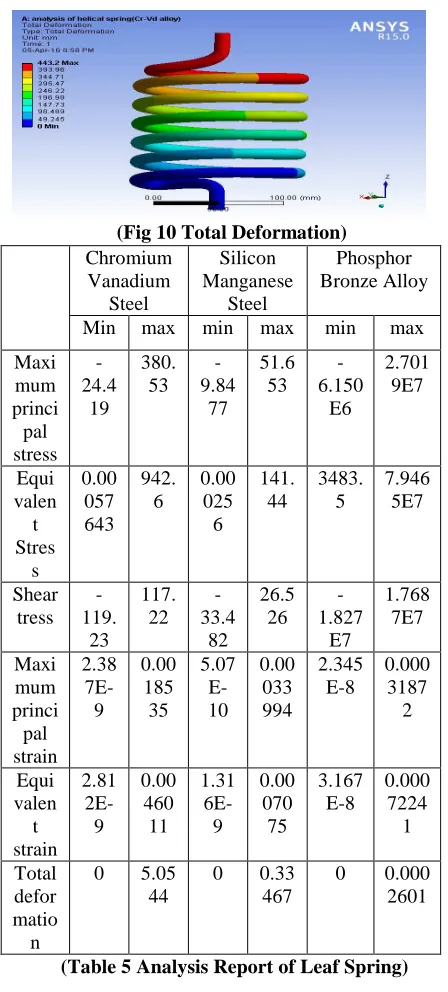
analyzed by ANSYS for Maximum principal stress, Equivalent stress, Shear stress, Maximum principal strain, Equivalent strain and total deformation.
(Fig 1 Equivalent Stress)
(Fig 2 Max Principal Strain)
(Fig 3 Max Principal Stress)
(Fig 4 Equivalent Strain)
(Fig 5 Total Deformation)
(Fig 6 Meshing)
(Fig 7 Equivalent Stress)
(Fig 8 Max Principal Strain)
248
(Fig 10 Total Deformation)
(Table 5 Analysis Report of Leaf Spring)
(Table 6 Analysis Report Of Helical Spring)
CONCLUSION:
Here the design is made in CATIA by calculating the dimensions through conventional approach for leaf spring and helical spring. Then the model is analyzed through the software ANSYS for Maximum principal stress, Equivalent stress, Shear stress, Maximum principal strain, Equivalent strain and total deformation.
From the analysis it was found that all the stress and strain values are more in case of helical spring compared to leaf spring for the same deflection
value. Here both the springs are designed by considering the same deflection value. From this report it is concluded that for the heavier loads leaf spring is more acceptable than helical spring. So for all the type of four wheeler vehicles for suspension leaf spring is advisible as compared to helical spring.
REFERENCES:
[1] G. Harinath Gowd and E. Venugopal Goud, “Static analysis of leaf spring”, International Journal of Engineering Science and Technology, Vol. 4, pp. 3794-3803, 2012. [2] Mr. V. K. Aher and Mr. P. M. Sonawane,
“Static and fatigue analysis of multi leaf spring used in the suspension system of LCV”, International Journal of Engineering Research and Applications, Vol. 2, pp. 786-1791, 2012
[3] Shigley, “ Mechanical Engineering Design”, Eighth Edition, Budynas−Nisbett, McGraw−Hill Primis , 2006, Ch. 10
[4] Mehdi Bakhshesh and Majid Bakhshesh, “Optimization of steel helical spring by composite spring”, International Journal of Multidisciplinary Sciences and Engineering, Vol. 3, pp. 47-51, 2012
249 vehicles”, Journal of Scientific & Industrial
Research, Vol. 66, pp. 128-134, 2007. [6] Design Data Hand book by S. Md. Jalaluddin.