Revising the Compositional Method for
Terminology Acquisition from Comparable Corpora
Emmanuel M orin B
´
eat rice Daille
Université de Nantes, LINA UMR CNRS 6241 2, rue de la Houssinière, BP 92208
F-44322 Nantes cedex 03
{emmanuel.morin,beatrie.daille}univ-nant es.fr
A
BSTRACTIn this paper, we present a new method that improves the alignment of equivalent terms monolingually acquired from bilingual comparable corpora: the Compositional Method with Context-Based Projection (CMCBP). Our overall objective is to identify and to translate high specialized terminology made up of multi-word terms acquired from comparable corpora. Our evaluation in the medical domain and for two pairs of languages demonstrates that CMCBP outperforms the state-of-art compositional approach commonly used for translationally equiv-alent multi-word term discovery from comparable corpora.
K
EYWORDS:
Comparable corpora, bilingual lexicon, compositionality, multi-word term, con-text information.1 Introduction
The automatic compilation of bilingual dictionaries has received considerable attention in re-cent years forlanguage for special purposes (LSP)(especially coming from scientific domains). LSP is characterised by the small amount of available textual data compared with general lan-guage, and a high proportion of specialised terms which are not be found in general language monolingual or bilingual dictionaries. For LSP, a specialised term could be either a single-word term (SWT) or a multi-word term (MWT), the latter being highly productive (Sag et al., 2002). A term is a lexical unit which represents a concept within a domain. As an example, in the medical domain,canceris an SWT,breast canceris an MWT.
Comparable corpora that are sets of texts in two or more languages without being translations of each other, seem to be the right solution to solve the textual scarcity of LSP: as monolingual productions, they are authentic texts, and the babel web ensures that there is a sufficient num-ber of multilingual documents. The comparability of the corpus should be ensured by using various shared characteristics across languages that are checked during the compilation phase (McEnery, 2007). For LSP, the domain and sub-domain are requested as well as the commu-nicative settings and the textual genre to identify reliable translations (Bowker and Pearson, 2002).
Our goal is to find the right translation for a source MWT in the set of MWT candidates in the target language. The simplest method assumes that the right translation of an MWT could be obtained by translating each component individually thanks to a general dictionary, by generat-ing all the combinations of word positions, and then filtergenerat-ing the translated expressions usgenerat-ing either the list of target MWTs (Morin and Daille, 2010), the target corpus (Robitaille et al., 2006) or the web (Grefenstette, 1999). This method is limited to the subset of MWTs that share the same compositional property - 48.7% were reported by Baldwin and Tanaka (2004) for English/Japanese NNcompounds. However, even if the MWT is characterised by the compositional property, the translation is not found when some words, which are part of the MWTs, do not belong to the general bilingual dictionary or when the translated combinations do not exist or have not been extracted by the term extraction program in the target language. Within this context, we propose to improve the compositional approach by using context infor-mation collected from LSP comparable corpora when one or several of the components, part of the MWTs, are not found in the dictionary. We demonstrate that the use of context information when performing terminology translation helped us to learn a significant number of additional correct lexical entries that could not be identified by the compositional method.
The remainder of this paper is organised as follows: Section 2 shows the intricate problems with the translations of MWTs. Section 3 presents the compositional method used for the au-tomatic translation of MWTs. Section 4 introduces CMCBP that takes advantage of the context information to improve the compositional method. Section 5 describes the linguistic resources and the open-terminology extraction tool used for our experiments. Section 6 evaluates the influence of CMCBP on the quality of bilingual terminology extraction through experiments involving French as a source language, and English and German as target languages. Section 7 discusses works related to this study. Finally, Section 8 presents our conclusions.
2 Translation of MWTs
If MWTs are less polysemous (Savary and Jacquemin, 2003) and more representative (Nomura and M., 1989; Nakagawa and Mori, 2003) of domain specialities than SWTs, pin-pointing their translations poses specific problems that are well-known, such as fertility, non-compositionality, or term variation1:
Fertility is known as a problem of difference of length between the source and the target MWT (Brown et al., 1993): for instance, the German SWTaxilladissektion(1 content word) is translated into English by the MWTaxillary dissection(two content words); the French MWTdépistage du cancer du sein(three content words) is translated into English by the MWTbreast screening(two content words).
Non-compositionality is illustrated when the target MWT is not typically composed of the translation of its parts (Melamed, 2001). For instance the French MWTcurage axillaire is translated into the English language asaxillary dissectionwhereas the English word dissectionis not the translation of the French wordcurage. Baldwin and Tanaka (2004) report that at least 50% of the JapaneseNNcompounds are not translated through a compositional strategy into English.
Term variation refers to an MWT that appears in texts in different forms reflecting either graphical, syntactic, morphological or semantic differences: for example, the French
MWTscancer du seinandcancer mammaireare both translated by the same English
MWTbreast cancer. Source and target MWTs can appear in different syntactic
struc-tures. For example, the French MWTprolifération tumoraleofNApattern is translated by the English MWTtumour proliferationofNNpattern, where the French adjective
tumoraleis linked through morphological derivation to the English nountumour. The
term variations could also involve paradigmatic variation when one element of the MWT is substituted by a synonym or a hypernym such astumour size→diameter tumourin the source language and not in the target language such astaille tumorale(lit. ’tumour size’).
It is quite difficult to design a general framework that can address all these problems simul-taneously (Robitaille et al., 2006) and for any language. The non-compositionality has to be solved during the translation process as it involves an MWT and its translation. The term variant problem is generally handled at the monolingual level during the term extraction task. This is done in two steps: term variant extraction and term variant grouping. A sophisticated variant recognition and conflation program will handle several types of variants: graphical, but also morphological and syntactic variation, ideally paradigmatic variants and acronyms. Using a term variant program allows us to cluster a set of term-like sequences reflecting base or variant forms. This clustering could be interpreted as a terminology normalization in the same way as lemmatisation at the morphological level. Handling term variation could indi-rectly solve part of the fertility problem using the syntactic variant of MWTs: as an example, in French, the termdépistage du cancer du sein(lit.breast cancer screening) could be collected as a syntactic variant of the termdépistage du sein(lit. breast screening) and thus provides a word-to-word translation. In German, the fertility problem could be solved by establishing an equivalence relation between a morphological compound of the type N1|N2where|is the
concatenation operator, and a syntagmatic compound of N1N2pattern: the noun
axilladissek-tionthat is morphologically analyzed asaxilla|dissektionwill be a variant of the MWTaxilläre dissektion.
The compositional method with context-based projection that we introduce in Section 4 will take into account the non-compositionality and term variation problems and indirectly the fertility problem through the term variant and the German compound splitting treatments.
3 Compositional Approach
Compositionality is defined as the property where“the meaning of the whole is a function of the meaning of the parts” (Keenan and Faltz, 1985, p. 24-25): afrying panis indeed apanused for frying. The implementation of the principle of translation compositionality from a comparable corpus relies on the following steps (Grefenstette, 1999; Tanaka, 2002; Robitaille et al., 2006):
Generation of the candidate translations All possible mappings are constructed regardless of word order with a total ofO(Qpi=1tin!)possible mappings (wheretiis the number
of translations of the content word i, andnthe number of content words). In the above example, 24 combinations are obtained. The number of generated translations can be reduced using MWT POS patterns in the source and the target languages. For instance, Tanaka and Baldwin (2003) defined the following templates to filter translation candidates:N
1 N
2Japanese structure is translated by N
1 N
2(33.2% of the cases), A
1 N
2 (28.4%),N
2
of(the)N
1(4.4%) English structures.
Selection of the candidate translations From the set of translation candidates, the most likely translations are selected according to term frequency in the target language. In the above example, the translations are MWTs of the target language identified by the terminology extraction system.
4 Compositional Method with Context-Based Projection (CMCBP)
The compositional approach that finds translations of multi-word terms is easy to implement, but it fails when:1. At least one element of an MWT is not found in the bilingual dictionary and thus cannot be translated.
2. The translated combination is valid but is not provided by the term extraction program for the target language. One explanation could be that the target MWT does not occur in the comparable corpus, or the source concept occurs in the target corpora but under a non terminology-like form, or an error during the preprocessing of the corpora induces that the terminology extraction program misses the MWT.
3. The translated combination is not valid. One of the MWT translation problems has been encountered (see Section 2).
When there is no translation candidates for an MWT, a first solution would be to find its synonyms in the source language. Similar words are predicted by Pekar et al. (2006) for low-frequency words and by Sharoff et al. (2009) for wrong translations. CMCBP that deals with term variants performs a clustering of synonymic terms. The translations that are proposed are for the set of synonymic term variants.
CMCBP is designed to identify MWT translations in a comparable corpus on a large scale and is able to solve points 1 and 3. It includes the use of the context of the words (which are parts of the MWT to be translated) when the compositional approach fails. We refer to the two monolingual parts of the comparable corpus as the source and target corpus. CMCBP uses four steps:
Computing the context of the MWT For an MWT or a morphological compound in the source corpus defined asCs1Cs2· · ·Cskto be translated (wherekis the number of
con-tent words or autonomous morphemes), we look up each componentCsiin the bilingual
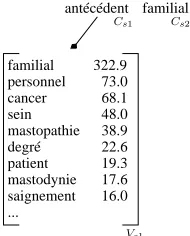
the source corpus. Mutual information or Likelihood-ratio are good measures of the co-occurrence relationship between 2 words. The co-co-occurrence information is expressed with a vector representation called context vector (Vsi). As an example, let us consider
the French MWTantécédent familial(Cs1Cs2). If the first componentantécédent(Cs1)
is not found in the bilingual dictionary then this component is replaced by its vector context:Vs1(see Figure 1).
antécédent familial
personnel cancer sein
degré patient
saignement ... mastopathie
mastodynie 73.0 68.1 48.0 38.9 22.6 19.3 17.6 16.0
familial 322.9
Cs2
[image:5.420.169.264.139.257.2]Vs1 Cs1
Figure 1: Computing context in the source corpus
Transfer of the MWT At this level, we are able to identify two situations depending on whether or not the components of the MWT are translated:
1. If the componentCsi is found in the dictionary, we compute the co-occurrence
information of each translation in the target corpus and store it in a context vector: V′
si.
2. If the componentCsiis not found in the dictionary, we use the context vector of
the source corpus Vsi. The elements ofVsiare projected into the target corpus
using the bilingual dictionary and the transferred context vector becomes: V′ si. If
the bilingual dictionary provides several translations for an element, all of them are used but the different translations are weighted according to their frequency in the target language. If an element is not found in the bilingual dictionary it is discarded.
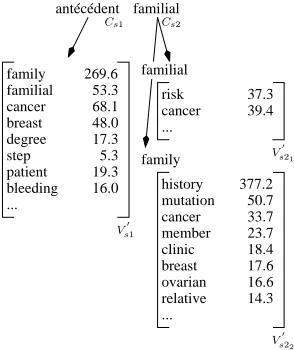
In the previous example, if we find two English translations for the componentfamilial (Cs2) such asfamilialandfamilyin the target language then we obtain two context
vectors:V′ s21andV
′s2
2(see Figure 2).
Generation of candidate translations Each MWT of the target language, for which each com-ponentCti is described by its context vectorVti, is then compared to the transferred
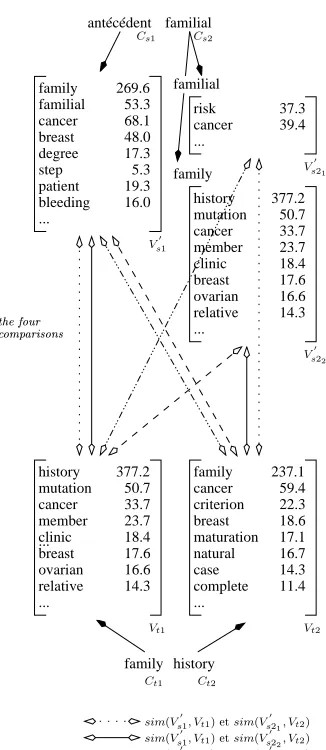
MWT through a similarity measure such as Cosine or Weighted Jaccard. For an MWT composed of two context vectorsVt1 andVt2in the target language and a transferred MWT composed of two context vectorsV′
s1andV ′
s2, two pairs of similarity scores
antécédent familial
68.1 53.3
17.3 5.3 19.3 16.0 family
familial cancer breast degree step patient bleeding ...
269.6
48.0 ...
risk cancer
37.3 39.4 familial
cancer
... mutation
member clinic breast ovarian
relative 14.3
16.6 17.6 18.4 23.7 33.7 50.7 377.2 history
family
Cs1 Cs2
Vs′1
Vs′22
[image:6.420.129.276.71.246.2]Vs′21
Figure 2: Projection in the target corpus
andsim(Vt1,Vs2′)with sim(Vt2,Vs1′). The combination score for each pair is then
de-fined as the geometric mean of each similarity score: psim(Vt1,Vs1′).sim(Vt2,Vs2′)and p
sim(Vt1,Vs2′).sim(Vt2,Vs1′). Figure 3 illustrates this comparison for the previous
exam-ple.
Ranking of candidate translations We rank the candidate translations in decreasing order of their combination score (see Figure 4).
5 Resources
In this section, we describe the different resources used for our experiments: the comparable corpus, the bilingual dictionary, and the multi-word term test set.
5.1 Comparable Corpora
... antécédent familial 68.1 53.3 17.3 5.3 19.3 16.0 family familial cancer breast degree step patient bleeding ... 269.6 48.0 ... risk cancer 37.3 39.4 family history cancer ... mutation member clinic breast ovarian relative 14.3 16.6 17.6 18.4 23.7 33.7 50.7 377.2 history familial family ... family complete case natural cancer ... mutation member clinic breast ovarian relative 14.3 16.6 17.6 18.4 23.7 33.7 50.7 377.2 history maturation breast criterion cancer 59.4 11.4 14.3 16.7 17.1 18.6 22.3 237.1 omparisons thefour
Cs1 Cs2
Vs′1
Vs′22
Vt1 Vt2
Ct2 Ct1
sim(Vs′1, Vt1)etsim(V
′ s21, Vt2)
sim(Vs′1, Vt1)etsim(V
′ s22, Vt2)
sim(Vs′1, Vt2)etsim(V
′ s21, Vt1)
sim(Vs′1, Vt2)etsim(V
′ s22, Vt1)
[image:7.420.136.299.64.439.2]Vs′21
family history cancer family family member high−risk family familial risk ...
[image:8.420.167.238.70.145.2]0.75 0.57 0.22 0.18 0.06 familial antécédent
Figure 4: Rank list of candidate translations
5.2 Bilingual Dictionary
The bilingual dictionaries used in our experiments are the French/English dictionary
ELRA-M0033 and the French/German dictionary ELRA-M0034 available from the ELRA catalogue2.
The French/English dictionary contains 243,539 translations and the French/German dictio-nary 170,967 translations. These are two general language dictionaries which contain only a few terms related to the medical domain.
5.3 Multi-Word Term Test Set
Terms are extracted monolingually from the comparable corpora. To collect close candidate terms across languages, it is necessary to use a term extraction program that is multilin-gually designed. We choose the TTC TermSuite (Rocheteau and Daille, 2011)3 that applies
the same term extraction method to several languages including French, German and En-glish. TermSuite first normalises the texts through the following linguistic pre-processing steps: tokenisation, part-of-speech tagging and lemmatisation using TreeTagger (Schmid, 1995). TermSuite then extracts SWTs and MWTs whose syntactic patterns correspond either to a canonical or a variation structure. The patterns are expressed using MULTEXT part-of-speech tags and are provided for each language. The main patterns, whatever the language is, areN andAfor SWTs. The main patterns of MWTs are for:
• FrenchNN:ganglion sentinelle(sentinel lymph node);NSpN:cancer du sein(breast cancer);NA:curage axillaire(axillary dissection);
• EnglishNN:breast cancer;AN:far therapy;NSpN: ;
• GermanAN:thromboembolischer vorfall(thromboembolic incident);NSpN:patientin mit mammakarzinom(patient with breast cancer);ND:gN: erfahrung der früherken-nung(experience of early detection).
The variants handled for MWTs are graphical, morphological, and syntactic. Both SWTs and MWTs accept variants but some are more likely to concern one main type such syntactic vari-ants for MWTs. TermSuite defines a morphological variant as a morphological modification of one of the components of the MWT, and a syntactical variant as the adding of another word at the frontier or inside the MWT. For example, in the French part of the comparable corpus, the MWT candidatecancer du sein(breast cancer) appears in the following forms where shared items are numbered with the same values.
2
http://www.elra.info/
3
• base formofN 1
S 1
pN
2pattern:cancer du sein(breast cancer); • inflexional variant:cancers du sein(breast cancers);
• syntactic variant(insertion inside the base form of a modifier):N 1
AS 1
pN 2cancer primitif du sein(primary breast cancer);
• syntactic variant (expansion coordination of base form): N 1
Sp N S 1
p N
2 cancer des ovaires et du sein(ovarian and breast cancer).
In German, it is necessary to reconsider the rough distinction between single- multi-word terms in order to take morphological compounds into account. The common German compounds of the typeN
1| N
2(”|” is the concatenation operation) are often translated by
NSpNpatterns in French:Produktionsstandort↔site de productionor by theNNpatterns in English. Morpho-logical compounds are identified by tokenisation programs as single-word terms but they look quite similar to multi-word terms. We use the morphological splitter which is combined with a dictionary look-up developed by Weller and Heid (2012) in order to get the MWT syntagmatic equivalence of a German morphological compound.
In order to build the test set, we have selected the French MWTs extracted by TermSuite for which the number of occurrences is greater than or equal to 5. The test set is composed of 976 French MWTs for which 90% of the base forms are only composed of two content words.
6 Experiments
In this section, we evaluate the performance of the dictionary look-up, the compositional method and CMCBP on the quality of bilingual terminology extraction.
6.1 Dictionary Look-up
First of all, we count the number of terms of the test set directly translated by looking them up in the bilingual dictionaries. From the 976 French MWTs to be translated, 51 are recorded in the French/English dictionary and 12 in the French/German dictionary. Here, the MWTs correctly translated are mainly generic terms that are not specific to the thematic of breast cancer such astraitement médical/medical treatmentandacide aminé/amino acid: in French/English andanalyse statistique/statistische untersuchung(statistical analysis) andeffet secondaire/begleiterscheinung(side effect) in French/German. In this instance we were unable
to generate any translations for 836 French MWTs in English and for 964 French MWTs in German.
6.2 Compositional Method
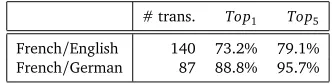
We then evaluate the quality of the translations provided by the compositional method (the MWTs found in the dictionary are not used). Table 1 shows the results obtained for the trans-lation from French/English and German/English. The first column indicates the number of French MWTs that are translated. Since the compositional approach can give several target translations for one French MWT, the last two columns indicate theTop1andTop5accuracy.
To evaluate theTopnaccuracy, we first keep for each French word to be translated itsnfirst
ranked according to their frequency in the target part of the comparable corpus. The results of this experiment show that 140 of the 836 French MWTs are translated into English for the Top5with a high level of accuracy: 79.1%, and 87 of the 964 French MWTs are translated into German for theTop5with a high level of accuracy: 95.7%. Here, we were unable to generate
any translations for 785 French MWTs in English and 877 French MWTs in German.
# trans. Top1 Top5
French/English 140 73.2% 79.1%
[image:10.420.119.285.129.171.2]French/German 87 88.8% 95.7%
Table 1: Results for the compositional method
6.3 Compositional Method with Context-Based Projection
We now apply CMCBP (here again the MWTs found in the dictionary are not used). In this experiment, the parameters required for our approach are as follows: the size of the context windowwis up to 3 (i.e. a seven-word window), the association measure is Mutual Informa-tion, and the distance measure is Cosine. Other combinations of parameters were assessed but the previous parameters gave the best performance. Table 2 presents the percentage of French terms for which the correct translation is obtained among theTop1,5,10, and20candidates
translations from French to English and German. Table 2 shows that 514 of the 836 French MWTs are translated into English with the CMCBP with an accuracy of 42.1% for theTop1
and 57.1% for theTop20and 510 of the 964 French MWTs are translated into German with an accuracy of 44.3% for theTop1and 51.2% for theTop20. These results indicate that the
majority of the correct translated MWTs are in fact obtained from theTop5. Moreover, the
CMCBP retains the advantages of the compositional method. All translations obtained with the compositional method are found in the same rank with the CMCBP.
# trans. Top1 Top5 Top10 Top20
French/English 514 42.1% 55.4% 56.8% 57.1%
French/German 510 44.3% 49.4% 51.2% 51.2%
Table 2: Results for the compositional method enhanced with context alignments From the MWTs that are correctly translated and not found by the compositional approach, we found a large majority of French MWTs involving a relational adjective. However, the French
MWTdépistage mammographiqueis not translated by the compositional approach since the
French relational adjectivemammographiqueis not found in the dictionaries. In contrast, the correct English translationmammographic screeningis found in theTop3with the CMCBP
be-cause we have associated the French context vector ofmammographiquewith the English con-text vector ofmammographicand the French/English pairdépistage/screeningis found in the dictionary. The other French MWTs correctly translated are mainly MWTs with a compositional structure for which one element is not found in the dictionary such as:amélioration significa-tive/significant benefit(Top1), andcaractéristique tumoral/tumor charakteristik(tumor
andcurage axillaire/axillary dissection(Top11). From the MWTs incorrectly translated, we can
point out two main cases. First, we find target MWTs semantically close to the French MWTs to be translated such as: postmenopausalen frau (postmenopausal women) (Top5) and
prä-menopausalen frau(premenopausal women) (Top7) forfemme ménopausé(menopausal women).
Postmenopausalen frauandprämenopausalen frauare morphological variants ofmenopausalen frauand should have been identified as thus by the term extraction program, but unfortunately the canonical formamenopausalen fraudoes not occur in the comparable corpora. Secondly, we found only a sub-part of the English MWTs such as:node dissectionforcurage ganglionnaire (lymph node dissection). This case needs further work as it deals with a fertility case that is not able to be solved with the term variant recognition program.
7 Related Work
The principle of translation compositionality is restrictive. Several studies have concentrated on enhancing the compositional approach: Robitaille et al. (2006) proposed a backing-off method: if there is insufficient data in the dictionary to translate an MWT ofncontent words, a scaled MWT with a length less than, or equal to,nis used instead. Morin and Daille (2010) proposed an extended compositional method that bridges the gap between MWTs of different syntactic structures through morphological links. The compositional approach is also called the “bag-of-equivalents” approach (Vintar, 2010) when the bilingual dictionary is built from a parallel corpus and contains all words that occur in the corpus and their suggested translation equivalents, together with a probability score. The “bag-of-equivalents” approach has been used for SMT to build a word-level translation lexicon from parallel corpora (Munteanu and Marcu 2006) and a cognate lexicon from comparable corpora (Koehn and Knight 2002). Much of the work involving general or LSP comparable corpora has focused on extracting SWT translations using only contextual information (Fung, 1998; Rapp, 1999; Chiao and Zweigenbaum, 2002; Gaussier et al., 2004; Morin et al., 2007; Laroche and Langlais, 2010, among others). The contextual information method as defined by Fung (1998) gives very low results for MWTs: from the 785 non translated French MWTs, 483 French MTWS with an accuracy of 15.6% (Top10) were found.
CMCBP is a new method dedicated to MWT that combines both the compositional and the con-textual information. CMCBP significantly improves both the compositional method commonly used for bilingual alignment of MWTs extracted from comparable corpora, and the contex-tual information method we obtained from English: 514 French translations of MWTS with a precision of 56.8% and 510 German translations of MWTS with a precision of 51.2% for Top10.
8 Conclusion
In this study, we have investigated the compilation of bilingual terminologies from a specialized comparable corpus and show how to push back the limits of the compositional approach used in alignment programs to translate MWTs. We have proposed CMCBP: a compositional method enhanced with pre-processed context information. The experiments that we carried out have shown that we increase the results of the compositional approach by providing a significant number of additional correct lexical entries that could not be identified either by the dictionary look-up or by compositional methods.
to improve the solving of the fertility problem for MWTs which produces incomplete transla-tions. Fertility was only partially solved thanks to the term variation treatment associated to the CMCBP. We aim to modify the evaluation protocol by accepting one-to-many translations in the case of synonym or semantically-related translation candidates that are not handled through term variation processing.
Acknowledgments
The research leading to these results has received funding from the European Community’s Seventh Framework Programme (FP7/2007-2013) under Grant Agreement no 248005.
References
Baldwin, T. and Tanaka, T. (2004). Translation by Machine of Complex Nominals: Getting it Right. InProceedings of the ACL 2004 Workshop on Multiword Expressions: Integrating Processing, pages 24–31, Barcelona, Spain.
Bowker, L. and Pearson, J. (2002). Working with Specialized Language: A Practical Guide to Using Corpora. Routledge, London/New York.
Brown, P., Della Pietra, S., Della Pietra, V., and Mercer, R. (1993). The Mathematics of Statistical Machine Translation: Parameter Estimation.Computational Linguistics, 19(2):263– 311.
Chiao, Y.-C. and Zweigenbaum, P. (2002). Looking for Candidate Translational Equivalents in Specialized, Comparable Corpora. InProceedings of the 19th International Conference on Computational Linguistics (COLING’02), pages 1208–1212.
Fung, P. (1998). A Statistical View on Bilingual Lexicon Extraction: From Parallel Corpora to Non-parallel Corpora. In Farwell, D., Gerber, L., and Hovy, E., editors,Proceedings of the 3rd Conference of the Association for Machine Translation in the Americas (AMTA’98), pages 1–16, Langhorne, PA, USA.
Gaussier, E., Renders, J.-M., Matveeva, I., Goutte, C., and Déjean, H. (2004). A Geomet-ric View on Bilingual Lexicon Extraction from Comparable Corpora. InProceedings of the 42nd Annual Meeting on Association for Computational Linguistics (ACL’04), pages 526–533, Barcelona, Spain.
Grefenstette, G. (1999). The World Wide Web as a Resource for Example-Based Machine Translation Tasks. InASLIB’99 Translating and the Computer 21, London, UK.
Keenan, E. L. and Faltz, L. M. (1985). Boolean Semantics for Natural Language. D. Reidel, Dordrecht, Holland.
Koehn, P. and Knight, K. (2002). Learning a translation lexicon from monolingual corpora. In Proceedings of the ACL-02 Workshop on Unsupervised Lexical Acquisition, pages 9–16, Philadel-phia, Pennsylvania, USA.
McEnery, A.and Xiao, Z. (2007). Parallel and comparable corpora: What is happening? In Anderman, G. and Rogers, M., editors,Incorporating Corpora: The Linguist and the Translator, Multilingual Matters. Clevedon.
Melamed, I. D. (2001).Empirical Methods for Exploiting Parallel Texts. MIT Press, Cambridge, MA, USA.
Morin, E. and Daille, B. (2010). Compositionality and Lexical Alignment of Multi-word terms. InLanguage Resources and Evaluation, volume 44, pages 79–95. Springer.
Morin, E., Daille, B., Takeuchi, K., and Kageura, K. (2007). Bilingual Terminology Mining – Using Brain, not brawn comparable corpora. InProceedings of the 45th Annual Meeting of the Association for Computational Linguistics (ACL’07), pages 664–671, Prague, Czech Republic.
Munteanu, D. S. and Marcu, D. (2006). Extracting parallel sub-sentential fragments from non-parallel corpora. InProceedings of the 21st International Conference on Computational Linguistics and 44th Annual Meeting of the Association for Computational Linguistics (COLING-ACL’06), Sydney, Australia.
Nakagawa, H. and Mori, T. (2003). Automatic term recognition based on statistics of com-pound nouns and their components.Terminology, 9(2):201–219.
Nomura, M. and M., I. (1989). Gakujutu Yogo Goki-Hyo. National Language Research Insti-tute, Tokyo.
Pekar, V., Mitkov, R., Blagoev, D., and Mulloni, A. (2006). Finding translations for low-frequency words in comparable corpora.Machine Translation, 20(4):247–266.
Rapp, R. (1999). Automatic Identification of Word Translations from Unrelated English and German Corpora. InProceedings of the 37th Annual Meeting of the Association for Computa-tional Linguistics (ACL’99), pages 519–526, College Park, MD, USA.
Robitaille, X., Sasaki, X., Tonoike, M., Sato, S., and Utsuro, S. (2006). Compiling French-Japanese Terminologies from the Web. InProceedings of the 11th Conference of the European Chapter of the Association for Computational Linguistics (EACL’06), pages 225–232, Trento, Italy.
Rocheteau, J. and Daille, B. (2011). TTC TermSuite - A UIMA Application for Multilingual Terminology Extraction from Comparable Corpora. InProceedings of the IJCNLP 2011 System Demonstrations, pages 9–12, Chiang Mai, Thailand. Asian Federation of Natural Language Processing.
Sag, I. A., Baldwin, T., Bond, F., Copestake, A. A., and Flickinger, D. (2002). Multiword expressions: A pain in the neck for nlp. InProceedings of the 3rd International Conference on Computational Linguistics and Intelligent Text Processing (CICLing’02), pages 1–15, Mexico City, Mexico.
Schmid, H. (1995). Improvements In Part-of-Speech Tagging With an Application To German. InIn Proceedings of the ACL SIGDAT-Workshop, pages 47–50.
Sharoff, S., Babych, B., and Hartley, A. (2009). ’irrefragable answers’ using comparable corpora to retrieve translation equivalents.Language Resources and Evaluation, 43(1):15–25. Tanaka, T. (2002). Measuring the Similarity between Compound Nouns in Different Lan-guages Using Non-parallel Corpora. InProceedings of the 19th International Conference on Computational Linguistics (COLING’02), pages 1–7, Taipei, Taiwan.
Tanaka, T. and Baldwin, T. (2003). Noun-Noun Compound Machine Translation: A Feasi-bility Study on Shallow Processing. InProceedings of the ACL 2003 workshop on Multiword Expressions: Analysis, Acquisition and Treatment, pages 17–24, Sapporo, Japan.
Vintar, S. (2010). Bilingual term recognition revisited: The bag-of-equivalents term alignment approach and its evaluation.Terminology, 16(2):141–158.