Discourse-level argumentation in scientific articles:
human and automatic annotation
S i m o n e T e u f e l a n d M a r c M o e n s H C R C L a n g u a g e T e c h n o l o g y G r o u p
D i v i s i o n o f I n f o r m a t i c s U n i v e r s i t y o f E d i n b u r g h
S. T e u f e l @ e d . ac. uk, M. Moens@ed. ac. u k
A b s t r a c t
In this paper we present a rhetorically de- fined annotation scheme which is part of our corpus-based method for the summari- sation of scientific articles. The annotation scheme consists of seven non-hierarchical labels which model prototypical academic argumentation and expected intentional 'moves'. In a large-scale experiments with three expert coders, we found the scheme stable and reproducible. We have built a resource consisting of 80 papers annotated by the scheme, and we show t h a t this kind of resource can be used to train a system to automate the annotation work.
1
I n t r o d u c t i o n
Work on summarisation has suffered from a lack of appropriately annotated corpora t h a t can be used for building, training and evaluating summarisation systems. Typically, corpus work in this area has taken as its starting point texts target summaries: abstracts written by the researchers, supplied by the original authors or provided by professional ab- stractors. Training a summarisation system then in- volves learning the properties of sentences in those abstracts and using this knowledge to extract simi- lax abstract-worthy sentences from unseen texts. In this scenario, system performance or development progress can be evaluated by taking texts in a test sample and comparing the sentences extracted from these texts with the sentences in the target abstract. But this approach has a number of shortcomings. First, sentence extraction on its own is a very gen- eral methodology, which can produce extracts t h a t are incoherent or under-informative especially when used for high-compression summarisation (i.e. reduc- ing a document to a small percentage of its orig- inal size). It is difficult to overcome this prob-
lem, because once sentences have been extracted from the source text, the context t h a t is needed for their interpretation is not available a n y m o r e and cannot be used to produce more coherent abstracts (Spgrck Jones, 1998).
Our proposed solution to this p r o b l e m is to ex- tract sentences but also to
classify t h e m into one of
a small number of possible a r g u m e n t a t i v e roles, re- flecting whether the sentence expresses a m a i n goal of the source text, a shortcoming in someone else's work, etc. The summarisation system can t h e n use this information to generate template-like abstracts: Main goal of the t e x t : . . . ; Builds on work b y : . . . ; Contrasts with:... ; etc.Second, the question of what constitutes a use- ful gold standard has not yet been solved satisfac- torily. Researchers developing corpus resources for summarisation work have often defined their own gold standard, relying on their own intuitions (see, e.g. Luhn, 1958; Edmundson, 1969) or have used abstracts supplied by authors or by professional ab- stractors as their gold standard (e.g. Kupiec et al., 1995; Mani and Bloedorn, 1998). Neither approach is very satisfactory. Relying only on your own intu- itions inevitably creates a biased resource; indeed, Rath et al. (1961) report low agreement between human judges carrying out this kind of task. On the other hand, using abstracts as t a r g e t s is not necessarily a
good gold standard for comparison of
the systems' results, although a b s t r a c t s are the only kind of gold standard t h a t comes for free with the papers. Even if the abstracts are written by pro- fessional abstractors, there are considerable differ- ences in length, structure, and information content. This is due to differences in the c o m m o n a b s t r a c t presentation style in different disciplines and to the projected use of the abstracts (cf. Liddy, 1991). In the case of our corpus, an additional p r o b l e m was the fact that the abstracts are written by the au- thors themselves and thus susceptible to differencesin individual writing style.
For the task of summarisation and relevance deci- sion between similar papers, however, it is essential t h a t the information contained in the gold standard is comparable between papers. In our approach, the vehicle for comparability of information is similarity in argumentative roles of the associated sentences. We argue that it is more difficult to find the kind of information that preserves similarity of argumenta- tive roles, and that it is not guaranteed t h a t it will occur in the abstract. : .. . .
A related problem concerns fair evaluation Of the extraction methodology. The evaluation of ex- tracted material necessarily consists of a comparison of sentences, whereas one would really want to com- pare the informational content of the extracted sen- tences and the target abstract. Thus it will often be the case that a system extracts a sentence which in t h a t form does not appear in the supplied abstract (resulting in a low performance score) but which is nevertheless an abstract-worthy sentence. T h e mis- match often arises simply because a similar idea is expressed in the supplied abstract in a very differ- ent form. But comparison of content is difficult to perform: it would require sentences to be m a p p e d into some underlying meaning representations and then comparing these to the representations of the sentences in the gold standard. As this is techni- cally not feasible, system performance is typically performed against a fixed gold standard (e.g. the aforementioned abstracts), which is ultimately un- desirable.
Our proposed solution to this problem is to build a corpus which details not only what the abstract- worthy sentences are but also what their argumen- tative role is. This corpus can then be used as a resource to build a system to similarly classify sen- tences in unseen texts, and to evaluate t h a t system. This paper reports on the development of a set of such argumentative roles that we have been using in our work.
In particular, we employ human intuition to an- notate argumentatively defined information. We ask our annotators to classify every sentence in the source text in terms of its argumentative role (e.g. that it expresses the main goal of the source text, or identifies open problems in earlier work, etc). Under this scenario, system evaluation is no longer a com- parison of extracted sentences against a supplied ab- stract, or against a single sentence t h a t was chosen as expressing (e.g.) the main goal of the source text. Instead, every sentence in the source text which ex- presses the main goal will have been identified, and
the system's performance is evaluated against that
classification.
O f course, having someone annotate text in this
w a y m a y still lead to a biased or careless annotation.
W e therefore needed an annotation scheme which is simple enough to be usable in a stable and intu- itive w a y for several annotators. This paper also
reports on h o w we tested the stability of the anno-
tation scheme w e developed. A second design crite- rion for our annotation scheme was that w e wanted
the roles to be annotated automatically. This paper
reports on preliminary results which show that the annotation process can indeed be automated.
T o summarise, w e have argued that discourse structure information will improve summarisation. Other researchers (Ono et al., 1994; Marcu, 1997)
have argued similarly, although most previous work
on discourse-based summarisation follows a different discourse model, namely Rhetorical Structure The- ory ( M a n n and Thompson, 1987). In contrast to R S T , w e stress the importance of rhetorical moves
which are
global
to the argumentation of the paper,as opposed to more local R S T - t y p e relations. O u r
categories are not hierarchical, and they are m u c h
less fine-grained than RST-relations. A s mentioned
above, w e wanted them to a) provide context in-
formation for flexible summarisation, b) provide a
higher degree of comparability between papers, and
c) provide a fairer evaluation of superficially differ-
ent sentences.
In the rest of this paper, w e will first describe h o w
we chose the categories (section 2). Second, w e had
to construct training and evaluation material such that w e could be sure that the proposed categorisa-
tion yielded a reliable resource of annotated text to
train a system against, a gold standard. T h e h u m a n annotation experiments are reported in section 3. Finally, in section 4, w e describe some of the auto- mated annotation work which w e have started re- cently and which uses a corpus annotated according to our scheme as its training material.
2 T h e a n n o t a t i o n s c h e m e
T h e domain in which we work is that of scientifc re-
search articles, in particular computational linguis-
tics articles. W e settled on this domain for a n u m -
ber of reasons. O n e reason is that it is a domain w e are familiar with, which helps for intermediate evaluation of the annotation work. T h e other rea-
son is that computational linguistics is also a rather
heterogeneous domain: the papers in our collection cover a wide range of subject matters, such as logic
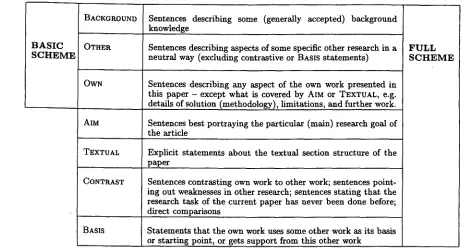
B A S I C SCHEME
BACKGROUND Sentences describing some (generally accepted) background
knowledge
OTHER Sentences describing aspects of some specific other research in a neutral way (excluding contrastive or BASIS statements)
OWN Sentences describing any aspect of the own work presented in this paper - except what is covered by AIM or TEXTUAL, e.g. details of solution (methodology), limitations, and further work.
AIM Sentences best portraying the particular (main) research goal of the article
TEXTUAL Explicit statements about the textual section structure of the paper
CONTRAST Sentences contrasting own work to other work; sentences point- ing out weaknesses in other research; sentences stating that the research task of the current paper has never been done before; direct comparisons
BASIS Statements that the own work uses some other work as its basis or starting point, or gets support from this other work
Figure 1: Overview of the a~notation scheme
F U L L S C H E M E
scheme which we hope to be applicable in a range of disciplines.
Despite its heterogeneity, our collection of papers does exhibit predictable rhetorical patterns of sci- entific argumentation. To analyse these patterns we used STales' (1990) CARS (Creating a Research space) model as our starting point.
The annotation scheme we designed is sum- marised in Figure 1. The seven categories describe argumentative roles with respect to the overall com- municative act of the paper. They are to be read as mutually exclusive labels, one of which is attributed to each sentence in a text. There are two kinds of categories in this scheme: basic categories and n o n - basic categories. Basic categories are defined by at- tribution of intellectual ownership; they distinguish between:
• statements which are presented as generally ac- cepted (BACKGROUND);
• statements which are attributed to other, spe- cific pieces of research outside the given pa- per, including the authors' own previous work
(OTHER);
• statements which describe the authors' own n e w
contributions (OWN).
The four additional (non-basic) categories are more directly based on STales' theory. The most
important of these is AIM, as this move on its own is already a good characterisation of the en- tire paper, and thus very useful for the generation of abstracts. The other categories a r e TEXTUAL, which provides information a b o u t section structure that might prove helpful for subsequent search steps. There are two moves having to do with the a u t h o r ' s attitude towards previous research, namely BASIS and CONTRAST. We expect this kind of information to be useful for the creation of t y p e d links for biblio- metric search tools and for the a u t o m a t i c determi- nation of rival approaches in the field and intellec- tual ancestry of methodologies (cf. Garfield's (1979) classification of the function of citation within re- searchers' papers).
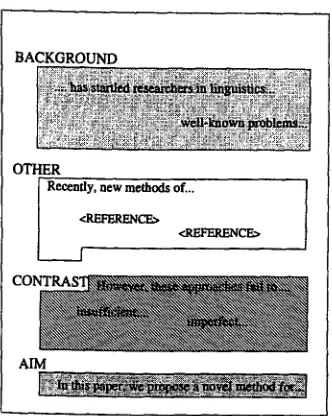
The structure in Figure 2, for example, displays a common rhetorical p a t t e r n of scientific argumen- tation which we found in m a n y introductions. A BACKGROUND segment, in which the history and the importance of the task is discussed, is followed by a longer sequence of OTHER sentences, in which spe- cific prior work is described in a neutral way. This discussion usually terminates in a criticism of the prior work, thus giving a motivation for the own work presented in the paper. T h e next sentence typ- ically states the specific goal or contribution of the paper, often in a formulaic way (Myers, 1992).
Such regularities, where the segments are contigu- ous, non-overlapping and non-hierarchical, can be
[image:3.612.70.532.71.322.2]BACKGROUND
OTHER
i Recently, new methods
of...
I
<REFE.RENCE>
<REFERENCE> f
CO
AIM
Figure 2: Typical rhetorical pattern in a research paper introduction
expressed well with our category labels. Whereas non-basic categories are typically short segments of one or two sentences, the basic categories form much larger segments of sentences with the same rhetorical role.
3 H u m a n A n n o t a t i o n
3.1 Annotating full texts
To ensure that our coding scheme leads to less bi- ased annotation than some of the other resources available for building summarisation systems, and to ensure that other researchers besides ourselves can use it to replicate our results on different types of texts, we wanted to examine two properties of our scheme: stability and reproducibility (Krippendorff, 1980). Stability is the extent to which an annota- tor will produce the same classifications at different times. Reproducibility is the extent to which differ- ent annotators will produce the same classification. We use the Kappa coefficient (Siegel and Castellan, 1988) to measure stability and reproducibility. The rationale for using Kappa is explained in (Carletta, 1996).
The studies used to evaluate stability and repro- ducibility we describe in more detail in (Teufel et al., To Appear). In brief, 48 papers were annotated by three extensively trained annotators. The train- ing period was four weeks consisting of 5 hours of annotation per week. There were written instruc- tions (guidelines) of 17 pages. Skim-reading and
annotation of an average length (3800 word) pa- per typically took 20-30 minutes. The studies show that the training material is reliable. In particu- lar, the basic annotation scheme is stable (K=.82, .81, .76; N=1220; k=2 for all three annotators) and reproducible (K=.71, N=4261, k=3), where k de- notes the number of annotators, N the number of sentences annotated, and K gives the Kappa value. The full annotation scheme is stable (K=.83, .79, .81; N=1248; k - 2 for all three annotators) and re- producible (K=.78, N=4031, k=3). Overall, repro- ducibility and stability for trained annotators does not quite reach the levels found for, for instance, the best dialogue act coding schemes, which typi- cally reach Kappa values of around K=.80 (Carletta et al., 1997; Jurafsky et al., 1997). Our annotation requires more subjective judgements and is possibly more cognitively complex. Our reproducibility and stability results are in the range which Krippendorff (1980) describes as giving marginally significant re- sults for reasonable size data sets when correlating two coded variables which would show a clear cor- relation if there were perfect agreement. As our re- quirements are less stringent than Krippendorff's, we find the level of agreement which we achieved acceptable.
OWN
OTHER
BACKGROUND
CONTRAST
AIM
BASIS
TEXTUAL
69.4% 15.8% 5.7% 4.4% 2.4% 1.4% 0.9%
Figure 3: Distribution of categories
0.8 0.7 0.6 0.5 K 0.4 0.3 O.2 0.1
0 CONTRAST AIM B A S I S TEXTUAL
[image:4.612.102.268.73.281.2] [image:4.612.349.489.523.633.2]Figure 4: Reproducibility diagnostics: non-basic categories
non-basic categories could be distinguished from all other categories, measured by Krippendorff's diag- nostics for category distinctions (i.e. collapsing all other distinctions). When compared to the over- all reproducibility of .71, we notice that the anno- tators were good at distinguishing AIM and TEX- TUAL, and less good at determining BASIS and CON- TRAST. This might have to do with the location of those types of sentences in the paper: AIM and TEX- TUAL are usually found at the beginning or end of the introduction section, whereas
CONTRAST,
and even more so BASIS, are usually interspersed within longer stretches of OWN. As a result, these cate- gories are more exposed to lapses of attention during annotation.The fact that the annotators are good at deter- mining AIM sentences is an important result: as AIM sentences constitute the best characterisation of the research paper for the summarisation task at a very high compression to 1.8% of the original text length, we are particularly interested in having them anno- tated consistently in our training material. This re- sult is clearly in contrast to studies which conclude t h a t humans are not very reliable at this kind of task (Rath et al., 1961). We attribute this difference to a difference in our instructions. Whereas the subjects in Rath et al.'s experiment were asked to look for the most relevant sentences, our annotators had to look for specific argumentative roles which seems to have eased the task. In addition, our guidelines give very specific instructions for ambiguous cases.
These reproducibility values are important be- cause they can act as a good evaluation measure as it factors random agreement out, unlike percentage agreement. It also provides a realistic upper bound on performance: if the machine is treated as another coder, and if reproducibity does not decrease then the machine has reached the theoretically best re- sult, considering the cognitive difficulty of the task.
3.2 Annotating parts of texts
Annotating texts with our scheme is time- consuming, so we wanted to determine if there was a more efficient way of obtaining hand-coded training material, namely by annotating only parts of the source texts. For example, the abstract, introduc- tions and conclusions of source texts are often like "condensed" versions of the contents of the entire pa- per and might be good areas to restrict annotation to. Alternatively, it might be a good idea to restrict annotation to the first 20% or the last 10% of any given text. Yet another possibility for restricting the range of sentences to be annotated is based on the 'alignment' idea introduced in (Kupiec et al., 1995):
a simple surface measure determines sentences in the document t h a t are maximally similar to sentences in the abstract.
Obviously, any of these strategies of area restric- tion would give us fewer gold standard sentences per paper, so we would have to make sure t h a t we still had enough candidate sentences for all seven cate- gories. On the other hand, because these areas could well be the most clearly written and informationally rich sections, it might be the case t h a t the qual- ity of the resulting gold standard is higher. In this case we would expect the reliability of the coding in these areas to be higher in comparison to the reli- ability achieved overall, which in turn would result in higher accuracy when this task is done a u t o m a t - ically.
'I
0.8
0.6 K
0.4
02.
0
Figure 5: Reproducibility by annotated area
1 0 0 %
5 0 % -
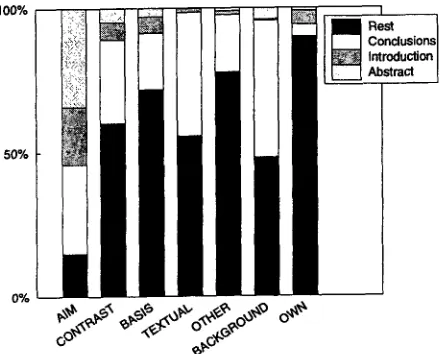
Figure 6: Label distribution by annotated area
We did extensive experiments on this. Figure 5 shows reliability values for each of the a n n o t a t e d portions of text, and Figure 6 shows the composi-
[image:5.612.331.542.270.416.2] [image:5.612.323.543.463.640.2]tion in terms of our labels for each of the annotated portions of text. The implications for corpus prepa- ration for abstract generation experiments can be summarised as follows. If one wants to avoid manu- ally annotating entire papers but still make all argu- mentative distinctions, one can restrict the annota- tion to sentences appearing in the introduction sec- tion, even though annotators will find them slightly harder to classify (K=.69), or to all alignable ab- stract sentences, even if there are not many alignable abstract sentences detectable overall (around 50% of the sentences in the abstract), or to conclusion sen- tences, even if the coverage of argumentative cate- gories is very restricted in the conclusions (mostly AIM and OWN sentences).
We also examined a fall-back option of just anno- tating the first 10% or last 5% of a paper (as not all papers in our collection have an explicitly marked introduction and conclusion section), but the relia- bility results of this were far less good (K=.66 and K=.63, respectively).
4 A u t o m a t i c a n n o t a t i o n
All the annotation work is obviously in aid of de- velopment work, in particular for the training of a system. We will provide a brief description of train- ing results so as to show the practical viability of the proposed corpus preparation method.
4.1 Data
Our training material is a collection of 80 con- ference papers and their summaries, taken from the Computation and Language E-Print Archive ( h t t p : / / x x x . l a n l .
gov/cmp-lg/).
The training material contains 330,000 word tokens.The data is automatically preprocessed into xml format, and the following structural information is marked up: title, summary, headings, paragraph structure and sentences, citations in running text, and reference list at the end of the paper. If one of the paper's authors also appears on the author list of a cited paper, then that citation is marked as self citation. Tables, equations, figures, captions, cross references are removed and replaced by place holders. Sentence boundaries are automatically de- tected, and the text is POS-tagged according to the UPenn tagset.
Annotation of rhetorical roles for all 80 papers (around 12,000 sentences) was provided by one of our human judges during the annotation study m e n - tioned above.
4.2 T h e m e t h o d
(Kupiec et al., 1995) use supervised learning to au- tomatically adjust feature weights. Each document sentence receives scores for each of the features, re- suiting in an estimate for the sentence's probability to also occur in the summary. This probability is calculated for each feature value as a combination of the probability of the feature-value pair occurring in a sentence which is in the summary (successful case) and the probability that the feature-value pair occurs unconditionally.
We extend Kupiec et al.'s estimation of the proba- bility that a sentence is contained in the abstract, to the probability that it has rhetorical role R (cf. Fig- ure 7).
P ( s e R I F ' " ' " F k ) ~
1-i~= p¢Fj )where
P(s e RIF1,..
P(s ~.
R):P(Fjl s e R):
P(•):
k: D:
., Fk): Probability that sentence s in the source text has rhetorical role R, given its feature values; relative frequency of role R (con- stant);
probability of feature-value pair occurring in a sentence which is in rhetorical class R;
probability that the feature-value pair occurs unconditionally; number of feature-value pairs; j-th feature-value pair.
Figure 7: Naive Bayesian classifier
Evaluation of the method relies on cross- validation: the model is trained on a training set of documents, leaving one document out at a time (the test document). The model is then used to as- sign each sentence a probability for each category R, and the category with the highest probability is chosen as answer for the sentence.
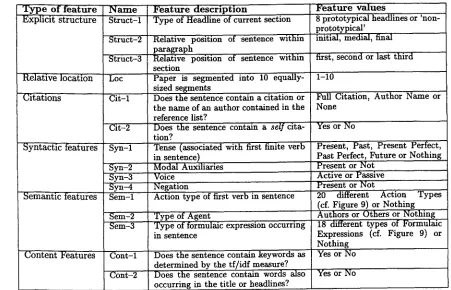
4.3 Features
The features we use in training (see Figure 8) are different from K u p i e c e t al.'s because we do not es- timate overall importance in one step, but instead guess argumentative status first and determine im- portance later.
[image:6.612.306.543.261.447.2]T y p e o f f e a t u r e Explicit structure
Relative location
Citations
Syntactic features
Semantic features
Content Features
N a m e Struct-1
Struct-2
Struct-3
Cit-1
Cit-2
Syn-1
Syn-2 Syn-3 Syn-4 Sere-1
Sem-2 Sem-3
Cont-1
Cont-2
F e a t u r e d e s c r i p t i o n
Type of Headline of current section
Relative position of sentence within paragraph
Relative position of sentence within section
Paper is segmented into 10 equally- sized segments
Does the sentence contain a citation or the name of an author contained in the reference list?
Does the sentence contain a self cita- tion?
Tense (associated with first finite verb in sentence)
Modal Auxiliaries
Negation
Action type of first verb in sentence
Type of Agent
Type of formulaic expression occurring in sentence
Does the sentence contain keywords as determined by the tf/idf measure? Does the sentence contain words also occurring in the title or headlines?
F e a t u r e v a l u e s
8 prototypical headlines or 'non- p.rototypical'
initial, medial, final
first, second or last third
1-10
Full Citation, Author Name or"" None
Yes or No
Present, Past, Present Perfect,' Past Perfect, Future or Nothing_ Present or Not
Active or Passive Present or Not
20 different Action Types (cf. Figure 9) or Nothing Authors or Others or Nothing 18 different types of Formulaic Expressions (cf. Figure 9) or Nothing
Yes or No
Yes or No
Figure 8: Features for supervised learning
m
m
m
m
The syntactic features rely on determining the first finite verb in the sentence, which is done sym- bolically using POS-information. Heuristics are used to determine the tense and possible negation.
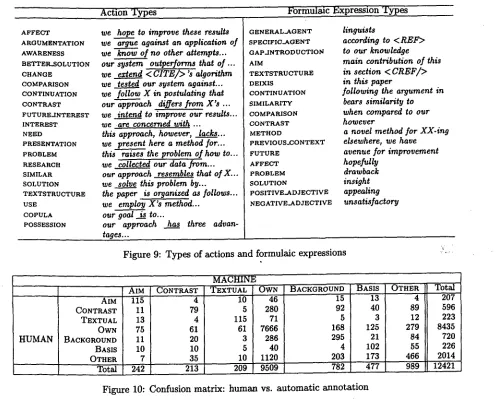
The semantic features rely on template matching. In the feature Sem-1, a hand-crafted lexicon is used to classify the verb into one of 20 Action Classes (cf. Figure 9, left half), if it is one of the 388 verbs contained in the lexicon. The feature Sem-2 encodes whether the agent of the action is most likely to re- fer to the authors, or to other agents, e.g. other researchers (177 templates). Heuristic rules deter- mine that the agent is the subject in an active sen- tence, or the head of the by-phrase (if present) in a passive sentence. Sere-3 encodes various other for- mulaic expressions (indicator phrases (Paice, 1981), meta-comments (Zukerman, 1991)) in order to ex- ploit explicit rhetoric phrases the authors might have used, cf. Figure 9, right half (414 templates).
The content features use the t f / i d f method and title and header information for finding contentful words or phrases. In contrast to all other features they do not attempt to model the form or meta- discourse contained in the sentences but instead model their domain (object-level) contents.
4.4 R e s u l t s
When the Naive Bayesian Model is added to the pool of coders, the reproducibility drops from K=.71 to K=.55. This reproducibility value is equivalent to the value achieved by 6 h u m a n annotators with no prior training, as found in an earlier experiment (Teufel et al., To Appear). Compared to one of the annotators, K a p p a is K=.37, which corresponds to percentage accuracy of 71.2%. This number cannot be directly compared to experiments like Kupiec et al.'s because in their experiment a compression of around 3% was achieved whereas we classify each sentence into one of the categories.
Further analysis of our results shows the system performs well on the frequent category OWN, cf. the confusion matrix in Fig. reftab:confusion. Indeed, as Figure 3 shows, OWN is so frequent t h a t choos- ing OWN all the time gives us a seemingly hard- to-beat baseline with a high percentage agreement of 69% (Baseline 1). However, the K a p p a statistic, which controls for expected r a n d o m agreement, re- veals just how bad t h a t baseline really is: K a p p a is K = - . 1 2 (machine vs. one annotator). R a n d o m choice of categories according to the distribution of categories (Baseline 2) is a better baseline; K a p p a
[image:7.612.74.525.74.364.2]Action Types Formulaic Expression Types
A F F E C T A R G U M E N T A T I O N A W A R E N E S S B E T T E R , S O L U T I O N CHANGE COMPARISON CONTINUATION CONTRAST FUTURE.INTEREST INTEREST NEED PRESENTATION PROBLEM RESEARCH SIMILAR SOLUTION TEXTSTRUCTURE USE COPULA POSSESSION
we hop._.._~e to improve these results we argue against an application of we know of no other attempts... our system outperforms that of ... we extend < C I T E / > 's algorithm we tested_ our system against... we follow X in postulating that our approach differs from X's . . .
we inten..d to improve our results... we are concerned with ...
this approach, however, lacks... we present here a method for... t h i ~ - ~ s e s the problem of how to... we collected our data from... our approach resembles that of X... we solve this problem by... the paper is organized as follows... we employ X's method...
our goal i...ss to...
our approach has three advan- tages...
G E N E R A L - A G E N T S P E C I F I C - A G E N T G A P - I N T R O D U C T I O N A I M
T E X T S T R U C T U R E DEIXIS C O N T I N U A T I O N S I M I L A R I T Y C O M P A R I S O N C O N T R A S T M E T H O D
P R E V I O U S _ C O N T E X T F U T U R E
A F F E C T P R O B L E M S O L U T I O N
P O S I T I V E . A D J E C T I V E N E G A T I V E . A D J E C T I V E
linguists
according to < REF'~ to our knowledge main contribution of this in section < C R E F / > in this paper
following the argument in bears similarity to
when compared to our however
a novel method for XX-ing elsewhere, we have avenue for improvement hopefully
drawback insight appealing unsatisfactory
Figure 9: Types of actions and formulaic expressions
HUMAN
AIM
CONTRAST TEXTUAL O W N BACKGROUND BASIS OTHER Total AIM 115 11 13 75 11 10 7 242
M A C H I N E
CONTRAST TEXTUAL
4 I0
79 5
4 115
61 61
20 3
10 5
35 10
213 209
.i ~-, ..
OWN BACKGROUND BASIS O T H E R Total
46 15 13 4 207
280 92 40 89 596
71 5 3 12 223
7666 168 125 279 8435
286 295 21 84 720
40 4 102 55 226
1120 203 173 466 2014
9509 782 477 989 12421
Figure 10: Confusion matrix: human vs. automatic annotation
for this baseline is K=0.
AIM categories can be determined with a preci- sion of 48% and a recall of 56% (cf. Figure 11). These values are more directly comparable to Ku- piec et al.'s results of 44% co-selection of extracted sentences with alignable s u m m a r y sentences. We assume that most of the sentences extracted by their method would have fallen into the AIM cate- gory. The other easily determinable category for the automatic method is TEXTUAL (p----55%; r=52%), whereas the results for the other non-basic categories are relatively lower - mirroring the results for hu- mans.
As far as the individual features are concerned, we found the strongest heuristics to be location, type of header, citations, and the semantic classes (indicator phrases, agents and actions); syntactic and content- based heuristics are the weakest. The first column in Figure 12 gives the predictiveness of the feature
AIM CONTRAST TEXTUAL OwN BACKGROUND BASIS OTHER
P r e c i s i o n Recall
48% 56%
37% 13%
55% 52%
81% 91%
38% 41%
21% 45%
47% 23%
Figure 11: Precision and recall per category
on its own, in terms of k a p p a between machine and one annotator. Some of the weaker features are not predictive enough on their own to break the domi- nance of the prior; in t h a t case, they behave just like Baseline 1 (K=-.12).
[image:8.612.63.559.68.474.2]F e a t u r e C o d e A l o n e L e f t o u t
Struct-1 -.12 .37
Struct-2 -.12 .36
Struct-3 .16 .36
Struct-l-3 .18 .34
I L°c
I..
.171
.34
Cit-1 .18 .37
Cit-2 .13 .37
C i t - l - 2 .18 -36
Syn-1 -.12 .37
Syn-2 -.12 .37
Syn-3 -.12 .37
Syn-4 -.12 .37
S y n - l - 4 . . . . -.12 .37
Sere-1 -.12 ".36
Sere-2 .07 .35
Sere-3 -.03 .36
Sere-l-3 " .13 .31
Cost-1 -.12 I .37
Cont-2 -.12 .37
Cont-lS2 -.12 .37
Baseline 1 (all
OWN):
K=-.12 Baseline 2 (random by distr.): K = 0Figure 12: Disambiguation potential of individual
heuristics
tures. These numbers show that some of the weaker
features contribute some predictive power in combi- nation with others.
While not entirely satisfactory, these results might be taken as an indication t h a t we have indeed m a n - aged to identify the right kinds of features for argu- mentative sentence classification. Taking the con- text into account should further increase results, as preliminary experiments with n - g r a m modelling have shown. In these experiments, we replaced the prior P ( s E R) in Figure 7 with a n - g r a m based probability of t h a t role occurring in the given con- text.
5
C o n c l u s i o n s
In this paper we have presented an a n n o t a t i o n scheme for corpus based summarisation. In tests, we have found this annotation scheme to be stable and reproducible. On the basis of this scheme, we have created a new kind of resource for training sum- marisation systems: a corpus a n n o t a t e d with labels which indicate the argumentative role of each sen- tence in the text. Results of our training work show t h a t the annotation work can be a u t o m a t e d .
R e f e r e n c e s
Jean Carletta, Amy Isard, Stephen Isard, Jacqueline C. Kowtko, Gwyneth Doherty-Sneddon, and Anne H. Anderson. 1997. The reliability of a dialogue structure coding scheme. Computatiorml Linguistics, 23(1):13-31.
Jean Carletta. 1996. Assessing agreement on classifica- tion tasks: the kappa statistic. Computational Lin- guistics, 22(2):249-254.
H. P. Edmundson. 1969. New methods in automatic extracting. Journal of the Association for Computing Machinery, 16(2):264-285.
E. Garfield. 1979. Citation indezing: its theory and ap- plication in science, thechnology and humanities. Wi- ley, New York.
Daniel Jurafsky, Elizabeth Shriberg, and Debra Bi- asca, 1997. Switchboard SWBD-DAMSL Shallow- Discourse-Function Annotation Coders Manual. Uni- versity of Colorado, Institute of Cognitive Science. TR-97-02.
Klaus Krippendorff. 1980. Content analysis: an intro- duction to its methodology. Sage Commtext series; 5. Sage, Beverly Hills London.
Julian Kupiec, Jan O. Pedersen, and Francine Chen. 1995. A trainable document summarizer. In Pro- ceedings of the 18th ACM-SIGIR Conference, pages 68-73.
Elizabeth DuRoss Liddy. 1991. The discourse-level structure of empirical abstracts: an exploratory study. Information Processing and Management, 27(1):55- 81.
H. P. Luhn. 1958. The automatic creation of literature abstracts. IBM Journal of Research and Development, 2(2):159-165.
Inderjeet Mani and Eric Bloedorn. 1998. Machine learn- ing of generic and user-focused summarization. In Proceedings of the Fifteenth National Conference on A I (AAAI-98), pages 821-826.
William C. Mann and Sandra A. Thompson. 1987. Rhetorical structure theory: description and construc- tion of text structures. In G. Kempen, editor, Natural Langua9 e Generation: New Results in Artificial In- telligence, Psychology and Linguistics, pages 85-95, Dordrecht. Nijhoff.
Daniel Marcu. 1997. From discourse structures to text summaries. In Proceedings of the ACL/EACL Work- shop on Intelligent Scalable Text Summarization.
Greg Myers. 1992. In this paper we report... - speech acts and scientific facts. Journal of Pragmatics, 17(4):295-313.
Kenji Ono, Ka~uo Sumita, and Seijii Miike. 1994. Ab- stract generation based on rhetorical structure extrac- tion. In Proceedings of the 15th International confer-
ence on Computational Linguistics (COLING-94).
[image:9.612.86.265.73.316.2]Chris D. Paice. 1981. The automatic generation of lit- erary abstracts: an approach based on the identifi- cation of self-indicating phrases. In Robert N o r m a n Oddy, S. E. Robertson, C. J. van Rijsbergen, and P. W. Williams, editors, Information Retrieval Re- search, pages 172-191. Butterworth, London. G.J Path, A. Resnick, and T. R. Savage. 1961. The
formation of abstracts by the selection of sentences. American Documentation, 12(2):139-143.
Sidney Siegel and N.J. Jr. Castellan. 1988. Nonparamet- tic statistics for the Behavioral Sciences. McGraw- Hill, second edition.
Karen Sp~rck Jones. 1998. Automatic summarising: factors and directions. In A A A I Spring Symposium
on Intelligent Text Summarization.
John Swales. 1990. Genre analysis: English in academic and research settings. Cambridge University Press. Simone Teufel, Jean Carletta, and Marc Moens. To Ap-
pear. A n annotation scheme for discourse-level argu- mentation in research articles. In Proceedings of the
Ninth Conference of the European Chapter of the As- sociation for Computational Linguistics (EA CL- 99).