Flexible Speech Act Based Dialogue Management
E l i H a g e n a n d F r e d P o p o w i c h School of C o m p u t i n g Science
S i m o n Fraser U n i v e r s i t y C a n a d a V 5 A 1S6
{hagen, popowich}@cs, sfu. ca
Abstract
We present an application independent dialogue engine that reasons on application dependent knowledge sources to calculate predictions about how a dialogue might continue. Predictions are language independent and are translated into lan- guage dependent structures for recognition and synthesis. Further, we discuss how the predic- tions account for different kinds of dialogue, e.g., question-answer or mixed initiative.
1 I n t r o d u c t i o n
The computerized spoken information systems (or Spoken Dialogue System--SDS) that we will con- sider in this paper are systems where a computer acts as the operator of some service and inter- acts with a user in natural language, e.g., switch board, directory assistance, or ticket service. Be- fore an SDS can provide its information, it needs to acquire data from the user, e.g., customer name and number, birth date, service location, or ser- vice date. We call these parameter values. In an SDS they are acquired orally and speech recogni- tion is used to decode the speech signal into words. A dialogue manager facilitates the negotiation of parameter values between a user and an SDS. We emphasize keeping our dialogue manager ap- plication and language independent, thus we fac- tored out the independent information into two components. A dialogue engine calculates pre- dictions for how to continue a dialogue from de- pendent knowledge sources (e.g., dialogue gram- mar and history, application description). A prag- matic interpreter maps syntactic/semantic inter- pretation results onto predictions.
Our predictions are called dialogue primitives; GEN-primitives predict system utterances and REC-primitives predict user utterances. They are language independent and on both the recogni- tion and the generation side, other modules trans- late them into language dependent structures. In this paper, we will discuss the kinds of primi- tives our dialogue manager calculates and how
REC-primitives
REC- ~,
SIDE I speech 1 [ syntac./sem. ] recognizer ~ interpreter
/
\
'telephone] primitives pragm, int.
microphone I ~ o ~ e
GEN I engine p r i m i t i v ~
~ [ response i applicati°n I generator description+ dialogue strategies GEN-
SIDE
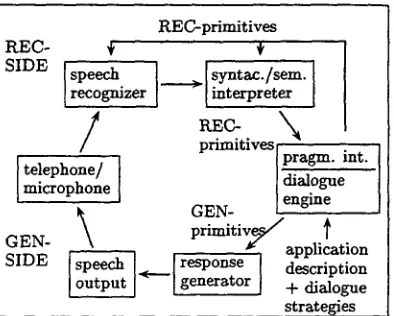
F i g u r e 1: System architecture of our SDS. The arcs indicate information flow.
they account for different kinds of dialogue, e.g., question-answer or mixed initiative.
2 B a c k g r o u n d
First, we discuss our system architecture and data flow between modules. Second, we present the ap- plication description of a movie service, which we will use for the examples in later sections. Third, we present some of our current primitives, and fi- naUy, we describe the dialogue engine and how it uses the application description and other sources to calculate dialogue primitives.
2.1 S y s t e m A r c h i t e c t u r e
[image:1.596.326.523.177.335.2]to generate system or user directed dialogue. The output of our dialogue manager is a bag of abstract, language independent primitives. On the generation side they encode the next sys- tem utterance and a response generator trans- lates the GEN-primitives into text, which is then synthesized. On the recognition side, the REC- primitives represent the dialogue manager's pre- dictions about the next user utterance. REC- primitives are translated into (recognition) con- texts and grammars for speech recognition and they may activate sub-components of a synsem grammar. After speech recognition has taken place, the dialogue engine must be told which pre- dictions came true, thus the pragmatic interpreter maps the output of synsem interpreter onto a sub- bag of REC-primitives, which is then returned to the dialogue engine for further processing (Sec- tion 2.4).
2.2 A p p l i c a t i o n D e s c r i p t i o n
The application description (AD) specifies the tasks that a service can solve and the parame- ter values needed to solve them. The AD for a movie service is presented in Figure 2. Our repre- sentation is an extended version of and-or trees 1 and in Figure 2, the U-shaped symbols represent
and-relations,
while the V-shaped symbols repre- sent or-relations. Thus, this movie service can perform three tasks: selling ticketsor
providing movieor
theatre information. If the user wants to buy tickets, the system needs to acquire six pa- rarneter values,e.g.,
the show time, the date,and
the name of the film. Date and show time can be acquired in several ways. For example, a date can be a simple date(e.g.,
"November 17th ~) or a combination of day of the weekand
week(e.g.,
"Wednesday this week.").The nodes keep state information.
Open
nodes have not yet been negotiated,topic
nodes are be- ing negotiated, andclosed
nodes have been negoti- ated. The currently active task has statusactive.
Parameters can be retrieved through the func- tionsactiveTask(AD), openParams(AD), closed-
Params(AD), and topicParams(AD). Status(p)
returns the status of parameter p.tasks(AD) and
params(AD)
return the task and parameter nodes. Similar hierarchical domain descriptions have been suggested in (Young et al., 1990) for a naval domain and in (Caminero-Gil et al., 1996) for an e-mall assistance domain. A tree-like organiza- tion of the domain is sufficent for the information retrieval domains, which we are currently consid- ering. We expect, however, that in future work we1Extensions include has-a relations.
movie service
movieInfot buyTicketst theatreInfot
Ticketsp
Timep timep dat% k~_~we e wee k p D a y P
F i g u r e 2: A description of a movie service. No- tation: U and v represent
and/or-relations.
Sub- scripts t and p denote tasks and parameters.will need to switch to a semantic network struc- ture or since our future research includes auto- matic generation of system utterances from our dialogue primitives, we hope to be able to uti- lize the ontology and domain organization work, which has proven so useful for text generation (Bateman et al., 1994; Bateman et al., 1995), for both dialogue management and text generation.
2.3 D i a l o g u e P r i m i t i v e s
Following the procedure outlined in Section 2.4, the dialogue manager calculates a bag of primi- tives for each turn and speaker. Our current col- lection is motivated through our experience with several domains,
e.g.,
movie service, horoscope service, and directory assistance. The collection is not exhaustive and we will add primitives as wider dialogue coverage is required.N o t a t i o n : A primitive is written prim- Name(p=v,n), where primName is its name; p E
params(AD)
U {aTask}; aTask is a special param- eter whose values Etasks(AD);
v is the value of p; and n is an integer denoting the number of times a primitive has been uttered. If v is uninstanti- ated, it is left out for readability. Unless otherwise stated, p Eparams(AD).
2.3.1 G E N - P r i m i t i v e s Our current GEN-primitives:
salutation(p=v): system opens or closes the inter- action, p E {hello, goodbye}, v E {morning, day, evening}.
requestValue(p): system requests a value for the paramter p. p E
params(AD)
U {aTask}.requestValue(p=v): system asks whether the value v of parameter p is correct. If this form is used, the system has a list of alternative values for p, and
v is n o t a recognition result (e.g., Frankfurt am M a i n o r F r a n k f u r t a n der Oder where Frankfurt is t h e recognition result.)
requestValue(aTask=v), v E tasks(AD) U {repeat- PreServiceTask, useService, repeatService}: system requests a value for aTask. If v E {repeatPre- ServiceTask, useService, repeatService}, the system requests whether t h e user wants t h e pre-service t a s k r e p e a t e d , t h e service s t a r t e d (first t a s k after pre-service task), or a new t a s k started.
requestConfirm(p=v): system asks whether the value v of p a r a m e t e r p is correct, v is a recog- nition result, p E params(AD) U {aTask}. A m - bignous results n o t resulting from speech recog- nition, e.g., Frankfurt am Main vs. ~zauldurt an der Oder, would yield multiple requestValue(p=v) primitives.
requestValueABC(p): s y s t e m requests the spelling of t h e value of p a r a m e t e r p.
requestParam(p=v): system asks whether the
value v is a value for p a r a m e t e r p.
evaluate(p=v) : s y s t e m acknowledges value v of p a r a m e t e r p.
promise(p=v): s y s t e m promises to a t t e m p t to answer t h e user's request, p E params(AD) U {aTask}. v E {pleaseWait}. Only used after nav- igate(), requestParam 0 or requestAIternative 0 if t h e user has to wait long for a reply.
inform(aTask=v): s y s t e m informs a b o u t the ac- quired d a t a b a s e results, v E aetiveTask(AD) U {tooMany, zero}. If v = activeTask(AD), there are several answers, if v = t o o M a n y / z e r o , there are e i t h e r too m a n y answers to be e n u m e r a t e d or
zero answers.
inform(aTask=n): s y s t e m presents t h e n'th answer t o t h e query t. n > 0
inforrnAIternative(p): system informs t h a t t h e r e are several possible values for p. p E params(AD) U {aTask}. v E {tooMany, null}. If v = tooMany, t h e r e are t o o m a n y alternatives to b e enumerated. v = null, means t h a t v is uninstantiated, not t h a t t h e r e a r e zero alternatives.
inforrnAIternative(p=v): system informs t h a t a possible value of p is v. p E params(AD) U {aTask}.
informNegative(p): system infolds that the user
misrecognized something, p E params(AD) U
{aTask}.
informPositive(p): s y s t e m informs t h a t the user recognized something correctly, p E params(AD) U {aTask}.
withdraw(p): s y s t e m withdraws from dialogue for reason p E {error} before it has s t a r t e d negotia- tions.
withdrawOffer(aTask=v): system withdraws an of- fer for reason v E {error}.
withdrawPrornise(aTask=v): s y s t e m withdraws a promise for reason v E {error}.
In Section 3, we present several s a m p l e instan- tiations of t h e primitives.
2.3.2 R E C - P r i m i t i v e s
Our current REC-primitives:
requestParam(p): user requests which p a r a m e t e r t h e system requested, p E params(AD) U {null}.
requestAIternatives(p): user requests possible val- ues for p a r a m e t e r p.
requestConffirm(aTask=n): user asks system t o confirm an answer t h a t it has given, e.g., "Was t h e first answer $30?" 0 < n < no of query results.
informValue(p=v): user provides value v for p a - r a m e t e r p. p was requested. 2
informExtraValue(p=v): user provides value v for p a r a m e t e r p. p was not requested in the preceeding system utterance.
informValueABC(p=v): user spells the value v of p a r a m e t e r p. T h e spelling is e x p a n d e d by synsem a n d expansions are presented t o t h e dialogue m a n - ager. 2
inforrnPositive(p=v): user confirms t h a t the value of p a r a m e t e r p is v. p E params(AD) U {aTask}.
informNegative(p=v): user disconfirms t h a t t h e value of p a r a m e t e r p is v. p E params(AD) U {aTask}.
correctValue(p=v): user corrects a misrecognized value. Often used together with informNegative. For example, "Hamburg, not Homburg. "2
informGarbage(p): user says s o m e t h i n g b u t recog- nizer a n d / o r synsem could n o t m a k e sense out of it.
changeValue(p=v): user changes t h e value of p a - r a m e t e r p to v i n s t e a d of v'. 2
repeatValue(p=v): user r e p e a t s t h e value v of p a - r a m e t e r p.2
correctPararn(p=v): user corrects t h a t v is t h e value of p, not p'.
disambiguate(p=v): user chooses v as the value of p when presented with a choice between several values for p. p E params(AD) U {aTask}.
rejectValue(p=v): the user has been given a se- ries of alternatives and chooses p=:v'. Primitive is combined with disambiguate(p=v').
navigate(aTask=v): user navigates in the query re- sults, v E {forward, backward, repeat, n} where 0 n < no of query results. 2
rejectRequest(p=v): user ignores or does not hear the system request, v E {null, didNotHear}.
rejectOffer(aTask=v): user ignores or does not hear the system offer, v E
tasks(AD)
U {null, did- NotHear}.evaluate(t=v): user evaluates an answer she has received, v E {positive, neutral, negative, cancel}. cancel is used to end the current dialogue after at least one answer has been given ~md start a new one without calling again.
promise(p): user promises to find a value for p.
withdrawAccept(aTask=v): user ,mthdraws from the conversation for reason v E {cancel, hangup}. With cancel, the user ends the current dialogue before an answer has been given and starts a new task Without calling again. 2
withdrawPromise(p=v): user withd.raws a promise to provide a value for reason v E {cancel, hangup}. 2
withdrawRequest(p=v): user withdraws a request.
p E
params(AD)
U {forward, backward, repeat, and n}. 2null(): returned to the dialogue manager if the ,user does not say anything and is
not ezpected
tosay anything,
e.g.,
after a greeting or promise.In Section 3, we present several sample instan- tiations of the primitives.
2.4 D i a l o g u e E n g i n e
The dialogue engine (Hagen, 1999) consists of a reasoning engine and several knowledge sources: An AD defines an application's data-needs, a di- alogue g r a m m a r defines how a dialogue m a y pro- ceed at the level of speech acts, and a dialogue history is a dynamically growing parse tree of an on-going dialogue with respect t o the dialogue grammar. Other knowledge sources m a y be re- quired, for instance, recognition confidence or dis- ambiguation of city names.
T h e dialogue engine calculates the next t u r n by consulting and combining information from the knowledge sources. It consults with the dialogue history and t h e dialogue g r a m m a r in order t o cal- culate which speech acts m a y continue a dialogue. Speech acts have no propositional content, thus in the context of the current dialogue history and
the state of the application description, they are translated into dialogue primitives, which have content, for example, the name of a parameter and a potential value for this parameter. Here we will walk t h r o u g h an example of how some prim- itives are calculated in a simple question-answer dialogue.
E x a m p l e : For our example we will use the A D in Figure 2. Assume t h a t the task has already been negotiated and set to theatre information
(i.e., activeTask(AD)
= theatrelnfo),i.e.,
the sys- t e m needs to acquire the name of the theatre and the name of the city. All other nodes in the ADare closed since t h e y are not relevant to this task.
The s p e e c h a c t g r a m m a r used in our system is presented in Appendix A b u t we will use a trivial g r a m m a r for the example. It can account for simple question-answer dialogues where a request from t h e system (sys) is followed by an inform from t h e user (usr). T h e system can respond to the inform with a sub-dialogue: sDialogue(sys)--~(request(sys) + Inform(usr))* Inform(usr)--+inform(usr) + [Dialogue(sys)]
T h e d i a l o g u e h i s t o r y reflects all previous ne- gotiations (here: task theatreinfo).
Dialogue(sys)
request(sys) .. Inform(usr) requestValue(task)
intprm.(usr) . . , informValue(task=theatrelnto)
The next t u r n can be rooted in either the Inform(usr) after the inform(usr) or in the Dia- Iogue(sys) after Inform(usr).
With all the above knowledge sources in place, the calculation of the next dialogue turn can start: 1. The last speech act in the dialogue history gives us a starting point in the grammar, thus moving forward from inform(usr), the next atomic speech act is request(sys)--either as a flat struc- ture
(i.e.,
request(sys) off Dialogue(sys)) or in a sub-dialogue(i.e.,
Dialogue(sys)-I-request(sys) off Inform(usr)).2. Knowing t h a t the system can request some- thing, the dialogue engine consults with the AD for
what
the system can ask about. T h e flat strucutre (request(us)) represents negotiation of the task but since we assume t h a t negotiation of the task is complete (i.e., Status(theatrelnfo) = ac- tive), this speech act is not interpreted into a prim-SThe star (') means that a dialogue may contain several request(sys) -I- Inform(usr) sequences. Lower- case speech acts are atomic, while others are complex. The dialogue in square brackets ([]) is optional.
itive. Next we consider the sub-diaJogue struc- ture. Both children of theatrelnfo are
open (i.e.,
they have not been negotiatied yet) thus the sys- tem randomly chooses to pursue city whose state is changed totopic.
The speech act and the pa- rameter are combined into the primitive request- Value(city)--request a value for the parameter city(e.g.,
"In which city is the theatre?"). We chose to use the sub-dialogue structure instead of the flat strucutre to represent negotiation of parame- ter values since they are subordinate to the task in the sense that the task dictates which parame- ter values are needed. This is also the case for the real gammar (Appendix A).3. The primitive requestValue(city) is added to the dialogue history:
Dialogue(sys) J
request(sys) I nform(usr) requestValue(task) j
intorm(usr) Dialogue(sys) inform Value(task=theatrelnfo)
request(sys) . requestValue(city)
4. Starting from request(sys), the grammar states that inform(usr)
(i.e.,
Inform(usr) + in- form(usr)) is the next speech act in the dialogue. requestValue(city) was the last primitive spoken. Reasoning that a user-inform in response to a sys- tem requestValue should involve the same parame- ter as the system's requestValue, the information is combined to form the primitive informValue(city),i.e.,
the user should respond to the system request with a value for the parameter city. Let's assume that the user replied "Hong Kong", thus the dia- logue history is expanded:Dialogue(sys)
request (sys) ., Inform(usr) req uestVa lue (task),...-.
intorm(u.sr). . o .Dialogue(sys) i n f o r m V a l u e ( t a s k = t h e a t r e l n t o ) /
request(sys) . Inform(usr) requestValue(city)
intorm(usr~
informValue(city& Hohg Kong)
5. Starting ~om inform(usr), the grammar re- turns reques't(sys) and Dialogue(sys)-t-request(sys). Since a recogniton result is available from the pre- vious turn, the engine checks its recogution con- fidence. If it is high, it would consider the nego- tiation of city finished, change its state to
closed,
and discard Dialogue(sys)+request(sys) since there is nothing to be requested about a closed param- eter. It would translate request(sys) into request- Value(theatre) since theatre is the only remainingopen
parameter.If confidence is low, the dialogue engine may decide to ask the user to confirm the recognized value. In which case, Dia-
Iogue(sys)+request(sys)
would be interpreted into requestConfirm(city=Hong Kong). Whether re- quest(sys) would be interpreted or not depends on the dialogue strategies chosen by the service designer (see Sections 3 and 4).If confidence is extremely low, the dialogue en- gine may decide to repeat the question. In which case, request(sys) would be interpreted into re- questValue(city, 2), while the sub-dialogue struc- ture would be discarded.
6. Any interpretation of the flat strucutre would result in the following addition to the last Dia- Iogue(sys) in the dialogue history.
I Dialogue(sys)
request(sys) . Inform(usr) recluest(sys) requestValue(city) i
infgrm(u.sr) . • informValue(city= Hong I~.ong)
Our example shows how a speech act can result in several primitives depending on the context and thus how the dialogue manager dynamically reacts to external events. Although this brief description may not show it, our dialogue manager can handle mixed initiative dialogue (Hagen, 1999). In (Ha- gen, 1999), we also present our theory of taking, keeping, and relinquishing the initiative.
Heisterkamp and McGlashan (1996) presented an approach that uses a similar division of func- tionality as we do: task (=application), contex- tual (=synsem + pragmatic), and pragmatic in- terpretation (=dialogue engine). They also use abstract parameterized units similar to ours, but they do not use a speech act grammar to cal- culate the units. Rather, they map contex- tual functions onto dialogue goals,
e.g.,
the func- tionnew_for_system(gaalcity:munich)
introduces the dialogue goalconfirm(goalcity:munich).
In
terms of our primitievs this could be expressed as requestConfirm 0 follows informValue 0. We choose not to start our modelling at this level since we want to be able to vary what follows informValue0,e.g.,
requestConfirmO, requestValueABCO, or eval- uate().3 P r i m i t i v e s i n U s e
G E N - P r i m i t i v e requestValue(film)
requestConfi rm (theatre=Ridge)
R E C - P r i m i t i v e s informValue(filrn) rejectRequest(film)
withd rawAccept (aTask=hangup) withd rawAccept(aTask=cancel) inform Positive(theatre=Ridge) inform Negative(theatre=Ridge) rejectReq uest(theatre=Ridge) withdrawAccept(aTask=ha ngup) withdrawAccept(aTask=cancel)
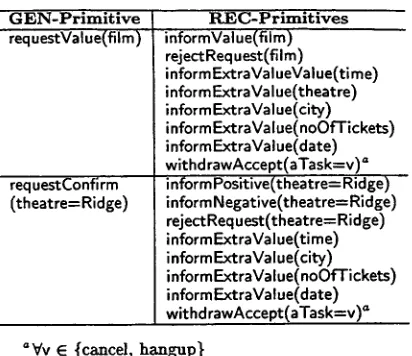
Table 1: REC-primitives calculated in response to two GEN-primitives in Dialogue 1.
e.g., in an information retrieval setting: provid- ing or requesting one piece of infi)rmation. Prim- itives can be used individually or combined to ac- count for more complex dialogue. Whether and how they are combined depends on the dialogue strategies specified by the service designer. In this and the following section, we will examine several such strategies and show how the primitives are combined to achieve them.
3 . 1 Q u e s t i o n - A n s w e r D i a l o g u e
In the simplest case, the service designer wants a strickt question-answer dialogue: 4
D i a l o g u e 1: Question-Answer Sys: "Which film do you want to see?"
req uest:Value(film)
Usr: "The Matrix. At the Ridge."
Int: informValue(film= Matrix)
Sys: "Which theatre?" requestValue(theatre) Usr: "Ridge. R I D G E." Int: "mformValue(theatre=Ridge). ,, Sys: "Did you say The Ridge?
requestConfi rm(theatre= Ridge) Usr: ~Yes. R I D G E."
Int: inform Positive(theatre= Ridge.)
For this type of dialogue, only the REC- primitives representing direct answers, rejects, and withdraws are calculated. In Table 1, we present those calculated in response to the first and the third system turn. We see that, after
requestValue(film),
onlyiinformValue(film)
is calculated and the pragmatic', interpreter has no chance to detect "At the Ridge" (even if synsem parsed it correctly) since there is no in- formExtraValue(theatre) available t o map it onto.Similarly, after requescConfirm(theatre=Ridge)
only informPositive(theatre=Ridge) and in- formNegative(theatre=Ridge) are available and "R I D G E" cannot be detected since there is no informValueABC(city) primitive present.
41n the sample dialogues, 'Sys' m e a n s system turn, 'Usr' m e a n s user turn, and 'Int' m e a n s primitives rec- ognized and sent back to the dialogue engine from the pragmatic interpreter.
G E N - P r i m i t i v e requestValue(film)
requestConfirm (theatre=Ridge)
PdgC-Primitives inforrnValue(film) rejectReq uest(film)
inform ExtraValueValue(time) informExtraValue(theatre) inforrn Ext raVal ue(city) inform ExtraValue(noOfTickets) inforrnExtraValue(date) withd rawAccept(aTask=v) = inform Positive(theatre= Ridge) inform Negative(theatre=Ridge) rejectReq uest(theatre=Ridge) inform Ext raVal ue(ti m e) inform ExtraValue(city) informExtraValue(noOfTickets) inform ExtraValue(date) withdrawAccept(aTask=v) a
=Vv E {cancel, hangup}
T a b l e 2: REC-primitives calculated in response to two GEN-primitives in Dialogue 2.
3.2 O v e r - A n s w e r i n g
In our experience, users frequently provide more information t h a n explicitly asked for, thus a more flexible dialogue strategy would be to allow over- answering and Dialogue 1 could have developed as follows:
D i a l o g u e 2: Over-Answering
Sys: "Which film do you want to see?" requestValue(film)
Usr: =Matrix. At the Ridge. R I D G E."
Int: informValue(film= Matrix)
+ informExtraValue(theatre=The Ridge) Sys: "Did you say The Ridge?"
req uestConfi rrn (theatre= Ridge) Usr: "Yes, and I want the late show."
Int: informPositive(theatre=Ridge) + informExtraValue(time=9P M)
In Table 2, we present the REC-primitives cal- culated in response to the same system turns as in Dialogue 1. In Dialogue 2, only over-answering of requestValue 0 primitives were allowed, thus "R I D G E" could still not be accounted for.
3 . 3 C o m p l e x M i x e d I n i t i a t i v e
Here we consider the most complex dialogue strat- egy t h a t we can currently offer: T h e system is able to account for complex mixed initiative dialogue (at least from a dialogue point of view), i.e., the user can requst clarifications, over-answer, change values, repeat values, correct values, spell values, and reject requests as she pleases.
D i a l o g u e 3: Complex Mixed Initiative
Sys: "Which ~Irn do you want to see?" requestValue(film)
Usr: =Sorry, did you ask for the time?"
Int: requestParam(time)
Sys: =No. Which film do you want to see?" informNegative(time) + requestValue(film, 2)
[image:6.596.335.541.44.222.2] [image:6.596.114.326.45.142.2]D i a l o g u e 3 c o n t ' d .
Usr: "Matrix. At the Ridge." Int: informValue(film= M atrix)
+ informExtraValue(theatre=The Ridge) Sys: "Did you say The Ridge?"
requestConfirm (theatre=Ridge, 1) Usr: "Sorry, I didn't hear that." Int: rejectReq uest(theatre=didNotHear) Sys: "Did you say The Ridge?"
requestConfirm(theatre= Ridge, 2) Usr: "Yes, The Ridge. R I D G E." Int: inform Positive(theatre= Ridge)
+ repeatValue(theatre= Ridge) + informValueABC(theatre=Ridge) Sys: "Ok. What time?"
evaluate(theatre=Ridge) + requestValue(time)
Usr: "I don't know. What are the alternatives?" Int: req uestAIternatives(time)
Sys: "18:30 or 21:00."
informAlternative(time=18:30) + informAIternative(time=21:00)
Usr: "Ok, two tickets for the late show tomorrow." Int: evaluate(time=neutral)
-l.- inform ExtraValue(noOfTickets=2) + informValue(time=21:00) + informExtraValue(date=July 4) Sys: "Did you say two tickets?"
req uestConfirm(noOfTickets=2) • Usr: "Yes, but I change to the early show."
Int: inform Positive(noOfTickets=2) + changeValue(time=18:30)
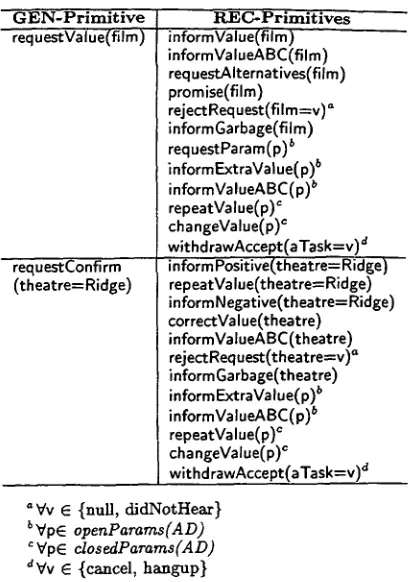
In Table 3, we present the REC-primitives cal- culated in response to two system utterances.
3.4 M u l t i - F u n c t i o n a l T u r n s
It has been argued t h a t speech act grammars can- not be used to describe dialogue since utterances can be multi-functional or encode more than one speech act; Speech act grammars can typically be in only one state at a time, thus they cannot cap- ture this phenomenon (Levinson, 1981). In an information retrieval setting such situations oc- cur, for example, when users disregard the system utterance and provide unrelated information or when a recogniton mistake occured and the sytem asks for confirmation. Instead of answering yes or no, users frequently answer with the correct value, which implicitly disconfirms the previous value: D i a l o g u e 4: Multi-Functional Utterances
Sys: "How many tickets?" req uestVal ue(noOfTickets) Usr: "I want tickets for July 4." I.ut: reject Request (noOf'l'ickets)
+ informExtraValue(date-~July 3) Sys: "Did you say July 3?"
requestConfirm (date=July 3) Usr: "Tomorrow!"
Int: informNegative(date=July 3) -t- correctValue(date=July 4)
In the first utterance, the user both ignores the system utterance and provides some information. In the second one, she negated and correctd the system suggestion with a single word.
G E N - P r i m i t i v e requestValue(film)
requestConfirm (theatre=Ridge)
R E C - P r i m i t i v e s informValue(film) informValueABC(film) requestAIternatives(film) promise(film)
rejectRequest(film=v) = informGarbage(film) requestParam(p) b informExtraValue(p) b informValueABC(p) b repeatValue(p) ~ changeValue(p) c
withdrawAccept(aTask=v) d inform Positive(theatre---- Ridge) repeatValue(theatre=Ridge) informNegative(theatre----Ridge) correctValue(theatre)
informValueABC (theatre) rejectRequest(theatre=v) a inform Garbage(theatre) informExtraValue(p) b informValueABC(p) b repeatValue(p) ¢ changeValue(p) c
withd rawAccept(aTask=v) 'd
=Vv E {null, didNotHear}
~VpE
openParams(AD)
VpE
closedParams(AD)
~Vv E {cancel, hangup}T a b l e 3: REC-primitives calculated in response to two GEN-primitives in Dialogue 3.
Since we are not using the speech act g r a m m a r directly and instead interpret the speech acts into a bag of primitives, we can assign as m a n y prim- itives to an utterance as necessary and are not bound by the states dictated by a grammar. This aspect of our approach becomes even more inter- esting when the system combines several primi- tives in its utterance (Section 4).
4 D i a l o g u e S t r a t e g i e s
[image:7.596.323.527.39.330.2]4.1 C o n f i r m a t i o n S t r a t e g i e s
We illustrate implicit and multiple confirmation,
i.e., the system realizes requestValue and request-
Confirm or multiple requestConfirm primitives in one utterance:
D i a l o g u e 5: Confirmation Strategies
Sys: "Which showing of The Mal;rix do you want?" requestValue(time)
-I- requestConfi rm (film= Matrix) Usr: "(No.) Buena Vista!"
Int: informNegative(film=The Mzttrix) + correct:Value(film=Buena Vista) + reject:Request(time)
Sys: "Which showing of Buena Vista do you want?" requestConfirm(film=Buena 'Vista)
+ requestValue(time) Usr: =The late show. Tomorrow. :~ Int: inforrnPositive(film=Buena Vista)
informValue(time=21:00)
+ infformExtraValue(date=8 October) Sys: "Did you say 21:00 today?"
requestConflrm (time=21:00) = requestConfirm(date=October 7) Usr: "No. Tomorrow."
Int: inform Positive(time=21:00) -I- informNegative(date= October 7) + correctValue(date=October 8)
For the first two utterances, the system has a recognition result for the parameter film with a low recognition score. Consequently, it calculates requestConfirm(film=Matrix/Buena Vista). Addi- tionally, there are still open parameter nodes in the AD, thus the dialogue engine picks one (ei- ther at random or if the service designer has ordered them, the next one) and calculates a requestValue primitive, here requestValue(time). If the service designer allows implicit confirma- tion, the two primitives are combined and ut- tered together in one turn. If the service de. signer does not allow implicit confirmation, the dialogue engine continues the dialogue with the topic that has alread been introduced, i.e., re. questConfirm (film= Matrix/Buena Vista). 5
For its last utterance, the system has two recog- nition results with a low recognition score, thus for each one of them it calculates a requestConfirm primitive. If the service designer, allows multiple confirmations, they are combined and realized as one utterance. If not, the dialogue engine chooses requestConfirm(time=21:00), since this topic was introduces first. If topics are introduced in the same utterance, it pickes one at random.
4.2 A D B a s e d Strategies
When requesting parameter values from the user, the system consults the application description for
SThis is a conceptual account. In the implemen- tation, the requestValue primitive would not be cal- cualted at all, if the service designer does not allow implicit confirmation.
open nodes. If there are several open nodes, the
dialogue manager can decide to keep the initiative and produce several primitives, which can be com- bined into one turn. If the nodes are joined with an or-relation, the text generator would trans- late the primitives into an utterance offering al- ternative ways of entering the same information. For example, "Please tell me the show time or early or late show." (requestValue(time) + re- questValue(namedTime)). If the nodes are joined with an and- or a has-a relation, the text gen- erator would translate the primitives into an ut- terances requesting several different pieces of in- f o r m a t i o n . For example, "What is the name of the city and the theatre?" (requestValue(city) + requestValue(theatre)).
As seen in the application descriptions there may be several ways of acquiring a particular value
e.g., date and time in Figure 2. If a parameter
value is recognized with a low score, the service designer can decide whether the system shall con- tinue processing the original parameter or whether it shall switch to one of the alternative ones. Thus after a bad recognition of date, the system can switch strategy and request weekDay and week in- stead.
Which strategies to follow is decided by the ser- vice designer through a set of switches in the dia- logue strategies specification file (Figure 1).
5 P r a g m a t i c I n t e r p r e t e r
After synsem interpretation, the user utterance must be mapped onto dialogue primitives. A bag of REC-primitives is calculated for each user ut- terance and the pragmatic interpreter must assure that the utterance is mapped onto primitives in this bag. There is always a mapping. The reject and withdraw primitives are always part of the bag thus in the worst case, the user utterance would be mapped onto one of these.
Since primitives in their uninstantiated form are application independent, we can develop generic rules for this mapping. In other words, the rules define how the dialogue strategies presented in Section 3 are mapped onto primitives and how we account for several primitives per utterance.
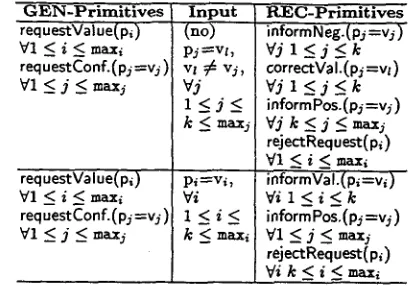
A rule has the form: GEN-Primitives A user ut- terance =~- REC-primitives. In Table 4, we present two rules for implicit confirmation. The first one corresponds to the first sys/usr pair in Dialogue 5. The user responds with a new value vs (Buena Vista) for P2 (film) in requestConfirm(p2=v2) and thereby disconfirms v2 (Matrix) and re- jects the request for a value for Pl (time) in requestValue(pl). The second rule corresponds to
G E N - P r i m i t i v e s
requestValue(p~)
V1 < i _< maxi req uestConf.(pj =vj ) Vl < j < max#requestValue(pi)
V1 < i < maxi requestConf.(p# =vj)V1 _< j < max#
I n p u t
(no)
p j ~ v t ~
vz ~ vj, Vj l < j _ < k ~ ma.xj
Vi l_<i_< k _< =axi
l ~ E C - P r i m i t i v e s
informNeg.(pj =v./)
Y j l < j < kcorrectVal.(pj =vl)
Y j l < j < kinformPos.
(pj =v# ) W k < j < max j rejectRequest(pi) V1 < i _< maxlinformVal.(pi=vi) V i l < i < k
informPos.(pj =vj)
Vl _< j < maxj rejectRequest(pi) Vi k < i < maxi
T a b l e 4: Mapping of user primitives, p = v means t h a t value v for param p.
input onto REC- the user provided
the second sys/usr pair in Dialogue 5. The user provides value vx (the late show) for Pl (time) in requestValue(pl) and thus confirms v2 (Buena Vista) in requestConfirm(p2=v2). For instanti- afion of the primitives, see Dialogue 5. Here, we only presented two examples. Similar rules were developed for all our primitives and dialogue strategies (see (Hagen, 2001)).
One reviewer asked whether we can modify the approach such that expectations can be overrid-
den if there is sufficently good information from
the synsem module. The short answer is that we
could (re-)calcnlate the primitives pretending that
the service designer allowed mixed initiative re-
gardless of the dialogue strategies actually chosen.
W~, however, think it is important to give her the right to decide. For example, if she has decided that over-answering is allowed, informExtraValue0 primitives for all parameters whose status is still open would be calculated and thus there is noth- ing to override. If, however, the service designer has decided that over-answering is not allowed, we assume that she had good reasons for doing that and the dialogue manager will not try to overrule this decision.
6 Conclusion
We have presented some results from our research on spoken dialogue management. We concen- trated on how to dynamically calculate a collec- tion of predictions for how to continue a dialogue (dialogue primitives), how to account for differ- ent dialogue strategies and utterances with sev- eral communicative goals through combinations of primitives, and how to m a p the user utterances onto primitives. The approach has been imple- mented and tested in several prototype systems,
e.g., horoscope, movie, and telephone rate service (Feldes et al., 1998).
Dialogue grammars have previously been used to manage dialogue (Bunt, 1989; Bilange, 1991; Traum and Hinkelman, 1992; JSnsson, 1993; Mast et al., 1994; Novick and Sutton, 1994; Chino and Tsuboi, 1996), but we are not aware of an ap- proach where speech acts are translated into a collection of primitives with propositional content. Previous grammar approaches use the speech acts directly or assume a one-to-one correspondence between utterance and speech act.
Through the natural division of the knowledge into type and content, we have achieved a flex- ible dialogue manager that adapts to users' be- haviour. We can take advantage of the predictive capabilites of speech act grammars and still be able to account for multi-functional utterances.
We have also demonstrated that our approach is flexible: 1. the dialogue engine, the pragmatic interpreter, the primitives and the algorithm for mapping user utterances onto predictions are ap- plication and language independent, which makes it easy to reuse our dialogue manager in new ap- plications, and 2. the dialogue manager can easily account for several types of dialogue, e.g., strict question-answer or mixed initiative. We give the service designer the freedom to decide which kind of dialogue she wants---on a high level--and the dialogue manager combines the basic primitives accordingly.
Future work includes empirical testing to ver- ify whether we are calculating appropriate predic- tions. Also, several aspects of our dialogue gram- mar have not yet been translated into primitives, for example, the frequent use of assert in natu- ral dialogue. As a wider dialogue coverage is re- quired, we will add primitives accordingly. We are also working on using the primities as input to a multi-lingual automatic text generation system.
Acknowledgements
The author thanks the three anonymous reviewers for their helpful comments on the first draft of this paper. Financial support from the Norwegian Research Council, project number 116578/410 is greatly appreciated.
References
[image:9.596.96.300.43.186.2]J.A. Bateman, B. Maguini, and G. Fabris. 1995. The generalized upper model knowledge base: Organization and use.
In Proc. of the
Conf. on Knowledge Representation and Shar-
ing,
Twente, The Netherlands.E- Bilange. 1991. A task independent oral dia- logue model. In
Proc. of the Euro. Conf. of the
ACL,
pages 83-87.H.C. Bunt. 1989. Information dialogues as com- municative action in relation to. partner model- ing and information processing. In M.M. Tay- lor, F. Neel, and D.G. BouwhLfis, editors, The
Structure of Multimodal Dialogue,
pages 47-73. North-Holland, Amsterdam.J. Caminero-Gil, J. Alvarez-Cercadillo, C. Crespo- Casas, and D. Tapias-Merino. 1996. Data- driven discourse modeling for semantic in- terpretation.
In Proe. of 1996 Intl. Conf.
on Acoustics, Speech, and Signal Processing
(ICASSP'96),
pages 401-404.T. Chino and H. Tsuboi. 1996. A new discourse model for spontaneous spoken dialogue. In 1021-1024, editor,
Proc. of the 1996 Intl. Conf.
on Spoken Language Processing {ICSLP'96).
S. Feldes, G. Fries, E. Hagen, and A. Wirth. 1998. A novel service creation enviromnent for speech enabled database access. In
Proc. ~th IEEE
Workshop on Interactive Voice Technology for
Telecommunications Applications (IVTTA '98),
29-30 Sept. 1998, Torino, Italy.E. Hagen. 1999. An approach to mixed ini- : tiative spoken information retrieval dialogue.
User Modeling and User-Adapted Interaction,
9(1/2):167-213.E. Hagen. 2001.
Mixed Initiative Spoken Dialogue
Management in Information Systems.
Ph.D. thesis, School of Computing Science, Simon Fraser University, Burnaby, BC, Canada. Jan. 2001 expected.P. Heisterkamp and S. McGlashan. 1996. Units of dialogue management. In
Proc.
of the 1996
Intl. Conf. on Spoken Language Processing (IC-
SLP'96).
A. JSnsson. 1993. A dialogue manager using initiative-response units and distributed con- trol. In
Proc. of 6th Euro. Conf. of the A CL,
pages 233-238.S.C. Levinson. 1981. Some pre-observations on the modelling of dialogue.
Discourse Processes,
4:93-116.M. Mast, F. Kummert, U. Ehrlich, G.A. Fink, T. Kuhn, H. Niemann, and G. Sagerer. 1994. Prosody takes over: Towards a prosodically
guided dialog system.
Speech Communication,
15(1-2):155-167.D.G. Novick and S. Sutton. 1994. An empirical model of acknowledgement for spoken-language systems. In
Proc. of the 32nd Annual Meeting
of the ACL,
pages 96-101.S. Sitter and A. Stein. 1992. Modelling the il- locutionary aspects of information-seeking di-
alogues. Information Processing and Manage-
ment,
8(2):165-180.D. 'I~aum and E. Hinkelman. 1992. Conversation acts in task-oriented spoken dialogue.
Compu-
tational Intelligence,
8(3):575-599.S. Young, A. Hauptmann, W. Ward, E. Smith, and P. Werner. 1990. High-level knowledge sources in usable speech recognition systems. In A. Walbel and K. Lee, editors,
Readings
in Speech Recognition,
pages 538-549. Morgan Kaufman, San Mateo, CA.A . T h e C o m p l e t e D i a l o g u e G r a m m a r The complete grammar is a slightly modified version of the grammar presented in (Sitter and Stein, 1992). N o t a t i o n : Complex dialogue moves begin with an upper case
(e.g.,
Request); atom/c dialogue acts are all lower case(e.g., re-
quest). S and K mean seeker and knower. Square brackets ([]) mean optional. X + means one or more instances of X. All moves except Inform and Assert are representated by the abstraction Move. Subscript i means that move and act must be of the same type,e.g.,
Request and request.Dialogue(S) --+ (Cycle(S)) +
Cycle(S) -). Request(S), Promise(K), Inform(K),
Evaluate(S).
Cycle(S) ~ Request(S), [Promise(K)], WithdrawRequest(S). Cycle(S) ~ Request(S), Promise(K),
WithdrawPromise(K).
Cycle(S) ~ Request(S), RejectRequest(K).
Cycle(S) ~ Offer(K), Accept(S), Inform(K), Evaluate(S), Cycle(S) ~ Offer(K), [Accept(S)], WithdrawOffer(K). Cycle(S) ---y Offer(K), Accept(S), WithdrawAccept(S). Cycle(S) -+ Offer(K), RejectOffer(S).
Cycle(S)
-+ Withdraw(usr). Cycle(S) ~ Withdraw(system).inform(K) .-.). inform(K), [Dialogue(S)].
Assert(S/K) ,-.), assert(S/K), [Dialogue(K/S)].
Movei(S/K).
Movei(S/K) ~ act~(S/K), [Dialogue(K/S)].
Movei(S/K) ~ acti(S/K), [Assert(S/K)].
Mov~ (S/K) -+ Dialogue(K/S).
Moves(S/K) ~ Assert(S/K), [acti(S/K)].
Move~(S/K) --~. Assert(S/K), [Dialogue(K/S)].