PyrEval: An Automated Method for Summary Content Analysis
Yanjun Gao, Andrew Warner and Rebecca J. Passonneau
The Pennsylvania State UniversityPennsylvania, USA
[email protected], [email protected], [email protected]
Abstract
The pyramid method is a content analysis approach in automatic summarization evaluation for manual construction of a content model from reference summaries, and manual scoring of unseen summaries with the pyramid model. PyrEval automates the manual pyramid method. PyrEval uses low-dimension distributional semantics to represent phrase meanings, and a new algorithm, EDUA (Emergent Discovery of Units of Attraction), to solve a set cover problem to construct the content model from vectorized phrases. Because the vectors are pretrained, and EDUA is an efficient greedy algorithm, PyrEval can apply pyramid content evaluation with no retraining, and in excellent time. Moreover, PyrEval has been tested on many datasets derived from humans and machine generated summaries, and shown good performance on both.
Keywords:Content Evaluation, Summarization, Summarization Evaluation Tool
1.
Introduction
Automatic summarization methods that produce a para-graph to express the main ideas of one or more texts have shifted in recent years. The long-standing prevalence of extractive summarizers, which select complete sentences from source documents, has begun to give way to abstrac-tive summarizers, which rewrite or generate sentences to eliminate less important content (Bing et al., 2015; Rush et al., 2015; Liu et al., 2015; Durrett et al., 2016; Nema et al., 2017). Automatic content evaluation of summarization systems has not seen the same progress. ROUGE has long been the dominant method for evaluating summary con-tent, and is used in most of the papers cited above. Here we present PyrEval, which applies pyramid content anal-ysis (Nenkova and Passonneau, 2004), a method intended for evaluation of abstractive summarization. The main in-novation in PyrEval is a novel formulation of the pyramid construction problem, and a greedy algorithm whose ap-proximate solution is both efficient and effective.
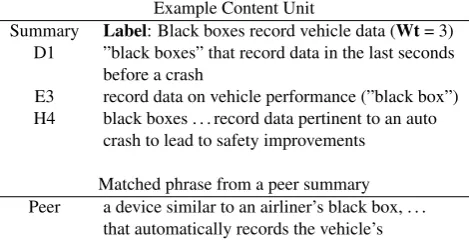
The pyramid method, introduced in (Nenkova and Passon-neau, 2004), groups the distinct ideas (content units) men-tioned in reference summaries to create a pyramid model of content, and differentiates the content units by impor-tance as well as meaning. It then evaluates target sum-maries against the pyramid content model. Early work ap-plied manual annotation of the pyramid method for largely extractive automated summarizers at a series of Document Understanding Conferences (DUC) and Text Analysis Con-ferences (TAC) administered by the National Institute of Standards (NIST) from 2006 through 2011 (Passonneau et al., 2006; Varma et al., 2009; Ji et al., 2010). Figure 1 shows a content unit from one of the pyramids created for the NIST pyramid evaluation at DUC 2006, along with a sentence in a summary from a peer (automated summarizer) that was matched to the content unit (CU). The illustrated content unit, labeled by the annotator, lists a phrase from each of three reference summaries (D, E, H) that express the labeled meaning. The importance weight of the CU is the number of contributing reference summaries.
Automated pyramid methods such as PyrScore
(Passon-Example Content Unit
Summary Label: Black boxes record vehicle data (Wt= 3) D1 ”black boxes” that record data in the last seconds
before a crash
E3 record data on vehicle performance (”black box”) H4 black boxes . . . record data pertinent to an auto
crash to lead to safety improvements
Matched phrase from a peer summary Peer a device similar to an airliner’s black box, . . .
that automatically records the vehicle’s
Figure 1: A content unit (CU) of weight 3 from a NIST manual pyramid for topic D0608, and a phrase from an ex-tractive summary (peer) that was matched to the CU.
neau et al., 2013) or PEAK (Yang et al., 2016) have been used in recent work on abstractive summarization, as in (Bing et al., 2015) (PyrScore) and (Peyrard and Eckle-Kohler, 2017) (PEAK), but have disadvantages that PyrEval addresses. PyrScore requires manual construction of a pyramid content model, and PEAK depends on exter-nal resources that are computatioexter-nally inefficient for large-scale use. This paper introduces the PyrEval software and gives an overview of how PyrEval builds on the earlier PyrScore.1 Details of each component will be presented in other publications. Tests of PyrEval performance on five years of manual pyramid evaluations conducted by NIST show that average performance on all topics for a given year correlates well with manual pyramid.
2.
Related Work
The most widely used content evaluation tool for machine-generated summaries is ROUGE (Lin, 2004), which takes model summaries as references and scores target sum-maries by matching substrings. It correlates well with hu-man scores in ranking perforhu-mance of systems on multiple summarization tasks. But it is not reliable for evaluating a
1Availablefordownloadfromhttps://github.
single summary (Louis and Nenkova, 2009). In addition, it does not provide informative feedback on the ideas con-tained in a summary, or the important ideas that have not been mentioned. In contrast, pyramid content scores are reliable for individual summaries, the scores can be inter-preted as indicating whether a summary contains mainly important ideas, and whether it contains enough of the im-portant ideas. Finally, the scores can be justified with re-spect to specific ideas that are included or missing. Interest in the pyramid method has been revived by devel-opment of PEAK (Yang et al., 2016), a fully automated ver-sion that performs well on student summaries. (Peyrard and Eckle-Kohler, 2017) incorporate PEAK scores into an optimization objective for generating summaries.
PEAK is one of two recent automated systems that im-plement pyramid evaluation (Yang et al., 2016). It con-structs a pyramid from reference summaries, and scores target summaries against its automated pyramid. It ex-tracts subject-predicate-object triples from reference sum-mary sentences using ClauseIE (Del Corro and Gemulla, 2013), then assembles a hypergraph where each triple is a hyperedge containing three nodes: subject, predicate
andobject. The semantic similarity of all pairs of nodes in distinct hyperedges is measured using Align, Disambiguate and Walk (ADW) (Pilehvar et al., 2013), which relies on WordNet (Miller, 1995). Triples from distinct summaries with high similarity are combined into content units. To assess a new summary, its triples are extracted, and the Munkres-Kuhn algorithm (Kuhn, 1955) is applied to a bi-partite graph from content unit (CU) nodes uto nodes v
that represent target summary triples.
PyrScore (Passonneau et al., 2013) uses manual pyramids to score target summaries, with Weighted Textual Ma-trix Factorization (WTMF) for latent semantic representa-tion (Guo and Diab, 2012), and ngram segmentarepresenta-tion to find all possible combinations of covering segmentations of in-put sentences. The scoring procedure can be formulated as a graph covering problem, where each sentence is a sub-graph, and each segmentation assigned to a sentence is a vertex of the graph. The goal is to align a candidate sen-tence segmentation with content units from a manual pyra-mid via semantic similarity between each segment and ev-ery contributor in a content unit, under the constraint that a content unit can be allocated to no more than one segment. PyrScore applies WMIN (Sakai et al., 2003), a greedy al-gorithm, to solve this weighted set covering problem. Both PyrScore and PEAK correlate well with manual pyra-mid scores, yet both methods have drawbacks. PyrScore does not construct a pyramid, so is not fully automated. ADW does random walks over WordNet, and ClauseIE generates a large number of low-quality triples; these steps result in high computation time. The PEAK pyramids are less interpretable because they contain many variants of the same CUs. PyrEval applies the same latent semantic meth-ods used in PyrScore, and includes all the functionality of PEAK. It is faster than PEAK, and includes additional func-tions. To construct a pyramid, PyrEval relies on a new al-gorithm we developed (detailed in a separate publication), to produce a pyramid with a single version of each CU. It incorporates an improved version of PyrScore. Here we
re-Figure 2: Venn diagram of summary content overlap
Figure 3: Example of a segment from D1004A automated summary and the matched content unit from D1004A PyrEval pyramid.
port on PyrEval’s performance and present it for public use.
3.
Pyramid Content Evaluation
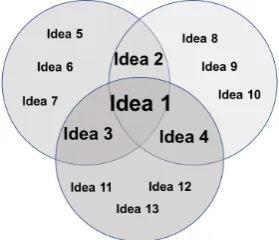
The pyramid method was developed to capture the observa-tion that high quality summaries from different individuals of the same source texts will express overlapping content, but will have even more content that is unique to each sum-mary. This makes it challenging to define the gold standard content. Figure 2 illustrates the typical case by means of a Venn diagram to show that, givennreference summaries, among the set of all distinct ideas from thensummaries, relatively few ideas will occur in all n, and for each de-creasing cardinality fromnto 1, there will be a larger num-ber of such ideas. Here one idea occurs in three summaries, three occur in two, and nine occur in only one. The font size of the schematically represented ideas in the figure re-flects their importance, with the highest importance going to ideas that are expressed in all the reference summaries. Importance represents which ideas should be included in a new summary to adhere to the distribution of ideas found in the reference summaries.Step Description Size Runtime (sec) 1 Preprocessing with Stanford CoreNLP 26 summaries (312 sent; 6K words) 73.40
2 Sentence Decomposing and WTMF same as above 208.68
3 Building Pyramid from Model Summaries 4 (human) summaries 4.35 4 Scoring Target Summaries by Pyramid 22 (machine) summaries 14.17
Table 1: Steps and times for PyrEval on one DUC topic(D0608).
same content. The weight is automatically assigned as the number of phrases. Each summary can contribute no more than once to the same content unit. The instructions require annotators to select, as far as possible, all the text from the reference summaries. The final pyramid consists of all the CUs identified by the annotator, with weights from 1 toN. To annotate a target summary against a pyramid model, the same annotation tool can be used to match phrases in the target summary to CUs in the pyramid. Figure 3 shows an example of scoring a segment from a target summary with the pyramid built by PyrEval. The sum of the weights of the matched CUs from the target summary is normal-ized in different ways to produce a score. Previous work has found this method to produce very stable and reliable scores (Nenkova et al., 2007), and to have very good inter-annotator agreement (Passonneau, 2010). Despite the la-bor intensiveness of manual annotation, pyramid has been applied in much work on summarization. We developed PyrEval to facilitate more widespread usage.
4.
PyrEval
4.1.
System Overview
Like PEAK, PyrEval implements pyramid construction and automated scoring. In contrast to PEAK, it can also score target summaries against a manually annotated pyramid that has been produced with the DUCView annotation tool. DUCView was developed for pyramid annotation, and has been used for all the NIST manual pyramid evaluations. Two initial procedures for processing input texts are: Step 1-segmentation of sentences into clause-like units by
Figure 4: System Flow of PyrEval
The death toll, mostly children and old people, has reached 9 but is expected to rise and there are thou-sands of injured and homeless, with no food or water.
Figure 5: A sentence from D1004A and its constituency parse output from Stanford CoreNLP. The subtrees domi-nated by the nodes marked with bold font are the structures extracted by the decomposition parser.
PyrEval’s sentence decomposition parser; Step 2-latent se-mantic representation via WTMF (see first two interior boxes in Figure 4). Then pairwise cosine similarities are computed between clause-like units from different model summaries, or clause-like units from target summaries and model CUs. Step 3 is Pyramid Construction, the second new component of PyrEval. Step 4 is PyrEval scoring; it is similar to PyrScore, but uses clause-like units rather than ngrams. Table 1 shows an example of running times for these four steps on one of the development sets from DUC06.
PyrEval was developed and tested on English. To apply it with other languages would require replacing the prepro-cessing steps that segment sentences into distinct clauses, and that produce low-dimensional vectors for their seman-tic representation. In principle, the current code package could easily be extended to substitute a sentence segmenter designed for a distinct language, and a pretrained matrix of words by sentences.
The installation for PyrEval requires Stanford CoreNLP (Manning et al., 2014), perl, python2.7 (or anaconda) with packages NLTK, statistics, beautifulsoup, networkx, sklearn and numpy. All the experiments reported here were conducted on an ubuntu machine, with 4 Intel i5-6600 CPUs.
4.1.1. Sentence Decomposition
decomposi-Figure 6: Enhanced dependency parser output from Stan-ford CoreNLP for the sentence in Figure 5.The bold fonts are the dependency relations extracted by our decomposi-tion parser.
Sentence Decomposition Example Segmentation 1
Segment 1 The death toll, mostly children and old people has reached 9 but is expected to rise
Segment 2 and there are thousands of injured and homeless with no food or water .
Segmentation 2
Segment 1 toll The death, mostly children and old people has reached 9 but
Segment 2 toll is expected to rise and there are thousands of of injured and homeless, with no food or water.
Figure 7: Sentence decomposition parser output for sen-tence shown in Figure 5
tion parser extracts verb phrases and clauses from the con-stituency parses, and relation arcs from dependency parses, then associates verb phrases with subjects. Unconsumed words are attached to segments based on their linear posi-tion relative to words in segments. Each segmentaposi-tion con-tains one or more segments (see Figure 7), and covers all words in a sentence. Every segment is then represented as a WMTF vector.
4.1.2. Pyramid Construction
In this paper, we give a high level description of the algo-rithm for constructing the pyramid. Each candidate con-tent unit is represented as an undirected, complete graphG
where vertices are vectors of segments from different sum-maries, and edges are cosine similarities (See Figure 3). To construct CU graphs, pairwise similarities between seg-ments from different summaries are computed, and edges are added if every pair of verticesvi, vj has a cosine sim-ilarity above a fixed thresholdt. Semantic coherence of a CU graph is measured as the Average Similarity (AS) of all segment pairs. GivenGwithnvertices, we definekas the number of edges and calculateASas:
AS=
P
u,v∈G,u6=v
similarity(u, v)
k (1)
CU weight produces a partition over all CUs; that is, all CUs of the same weight are one equivalence class. The sizes of the n equivalence classes for n reference
sum-maries are observed to have a power law distribution in-versely related to the weights (Nenkova et al., 2007); that is, the smallest class is the one with the highest weight. We developed a greedy algorithm to allocate segments to CUs that achieves the maximum average of theAS values for each equivalence class, and that adheres to a power law distribution.
4.1.3. Automated Scoring
PyrEval can score target summaries using a manually or automatically constructed pyramid. As with pyramid con-struction, sentences in target summaries are processed by the Stanford CoreNLP tools and sentence decomposition parser to produce candidate segmentations for each sen-tence, then WTMF is used to generate their vector represen-tations. The scoring function is the one used in PyrScore. The quantitative output includes a raw score (the sum of matched CU weights), and several ways to normalize. The user can choose to output a qualitative analysis as well.
5.
Experiments
We first tested PyrEval on single-document summaries from community college students that PEAK and PyrScore were tested on (Passonneau et al., 2017). PyrEval has four parameters: two that control the size of the equivalence classes corresponding to CUs of each weight (a, b), and two similarity thresholds (for CU construction,t1; for
scor-ing,t2). In each set of reference summaries, cosine
simi-larities are computed for all pairs of segments from ent summaries. Values are distributed differently for differ-ent sets of reference summaries, so we definet1as a
per-centile over the range of observed cosine values for a given set of reference summaries, and conduct grid search over a range of percentile values, as detailed below. Fort2we
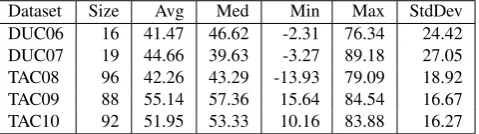
use 0.50 cosine similarity, as in previous work (Passonneau et al., 2017). The Pearson correlation with manual pyra-mid scores on 20 student summaries reached 89%, a 10% improvement over the previous results.
When we turned to DUC and TAC datasets (see above), consisting of extractive summarizers on newswire with model summaries written by NIST assessors, new chal-lenges arose. The decomposition parser for all results pre-sented here was extended to handle the more complex syn-tax found in newswire, relative to the student summaries. We performed grid search for DUC06 dev consisting of four of the twenty topics, and selected the best four sets of parameters. For each next year, we tested these same four parameter sets on a randomly selected dev set of size four, and found the best performance fora= 100,b= 2.5,
t1= 83%; these values yielded the smallest standard
devi-ations for average correldevi-ations with the manual pyramids. The value of theaparameter is apparently sensitive to the number of reference summaries. We tested PyrEval on the same student data reported in (Passonneau et al., 2017), which has five model summaries instead of the four that come with the NIST datasets. When we did grid search on a development set of the student data, we got better perfor-mance fora∈[125,250].
devel-Dataset Size Avg Med Min Max StdDev DUC06 16 41.47 46.62 -2.31 76.34 24.42 DUC07 19 44.66 39.63 -3.27 89.18 27.05 TAC08 96 42.26 43.29 -13.93 79.09 18.92 TAC09 88 55.14 57.36 15.64 84.54 16.67 TAC10 92 51.95 53.33 10.16 83.88 16.27
Table 2: Pearson correlations (Pearson’sr×100) with manual pyramid scores from DUC and TAC.
opment set. Because the semantic vectors are constructed from pretrained data, there is no training set. As shown, the trend over time is for PyrEval’s average correlation to be higher, and for the standard deviation to be lower. This could result simply from the much larger datasets as of 2008, or that PyrEval performs better on data from summa-rizers whose performance is better. Conroy & Dang (2008) report that the top ROUGE scores increase from about 0.27 in 2005 to about 0.34 in 2007. The maximum correla-tions for an individual topic in one year can be as high as 0.89. The minimum values tend to be many standard de-viations below the mean, suggesting that these are outliers, and that the median is a better summary statistic. Apart from DUC07, the medians are higher than the means.
6.
Discussion and Conclusion
The results in Table 2 show that PyrEval can achieve good average correlations of up to 0.55 (TAC10), and much higher (e.g., 0.89) on individual summarization tasks. As discussed in the next paragraph, we have identified a num-ber of needed improvements we plan to address.
Inspection of the pyramid for one of the DUC06 dev topics (D0608) that had lower performance illustrates one of the two issues our future work will address, both of which are classic problems in NLP: noun-noun compounds (includ-ing Named Entities) and conjunction. As shown in CU 1 of Figure 8, there are noun-noun compounds and NEs in all four segments (e.g., ”booster seat”, ”back seat”, ”crash test”, ”sport utility model”; ”MercedesBenz”, ”BodyS-mart”). The vector representations treat the compounds as sequences of individual words, which does not capture the correct semantics. Identification of multi-word expres-sions prior to generating the phrase vectors might correct this. We have also observed that conjunctions, which typi-cally introduce a great deal of syntactic ambiguity, are often parsed incorrectly. This can lead to incoherent output from the decomposition parser. Possible methods to address this include neural net dependency parsing, as in (Ficler and Goldberg, 2017), or clause-chart parsing (Kr´ıˇz and Hladk´a, 2016).
Figure 8 also shows a CU produced by PyrEval that cap-tures the same content as the manual content unit shown in Figure 1. The PyrEval CU has no label, but is other-wise similar to the manual CU: it has the same weight, and the contributing clauses come from the same sentences of the same summaries. The phrases selected by the human annotator for this CU are subphrases of the clauses that PyrEval groups together. Future work could rely on im-proved parsing to identify all distinct propositions, not just tensed clauses.
Figure 8: Examples of an incoherent CU (CU 1) and a co-herent CU (CU 5) from DUC0608.
In sum, PyrEval is a fast, complete, multi-use tool. In tests on summaries from extractive, multi-document summariz-ers, it achieves good average correlations with manual pyra-mid evaluations on five years of DUC/TAC .
7.
References
Bing, L., Li, P., Liao, Y., Lam, W., Guo, W., and Pas-sonneau, R. (2015). Abstractive multi-document sum-marization via phrase selection and merging. In Pro-ceedings of the 53rd Annual Meeting of the Association for Computational Linguistics and the 7th International Joint Conference on Natural Language Processing (Vol-ume 1: Long Papers), pages 1587–1597, Beijing. Conroy, J. M. and Dang, H. T. (2008). Mind the gap:
Dan-gers of divorcing evaluations of summary content from linguistic quality. InProceedings of the 22Nd Interna-tional Conference on ComputaInterna-tional Linguistics - Vol-ume 1 (COLING ’08), pages 145–152, Stroudsburg, PA, USA. Association for Computational Linguistics. Del Corro, L. and Gemulla, R. (2013). ClausIE:
clause-based open information extraction. In Proceedings of the 22nd International Conference on World Wide Web, pages 355–366. ACM.
Computational Linguistics (Volume 1: Long Papers), pages 1998–2008, Berlin.
Ficler, J. and Goldberg, Y. (2017). Improving a strong neu-ral parser with conjunction-specific features. In Proceed-ings of the 15th Conference of the European Chapter of the Association for Computational Linguistics (EACL): Volume 2, Short Papers, pages 343–348, Valencia, Spain, April. Association for Computational Linguistics. Guo, W. and Diab, M. (2012). Modeling sentences in the
latent space. InProceedings of the 50th Annual Meeting of the Association for Computational Linguistics, pages 864–872.
Ji, H., Grishman, R., Dang, H. T., Griffitt, K., and Ellis, J. (2010). Overview of the TAC 2010 knowledge base pop-ulation track. In Third Text Analysis Conference (TAC 2010), volume 3, pages 3–28.
Kr´ıˇz, V. and Hladk´a, B. (2016). Improving dependency parsing using sentence clause charts. InProceedings of the ACL 2016 Student Research Workshop, pages 86–92. Kuhn, H. W. (1955). The Hungarian method for the assign-ment problem. Naval Research Logistics (NRL), 2(1-2):83–97.
Lin, C.-Y. (2004). ROUGE: A package for automatic evaluation of summaries. In Stan Szpakowicz Marie-Francine Moens, editor, Text summarization branches out: Proceedings of the ACL-04 workshop, volume 8, pages 74–81. Barcelona, Spain.
Liu, F., Flanigan, J., Thomson, S., Sadeh, N., and Smith, N. A. (2015). Toward abstractive summarization using semantic representations. In Proceedings of the 2015 Conference of the North American Chapter of the Associ-ation for ComputAssoci-ational Linguistics: Human Language Technologies, pages 1077–1086.
Louis, A. and Nenkova, A. (2009). Automatically evalu-ating content selection in summarization without human models. InProceedings of the 2009 Conference on Em-pirical Methods in Natural Language Processing: Vol-ume 1-VolVol-ume 1, pages 306–314. Association for Com-putational Linguistics.
Manning, C. D., Surdeanu, M., Bauer, J., Finkel, J., Bethard, S. J., and McClosky, D. (2014). The Stan-ford CoreNLP natural language processing toolkit. In
Association for Computational Linguistics (ACL) System Demonstrations, pages 55–60.
Miller, G. A. (1995). Wordnet: a lexical database for en-glish.Communications of the ACM, 38(11):39–41. Nema, P., Khapra, M. M., Laha, A., and Ravindran, B.
(2017). Diversity driven attention model for query-based abstractive summarization. In Proceedings of the 55th Annual Meeting of the Association for Computational Linguistics (Volume 1: Long Papers), pages 1063–1072, Vancouver, Canada, July.
Nenkova, A. and Passonneau, R. (2004). Evaluating con-tent selection in summarization: The pyramid method. In Susan Dumais, et al., editors,Proceedings of Human Language Technologies and the North American Associ-ation of ComputAssoci-ational Linguistics (HLT-NAACL 2004), pages 145–152, Boston, Massachusetts, USA, May 2 -May 7. Association for Computational Linguistics.
Nenkova, A., Passonneau, R., and McKeown, K. (2007). The pyramid method: Incorporating human content se-lection variation in summarization evaluation. ACM Transactions on Speech and Language Processing (TSLP), 4(2):1–23. Article 4.
Passonneau, R. J., McKeown, K., Sigelman, S., and Good-kind, A. (2006). Applying the pyramid method in the 2006 document understanding conference. In Proceed-ings of the Document Understanding Conference (DUC 06).
Passonneau, R. J., Chen, E., Guo, W., and Perin, D. (2013). Automated pyramid scoring of summaries using distri-butional semantics. InProceedings of the 51st Annual Meeting of the Association for Computational Linguis-tics (Volume 2: Short Papers), pages 143–147.
Passonneau, R. J., Poddar, A., Gite, G., Krivokapic, A., Yang, Q., and Perin, D. (2017). Wise crowd content as-sessment and educational rubrics. International Journal of Artificial Intelligence in Education, pages 1–27. Passonneau, R. J. (2010). Formal and functional
assess-ment of the pyramid method for summary content evalu-ation.Natural Language Engineering, 16:107–131. Peyrard, M. and Eckle-Kohler, J. (2017). Supervised
learn-ing of automatic pyramid for optimization-based multi-document summarization. In Proceedings of the 55th Annual Meeting of the Association for Computational Linguistics (Volume 1: Long Papers), pages 1084–1094. Pilehvar, M. T., Jurgens, D., and Navigli, R. (2013). Align, disambiguate and walk: A unified approach for measur-ing semantic similarity. InProceedings of the 51st An-nual Meeting of the Association for Computational Lin-guistics (Volume 1: Long Papers), pages 1341–1351. Rush, A. M., Chopra, S., and Weston, J. (2015). A
neu-ral attention model for abstractive sentence summariza-tion. In Proceedings of the 2015 Conference on Em-pirical Methods in Natural Language Processing, pages 379–389, Lisbon, September.
Sakai, S., Togasaki, M., and Yamazaki, K. (2003). A note on greedy algorithms for the maximum weighted independent set problem. Discrete Applied Mathemat-ics, 126(2):313–322.
Varma, V., Pingali, P., Katragadda, R., Krishna, S., Ganesh, S., Sarvabhotla, K., Garapati, H., Gopisetty, H., Reddy, V. B., Reddy, K., et al. (2009). IIIT hyderabad at TAC 2009. InSecond Text Analysis Conference (TAC 2009). Yang, Q., Passonneau, R. J., and de Melo, G. (2016).