Text Simplification from Professionally Produced Corpora
Carolina Scarton, Gustavo Henrique Paetzold, Lucia Specia
Department of Computer Science, University of SheffieldRegent Court, 211 Portobello, Sheffield, S1 4DP, UK {g.h.paetzold, c.scarton, l.specia}@sheffield.ac.uk
Abstract
The lack of large and reliable datasets has been hindering progress in Text Simplification (TS). We investigate the application of the recently created Newsela corpus, the largest collection of professionally written simplifications available, in TS tasks. Using new alignment algorithms, we extract550,644complex-simple sentence pairs from the corpus. This data is explored in different ways: (i) we show that traditional readability metrics capture surprisingly well the different complexity levels in this corpus, (ii) we build machine learning models to classify sentences into complex vs. simple and to predict complexity levels that outperform their respective baselines, (iii) we introduce a lexical simplifier that uses the corpus to generate candidate simplifications and outperforms the state of the art approaches, and (iv) we show that the corpus can be used to learn sentence simplification patterns in more effective ways than corpora used in previous work.
Keywords:text Simplification, simplification corpora, Newsela
1.
Introduction
Text Simplification (TS) consists in making texts more eas-ily comprehensible. It can take many forms: Lexical Sim-plification (LS), in which complex words are replaced by simpler alternatives (Devlin, 1999), Syntactic Simplifica-tion (SS), which consists in changing the syntactic structure of a sentence (Siddharthan, 2006), and Semantic Simplifi-cation, in which portions of the text are paraphrased (Kan-dula et al., 2010).
Current empirical approaches rely mostly on the Wikipedia-Simple Wikipedia parallel corpus (Coster and Kauchak, 2011). This resource has been used by Machine Translation (MT) approaches (Zhu et al., 2010), tree transductors (Paetzold and Specia, 2013; Feblowitz and Kauchak, 2013), integer programming techniques (Woodsend and Lapata, 2011), and discriminative linear models (Bach et al., 2011). In LS, Yatskar et al. (2010) extract candidate simplifications from Wikipedia and Sim-ple Wikipedia edit histories, and Horn et al. (2014) extract word correspondences from word alignments between the complex-simple segments in the corpus.
Even though the Simple Wikipedia corpus has been a valu-able resource for modern TS, as discussed in Yasseri et al. (2012), Amancio and Specia (2014) and Xu et al. (2015), it is very small (167,689parallel sentence pairs (Coster and Kauchak, 2011)) in comparison to bilingual corpora used with similar modelling techniques in MT and, more crit-ically, covers a limited range of simplification operations, which are applied inad hocways by volunteer editors. Xu et al. (2015) introduce a new resource that allegedly ad-dresses these limitations: the Newsela corpus (Newsela, 2016). Unlike Simple Wikipedia, the Newsela corpus was created by professional editors and targets a specific audi-ence (students), which should make it a more reliable source for TS. However, the Newsela corpus has only re-cently started to be exploited for this task and not enough work has been done to understand its potential.
In this paper, we investigate whether (Xu et al., 2015)’s claims hold in practice. We produce sentence alignments
for the Newsela corpus (Section 2.) and conduct exper-iments to evaluate its effectiveness in TS tasks, namely: readability analysis (Section 4.), complex vs. simple classi-fication, complexity level prediction, lexical simplification and MT-based sentence simplification (Section 5.).
2.
Aligning the Newsela Corpus
The Newsela corpus (version 2016-01-29.1) is composed of 10,787news articles in English, which includes1,911 articles in their original form as well as in 4 or 5 versions rewritten by humans to suit different reading reading lev-els. Each document is characterised by a unique identifier, a version identifier (from 0 – most complex to 5 – sim-plest), and a reading level from2to12, where2represents the lowest and12the highest level. Version identifiers cap-ture the relationship between the reading levels of a pair of documents: e.g. version 1has a lower reading level than version0, version2has a lower reading level than version 1.
Articles are only aligned at document level and there is no guarantee that different versions of an article will have the same number of sentences, nor that they will be aligned in1-to-1fashion. The absence of paragraph and sentence alignments limits the use of the data.
paragraph/sentence alignments ( ˇStajner et al., 2017), while still offering comparable alignment accuracy.
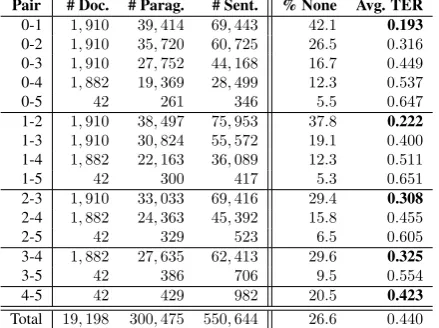
The result of the alignment is a corpus with19,198pairs of articles aligned at both paragraph (300,475pairs) and sen-tence (550,644pairs) levels. This is over three times larger than the Wikipedia–Simple Wikipedia corpus (Coster and Kauchak, 2011), making it the largest corpus of its kind. Columns2to4in Table 1 illustrate the number of paragraph and sentence alignments for all version pairs in the corpus. We categorise the sentence alignments according to four types of simplification:
• None: Complex and simple sentences are identical (146,251pairs).
• Compression: Multiple complex sentences are aligned to fewer simple sentences (24,661pairs). • Splitting: Multiple simple sentences are aligned to
fewer complex sentences: (121,582pairs).
• Rewriting:Same number of complex and simple sen-tences, but with different content: (258,150pairs).
Pair # Doc. # Parag. # Sent. % None Avg. TER 0-1 1,910 39,414 69,443 42.1 0.193 0-2 1,910 35,720 60,725 26.5 0.316 0-3 1,910 27,752 44,168 16.7 0.449 0-4 1,882 19,369 28,499 12.3 0.537
0-5 42 261 346 5.5 0.647
1-2 1,910 38,497 75,953 37.8 0.222 1-3 1,910 30,824 55,572 19.1 0.400 1-4 1,882 22,163 36,089 12.3 0.511
1-5 42 300 417 5.3 0.651
2-3 1,910 33,033 69,416 29.4 0.308 2-4 1,882 24,363 45,392 15.8 0.455
2-5 42 329 523 6.5 0.605
3-4 1,882 27,635 62,413 29.6 0.325
3-5 42 386 706 9.5 0.554
4-5 42 429 982 20.5 0.423
[image:2.595.61.281.312.476.2]Total 19,198 300,475 550,644 26.6 0.440
Table 1: Documents, aligned paragraphs and sentences at all levels (columns2-4), % of “none” alignments, and aver-age TER (columns5-6)
On average, sentence lengths remain close for adjacent lev-els (e.g. 25.0&24.4for levels0-1), but sentences become shorter for higher levels (12.5&11.1at levels4-5). This shows that editors significantly compress text while simpli-fying.
3.
Related Work
Xu et al. (2015) are the first to present an analysis of the Newsela corpus. They compare the Newsela and Wikipedia-Simple Wikipedia data using several metrics, showing that the Newsela corpus appears to be more use-ful. However, they do not use it in any tasks (e.g. lexical simplification) like we propose in this paper.
Besides proposing alignment algorithms for the Newsela corpus, ˇStajner et al. (2017) also build MT-based models with the aligned data. As test set, instead of using part of Newsela data, the Wikipedia-Simple Wikipedia dataset proposed by Xu et al. (2016) is used. Two out of three systems trained with Newsela aligned data perform better in terms of simplicity than state-of-the-art systems for the same corpus.
Zhang and Lapata (2017) train an attention-based encoder-decoder model (Bahdanau et al., 2014) and use reinforce-ment learning with a reward policy combining SARI (to measure simplicity) (Xu et al., 2016), BLEU (to measure grammaticality) (Papineni et al., 2002) and cosine simi-larity (to measure meaning preservation). This approach shows improvements over a model trained using a phrase-based MT approach in terms of BLEU and SARI.
Alva-Manchego et al. (2017) propose a TS model that uses predicted simplification operations. Simplification op-erations automatically annotated in source sentences are predicted as a first step, using sequence labelling tech-niques. As operations, they model onlyreplaceanddelete. Their TS model produces better results according to human judgements for simplicity than general-purpose MT-based models.
In general, the aforementioned contributions explore MT-based techniques and train systems using the Newsela data in similar ways as it was done previously for Wikipedia-Simple Wikipedia data. However, none of them provide an analysis of the Newsela data in terms of readability of the aligned data, the use of the data for complex vs. simple classification or complexity level prediction, or the impact of the data in state-of-the-art LS approaches.
4.
Corpus Analysis
We analyse the sentence-aligned Newsela corpus to (i) un-derstand the differences between its various levels of sim-plification, and (ii) investigate how existing readability and psycholinguistic metrics fair in distinguishing these levels.
Edit Rate This analysis focuses on the differences in ed-its between the various simplified versions. We use TER1 as a metric of edit distance, as it is widely used for this purpose in MT evaluation.
Columns5and6of Table 1 show the percentage of align-ments with TER = 0(“% None”) and averaged TER. As expected, the non-adjacent versions have higher TER val-ues, e.g. the distance between levels ‘0’ and ‘1’ is much smaller than the distance between levels ‘0’ and ‘5’. The percentage of sentences with no edits decreases as we move from adjacent to non-adjacent levels. Interestingly, be-tween the adjacent levels, the closer to the original level, the lower the TER, e.g. there are fewer edits between ‘0’ and ‘1’ than between ‘1’ and ’2’.
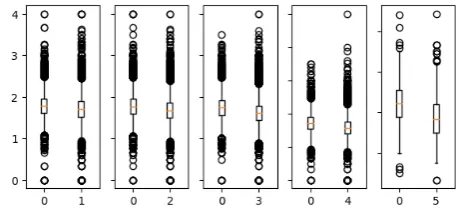
Readability Metrics Here we evaluate standard readabil-ity metrics that aggregate shallow text information (such as number of syllables and words): Flesch Reading Ease, Flesch-Kincaid Grade Level, SMOG Index, Gunning Fog Index, Automated Readability Index, Coleman-Liau Index, Linsear Write Formula and Dale-Chall Readability Score from the TEXTSTAT toolkit2. Figure 1 shows the Flesch Reading Ease box plot for pairs of original and simplified sentences with level ‘0’ as original version. Flesch varies from0 (most complex) to100(simplest). The Flesch in-dex for the simplified versions is higher than for the orig-inal version in all cases, which is an expected behaviour. Therefore, although the simplified versions of the Newsela
1
http://www.cs.umd.edu/˜snover/tercom
corpus can be composed of more and/or longer sentences than the original, the information encoded in them is still simpler.
[image:3.595.58.287.181.286.2] [image:3.595.305.535.359.465.2]A similar trend is observed for all other readability metrics and between all levels. For completion, we also show in Figure 2 the box plot for the Flesch-Kincaid Grade Level metric for 0-to-n original/simplified pairs. As expected, simplified versions have lower Flesch-Kincaid scores.
Figure 1: Flesch Reading Ease for simplified versions from level ‘0’
Figure 2: Flesch-Kincaid Grade Level for simplified ver-sions from level ‘0’
Psycholinguistic Metrics We also analysed the data us-ing12psycholinguistic features, motivated by those in the Coh-Metrix tool (Graesser et al., 2004):3
• Number of words / tokens / letters/ syllables • Type/token ratio
• Ratio betw. numbers of letters and words • Ratio betw. numbers of syllables and words • Number of content words
• Mean age of acquisition / familiarity / imageability / concreteness score of content words
For sentences without content words, the correspondent features were assigned zero. We extracted age of acqui-sition, familiarity, imageability and concreteness features from the bootstrapped MRC database (Paetzold and Spe-cia, 2016b), which is an extended version of the original MRC database (Coltheart, 1981).
Original sentences have a higher number of words, tokens, letters and syllables, as expected. Type/token ratio and number of content words are not considerably different be-tween original and simplified versions. Figures 3 and 4
3http://cohmetrix.com
[image:3.595.56.289.360.466.2]show the box plots for the ratio between number of letter and number words and the ration between number of sylla-bles and number words, respectively, when ‘0’ is the origi-nal level. Simplified versions have a higher ratio of letters per words and a lower ratio of syllables per words, when compared to original versions. It appears that even though simplified sentences have slightly longer words, such words have fewer syllables, which is often a sign of simplicity.
Figure 3: Ratio between number of letters and number of words for simplified versions from level ‘0’
Figure 4: Ratio between number of syllables and number of words for simplified versions from level ‘0’
Figures 5 and 6 show the box plots for age of acquisition and imageability metrics, when ‘0’ is the original. Age of acquisition aims to define the age at which a given word is learned, whilst imageability refers to the mental capability of retrieving an image, given a word. As expected, simpli-fied sentences show lower values for age of acquisition and higher values for imageability than their original counter-parts. Familiarity (the frequency to which a word is seen, heard or spoken daily) and concreteness did not show dif-ferences between simplified and original sentences.
5.
Using the Corpus in TS Tasks
5.1.
Complex vs. Simple Classification
Here we present sentence-level binary classifiers created for all possible combinations of levels of simplification. Sen-tences from the more complex version were assigned the label “complex”, while their simpler counterpart (at any level), the label “simple”. For sentences pairs whose TER is0(no simplification made), both original and simplified sentences were considered “simple”.
(Pe-Majority Readability Psycholinguistic All
P R F P R F P R F P R F
[image:4.595.114.480.68.242.2]0-1 0.634 1.0 0.491 0.684 0.929 0.641 0.651 0.889 0.576 0.696 0.936 0.661 0-2 0.576 1.0 0.421 0.715 0.857 0.711 0.660 0.826 0.633 0.724 0.860 0.724 0-3 0.545 1.0 0.385 0.740 0.875 0.759 0.687 0.782 0.684 0.753 0.872 0.770 0-4 0.533 1.0 0.370 0.756 0.917 0.794 0.708 0.789 0.717 0.776 0.909 0.808 0-5 0.514 1.0 0.349 0.758 0.951 0.809 0.718 0.837 0.740 0.767 0.953 0.823 1-2 0.616 1.0 0.470 0.681 0.881 0.652 0.643 0.881 0.555 0.696 0.868 0.664 1-3 0.553 1.0 0.393 0.715 0.853 0.725 0.674 0.752 0.664 0.727 0.845 0.734 1-4 0.533 1.0 0.370 0.744 0.891 0.778 0.713 0.773 0.704 0.765 0.890 0.791 1-5 0.514 1.0 0.349 0.798 0.954 0.849 0.742 0.781 0.750 0.801 0.957 0.853 2-3 0.586 1.0 0.433 0.662 0.861 0.638 0.633 0.896 0.584 0.674 0.848 0.653 2-4 0.543 1.0 0.382 0.704 0.851 0.717 0.677 0.743 0.664 0.722 0.847 0.732 2-5 0.517 1.0 0.352 0.761 0.929 0.800 0.726 0.776 0.730 0.772 0.922 0.810 3-4 0.587 1.0 0.434 0.649 0.883 0.611 0.622 0.828 0.551 0.655 0.869 0.628 3-5 0.525 1.0 0.361 0.709 0.875 0.727 0.685 0.729 0.673 0.711 0.888 0.745 4-5 0.557 1.0 0.399 0.664 0.837 0.656 0.644 0.753 0.626 0.644 0.789 0.622
[image:4.595.57.289.298.404.2]Table 2: Precision, recall and F-measure of classifiers for different simplification levels
Figure 5: Age of acquisition for simplified versions from level ‘0’
Figure 6: Imageability for simplified versions from level ‘0’
dregosa et al., 2011) with hyperparameters optmised using grid search. As features we used the nine readability met-rics from theTEXTSTATtoolkit and the12psycholinguistic features, mentioned in Section 4..
[image:4.595.57.290.466.570.2]Three models were built: one with the readability metrics only, one with the psycholinguistic metrics only and an-other with both. The classifiers were evaluated by using 10-fold cross-validation. As a baseline, we used a majority class classifier (Majority).
Table 2 shows the results for each complex-simple level. As expected, the classifiers built for non-adjacent levels achieve better performance than those for adjacent levels (in terms of F-measure). The opposite behaviour is
ob-served for the majority class models. This is expected, how-ever, since the number original/simplified pairs whose TER is0is much larger in adjacent levels than in non-adjacent levels, leading to more biased (and hence easier to predict) instances. It can also be noticed that the precision and F-measure of the classifiers follow the degree of difference between the complex and simple levels, as shown by TER (Table 1). Recall, on the other hand, is higher for adjacent levels. This is most likely caused also by the large num-ber of sentences considered simple because of no changes in TER (% None in Table 1). All classifiers outperform the majority class baseline and the best classifiers use the combination of both types of metrics as feature.
5.2.
Complexity Level Prediction
Here we directly predict the level of complexity of a sen-tence. These are defined as2-12reading proficiency levels, as explained in Section 2.: the higher the level, more com-plex the text. We use the same feature sets as in Section 5.1., but mix all sentences to build a single model and use the Ridge Regression algorithm.
We evaluate the model in terms of Mean Absolute Er-ror (MAE). As baseline, we considered the MAE obtained from applying the mean complexity level of the training set as the “prediction” for all instances in the test set. MAE values of 1.793,1.962 and1.715were obtained for mod-els built with readability, psycholinguistic and all features, respectively. The mean baseline MAE was of 2.247, and therefore all models outperformed the baseline, with the best model using all features.
5.3.
Lexical Simplification
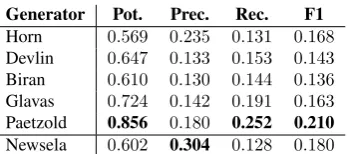
Generator Pot. Prec. Rec. F1
Horn 0.569 0.235 0.131 0.168
Devlin 0.647 0.133 0.153 0.143
Biran 0.610 0.130 0.144 0.136
Glavas 0.724 0.142 0.191 0.163
Paetzold 0.856 0.180 0.252 0.210
Newsela 0.602 0.304 0.128 0.180
[image:4.595.337.512.682.759.2]Famil. Glavas Paetzold
Horn 0.334 0.332 0.352
Devlin 0.291 0.265 0.341
Biran 0.230 0.267 0.238
Glavas 0.186 0.251 0.231
Paetzold 0.350 0.325 0.378
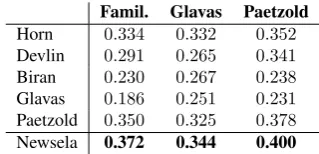
[image:5.595.88.248.68.145.2]Newsela 0.372 0.344 0.400
Table 4: Accuracy in the full pipeline evaluation
Here we assess the potential of our corpus in LS. LS is com-monly addressed as a pipeline of steps: candidates for a tar-get complex word are produced via aSubstitution Genera-tion(SG) method, filtered with respect to the context of the complex word via aSubstitution Selection(SS) method, and finally ordered for simplicity by aSubstitution Rank-ing(SR) method.
We use our aligned corpus for SG following the state of the art approach in (Horn et al., 2014). First, we produce word alignments using Meteor (Denkowski and Lavie, 2011) and extract complex-to-simple word correspondences. Then we filter word pairs with different POS tags, where the com-plex word is a stop word, or either word is a proper noun. Finally, we generate all possible inflections for nouns and verbs (Burns, 2013).
We compare this approach to six other generators from a recent benchmark (Paetzold and Specia, 2016a): the Horn generator (Horn et al., 2014), which employs the ap-proach described above over Wikipedia-Simple Wikipedia data, the Devlin (Devlin and Tait, 1998), Biran (Biran et al., 2011), Glavas (Glavaˇs and ˇStajner, 2015) and Paet-zold (PaetPaet-zold and Specia, 2016c) generators, which ex-ploit WordNet, comparable complex-to-simple documents, typical word embeddings and context-aware word embed-dings, respectively. All generators were implemented with the LEXenstein framework (Paetzold and Specia, 2015). We use the BenchLS dataset as our gold-standard dataset (Paetzold and Specia, 2016a). It is the largest dataset of its kind, with 929 instances, each composed by a sentence, a target complex word, and a set of gold substitutions given by humans. To compare the generators, we use standard metrics:Potential– the proportion of instances in which at least one of the candidates generated is in the gold-standard, Precision– the proportion of generated substitutions that are in the gold-standard, Recall– the proportion of gold-standard substitutions that are among the generated substi-tutions, andF1. Table 3 reveals that our approach achieves the highest Precision overall, as well as higher Potential and F1 scores.
We also evaluated our generator in practice through a full pipeline evaluation, where the output is the best lexical sim-plification for each complex word. To do so, we paired all aforementioned generators with three state of the art SR strategies:
• Familiarity(Paetzold and Specia, 2016b): Ranks can-didates according to their word familiarity scores, as extracted from the bootstrapped MRC database. • Glavas(Glavaˇs and ˇStajner, 2015): Ranks candidates
according to various features, then obtains a final rank-ing for a candidate by averagrank-ing the ranks of said
fea-tures.
• Paetzold(Paetzold and Specia, 2015): Learns a rank-ing model from a binary classification setup.
All rankers were implemented with the LEXenstein frame-work with features and settings as in (Paetzold and Specia, 2016a). The gold-standard test set used is also BenchLS, and the metric isAccuracy: the ratio with which the high-est ranking candidate is not the target word itself and is among the gold-standard candidates. Table 4 shows that our generator outperformed all others with any ranking method, highlighting the potential of the Newsela corpus for LS.
5.4.
Sentence Simplification
Simplification can be addressed as a “translation approach” (Shardlow, 2014). This approach requires a large enough sentence-aligned complex-simple corpus and a method to learn simplification rules, such as off-the-shelf Statistical Machine Translation (SMT) toolkits.
We experiment with the aligned Newsela corpus following an SMT-like pipeline, using only the adjacent levels of sim-plification (0-1, 1-2, 2-3, 3-4 and 4-5) (278.184sentences). For comparison, we build a model using the Wikipedia-Simple Wikipedia sentence-aligned corpus (167,689 sen-tences). Both datasets were divided in approximately70% for training,10% for development and20% for test. Addi-tionally, we also built a model using a subset of the Newsela dataset containing the same number of sentence pairs as the Wikipedia-Simple Wikipedia dataset, i.e. the training and development sets were reduced via random sampling to the size of the Wikipedia-Simple Wikipedia dataset.
We train standard MOSES toolkit (Koehn et al., 2007) with default configurations. Table 5 shows the evalua-tion of the simplificaevalua-tion systems built in terms of BLEU, SARI and Flesch Ease Index. In this table “full” refers to the model trained with the entire Newsela dataset and “wiki size” refers to the model trained with the portion of the Newsela dataset with the same size as the Wikipedia-Simple Wikipedia dataset.
BLEU scores are higher for the Newsela trained system in both “full” and “wiki size” settings, which can indicate that the models trained with Newsela data are producing outputs more grammatically correct than the model trained with Wikipedia-Simple Wikipedia data. SARI, however, shows that models built with Wikipedia-Simple Wikipedia data seems to be producing slightly simpler outputs. The Flesch index for simplified sentences (FLESCH-S) is lower than that of the reference sentences (FLESCH-R) for both corpora. This seems to reflect the fact that automatic sim-plifications are closer to the original (FLESCH-O) than to the reference.
BLEU SARI FLESCH-S FLESCH-O FLESCH-R Wikipedia 0.569 0.302 66.93 66.21 74.32
Wikipedia: TER=0 0.918 0.330 71.12 69.85 69.85
Wikipedia: TER>0 0.454 0.292 67.29 65.34 79.98
Newsela (full) 0.692 0.270 75.04 74.89 80.62
Newsela (full): TER=0 0.992 0.330 87.49 87.33 87.33
Newsela (full): TER>0 0.575 0.238 70.34 70.19 78.91
Newsela (wiki size) 0.691 0.272 75.10 74.89 80.62
Newsela (wiki size): TER=0 0.991 0.330 87.52 87.33 87.33
[image:6.595.126.464.68.173.2]Newsela (wiki size): TER>0 0.574 0.240 70.41 70.19 78.91
Table 5: Results for SMT-based simplifiers
not a reliable metric when original, reference and simplified sentences are the same. For all cases where TER= 0, the SARI value was0.330, which can be seem as a low value if the systems are producing an output equal to the reference. Since this metric was designed for cases where sentences should also be simplified (as explained in Xu et al. (2016)), the use of SARI for cases where the original sentences are already simple is not reliable.
6.
Conclusions
Upon studying the sentence-aligned Newsela corpus we found that: (i) it follows an expected TER distribution, with the lowest TER being between adjacent levels; (ii) the sim-plified sentences score as more readable than their origi-nal counterparts according to traditioorigi-nal readability met-rics, and (iii) the corpus proved a more reliable source of complex-simple correspondences for LS and MT-based simplification than the Wikipedia-Simple Wikipedia cor-pus. We achieve some the highest performance to date when generating candidate substitutions for complex words as well as when applying these into a full LS pipeline. Im-provements for MT-based simplification using the Newsela corpus are also observed but more in depth (manual) evalu-ation is needed for these experiments.
In the future, we hope that the aligned corpus will lead to better data-driven approaches to TS. We cannot release the aligned Newsela corpus, but it can be recreated using MAS-SAlign4(Paetzold et al., 2017), which provides the align-ment algorithm used.
7.
Acknowledgements
This work was supported by the EC project SIMPATICO (H2020-EURO-6-2015, grant number 692819).
8.
Bibliographical References
Alva-Manchego, F., Bingel, J., Paetzold, G. H., Scarton, C., and Specia, L. (2017). Learning how to simplify from explicit labeling of complex-simplified text pairs. InProceedings of IJCNP, pages 295–305.
Amancio, M. A. and Specia, L. (2014). An analysis of crowdsourced text simplifications. InProceedings of the 3rd PITR, pages 123–130.
Bach, N., Gao, Q., Vogel, S., and Waibel, A. (2011). Tris: A statistical sentence simplifier with log-linear models and margin-based discriminative training. InIJCNLP.
4https://github.com/ghpaetzold/massalign
Bahdanau, D., Cho, K., and Bengio, Y. (2014). Neural ma-chine translation by jointly learning to align and trans-late. arXiv preprint arXiv:1409.0473.
Barzilay, R. and Elhadad, N. (2003). Sentence alignment for monolingual comparable corpora. InProceedings of the 2003 EMNLP, pages 25–32.
Biran, O., Brody, S., and Elhadad, N. (2011). Putting it simply: a context-aware approach to lexical simplifica-tion. InProceedings of the 49th ACL, pages 496–501. Bott, S. and Saggion, H. (2011). An unsupervised
align-ment algorithm for text simplification corpus construc-tion. InProceedings of the 2011 MTTG, pages 20–26. Burns, P. R. (2013). Morphadorner v2: A java library for
the morphological adornment of english language texts. Northwestern University, Evanston, IL.
Coltheart, M. (1981). The mrc psycholinguistic database. The Quarterly Journal of Experimental Psychology, 33(4):497–505.
Coster, W. and Kauchak, D. (2011). Simple english wikipedia: A new text simplification task. In Proceed-ings of the 49th ACL, pages 665–669.
Denkowski, M. and Lavie, A. (2011). Meteor 1.3: Auto-matic metric for reliable optimization and evaluation of machine translation systems. InProceedings of the 6th WMT, pages 85–91. Association for Computational Lin-guistics.
Devlin, S. and Tait, J. (1998). The use of a psycholinguistic database in the simplification of text for aphasic readers. Linguistic Databases, pages 161–173.
Devlin, S. (1999). Simplifying Natural Language for Aphasic Readers. Ph.D. thesis, University of Sunder-land.
Feblowitz, D. and Kauchak, D. (2013). Sentence simpli-fication as tree transduction. InProceedings of the 2nd Workshop on Predicting and Improving Text Readability for Target Reader Populations, pages 1–10.
Glavaˇs, G. and ˇStajner, S. (2015). Simplifying lexical sim-plification: Do we need simplified corpora? In Proceed-ings of the 53rd ACL, pages 63–69.
Graesser, A. C., McNamara, D. S., Louwerse, M. M., and Cai, Z. (2004). Coh-Metrix: Analysis of text on cohe-sion and language. Behavior Research Methods, Instru-ments and Computers, 36(2):193–202.
Horn, C., Manduca, C., and Kauchak, D. (2014). Learning a lexical simplifier using wikipedia. In Proceedings of the 52nd ACL, pages 458–463.
semantic and syntactic text simplification tool for health content. InProceedings of the 2010 AMIA, pages 366– 70.
Koehn, P., Hoang, H., Birch, A., Callison-Burch, C., Fed-erico, M., Bertoldi, N., Cowan, B., Shen, W., Moran, C., Zens, R., Dyer, C., Bojar, O., Constantin, A., and Herbst, E. (2007). Moses: Open source toolkit for statis-tical machine translation. InProceedings of the Annual Meeting of the Association for Computational Linguis-tics, demonstration session, Prague, Czech Republic. Paetzold, G. H. and Specia, L. (2013). Text
simplifica-tion as tree transducsimplifica-tion. InProceedings of the 9th STIL, pages 116–125.
Paetzold, G. H. and Specia, L. (2015). Lexenstein: A framework for lexical simplification. InProceedings of The 53rd ACL, pages 85–90.
Paetzold, G. H. and Specia, L. (2016a). Benchmarking lex-ical simplification systems. InProceedings of the 10th LREC.
Paetzold, G. H. and Specia, L. (2016b). Inferring psy-cholinguistic properties of words. InProceedings of the 2016 NAACL, pages 435–440.
Paetzold, G. H. and Specia, L. (2016c). Unsupervised lex-ical simplification for non-native speakers. In Proceed-ings of The 30th AAAI, pages 3761–3767.
Paetzold, G. H. and Specia, L. (2016d). Vicinity-driven paragraph and sentence alignment for comparable cor-pora. arXiv preprint arXiv:1612.04113.
Paetzold, G., Alva-Manchego, F., and Specia, L. (2017). Massalign: Alignment and annotation of comparable documents. InProceedings of the 8th IJCNLP, pages 1– 4.
Papineni, K., Roukos, S., Ward, T., and Zhu, W.-J. (2002). Bleu: a method for automatic evaluation of machine translation. InProceedings of the 40th ACL, pages 311– 318.
Pedregosa, F., Varoquaux, G., Gramfort, A., Michel, V., Thirion, B., Grisel, O., Blondel, M., Prettenhofer, P., Weiss, R., Dubourg, V., Vanderplas, J., Passos, A., Cour-napeau, D., Brucher, M., Perrot, M., and Duchesnay, E. (2011). Scikit-learn: Machine learning in Python. Jour-nal of Machine Learning Research, 12:2825–2830. Shardlow, M. (2014). A survey of automated text
simpli-fication. International Journal of Advanced Computer Science and Applications.
Siddharthan, A. (2006). Syntactic simplification and text cohesion. Research on Language and Computation, 4(1):77–109, March.
Smith, J. R., Quirk, C., and Toutanova, K. (2010). Extract-ing parallel sentences from comparable corpora usExtract-ing document level alignment. In Proceedings of the 2010 HLT, pages 403–411.
ˇStajner, S., Franco-Salvador, M., Ponzetto, S. P., Rosso, P., and Stuckenschmidt, H. (2017). Sentence alignment methods for improving text simplification systems. In Proceedings of ACL, pages 97–102.
Woodsend, K. and Lapata, M. (2011). Learning to sim-plify sentences with quasi-synchronous grammar and
in-teger programming. InProceedings of the 2011 EMNLP, pages 409–420.
Xu, W., Callison-Burch, C., and Napoles, C. (2015). Prob-lems in current text simplification research: New data can help. Transactions of the Association for Computa-tional Linguistics, 3:283–297.
Xu, W., Napoles, C., Pavlick, E., Chen, Q., and Callison-Burch, C. (2016). Optimizing statistical machine trans-lation for text simplification.TACL, 4:401–415.
Yasseri, T., Kornai, A., and Kert´esz, J. (2012). A practi-cal approach to language complexity: a wikipedia case study. PloS one, 7(11):e48386.
Yatskar, M., Pang, B., Danescu-Niculescu-Mizil, C., and Lee, L. (2010). For the sake of simplicity: Unsupervised extraction of lexical simplifications from wikipedia. In NAACL, pages 365–368, Los Angeles, California. Zhang, X. and Lapata, M. (2017). Sentence
simplifica-tion with deep reinforcement learning. In Proceedings of EMNLP, pages 595–605.
Zhu, Z., Bernhard, D., and Gurevych, I. (2010). A mono-lingual tree-based translation model for sentence sim-plification. Computational Linguistics, (August):1353– 1361.