Page Stream Segmentation with Convolutional Neural Nets Combining Textual
and Visual Features
Gregor Wiedemann, Gerhard Heyer
Department of Computer ScienceLeipzig University, Germany
[email protected], [email protected]
Abstract
In recent years, (retro-)digitizing paper-based files became a major undertaking for private and public archives as well as an important task in electronic mailroom applications. As a first step, the workflow involves scanning and Optical Character Recognition (OCR) of documents. Preservation of document contexts of single page scans is a major requirement in this context. To facilitate workflows involving very large amounts of paper scans, page stream segmentation (PSS) is the task to automatically separate a stream of scanned images into multi-page documents. In a digitization project together with a German federal archive, we developed a novel approach based on convolutional neural networks (CNN) combining image and text features to achieve optimal document separation results. Evaluation shows that our PSS architecture achieves an accuracy up to 93 % which can be regarded as a new state-of-the-art for this task.
Keywords:page stream segmentation, convolutional neural nets, document image classification, document management, text classification
1.
Introduction
For digitization of incoming mails in business contexts as well as for retro-digitizing archives, batch scanning of documents can be a major simplification of the process-ing workflow. In this scenario, scanned images of multi-page documents arrive at a document management system as an ordered stream of single pages lacking information on document boundaries. Page stream segmentation (PSS) then is the task of dividing the continuous document stream into sequences of pages that represent single physical doc-uments.1
Applying a fully automated approach of document page segmentation can be favorable over manually separating and scanning documents, especially in contexts of very large data sets which need to be separated (Gallo et al., 2016). In a joint research project together with a German research archive, we supported the task of retro-digitization of a paper archive consisting of circa one million pages put on file between 1922 and 2010 (Isemann et al., 2014). The collection contains documents of varying content, types and lengths around the topic of ultimate disposal of nuclear waste, mostly administrative letter correspondence and re-search reports, but also stock lists, meeting minutes and email printouts. The 1M pages were archived in roughly 20.000 binders which were batch-scanned due to limited manual capacities for separating individual documents. The long time range of archived material affects document qual-ity, proliferation of layout standards, different fonts and the use of hand-written texts. All these circumstances pose se-vere challenges to OCR as well as to page stream segmen-tation (PSS).
In this article, we introduce our approach to PSS compar-ing (linear) support vector machines (SVM) and convolu-tional neural networks (CNN). For the first time for this task, we combine textual and visual features into one
net-1The task is also referred to as Document Flow Segmentation
or Document Separation.
work to achieve most-accurate results. The upcoming sec-tion 2. elaborates on related work. In secsec-tion 3. we describe our dataset together with one reference dataset for this task. In section 4. we introduce our neural network based archi-tecture for PSS. As a baseline, we introduce an SVM-based model solely operating on text features. Then, we introduce CNN for PSS on text and image data separately as well as in a combined architecture. Section 5. presents a quantita-tive and a qualitaquantita-tive evaluation of the approach on the two datasets.
2.
Related work
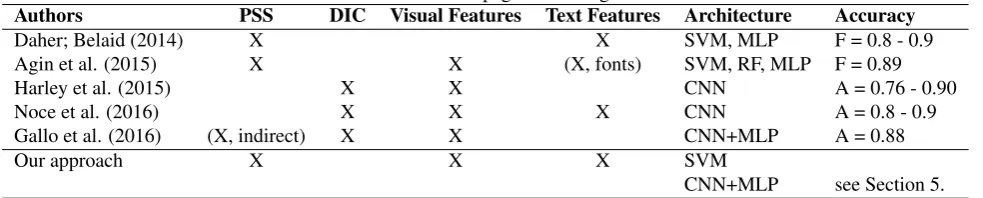
Page stream segmentation is related to a series of other tasks concerned with digital document management work-flows. Table 1 summarizes important characteristics of re-cent works in this field. A common task related to PSS is document image classification (DIC) in which typically vi-sual features (pixels) are utilized to classify scanned docu-ment representations into categories such as “invoice”, “let-ter”, “certificate” etc. Category systems can become quite large and complex. (Gordo et al., 2013) summarize differ-ent approaches in a survey article on PSS and DIC. In (Gallo et al., 2016), PSS is performed on top of the re-sults from a DIC process. Pages from the stream are seg-mented each time the DIC system detects a change of class labels between consecutive page images. This approach can only be successful in case there are alternating types of documents in the sequential stream. Often, this cannot be guaranteed, especially in case of small document category systems.
per-ceptrons (MLP). (Agin et al., 2015) employ bag of visual words (BoVW) and font information obtained from OCR as features, and test performance with three binary classi-fiers (SVM, Random Forest, and MLP).
The recent state-of-the-art for DIC is achieved by (Gallo et al., 2016), (Harley et al., 2015) and (Noce et al., 2016) who employ Deep Learning with Convolutional Neural Net-works to identify document classes. While the former two employ only visual features, the latter study uses both, vi-sual and text features for DIC. For this, class-specific key terms are extracted from the OCR-ed training documents and highlighted with correspondingly colored boxes in the document images. Then, a CNN is applied to learn doc-ument classes from these images augmented with textual information highlighting.
Although with (Gallo et al., 2016) there is already one study employing neural network technology not only for DIC but also for PSS, their approach was not applicable to our project for two reasons. First, as mentioned earlier, they perform PSS only indirectly based on changing class labels of consecutive pages. Since we only have 17 docu-ment categories and a majority of them belong to one cate-gory (”letter”), we need to perform direct separation of the page stream by classifying each page into either SD or ND. Second, quality and layout of our data is extremely hetero-geneous due to the long time period of document creation. We expect a lowered performance by solely relying on vi-sual features for separation. Therefore, taking the previous work of (Gallo et al., 2016) as a starting point, we pro-pose our approach for direct PSS as a binary classification task combining textual features and visual features using deep neural networks. We compare this architecture against a baseline comprising an SVM classifier solely relying on textual features.
3.
Datasets
We evaluate our approach on two datasets, one sample from the German archive data of our project context, and one public resource of annotated document scans from U.S. to-bacco companies.
3.1.
German archive data
The German dataset consists of a variety of document classes from a very long time frame. Most of the docu-ments were archived between the mid-1960s and 2010. Due to this, OCR-quality, document lengths, layout standards as well as used fonts differ widely.
After batch scanning, about 40 % of all binders from the German research archive have been manually separated into documents and annotated with document categories. The manually separated documents can serve as a ground truth for our experiments on model selection and feature engineering for automatic page stream segmentation. For these experiments, we randomly selected 100 binders from the set of all manually separated binders. The binders rep-resent 100 ordered streams of scanned pages, in total con-sisting of 22,741 pages. 80 of the selected binders contain-ing 17,376 pages were taken as a traincontain-ing set, 20 binders with 5095 pages were taken as test set. Scanned pages
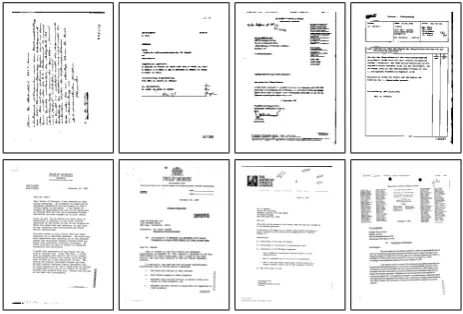
Figure 1: Examples for first pages (classnew document); from Archive22k (above) and Tobacco800 (below).
Figure 2: Examples for subsequent pages (classsame docu-ment); from Archive22k (above) and Tobacco800 (below).
were resampled to a size of 224 ×224 pixels and color-converted to black and white with the OTSU binarization method (Otsu, 1979). The upper lines in Fig. 1 and 2 show examples of first pages, resp. subsequent pages from docu-ments.
From original document scans, text information was ex-tracted by optical character recognition (OCR). In the fol-lowing, this dataset is referred to asArchive22k.
3.2.
Tobacco800
As a second evaluation set, we run our classification pro-cess on theTobacco800document image database (Lewis et al., 2006). The dataset allows comparing the performance of our approach to other recent studies.
The Tobacco800 dataset is a small annotated subset of the Truth Tobacco Industry Documents, a collection of more than 14 million documents originating from seven ma-jor U.S. tobacco industry organizations dealing with their research, manufacturing, and marketing during the last decades. The documents had to be publicly released due to lawsuits in the United States.
Table 1: Recent work on page stream segmentation
Authors PSS DIC Visual Features Text Features Architecture Accuracy
Daher; Belaid (2014) X X SVM, MLP F = 0.8 - 0.9
Agin et al. (2015) X X (X, fonts) SVM, RF, MLP F = 0.89
Harley et al. (2015) X X CNN A = 0.76 - 0.90
Noce et al. (2016) X X X CNN A = 0.8 - 0.9
Gallo et al. (2016) (X, indirect) X X CNN+MLP A = 0.88
Our approach X X X SVM
CNN+MLP see Section 5.
task. Samples from the Tobacco dataset were also used in (Harley et al., 2015) and (Noce et al., 2016). Again, we extract text information for each page via OCR from the original page scans, OTSU-binarize them to a black/white color palette and resize them to a 224×224 pixel resolu-tion. The lower lines in Fig. 1 and 2 show examples of first pages, resp. subsequent pages from Tobacco800 docu-ments.
As the example pages show, both collections share simi-larities in their visual appearance. First pages compared to subsequent ones may contain distinct header elements. But in general, the human observer has difficulties to identify clear layout patterns discriminating between both classes, especially for the Archive22k documents. Therefore, visual features alone may not be sufficient for accurate PSS. Regarding their textual content, the two datasets share cer-tain similarities but also differ with respect to language, size, and creatorship. Both have in common that they cover long time periods and are thematically located within a rather narrow domain (nuclear waste disposal, tobacco in-dustry). Nonetheless, they largely differ with respect to characteristics of content creators. On the one hand, there is a state-run research library archiving material from a wide variety of actors, while on the other hand there are internal documents from a rather small set of business actors with corporate design standards. Due to this, we expect differ-ent performance from textual and visual features for PSS on both datasets.
4.
Binary classification for PSS
Analogue to (Daher and Abdel, 2014) and (Agin et al., 2015), we approach PSS as a binary classification task on single pages from a data stream. Pages are classified into either continuity of thesame document(SD) or beginning of anew document (ND). For classification, we compare two architectures: SVM with specifically engineered text features (4.1.) and a combination of CNN and MLP with both, textual and visual features (4.2.).
4.1.
Baseline: SVM on text features
As a baseline, we use linear text classification together with specifically engineered features for PSS. For this first step, we rely on SVM with a linear kernel2. This learning al-gorithm has proven to be very efficient for binary clas-sification problems with sparse and large feature spaces
2
We use the Liblinear library by (Fan et al., 2008)
(Joachims, 1998) and is computationally much faster than neural network architectures.3
We extract four types of features from the OCR-ed text data of the single pages.
Unigrams: Page texts were tokenized and resulting to-kens reduced to their word stem. We further replaced digits in tokens with a #-character and pruned types from the vo-cabulary which occurred less than 3 times (Tobacco800), resp. 10 times (Archive22k). Pruning was applied to main-tain manageable vocabulary sizes and reduce noise from infrequent events in the data. Different thresholds for fea-ture pruning were chosen with respect to different col-lection sizes. This step resulted in 6,849 (Tobacco800), resp. 18,917 (Archive22k) features encoding raw frequency counts of all word types on each page.
Topic composition: In a second step, we obtained fea-tures of topical composition for each page from an unsuper-vised machine learning process. For this, we rely on Latent Dirichlet Allocation (LDA), also referred to as topic mod-eling (Blei et al., 2003).4Topic proportions based on multi-nomial posterior probability distributions θ from a topic model can be used as a dense feature vector comprising latent semantics of the modeled documents. In addition to highly sparse n-gram features, they can provide useful in-formation to any text classifier. Following a method pro-posed by (Phan et al., 2011), we presented single page texts as pseudo-documents to the process and compute a model withK = 50(Tobacco800), resp. K= 100(Archive22k) topics. Different topic resolutions were chosen again with respect to different collection sizes. For each pagep, we then use the resulting topic-page distributionθpas feature
vector supplementary to the previously extracted vector of unigram counts.
Topic difference: We expect multi-page documents to comprise a rather coherent topic structure. Thus, for each
3
We refrain from using image features in this architecture, be-cause pixel features are not supposed to be linearly separable. First experiments confirmed that pixel features do not contribute discriminative information on top of text features to the linear SVM for our task. Of course, we could use a different SVM ker-nel for image classification. But, very likely we would lose the advantage of computational speed. Due to this, we stick to text features for our baseline method.
4
pagep, we determine the difference between its topic com-positionθpand its predecessorθp−1as a third feature type
for PSS. We utilize two measures, Hellinger distance and Cosine distance, to create two additional features. While the former is a common metric to compare two probability distributions, the latter also has been adopted successfully to compare topic model results (Niekler and J¨ahnichen, 2012). Distance values near zero indicate a high similar-ity of topic composition compared to the predecessor page. Values near one indicate a significant change of topic com-position which could indicate the beginning of a new docu-ment.
Predecessor pages: As a last feature type, we add a copy of features extracted in the previous three steps belonging to the predecessor page as new features to each current page. This can be achieved easily by appending their values to-gether with a new unique feature identifier. For this, we simply concatenate existing feature identifiers with a prefix, e.g. ‘PREV#’. This is necessary to allow for the distinction between feature values for the current page and copied val-ues from the predecessor page. By this, any classifier not only can rely on the information about characteristics of the current page for its decision but also may learn from infor-mation contained on the previous page. For instance, the presence of a salutation phrase such as “With kind regards” on a predecessor page highly increases the probability for the beginning of a new document on the current page. The performance of SVM classification to determine for each page whether it is the beginning of a new document or the continuation of the current document is tested in dif-ferent steps. In each step, one of the four just introduced feature types is added to the feature set. Step-wise addition of the feature types to the linear SVM allows controlling whether each type effectively provides valuable informa-tion for the process.
4.2.
Neural networks on text and image features
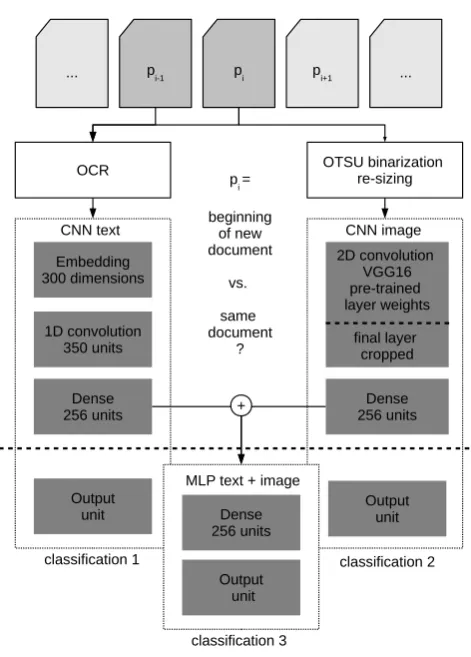
For our new PSS approach (cp. Fig. 3 for a schematic rep-resentation of the architecture), we first create two separate convolutional neural networks (CNN) for binary classifica-tion of pages into either SD or ND, one based on text data and another based on image scans. In a third step, we com-bine the learned parameters from the two final hidden layers of both CNN to an input vector of features for a multi-layer perceptron. This MLP delivers a third and final classifica-tion result based on both feature types.CNN for text data: (Kim, 2014) proposed a simple but effective CNN-architecture for text classification which achieved high performance for sentiment analysis tasks on standard data sets. He uses 1-dimensional convolution over word sequences encoded as embedding vectors. We adopt a slightly simpler version of this network architecture by relying on only one kernel size instead of combining con-volution layers with three different kernel sizes. Our net-work starts with an embedding layer with 300 dimensions, followed by a convolution layer with 350 filters and a ker-nel size of 3. On the resulting convolution filters, global max pooling is applied, followed by a dense layer of 256 neurons with “ReLU” activation, a dropout layer (dr=.5) and a final prediction layer for the binary class (sigmoid
Figure 3: CNN + MLP architecture for PSS
... pi-1 pi pi+1 ...
OCR OTSU binarization re-sizing
Embedding
activation). The embedding layer is randomly initialized.5 Learning for this network was performed using RMSProp optimization with learning rate 0.0002 and mini-batches of size 32.
CNN for image data: Following the works in (Noce et al., 2016) and (Gallo et al., 2016), we use a very deep CNN architecture to classify scanned pages based on their binarized and resized representation as 224×224 pixels. We employ a network of 16 weight layers with very small convolution filters (3×3) and max pooling as introduced by (Simonyan and Zisserman, 2014). The network is ini-tialized with pretrained weights based on the ‘imagenet’ dataset (VGG-16). Actually, ‘imagenet’ provides manually labeled photographs for object recognition tasks. But, ear-lier work has shown that CNN weights pre-trained on ima-genet, although not specifically intended for the task of doc-ument image classification, can significantly improve DIC results for small datasets, too (Harley et al., 2015). Hence, we expect them to be beneficial also for our PSS task. To allow the network to adapt to our specific data and
clas-5
sification task, we applied a common technique of fine-tuning pretrained deep CNN. For this, we removed the final prediction layer and flattened the output of the last fully connected layer. Then, we fixate all weights of the orig-inal model layers. On top of this architecture, we added a new trainable, fully connected layer with 256 units and dropout regularization (dr = .5), and a new final predic-tion layer (sigmoid activapredic-tion) for our binary classificapredic-tion task. Learning for this network was performed using the Adam optimizer with a small learning rate (lr = 0.0001) and mini-batches of size 32.
Combining text and visual features: Each of the two previously introduced CNN are capable of classifying pages into either SD or ND on their own. But, since dif-ferent information is utilized in each approach, we expect a performance gain from combining textual and visual in-formation. For this, we modify the two previously intro-duced models in the same way. First, each model is trained on the training data individually. Then, we remove the final prediction layer from each model. In a next step, each example from the training and test data is fed into the networks again, to receive prediction values from the last fully connected layers of the two pruned networks. The output values from these last layers can be interpreted as new feature vectors for each data instance which en-code dimensionality-reduced information from both, text and images.
From the text-based CNN, we receive a feature vector of 256 dimensions for each page according to the last dense layer of the model. To this vector, we concatenate theK in-ferred topic proportion features and the two topic distance features from our baseline approach. Since text features from predecessor pages proved to be very useful in SVM baseline classification, we also use features from neigh-bor pages in our final model. For this, we concatenate the vector of the current page with the vectors from its two predecessor pages to one text feature vector of length
3×(256 +K+ 2). In a last step, we concatenate the 256 image features from the image-based CNN to receive a fi-nal vector of 1,180 (Tobacco800), resp. 1,330 (Archive22k) dimensions.6
These final feature vectors now encode both, text and visual information from each page. They serve as input for a new MLP network consisting of 256 fully connected nodes with “ReLU” activation and l2-regularization (f actor= 0.01), followed by dropout regularization (dr = .5) and a fi-nal, fully connected prediction layer with sigmoid activa-tion. Learning is performed using the Adam optimizer (lr= 0.0005) and a batch size of 16.
5.
Evaluation
Quantitative evaluation: Table 2 displays the results of all tested model architectures and features types for PSS on our two investigated data sets. Performance is measured by the accuracy of identification of a new document be-ginning vs. continuity of the same document. Since the
6Concatenating text features from a window size 3 has been
decided experimentally. We also found that concatenating image features from predecessor pages did not improve the final perfor-mance.
Table 2: Evaluation of page stream segmentation
Approach/dataset Archive22k Tobacco800
Acc. kappa Acc. kappa SVM unigrams 0.840 0.421 0.829 0.640 + topic composition 0.839 0.419 0.829 0.640 + topic difference 0.847 0.446 0.837 0.657 + predecessor page 0.855 0.446 0.822 0.624 CNN Text 0.904 0.594 0.760 0.493 CNN Image 0.884 0.515 0.837 0.654 MLP Image + Text 0.929 0.691 0.911 0.816
distribution of both classes is fairly uneven due to differ-ent documdiffer-ent length (there are a lot more pages in the SD class), we additionally use kappa statistics to report a chance-corrected agreement between human and machine separations of page streams.
The text features specifically engineered for PSS based on LDA topic composition and difference between consecu-tive pages improve the SVM results for text-based classi-fication. Adding features from the predecessor page im-proves results for one dataset (Archive22k), but not for the other (Tobacco800).
For the German dataset, we can observe that document boundaries can be identified more accurately with the CNN architectures than with linear SVM classification. For the English dataset, SVM constantly beats convolutional neu-ral net classification on text features, but not on image fea-tures. One potential reason might be the rather small size of the dataset which does not contain enough examples for the complex CNN architecture to learn from.
For both datasets, accuracy and kappa statistics improve significantly when image and text feature types are com-bined in one MLP architecture. The classifier achieves circa 93 % accuracy on the German dataset and more than 91 % on the English data. Compared to the results reported by the studies in section 2., this can be regarded as a new state-of-the-art for page stream segmentation.
Qualitative evaluation: Although first pages and subse-quent pages of documents can be distinguished with high accuracy, our improved PSS approach still makes a consid-erable number of errors. There are two types of errors for the binary classification of pages: False positives (FP) and false negatives (FN). According to the manually separated pages in the gold standard, FP are subsequent pages (class SD) that are recognized by the classifier as first page (class ND). FN are defined the other way around. For SVM clas-sification in the German dataset, FP account for about three quarters of all errors in the test set. FN make up about one quarter of all errors. This mismatch means that automatic PSS potentially splits the page stream into more documents than there are actually in the gold standard.
docu-ment. This means although an automatic split is counted as an error in the quantitative evaluation, it nevertheless can represent a meaningful, content-related split for our appli-cation of retro-digitizing a large paper archive.
6.
Discussion
We presented a new approach for page stream segmentation based on binary classification of pages. Our approach com-bines two convolutional neural networks to create features from image and text data which are used as input for a third MLP network. Our approach achieves very high accuracy for the task to identify the beginning of a new document in a flow of scanned document pages. An accuracy above 91 % for the Tobacco800 dataset which has been used in previ-ous studies on this task, and accuracy of 93 % on our own dataset can be regarded as a new state-of-the-art for this task. The approach allowed us to drastically reduce costs for separating batch-scanned pages into document units in our project of retro-digitizing a research archive of around one million pages.
7.
Acknowledgements
This work has been realized at the Leipzig University in the joint research project “Knowledge Management of Legacy Documents in Science, Administration and Industry” to-gether with the Helmholtz Research Centre for Environ-mental Health in Munich and the CID GmbH, Freigericht. The authors thank colleagues at Helmholtz and CID for their valuable support.
8.
Bibliographical References
Agin, O., Ulas, C., Ahat, M., and Bekar, C. (2015). An ap-proach to the segmentation of multi-page document flow using binary classification. In6th International Confer-ence on Graphic and Image Processing (ICGIP 2014). Blei, D. M., Ng, A. Y., and Jordan, M. I. (2003). Latent
dirichlet allocation. Journal of Machine Learning Re-search, 3:993–1022.
Daher, H. and Abdel, B. (2014). Document flow segmen-tation for business applications. InDocument Recogni-tion and Retrieval XXI, pages 9201–9215, San Francisco, France.
Fan, R.-e., Chang, K.-w., Hsieh, C.-j., Wang, X.-r., and Lin, C.-j. (2008). Liblinear: A library for large linear classifi-cation. Journal of Machine Learning Research, 9:1871– 1874.
Gallo, I., Noce, L., Zamberletti, A., and Calefati, A. (2016). Deep neural networks for page stream segmen-tation and classification. InInternational Conference on Digital Image Computing: Techniques and Applications (DICTA), pages 1–7.
Gordo, A., Rusi˜nol, M., Karatzas, D., and Bagdanov, A. D. (2013). Document classification and page stream seg-mentation for digital mailroom applications. In 12th International Conference on Document Analysis and Recognition, pages 621–625.
Harley, A., Ufkes, A., and Derpanis, K. (2015). Evaluation of deep convolutional nets for document image classi-fication and retrieval. In13th International Conference
on Document Analysis and Recognition (ICDAR), pages 991–995.
Isemann, D., Niekler, A., Preßler, B., Viereck, F., and Heyer, G. (2014). OCR of legacy documents as a build-ing block in industrial disaster prevention. In DIM-PLE Workshop on DIsaster Management and Principled Large-scale information Extraction for and post emer-gency logistics, LREC 2014.
Joachims, T. (1998). Text categorization with support vec-tor machines: learning with many relevant features. Kim, Y. (2014). Convolutional neural networks for
sen-tence classification. EMNLP 2014.
Lewis, D., Agam, G., Argamon, S., Frieder, O., Gross-man, D., and Heard, J. (2006). Building a test collec-tion for complex document informacollec-tion processing. In
Proc. 29th Annual Int. ACM SIGIR Conference, pages 665–666.
Mikolov, T., Sutskever, I., Chen, K., Corrado, G., and Dean, J. (2013). Distributed representations of words and phrases and their compositionality.
Niekler, A. and J¨ahnichen, P. (2012). Matching results of latent dirichlet allocation for text. InProceedings of the 11th International Conference on Cognitive Model-ing (ICCM 2012), pages 317–322. Universit¨atsverlag der TU Berlin.
Noce, L., Gallo, I., Zamberletti, A., and Calefati, A. (2016). Embedded textual content for document im-age classification with convolutional neural networks. In Proceedings of the 2016 ACM Symposium on Docu-ment Engineering (DocEng), pages 165–173, New York. ACM.
Otsu, N. (1979). A threshold selection method from gray-level histograms. IEEE Transactions on Systems, Man, and Cybernetics, 9(1):62–66, jan.
Phan, X.-H., Nguyen, C.-T., Le, D.-T., Nguyen, L.-M., Horiguchi, S., and Ha, Q.-T. (2011). A hidden topic-based framework toward building applications with short web documents. IEEE Transactions on Knowledge and Data Engineering, 23(7):961–976.
Simonyan, K. and Zisserman, A. (2014). Very deep con-volutional networks for large-scale image recognition.