Ingrid Zukerman and Richard McConachy
Department of Computer Science, Monash University
Clayton, VICTORIA 3168, A U S T R A L I A
emaU: {ingrid,ricky}@bruce.cs.monash.edu.au
phone: 't-61 3 905-5202
fax: --I--61 3 905-5146
A b s t r a c t . Discourse planning systems developed to d a t e apply local considerations in order to generate an initial pre- sentation t h a t achieves a given communicative goal. However, they lack a global criterion for selecting among alternative presentations. In this paper, we cast the problem of plan- ning discourse as an optimization problem, which allows the definition of a global optimization criterion. In particular, we consider two such criteria: (1) generating the most con- cise discourse, and (2) generating the 'shallowest' discourse, i.e., discourse t h a t requires the least prerequisite information. These criteria are embodied in a discourse planning mecha- nism which considers the following factors: (1) the effect of a user's inferences from planned utterances on his/her beliefs, (2) the amount of prerequisite information a user requires to understand an utterance, and (3) the amount of infor- mation t h a t must be included in referring expressions which identify the concepts mentioned in an utterance. This mecha- nism is p a r t of a discourse planning system called W I S H F U L - II which generates explanations about concepts in technical domains.
1
I n t r o d u c t i o n
Schema-based Natural Language Generation (NLG) systems, e.g., [Weiner, 1980; McKeown, 1985; Paris, 1988], determine the information to be presented based on common patterns of discourse. Goal-based planners, e.g., [Moore and Swartout, 1989; Cawsey, 1990], select a discourse operator if its pre- scribed effect matches a given communicative goal. If there is more than one such operator, the operator whose prereq- uisite information is believed by the user is preferred. How- ever, if all the candidate operators require the generation of discourse t h a t conveys some prerequisite information, the selection process is either random or the system designer de- termines in advance which operators should be preferred.
In this paper, we cast the problem of planning discourse that achieves a given communicative goal as an application of an optimization algorithm. This approach supports the defi- nition of different optimization objectives, such as generating (1) the most concise discourse; (2) the 'shallowest' discourse, i.e., discourse t h a t requires the least amount of prerequisite information; or (3) the most concrete discourse, i.e., discourse with the most examples. The resulting mechanism is part of a discourse planning system called W I S H F U L - I I , which is a descendant of the W I S H F U L system described in [gukerman and McConachy, 1993a].
Table 1 illustrates the discourse generated by our system using the concise and the shallow optimization objectives.
T a b l e 1. Sample Concise and Shallow 'Wallaby' Discourse i C o n c i s e D i s c o u r s e S h a l l o w D i s c o u r s e
W a l l a b i e s h a v e a p o u c h , W a l l a b i e s a r e N a r s u p i a l s and w h i c h i s l i k e a p o c k e t , t h e y come f r o m L u s t r a l i a .
T h e y a r e l i k e k a n g a r o o s , They hop and t h e y a r e 3 f t . b u t t h e y a r e 3 f t . t a l l . t a l l . W a l l y i s a u a l l a b y .
These texts were generated in order to convey the attributes
type, habitat, body parts, height
and
transportation mode
of the conceptWallaby
to a user who owns a t o y wallaby c a l h d Wally, and knows something about kangaroos, but is not familiar with the term pouch.T h e concise discourse conveys most of the intended in- formation by means of a Simile between wallabies and kan- garoos. T h e Simile also yields the erroneous inference that wallabies are the same height as kangaroos. To contradict this inference, the system asserts t h a t wallabies are 3 ft. tall. Since the user does not know t h a t kangaroos have a pouch, this is asserted, and since the user does not know what a pouch is, information which evokes this concept is presented. The shallow discourse, on the other hand, uses Wally (the toy wa.llaby) to convey the body parts of a wallaby without naming t h e m explicitly. This information is complemented by Assertions about a wallaby's type, habitat, height and t r a n s p o r t a t i o n mode.
In the next section, we present an overview of W I S H F U L - II. In Section 3, we describe the discourse plaaming mech- anism. We then discuss the results we have obtained, and present concluding remarks.
2
O v e r v i e w o f t h e S y s t e m
W I S H F U L - I I receives as input a conceptto be conveyed, e.g., Wallaby, a list of aspects t h a t must be conveyed a b o u t this concept, e.g., h a b i t a t and b o d y parts, and a desired level of expertise the user should a t t a i n as a result of the presenta- tion.
W I S H F U L - I I was used to generate descriptive discourse in various technical domains, such as chemistry, high-school al- gebra, animal taxonomy and Lisp. It produces multi-sentence p a r a g r a p h s of connected English text. The discourse plan- ning mechanism, which is the focus of this paper, generates a set of Rhetorical Devices (RDs), where each RD is a rhetor- ical action, such as Assert, Negate or Instantiate, applied to a proposition. This set of RDs is optimal with respect to a given optimization criterion, e.g., conciseness or depth.
T h e following steps axe performed by W I S H F U L - I I . 1. C o n t e n t S e l e c t i o n - W I S H F U L - I I consults a model of
must be presented to convey the given aspects of a concept. This step selects propositions about which the user has misconceptions, propositions t h a t axe unknown to the user, and propositions t h a t are not believed by the user to the extent d e m a n d e d by the desired level of expertise. 2. G e n e r a t i o n o f t h e O p t i r a a l S e t o f R D s - W I S H F U L -
II searches for a set of RDs t h a t conveys the propositions generated in the previous step while satisfying a given op- timization objective. T h e process of generating candidate sets of RDs considers the following factors: (1) the effect of inferences from an RD on a user's beliefs; (2) the amount of prerequisite information required by the user to under- s t a n d the concepts in an RD; and (3) the amount of in- formation to be included in referring expressions which identify the concepts in an RD.
3. D i s c o u r s e S t r u c t u r i n g - A discourse structuring mech- anism extracts discourse r d a t i o n s and constraints from the set of RDs generated in Step 2. It then generates an or- dered sequence of the RDs in this set, where the strongest relations between the RDs are represented and no con- straints are violated. Where necessary, the RDs in this sequence are interleaved with conjunctive expressions t h a t signal the relationship between t h e m [Zukerman and Mc- Conachy, 1993b].
4. G e n e r a t i o n o f A n a p h o r l c R e f e r r i n g E x p r e s s i o n s - Anaphoric referring expressions are generated for RDs t h a t refer to a concept in focus. This process follows the or- ganization of the discourse, since the appropriate use of a n a p h o r a depends on the structure of the discourse. 5. D i s c o u r s e R e a l i z a t i o n - The resulting sequence of RDs
is realized in English by means of the Functional Unifica- tion G r a m m a r described in [Elhadad, 1992].
3
G e n e r a t i n g t h e O p t i m a l Set of R D s
T h e main stage of the optimization procedure consists of generating alternative sets of RDs t h a t can convey a set of propositions. T h e first step in this stage consists of generating candidate RDs t h a t can convey each proposition separately. To this effect, W I S H F U L - I I reasons from the propositions de- termined in the content selection step to the RDs t h a t may be used to convey these propositions. T h i s reasoning mecha- nism has been widely used in NLG systems, e.g., [Moore and Swartout, 1989; Cawsey, 1990].T h e process of generating a set of RDs t h a t can convey a set of propositions is not a straightforward extension of the process of generating candidate RDs t h a t can convey each proposition separately. This is due to the foUowing reasons: (1) an inference from an RD generated to convey a propo- sition pl m a y undermine the effect of an RD generated to convey a proposition
pj;
and (2) an RD generated to con- vey a proposition pl may be made obsolete by an RD which was generated to convey another proposition, but from which the user can infer pi. Further, it is not sufficient to propose a single set of RDs t h a t can convey a set of propositions, because a set of RDs t h a t initially a p p e a r s to be promising m a y require a large number of RDs to convey its prerequi- site information or to identify the concepts mentioned in it. Thus, after generating the RDs t h a t can convey each of the intended propositions separately, the optimization procedurem u s t consider concurrently the following inter-related factors in order to generate candidate sets of RDs t h a t can convey the intended propositions: (1) the effect of the RDs in a set on a user's beliefs, (2) the prerequisite information t h a t the user must know in order to understand these RDs, and (3) the referring expressions required to identify the concepts mentioned in these RDs.
Owing to the interactions between the RDs in a set, the problems of generating the most concise set of RDs and gen- erating the shallowest set of RDs are N P - h a r d 1. Since this level of complexity is likely to be maintained for o t h e r opti- mization objectives, we have chosen a weak search procedure for the implementation of the optimization process.
In the following sections, we describe the optimization pro- cess as an application of the Graphsearch algorithm [Nilsson, 1980], and discuss the implementation of the main steps of this algorithm.
3.1
T h e Basic O p t i m i z a t i o n P r o c e d u r e
Our optimization procedure,Optimize-RDs,
receives as in- put the set of propositions generated in the content selection step of W I S H F U L - I I . It implements a simplitied version of the Graphsearch algorithm [Nilsson, 1980] to generate a set of RDs t h a t conveys these propositions and satisfies a given optimization criterion. T h e discourse planning considerations are incorporated during the expansion stage and the evalua- tion stage of Graphsearch.T h e expansion stage of our procedure activates algorithm
Ezpand-sets-of-RDs,
which generates alternativeminimally
sufficient
sets of RDs t h a t can convey a set of intended propositions ( S t e p 5 in procedureOptimize.RDs).
A set of RDs is minimally sufficient if the removal of any RD causes the set to stop conveying the intended information. Note t h a t a minimally sufficient set of RDs is not necessarily a min- imal set of RDs. For example, both of the alternatives in Table 1 are composed of minimally sufficient sets of RDs. In this stage, the procedure also determines which prerequi- site propositions must be known to the user to enable a set of RDs to convey the intended propositions, and which referring expressions are required to identify the concepts in a set of RDs. During the evaluation stage, the procedure ranks each set of RDs in relation to the other candidates, and prunes redundant RDs (Step 7). Both the ranking process and the pruning process consider the extent to which a set of RDs is likely to satisfy a given optimization criterion.Algorithm O p t i m l z e - R D s ( {propositions} )
1. Create a search graph G consisting solely of a s t a r t node s which contains
{propositions}.
P u t s in a list calledOPEN.
2. L O O P : If
OPEN is
empty, exit with failure.3. Select the first node in
OPEN,
remove it fromOPEN. Call
this node n.
4. If n does not require prerequisite information or referring expressions, then exit successfuUy (n is a goal node). 5. E x p a n s i o n :
M *..- Ezpand-sets-oI-RDs(n).
Install the sets of RDs in M as successors of n in G.
6. Add the successors of node n to
OPEN.
7. E v a l u a t i o n : Reorder the nodes in
OPEN
and prune re- dundant nodes according to the given optimization crite- rion.8. Go LOOP.
3.2
E x p a n d i n g Sets o f R D s
Procedure
Expand-sets-of-RDs
receives as input a node to be expanded, and returns all the minimally sufficient sets of RDs t h a t convey the set of propositions in this node, ac- companied by their respective prerequisite propositions and referring expressions. We c o m p u t eall
the minimally suffi- cient sets of RDs, r a t h e r t h a n j u s t the minimal set of RDs, because a set of RDs t h a t initially appears to be promising may require a large number of RDs in order to convey its prerequisite information or to identify the concepts in it.Algorithm
E x p a n d - s e t s - o f - R D s ( n )1. Determine RDs t h a t increase a user's belief in each propo- sition in node n. (Not all the RDs generated in this step axe capable of conveying an intended proposition by them- selves, b u t they may be able to do so in combination with other RDs.) ( S e c t i o n 3.2.1) 2. Use these RDs to construct minimally sufficient sets of
RDs t h a t convey all the propositions in n jointly. P u t these sets of I~Ds in {A47~D}. ( S e c t i o n 3.2.2) 3. Determine the prerequisite propositions required by each set of RDs in { A 4 g D } so t h a t the user can understand it. ( S e c t i o n 3.2.3) 4. Determine referring expressions which evoke the concepts in each set of RDs in {.MT~D}. ( S e c t i o n 3.2.4)
The o u t p u t of
Ezpand.sets-of.RDs
takes the form of a set ofRD-Graphs.
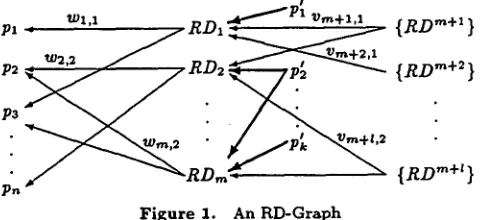
An R D - G r a p h is a directed graph t h a t con- tains the following components: (1) the set of propositions to be conveyed ( p l , . - - , p , ~ in Figure 1); (2) a minimally suffi- cient set of RDs(RD~,..., RDm);
(3) the effect of the infer- ences from the RDs in this set on the intended propositions, and possibly on other (unintended) propositions (labelledwid);
(4) the prerequisite propositions t h a t enable these RDs to succeed (p~ . . . . ,p~); (5) the relations between the pre- requisite propositions and the main RDs (in thick lines); (6) the sets of RDs t h a t evoke concepts in the main RDs ({RD m+l } . . . . ,{RD m+t
}); and (7) the relations between the evocative sets of RDs and the main RDs (labelled vm+id)- The main set of RDs and the relations between the RDs in this set and the propositions to be conveyed are generated in Step 2 above. The weight wid contains information about the effect of RDi on the user's belief in propositionpj.
The prerequisite propositions are generated in Step 3, and the evocative sets of RDs and their corresponding links are pro- duced in S t e p 4.3.L1 Determining RDs
Given a list of propositions to be conveyed, {p}, in this step we propose RDs t h a t can increase a user's belief in each of these propositions. To this effect, for each propo- sition
pi E
{p} we first consider the following RDs: Asser- tion ( A ) , Negation ( N ) , Instantiation (I) and Simile (S),w l a . ~, . ~ - - " ' P ~ v ~ + 1 , 1
, {
{RD =+'}
~ . . /
~RD,~'r
"- {RD ~+'1
F i g u r e 1. An RD-Graph
where different Instantiations and Similes may be generated for each proposition. For example, the proposition [Bracket- Simplification step-1 + / - ] may be i n s t a n t i a t e d with respect to Numbers, e.g., 2(3 + 5) -- 2 × 8, and to Like Terms, e.g.,
2(3z + 5z) = 2 × 8z. Those RDs t h a t increase a user's belief in pl are then put in a list called
RD.list(pl).
Next, for each proposition pi, we consider the RDs inRD-list(pi).
If an in- ference from any of these RDs increases a user's belief in a proposition p j # pi, this RD is added toRD.list(pj).
In aA- dition, if any of the generated RDs yields an incorrect belief with respect to a proposition t h a t is not in {p}, this propo- sition is added to {p}, and the process of determining RDs is repeated for this proposition in conjunction with the other propositions in {p}. This is necessary because RDs t h a t axe used to convey this new proposition could affect other propo- sitions previously in {p} and vice versa. This process stops when no incorrect beliefs are inferred.This process is implemented in algorithm
Determine-RDs,
which receives three input parameters: (1) the propositions for which RDs were generated in the previous recursive call to
Determine-RDs,
(2) the propositions to be considered in the current activation ofDetermine-RDs,
and (3) theRD-list
generated in the previous recursive calls. Its initial activation
is Determine-RDs(nil,{p}, nil),
and its o u t p u t isRD.list.
A l g o r i t h m
Determine-RDs( {oldp},{newp},RD-list)
1. B a c k w a r d r e a s o n i n g :
For each proposition p / G
{newp}
do:(a) Consider the following RDs: Assert(pi), Negate(~pi), I n s t a n t i a t e ( p i , I ) and Say-Simile(Oi,O), where the In- stantiation is performed with respect to an instance I , and the Simile is performed between an object Oi, which is the subject of proposition pl, and another object O ~. (Note t h a t several instances I and objects O may be used to generate different Instantiations and Similes, re- spectively.)
(b) Assign to
RD-list(pi)
the RDs t h a t increase the user's belief inpl.
2. F o r w a r d r e a s o n i n g :
(a) For each proposition
pi E {newp}
determine whether any RD inRD.list(pi)
supports other propositions in{oldp} U{newp}.
If so, add this RD to theRD-lists
of these propositions. [image:3.612.319.559.70.180.2](b) For each proposition pi ~
{oldp}
determine whether any RD inRD.list(pl)
supports propositions in{newp}.
If so, add this RD to theRD-lists
of these propositions. (c) Append the propositions in{newp}
to{oldp}.
(d) If any R D used to convey a proposition pi E
{newp}
yields incorrect beliefs, then
i. Assign to
{newp}
the propositions which contradict these beliefs.if. Assign to
RD-list
the result returned by Determine- RDs({oldp},{newp},RD-list)3. Return( RD-list)
To illustrate this process, let us consider a situation where we want to convey to the user the following propositions: [Wallaby hop] and [Kangaroo hop]. In the first stage, our pro- cedure generates two RDs t h a t can convey the proposition [Wallaby hop]: A s s e r t [ W a l l a b y hop] and I n s t a n t i a t e [ W a l l a b y hop], where t h e Instantiation is performed with respect to a wallaby called Wally t h a t is known to the user. Our proce- d u r e generates only the RD A s s e r t [ K a n g a r o o hop] to convey t h e proposition [Kangaroo hop] (an Instantiation is not gen- e r a t e d since t h e user is not familiar with any particular kan- garoos). In the forward reasoning stage, the inferences from these RDs axe considered. If the user knows t h a t wall£bies are similar to kangaroos, the RD generated to convey the proposition [Kangaroo hop] can increase the user's belief in t h e proposition [Wallaby hop], and is therefore added to the
RD-listof
[Wallaby hop]. Similarly, the RDs generated to con-vey [Wallaby hop] are added to the RD.listof [Kangaroo hop].
F r o m the above Assertions the user may also infer incorrectly t h a t wombats hop. In this case, a proposition which negates this incorrect conclusion, i.e., [Wombat -~hop], is assigned to
{newp}.
The R D s t h a t can convey this proposition in our ex- a m p l e axe N e g a t e [ W o m b a t hop] and I n s t a n t i a t e [ W o m b a t -~hop], where t h e Instantiation is performed with respect to a wombat called W i m p y t h a t is known to the user. These RDs in turn m a y yield the incorrect inferences that neither wallabies nor kangaroos hop, which contradict the intended propositions. However, since the propositions that contradict these inferences already exist in{oldp},
the process stops.3.2.2 Constructing Minimally Sufficient Sets of RDs
In this step, we generate all the minimally sufficient sets of RDs t h a t can convey jointly all the intended propositions. For each proposition
pi,
we first determine whether RDs t h a t were generated to convey other propositions can decrease a user's belief in pl. Next, for each RD inRD.list(pl),
we deter- mine whether it can overcome the detrimental effect of these 'negative' RDs. This step identifies combinations of RDs t h a t c a n n o t succeed in conveying the intended propositions. It re- sults in the following labelling of the RDs inRD-list:
RDs t h a t cart overcome all negative effects are labelled with the s y m b o l Jail] (the only RDs t h a t may be labelled in this man- ner axe Assertions and Negations); RDs t h a t cannot convey an intended proposition by themselves are labelled with the s y m b o l [-]; RDs t h a t can convey an intended proposition, but cannot overcome any negative effects are labelled with [none]; and the remaining RDs are labelled with the negative RDs t h e y can overcome.We then use a search p r o c e d u r e to generate all the sets of RDs which consist of one RD from each
RD.list.
The sets of RDs t h a t convey all t h e intended propositions are then stored in a list calledSUCCEED;
and the sets of RDs t h a t fall to convey one or m o r e propositions axe stored in a list calledFAILED,
t o g e t h e r with the proposition(s) t h a t failed to be conveyed. A d d i t i o n a l minimally sufficient sets of RDs axe then generated fromFAILED as
follows: we select a proposition pi t h a t was n o t conveyed, and create pairs of RDs composed of the RD t h a t failed to convey pi and each of the other RDs inRD.list(pl)
t h a t is not labelled Jail] (the RDs t h a t are labelled Jail] can convey pi by themselves, and therefore there is no need to combine t h e m with other RDs). Each pair of RDs inherits the negative RDs t h a t can b e over- come by its paxents, and m a y be able to overcome additional negative RDs which caused its p a r e n t s to fail separately. For each pair of RDs, a new set of RDs is created by replacing the RD which failed to convey pi with this pair of RDs. The search is then continued for each of these new sets of RDs until a minimally sufficient set of RDs is generated or fail- ure occurs again. In this case, the process of generating pairs of RDs is repeated, and t h e seaxch is resumed. If a pair of RDs fails, then it forms the basis for triplets, and so on. The search stops when theRD.list
of a proposition which failed to be conveyed contains no RDs with which the failed RDs (or RD-tuples) can be combined.A l g o r i t h m
Construct.sets-of-RDs( {p}, RD-list)
1. Initialize two lists,
SUCCEED
andFAILED,
to empty.2. Determine- I~Ds( nil, {p } , nil).
3. For each proposition p~ E {p}
(a) P u t in
NegRDs(pl) all
the RDs inRD-list
t h a t have a negative effect on pi.(b) Label each RD in
RD-list(p~)
according to the RDs inNegRDs(pi)
whose effect it can overcome. If there are several RDs inNegRDs(pi)
then all the combinations of these RDs must be considered.4. Exhaustively generate all the combinations of RDs con- sisting of one RD from t h e
RD-list
of each proposition. Consider the combined effect of several RDs to determine whether a set of RDs conveys completely a set of proposi- tions.5. A p p e n d the successful combinations of RDs to
SUCCEED,
and remove any sets of RDs in
SUCCEED
t h a t subsume other sets of RDs.6. A p p e n d the failed combinations of RDs to
FAILED to-
gether with the reason for the failure, i.e., the RDs t h a t failed and the propositions t h a t were not conveyed. 7. If
FAILED
is empty, then exit.8. Assign to
CURRD
the first set of RDs inFAILED,
and remove it fromFAILED.
9. Select from
CURRD
a proposition pi t h a t was not con- veyed, and generate successors ofCURRD as
follows: (a) Generate children of the RD t h a t failed to convey pi bycombining it with other RDs in
RD-list(pi)
t h a t axe not labelled Jail].(b) If the failed RD has no children in pl, then remove from
Table 2. Sample R D s (labelled) Proposition R D s a n d labels Pl:
[Wallaby hop]
A(pI)Jail]
I(pl)
[none]
A(p2)
[-]
P2:
[Kangaroo hop]
A(p2)Jail]
A(pl)
[I(-p3)]
x(p~)
[-]
"P3: [Wombat -~hop] i ]~]'(P3)
[A(pl)+I(p1), A(p2)]
I I('~p3) [I(pl), A(pI)](c) A t t a c h to each combination of RDs the list of negative RDs it can overcome.
(d) Create sets of RDs such t h a t in each set the failed RD is replaced with one of its children.
10. Go to Step 5.
To illustrate this process, let us reconsider the example discussed in Section 3.2.1. Table 2 contains the
RD-lists
for the propositions in this example, where each RD is labelled according to the RDs whose negative effect it can overcome. For instance, N e g a t e ( p 3 ) can overcome the combined nega- tive effect of A s s e r t ( p ~ ) and I n s t a n t i a t e ( p z ) , and also the effect of A s s e r t ( p 2 ) . However, it cannot overcome the com- bined effect of A s s e r t ( p 1 ) and A s s e r t ( p 2 ) , or A s s e r t ( p 2 ) and I n s t a n t i a t e ( p 1 ) . I n s t a n t i a t e ( p x ) can convey proposi- tion pl, but cannot overcome any negative effects. A s s e r t ( p 2 ) contributes to the belief in pl but cannot convey it alone.Figure 2 contains part of the search tree generated in Step 4 of algorithm
Construct-sets-o/-RDs.
Each path in this tree contains one RD from each row in Table 2. Successful paths axe drawn with thick lines and are marked S. Failed paths are marked F accompanied by the propositions which were not conveyed by the RDs in these paths. An RD that increases a user's belief in more than one proposition may a p p e a r in a path more t h a n once. T h e repeated instances of such an RD appear in brackets, e.g., { A s s e r t ( p x ) } , indicating t h a t the RD will be mentioned only once. In the successful path to the left, A s s e r t ( p 1 ) can overcome all negative effects to convey p~. In addition, it can overcome the negative effect of I n s t a n t i a t e ( - , p 3 ) to convey p2, and I n s t a n t i a t e ( - , p 3 ) can overcome the negative effect of A s s e r t ( p 1 ) to convey ",p3.A(pl)
A(p~)
{A(p,))
/\ /\
N(p~) I(-,p~)
g(p~) I(--,p~)
F F F S
"nP3 "aP3 P2
I(pa)
/\
N(p3) I(-~p3)
S F
"~p3
F i g u r e 2. Partial Sample Seaxdl Tree
T a b l e 3. Sets of RDs after the Initial Search 1. Assert(p1) Instantiate(-~p3) SUCOZSSFUL 2. Assert(p1) Instantiate(pl)
Negate(p3)
F A I L E D
3. Assert(pl) Assert(p2) "~P3 Negate(ps)
4. Assert(p1) Negate(p3) P2
5. Instantiate(pl) Assert(p2) "P3 Negate(p3)
6. I n s t a n t i a t e ( p l ) Assert(p2) "~P3 Instantiate(-,p3)
7. I n s t a n t i a t e ( p l ) Negate(p3) {Pi,P2} 8. Instantlate(pl) {Pl, P2 }
Instantiate(-,p3)
9. Assert(p2) Negate(p3) Pl 10. Assert(p2) Instantlate(-~p3)
{Pl,'~P3}
In the successful p a t h to the right, A s s e r t ( p 1 ) together with I n s t a n t i a t e ( p l ) overcome the negative effect of N e g a t e ( p 3 ) to convey p2, even though neither could do so by itself; and N e g a t e ( p 3 ) can overcome the joint effect of A s s e r t ( p 1 ) and I n s t a n t l a t e ( p l ).
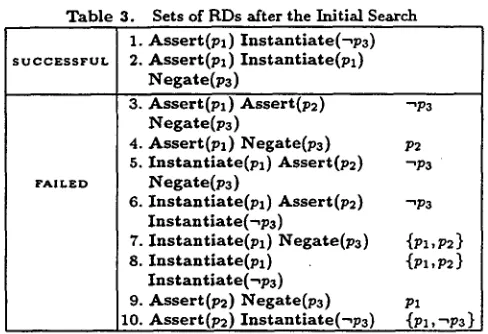
Table 3 contains the successful minimally sufficient sets of RDs generated by this search and the failed sets of RDs accompanied by the propositions t h a t were not conveyed. In Step 9 of
Construct-sets-o/-RDs,
the RDs t h a t failed to convey a proposition axe combined with other RDs t h a t can increase the user's belief in this proposition. For instance, N e g a t e ( p 3 ) is combined with I n s t a n t l a t e ( - ~ p 3 ) for all the p a t h s where -~p3 failed to be conveyed, and the seaxch is continued. Our procedure does not generate children from repeated RDs t h a t failed to convey a proposition, since this would yield already existing combinations of RDs. Table 4 contains the minimally sufficient sets of RDs returned by al- gorithmGonstruet-sets-ofiRDs.
Set 5-6 is obtained by com.- plementing Set 5 in Table 3 with the RD I n s t a n t i a t e ( - ~ p 3 ) , and also by complementing Set 6 with the RD N e g a t e ( p 3 ) . Additional successful sets of RDs are generated by append- ing complen~entaxy RDs to the failed sets of RDs in Table 3. However, these sets subsume Set I, 2 and 5-6, and hence axe not minimally sufficient. For example, w h e n Set 4 in Table 3 is complemented with Instantiate(pl), it yields a set of R D s that is equal to Set 2. This set is removed in Step 5 ofGonstruct-sets-of-RDs.
This process ensures that only minimally sufficient sets of R D s are generated, because it generates RD-tuples only from the unsuccessful R D s in the RD-list of a proposition, and it prunes sets of R D s that subsume other sets of RDs. In addition, this process ensures that all the minimally sufficient sets of R D s axe generated, because it considers all the R D - tuples resulting from the unsuccessful R D s in the RD.list of a proposition.
Table 4. Minimally Sufficient Sets of a D s 1. Assert(p1) Instantiate(-~p3)
2. A s s e r t ( p l ) I n s t a n t i a t e ( p l ) Negate(p3) 5-6. I n s t a n t i a t e ( p l ) Assert(p2) Negate(p3)
[image:5.612.64.299.72.178.2] [image:5.612.65.290.548.680.2]3.2.3 Determining Prerequisite Propositions
The prerequisite propositions to be conveyed depend on the user's expertise with respect to the concepts mentioned in a set of RDs, and on the context where these concepts are mentioned. T h e context influences b o t h the aspects of these concepts t h a t m u s t be understood by the user and the extent to which these aspects must be understood.
T h e process of determining the relevant aspects of a con- cept and the required level of expertise is described in [Zuk- e r m a n and McConachy, 1993a]. T h e relevant aspects of a concept are d e t e r m i n e d by considering the predicates of the propositions where a concept is mentioned, and the role of the concept in these propositions. For example, in order to un- d e r s t a n d the RD
Assert[Marsupial has-part pouch],
the user must know the aspectstype
andstructure
of a pouch, i.e., w h a t it is and w h a t it looks like. T h e extent to which a user m u s t know the selected aspects of a concept depends on the relevance of this concept to the original propositions to be conveyed, i.e., t h e system demands a high level of expertise with respect to the more relevant concepts, and a lower level of expertise with respect to the less relevant ones.After the relevant aspects and required level of expertise of each concept have been determined, W I S H F U L - I I applies the content selection s t e p described in Section 2 to determine the prerequisite propositions of each concept. W I S H F U L - I I then merges into a single set the prerequisite propositions gen- e r a t e d for individual concepts. This merger is executed be- cause some prerequisite propositions of two or more concepts may be conveyed by a single RD. A special case of this hap- pens when two or more concepts have common prerequisite propositions. For example, consider the situation depicted in Figure 3, where prerequisite information for the set of RDs
{RD1,RD2} is
being conveyed.RD1
requires the prerequi- site propositions {pl,p2}, whileRD2
requires the prerequi- site propositions {p2, p3, p4 }. If we considered separately the prerequisites of these RDs, we would generateRDs
to con- vey{pl,p2},
and{RD4,RDs}
to convey{p2,pa,p4}.
This would result in a t o t a l of three RDs. However, by consider- ing jointly all t h e prerequisite propositions of{RDi, RD2},
we will require two RDs only, namely{RD3, RDs}.
3.2.4 Evoking the Concepts in a Set of RDs
RDs t h a t convey referring information differ from RDs t h a t convey prerequisite propositions in t h a t the former identifies a concept by means of information known to the user, while the l a t t e r conveys information t h a t the user does not know about a concept. Further, the process of generating referring information has the flexibility of selecting t h e propositions t h a t can identify a concept uniquely, while the propositions
F i g u r e 3.
l P1 ~
RDz
RD1
P~ ~ 7
RD2
pz
RD4
p4
RDs
Prerequisite Propositions of a Set of RDs
T a b l e 5. Sample Referring Expressions C o n c e p t Lexical C o m p l e m e n t i n g
I t e m I n f o r m a t i o n
Compl : Algebraic Terms with one variable
Like-Terms
"Like Terms" CO~Ttp2: expressions such as 2(3z + 4x)
Comp3:
both Like Terms Algebraic- "Algebraic and Unlike Terms Terms Terms"Comp4
: expressions such as2(3z-b 49) and 5(2z -1- 3z)
t h a t convey prerequisite information are dictated by the con- t e x t and by the user's expertise.
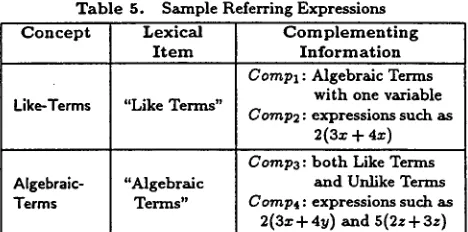
In order to generate referring expressions for the concepts mentioned in a set of RDs, we propose for each concept a list of candidate lexical items t h a t can be used to refer to it. If there is a lexical item t h a t identifies each concept uniquely and is known to the user, the evocation process is finished. However, if there axe concepts t h a t are not identified uniquely by any of their c a n d i d a t e lexical items, then these lexical items axe complemented with additional RDs that help t h e m identify the intended concepts. This t a s k is performed by iteratively selecting propositions t h a t identify an intended concept until this concept is singled out, and generating RDs t h a t convey these propositions. This algorithm differs from the procedure described in [Dale, 1990] in t h a t we generate several alternative sets of complementing RDs in order to avoid dead-end situations where the only identifying infor- m a t i o n t h a t is generated for a set of concepts is circular. T h e evocation process then selects the most concise non-circulax combination of referring expressions t h a t identifies all the concepts in a set of RDs. For example, Table 5 illustrates candidate referring expressions generated for the concepts Like-Terms and Algebraic-Terms. Each referring expression is composed of a lexical i t e m and a complement 3 . The non- circular alternatives in this example contain the complements
{Co~p~,Comp,}, {co~p~,Co~p~} and {Co~p~,Co~p,}
3.3 T w o O p t i m i z a t i o n Criteria
As indicated in Section 3.1, the optimization criterion deter- mines the manner in which the nodes in
OPEN
are ranked and pruned. In our implementation we have tried two opti- mization criteria: (1) conciseness and (2) depth.3.3.1 Optimizing the Depth of the Generated RDs
W h e n optimizing the d e p t h of a set of RDs, the nodes inOPEN
are pruned according to the following rule: I F D e p t h ( h i ) = D e p t h ( n j ) AND{ Prerequisites-of(n/) D Prerequisites-of(n j ) OR { Prerequisites-of(n/) = Prerequisites-of(hi) AND
{ IReferring-exp-of(ni)l > IReferring-exp-of(nj)[ OR { IReferring-exp-of(n~)l = IReferring-exp-of(n~)l AND
T o t a l - W e i g h t ( n / ) > T o t a l - W e i g h t ( h i ) } } } } T H E N remove
hi.
[image:6.612.340.574.68.184.2] [image:6.612.149.253.630.689.2]T a b l e 6. Prerequisite Propositions and Total Weight of MinimaLly Sufficient Sets of RDs
S e t of R D s T o t a l W e i g h t 1. Assert(p1) I n s t a n t i a t e ( - , p s ) 2
2. Assert(p1) I n s t a n t i a t e ( p l ) 2.5 Negate(ps)
5-6. I n s t a n t i a t e ( p l ) Assert(p2) 3 . 5
Negate(ps)Instantiate(-~ps)
P r e r e q u i s i t e P r o p o s i t i o n s
P l l , P I 2 , P 1 3 P l i , P l 2 , P l 3 ~
PSl P21
Psi
T h e tveight of a node reflects the number of RDs in this node and their type. T h e total weight of a node is the sum of the weights of the nodes in the p a t h from the root of the search tree to this node. All the RDs have a weight of 1, except an Instantiation of a proposition p that accompanies an Asser- tion of p or a Negation of ~p. Such an Instantiation has a weight of 1 ~, because it does not contain new information, r a t h e r it is a continuation of the idea presented in the As- sertion or the Negation. For example, the Instantiation in Set 1 in Table 6 has a weight of 1, because the instantiated proposition is different from the asserted proposition. In con- trust, in Set 2, the weight of the Instantiation is ½ because it instantiates the asserted proposition.
T h e above rule is also applied after Step 4 of algorithm Expand-sets-afiRDs to prune the list of minimally sufficient sets of 1RDs (Section 3.2). It removes a node if its prerequi- sites subsume those of another node. It considers the number of referring expressions of a node only when the same pre- requisite propositions are required by two nodes, and con- siders the total weight of a node only when two nodes have the same prerequisite propositions and the same number of referring expressions. This rule compares only nodes at the same depth, because even if the prerequisites of a node at level i subsume the prerequisites of a node at level i -t- 1, the node at level i may lead to discourse t h a t has depth i q- 1, while the node at level i ÷ 1 can lead to discourse of depth i -t- 2 at best.
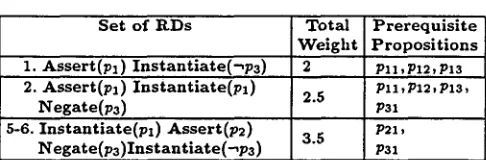
To illustrate the pruning process let us reconsider the min- imally sufficient sets of RDs in Table 4, assuming t h a t the prerequisite propositions required by these sets are as shown in Table 64 . Here, the pruning rule removes Set 2, since its prerequisite propositions subsume those of Set 1.
T h e nodes remaining in OPEN are ordered as follows:
1. In increasing order of their depth, so t h a t we expand the more shallow nodes first during the optimization process. 2. In increasing order of the number of prerequisite proposi- tions they require, so t h a t the nodes t h a t contain the sets of RDs with the fewest prerequisites are preferred among the nodes at the same level.
3. In increasing order of the number of referring expressions they have, so t h a t the nodes with the fewest referring ex- pressions are preferred among the nodes with the same number of prerequisite propositions.
4. In increasing order of their total weight, so t h a t the most concise set of RDs is preferred when all else is equal.
4 The first coefficient of each prerequisite proposition indicates the RD for which it is required, e.g., p i t is a prerequisite of A s s e r t ( p l ) .
To illustrate this process let us consider the minimally suf- ficient sets of RDs t h a t remain after pruning, namely Set 1 and Set 5-6, and assign t h e m to nodes nl and n s - e respec- tively. Since Set 5-6 has the fewest prerequisite propositions, u s - 6 will precede nl in OPEN, and will be the next node to be expanded by algorithm Optimize.RDs (Section 3.1). If upon expansion of n s - s we find t h a t there is a minimally sufficient set of RDs t h a t conveys propositions {p21 ,psi } and requires no prerequisite information, then the node which contains this set of RDs is a goal node, and the search is finished.
3.3.2 Optimizing the Number of Generated RDs
When optimizing the total number of RDs to be presented, the following rule is used to prune the nodes in OPEN: I F T o t a l - W e i g h t ( h i ) > T o t a l - W e i g h t ( h i ) AND
Prerequisites-of(nl) D Prerequisites-of(n./) T H E N remove ni.
As in d e p t h optimization, this rule is also applied after Step 4 of algorithm Ea:pand-sets-of-RDs to prune the list of minimally sufficient sets of RDs.
T h e nodes remaining in OPEN are sorted in increasing order of their t o t a l weight.
To illustrate this process let us consider once more the minimally sufficient sets of RDs in Table 6. Since the prereq- uisite propositions of Set 2 s u b s u m e those of Set 1, and the total weight of Set 2 is higher t h a n t h a t of Set 1, Set 2 is removed in the pruning stage. T h e ordering of the remain- ing nodes in OPEN is different from the ordering obtained for the d e p t h optimization, i.e., n l precedes n s - e in OPEN, since the t o t a l weight of Set 1 is less than the t o t a l weight of Set 5-6.
4 R e s u l t s
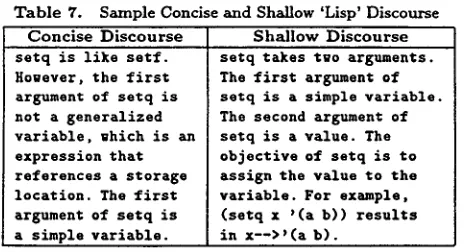
W I S H F U L - I I was implemented using Common Lisp on a S P A R C s t a t i o n 2 and on a PC-486. The system takes less than 4 seconds of CPU time to produce English output, and the optimization process alone takes less than 2 seconds for discourse of up to 10 RDs. Table 1 in Section 1 and Table 7 ( a d a p t e d from an example in [Moore and Swartout, 1989]) illustrate the o u t p u t generated by W I S H F U L - I I for the two optimization criteria we have implemented, viz conciseness and depth. A p p e n d i x A contains examples of the o u t p u t pro- duced by W I S H F U L - I I when the same discourse is generated for the concise and the shallow optimization criteria.
[image:7.612.60.303.93.173.2]T a b l e 7. Sample Concise and Shallow 'Lisp' Discourse Concise D i s c o u r s e S h a l l o w D i s c o u r s e
s e t q i s l i k e s e r f . H o w e v e r , t h e f i r s t a r g u m e n t o f s e t q i s n o t a g e n e r a l i z e d v a r i a b l e , w h i c h i s an e x p r e s s i o n t h a t
r e f e r e n c e s a s t o r a g e location. The first argument of s e t q is a simple variable.
s e t q takes t w o arguments.
The first argument o f
s e t q i s a s i m p l e v a r i a b l e . The s e c o n d a r g u m e n t o f s e t q i s a v a l u e . The o b j e c t i v e o f s e t q i s t o a s s i g n t h e v a l u e t o t h e v a r i a b l e . F o r e x a m p l e , ( s e t q x ' ( a b ) ) r e s u l t s
in x - - > ' ( a b ) .
number of RDs which mentioned different concepts. In par- ticular, the concise discourse was characterized by the pres- ence of Similes t h a t required some in-depth clarification of a non-source concept s, while t h e shallow discourse was chaxac- terized by the presence of a Description composed of a list of Assertions possibly accompanied by Instantiations.
5
C o n c l u s i o n
In this paper, we have cast discourse planning as an opti- mization process which generates discourse t h a t satisfies a specific optimization criterion. We have described a weak search procedure t h a t implements this process while taking into consideration the following factors: (1) a user's infer- ences from proposed RDs, (2) the prerequisite information required by the user to u n d e r s t a n d the concepts mentioned in a set of RDs, and (3) the referring expressions required to enable the user to identify these concepts. Two optimiza- tion criteria have been considered, viz conciseness and depth. The system which implements these ideas has been used to generate descriptive discourse in various technical domains.
R E F E R E N C E S
A. Cawsey (1990), Generating E x p l a n a t o r y Discourse. In: R. Dale, C. Mellish and M. Zock, eds., Current Research in Natural Language Generation (Academic Press), pp. 75- 102.
I t . Dale (1990), Generating Recipes: A n Overview of Epi- cure. In: R. Dale, C. Mellish and M. Zock, eds., Cur- rent Research in Natural Language Generation (Academic Press), pp. 229-255.
M. Elhadad (1992), F U G : T h e Universal Unifier User Man- ual Version 5.0, Technical Report, Columbia University, New York, New York.
M.R. Garey and D.S. Johnson (1979). Computers and In- tractability, A Guide to the Theory o] NP-Completeness (W.H. Freeman and Company, San Francisco).
K. McKeown (1985), Discourse Strategies for Generating Natural Language Text, Artificial Intelligence 27(1), pp. 1-41.
J.D. Moore and W . R . Swartout (1989), A Reactive Ap- proach to Explanation. In: Proceedings o/ the Eleventh International Joint Conference on Artificial Intelligence, Detroit, Michigan, pp. 1504-1510.
s A source concept in a Simile is a concept from which the intended information is drawn, e.g., kangaroo in Table 1 and setf in Table 7 are source concepts; pouch in Table 1 and generalized-variable in Table 7 are non-source concepts.
N. Nilsson (1980), Principles o/ Artificial Intelligence (Tioga Publishing Company, P a l e Alto, California).
C.L. Paris (1988), Tailoring O b j e c t Descriptions to a User's • Level of Expertise, Computational Linguistics 14(3), pp.
64-78.
J. Weiner (1980), Blab, A System Which Explains Its Rea- soning, Artificial Intelligence 15, pp. 19-48.
I. Zukerman add R.S. McConachy (1993a), Generating Con- cise Discourse t h a t Addresses a User's Inferences. In: Pro- ceedings of the Thirteenth International Joint Conference on Artificial Intelligence, Chaxnbery, France, pp. 1202-1207. I. Zukerman and R.S. McConachy (1993b), A n Optimizing
Method for Structuring Inferentially Linked Discourse. In: Proceedings of the National Conference on Artificial Intel- ligence, Washington, D.C., pp. 202-207.
Appendix A: Sample Output
T a b l e 8. 'Racing car' Discourse
An i n d y c a r i s an A m e r i c a n r a c i n g c a r . I t h a s a v e r y p o e e r f u l e n g i n e , w i d e t i r e s , h u g e b r a k e s a n d b i g w i n g s t o make l o t s o f d o w u f o r c e . L o t s o f d o w n f o r c e h e l p s i t go a r o u n d c o r n e r s q u i c k l y , h o w e v e r l o t s o f d o g n f o r c e d o e s n o t h e l p i t go
straight quickly. A f o r m u l a I car is like an indycar, h o w e v e r a f o r m u l a I car is a E u r o p e a n racin E car.
T a b l e 9. 'DOS and UNIX' Discourse
DOS i s an o p e r a t i n g s y s t e m . I t h a s a command l i n e i n t e r f a c e , w h i c h i s an i n t e r f a c e w h e r e you t y p e commands a t a t e x t p r o m p t , e . g . , m k d i r , I s . I t i s a s i n g l e u s e r o p e r a t i n g s y s t e m a n d i t d o e s n o t a l l o w m u l t i t a s k i n g , w h i c h i s d o i n g more t h a n o n e j o b a t a t i m e . UNIX i s l i k e DOS, h o w e v e r i t i s a m u l t i u s e r o p e r a t i n g s y s t e m a n d d o e s a l l o w m u l t i t a s k i n g . Some UNIX commands a r e t h e same a s DOS, e . g . , m k d i r , h o w e v e r some a r e d i f f e r e n t , e . g . , pwd. DOS r u n s on PC c o m p a t i b l e s . I n a d d i t i o n t o PC c o m p a t i b l e s UNIX r u n s on w o r k s t a t i o n s .
T a b l e 10. 'Document layout' Discourse
TEX i s a l a y o u t l a n g u a g e f o r d o c u m e n t s . A l a y o u t l a n g u a g e a l l o w s y o u t o c o n t r o l t h e a p p e a r a n c e o f o f y o u r d o c u m e n t , e . g . , t e x t s i z e a n d p l a c e m e n t . I t u s e s embedded commands, e h i c h a r e commands p l a c e d w i t h i n t h e d o c u m e n t , e . g . , ~ a g e n o . T h e s e commands a r e e x e c u t e d a f t e r y o u r d o c u m e n t i s e d i t e d . T r o l l i s l i k e TF~, h o w e v e r i t h a s d i f f e r e n t commands, e . g . , .BP. A w o r d p r o c e s s o r a l s o a l l o w s y o u t o c o n t r o l t h e a p p e a r a n c e o f y o u r d o c u m e n t , h o w e v e r i t i s n o t a l a y o u t l a n g u a g e . M o r d p r o c e s s o r s a l s o u s e embedded commands, h o w e v e r t h e y a r e n o t e x e c u t e d a f t e r y o u r d o c u m e n t i s e d i t e d , t h e y a r e e x e c u t e d w h i l e y o u r d o c u m e n t i s e d i t e d .
[image:8.612.81.319.65.191.2]