Use of Domain-Specific Language Resources in Machine Translation
Sanja ˇStajner, Andreia Querido, Nuno Rendeiro, Jo˜ao Rodrigues, and Ant´onio Branco
Department of Informatics, Faculty of SciencesUniversity of Lisbon, Portugal
{sanja.stajner, joao.rodrigues, andreia.querido, nuno.rendeiro, antonio.branco}@di.fc.ul.pt
Abstract
In this paper, we address the problem of Machine Translation (MT) for a specialised domain in a language pair for which only a very small domain-specific parallel corpus is available. We conduct a series of experiments using a purely phrase-based SMT (PBSMT) system and a hybrid MT system (TectoMT), testing three different strategies to overcome the problem of the small amount of in-domain training data. Our results show that adding a small size in-domain bilingual terminology to the small in-domain training corpus leads to the best improvements of a hybrid MT system, while the PBSMT system achieves the best results by adding a combination of in-domain bilingual terminology and a larger out-of-domain corpus. We focus on qualitative human evaluation of the output of two best systems (one for each approach) and perform a systematic in-depth error analysis which revealed advantages of the hybrid MT system over the pure PBSMT system for this specific task.
Keywords:Qualitative human evaluation, domain-specific machine translation, hybrid machine translation, TectoMT
1.
Introduction
Phrase-based statistical machine translation (PBSMT) sys-tems are considered the state of the art for language pairs for which large amounts of parallel data for training are available. For vast majority of language pairs (English-Portuguese among them), however, the available corpora are usually limited on one or two particular domains, e.g. legal documents (JRC-Acquis corpus), or parliamentary discussions (Europarl corpus). In those cases, for domain-specific MT, it is believed that rule-based or hybrid MT systems have higher potential to overcome the problems of data sparsity.
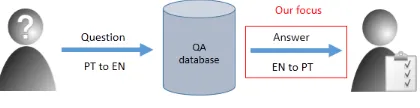
[image:1.595.66.276.573.627.2]In this paper, we focus on English to Portuguese MT for Information Technology (IT) domain, motivated by the fol-lowing real world usage scenario: an user asks a question in Portuguese, the question is machine translated into En-glish, the answer is searched for in an English database, automatically translated back to Portuguese and presented to the user (Figure 1).
Figure 1: The task.
All experiments have been performed within the QTLeap project,1 which aims to investigate an articulated
method-ology for machine translation based on deep language engi-neering approaches. As no freely available corpora for the PT language pair exists for the IT domain, a small EN-PT corpus was compiled under the QTLeap project in order to enable in-domain examples and guide the hand-crafted rules for the synthesis phase of the hybrid MT system being
1www.qtleap.eu
developed. This QTLeap corpus consists of recorded inter-actions of real users with experts to obtain technical support via chat, which were translated by professional translators into the eight languages of the project.2
We perform a series of MT experiments using two sys-tems: (1) the TectoMT ( ˇZabokrtsk´y et al., 2008) adapted to English-Portuguese translation (Silva et al., 2015), as a hybrid system with hybrid analysis, rule-based synthesis and statistically based transfer, and (2) the standard PBSMT system in Moses (Koehn et al., 2007). We vary the training datasets exploring three different strategies to overcome the problem of small amount of training data: (1) adding larger out-of-domain dataset, (2) adding in-domain bilingual ter-minology, (3) adding both.
The main contribution of this paper is the in-depth error analysis, showing the error patterns in each of the systems (TectoMT and PBSMT) when trained on the same datasets, thus directly contrasting those two approaches and showing the main advantages of the hybrid MT system. We further propose a set of rules for improving the synthesis stage in the TectoMT system to eliminate those errors in the future versions of the system.
The next contribution lies in better understanding how dif-ferent (fine-grained) types of errors influence fluency and adequacy, which relies on the combination of human as-sessment of fluency and adequacy and detailed error anal-ysis of each group of sentence pairs (depending on the flu-ency and adequacy scores).
Finally, our results confirm the hypothesis that TectoMT achieves best improvements with adding only bilingual ter-minology to the small in-domain training dataset, while PB-SMT achieves best improvements with adding a combina-tion of a larger out-of-domain corpus and bilingual termi-nology, regardless of the out-of-domain corpora used (Eu-roparl or scientific news).
2The corpus is freely available through METASHARE:
2.
Related Work
We divide the related work into two sections. The first sec-tion (Secsec-tion 2.1.) gives a brief introducsec-tion to the hybrid MT system used in our study (TectoMT) providing the nec-essary background for a better understanding of the results and discussion. The second section (Section 2.2.) sum-marises previous studies on English to Portuguese machine translation task.
2.1.
TectoMT – A Hybrid MT System
TectoMT ( ˇZabokrtsk´y et al., 2008) is a modular hybrid MT system which uses two levels of structural representation: a shallow analytical layer (a-layer), and a deep tectogram-matical layer (t-layer). It consists of three phases: analysis, transfer, and synthesis.
The analysis phase consists of two steps. In the first step, standard dependency parsers are used to construct the layer. In the second step, the dependency trees of the a-layer (a-trees) are converted into the dependency trees of the t-layer (t-trees) using a set of rule-based modules. The a-layer is represented by a labeled dependency tree (a-tree) which contains all tokens of the sentence as its nodes. Each node contains several types of information: word form, lemma,part-of-speech tag and morphological information, and afun, a surface dependency label denoting syntactic function (subject, object, predicate, etc.). The t-layer is a deep syntactic/semantic layer represented by a depen-dency tree (t-tree) which describes the linguistic meaning of the sentence according to the FGD (Functional Gener-ative Description) theory (Sgall et al., 1986). The nodes of the t-tree contain only content words of the sentence and added information (not contained in the sentence) as pro-dropped subject personal pronouns. Each t-node has four attributes: t-lemma(“deep lemma” which is in most cases identical to surface lemma),functor(a semantic role label based on the FGD theory),grammateme(contains in-formation such as person, number, tense, modality, etc.), andformeme(morpho-syntactic form information, such as
v:to+inffor infinitive verbs orn:into+Xfor a prepo-sitional phrase). Auxiliary words are not represented as nodes in the t-tree but rather influence the attributes of the t-nodes.
The transfer phase in TectoMT is performed on the t-layer by translating t-lemmas and conversion of formemes and grammatemes (Bojar and T´ynovsk´y, 2009; ˇZabokrtsk´y et al., 2008) . This phase is mostly statistical, based on max-imum entropy (MaxEnt) model (Mareˇcek et al., 2010), en-hanced with translation dictionaries and a small number of handcrafted rules for handling out-of-vocabulary words. Finally, the synthesis phase consists of series of small, mostly rule-based modules which have a goal of trans-forming the translated t-tree into an a-tree and then lin-earise the a-tree into a plain surface form of the output sen-tence. These modules are language-specific and take care of word order, agreement (e.g. subject-predicate agree-ment or noun-adjective agreeagree-ment), insertion of grammat-ical words (such as prepositions, articles, particles, etc.), inflections, and capitalisation.
2.2.
English to Portuguese Machine Translation
The studies concerning EN-PT MT are very scarce and mostly report on results of the PBSMT systems. The best results (BLEU = 0.55) were obtained on the JRC-Acquis corpus (Koehn et al., 2009), followed by the results ob-tained using a significantly smaller FAPESP corpus (Aziz and Specia, 2011) of scientific news texts (BLEU = 0.46). The PBSMT systems trained on Europarl corpus (and inter-polated with models trained on datasets from the same do-main as the test datasets) and tested on dodo-main-specific cor-pora – TED talks and TAP (Portuguese airline) magazine – achieved significantly lower BLEU scores, 0.20 and 0.19 respectively (Costa et al., 2014). Google Translate achieved better, but still not very high, BLEU scores (0.28 and 0.26, respectively) on the same task (Costa et al., 2014).There have been two studies comparing a hybrid and a PB-SMT system for EN-PT language pair (Silva et al., 2015; ˇStajner et al., 2015), reporting the performances of the two approaches as comparable. None of those studies, however, performs an error analysis to directly compare the errors made by those systems.
3.
Machine Translation Experiments
The corpora used in MT experiments, experimental setup and the results of the automatic evaluation of all MT sys-tems are presented in the next three subsections.3.1.
Corpora
We used six corpora in this study:
1. EP1– Full Europarl corpus (Koehn, 2005) with En-glish on the source side and Portuguese on the target side (1,960,407 sentence pairs).
2. EP2– A smaller portion of Europarl corpus which has the same size as the FAPESP corpus (162,350 sen-tence pairs).
3. FAPESP – A Portuguese-English bilingual collec-tion of the online issue of the scientific news Brazil-ian magazine “Revista Pesquisa FAPESP”3(Aziz and Specia, 2011).
4. IT1 – An in-domain IT corpus with 2,000 sentence pairs (1,000 questions and 1,000 answers) compiled under the QTLeap project (QTLeap corpus, batch 1). This corpus was used as the training dataset (or a part of the training dataset) in our translation experiments.
5. IT2 – Another in-domain IT corpus, with 1,000 sentence pairs (answers only) compiled under the QTLeap project (QTLeap corpus, batch 2), and com-parable with the IT1 corpus. This corpus was used as the test dataset in all our translation experiments.
6. TERM – A parallel corpus of IT terminology (uni-grams or multiword expressions), which consists of theMicrosoft Terminology Collection4(13,030 terms)
3http://revistapesquisa.fapesp.br/ 4https://www.microsoft.com/Language/
Corpora Source (EN) Target (PT)
EP I am pleased that the Council and the Commission have responded to this concern of Parliament.
Congratulo-me por ver que o Conselho e a Comiss˜ao atenderam a esta preocupac¸˜ao do Par-lamento.
FAPESP
Do you make use of these procedures at Alellyx? Na Alellyx utilizam-se esses procedimentos?
At this stage Simpson had already began to get involved in the project.
Nessa ´epoca, o Simpson j´a estava comec¸ando a se envolver no projeto.
IT1
Remove the wireless network and try reconnect-ing again usreconnect-ing valid credentials.
Remova a rede sem fios e ligue novamente com dados v´alidos.
How can I delete Skype’s conversation history? Como posso apagar o hist´orico de conversas do Skype?
IT2
In the Insert menu, select Table. No menu inserir selecione Tabela.
Select the cells you want to format, then click the right mouse button on one that is selected and choose Format Cells.
Selecione as c´elulas que pretende formatar, depois clique com o bot˜ao direito do rato numa que esteja selecionada e escolha Formatar C´elulas.
TERM
shift key tecla shift
file system sistema de ficheiros
command line options opc¸˜oes da linha de comandos
Table 1: Examples from the corpora
Experiment Training dataset BLEU score
EP1/EP2 FAPESP IT1 TERM Total TectoMT PBSMT
EP1 1,960,407 / / / 1,960,407 19.34 18.99
EP2 162,350 / / / 162,350 17.76 17.53
FAPESP / 162,350 / / 162, 350 19.43 19.20
IT1 / / 2,000 / 2,000 20.77 21.55
IT1+EP2 162,350 / 2,000 / 164,350 19.77 20.79
IT1+FAPESP / 162,350 2,000 / 164,350 20.53 *22.64
IT1+TERM / / 2,000 14,025 16,025 *21.89 *22.73
IT1+EP2+TERM 162,350 / 2,000 14,025 178,375 *21.04 *22.25
[image:3.595.51.550.67.334.2]IT1+FAPESP+TERM / 162,350 2,000 178,375 14,025 *21.63 *23.53
Table 2: Number of sentence pairs (terms and MWE in the case of the TERM corpus) used for the training and the achieved BLEU score. Best results of each system are shown in bold. Results of the systems which significantly (using paired bootstrap resampling (Koehn, 2004)) outperformed all four baselines are shown with an ‘*’.
and a small portion of LibreOffice terminology (995 terms).5
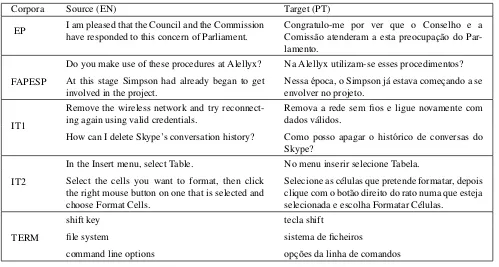
Several examples from each corpus are given in Table 1.
3.2.
Experimental Setup
We performed a series of MT experiments for English to Portuguese translation using two different approaches: a hybrid MT system (TectoMT) and a PBSMT system in the Moses toolkit. All models were tested on the same dataset (IT2).
For the TectoMT system, we used the English to Portuguese TectoMT system (Silva et al., 2015) developed under the QTLeap project.
For the PBSMT system, we used the GIZA++ implemen-tation of IBM word alignment model 4 (Och and Ney,
5
We would like to thank Eleftherios Avramidis and Lukas Poustka for making the LibreOffice corpus available to us.
2003), and the refinement and phrase-extraction heuristics described further by Koehn et al. (2003). All PBSMT sys-tems were tuned on the IT1 corpus using minimum error rate training (MERT) (Och, 2003). Their language models were built on a 2,121,382 sentence corpus (target side of the full EP+FAPESP corpora) using the KenLM (Heafield, 2011) 5-gram language model. The stack size was limited to 100 hypotheses during decoding.
Group Description Fluency Adequacy
TectoMT better rated than PBSMT
1a Both good (TectoMT = 4, PBSMT = 3) 0 0
1b TectoMT good (3 or 4), PBSMT bad (1 or 2) 10 20
1c Both bad (TectoMT = 2, PBSMT = 1) 17 10
TectoMT and PBSMT rated the same 2a Both good (both = 3 or both = 4) 4 11
2b Both bad (both = 2 or both = 1) 55 40
PBSMT better rated than TectoMT
3a Both good (TectoMT = 3, PBSMT = 4) 0 3
3b TectoMT bad (1 or 2), PBSMT good (3 or 4) 8 12
[image:4.595.54.537.69.179.2]3c Both bad (TectoMT = 1, PBSMT = 2) 6 4
Table 3: Number of sentence pairs analysed in each group.
Code Error Example
SENS Incorrect sense “phones”(with the meaning “headphones”) translated as“telem´oveis”
(mobile phones) instead of correct“auscultadores”
WRTR Wrong translation “Unidade de Google”instead of“Google Drive”
UNTR Left untranslated “format”, “connect”...
ADDW Added words “Sign into the YouTube account.” translated as “NumISPna conta no youtube.”
MISW Missing words “double-click” translated as “clique” (click) CAP Capitalisation that says, “Starred”→que dizestrela COM Missing commas that says,“Starred”→que diz estrela QUO Missing quotation marks that says,“Starred”→que dizestrela
REL Missing relative pronoun “escolha a l´ıngua quer” instead of “escolha a l´ınguaquequer” DEF Missing definite articles “em seu teclado” instead of “emoseu teclado”
WRA Wrong article “apesquisa” instead of “umapesquisa”
VMD Wrong verb mood “selecionavoltar a” instead of “selecionevoltar a” WVM Wrong verb morphology wrong tense, person or number
INP Inserted preposition “Alt key”→“tecladealt”
MIP Missing preposition “carregar bot˜ao” instead of “carregarno bot˜ao” WRP Wrong preposition “irem decodificac¸˜ao” instead of “iracodificac¸˜ao” GCA Gender concordance (article) “escolhaacanal” instead of “escolhaocanal” GCP Gender concordance (pronoun) “junto desuaperfil” instead of “junto aoseuperfil” NUC Number concordance “bot˜oes quediz” instead of “dizem”
WWO Wrong word order Open Network Broadcast → “Difus˜ao de rede deabrir”, instead of “AbrirDifus˜ao de Rede”
Table 4: Classification of adequacy and fluency errors.
3.3.
Results of the Translation Experiments
The training datasets of each of the nine experiments (per-formed for both MT systems) are presented in Table 2, to-gether with the results of the automatic evaluation of both systems (TectoMT and PBSMT) in terms of the BLEU score (Papineni et al., 2002).Our results indicated that addition of a larger out-of-domain corpus only improves the performance of the PBSMT sys-tem, while it deteriorates the performance of the TectoMT system. The TectoMT achieves best improvements with ad-dition of the bilingual terminology only.
4.
Hybrid vs Statistical MT System
It is known that BLEU scores cannot be used for compar-ing two MT systems with different architectures (TectoMT and PBSMT in our case), but only for comparing differ-ent versions of the same system (either PBSMT or Tec-toMT in our case). Therefore, we focused on the results of the IT1+TERM experiments – which led to the best BLEUscore for the TectoMT system, and the second best BLEU score for the PBSMT system (Table 2) – and performed hu-man evaluation and in-depth error analysis in order to com-pare the performances of the TectoMT and PBSMT systems on the same datasets.
4.1.
Human Evaluation
[image:4.595.45.539.217.511.2]Ad-Error 1b 1c 2a 2b 3a 3b 3c Tecto PBSMT Tecto PBSMT Tecto PBSMT Tecto PBSMT Tecto PBSMT Tecto PBSMT Tecto PBSMT
SENS 1 4 2 1 1 1 8 4 0 0 0 0 0 0
WRTR 5 7 3 4 2 3 14 20 1 1 3 2 2 1
UNTR 2 16 6 6 2 5 33 44 1 1 5 9 2 4
ADDW 0 1 0 4 0 4 0 10 0 0 0 1 0 1
[image:5.595.53.543.69.155.2]MISW 4 3 0 2 1 2 1 8 0 0 0 2 0 1
Table 5: Distribution of adequacy errors.
Error 1b 1c 2a 2b 3b 3c
Tecto PBSMT Tecto PBSMT Tecto PBSMT Tecto PBSMT Tecto PBSMT Tecto PNSMT
CAP 9 3 14 9 6 2 50 27 5 1 5 5
COM 7 2 11 1 1 0 32 10 3 2 0 0
QUO 2 0 1 1 0 0 0 0 0 0 0 0
REL 0 1 2 3 0 0 5 6 0 0 1 0
DEF 3 1 9 0 2 0 23 26 0 0 1 0
WRA 0 2 0 1 0 1 0 5 0 1 0 0
VMD 2 8 4 10 0 2 40 13 0 1 1 2
WVM 4 0 3 1 2 1 5 1 1 0 0 0
INP 3 9 4 8 1 1 26 21 1 3 2 4
MIP 3 3 7 4 2 0 27 35 5 0 3 0
WRP 0 3 4 1 0 0 3 8 1 0 0 2
GCA 1 3 0 4 0 1 6 21 0 0 1 0
GCP 0 0 0 1 0 0 0 8 0 1 0 0
NUC 0 1 4 3 0 0 14 8 0 0 1 0
WWO 0 9 6 20 0 0 39 45 6 0 5 4
Table 6: Distribution of fluency errors.
equacy = 2.24).6
In order to gain more insights into problems of each ap-proach and assess the possibility to overcome them in the future, we divided those 100 sentence pairs in eight groups (Table 3) according to the scores obtained by the annota-tors. The sentences which were not classified in the same group by both annotators were additionally annotated by a third annotator (again a linguist and native speaker of Por-tuguese). The sentences were finally assigned to the group chosen by the majority of annotators.
4.2.
Error Analysis
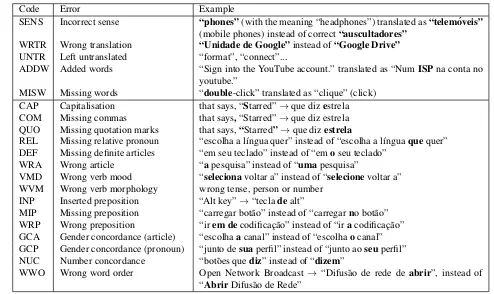
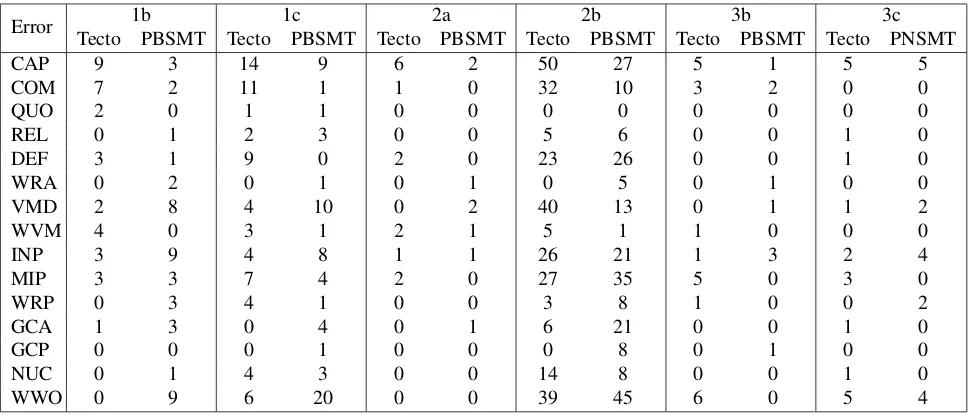
We first analysed the sentences in each group in more de-tails searching for the repetitive error patterns and made a classification of most frequent adequacy and fluency errors (Table 4). Next, we quantified each error type, for fluency and for adequacy separately (Tables 5 and 6).
4.2.1. Adequacy Errors
In terms of adequacy, it seems that the main difference in the performance of the TectoMT system and the PBSMT system lies in the number of untranslated words – UNTR (Table 5). In the cases where the output of both systems was rated as equally good (group 2a), the PBSMT sys-tem was found to have a slightly higher number of un-translated words (UNTR) and additional words (ADDW).
6The difference in adequacy scores was significant at a 0.05
level.
In the cases where the output of both systems was rated as equally bad (group 2b), the output of the PBSMT sys-tem had a significantly higher number of wrongly translated words (WRTR), untranslated words (UNTR), added words (ADDW), and missing words (MISW), while the output of the TectoMT system had two times higher number of word sense errors (SENS).
4.2.2. Fluency Errors
Overall, it seems that the hybrid system more often fails in punctual cases like capitalisation (CAP), missing punctua-tion (COM, QUO), while the PBSMT system leads to more reordering errors (WWO) by inverting the verb+object or-der. In those cases where the output of both systems was rated as bad, but the output of the hybrid system was rated as slightly less bad (group 1c), it seems that human evalu-ators put more weight on the errors in word order (WWO) and wrong verb mood (WVM) made by the PBSMT system than on the capitalisation errors (CAP), punctuation errors (COM), and errors in prepositions (MIP and WRP) made by the hybrid system.
5.
Discussion
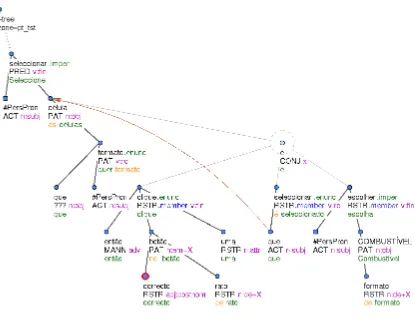
[image:5.595.54.539.195.403.2]Figure 2: The target t-tree with a wrong word order (the nodecorrectoshould be placed after the nodebot˜ao).
mood, and wrong word order) in order to search for their origin (whether they are the result of mistakes made during the analysis, transfer, or synthesis phase).
5.1.
Capitalisation errors (CAP)
By inspecting the a-trees and t-trees of the sentences con-taining capitalisation errors, e.g. Examples (1) – (3), we noticed that this type of errors originates from the transfer phase. In the current version of the TectoMT system, the capitalisation is maintained only for the tokens at the be-ginning of a sentence.
(1) Source: You have to go toFormat>Uppercase.
(2) Translation: Dever´a ir aformato>Uppercase.
(3) Reference: Dever´a ir aFormatar>Mai´usculas.
Our examination revealed that the correctly capitalised tar-get words (within the sentence) appear only in the cases of the wrong transfer of the original source lemmas (when the transfer is done by simply cloning the source lemma). This error is fairly easy to avoid. A possible solution would be to implement a block which forces all the nodes of the source tree with a capitalised letter to be capitalised in the corresponding node in the target tree.
5.2.
Wrong verb mood (VMD)
This type of errors, e.g. Examples (4) – (6), appear due to mistakes in the analysis and transfer phases which lead to a
target tree with a missing #perspron (personal and posses-sive pronouns) node.
(4) Source: In the Google Drive sitegoto the tab Re-cent.
(5) Translation: No site de conduc¸˜ao de Googlevaiao separador recente.
(6) Reference: No site do Google drivev´aat´e ao sepa-rador Recente.
This prevents the identification of the grammatical values of the subject and the correct agreement between subject and verb.
5.3.
Wrong word order (WWO)
In most cases, the wrong word order in the output of the TectoMT system, e.g. Examples (7) – (9), originates from the wrong analysis phase which leads to an incorrect part-of-speech tagging or from the missing block (currently be-ing implemented) for handlbe-ing the:postnomformeme.
(7) Source: Click therightmouse button.
(8) Translation: Clique nocorrectobot˜ao de rato.
(9) Reference: Clique no bot˜aodireitodo rato.
In this case, the node correcto with the formeme
:postnomshould be reordered and placed after debot˜ao
6.
Conclusions
We addressed the problem of domain-specific MT for a lan-guage pair for which only very small amount of training data is available. The results of our experiments showed that, in such case, performance of a hybrid MT system sig-nificantly improves with addition of a small amount of in-domain bilingual terminology (approx. 14,000 entries) to the very small in-domain training corpus (2,000 sentence pairs). They also indicated that addition of a larger out-of-domain corpus only improves the performance of the PB-SMT system and not the hybrid MT system.
The extensive in-depth error analysis of the output of the hybrid and PBSMT systems trained on the same dataset (small in-domain corpus with added bilingual terminol-ogy), directly compared and analysed sentence by sentence, reported the output of the hybrid system as better than the output of the PBSMT system. The hybrid system mostly failed in capitalisation and retaining punctuation marks, while the PBSMT system had a greater number of reorder-ing errors, untranslated tokens and missreorder-ing words.
Acknowledgements
This work has received support by the EC’s FP7 (FP7/2007-2013) under grant agreement number 610516: “QTLeap: Quality Translation by Deep Language Engineering Ap-proaches”.
7.
References
Aziz, W. and Specia, L. (2011). Fully Automatic Compi-lation of a Portuguese-English Parallel Corpus for Sta-tistical Machine Translation. InProceedings of the 8th Brazilian Symposium in Information and Human Lan-guage Technology, Cuiab´a, MT, October.
Bojar, O. and T´ynovsk´y, M. (2009). Evaluation of Tree Transfer System. Euromatrix project (statistical and hybrid machine translation between all european lan-guages), deliverable 3.4, Charles University in Prague. Costa, A., Lu´ıs, T., and Coheur, L. (2014). Translation
Errors from English to Portuguese: an Annotated Cor-pus. InProceedings of the 9th International Conference on Language Resources and Evaluation (LREC), pages 1231–1234.
Heafield, K. (2011). KenLM: Faster and Smaller Lan-guage Model Queries. In Proceedings of the EMNLP 2011 Sixth Workshop on Statistical Machine Translation, pages 187–197, Edinburgh, Scotland, United Kingdom, July.
Koehn, P., Och, F. J., and Marcu, D. (2003). Statisti-cal phrase-based translation. InProceedings of the Con-ference of the North American Chapter of the Associa-tion for ComputaAssocia-tional Linguistics on Human Language Technology - Volume 1, pages 48–54. Association for Computational Linguistics.
Koehn, P., Hoang, H., Birch, A., Callison-Burch, C., Fed-erico, M., Bertoldi, N., Cowan, B., Shen, W., Moran, C., Zens, R., Dyer, C., Bojar, O., Constantin, A., and Herbst, E. (2007). Moses: Open source toolkit for statistical machine translation. InProceedings of the 45th Annual Meeting of the Association for Computational Linguis-tics (ACL). ACL.
Koehn, P., Birch, A., and Steinberger, R. (2009). 462 Ma-chine Translation Systems for Europe. InProceedings of the MT Summit XII, pages 65–72.
Koehn, P. (2004). Statistical Significance Tests for Ma-chine Translation Evaluation. In Proceedings of the Empirical Methods in Natural Language Processing (EMNLP), pages 388–395.
Koehn, P. (2005). Europarl: A Parallel Corpus for Statis-tical Machine Translation. InProceedings of the Tenth Machine Translation Summit, pages 79–86.
Mareˇcek, D., Popel, M., and ˇZabokrtsk´y, Z. (2010). Max-imum entropy translation model in dependency-based MT framework. In Proceedings of the Joint 5th Work-shop on Statistical Machine Translation and Metrics-MATR, pages 201–206.
Och, F. J. and Ney, H. (2003). A systematic comparison of various statistical alignment models. Computational Linguistics, 29(1):19–51.
Och, F. (2003). Minimum Error Rate Training in Statisti-cal Machine Translation. InProceedings of the 41st An-nual Meeting of the Association for Computational Lin-guistics (ACL), pages 160–167. Association for Compu-tational Linguistics.
Papineni, K., Roukos, S., Ward, T., and Zhu, W.-J. (2002). BLEU: a Method for Automatic Evaluation of Machine Translation. InProceedings of the 40th Annual Meeting of the Association for Computational Linguistics (ACL), pages 311–318.
Sgall, P., Hajicov´a, E., and Panevov´a, J. (1986). The Mean-ing of the Sentence in Its Semantic and Pragmatic As-pects. Springer Science & Business Media.
Silva, J., Rodrigues, J., Gomes, L., and Branco, A. (2015). Bootstrapping a hybrid deep MT system. InProceedings of the Fourth Workshop on Hybrid Approaches to Trans-lation (HyTra), pages 1–5. ACL.
ˇStajner, S., Rodrigues, J., Gomes, L., and Branco, A. (2015). Machine Translation for Multilingual Trou-bleshooting in the IT Domain: A Comparison of Dif-ferent Strategies. In Proceedings of the Deep Machine Translation Workshop (DMTW), pages 106–115. ˇ