UIMA-based JC
O
R
E
2.0 Goes G
IT
H
UB
and M
AVEN
C
ENTRAL
—
State-of-the-Art Software Resource Engineering and
Distribution of NLP Pipelines
Udo Hahn
1Franz Matthies
1Erik Faessler
1Johannes Hellrich
1 2 1Jena University Language & Information Engineering (JULIE) Lab2Research Training Group “The Romantic Model. Variation - Scope - Relevance”
Friedrich-Schiller-Universit¨at Jena Jena, Germany
http://www.julielab.de
Abstract
We introduce JCORE2.0, the relaunch of a UIMA-based open software repository for full-scale natural language processing originating from theJena University Language & Information Engineering (JULIE) Lab. In an attempt to put the new release of JCOREon firm software engineering ground, we uploaded it to GITHUB, a social coding platform, with an underlying source code versioning system and various means to support collaboration for software development and code modification management. In order to automate the builds of complex NLP pipelines and properly represent and track dependencies of the underlying JAVAcode, we incorporated MAVEN
as part of our software configuration management efforts. In the meantime, we have deployed our artifacts on MAVENCENTRAL, as well. JCORE2.0 offers a broad range of text analytics functionality (mostly) for English-language scientific abstracts and full-text articles, especially from the life sciences domain.
Keywords: natural language processing pipelines, open software repository, software engineering, software configuration man-agement, collaborative code manman-agement, JCORE, UIMA, GITHUB, MAVENCENTRAL
1.
Introduction
A true sign of the growing maturity of natural language processing is the continuous production of reusable code (e.g., for POS tagging, parsing, WSD, reference resolution, etc.) and language data resources (e.g., annotated corpora or computational lexicons). For a long time, a common way to share such artifacts has been to create a publically accessible space on one’s own site, list available resources, and, after acknowledgment of licencing conditions, allow download of either source code or binaries.
We have been following this passive directory model for many years with our own NLP tool suite, the JULIE
Lab UIMA Component Repository (JCORE; Hahn et al. (2008)), as well. JCORE– based on the UIMA middleware framework1– assembled (following UIMA speak) several collection readers (for document input), analysis engines (for NLP core tasks, e.g., document and sentence segmen-tation, named entity tagging or acronym resolution) and CAS consumers (e.g., for storing analysis results in an in-dex structure). These resources were hosted and made pub-lically accessible via http://www.julielab.de/ Resources/JCoRe+NLP+Tools.html.
This service for the NLP community, despite the positive feedback we got from our users, increasingly also generated several problems which can be summarized as follows:
• Some modules maintained on an irregular basis be-came outdated (e.g., the MEDLINE2 reader needs
1https://uima.apache.org/ 2M
EDLINEis a bibliographical database for life sciences doc-uments which currently comprises more than 25M references; for more details, cf. https://www.nlm.nih.gov/bsd/ pmresources.html
adaptation to the yearly updated MEDLINE XML schema),
• Bug fixes from external users or functional extensions they asked for were hard to integrate in the daily work-flow. This is mainly due to the change patterns of the personnel working in academic software labs (e.g., the original developers of a piece of software leave after having completed their Master or Doctoral thesis, new staff entering usually focuses on novel goals rather than caring much about legacy software from former students). Hence, responding adequately to such feed-back was not always easy to manage,
• Due to the lack of an automated build and release pro-cess, the tools on our web page had to be updated manually. This could lead to large discrepancies be-tween the latest state of the source code in our private version control systems and the version published on JULIELab’s web site. Hence, the integration of exter-nal feedback was even more impeded by the fact that suggestions from external users could refer to obsolete versions of our code,
• A communication bottleneck occurred on our lab’s side since a growing number of users contacted us for support (e.g., concerning installation problems),
• The UIMA framework on which JCOREis based of-ten posed problems for users of our resources not so (well) acquainted with this environment. Hence, some UIMA tutoring and consulting was necessary for run-ning JCOREtools outside the JULIELab,
them locally using the UIMA PEARinstaller and then creating a UIMA pipeline descriptor. Since PEAR
packages are installed in local directories, including library dependencies, such a pipeline could not eas-ily be shared, e.g., by collaborators within the same group.
Other well-known representatives in the NLP domain who also adhere to the passive model for software distribution outlined above are, for instance
• LINGPIPE:http://alias-i.com/lingpipe
• GATE:3https://gate.ac.uk/
Despite the progress revealed by such repositories, from a software development perspective some fundamental short-comings are evident. First, the interaction between produc-ers and consumproduc-ers of software housed in such repositories is fundamentally asymmetric and non-interactive. When the modules of choice have been downloaded from such sites they can be used on an ‘as is’ basis. But if bug fixes or reasonable extensions have been carried out at external sites, they have to be reported back informally, usually via email, to the original developers in a ‘private’ exchange mode. Also the channels for such software change commu-nication are entirely decoupled from the platforms on which software development takes place. Furthermore, often no routine software engineering support (for version tracking, code merging, testing of modified code, etc.) is provided for professionally administering the proposed changes of the sources at the origin. So, embedded collaboration sup-port is a clear desideratum.
Within the field of software engineering, team support for software developers has increasingly become a major con-cern (Mistr´ık et al., 2010). The growing relevance of social media for team building and collaborative, communication-intense group work has further fueled the emergence of so-calledsocial coding platforms(for a survey of major play-ers, cf. Begel et al. (2013)). One of the most prominent exemplars of this breed of software development frame-works is GITHUB4(Dabbish et al., 2012). With GITHUB, users are in command of a large-scale workspace where they place their software in repositories which are man-aged by a powerful version management system. Differ-ent change managemDiffer-ent policies and collaboration meth-ods for the communication, notification (activity awareness and tracing) and visualization of source code changes on the basis of opted-in social roles (followers, watchers, etc.) are at the heart of GITHUB, thus adapting the social net-work metaphor to software development.
The enhanced opportunities and increased productivity gained by this and other comparable novel software devel-opment frameworks created entirely new communities of practice. This development had also a strong appeal for the NLP community. Many groups who once adhered to the passive directory model changed their rules of the game and subscribed to this collaborativesocial coding modelin the NLP domain, for instance
3
The developers of GATE, in the meantime, provide their com-ponents via MAVENCENTRAL.
4
https://github.com/
• STANFORD TOOLS: https://github.com/ stanfordnlp/CoreNLP, the primary site sits on GITHUB
• DKPROCORE:https://github.com/dkpro/ dkpro-core, the primary site sits on GITHUB
• NLTK: https://github.com/nltk/nltk, the primary site sits on GITHUB
• OPENNLP: https://github.com/apache/ opennlp, GITHUB repository is a mirror of an SVN repository – their source code is located at
https://svn.apache.org/repos/asf/ opennlp/trunk/
• UIMA: https://github.com/apache/ uima-uimaj, GITHUB repository is a mirror of an SVN repository – their source code is located at http://svn.apache.org/repos/asf/ uima/addons/trunk/
As some application fields pose highly specific challenges for NLP pipelines (e.g., anonymization in the medical arena, gene or chemical name recognition in the fields of biology and chemistry, respectively), even for such special-ized areas comprehensive NLP portals have been created— originally under the passive directory model, now increas-ingly moving to GITHUBas well, such as
• CTAKES (for medicine): https://github. com/apache/ctakes; (currently) seems incom-plete on GITHUB, compared with the mirror at the project’s web site under http://ctakes/ apache.org/
• JCORE (for biology): http://julielab. github.io; the older version of JCORE main-tained under http://www.julielab.de/ Resources/JCoRe+NLP+Tools.html has become obsolete with the current publication of JCORE2.0 on GITHUB.
Social interaction offers lots of unprecedented opportuni-ties for efficient and effective coding. But keeping track of intrinsic inter-module dependencies and not losing con-trol of versatile changes in complex software architectures introduces yet another orthogonal dimension of organiza-tional complexities into distributed coding processes. To properly document and lucidly track dependencies be-tween pieces of code and even allow to automate the build-ing of large-scale software projects, MAVEN5 has turned out as a convenient build management and comprehen-sion tool centered around the concept of a project object model (POM). To fully exploit the usage of MAVEN for JCORE, the deployment of our software to MAVENCEN
-TRALhas become the second software engineering corner-stone of the release of JCORE 2.0. Interestingly, with the exception of LINGPIPE and NLTK,6 all other major
5
https://maven.apache.org/
6
NLP tool suites (i.e., STANFORDTOOLS, DKPROCORE, OPENNLP, UIMA) have also been moving to deploy their
software to MAVENCENTRAL.
2.
JC
OR
E2.0 —
J
ULIEComponent Repository
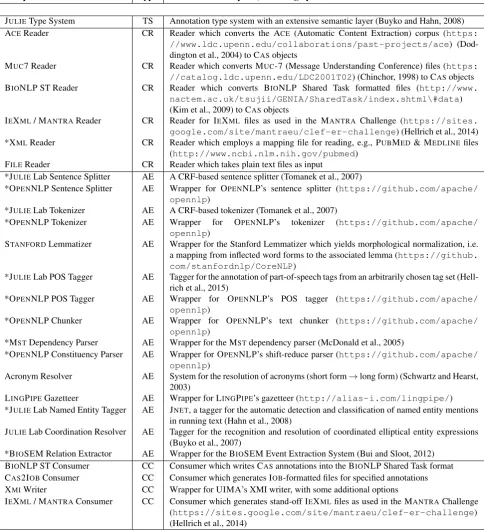
With JCORE 2.0, we relaunch the JULIE Component Repository in conformance with contemporary software de-velopment and engineering standards. This step is intended to not only simplify the accessibility and usability of our tools, but also implies that we commit ourselves to more rigid and frequent release cycles. JCORE 2.0 features, at the time of this writing (March 2016), 25 components (see Table 1), all written in JAVA. They are either self-developed JULIELab software or wrappers for third-party tools which we made compatible with UIMA and, more specific, with our type system (Buyko and Hahn, 2008). NLP pipelines within the UIMA framework we subscribed to can be con-figured from the following types of components:
• groups of severalcollection readers (CR) which en-able users to access annotation information from other projects and corpora,
• several analysis engines (AE) which constitute the main part of an NLP pipeline ranging from low-level tasks such as tokenization to high-end functionality (e.g., dependency parsing, relation extraction, etc.),
• a couple ofCAS consumers(CC) which export the an-notations to different formats, and
• last but not least, the JULIE Lab type system (TS) which forms a comprehensive annotation type defini-tion scheme.
Table 1 lists all components with a short description of their functionality and, if applicable, a reference to the descrip-tion of the underlying module. Further informadescrip-tion will be accessible from their respective GITHUB entry or their POM file. Compared with our initial JCORE repository (Hahn et al., 2008), some components are missing. These are either obsolete (e.g., the CAS2DB Consumer) or ob-tainable from other sources, as in the case of the LUCENE
INDEXERwhich is now featured in the UIMA SANDBOX7
(Faessler et al., 2009). For the majority of our AEs, we de-rived special packages consisting of the base component, a pre-trained model and a fitting UIMA component descrip-tor for ‘out of the box’ use.8These packages are bundled as JCOREProjectsand also available on MAVEN CENTRAL
and GITHUB. In Section 5., we will provide a short docu-mentation on how to best use our newly packaged reposi-tory.
As already mentioned, we decided to tackle the problems of lacking visibility, collaboration, reuse and availability of JCORE by moving the tool suite to an open development framework. We committed ourselves to GITHUB in order
7
https://uima.apache.org/sandbox.html# lucas.consumer
8AEs for which such a package exists are marked accordingly with ‘*’ in Table 1.
to provide a platform for an unobstructed and interactive software exchange and MAVENCENTRAL9for giving users
of JCORE2.0 the capability to access all of its components without much impediments. In this manner, we pave the way to easily plug together NLP pipelines without the need to worry much about UIMA technicalities.
Thus, the goal of making JCORE2.0 tools public was, and still is, not only to provide a comfortable setting for our own work, but, first and foremost, to offer the scientific community easy to follow workflows to partake of results of cutting-edge research conducted in our lab. For instance, the newly added JULIE Lab part-of-speech tagger (JPOS) outperformed both the OPENNLP and the Stanford POS Tagger with regard to POS tagging in the German medical and newspaper domain (Hellrich et al., 2015).
As this paper describes the relaunch of an already ac-knowledged component repository with focus on its new paradigm, in the following, we will only give a concise re-cap of the different categories our components are divided into, with some general remarks about the workings of the latter. If needed, a more precise description can be found in Hahn et al. (2008) or the respective GITHUBpage.
2.1.
Type System
The data structure backbone of JCOREis still our compre-hensive annotation type system (Buyko and Hahn, 2008). It offers a broad range of types to use in the context of various text analytics task—on a basic annotation level lin-guistic types like sentence, token, abbreviation, part-of-speech types, etc., or on a formal document structure level types such astitle,abstract,paragraph, etc. Moreover the type system supports a substantial semantic layer for the biomedical domain including entities (such as gene, or-ganism, cell), relations and events (e.g., various forms of protein-protein interactions). As this type system was al-ready very elaborate and covered a large variety of morpho-syntactic and semantic features, there was not much to add except for some restructuring and minor extensions.
2.2.
Collection Readers
JCORE 2.0 features six different collection readers which can be thought of as preprocessors for the actual text analysis tasks. Four of them (the ACE, BIONLP ST, IEXML/MANTRA and MUC7 Reader) comply with spe-cific task-dependent file formats to feed the UIMA pipeline with semantically annotated text from the respective shared task—from the biomedical domain (BIONLP ST and MANTRA) and the newswire domain (ACEand MUC7).10 The other two (XMLand FILEReader) are more general in
nature and read XMLfiles or plain text files, respectively. The former reader is extensible by a mapping file to con-form to specific con-formats (e.g. MEDLINEor PUBMED; cf. Footnote 2).
2.3.
Analysis Engines
The analysis engines are at the heart of every UIMA pipeline and are (in the case of JCORE) responsible for
9http://search.maven.org/ 10However, the B
Component Type Functional Description, Including Specification of Sources and References
JULIEType System TS Annotation type system with an extensive semantic layer (Buyko and Hahn, 2008) ACEReader CR Reader which converts the ACE (Automatic Content Extraction) corpus (https:
//www.ldc.upenn.edu/collaborations/past-projects/ace) (Dod-dington et al., 2004) to CASobjects
MUC7 Reader CR Reader which converts MUC-7 (Message Understanding Conference) files (https: //catalog.ldc.upenn.edu/LDC2001T02) (Chinchor, 1998) to CASobjects BIONLP ST Reader CR Reader which converts BIONLP Shared Task formatted files (http://www.
nactem.ac.uk/tsujii/GENIA/SharedTask/index.shtml\#data) (Kim et al., 2009) to CASobjects
IEXML/ MANTRAReader CR Reader for IEXML files as used in the MANTRA Challenge (https://sites. google.com/site/mantraeu/clef-er-challenge) (Hellrich et al., 2014) *XMLReader CR Reader which employs a mapping file for reading, e.g., PUBMED& MEDLINEfiles
(http://www.ncbi.nlm.nih.gov/pubmed) FILEReader CR Reader which takes plain text files as input
*JULIELab Sentence Splitter AE A CRF-based sentence splitter (Tomanek et al., 2007)
*OPENNLP Sentence Splitter AE Wrapper for OPENNLP’s sentence splitter (https://github.com/apache/ opennlp)
*JULIELab Tokenizer AE A CRF-based tokenizer (Tomanek et al., 2007)
*OPENNLP Tokenizer AE Wrapper for OPENNLP’s tokenizer (https://github.com/apache/ opennlp)
STANFORDLemmatizer AE Wrapper for the Stanford Lemmatizer which yields morphological normalization, i.e. a mapping from inflected word forms to the associated lemma (https://github. com/stanfordnlp/CoreNLP)
*JULIELab POS Tagger AE Tagger for the annotation of part-of-speech tags from an arbitrarily chosen tag set (Hell-rich et al., 2015)
*OPENNLP POS Tagger AE Wrapper for OPENNLP’s POS tagger (https://github.com/apache/ opennlp)
*OPENNLP Chunker AE Wrapper for OPENNLP’s text chunker (https://github.com/apache/ opennlp)
*MSTDependency Parser AE Wrapper for the MSTdependency parser (McDonald et al., 2005)
*OPENNLP Constituency Parser AE Wrapper for OPENNLP’s shift-reduce parser (https://github.com/apache/ opennlp)
Acronym Resolver AE System for the resolution of acronyms (short form→long form) (Schwartz and Hearst, 2003)
LINGPIPEGazetteer AE Wrapper for LINGPIPE’s gazetteer (http://alias-i.com/lingpipe/) *JULIELab Named Entity Tagger AE JNET, a tagger for the automatic detection and classification of named entity mentions
in running text (Hahn et al., 2008)
JULIELab Coordination Resolver AE Tagger for the recognition and resolution of coordinated elliptical entity expressions (Buyko et al., 2007)
*BIOSEM Relation Extractor AE Wrapper for the BIOSEM Event Extraction System (Bui and Sloot, 2012) BIONLP ST Consumer CC Consumer which writes CASannotations into the BIONLP Shared Task format CAS2IOBConsumer CC Consumer which generates IOB-formatted files for specified annotations XMIWriter CC Wrapper for UIMA’s XMI writer, with some additional options
[image:4.595.54.539.78.610.2]IEXML/ MANTRAConsumer CC Consumer which generates stand-off IEXMLfiles as used in the MANTRAChallenge (https://sites.google.com/site/mantraeu/clef-er-challenge) (Hellrich et al., 2014)
Table 1: Overview of the JCORE2.0 Component Repository
the actual text processing. JCORE2.0 contains at the time of this writing 15 AEs which deal with either morpho-syntactic or semantic processing.
Morpho-Syntactic Processing. Token and sentence seg-mentation is taken care of by a wrapper for the OPENNLP tool suite based on Maximum Entropy (ME) mod-els (Berger et al., 1996) and a self developed tool based on Conditional Random Fields (CRF) (Lafferty et al., 2001). In order to deal with morphological variation of words, we provide the Stanford Lemmatizer. This component takes at least tokenized and POS-tagged text and returns
a dictionary form of each word. To provide the afore-mentioned part-of-speech (POS) tags, we supply a wrapper for OPENNLP’s POS tagger and a self developed compo-nent (Hellrich et al., 2015). The tool set for syntactic anal-ysis features a phrase chunker, a constituency parser (both wrappers for OPENNLP) and a slightly modified version of the MSTPARSER (McDonald et al., 2005), a parser for non-projective dependency structures, where we adapted the source code to UIMA’s workflow so that models are only loaded once in the course of the initialization phase.
finding a full form for a corresponding short form or ab-breviation, such as forUN→United Nations) is supported by our reimplementation of the Schwartz-Hearst algorithm (Schwartz and Hearst, 2003). Named entities are han-dled by two different tools: one is based on LINGPIPE’s gazetteer and the other is JNET, a CRF-based entity tag-ger developed at JULIE Lab that can be used for arbitrary domains and entity classes given appropriate training mate-rial (Hahn et al., 2008). Thirdly, for the recognition and resolution of coordinated elliptical entity expressions we currently only provide a Lab-made rule-based tagger. A machine learning-based tagger became nonfunctional as a result of switching to new versions because of global de-pendencies in JCORE 2.0 and, thus, needs a major over-haul.
Finally, as JCORE’s top level analysis component, we in-tegrated the BIOSEM relation extractor (Bui and Sloot,
2012) into our repository. It not only achieves state-of-the-art performance in tasks dealing with the extraction of events and relations in the biomedical domain,11 but also excels with truly competitive compute-time performance data when compared to relation extractors which use de-pendency parsing, as well as with small-sized models.
2.4.
CAS Consumers
The CAS consumers are the post-processors of a UIMA pipeline and deploy the results of the AEs in different for-mats depending on the actual consumer. These forfor-mats could either be text/XML files, databases or, like in the case of the LUCENEINDEXER(Faessler et al., 2009), even more sophisticated outputs. JCOREconsists of four
differ-ent consumers, two of which are more specific and accom-pany the corresponding CRs, namely the BIONLP ST Con-sumer and the IEXML/MANTRAConsumer which generate files expected by the appropriate task. The XMI Writer is a more complex wrapper around the UIMA inherent XMICASSERIALIZERas it also allows single or multiple files to be compressed into zip files. The CAS2IOBWriter produces IOB-formatted text files and can be adjusted to limit the output to specific annotation types only.
As already mentioned the CAS2DBCONSUMERfell victim to our updating process, as many dependencies need to be restructured to fit into the new JCOREscheme. Its revital-ization is on the agenda for future versions of JCORE.
3.
G
ITH
UBIn the past years, GITHUB has become the most
popu-lar Web-based social code sharing service world-wide.12 Based on the GIT distributed version control system,13 it has emerged as an essential tool in technology areas that re-quire intense human group collaboration for effective task completion, such as software development, technical and business co-authoring, education, etc. (Begel et al., 2013).
11In theBioNLP 2013 Shared Task, the system ranked 3rd and 1st regarding approximate and strict matching, respectively. In the
2011 Shared Taskit ranked 1st for full texts and 3rd for abstracts. 12
As of March 2016, there are 12M people collaborating across 31M repositories on GITHUB; seehttps://github.com/ about/press
13https://git-scm.com/
GITHUB’s positive impact on such collaboration processes (as reported, e.g., by Tsay et al. (2012)) is mainly due to the awareness and transparency features it provides to team, project and community members (Dabbish et al., 2012). The following description, quoted from Zagalsky et al. (2015), nicely summarizes the main features of GITHUB (for another brief summary, cf. Dabbish et al. (2012)[p.1280]). It “offers several unique features to fa-cilitate user collaboration. Its most important feature is the Pull Request (PR) mechanism which is a way to ini-tiate discussion with other users and share or comment on the various artifacts in a project (typically changes to the project’s content). The discussion may include code that is visible to everyone and it shows the exact changes that would be merged if the PR were accepted. A PR may in-volve other content (e.g., screenshots) to provide a back-ground for the discussion, or include changes to other re-sources in the project.
When a user wishes to contribute to someone else’s project, they can Clone14 the project to create a full copy of the project in their local environment, but where committed changes will still affect the original project. This is called aShared Repository Model:15 contributors can either com-mit changes directly into the shared repository or use PRs to start code reviews and conversations about proposed changes before the changes are merged into the master branch.
Alternatively, a user canFork16the entire project to create a parallel project where committed changes do not directly affect the original project. This is called a Fork & Pull Model: PRs provide a way to notify the original project maintainers about the changes you would like them to con-sider.
Users can not only follow other users or projects of interest, but they can also broadcast their activities to their follow-ers. Furthermore, users can discover new projects by using theExplorefeature, or share snippets using theGistfeature. GITHUBalso supports awareness by broadcasting updates to the user’s news feed. The combination of these features facilitates“a culture of spontaneous-but-structured collab-oration”.”17 (Zagalsky et al., 2015)[p.1907-08].
4.
Maven
MAVEN, the widely used JAVAdependency and build man-agement tool, communicates and interacts by default with The Central Repositorywhich offers the largest collection of JAVAcomponents.18 This forms the already mentioned MAVENCENTRAL, where we will deploy all JCORE 2.0 components and their dependencies; nearly all of the de-pendencies that were not developed by us are already
14https://help.github.com/articles/
duplicating-arepository
15https://guides.github.com/introduction/
flow/
16
https://help.github.com/articles/ fork-a-repo
17
tp://software-carpentry.org/blog/2012/ 04/github-for-education.html
18http://central.sonatype.org/pages/about.
present there.
To facilitate a uniform build system, each MAVENproject features as its core a POMfile which is the pivotal point in
the format of an XML file that not only specifies project metadata but also handles configuration, e.g., resolving dependencies. This might arguably be one of the main strengths of MAVEN, in general. It empowers the user to simply declare what other components are needed for a project and the appropriate libraries are automatically and dynamically loaded into the project’s building path, either from theLocalor theRemote Repository,19if they are non-existent in the former or newer in the latter. This results in a plethora of well-maintained and up-to-date libraries all of them accessible in an comprehensible way. For well-known and frequently used JAVAIntegrated Development Environ-ments (IDEs, such as ECLIPSE, NETBEANS or INTELLI
IDEA), there also exist MAVEN plug-ins that make the preparation and modification of POMs even more handy.
5.
JC
OR
E2.0—How to
Naturally, with the transition to JCORE 2.0 and the farewell from a passive model of software development and distribution, we refrained from providing PEARpackages. There are now basically two ways of using the components of our repository to plug together NLP pipelines which we will describe, in brevity, in the following.20 The JCORE
Pipelines Repositorycontains projects that exemplify both strategies. Regardless of which approach is chosen, one needs to operate with JAVA, MAVENand UIMA.
DECLARATIVE. On the one hand, there is the declarative approach where one utilizes a so-calledCollection Process-ing Engine(CPE), an XML file which declares which com-ponents and respective settings to use. At the time of this writing, we are working on a reference sheet where the po-tential user will find the coordinates for each component to fill out these CPEs and scripts that will provide an easy way to prepare the pipeline (e.g., checking if all is set up cor-rectly and downloading the appropriate MAVENartifacts). Using, understanding and/or modifying code is not neces-sary for this method.
PROCEDURAL. On the other hand, a more programmatic approach is to employ, for instance, UIMA FIT21 in or-der to simplify the description and instantiation of com-ponents and write the actual pipeline in JAVA code. This variant offers its users a conspicuous level of control over the pipeline. As with the former procedure, MAVENtakes care of the dependency resolution and loads the necessary libraries dynamically into the workspace.
This technique leads to an even more proactive mode, if one is willing to collaborate in further development and/or bug-fixing of our components by downloading the up-to-date
19
Simply speaking, aRemote Repositoryis, for instance, the aforementioned Central Repository but can also be set up and specified to be on a private server. TheLocal Repositoryis a cache of the downloads from the former.
20
Some components have a standalone mode, as well. How to use them in this manner will be explained on their respective GITHUBpage.
21https://uima.apache.org/uimafit.html
GITHUB repository and use its content to directly assess any change to a component one has made.
To complete this section, we will give a concise overview of the different relevant repositories into which we have split up JCORE2.0 on GITHUB:
JCOREBase. The Base package contains all basic components—the Type System, all CRs, AEs and CCs. This repository is highly relevant if one is in-terested in active development of JCORE. All projects included come only with a basic descriptor file and are rarely usable on their own since they lack model files.
JCOREProjects. The Project package covers pre-built projects that should be used if one hasn’t the need to train models on one’s own. The components of this repository don’t feature actual code but rather con-sist of a POM file with coordinates to their respective BASEpackage, a fully functional descriptor XML and a model from the biomedical domain. Every BASE
component which needs training is featured at least once here.
JCOREPipelines. In the Pipeline package we provide pre-built pipelines for specific NLP tasks. Each indi-vidual component comes at least with the scripts men-tioned beforehand, a CPEand a POMfile. At the time of this writing (March 2016), it contains a named en-tity detection pipeline that takes simple text files as in-put and returns IOB-formatted files with annotations for entities as output; this pipeline uses the CPE ap-proach. The other component utilizes the BIOSEM re-lation extractor to read text and protein files from the BioNLP Shared Taskin order to produce appropriate event annotation files with a model trained on the 2011 Shared Task data.
6.
Conclusion
In this paper, we described the transition from the initial JCORErepository release which relied on a passive model of software distribution to JCORE2.0 which features a so-cial coding model. This move expresses a clear commit-ment to contemporary standards of an open and collabo-rative software management model as promoted by an in-creasing number of leader groups in the NLP community. As JCORE 2.0 mainly aims to provide tools for the field of biomedical NLP, we believe to have made a major step towards reusability, accessibility and collaboration in this area.
The workflow of initializing adjustments to and modifi-cations of our components is made even easier and can now proceed in an interactive manner. Meaningful and beneficial changes by the community can make it more swiftly into our tool set, as we envisage more frequent release cycles. Even if potential users of JCORE 2.0 are only interested in using our components ‘as is’, the migration to MAVENCENTRALsupplies better and easier access paths.
JCOREcomponents is by following the GITHUBPage
http://julielab.github.io
7.
Acknowledgments
This work is partially supported by grants from the Deutsche Forschungsgemeinschaft (DFG)—Erik Faessler is funded by a grant within the CRC AQUADIVA (SFB 1076), while Johannes Hellrich is funded by a grant from theResearch Training Group “The Romantic Model. Vari-ation - Scope - Relevance”(GRK 2041/1).
8.
Bibliographical References
Begel, A., Bosch, J., and Storey, M.-A. (2013). Social networking meets software development: Perspectives from GITHUB, MSDN, STACKEXCHANGE, and TOP -CODER.IEEE Software, 30(1):52–66.
Berger, A. L., Della Pietra, S. A., and Della Pietra, V. J. (1996). A maximum entropy approach to natural lan-guage processing.Computational Linguistics, 22(1):39– 71.
Bui, Q.-C. and Sloot, P. M. A. (2012). A robust approach to extract biomedical events from literature. Bioinformat-ics, 28(20):2654–2661.
Buyko, E. and Hahn, U. (2008). Fully embedded type sys-tems for the semantic annotation layer. In ICGL 2008 — Proceedings of the 1st International Conference on Global Interoperability for Language Resources. Hong Kong, SAR, January 9-11, 2008, pages 26–33.
Buyko, E., Tomanek, K., and Hahn, U. (2007). Resolu-tion of coordinaResolu-tion ellipses in biological named entities using Conditional Random Fields. InPACLING ’07 — Proceedings of the 10th Conference of the Pacific Asso-ciation for Computational Linguistics. Melbourne, Aus-tralia, September 19-21, 2007, pages 163–171.
Chinchor, N. A. (1998). Overview of MUC-7/MET-2. In MUC-7 — Proceedings of the 7th Message Understand-ing Conference. Fairfax, Virginia, USA, April 29 - May 1, 1998.
Dabbish, L., Stuart, C., Tsay, J. T., and Herbsleb, J. (2012). Social coding in GITHUB: Transparency and collabo-ration in an open software repository. InCSCW ’12 — Proceedings of the ACM 2012 Conference on Computer Supported Cooperative Work. Seattle, WA, USA, Febru-ary 11-15, 2012, pages 1277–1286.
Doddington, G., Mitchell, A., Przybocki, M., Ramshaw, L. A., Strassel, S., and Weischedel, R. M. (2004). The Automatic Content Extraction ACEProgram: Tasks, data & evaluation. InLREC 2004 — Proceedings of the 4th International Conference on Language Resources and Evaluation. In Memory of Antonio Zampolli. Lisbon, Portugal, 24-30 May, 2004, volume 3, pages 837–840. Faessler, E., Landefeld, R., Tomanek, K., and Hahn, U.
(2009). LUCAS: - a LUCENECAS Indexer. In Christian Chiarcos, et al., editors, Von der Form zur Bedeutung: Texte automatisch verarbeiten. From Form to Meaning: Processing Texts Automatically. Proceedings of the Bien-nial GSCL Conference 2009, pages 217–224, T¨ubingen. Gunter Narr Verlag.
Hahn, U., Buyko, E., Landefeld, R., M¨uhlhausen, M., Poprat, M., Tomanek, K., and Wermter, J. (2008). An overview of JCORE, the JULIELab UIMA Component Repository. InProceedings of the LREC ’08 Workshop “Towards Enhanced Interoperability for Large HLT Sys-tems: UIMA for NLP”. Marrakech, Morocco, 31 May 2008, pages 1–7.
Hellrich, J., Clematide, S., Hahn, U., and Rebholz-Schuhmann, D. (2014). Collaboratively annotating mul-tilingual parallel corpora in the biomedical domain: Some MANTRAs. InLREC 2014 — Proceedings of the 9th International Conference on Language Resources and Evaluation. Reykjavik, Iceland, May 26-31, 2014, pages 4033–4040.
Hellrich, J., Matthies, F., Faessler, E., and Hahn, U. (2015). Sharing models and tools for processing German clinical texts. In Ronald Cornet, et al., editors, Digital Health-care Empowering Europeans. Proceedings of the 26th Medical Informatics in Europe Conference — MIE 2015. Madrid, Spain, May 27-29, 2015, number 210 in Studies in Health Technology and Informatics, pages 734 – 738, Amsterdam etc. IOS Press.
Kim, J.-D., Ohta, T., Pyysalo, S., Kano, Y., and Tsujii, J. (2009). Overview of BioNLP ’09 Shared Task on Event Extraction. InBioNLP 2009 — Proceedings of the Com-panion Volume: Shared Task on Event Extraction. Boul-der, CO, USA, June 5, 2009, pages 1–9.
Lafferty, J. D., McCallum, A. K., and Pereira, F. C. N. (2001). Conditional Random Fields: Probabilistic mod-els for segmenting and labeling sequence data. InICML ’01 — Proceedings of the 18th International Conference on Machine Learning. Williams College, Williamstown, MA, USA , June 28 - July 1, 2001, pages 282–289. McDonald, R. T., Pereira, F. C. N., Ribarov, K., and
Hajiˇc, J. (2005). Non-projective dependency parsing using spanning tree algorithms. In HLT-EMNLP 2005 — Proceedings of the Conference on Human Language Technology and Empirical Methods in Natural Lan-guage Processing. Vancouver, B.C., Canada, October 6-8, 2005, pages 523–530.
Ivan Mistr´ık, et al., editors. (2010). Collaborative Software Engineering. Springer-Verlag, Berlin, Heidelberg. Schwartz, A. S. and Hearst, M. H. (2003). A simple
algo-rithm for identifying abbreviation definitions in biomed-ical text. In Russ B. Altman, et al., editors, PSB 2003 — Proceedings of the Pacific Symposium on Biocomput-ing 2003. Kauai, Hawaii, USA, January 3-7, 2003, pages 451–462.
Tomanek, K., Wermter, J., and Hahn, U. (2007). Sen-tence and token splitting based on Conditional Random Fields. InPACLING ’07 — Proceedings of the 10th Con-ference of the Pacific Association for Computational Lin-guistics. Melbourne, Australia, September 19-21, 2007, pages 49–57.
Zagalsky, A., Feliciano, J., Storey, M.-A., Zhao, Y., and Wang, W. (2015). The emergence of GITHUB as a