A Corpus of Clinical Practice Guidelines
Annotated with the Importance of Recommendations
Jonathon Read
♠Erik Velldal
♡Marc Cavazza
♢Gersende Georg
♣ ♠Teesside University, School of Computing♡University of Oslo, Department of Informatics
♢University of Kent, School of Engineering and Digital Arts
♣Haute Autorit´e de Sant´e
[email protected], [email protected], [email protected], [email protected]
Abstract
In this paper we present the Corpus of REcommendation STrength (CREST), a collection of HTML-formatted clinical guidelines annotated with the location of recommendations. Recommendations are labelled with an author-provided indicator of their strength of importance. As data was drawn from many disparate authors, we define a unified scheme of importance labels, and provide a mapping for each guideline.
We demonstrate the utility of the corpus and its annotations in some initial measurements investigating the type of language construc-tions associated with strong and weak recommendaconstruc-tions, and experiments into promising features for recommendation classification, both with respect to strong and weak labels, and to all labels of the unified scheme. An error analysis indicates that, while there is a strong relationship between lexical choices and strength labels, there can be substantial variance in the choices made by different authors.
Keywords:Corpus annotation, Extra-propositional aspects of meaning, Normalised Pointwise Mutual Information, Support Vec-tor Machines
1.
Introduction
Practice guidelines document various recommendations re-garding best practice for particular clinical situations. They provide assistance to medical practitioners and their pa-tients when making decisions about individual health care (Field and Lohr, 1990), and can also influence high-level health care policy making.
Guideline authors often annotate their recommendations with labels that indicate the strength of importance of the statement (see Figure 1 for examples). Such labels present an interesting resource that can add a further dimension to current work in extra-propositional aspects of mean-ing (Morante and Sporleder, 2012; Blanco et al., 2015)— namely the investigation of linguistic constructions that convey the importance of propositions. To support such work we have developed the Corpus of REcommendation STrength (CREST), a collection of clinical guidelines an-notated with instances of recommendations together with their strength of importance as specified by their authors.1
In this paper we introduce related work in Section 2, before describing how we created our corpus in Section 3. Sec-tion 4 presents an initial analysis of some of the features of the strength of importance. Then in Section 5 we present the results and an error analysis of some initial classifica-tion experiments including the discriminaclassifica-tion between the two most frequently occurring labels as they multi-class problem involving all labels. We then conclude in Section 6 and outline our plans for further development and investi-gation of the corpus.
1
The corpus is freely available to download from
http://www.velldal.net/erik/crest/
2.
Related work
Zhang and Xu (2015) created a corpus of emails anno-tated with their importance, where participants solicited through Mechanical Turk (rather than the authors) chose labels of important, normal and not important. The authors found that a machine learning-based classifier could iden-tify unimportant emails with a precision of 54.7%.
Hussain, Michel, and Shiffman (2009) collected a represen-tative sample of guideline recommendations with the aim of understanding how recommendations are written. They noted inconsistencies in lexical and typographical indica-tors, such that almost a third of guidelines contained rec-ommendations that were not clearly identifiable. This cor-pus differs from our own in that: it contains only a subset of the recommendations in each guideline considered whereas ours contains all recommendations; it retains recommenda-tion strength as in-text annotarecommenda-tions rather than the machine-readable versions in our corpus; and it (to our knowledge) is not freely-available.
of this research by considering the interaction of deontic ex-pressions with other extra-propositional aspects of meaning such as speculation (Velldal et al., 2012), and by analysing associations of linguistic features with the explicit labels of recommendation strength.
3.
The corpus
The initial CREST release contains 170 guidelines devel-oped by 69 different institutions. These institutions employ 30 different schemes for the rating of recommendations, with variations in grade labels and descriptions. Below we discuss a unified rating scheme we use for categorising rec-ommendations in the corpus (Section 3.2), after discussing details about the extraction process (Section 3.1).
3.1.
Data collection
The guidelines were obtained from the National Guide-line Clearinghouse,2 a public database maintained by the Agency for Healthcare Research and Quality, of the U.S. Department of Health and Human Services. Using the web interface to search for guidelines where the strength of rec-ommendations are weighted according to a rating scheme yielded 1,808 guidelines; for this initial build of the cor-pus we acquired the first 180 guidelines. Of these 10 were discarded because they did not explicitly label rec-ommendations with weights (contrary to their metadata). The rating scheme and section containing the recommenda-tions were extracted from the remaining guidelines, before manually replacing each textual label of recommendation strength with an attribute attached to the HTML element that corresponded to the scope of the annotation (most typ-ically<p/>or<li/>). In some cases labels of importance
scope subsententially; this was represented by introducing
<span/>elements to record the scope of labels. Finally, the in-text annotations of strength were removed, along with evidence-level3 annotations, if present (under the assump-tion that evidence levels could correlate with recommen-dation strengths and thus become informative but extra-linguistic features of importance). Figure 1 presents a typi-cal example of the manual transformation process.
To promote comparability in future research, the corpus in-cludes suggested partitions, wherein 30% of guidelines are reserved for held-out testing and the remainder are allo-cated into ten folds for cross-validation in developmental experiments.
3.2.
Unified rating scheme
The 170 recommendation guidelines in the corpus em-ploy 30 different rating schemes denoting various subtleties about recommendation strength. The schemes take on a variety of labels and levels of granularity (e.g. some con-sider only strong and weak recommendations, while oth-ers include three or four levels). For instance, the GRADE
2
http://www.guideline.gov/
3
Guidelines are often developed through the evidence-based medicine framework for systematically assessing clinical research findings; some guidelines supplement the strength annotation with an indication of the level of quality of evidence upon which the recommendation is based.
system (Guyatt et al., 2008) distinguishes between strong recommendations (benefits of action clearly outweigh its risks/burdens) and weak recommendations (the balance be-tween benefits and risks/burdens is less clear). Other guide-line schemes offer finer granularity between grades of rec-ommendation strength. Some schemes also single out spe-cial recommendations that are based not on scientific ev-idence but instead on the consensus of experts. Other schemes include a label to indicate that a recommenda-tion could not be made at all because of inconclusive evi-dence. For instance, the U. S. Preventive Task Force grades strength with the letters A–C, with D to indicate recom-mendations against an action, and I to highlight that ev-idence is insufficient to make any recommendation for the given question (U.S. Preventive Services Task Force, 2014). Strength grades are often expressed in terms of the balance between expected benefit and harm for those patients to which the recommendation applies, but some instead are defined according to the quality of evidence upon which the recommendation is based.
Such disparity in strength schemes presents a challenge for research into the choice of linguistic constructions ex-pressing recommendation strength because differences in naming conventions and granularity make it difficult to apply machine learners for making generalisations across schemes. To alleviate these challenges, we map the dis-parate schemes into one unified scheme:
• The labels STRONG, MODERATE, and WEAK are as-signed based on the strength of the associate recom-mendation (strong recomrecom-mendations being the most important while weak recommendations are least im-portant).
• TheCONSENSUSconsensus label is assigned because, while there is insufficient evidence to label a recom-mendation as strong, moderate, or weak, there is nev-ertheless agreement among a committee of experts that the associated action is appropriate.
• The INCONCLUSIVE label is assigned because there is insufficient evidence to label a recomemdnation as strong, moderate or weak, and the committee of ex-perts was unable to reach a consensus on what is an appropriate action.
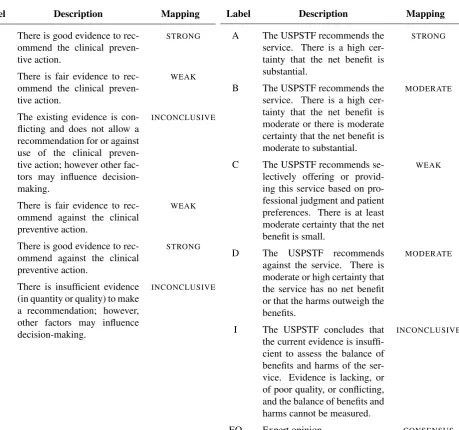
Figure 2 enumerates the labels and associated descriptions for two typical schemes for recommendation strength and the unified labels into which they map.
Mappings were assigned by looking at the grades of a scheme in relation to each other, together with their descrip-tions, and considering the following heuristics in parallel:
• If a unified label matches or is synonymous with the label of a grade or keywords in its description it is a good candidate for mapping.
<p>Clinicians might counsel patients that this symptomatic benefit is possibly maintained for 1 year (Level C), although THC is probably ineffective for improving objective spasticity
measures (short-term) or tremor (Level B).</p> <p>Clinicians might offer Sativex oromucosal cannabinoid spray (nabiximols), where available, to reduce symptoms of spasticity, pain, or urinary frequency, although it is probably
ineffective for improving objective spasticity measures or number of urinary incontinence episodes (Level B).</p>
<p>Clinicians <span recommendation="C"> might counsel patients that this
symptomatic benefit is possibly maintained for 1 year</span>, <span recommendation="B">although THC is probably ineffective for improving objective spasticity measures
(short-term) or tremor</span>.</p> <p recommendation="B">Clinicians might offer Sativex oromucosal cannabinoid spray (nabiximols), where available, to reduce symptoms of spasticity, pain, or urinary frequency, although it is probably ineffective for improving objective spasticity measures or number of urinary incontinence episodes.</p>
Figure 1: An example demonstrating the manual annotation process. Primary HTML is shown on the left, in which recommendation strength is annotated textually. The resulting XML is on the right, where recommendation strength is recorded using attributes on elements, with<span/>elements introduced to indicate subsentential scoping where necessary.
(a)
Label Description Mapping
A There is good evidence to rec-ommend the clinical preven-tive action.
STRONG
B There is fair evidence to rec-ommend the clinical preven-tive action.
WEAK
C The existing evidence is con-flicting and does not allow a recommendation for or against use of the clinical preven-tive action; however other fac-tors may influence decision-making.
INCONCLUSIVE
D There is fair evidence to rec-ommend against the clinical preventive action.
WEAK
E There is good evidence to rec-ommend against the clinical preventive action.
STRONG
L There is insufficient evidence (in quantity or quality) to make a recommendation; however, other factors may influence decision-making.
INCONCLUSIVE
(b)
Label Description Mapping
A The USPSTF recommends the service. There is a high cer-tainty that the net benefit is substantial.
STRONG
B The USPSTF recommends the service. There is a high cer-tainty that the net benefit is moderate or there is moderate certainty that the net benefit is moderate to substantial.
MODERATE
C The USPSTF recommends se-lectively offering or provid-ing this service based on pro-fessional judgment and patient preferences. There is at least moderate certainty that the net benefit is small.
WEAK
D The USPSTF recommends against the service. There is moderate or high certainty that the service has no net benefit or that the harms outweigh the benefits.
MODERATE
I The USPSTF concludes that the current evidence is insuffi-cient to assess the balance of benefits and harms of the ser-vice. Evidence is lacking, or of poor quality, or conflicting, and the balance of benefits and harms cannot be measured.
INCONCLUSIVE
EO Expert opinion. CONSENSUS
Label Instances Length Types
STRONG 1,756 33.9 ±26.8 5,219
MODERATE 373 38.6 ±26.9 2,378
WEAK 1,358 36.0 ±34.5 4,926
CONSENSUS 364 31.4 ±23.1 1,905
INCONCLUSIVE 178 33.7 ±20.3 1,300
overall 4,029 34.8 ±29.2 8,138
Table 1: The composition of the corpus, in terms of the number of instances of each strength of recommendation in the unified scheme, their average length (with standard deviation indicated using±), and vocabulary size.
This is not necessarily the case however (such as in Figure 2a where the descriptions for labels C, D, E and L overrule this heuristic).
• The polarity of a recommendation description should not affect its unified label (such as for labels D and E in Figure 2a).
The mappings are non-destructive as they are specified as a series of unified equivalents associated with each grade definition.
To assess the reliability of such mappings we conducted an inter-annotator agreement study where participants con-sidered scheme labels and their descriptions and selected the most appropriate grade in the unified strength scheme. Using Fleiss’ (1971) Kappa, we found strong agreement between untrained annotators (κ= 0.77,n= 14), suggest-ing that a unified scheme is sufficiently reliable, at least in terms of interpretation by respondents who are not experts in the clinical domain. Interestingly, measuring agreement between two authors of this paper indicated that experience with linguistic analysis does not necessarily result in signif-icantly greater agreement as evidenced by Cohen’s (1960) Kappa (κ= 0.80). Future work will expand this study to consider agreement between health care professionals.
The labels of our unified scheme are listed in Table 1, along with various statistics describing the distribution of recom-mendations in the corpus.
4.
Features of recommendation strength
Some features of recommendation strength may be enumer-ated through introspection; most readers of English can dis-cern the difference in the use ofmust,should, ormay, for example. This corpus presents an opportunity to investi-gate linguistic constructions that are less obviously asso-ciated with the strength of a recommendation. To initiate investigations in this direction we estimated the association between various linguistic features (f) and the labels of the unified strength scheme (l) using normalised pointwise mu-tual information (Bouma, 2009):
NPMI(f;l) = log p(f, l)
p(f)p(l)× 1
−logp(f, l)
NPMI falls in the range[−1,1]where 1 indicates perfect positive correlation, -1 indicates perfect negative correla-tion, and 0 indicates independence. In our experiments we computed probability using maximum likelihood estima-tion based on the number of recommendaestima-tions containing a feature, as observed in the development corpus.
Adopting the semantic orientation approach introduced by Turney (2002) for sentiment polarity, we estimate the strength conveyed by a feature by finding the difference4 between its association withSTRONGandWEAKlabels:
strength(f) =1
2(NPMI(f;STRONG)−NPMI(f;WEAK)) We used the strength measure to score each of the twelve expressions investigated in Lomotan, Michel, Lin, and Shiffman’s (2009) survey of health professionals’ interpre-tation of deontics. The resulting scores correlated reason-ably strongly with the ‘level of obligation’ scores found by Lomotan et al. (Pearson’s r = 0.56), indicating that there are similarities between the results of our respective methodologies.
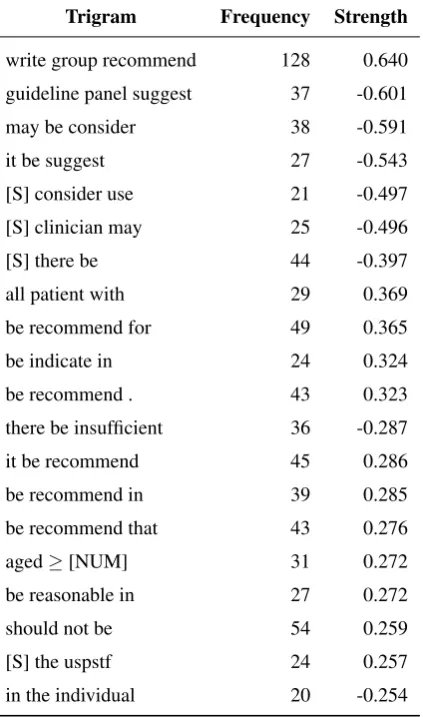
Table 2 lists the twenty highest scoring trigrams found us-ing this measure, where trigrams are formed from lemmas predicted by Stanford’s CoreNLP (Manning et al., 2014). The trigrambe reasonable insuggests a deontic expression not covered by the survey of Lomotan et al. (2009), as in “action X is reasonable for all patients”. Other features are not deontic expressions yet seem reasonable indicators of recommendation strength—for example,all patient with
narrows the focus of a recommendation to all patients of a particular class. Some trigrams seem less intuitive cues of recommendation strength and are perhaps indicative of extra-linguistic phenomena (e.g. [S] the uspstf having a high postive strength suggests that USPSTF guideline de-velopers are more inclined to offerSTRONG recommenda-tions).
5.
Initial classification experiments
To explore the difficulty of automatically predicting the strength labels of recommendations we performed some preliminary classification experiments. Section 5.1 reports results of classification using the two most frequent classes (STRONGandWEAK) together with an error analysis. Sec-tion 5.2 investigates the multi-class problem with experi-ments involving all five labels.5.1.
Discriminating between
STRONGand
WEAKrecommendations
Using Joachims’ (1999) implementation of support vector machines5 we attempted to discriminate between recom-mendations that were eitherSTRONGorWEAK(according to the unified scheme discussed in Section 3.2). We evalu-ated the classification accuracy using ten-fold cross valida-tion on guidelines from the development set, and describing
4If, when estimating feature strength, there are no instances of a feature for a given label observable in the corpus we assume they occur independently (i.e. NPMI(f;l) = 0).
5
SVMlight— available from
Trigram Frequency Strength
write group recommend 128 0.640
guideline panel suggest 37 -0.601
may be consider 38 -0.591
it be suggest 27 -0.543
[S] consider use 21 -0.497
[S] clinician may 25 -0.496
[S] there be 44 -0.397
all patient with 29 0.369
be recommend for 49 0.365
be indicate in 24 0.324
be recommend . 43 0.323
there be insufficient 36 -0.287
it be recommend 45 0.286
be recommend in 39 0.285
be recommend that 43 0.276
aged≥[NUM] 31 0.272
be reasonable in 27 0.272
should not be 54 0.259
[S] the uspstf 24 0.257
in the individual 20 -0.254
Table 2: Top twenty trigrams of lemmas occurring in the corpus, ordered by absolute strength of importance as cal-culated using the strength function. [S] represents the start of a sentence; [NUM] is wildcard where any number ap-plies.
recommendations using features of word forms, lemmas, lemmas with part-of-speech, bigrams, trigrams, and depen-dencies predicted using Stanford’s CoreNLP (Manning et al., 2014), and the trade-off between training error and mar-gin was set automatically by the machine learning package. Table 3 lists the results of the support vector machines com-pared with two baseline approaches to classification:
Majority always selecting the more frequent class, STRONG(57.3%); and
Majority & Deontic Verbs using the properties of deontic verbs by selectingSTRONGwhen observing a verb of obligation and WEAKwhen observing a verb of per-missibility, and backing off to the majority baseline when neither is observed (61.4%),
Support vector machines trained with lemmas offer a sig-nificant improvement in classification accuracy (75.7%).
An error analysis (conducted on 20% of the errors made by support vector machines trained with lemma features) sug-gested that guidelines are somewhat inconsistent with re-spect to lexical choices made forSTRONGandWEAK
rec-Features Accuracy
Baselines
Majority 57.3
Majority & Deontic Verbs 61.4
Support Vector Machines
Words 74.2
Lemmas 75.7
Lemmas with Part-of-Speech 75.6
Bigrams 73.7
Trigrams 68.7
Dependencies 71.8
Table 3: The cross-validated accuracy of baselines and of support vector machines when distinguishing between STRONGandWEAKrecommendations in the development subset.
ommendations. The majority (38.5%) of errors analysed appeared to be due to guideline authors using deontic verbs one might normally associate with the opposite class, for example:
(1) The guideline developers suggest that other method-ologies for repackaged IVFE, such as drawn-down IVFE units, are preferable. [Annotated as STRONG, predicted asWEAK]
(2) Patients should receive a maximum trial period of 16 weeks of therapy. This should comprise 8 weeks at the starting dose of ESA G-CSF and a further 8 weeks at the higher doses, if required. [Annotated asWEAK, predicted asSTRONG].
Conversely, 18.9% of errors occur in sentences that use de-ontic verbs that are associated with their label, and yet were misclassified, for example:
(3) TEE should be performed in patients considered for percutaneous mitral balloon commissurotomy to as-sess the presence or absence of left atrial thrombus and to further evaluate the severity of mitral regurgitation (MR). [Annotated asSTRONG, predicted asWEAK]
(4) A suggestion is made to use ethanol lock to prevent catheter-related bloodstream infections (CLABSI) and to reduce catheter replacements in children at risk of PNALD. [Annotated asWEAK, predicted asSTRONG]
These apparently contradictory types of errors point to noise in the lexical choices associated with labels assigned by the guideline authors; a challenge of this dataset is to automatically identify and handle such noisy examples.
(5) Assess for deterioration of the ulcer or possible infec-tion when the individual reports increasing intensity of pain over time. [Annotated asSTRONG, predicted as WEAK]
(6) Ensure that a complete skin assessment is part of the risk assessment screening policy in place in all health care settings. [Annotated asWEAK, predicted asSTRONG]
The imperative form appeared more frequently in associa-tion withSTRONGrecommendations however—suggesting that its presence may be a useful feature in future classifi-cation experiments.
Other errors (10.8%) were concerning recommendations that communicate facts and definitions rather than actions:
(7) Several studies report changes in nutrient adequacy with caloric restriction, however the extent of nutrient inadequacy and the nutrients affected are dependent on the composition of the diet followed, as well as on the nutritional needs of the individual. [Annotated as STRONG, predicted asWEAK]
(8) Obesity (body mass index [BMI] greater than 30kg/m2) is a condition for which there is no restric-tion on the use of the progestogen-only implant. [An-notated asWEAK, predicted asSTRONG]
Such recommendations contain few explicit cues as to the importance of the reported facts and definitions.
5.2.
Discriminating between all labels
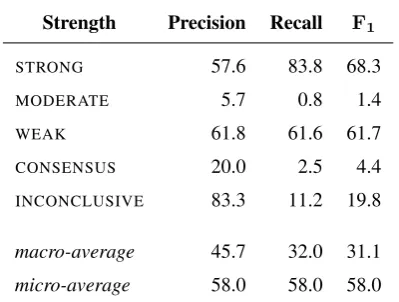
We next performed multi-class classification experiments, using Joachims’ implementation of multi-class support vec-tor machines (Crammer and Yoram, 2001).6 Table 4 lists the cross-validated results of training using lemma fea-tures. We found a macro-averaged F1 of 31.1% and a micro-averaged F1 of 58.0% (which can be compared to the majority-choice baseline macro-average of 20.0% and micro-average of 44.1%).
An error analysis yielded similar findings to those reported above, with the additional observation that the infrequent classes (MODERATE, CONSENSUS, and INCONCLUSIVE) were rarely predicted by the classifier—as can be seen in the contingency table shown in Table 5, they account for only 3.2% of predictions despite occurring with 23.1% of recommendations. Use of cost-sensitive learning can yield significant gains in performance for multi-class text classi-fication problems, especially in case of unbalanced training data such as this (Read et al., 2012).
6.
Conclusions and outlook
This paper has described the development of the Corpus of REcommendation STrength (CREST), a collection of clinical guidelines annotated with recommendations and
6
SVMmulticlass— available from
https://www.cs.cornell.edu/people/tj/svm_ light/svm_multiclass.html
Strength Precision Recall F1
STRONG 57.6 83.8 68.3
MODERATE 5.7 0.8 1.4
WEAK 61.8 61.6 61.7
CONSENSUS 20.0 2.5 4.4
INCONCLUSIVE 83.3 11.2 19.8
macro-average 45.7 32.0 31.1
micro-average 58.0 58.0 58.0
Table 4: The results of predicting recommendations’ labels of importance, using support vector machines trained with lemma features. Compare with a baseline of always select-ing the majority class (STRONG) which achieves a macro-averagedF1of 20.0% and a micro-averagedF1of 44.1%.
their corresponding strength of importance. The field of NLP has in recent years seen increasing interest in extra-propositional aspects of meaning. This sub-area of research includes phenomena like subjectivity, hedging or uncer-tainty, negation, factuality, and other related phenomena (Morante and Sporleder, 2012; Blanco et al., 2015). The re-lease of CREST facilitates a new direction within this line of research, focusing on linguistic constructions that con-vey the importance of propositions.
The data set includes the full original HTML of the guide-lines in addition to the sections of major recommendations extracted from each guideline mapped to a shared scale of strength grading. While the initial release of the cor-pus contains English guidelines only, we will expand it to also include guidelines written in French. The corpus also comes with a pre-defined training and development section (of ten folds) and a test set.
This corpus presents some interesting challenges for ma-chine learning-based classification, and one can immedi-ately observe that it may require more sophisticated rep-resentations than simple bags-of-words. The various phe-nomena filed under extra-propositional aspects of meaning interact in non-trivial ways. For example, in:
(9) Clinicians might counsel patients that this symp-tomatic benefit is possibly maintained for 1 year.
the hedgepossiblyaffects the described benefit and not the strength of the recommendation. The full version of this pa-per will discuss the challenges in applying machine learn-ing to identifylearn-ing the strength of importance, buildlearn-ing on preliminary experiments assessing the contribution of var-ious linguistic features such as part-of-speech and depen-dency triples.
la-Predicted
STRONG MODERATE WEAK CONSENSUS INCONCLUSIVE Total
STRONG 37.0 0.4 6.4 0.3 0.1 44.2
MODERATE 6.3 0.1 2.7 0.3 0.0 9.4
Actual WEAK 12.1 0.3 20.2 0.2 0.0 32.8
CONSENSUS 6.1 0.6 2.3 0.2 0.0 9.2
INCONCLUSIVE 2.7 0.1 1.1 0.1 0.5 4.5
Total 64.2 1.5 32.7 1.1 0.6
Table 5: A contingency table showing the distribution of the multi-class support vector machines classify when predicting all five labels. Rows indicate the predicted label while columns indicate the actual label. Values are percentages with respect to all recommendations.
bels, and arguably the linguistic choices made in associa-tion with the labels. Our ultimate aim in developing this corpus is to augment document engineering environments for clinical guidelines (Georg and Jaulent, 2007) with func-tionality that assists developers in constructing unambigu-ous recommendations. A traditional classification approach can help identify ambiguous recommendations, but a fur-ther requirement is that a convincing justification must be offered to the developer. For instance, the authors of the recommendation:
(10) High-flow oxygen should be administered by face mask to all patients with anaphylaxis.
assigned a strength grade described as “troublingly incon-sistent or inconclusive studies”—yet, with the deontic ex-pressionshouldand its relevance specified asall patients, readers might take this as a strong recommendation. De-tecting these sorts of inconsistencies provides just one of several use cases for experimenting with machine learning with the CREST corpus.
7.
Acknowledgements
The contribution of the third and fourth authors was funded in part by the European Commission through the FP7 Open FET “MUSE” Project (ICT-296703). The contents of this paper only reflect the authors’ opinions and not necessarily the official position of Haute Autorit´e de Sant´e.
8.
Bibliographical References
Blanco, E., Morante, R., and Sporleder, C. (2015). Pro-ceedings of the Second Workshop on Extra-Propositional Aspects of Meaning in Computational Linguistics (Ex-ProM 2015).
Bouma, G. (2009). Normalized (pointwise) mutual in-formation in collocation extraction. In Proceedings of the Biennial GSCL Conference 2009, pages 31–40, T¨ubingen, Germany.
Cohen, J. (1960). A coefficient of agreement for nom-inal scales. Educational and Psychological Measure-ment, 20:37–46.
Crammer, K. and Yoram, S. (2001). On the algorithmic implementation of multiclass kernel-based vector ma-chines. Journal of Machine Learning Research, 2:265– 292.
Field, M. J. and Lohr, K. N. (1990). Clinical Practice Guidelines: Directions for a New Program. National Academies Press.
Fleiss, J. L. (1971). Measuring nominal scale agreement among many raters. Psychological Bulletin, 76(5):378– 382.
Georg, G. and Jaulent, M.-C. (2007). A document engi-neering environment for clinical guidelines. In Proceed-ings of the 2007 ACM Symposium on Document Engi-neering, pages 69–78.
Guyatt, G. H., Oxman, A. D., Vist, G. E., Kunz, R., Falck-Ytter, Y., Alonso-Coello, P., and Sch¨unermann, H. J. (2008). GRADE: An emerging consensus on rating qual-ity of evidence and strength of recommendations. BMJ, 336:924–926.
Hussain, T., Michel, G., and Shiffman, R. N. (2009). The Yale Guideline Recommendation Corpus: A representa-tive sample of the knowledge content of guidelines. In-ternational Journal of Medical Informatics, 78:354–363. Joachims, T. (1999). Making large-scale SVM learning practical. In B Sch¨olkopf, et al., editors, Advanced in Kernel Methods—Support Vector Learning. MIT Press. Lomotan, E. A., Michel, G., Lin, Z., and Shiffman, R. N.
(2009). How “should” we write guideline recommenda-tions? Interpretation of deontic terminology in clinical practice guidelines: Survey of the health services com-munity. Quality & Safety in Healthcare, 19:509–513. Manning, C. D., Surdeanu, M., Bauer, J., Finkel, J.,
Bethard, S. J., and McClosky, D. (2014). The Stanford CoreNLP natural language processing toolkit. In Pro-ceedings of the 52nd Annual Meeting of the Association for Computational Linguistics: System Demonstrations, pages 55–60.
Morante, R. and Sporleder, C. (2012). Proceedings of the Workshop on Extra-Propositional Aspects of Meaning in Computational Linguistics (ExProM 2012).
and Engineering, 6:143–150.
Shaneyfelt, T. M. and Centor, R. M. (2009). Reassessment of clinical practice guidelines: Go gently into that good night. JAMA, 301(8):868–869.
Shrier, I., Boivin, J.-F., Platt, R. W., Steele, R. J., Bro-phy, J. M., Carnevale, F., Eisenberg, M. J., Furlan, A., Kakuma, R., Macdonald, M. E., Pilote, L., and Ris-signol, M. (2008). The interpretation of systematic re-views with meta-analyses: An objective or subjective process? BMC Medical Informatics and Decision Mak-ing, 8(1):19.
Turney, P. D. (2002). Thumbs up or thumbs down?: Se-mantic orientation applied to unsupervised classification of reviews. InProceedings of the 40th Annual Meeting of the Association for Computational Linguistics, pages 417–424.
U.S. Preventive Services Task Force. (2014). Grade definitions. http://www.uspreventive servicestaskforce.org/Page/Name/grade -definitions, October. Accessed 2016-03-01. Velldal, E., Øvrelid, L., Read, J., and Oepen, S. (2012).
Speculation and negation: Rules, rankers and the role of syntax.Computational Linguistics, 38(2):368–410. Zhang, F. and Xu, K. (2015). Annotation and classification