A Pointer Network Architecture for Context-Dependent Semantic Parsing
Xuanli He♣ Quan Hung Tran♥ Gholamreza Haffari♣
♣Monash University, Australia
♥Adobe Research, San Jose, CA
{xuanli.he1, gholamreza.haffari}@monash.edu [email protected]
Abstract
Semantic parsing targets at mapping human utterances into structured meaning represen-tations, such as logical forms, programming snippets, SQL queries etc. In this work, we focus on logical form generation, which is ex-tracted from an automated email assistant sys-tem. Since this task is dialogue-oriented, in-formation across utterances must be well han-dled. Furthermore, certain inputs from users are used as arguments for the logical form, which requires a parser to distinguish the func-tional words and content words. Hence, an intelligent parser should be able to switch be-tween generation mode and copy mode. In or-der to address the aforementioned issues, we equip the vanilla seq2seq model with a pointer network and a context-dependent architecture to generate more accurate logical forms. Our model achieves state-of-the-art performance on the email assistant task.
1 Introduction
Recently, due to the breakthrough of the deep learning, numerous and various tasks within the filed of natural language processing (NLP) have made impressive achievements (Vaswani et al.,
2017; Devlin et al., 2018; Edunov et al., 2018). However, most these achievements are assessed by automatic metrics, which are relatively superficial and brittle, and can be easily tricked (Paulus et al.,
2017; Jia and Liang, 2017; L¨aubli et al., 2018). Hence, understanding the underlying meaning of natural language sentences is crucial to NLP tasks. As an appealing direction in natural language understanding, semantic parsing has been widely studied in the NLP community (Ling et al.,2016;
Dong and Lapata, 2016; Jia and Liang, 2017). Semantic parsing aims at converting human ut-terances to machine executable representations. Most existing work focuses on parsing individual
utterances independently, even they have an access to the contextual information. In spite of several pioneering efforts (Zettlemoyer and Collins,2009;
Srivastava et al., 2017), these pre-neural models suffer from complicated hand-crafted feature en-gineering, compared to their neural counterparts (Dong and Lapata,2018;Rabinovich et al.,2017). One notable exception is the work of Suhr et al.
(2018), who incorporate context into ATIS data with a neural approach.
In this work, we propose a neural semantic parser for email assistant task which incorporates the conversation context as well as a copy mech-anism to fill-in the arguments of the logical forms from the input sentence. Our model achieves state-of-the-art (SOTA) performance. We further pro-vide details analysis about where these improve-ments come from.
2 Models
To build our models, we follow a process of error-driven design. We first start with a simple seq2seq model, then we closely examine the errors, group them, and then propose a solution to each of these error groups. From our examination, we identify two main sources of errors of a seq2seq model: i) the overly strong influence of the language model component, and ii) the lack of contextual informa-tion. Thus we design our model to incorporate the
Pointer MechanismandContext-dependent Mech-anism to solve these problems. From this point, we refer to the errors caused by the first source (language model) asCopy-related errors, and the ones caused by the second source (lack of context) asContext-related errors.
2.1 Word Copy using the Pointer Mechanism
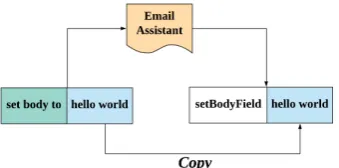
Figure 1: A example of semantic parsing on the email assistant system.
model aspect. Thus, it tends to use the strings it has seen in the training dataset (see Table1).
current utterance: set body to blue logical form
reference: (setFieldFromString ( getProbMutableField-ByFieldName body ) ( stringValue ” blue ” ) )
seq2seq: (setFieldFromString ( getProbMutableFieldBy-FieldName body ) ( stringValue ”charlie is on his way” ) )
Table 1: An error made by the base seq2seq model. Copy mechanism can fix it.
From this analysis, we realize that it would be crucial for the model to learn when to copy from the source sentence, and when to generate a new token. Thus, we incorporate the pointer mecha-nism into our base seq2seq approach.
As shown in Figure1, for an email assistant sys-tem, users inputs are usually comprised of a func-tional part and a content part. A semantic parser should be able to distinguish and handle them in a different way. Specifically, the parser must gener-ate a series of lambda-like functions for the func-tional part, while the content part should be copied to the argument slot.
Our pointer network is inspired by that of See et al.(2017) designed for the summarisation task. Given an utterancexand a logical formy, at each time step t, we have a soft switch which deter-mines the contributions of the token generator and the copier which uses a pointer over the words of the input utterance:
P(yt) =pgenPvocab(yt) + (1−pgen) X
i:xi=yt
αti
whereαti is the attention score over the positioni in the t-th generation step, and Pvocab is a
prob-ability distribution over the vocabulary. pgen ∈
[0,1]is thegeneration probability, modelled as:
pgen =σ(wTcct+wTsst+wTxxt+b)
wherectandstare the context vector and the
de-coder state respectively, whilewTc,wTs,wTx andb are learnable parameters.
2.2 Conditioning on Conversation Context
Understanding conversations between a user and the system requires the comprehension of the flow of the discourse among sequence of utterances. Processing utterances independently within a con-versation leads to misinterpreting users inputs, which will result in incorrect logical form genera-tion (see Table2). Therefore, we incorporate the context when processing the current utterance for a better generation.
dialog history ...
user: compose a new email. the recipient is mom. the subject is hello
user: cancel ...
current utterance: cancel
logical form reference: ( undo ) seq2seq: (cancel)
Table 2: An error made by the base seq2seq model. It is clear that without the context information, the model cannot infer the correct logical form.
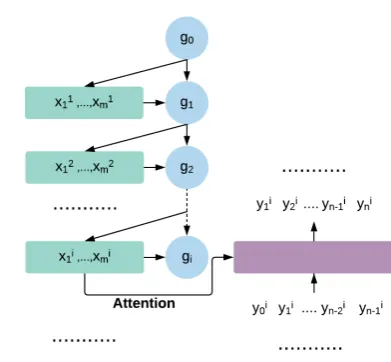
Basically, a conversation consists of a sequence of user utterances:{x1, ...,xT} paired with a list of logical forms: {y1, ...,yT}. For a given ut-terance sequence xi = {xi1, ...,xim}, a semantic parser should predict its associated logical form yi ={yi1, ...,yin}. Inspired bySuhr et al.(2018), we introduce a hierarchical architecture to model both utterance-level and conversation-level infor-mation; see Figure2. At the utterance level, we use an attentional seq2seq model to establish the mapping from an utterancexito its corresponding logical formyi:
hi1:m = Encoder(xi1, ...,xim), (1)
cit = Attention(hi1:m,sit−1), (2)
yit,sit = Decoder(yit−1,sit−1,cit) (3)
As the seq2seq model, we investigate the use of RNN-based and Transformer-based architectures. Furthermore, we make use of a conversation-level RNN to capture the wider conversational context:
gi = RNN(him,gi−1) (4)
In order to incorporate the conversational infor-mation into our model, we modify the Equ. 1by injectinggi−1:
hi1:m= Encoder([xi1 :gi−1], ...,[xim :gi−1])
[image:3.595.75.271.169.350.2]where[:]denotes a concatenation operation.
Figure 2: Overall architecture of our semantic parser. We omit the pointer network due to lack of space.
Similar to memory networks (Sukhbaatar et al.,
2015), it is essential to give the decoder a di-rect access to the last k utterances, if we want to leverage the discourse information effectively. Hence, we concatenate the previous k utterance
{xi−k, ..,xi−1} with the current utterance. Now
Equ.2is rewritten as:
cti= Attention(hi1:m−k, ..,h1:mi−1,hi1:m,sit−1)
In addition, since the importance of the concate-nated utterances is different, it is significant to differentiate these utterances to reduce confusion. Therefore, as suggested bySuhr et al.(2018), we add relative position embeddingsEpos[·]to the
ut-terances when we compute attention scores. De-pending on their distances from the current utter-ance, we append Epos[0], ..,Epos[k]to the
previ-ous utterances respectively.
3 Experiments
Dataset Semantic paring is crucial to dialogue systems, especially for multi-turn conversations. Additionally, understanding users’ intentions and extracting salient requirements play an important role in the dialogue-related semantic parsing. We use a dataset created by Srivastava et al. (2017)
as a case study to explore the performance of se-mantic parsing in dialogue systems. This dataset is collected from an email assistant, which can help users to manage their emails. As shown in Table3
Users can type some human sentences from the interface. Then the email assistant can automati-cally convert the natural sentences to the machine-understandable logical forms.
dialog history ...
user: Define the concept “ contact ”
user: add field “ email ” to concept “ contact ” user: create contact “ Mom ”
...
logical form ...
(defineConcept ( stringNoun “ contact ” ) )
(addFieldToConcept contact ( stringNoun “ email ” ) ) (createInstanceByFullNames contact ( stringNoun “ mom ” ) )
...
Table 3: A partial conversation from the data
FollowingSrivastava et al.(2017), we partition the dataset into a training fold (93 conversations) and a test fold (20 conversations) as well. How-ever, this partition might be different from Sri-vastava et al.(2017), as they only release the raw Email Assistant dataset. The total number of user utterances is 4759, the number of sessions is 113, and the mean/max of the number of utterances per interactive session is 42/273.
3.1 Main Results
Prior to this work,Srivastava et al.(2017) also in-corporate the conversational context into a CCG parser (Zettlemoyer and Collins,2007). CCG re-quires extensive hand-feature engineering to con-struct text-based features. However, neural se-mantic parsers have been demonstrating impres-sive improvement over various and numerous dataset (Suhr et al.,2018;Dong and Lapata,2018). Hence, we explore both RNN-based (Bahdanau et al.,2014) and transformer-based (Vaswani et al.,
[image:3.595.305.526.181.323.2]Table 4 demonstrates the accuracy of differ-ent models. Our RNNS2S baseline already sur-passes the previous SOTA result with a large mar-gin. However, since we use our own partition, this comparison should not be as a reference. Both pointer network and conversational architec-ture dramatically advance the accuracy. Finally, our transformer model combining these two tech-niques obtains a new SOTA result.
Accuracy Previous methods
Seq2seq (Srivastava et al.,2017) 52.3 SPCon (Srivastava et al.,2017) 62.3 Our models
RNNS2S 68.0
RNNS2S + pointer 69.3
RNNS2S + context 69.8
RNNS2S + context + pointer 70.5
Transformer 69.3
[image:4.595.325.501.56.158.2]Transformer + pointer 72.2 Transformer + context 71.0 Transformer + context + pointer 73.4
Table 4: Test accuracy on Email Assistant dataset.
Boldindicates the best result. SPCon is the best CCG parser with contextual information inSrivastava et al.
(2017)
3.2 Analysis
In this section we provide some deep analysis on our models. Since we see the same trend in both RNNS2S and Transformer, we only report the analysis of RNNS2S. The supplementary ma-terial reports the analysis of Transformer.
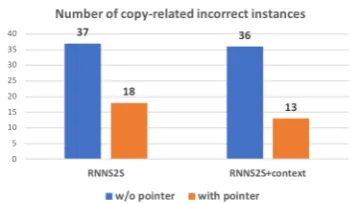
The effects of the copy mechanism We analyze the test data, and count the number of errors that can be rectified by introducing the pointer network for both vanilla and context-dependent seq2seq models. In the test set, we identify that a total of 37 errors made by the seq2seq model and 36 er-rors made by the seq2seq+context model can be rectified by the copy mechanism. According to Figure3, our pointer network fixes at least half of the incorrect instances. Clearly, the pointer mech-anism cannot solve all copy-related errors. After scrutinizing the system-generated results, we re-alize that the pointer network tends to retain the copy mode once it is triggered. This phenomenon is consistent with the observations by See et al.
[image:4.595.74.291.192.376.2](2017). Consequently, the extra copies impinge on the accuracy of the system.
Figure 3: Number of copy-related incorrect instances that can be corrected by a pointer network.
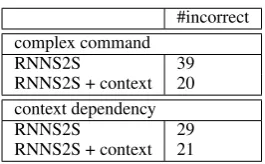
The effects of the context-dependent mecha-nism. In the experiments, our context-dependent mechanism is shown to be able to address context-related errors, especially when user’s input implies a complex and compositional command. These complex commands usually involve a series of complicated actions, as shown in Table 5. Ac-cording to Table6, our context-dependent model rectifies 27 out of 68 context-related errors.
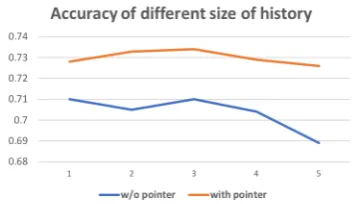
[image:4.595.325.507.342.448.2]Figure 4: Accuracy of different size of history.
Figure 5: Heat map of different size of history.
[image:4.595.309.528.495.581.2]utterance:
Set recipient to Mom’s email . Set subject to hello and send the email logical form:
[image:5.595.115.248.161.243.2]( doSeq ( setFieldFromFieldVal ( getProbMutableFieldByFieldName body ) ( evalField ( getProbFieldByInstanceName-AndFieldName inbox body ) ) ) ( doSeq ( setFieldFromFieldVal ( getProbMutableFieldByFieldName recipient list ) ( eval-Field ( getProbeval-FieldByInstanceNameAndeval-FieldName inbox sender ) ) ) ( send email ) ) )
Table 5: An example of complex and compositional commands.
#incorrect complex command
RNNS2S 39
RNNS2S + context 20 context dependency
RNNS2S 29
RNNS2S + context 21
Table 6: Incorrect instances of RNNS2S and context-dependent RNNS2S models in terms of complex com-mands and context dependency.
on different datasets, but they will demonstrate the same trend.
4 Conclusions
In this work, we explore a neural semantic parser architecture that incorporates conversational con-text and copy mechanism. These modelling im-provements are solidly grounded by our analysis, and they significantly boost the performance of the base model. As a result, our best architecture es-tablish a new state-of-the-art on the Email Assis-tant dataset. In the future, we would explore other architectural innovations for the system, for exam-ple, the neural denoising mechanisms.
5 Acknowledgement
We would like to thank three anonymous re-viewers for their valuable comments and sugges-tions. This work was supported by the Multi-modal Australian ScienceS Imaging and Visual-isation Environment (MASSIVE).1 This work is partly supported by the ARC Future Fellowship FT190100039 to G.H.
References
Dzmitry Bahdanau, Kyunghyun Cho, and Yoshua Ben-gio. 2014. Neural machine translation by jointly learning to align and translate. arXiv preprint arXiv:1409.0473.
Jacob Devlin, Ming-Wei Chang, Kenton Lee, and Kristina Toutanova. 2018. Bert: Pre-training of deep
1https://www.massive.org.au/
bidirectional transformers for language understand-ing.
Li Dong and Mirella Lapata. 2016. Language to logical form with neural attention. arXiv preprint arXiv:1601.01280.
Li Dong and Mirella Lapata. 2018. Coarse-to-fine de-coding for neural semantic parsing. arXiv preprint arXiv:1805.04793.
Sergey Edunov, Myle Ott, Michael Auli, and David Grangier. 2018. Understanding back-translation at scale.arXiv preprint arXiv:1808.09381.
Robin Jia and Percy Liang. 2017. Adversarial exam-ples for evaluating reading comprehension systems.
arXiv preprint arXiv:1707.07328.
Diederik P Kingma and Jimmy Ba. 2014. Adam: A method for stochastic optimization. arXiv preprint arXiv:1412.6980.
Samuel L¨aubli, Rico Sennrich, and Martin Volk. 2018. Has machine translation achieved human parity? a case for document-level evaluation. arXiv preprint arXiv:1808.07048.
Wang Ling, Edward Grefenstette, Karl Moritz Her-mann, Tom´aˇs Koˇcisk`y, Andrew Senior, Fumin Wang, and Phil Blunsom. 2016. Latent predic-tor networks for code generation. arXiv preprint arXiv:1603.06744.
Romain Paulus, Caiming Xiong, and Richard Socher. 2017. A deep reinforced model for abstractive sum-marization.arXiv preprint arXiv:1705.04304.
Maxim Rabinovich, Mitchell Stern, and Dan Klein. 2017. Abstract syntax networks for code gen-eration and semantic parsing. arXiv preprint arXiv:1704.07535.
Abigail See, Peter J Liu, and Christopher D Man-ning. 2017. Get to the point: Summarization with pointer-generator networks. arXiv preprint arXiv:1704.04368.
Shashank Srivastava, Amos Azaria, and Tom M Mitchell. 2017. Parsing natural language conversa-tions using contextual cues. InIJCAI, pages 4089– 4095.
Sainbayar Sukhbaatar, Jason Weston, Rob Fergus, et al. 2015. End-to-end memory networks. InAdvances in neural information processing systems, pages 2440–2448.
Ashish Vaswani, Noam Shazeer, Niki Parmar, Jakob Uszkoreit, Llion Jones, Aidan N Gomez, Łukasz Kaiser, and Illia Polosukhin. 2017. Attention is all you need. InAdvances in Neural Information Pro-cessing Systems, pages 5998–6008.
Luke Zettlemoyer and Michael Collins. 2007. Online learning of relaxed ccg grammars for parsing to log-ical form. In Proceedings of the 2007 Joint Con-ference on Empirical Methods in Natural Language Processing and Computational Natural Language Learning (EMNLP-CoNLL), pages 678–687.
Luke S Zettlemoyer and Michael Collins. 2009. Learn-ing context-dependent mappLearn-ings from sentences to logical form. In Proceedings of the Joint Confer-ence of the 47th Annual Meeting of the ACL and the 4th International Joint Conference on Natural Lan-guage Processing of the AFNLP: Volume 2-Volume 2, pages 976–984. Association for Computational Linguistics.
A Implementation Details
In RNNS2S model, at the utterance level, a one-layer bidiretional RNNs for the encoder, while the decoder is a two-layer RNNs. We use a one-layer RNNs to represent the conversational information flow. All RNNs use LSTM cells, with a hidden size of 128. The sizes of word embeddings and position embeddings are 128 and 50 respectively. We train our models for 10 epochs by Adam opti-mizer (Kingma and Ba,2014) with an initial learn-ing rate of 0.001. The batch size of non-context training is 16, while the context variant is 1.
For Transformer model, we use 3 identical transformer blocks for both encoder and decoder. Within each block, the size of the embeddings is 256, while the feed forward network has 512 neu-rons. We set the size of heads to 4. The conversa-tional encoder is a one-layer RNNs with the size of 256. The optimizer and training schedule is same asVaswani et al.(2017), exceptwarmup steps= 500. Due to the warmup steps, We train this model for 14 epochs. The batch size is same as that of RNNS2S.
B Analysis of Transformer
The effects of the pointer mechanismAccording to Figure6, half of the incorrect instances are fixed by the pointer mechanism.
#incorrect complex command
Transformer 35
Transformer + context 24 context dependency
Transformer 25
[image:6.595.329.502.61.164.2]Transformer + context 16
[image:6.595.309.520.234.352.2]Table 7: Incorrect instances of Transformer and context-dependent Transformer models in terms of complex commands and context dependency.
Figure 6: Number of copy-related incorrect instances that can be corrected by a pointer network.
The effects of the context-dependent mecha-nism. Similarly, incorporating the contextual in-formation is able to address the context-oriented issues by a larger margin (see Table7).
Finally, as observed in the main paper, having an access to the 3 previous utterances achieves the best performance.
[image:6.595.326.503.521.623.2]