Managing Public Sector Data for Multilingual Applications Development
Stelios Piperidis, Penny Labropoulou, Miltos Deligiannis, Maria Giagkou
Athena RC/Institute for Language and Speech ProcessingEpidavrou & Artemidos, Maroussi, Athens, Greece [email protected], [email protected], [email protected], [email protected]
Abstract
The current paper outlines the ELRC-SHARE repository, an infrastructure designed and developed in the framework of the European Language Resource Coordination action with the objective to host, document, manage and appropriately distribute language resources pertinent to machine translation, and specifically tailored to the needs of the eTranslation service of the European Commission. Due to the scope of the eTranslation service which seeks to facilitate multilingual communication across public administrations in 30 European countries and to enable Europe-wide multilingual digital services, ELRC-SHARE demonstrates a number of characteristics in terms of its technical and functional parameters, as well as in terms of its data management and documentation layers. The paper elaborates on the repository technical characteristics, the underlying metadata schema, the different ways in which data and metadata can be provided, the user roles and their respective permissions on data management, and, finally, the extensions currently being implemented.
Keywords:public sector language resources, repository, documentation, machine translation
1.
Introduction
Machine Translation (MT) technology can be applied to any language pair and adapted to specific domains and text types provided that sufficient amount of Language Re-sources (LRs) can be made available for training, adapt-ing and evaluatadapt-ing the respective translation engines. The eTranslation digital service infrastructure1 developed by the European Commission (EC), for example, needs to be adapted to meet the quality requirements of other Digital Service Infrastructures (DSI) like eJustice or Online Dis-pute Resolution, besides being extended to new language pairs. To meet the objectives of eTranslation adaptation, extension and overall improvement, the EC has launched the European Language Resources Coordination (ELRC) action (L¨osch et al., 2018) with the mandate to collect and manage the appropriate LRs for all languages of the EU plus Norwegian and Icelandic, and for a number of domains that are relevant to other DSIs that the EC is building under the umbrella of the Connecting Europe Facility (CEF) pro-gramme2. Properly collecting, documenting and managing such data and making them available for developing MT en-gines calls for appropriate LRs management supported by a dedicated repository with the appropriate functionalities catering for the whole LRs lifecycle.
In this paper we focus on the repository infrastructure de-veloped for this initiative, i.e. the ELRC-SHARE repos-itory. Section 2 briefly introduces the ELRC action and provides an overview of the ELRC-SHARE technical char-acteristics, section 3 describes the underlying metadata schema used for LRs documentation, section 4 explains the different ways in which data, i.e. LRs and their metadata can be provided and managed, section 5 elaborates on the user management layer, while section 6 describes some of the extensions currently being built.
1
https://ec.europa.eu/cefdigital/wiki/display/CEFDIGITAL/ eTranslation
2https://ec.europa.eu/digital-single-market/en/news
/connecting-europe-facility-cef-digital-service-infrastructures
2.
ELRC and ELRC-SHARE
2.1.
About the ELRC action
Within this framework, the ELRC Network aims to raise awareness, promote uptake and foster the acquisition, iden-tification and collection of LRs, targeting mainly at contri-butions of open language data from public administrations across the CEF countries. The resources identified, col-lected and made available as a result of the ELRC initiatives need to be:
• documented with the appropriate information describ-ing the resource (aka metadata)
• easily uploaded and stored in a repository accessible by all relevant actors
• updated as necessary (both metadata & data)
• indexed and, as a result, accessed and downloaded (as necessary) according to the terms and conditions of their use.
The ELRC Network makes use of different channels to of-fer the above functionalities, the core of which is the ELRC-SHARE repository.
2.2.
About the ELRC-SHARE repository
The ELRC-SHARE repository3 is intended for manag-ing LRs that are considered useful for feedmanag-ing the CEF eTranslation digital service. It was originally designed to store, document and render accessible LRs, but its role has evolved in accordance with the requirements set for the management of LRs in the ELRC context. It, thus, currently aims to cover the whole lifecycle of LRs: up-loading, documentation, uploading of accompanying doc-uments, monitoring and reporting, updating, browsing, de-livery and downloading.
The ELRC action is looking for public sector relevant open language data that can be made available for re-use
3
based on the EU Public Sector Information (PSI) directive4, but also for potentially restricted datasets (e.g. commer-cially available datasets, restricted resources pending nego-tiations/agreements/processing required for privacy protec-tion, etc.). The LRs that ELRC targets can be any of the following:
• collections/sets of textual data (”corpora”) in one or more languages, including for instance:
– monolingual sets of public administration official documents (e.g. ministerial decisions, legal acts, Board decisions etc.), as well as sets of relevant journal, newspaper, bulletin, blog articles, etc.,
– bi/multilingual parallel corpora, i.e. sets of orig-inal documents with their translations, or ready-made translation memories, i.e. translated docu-ments aligned with their originals.
• lexical/conceptual resources, such as:
– terminological lexica, glossaries etc., including lists of terms, with or without any other informa-tion (e.g. definiinforma-tion, examples, translainforma-tion equiv-alents, linguistic information etc.)
– lists of words, such as person names, names of places, names of products etc.
– lexica and dictionaries containing words with lin-guistic information (e.g. part of speech, inflec-tional information, syntactic frames etc.)
• language descriptions that comprise, for instance, computational formal grammars (i.e. sets of rules that formalize a language), as well as language and trans-lation models (i.e. resources which contain statistical information that assigns a probability to a piece of un-seen text, based on some training data).
From a user perspective, ELRC-SHARE offers:
For data contributors: basic functionalities for contribut-ing LRs through a very simple web form
For metadata editors (ELRC Network members): a user-friendly documentation environment for the description of resources (with the ELRC-SHARE metadata schema)
For the general public: a simple and faceted search and browsing of the resources inventory.
At the backend, ELRC-SHARE employs:
• a module for storing LRs, together with their respec-tive metadata records and accompanying documenta-tion (e.g. deposidocumenta-tion and licensing documents, valida-tion report);
• a user management module assigning specific access rights to the resources and the repository operations, depending on the user’s role and the publication status of a resource;
4
https://ec.europa.eu/digital-single-market/en/european-legislation-reuse-public-sector-information
• notification and reporting mechanisms for the efficient monitoring of updates of the hosted LRs.
ELRC-SHARE is based on a META-SHARE software in-stance, its latest version building on META-SHARE v3.1.1. The software has been adapted to the operational needs of ELRC and it has been evolving to respond to specific re-quirements of its stakeholders. The ELRC-SHARE repos-itory can be replicated on additional servers. However, unlike the META-SHARE distributed network structure (Piperidis, 2012), ELRC-SHARE is deployed as a single repository (i.e. one central, managing, node in META-SHARE terminology) centrally managed by the ELRC con-sortium. Furthermore, following ELRC requirements, new user roles have been added (namely technical and legal re-viewing roles with their own class of access rights), the metadata schema is updated to reflect, for instance, evo-lution in the open data licensing policies of countries, and new functionalities for reporting, data exporting and pack-aging have been implemented.
3.
ELRC-SHARE metadata schema
ELRC LRs are (formally) documented using the ELRC-SHARE schema. In essence, the ELRC-ELRC-SHARE metadata schema is an application profile of the META-SHARE schema appropriately modified to meet the requirements of ELRC.
META-SHARE (Gavrilidou et al., 2012) is a generic schema designed for the description of LRs in the wider area of Language Technology. It covers the descrip-tion of data(textual, multimodal/multimedia and lexical data, grammars, language models, etc.) andtechnologies (tools/services)used for their processing. Its main features (that are also inherited to ELRC-SHARE) are:
• flexibility, empowered with a two-level approach, where the initial level (minimal schema) consists of a set of basic elements required for at least identify-ing and accessidentify-ing a LR, and a second level (maximal schema) with a higher degree of granularity of infor-mation
• modularity, implemented in the form of
“compo-nents”, i.e. groups of semantically coherent
ele-ments, following the Component MetaData Infrastruc-ture (CMDI) recommendations (Broeder et al., 2008)
• standardisation: where possible, controlled vocabular-ies are preferred over free text for the value space of el-ements, especially when these can be associated with internationally acknowledged standards, best practices or widespread vocabularies (e.g. ISO 3166 for coun-try codes, RFC 5646 for languages, IANA mimetypes etc.)
• interoperability with other related metadata schemas: links are provided to the conceptually same or similar elements mainly with Dublin Core (DC)5and the Data Catalog Vocabulary (DCAT)6.
5
http://www.dublincore.org 6
The elements are carefully selected to captureproperties
of the resources and relations with other resources that are deemed important for their description and relate to any of the stages of theresource lifecycle, from produc-tion to consumpproduc-tion. In particular, relaproduc-tions are encoded in the metadata records of all resources which have gone through some processing, conversion or transformation in-dicating the type of relation between the two, essentially different, versions of a resource; e.g. a raw parallel corpus that has undergone alignment gives rise to a new version of the resource described with a new metadata record; the two metadata records (of the original and the aligned version) are linked together with a relation of type “isAlignedVer-sionOf”.
The ELRC-SHARE schema is at the same time a restric-tion and an extension of META-SHARE: the adaptarestric-tions include the removal of a substantial set of elements/values as well as the addition of new elements/values. For in-stance, all elements appropriate for non textual resources have been pruned. On the other hand, the requirements of ELRC have given rise to new elements/values mainly in the categories of licensing and classification. For instance, the legal component was adapted to include
• values for the ”licence” element that specify licences recommended for public sector open data
• a value that indicates that a resource falls under the PSI directive
• elements that declare whether a resource includes per-sonal and sensitive data and, as a result, needs special handling and further processing.
The schema includes the following mandatory metadata categories:
• Administrative information: features important for theidentificationof a LR (e.g. resource name, a short description of its contents, etc.), itsdistribution (e.g. the access form, i.e. whether it can be downloaded or accessed through an interface and the licensing terms under which it can be used),contact information(data and email of a contact person), information on the
metadata record(e.g. data of the metadata editor, cre-ation and update dates etc.)
• Technical information: features on the language
(number of languages, language identifier(s) and name(s)), size of the resource and the format(s) in which the resource is available (e.g. plain text, PDF, XML, TMX etc.), and subtype, the values of which are specific to each resource type (e.g. terminologi-cal glossary, dictionary etc. for lexiterminologi-cal/conceptual re-sources vs. grammar or model for language descrip-tions).
In addition, the following metadata categories are optional:
• information on the creation of the resource (e.g. the re-source creator, whether it involved an automatic pro-cess and, if yes, the tool(s) that were used, creation date etc.), links or bibliographic data of documents that describe the resource.
• domain and text type classification, character encod-ing, description of the types of linguistic or extra-linguistic information (e.g. lemmas, grammatical cat-egories, translation equivalents etc.) contained in lex-ical/conceptual resources and language descriptions.
It should be noted here that, although optional, domain, and in many cases, text typeclassificationare of utmost im-portance to the ELRC objectives. The Eurovoc thesaurus7 and, more specifically, the two upper levels of the hierarchy have been selected to ensure uniform domain classification across the resources and alignment with the domain clas-sification already employed by the Directorate-General for Translation of the EC and by other European institutions. Due to the special focus on the reuse of the eTranslation ser-vice by other CEF sector-specific DSIs, an additional meta-data element has been introduced, that of relevance of the LR to a DSI, thus facilitating retrieval of resources that can be used for training machine translation engines tailored to the domain(s) of a specific DSI. Finally, for the text type classification, we have devised our own controlled vocabu-lary based on the types of texts that are typical of the Public Sector (e.g. administrative texts, bulletins, legal documents etc.) and the ones we expect to obtain from our sources.
4.
Contributing, documenting and
managing resources
Contributing resources through the ELRC-SHARE reposi-tory is a process that is kept as simple as possible given that the intended contributors are primarily Public Sector em-ployees who are not necessarily familiar with the concepts of, and around, language resources.
Providing resources and the required documentation is pos-sible only after users have registered to the system. They can then use a simple web form to describe and upload LRs. For each LR, at least a short description and a title in En-glish must be provided; the resource itself can be uploaded in zipped format (currently up to 100MB) or, alternatively, users may supply a link to a URL where the resource can be downloaded from.
Following this submission, the contributed data and basic metadata are received by the repository administrators and are imported into the repository. For each new contribution, proper notification email alerts are sent to designated ELRC consortium members (metadata editors) who have the responsibility to enrich the documentation, check the resource and publish it. The ELRC member may contact the contributor to ask for further information about the resource and its licensing conditions. The docu-mentation and checking are supported with an editor form that implements the full ELRC-SHARE schema. During the documentation process, the resource descriptions are considered ”internal” and can be viewed only by authorised editors of the ELRC consortium. When the documentation and the licensing conditions under which the resource is provided are finalised, the resource description (metadata record) will be made public through the inventory and the resource itself will be downloadable by users, in
7
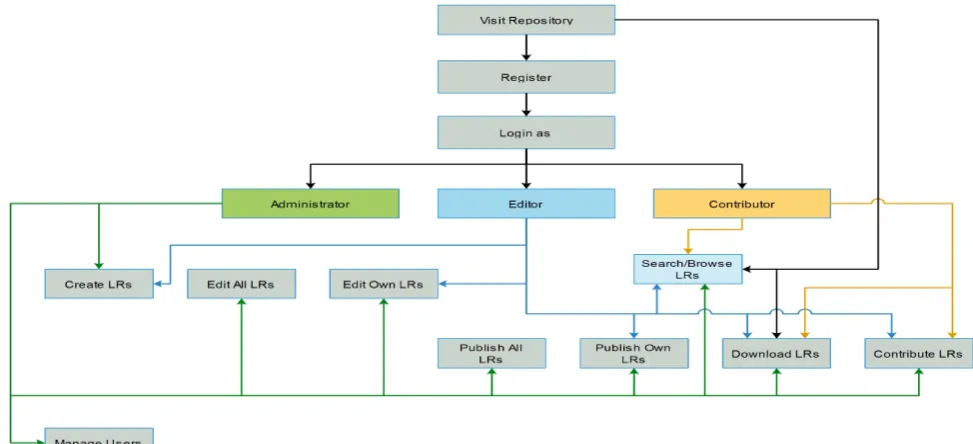
Figure 1: Available user rights per user role
accordance to its licensing conditions.
Contributions may also come from ELRC members using the editor interface, in which case the LRs are deposited straight into the repository, again as a zipped file. To up-load the resource, the minimal information must have al-ready been encoded for the resource. The description can still continue to be updated at any time, before and after uploading.
In addition, ELRC resources may be generated by using an automatic language resource discovery (Papavassiliou et al., 2018) and compilation system (ILSP-FC). ILSP-FC ((Papavassiliou et al., 2016); (Papavassiliou et al., 2013)) is essentially a pipeline of tools that, given a set of seed URLs, and optionally a domain profile in the form of a list of do-main specific terms, crawl the web, fetch web pages, check their domainness, pair the translated web pages and align them at sentence level, thus generating a TMX file. The ILSP-FC system automatically extracts the required meta-data and renders them in the ELRC-SHARE profile form, ready to be automatically uploaded to the repository. All LRs residing in the repository undergo a systematic valida-tion procedure (L¨osch et al., 2018), the results of which are coded in the respective validation reports stored together with any other ancillary documentation accompanying the resource.
The result of the documentation process is compiled into the ELRC-SHARE inventory of resources comprising all the descriptions (metadata catalogue).8
5.
Managing access and editing rights
Access to ELRC-SHARE is regulated by user roles and per-missions. Unregistered users can only browse and search
8The inventory with the LR descriptions is licensed under the
Creative Commons Attribution (CC-BY) version 4.0 or higher.
the repository and view the resource descriptions. Regis-tered users can be assigned one of the following roles, with respective rights and permissions: a)contributor(default), b)editor, c)administrator. Figure 1 illustrates the available user rights per role within the repository.
The resources hosted in the repository are assigned a Pub-lication Status which determines the visibility of their de-scriptions to different user types. The Publication Statuses are:
• internal: used as the initial status for all metadata records;
• ingested: LRs with enriched and initially validated metadata records;
• published: LRs with finalised metadata records. Pub-lished records are available for searching and brows-ing on the public inventory of resources.
The combination of user access rights and resource status yields an enhanced user management module that gives re-source owners extra leverage and control over the visibility and accessibility of the repository resources. Currently, the ELRC-SHARE inventory lists 225 published language re-sources, with 200 additional and/or derivative resources in ingested mode, i.e. waiting to be published. The evolution of the inventory is reported in the form of simple spread-sheets, while specific APIs for querying the metadata in-ventory are under implementation.
6.
Extensions currently under way
In order to help public administrations across borders share electronic data and documents in a secure, reliable and trusted way, ELRC-SHARE is being endowed with an eDe-livery9Access Point (AP), as an alternative to direct contri-bution and uploading. ELRC-SHARE will thus ensure that9
any sensitive or confidential data transferred from public administrations into the repository are encrypted and se-cure.
ELRC-SHARE is deploying an eDelivery AP using an appropriately configured Domibus EC implementation, which is an ebMS3 AP based on the e-SENS AS4 Profile. Access Points can have a message ”sender” or/and message ”receiver” role. Since the ELRC-SHARE Access Point will be receiving data from public administrations, it will act as a receiver in the message exchange process, accepting messages and data from public administrations that already have an available sender Access Point.
Finally, ELRC-SHARE is currently being extended to al-low for the cataloging and documentation of language pro-cessing tools and services, e.g. aligners, annotators, named entities recognizers and other tools pertinent to machine translation. In the future, ELRC-SHARE will support the direct processing of resources with available tools and services. LRs will be associated with adequately docu-mented available tools/services (e.g. text normalization for encoding detection, UTF-8 conversion and metadata extraction, language identification, text classification, de-duplication, translation pair detection, text alignment, etc.), which produce new resources that will be stored in the ELRC-SHARE repository as new versions or derivatives of the original resource.
7.
Acknowledgements
The European Language Resource Coordination (ELRC) is a service contract operating under the EC’s Connect-ing Europe Facility SMART 2014/1074 programme from April 2015 to April 2017 and continues until December 2019 under SMART 2015/1091 LOT 2 “Language Re-source coordination and collection with related legal and technical work” and SMART 2015/1091 LOT 3 “Acquisi-tion of addi“Acquisi-tional Language Resources and related refine-ment/processing services and their provision of the Lan-guage Resource Repository of CEF Automated Translation Platform”. We would like to thank all ELRC consortium members, DFKI, TILDE and ELDA, and the numerous contributors from the 30 CEF-affiliated countries for con-tributing their language resources.
8.
Bibliographical References
Broeder, D., Declerck, T., Hinrichs, E., Piperidis, S., Ro-mary, L., Calzolari, N., and Wittenburg, P. (2008). Foundation of a component-based flexible registry for language resources and technology. In Nicoletta Calzo-lari, et al., editors,Proceedings of the Sixth International Conference on Language Resources and Evaluation
(LREC’08), Marrakech, Morocco, May. European
Lan-guage Resources Association (ELRA). http://www.lrec-conf.org/proceedings/lrec2008/.
Gavrilidou, M., Labropoulou, P., Desipri, E., Piperidis, S., Papageorgiou, H., Monachini, M., Frontini, F., De-clerck, T., Francopoulo, G., Arranz, V., and Mapelli, V. (2012). The META-SHARE Metadata Schema for the Description of Language Resources. In Nicoletta Cal-zolari, et al., editors,Proceedings of the Eigth
Interna-tional Conference on Language Resources and
Evalu-ation (LREC’12), Paris, France, 5. European Language
Resources Association (ELRA), ELRA.
L¨osch, A., Mapelli, V., Piperidis, S., Vasil¸jevs, A., Smal, L., Declerck, T., Schnur, E., Choukri, K., and van Genabith, J. (2018). European Language Resource Coordination: Collecting Language Resources for Public Sector Infor-mation Management. In Proceedings of the 11th
Lan-guage Resources and Evaluation Conference. European
Language Resources Association (ELRA).
Papavassiliou, V., Prokopidis, P., and Thurmair, G. (2013). A modular open-source focused crawler for mining monolingual and bilingual corpora from the web. In Pro-ceedings of the Sixth Workshop on Building and Using
Comparable Corpora, pages 43–51, Sofia, Bulgaria.
As-sociation for Computational Linguistics.
Papavassiliou, V., Prokopidis, P., and Piperidis, S. (2016). The ILSP/ARC submission to the WMT 2016 Bilin-gual Document Alignment Shared Task. InProceedings
of the First Conference on Machine Translation, pages
733–739, Berlin, Germany. Association for Computa-tional Linguistics.
Papavassiliou, V., Prokopidis, P., and Piperidis, S. (2018). Discovering parallel language resources for training MT engines. InProceedings of the 11th Language Resources
and Evaluation Conference. European Language
Re-sources Association (ELRA).
Piperidis, S. (2012). The META-SHARE Language Re-sources Sharing Infrastructure: Principles, Challenges, Solutions. In Nicoletta Calzolari (Conference Chair), et al., editors, Proceedings of the Eight International Conference on Language Resources and Evaluation
(LREC’12), Istanbul, Turkey, may. European Language