A Lightweight Modeling Middleware for Corpus Processing
Markus G¨artner Jonas Kuhn
Institute for Natural Language Processing University of Stuttgart
{markus.gaertner,jonas.kuhn}@uni-stuttgart.de
Abstract
Present-day empirical research in computational or theoretical linguistics has at its disposal an enormous wealth in the form of richly annotated and diverse corpus resources. Especially the points of contact between modalities are areas of exciting new research. However, progress in those areas in particular suffers from poor coverage in terms of visualization or query systems. Many limitations for such tools stem from the non-uniform representations of very diverse resources and the lack of standards that address this problem from the perspective of processing or querying. In this paper we present our framework for modeling arbitrary multi-modal corpus resources in a unified form for processing tools. It serves as a middleware system and combines the expressiveness of general graph-based models with a rich metadata schema to preserve linguistic specificity. By separating data structures and their linguistic interpretations, it assists tools on top of it so that they can in turn allow their users to more efficiently exploit corpus resources.
Keywords:data model, multi-modal, metadata
1.
Introduction
The availability of richly annotated multi-layer corpora is one of the cornerstones of modern theoretical and compu-tational linguistics. With a steady flow of newly created corpus resources and tools to annotate or process those cor-pora comes also the need for exploratory support tools, es-pecially visualization and query systems, to get a better un-derstanding of the resources at hand.
The context of this contribution is the successor project of the ICARUS (G¨artner et al., 2013) platform, an interactive visualization and query tool for corpora with dependency syntax, coreference structures (G¨artner et al., 2014) or rich annotations for intonation (G¨artner et al., 2015). This project aims at providing researchers a platform to explore and query even more diverse multi-layer and multi-modal corpus resources and artifacts through a single interactive interface. Our target resources include, but are not limited to, text and speech data annotated for a variety of different layers on varying linguistic levels and granularities, such as the SFB732 Silver Standard Collection, of which a first overview has been provided by Eckart and G¨artner (2016). A strong focus lies hereby on connecting linguistic layers or modalities which so far have not received much attention in their particular combination. This is to support interest-ing research questions, such as the interaction of informa-tion status and prosodic realizainforma-tion(Baumann and Riester, 2013) or the incorporation of prosodic information into the task of automatic coreference resolution on spoken text as done by Roesiger and Riester (2015).
As a result we faced the challenge of modeling access from a single processing software to a very diverse set of cor-pus resources. And while several standards around the Lin-guistic Annotation Framework (LAF)(Ide and Suderman, 2014) exist, they primarily take the point of view of prepa-ration or cuprepa-ration of data. The ongoing standardization ef-fort for a Corpus Query Lingua Franca(CQLF, ISO/DIS 24623-1)(Banski et al., 2016) correctly identifies the lack of standards which address a quite different view, that is, the one of querying or processing of corpus resources. As
such there is no standardized or universally accepted solu-tion readily available for this modeling task, which led us to designing and implementing a new dedicated framework. With “modeling corpus resources” we refer to the task of representing the structure and content of a corpus or sim-ilar resource by means of a data model in memory, i.e. during an application’s runtime. As a corpus or equivalent resource we treat any collection of utterances in arbitrary form, be they written, spoken or presented in yet another modality. Note that presently this definition excludes the modeling of other types of linguistic resources like lexi-cons or dictionaries as realized for example in theLexical Markup Framework(Francopoulo et al., 2006).
In the remainder of this paper we present our approach for providing unified access to very different corpus resources. Section 2 discusses the underlying issue of a heterogeneous format multiverse and Section 3 contextualizes our work. We present a detailed overview of various aspects of our framework in Section 4 and then proceed to illustrate its usage with code examples in Section 5. Information on the availability of the software and its documentation is pro-vided in Section 6 and Section 7 concludes.
2.
Format Multiverse and Middleware
Extensive work has already been invested into designing and establishing interoperable formats for linguistic re-sources and annotations based on various common trans-port formats. Notable examples are the NLP Interchange Format(NIF) (Hellmann et al., 2013), an RDF/OWL-based format, orGrAF(Ide and Suderman, 2007), a pivot XML-based serialization format for the Linguistic annotation framework (LAF) (Ide and Suderman, 2014). GrAF has also been standardized by ISO1 as part of the “Language
resource management” committee (ISO/TC 37/SC 4). The LAPPS Interchange Format (Verhagen et al., 2016) is a JSON-LD2 format and used for data transfer between
ser-vice implementations in the The Language Applications
1ISO 24612:2012
2
Physical Format
(b) Multiple supported format stacks
Data Model + Metadata
Figure 1: Bottom-up data flows in several resource processing applications depicted as software stacks. Grey filled boxes represent data to be processed, blue bordered ones are parts of an application’s own codebase and green shows the placement of our middleware solution in such an architecture in (c).
Grid (Ide et al., 2016). Less flexible exchange formats in-clude for instance theText Corpus Format(TCF) of the We-bLicht (Hinrichs et al., 2010) environment, where the cov-erage of different annotation layers or hierarchical struc-tures remains fixed.
Albeit having very expressive and standardized formats available, the reality is that more often than not corpora or system outputs used in day-to-day research work are stored in specialized or proprietary formats. Especially tools used for a specific task or field of research often use formats that have emerged as a kind of “local” standard for the particu-lar field, such as Praat TextGrid files (Boersma, 2001) for phonetic analysis. Tools designed in the context of a par-ticular task not uncommonly motivate the design and lim-itations of their data model with the original data format provided. In the popular CoNLL Shared Tasks for example data sets consistently are made available in a tabular format tailored to the individual tasks (e.g. parsing 2009 (Hajiˇc et al., 2009), coreference resolution 2011 (Pradhan et al., 2011) and again parsing to Universal Dependencies in the 2017 shared task3). Tools developed for those tasks often made the respective CoNLL format their exclusive input and output representation, leading to a plethora of classic monolithic designs of the form shown in Figure 1a. Processing applications such as search or visualization tools are then required to either support multiple formats and associated abstract models (see Figure 1b) or force the user into converting input data into a pivot format (further encouraging designs as in Figure 1a). This leads to in-creased workload for either the developers or end users. An alternative solution is to shift the unification effort into a framework that acts as a middleware between data sources and the actual processing logic of an application. The placement of our framework as this kind of middleware so-lution, in comparison to above situations, is presented in Figure 1c. Using a middleware solution also enables appli-cations built on it to have their output freely converted into all formats supported by the framework. We believe that removing the need or motivation to build monolithic appli-cation architectures then in turn can even foster the use of standardized serialization formats likeGrAF.
3.
Related Work
At present several software toolkits for modeling corpus re-sources in a flexible way exist. Graph-based models have become a very popular approach for their implementation.
SALT (Zipser, 2009), a graph-based model toolkit, is used
3http://universaldependencies.org/conll17
in an established ecosystem together with the converter-frameworkPEPPER(Zipser et al., 2011) and the search in-terfaceANNIS3(Krause and Zeldes, 2014), the latter com-bining it with a relational database for storage. SALT pro-vides full bidirectional links between related nodes (such as a sentence and its tokens) and also imposes fixed restric-tions on the scope of relarestric-tions. It is well-suited for model-ing shallow snapshots of a corpus, but especially the bidi-rectional linking makes it inherently expensive for model-ing large numbers of concurrent structures (e.g. multiple parses for the same sentence) and hampers scalability. Mo-tivated by the need to model rich annotations for text and speech data, theNITE Object Model(Carletta et al., 2003) is another graph-based model that allows linking of ele-ments to portions of a singular shared timeline. Yet another approach is to use formalisms from the Semantic Web con-text like the Web Ontology Language (OWL4) and combine
them with existing storage technology like XML or a rela-tional database as proposed by Burchardt et al. (2008). Based on the Apache UIMATMproject a series of soft-ware components for natural language processing around theDKPro Core(Eckart de Castilho and Gurevych, 2014) framework have been developed. They are mainly focused on building shareable analysis pipelines and build on a strongly typed model, where linguistic types or theories are directly encoded. This can be helpful for data exchange between collections of predefined processing components such as parsers. However, it made this approach unsuited for us as alternative to designing our own modeling toolkit. Other text processing pipelines include OpenNLP5, the General Architecture for Text Engineering(Cunningham et al., 2002) and theNatural Language Toolkit (Bird, 2006) for Python. They provide solutions for various NLP tasks and also feature modeling approaches of varying expres-siveness. Their general focus on text data however keeps them limited and unfit as basis for a middleware system that attempts to unify access to multiple modalities.
4.
Architecture
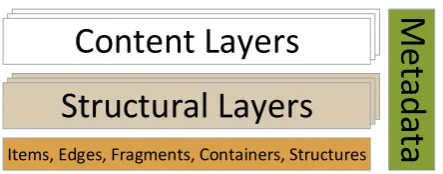
An implementation of our modeling approach is provided as an open-source Java toolkit (further information on avail-ability is provided in Section 6) which requires version 8 of the Java Runtime Environment (JRE). It offers a set of ab-stractbuilding blocksand other components to compose the data structures that make up a given corpus resource once read into the model and an extensive API to interact with them in various ways.
Structural Layers
Content Layers
Items, Edges, Fragments, Containers, Structures
Me
tadata
Figure 2: Core components for storage and associated metadata of the model architecture. Storage components are aligned horizontally.
A core concept is to separate components that represent ad-dressable units (tokens, sentences, audio frames, syntactic structures, edges, regions of an image or video stream.) from their actual content (such as classic text annotations or binary data of audio or video streams). Figure 2 shows the hierarchy of core components in the model with parts responsible for storage aligned horizontally. The follow-ing sections line out the conceptual foundations of our ap-proach and then describe the core components and concepts in detail.
4.1.
Separation of Model Responsibilities
While the approaches described in Section 3 and many oth-ers are sufficient for the task of representing data in mem-ory, the gain in representational generality is often achieved at the cost of specificity when it comes to the linguistic meaning or interpretation of modeled units or annotations. Thus even when using them as a developer one still needs to model this information and connect it with the data struc-tures in such models.
To work around these shortcomings we decided to split the task of modeling corpus resources into two subparts: One part for segmentation, structure and data storage max-imizes generality but sacrifices any direct knowledge about linguistic specificity (equivalent to aforementioned general-purpose graph models). Independent of this the other part acts as metadata and carries the information describing composition and dependencies of a specific resource. We outline the two aforementioned parts and how they in-teract with each other in Sections 4.3 to 4.5.
4.2.
Design Foundations
Our model design builds on several observations and re-quirements for modeling diverse corpus resources, some of which have been proposed by Ide et al. (2003) in an early iteration of LAF. We list these requirements and show how our modeling approach fulfills them:
Expressive adequacy and Openness: We do not impose any limitations on the nature of linguistic information or theories that are expressed or stored in our framework to keep it as flexible as possible.
Uniformity: We utilize a compact set of universal “build-ing blocks” (see Section 4.3) to model all kinds of structural or hierarchical information in a corpus (equal in expressive-ness to a graph, but closer to linguistic universals).
Media independence: As stated in the introductory part of Section 4 our framework conceptually splits structural properties of a resource from its (media) content, treating all content as annotations. It thereby allows for arbitrary an-notations to be associated with individual building blocks.
Semantic adequacy: We utilize a compact metadata schema (see Section 4.5) to formally define a resource’s overall composition. This includes declarations of avail-able layers as well as their hierarchies and dependencies.
Granularity: For every resource there is at least one mandatory segmentation layer that defines atomic units as a common foundation. This guarantees spacial comparability of all other structural constructs on top of it. As an exten-sion to the original observation made by Ide et al. (2003) we also acknowledge the need to retrospectively define an even finer granularity as originally declared for a resource. Our framework supports subdivision of existing units in a corpus by declaring anchors into rastered6 annotation
val-ues for those blocks (see Section 4.3 for further explanation and Section 5.3 for a usage example).
Extensibility: We offer various mechanisms for extend-ing the functionality of the corpus modelextend-ing framework:
• A template system for the metadata schema to for exam-ple allow sharable tagset definitions or format schemata for converters (see Figure 4 for a tagset template).
• Integration of new converter implementations via the Java Plugin Framework7, Java’s own Service Provider Interface (SPI) or the Open Services Gateway initiative8.
• An abstract type system for building blocks that al-lows custom implementations to optimize based on the underlying corpus resource, for instance read-only re-sources or when accessing a corpus stored in a (rela-tional) database versus converting from classic file data.
• Interfaces to implement the handling of new media or an-notation types for tasks such as fragmentation (cf. Sec-tion 4.3) or spacial comparison of those fragments.
Scalability: Special care is taken to ensure the framework and its performance are able to scale along two different and very important axes:
• Horizontallywith the size of resources, i.e. the number of addressable units they contain (which can reach up to billions of tokens for web corpora like those from the
WaCkyfamily (Baroni et al., 2009)).
• Verticallyin terms of the number of (parallel) annotation layers of arbitrary type. Especially speech corpora can contain very rich phonetic annotations on various levels when annotated by automatic systems.
4.3.
Components
Instead of squeezing an entire corpus into one big graph we provide a series of types and constructs that model aspects of a corpus in ways closer to actual linguistic concepts.
6
We borrow the term to describe the transformation of raw an-notation values into collections of addressable discrete units, such as sequences or grids. Common examples are individual charac-ters in a text, pixels in an image or frames in an audio stream.
7
http://jpf.sourceforge.net/ 8
0..*
0..* 1
2 Item
Fragment Edge
Container
Structure
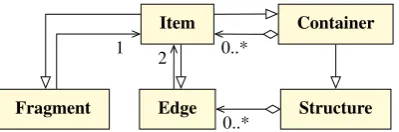
Figure 3: Simplified UML class diagram showing the rela-tions between basic types described in Section 4.3.
Units: At the core we provide generic building blocks to model addressable units in a corpus (see Figure 3 for a basic UML class diagram of those types and their relations and Table 1 for additional explanations). ThoseItemscan rep-resent any individual data points, regions, edges or aggre-gations within a corpus. In addition to construct a corpus by aggregation, Fragmentsoffer a way of subdividing existing items into smaller addressable units.
Each item in a corpus can be identified by two ways: One is a numericalidthat is unique within its host layer and the other is its current position in that layer. While the id is persistent, the current index can change for editable corpus data and is mainly used for spatial comparisons or map-pings. Unlike other approaches we do not maintain a full bidirectional linking between related items outside of their native host container. Instead a container only holds links to its contained items, but the reverse linking is moved into dedicated mapping facilities on the layer level. This keeps linking overhead to a minimum and makes the model scal-able wrt concurrent segmental or structural information.
Layer: Layers in our model directly correspond to their linguistic counterparts and organize parts of a corpus such as annotations, segmentations, hierarchies or other types of structures. Layers carrying segmental or grouping infor-mation play a special role since they can act as foundation or boundary layers. The former provide a shared space for spatial comparisons equivalent to timelines in other systems and the latter are used for restricting the scope of complex constructs such as relations. To link different aggregating or foundation layers dedicated mapping facilities are used to translate between those index spaces.
Context: Layers are naturally grouped according to the data source their content originated from, for example a database, web-service or a local file. On the context level dependencies to external corpus resources are defined and each context must have a singular layer designated for the roles offoundationandprimary, to define the segmentation of traversable data chunks of the context and their shared address space. Each context is associated with its individual converter implementation that mediates between the phys-ical source of data and the in-memory model instances as described in more detail in Section 4.7.
Corpus: On the top of the hierarchy a corpus combines an arbitrary number of contexts, which enables modeling of resources that consist of multiple data sources or are ex-pressed in several different formats. Each corpus in the framework is an independent and interactive object that client code can work with in many different ways, some of which are described and compared in Section 4.6.
Type Function
Item basic addressable unit Edge link/relation between items
Fragment anchors used to split existing items based on their rastered annotation values
Container logical grouping of items
Structure container that augments its elements (= nodes) with edges
Table 1: Basic types used to model addressable units, seg-mentation and structure in a corpus resource and their re-spective functions. Aggregating types are italicized.
4.4.
Annotations
A very central requirement for successfully unifying richly annotated corpus resources across different modalities is the ability to deal with very diverse types of annotations. To achieve this we impose no direct limitations on the nature of annotation values that can be stored or retrieved through the model. In addition we defined a (extensible) collection of commonly used annotation types that are directly sup-ported by specialized storage implementations. The most important ones are listed as follows:
• Character sequences (Strings). With Java natively modeling characters as UTF-16 code units in memory, this directly provides sufficient Unicode support.
• Numerical values (integer,long,float,double)
• Links to external resources such as files or websites (URL,URIand local file paths).
• Images modeled as bitmap graphics.
• Binary streams such as audio or video content. Our framework does not restrict or support specific multime-dia formats. It is left to the producer of a resource de-scription (cf. Section 4.5) to include sufficient informa-tion about the encoding, preferably in the form of stan-dardized format identifiers so that Java’s default frame-works for handling media content can be used.
• References to other Itemsto model simple structures such as arguments.
• Vector and matrix types to allow aggregation of other supported value types.
4.5.
Metadata
In Section 4.3 we covered the design of a very flexible data model for representing the content of arbitrary cor-pus resources. This maximized generality reduces the typ-ical overhead of developing very content specific software components (e.g. a custom-built search or visualization in-terface tailored to the content of a single corpus).
con-1 <annotationid=”common.tags.stts”name=”STTS−
Tagset”,valueType=”string”> 2 <values>
3 <valuename=”Adjective”>JJ</value> 4 <valuename=”Noun”>NN</value> 5 <valuename=”Determiner”>DT</value> 6 <valuename=”Verb, gerund”>VBG</value> 7 <valuename=”Verb, 3rd sg”>VBZ</value>
8 [...]
9 </values> 10 </annotation>
Figure 4: Part of a manifest in XML format describing a part of the STTS tagset for part-of-speech annotations as a reusable template. See Figure 5 for an example of another metadata component referencing this template.
1 <corpusid=”my.simple.corpus”> 2 <contextfoundation=”token”> 3 <layerGroupprimary=”token”> 4 <itemLayerid=”token”/> 5 <itemLayerid=”sentence”> 6 <baseLayerlayerId=”token”/> 7 <containercontainerType=”span”/> 8 </itemLayer>
9 <annotationLayerid=”content”> 10 <baseLayerlayerId=”token”/>
11 <annotationkey=”id”valueType=”int”/> 12 <annotationkey=”form”/>
13 <annotationkey=”lemma”/>
14 <annotationkey=”pos”templateId=”common.tags. stts”>
15 <!-- Inherited from template -->
16 </annotation> 17 </annotationLayer> 18 </layerGroup> 19 </context> 20 </corpus>
Figure 5: Manifest XML specifying the structure of a sim-ple two-level corpus resource with some shallow tions. Note how the declaration for part-of-speech annota-tions in line 14 references a template previously defined in Figure 4. A sentence matching this structural description can be found in Figure 6 encoded in two different formats.
tent of a tagset. If only provided a general graph-like repre-sentation of a corpus without any additional information, a processing software component would have to undergo the time-consuming task of analyzing the resource first. To this end we designed a compact metadata schema and its associated serialization format in XML that can express in-formation regarding a corpus resource’s structure and con-tent. For every complex type (ContainerorStructure) and each layer used in the storage model this metadata model provides dedicated descriptions called manifests
(“simple” types are described as part of their surrounding host construct). These descriptions include dependencies between layers, what annotations are available for which items, as well as types of structures or containers and more.
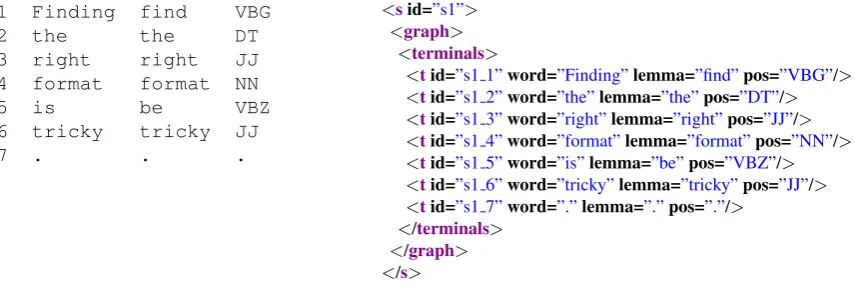
For improved interoperability most metadata elements can be linked to established identifiers of linguistic categories to better express their meaning, for example using ISO-cat/DatCatInfo as described in (Windhouwer and Wright, 2012). Conventional metadata to describe a resource’s provenance is however outside the scope of this scheme. Using such a manifest enables tools to properly handle the general data structures provided by the storage model to-tally independent from the original format or data source of a corpus. Figure 6 shows instances of two different textual formats that both encode the same chunk of data match-ing the description in Figure 5. For an application the re-sulting representation in our data model looks exactly the same. It could also contain information on how to access the resource it is describing, but this is currently outside our intended scope for the metadata model. Note that it remains the responsibility of the producer of a resource to provide this metadata and also to some extent to implement means of converting the raw form of a resource into an ac-tual model representation (more on this in Section 4.7).
4.6.
Interaction
Modeling frameworks often confine themselves to provid-ing generic data structures and support for their serializa-tion. This keeps them usually easy to use, but leaves the bulk of additional management to client code. Different types of applications pose very diverse requirements to un-derlying model libraries. To accommodate a wide range of possible use-cases our framework features different opera-tion modes for interacting with a corpus:
Navigation: Depending on their individual needs, appli-cations can access data in a corpusdirectly(communicating with the converter level without intermediate abstraction layers), as a stream(forward-only iteration) or in a “win-dow” mode through so calledviews. The latter approach allows for horizontal and vertical filtering (for instance to limit elements to candidates provided by some index sys-tem and to reduce the amount of required annotation layers) and also supports paging to traverse the selected sub-corpus block-wise.
Assistance: The components described in Section 4.3 can be used with a varying degree of framework support, for instancerawas generic building blocks if no management support by the framework is desired orfully managedwhen accessing the corpus content through avieworstream. As-sistance includes for example structural or annotation veri-fication based on the associated metadata definitions.
Editability: Resources are declared static or editable in their metadata and client code can additionally specify if it needs write access when connecting to a corpus. The framework is then able to optimize actual model instances for performance based on those decisions. When inwrite
mode, the framework also offers an integrated edit history for live data to record (or undo) any modifications and a notification system to inform client code of changes.
4.7.
Conversion
1 Finding find VBG
2 the the DT
3 right right JJ
4 format format NN
5 is be VBZ
6 tricky tricky JJ
7 . . .
<sid=”s1”> <graph>
<terminals>
<tid=”s1 1”word=”Finding”lemma=”find”pos=”VBG”/> <tid=”s1 2”word=”the”lemma=”the”pos=”DT”/> <tid=”s1 3”word=”right”lemma=”right”pos=”JJ”/> <tid=”s1 4”word=”format”lemma=”format”pos=”NN”/> <tid=”s1 5”word=”is”lemma=”be”pos=”VBZ”/> <tid=”s1 6”word=”tricky”lemma=”tricky”pos=”JJ”/> <tid=”s1 7”word=”.”lemma=”.”pos=”.”/>
</terminals> </graph> </s>
Figure 6: Automatically processed sentence in both a tabular (left text) format similar to the ones used in various CoNLL Shared Tasks, e.g. (Hajiˇc et al., 2009), and TigerXML (K¨onig et al., 2003) on the right. Both representations contain the same annotations and hierarchical structure expressed by the manifest description in Figure 5.
particular representation or data source. This is an issue which cannot be solved universally due to the fundamen-tal differences in the ways data is stored in different sys-tems or file types (such as database system versus plain text or audio files). While ideally the existence of serialization formats for linguistic annotations such asGrAF(cf. Sec-tion 2) would obsolete many less expressive or flexible ap-proaches, in reality pragmatic considerations of sticking to alternative formats often prevail. The matter is further com-plicated when taking different use-cases into account where corpora of vastly different sizes are involved and where as-pects like pure storage-efficiency takes priority over those of expressiveness or flexibility of the format being used. As such the necessity of decoupling in-memory modeling completely from the original representations still remains.
In our framework this task of physicallyconnecting to a given corpus resource (i.e. converting between its native form and the respective in-model instances) is performed by implementations of theDriverinterface. Drivers al-low the core framework to completely abstract away from the specifics of individual data sources. From the frame-work’s point of view the complexity is reduced to querying the driver implementations for information such as the size of a layer and to issue read or write operations for selected parts of a resource (which in turn causes the driver to per-form the necessary conversions).
While the initially stated complexity to some extent still re-mains, it is possible to implement this “converter” part of the application in such a way that the specifics of a physical representation can be defined by means of a schema which allows converters to adapt to input that is different but of a similartype9 and greatly reduces required development
effort. We cover a series of common formats and sources natively and provide generic converter solutions which can be configured using such schemata (either as part of a man-ifest, via external files or programmatically).
9
For example the support for schema definitions to read arbi-trary tabular text data in the ICARUS (G¨artner et al., 2015) explo-ration and query tool
5.
Usage Examples
This section illustrates how client code uses the concepts introduced in previous sections and especially the different interaction modes outlined in Section 4.6. Where applica-ble, example code will assume the simple corpus structure shown in Figure 5 and the one-sentence content in Figure 6.
5.1.
Building a Corpus
For low-level tasks, for instance a driver implementation, direct constructive interaction with the basic framework members is required. The following code snippet illustrates the construction of the sentence shown in Figure 6:
1// Binding to manifests/storage
2ContainerManifest sentenceManifest = ...;
3Container sentenceRootContainer = ...;
4AnnotationLayer contentLayer = ...;
5// Simplify creation of building blocks via factory
6LayerMemberFactory factory = newMemberFactory();
7// Instantiate sentence container
8Container sentence = factory.newContainer(
sentenceManifest, sentenceRootContainer, 1);
9// Create, add and annotate tokens
10Item token1 = factory.newItem(sentence,1);
11sentence.addItem(token1);
12contentLayer.setValue(token1, "form", "Finding");
13
14Item token2 = factory.newItem(sentence,2);
15sentence.addItem(token2);
16contentLayer.setValue(token2, "form", "the");
17
18// Finally add finished sentence
19sentenceRootContainer.addItem(sentence);
The process involves manually constructing the individual tokens, grouping them into a sentence and attaching annota-tions. It also assumes an existing host corpus and access to certain parts of the associated manifest and layers to store new content in. For brevity only the first two tokens are constructed and other annotation layers besides theform layer are omitted.
5.2.
Accessing Corpus Parts
As mentioned previously in Section 4.6 there are several ways for accessing (parts of) a corpus resource through the framework. The following two code examples show very different approaches, one involving horizontal filtering and one for simple sequential streaming.
means ofIndexSetinstances and the layers it requires by aScopein lines 3 and 5. With those parameters the corpus then creates aCorpusViewobject which essentially acts as a filtered sub-corpus. Iterating over the tokens contained in this view and outputting their respectiveform annota-tions then results in “the format is tricky” to be printed one token per line:
1Corpus corpus = ...;
2// Define the section of interest
3IndexSet[] indices = IndexUtils.wrap(1,3,4,5);
4// Define the layers of interest
5Scope scope = Scope.withLayers(corpus,"token",
"content");
6// Filtered "window" of the corpus
7CorpusView view = corpus.createView(scope, indices,
AccessMode.READ, Options.NONE);
8// Our "triple store" of annotations
9AnnotationLayer content = view.fetchLayer("content");
10// Request loading of the corpus portion
11view.getPageControl().load();
12// Interface for accessing the view
13CorpusModel model = view.getModel();
14// Contained "list" of tokens
15Container rootContainer = model.getRootContainer();
16// Iterate over all tokens
17for(int i=0; i<rootContainer.getItemCount(); i++) {
18 Item item = rootContainer.getItemAt(i);
19 System.out.println(content.getValue(item, "form"));
20}
Often an application does not require elaborate filtering of a corpus before processing. Especially analysis tools such as parsers simply need a way of accessing an entire corpus one element at a time. For this use-case the framework provides streaming, as shown in the following code:
1Corpus corpus = ...;
2// Define the layers of interest
3Scope scope = Scope.withLayers(corpus,"token",
"content");
4// Create stream for entire corpus
5ItemStream stream = corpus.getStream(scope,
AccessMode.READ, Options.NONE);
6// Our "triple store" of annotations
7AnnotationLayer content = view.fetchLayer("content");
8// Traverse items in sequence
9while(stream.advance()) {
10 Item item = stream.currentItem()
11 System.out.println(content.getValue(item, "form"));
12}
Again client code defines the layers it is interested in, but this time it obtains anItemStreamthat lets it iterate over all the tokens in the corpus. Since there is no horizontal fil-tering involved this time, the output will be the entire sen-tence from Figure 6 “Finding the right format is tricky .”.
5.3.
Fragmentation
What is the obligatory form for a corpus’ primary data? Should it be a collection of already segmented units? Or should it be the original raw data such as the entire text of a book? Rarely is there an absolute answer for such questions within the universe of highly diverse corpus resources.
Our framework therefore does not force a singular approach for composing a corpus. The previous code snippets always used elements oftokenlayer that already were properly segmented. The next example shows how those tokens can be created by splitting annotation values to fragment the respective original text.
1// Simplify creation of building blocks
2LayerMemberFactory factory = newMemberFactory();
3// Existing item that represents entire text
4Item text = ...;
5// Define span for "Finding"
6Position begin = Positions.create(0);
7Position end = Positions.create(6);
8Fragment token1 = factory.newFragment(sentence, 1,
text, begin, end);
9// Define span for "the"
10begin = Positions.create(8);
11end = Positions.create(10);
12Fragment token2 = factory.newFragment(sentence, 2,
text, begin, end);
5.4.
Using Manifests
Manifests (the metadata part of our framework) offer a great way for applications to optimize computation or graphical user interfaces specifically for the content of a corpus in advance. Since the entire composition of a cor-pus object is described in detail in a formalized manner by its associated manifest, client code can use this information without having to actually read the content of a the corpus or to tailor its behavior to a certain type of resource. The following code snipped illustrates how an application can use the manifest in Figure 5 (more specifically, the tagset template from Figure 4) to create specialized com-ponents for its user interface (UI):
1// Manifest as provided to client code
2AnnotationLayerManifest layerManifest = ...;
3// Pick part-of-speech annotations as example
4AnnotationManifest annotations =
layerManifest.getAnnotationManifest("pos");
5// Fetch the allowed values for this annotation
6ValueSet tagset = annotations.getValueSet()
7for(int i=0; i<tagset.valueCount(); i++) {
8 Object value = tagset.getValueAt(i);
9 // Check if advanced documention is available
10 if(value instanceof ValueManifest) {
11 ValueManifest manifest = (ValueManifest) value;
12 // Human readable id of the tag
13 String name = manifest.getName();
14 // Detailed description of the tag
15 String description = manifest.getDescription();
16 // Actual underlying tag value
17 value = manifest.getValue();
18 // Now make a more user friendly UI
19 addComplexUiElement(value, name, description);
20 } else {
21 // Use "value" without additional info
22 addSimpleUiElement(value);
23 }
24}
By exploiting the information available through the prede-fined tagset, the application can create rich UI components that provide increased usability to its users. For instance, human readable names and descriptions that accompany the bare value definitions in the manifest can be used for addi-tional info-labels or tooltips in the interface.
6.
Availability
The core of our framework is available as a collection of individual Java libraries that cover and implement differ-ent aspects of our approach. We published the model li-braries themselves, as well as a detailed documentation in the framework of CLARIN10 and made it available via a persistent identifier11in order to ensure sustainability.
7.
Conclusion
In this paper we presented our design and implementation of a novel corpus modeling framework. It approaches the task of modeling corpus resources from a perspective of processing and querying. Being available as a Java toolkit it can be used to provide unified in-memory representa-tions of arbitrary corpus resources. Independence wrt to linguistic theories or tagsets allows it to work across dif-ferent modalities. While our reference implementation is provided in Java, the default metadata serialization format is XML and so the entire concept can be also transfered to other programing languages.
In the future we plan on broadening the support for (stan-dardized) serialization formats and also provide a built-in interface for database connectivity. While currently fo-cused strictly on the modeling of corpora as collections of utterances, we do consider extending the toolkit to at least conceptually recognize other resources such as lexicons for which adequate modeling solutions already exist.
8.
Acknowledgements
This work was funded by the German Federal Ministry of Education and Research (BMBF) via CLARIN-D, No. 01UG1120F and the German Research Foundation (DFG) via the SFB 732, project INF.
9.
Bibliographical References
Banski, P., Frick, E., and Witt, A. (2016). Corpus query lingua franca (cqlf). In Nicoletta Calzolari (Conference Chair), et al., editors,Proceedings of the Tenth Interna-tional Conference on Language Resources and Evalua-tion (LREC 2016), Paris, France, may. European Lan-guage Resources Association (ELRA).
Baroni, M., Bernardini, S., Ferraresi, A., and Zanchetta, E. (2009). The WaCky wide web: a collection of very large linguistically processed web-crawled corpora. Language Resources and Evaluation, 43(3):209–226.
Baumann, S. and Riester, A. (2013). Coreference, lexical givenness and prosody in German.Lingua, 136:16–37. Bird, S. (2006). NLTK: The Natural Language Toolkit. In
Proceedings of the COLING/ACL 2006 Interactive Pre-sentation Sessions, pages 69–72, Sydney, Australia, July. Association for Computational Linguistics.
Boersma, P. (2001). Praat, a system for doing phonetics by computer. Glot International, 5(9/10):341–345.
Burchardt, A., Pad´o, S., Spohr, D., Frank, A., and Heid, U. (2008). Constructing integrated corpus and lexicon mod-els for multi-layer annotations in OWL DL. Linguistic Issues in Language Technology, 1:1–33.
Carletta, J., Kilgour, J., O’Donnell, T., and O’donnell, T. (2003). The nite object model library for handling struc-tured linguistic annotation on multimodal data sets. InIn Proceedings of the EACL Workshop on Language Tech-nology and the Semantic Web (3rd Workshop on NLP and XML, NLPXML-2003, page 2003.
Cunningham, H., Maynard, D., Bontcheva, K., and Tablan, V. (2002). Gate: An architecture for development of ro-bust hlt applications. InProceedings of the 40th Annual Meeting on Association for Computational Linguistics,
ACL ’02, pages 168–175, Stroudsburg, PA, USA. Asso-ciation for Computational Linguistics.
Eckart, K. and G¨artner, M. (2016). Creating Silver Stan-dard Annotations for a Corpus of Non-StanStan-dard Data. In Stefanie Dipper, et al., editors,Proceedings of the 13th Conference on Natural Language Processing (KON-VENS 2016), volume 16 ofBLA: Bochumer Linguistis-che Arbeitsberichte, pages 90–96, Bochum, Germany. Eckart de Castilho, R. and Gurevych, I. (2014). A
broad-coverage collection of portable nlp components for building shareable analysis pipelines. In Proceed-ings of the Workshop on Open Infrastructures and Anal-ysis Frameworks for HLT, pages 1–11, Dublin, Ireland, August. Association for Computational Linguistics and Dublin City University.
Francopoulo, G., George, M., Calzolari, N., Monachini, M., Bel, N., Pet, Y., and Soria, C. (2006). Lex-ical markup framework (lmf. In In Proceedings of LREC2006.
G¨artner, M., Thiele, G., Seeker, W., Bj¨orkelund, A., and Kuhn, J. (2013). ICARUS – an extensible graphical search tool for dependency treebanks. InProceedings of the 51st Annual Meeting of the Association for Computa-tional Linguistics: System Demonstrations, pages 55–60, Sofia, Bulgaria, August. Association for Computational Linguistics.
G¨artner, M., Bj¨orkelund, A., Thiele, G., Seeker, W., and Kuhn, J. (2014). Visualization, search, and error analy-sis for coreference annotations. InProceedings of 52nd Annual Meeting of the Association for Computational Linguistics: System Demonstrations, pages 7–12, Bal-timore, Maryland, June. Association for Computational Linguistics.
G¨artner, M., Schweitzer, K., Eckart, K., and Kuhn, J. (2015). Multi-modal visualization and search for text and prosody annotations. In Proceedings of ACL-IJCNLP 2015 System Demonstrations, pages 25–30, Beijing, China, July. Association for Computational Lin-guistics and The Asian Federation of Natural Language Processing.
Hajiˇc, J., Ciaramita, M., Johansson, R., Kawahara, D., Mart´ı, M. A., M`arquez, L., Meyers, A., Nivre, J., Pad´o, S., ˇStˇep´anek, J., Straˇn´ak, P., Surdeanu, M., Xue, N., and Zhang, Y. (2009). The conll-2009 shared task: Syn-tactic and semantic dependencies in multiple languages. In Proceedings of the Thirteenth Conference on Com-putational Natural Language Learning: Shared Task, CoNLL ’09, pages 1–18, Stroudsburg, PA, USA. Asso-ciation for Computational Linguistics.
Hellmann, S., Lehmann, J., Auer, S., and Br¨ummer, M., (2013). Integrating NLP Using Linked Data, pages 98– 113. Springer Berlin Heidelberg, Berlin, Heidelberg. Hinrichs, E. W., Hinrichs, M., and Zastrow, T. (2010).
We-bLicht: Web-Based LRT Services for German. In Pro-ceedings of the ACL 2010 System Demonstrations, pages 25–29.
Czech Republic, June. Association for Computational Linguistics.
Ide, N. and Suderman, K. (2014). The linguistic annotation framework: A standard for annotation interchange and merging. Lang. Resour. Eval., 48(3):395–418, Septem-ber.
Ide, N., Romary, L., and de la Clergerie, E. (2003). Inter-national standard for a linguistic annotation framework. In Jon Patrick et al., editors, Proceedings of the HLT-NAACL 2003 Workshop on Software Engineering and Architecture of Language Technology Systems (SEALTS), pages 25–30.
Ide, N., Pustejovsky, J., Cieri, C., Nyberg, E., DiPersio, D., Shi, C., Suderman, K., Verhagen, M., Wang, D., and Wright, J., (2016). The Language Application Grid, pages 51–70. Springer International Publishing, Cham. K¨onig, E., Lezius, W., and Voormann, H., (2003).
TIGERSearch 2.1 User’s Manual. Chapter V - The TIGER-XML treebank encoding format. IMS, Univer-sit¨at Stuttgart.
Krause, T. and Zeldes, A. (2014). Annis3: A new architec-ture for generic corpus query and visualization. Digital Scholarship in the Humanities.
Pradhan, S., Ramshaw, L., Marcus, M., Palmer, M., Weischedel, R., and Xue, N. (2011). CoNLL-2011 Shared Task: Modeling Unrestricted Coreference in OntoNotes. InCoNLL: Shared Task, pages 1–27, Port-land, Oregon, USA, June.
Roesiger, I. and Riester, A. (2015). Using prosodic anno-tations to improve coreference resolution of spoken text. InProceedings of the 53rd Annual Meeting of the Associ-ation for ComputAssoci-ational Linguistics and the 7th Interna-tional Joint Conference on Natural Language Processing (Volume 2: Short Papers), pages 83–88, Beijing, China, July. Association for Computational Linguistics. Verhagen, M., Suderman, K., Wang, D., Ide, N., Shi, C.,
Wright, J., and Pustejovsky, J., (2016). The LAPPS In-terchange Format, pages 33–47. Springer International Publishing, Cham.
Windhouwer, M. and Wright, S. E. (2012). Linking to lin-guistic data categories in isocat. InLinked Data in Lin-guistics, pages 99–107. Springer.
Zipser, F., Zeldes, A., Ritz, J., Romary, L., and Leser, U. (2011). Pepper: Handling a multiverse of formats. Zipser, F. (2009). Entwicklung eines