Using collocations for topic segmentation and link detection
Olivier FERRET CEA – LIST/LIC2M Route du Panorama – BP 6 92265 Fontenay-aux-Roses Cedex
Abstract
We present in this paper a method for achiev-ing in an integrated way two tasks of topic analysis: segmentation and link detection. This method combines word repetition and the lexi-cal cohesion stated by a collocation network to compensate for the respective weaknesses of the two approaches. We report an evaluation of our method for segmentation on two cor-pora, one in French and one in English, and we propose an evaluation measure that spe-cifically suits that kind of systems.
1
Introduction
Topic analysis, which aims at identifying the top-ics of a text, delimiting their extend and finding the relations between the resulting segments, has recently raised an important interest. The largest part of it was dedicated to topic segmentation, also called linear text segmentation, and to the TDT (Topic Detection and Tracking) initiative (Fiscus et al., 1999), which addresses all the tasks we have mentioned but from a domain-dependent view-point and not necessarily in an integrated way. Systems that implement this work can be catego-rized according to what kind of knowledge they use. Most of those that achieve text segmentation only rely on the intrinsic characteristics of texts: word distribution, as in (Hearst, 1997), (Choi, 2000) and (Utiyama and Isahara, 2001), or lin-guistic cues as in (Passonneau and Litman, 1997). They can be applied without restriction about do-mains but have low results when a text doesn’t characterize its topical structure by surface clues. Some systems exploit domain-independent knowl-edge about lexical cohesion: a network of words built from a dictionary in (Kozima, 1993); a large set of collocations collected from a corpus in (Fer-ret, 1998), (Kaufmann, 1999) and (Choi, 2001). To
some extend, this knowledge permits these sys-tems to discard some false topical shifts without losing their independence with regard to domains. The last main type of systems relies on knowledge about the topics they may encounter in the texts they process. This is typically the kind of approach developed in TDT where this knowledge is auto-matically built from a set of reference texts. The work of Bigi (Bigi et al., 1998) stands in the same perspective but focuses on much larger topics than TDT. These systems have a limited scope due to their topic representations but they are also more precise for the same reason.
Hybrid systems that combine the approaches we have presented were also developed and illustrated the interest of such a combination: (Jobbins and Evett, 1998) combined word recurrence, colloca-tions and a thesaurus; (Beeferman et al., 1999) relied on both collocations and linguistic cues. The topic analysis we propose implements such a hybrid approach: it relies on a general language resource, a collocation network, but exploits it together with word recurrence in texts. Moreover, it simultaneously achieves topic segmentation and link detection, i.e. determining whether two seg-ments discuss the same topic.
We detail in this paper the implementation of this analysis by the TOPICOLL system, we report evaluations of its capabilities concerning segmen-tation for two languages, French and English, and finally, we propose an evaluation measure that integrates both segmentation and link detection.
2
Overview of
TOPICOLLof the analysis is moved over each text to be proc-essed. This window contains the lemmatized con-tent words of the text, resulting from its pre-processing. A topic context is associated to this focus window. It is made up of both the words of the window and the words that are selected from a collocation network1 as strongly linked to the words of the window. The current segment is also given a topic context. This context results from the fusion of the contexts associated to the focus window when this window was in the seg-ment space. A topic shift is then detected when the context of the focus window and the context of the current segment are not similar any more for seve-ral successive positions of the focus window. This process also performs link detection by comparing the topic context of each new segment to the con-text of the already delimited segments.
The use of a collocation network permits TOPICOLL to find relations beyond word recur-rence and to associate a richer topical representa-tion to segments, which facilitates tasks such as link detection or topic identification. But work such as (Kozima, 1993), (Ferret, 1998) or (Kauf-mann, 1999) showed that using a domain-independent source of knowledge for text seg-mentation doesn’t necessarily lead to get better results than work that is only based on word distri-bution in texts. One of the reasons of this fact is that these methods don’t precisely control the re-lations they select or don’t take into account the sparseness of their knowledge. Hence, while they discard some incorrect topic shifts found by meth-ods based on word recurrence, they also find in-correct shifts when the relevant relations are not present in their knowledge or don’t find some cor-rect shifts because of the selection of non relevant relations from a topical viewpoint. By combining word recurrence and relations selected from a collocation network, TOPICOLL aims at exploiting a domain-independent source of knowledge for text segmentation in a more accurate way.
3
Collocation networks
TOPICOLL depends on a resource, a collocation network, that is language-dependent. Two collo-cation networks were built for it: one for French,
1 A collocation network is a set of collocations between words. This set can be viewed as a network whose nodes are words and edges are collocations.
from the Le Monde newspaper (24 months be-tween 1990 and 1994), and one for English, from
the L.A. Times newspaper (2 years, part of the
TREC corpus). The size of each corpus was around 40 million words.
The building process was the same for the two networks. First, the initial corpus was pre-processed in order to characterize texts by their topically significant words. Thus, we retained only the lemmatized form of plain words, that is, nouns, verbs and adjectives. Collocations were extracted according to the method described in (Church and Hanks, 1990) by moving a window on texts. Pa-rameters were chosen in order to catch topical relations: the window was rather large, 20-word wide, and took into account the boundaries of texts; moreover, collocations were indifferent to word order. We also adopted an evaluation of mutual information as a cohesion measure of each collocation. This measure was normalized ac-cording to the maximal mutual information rela-tive to the considered corpus.
After filtering the less significant collocations (collocations with less than 10 occurrences and cohesion lower than 0.1), we got a network with approximately 23,000 words and 5.2 million col-locations for French, 30,000 words and 4.8 million collocations for English.
4
Description of
TOPICOLLTOPICOLL is based on the creation, the update and the use of a topical representation of both the seg-ments it delimits and the content of its focus win-dow at each position of a text. These topical repre-sentations are called topic contexts. Topic shifts are found by detecting that the topic context of the focus window is not similar anymore to the topic context of the current segment. Link detection is performed by comparing the context of a new segment to the context of the previous segments.
4.1
Topic contexts
A topic context characterizes the topical dimen-sion of the entity it is associated to by two vectors of weighted words. One of these vectors, called
text vector, is made up of words coming from the
of a word expresses its importance with regard to the other words of the vector.
4.1.1 Topic context of the focus window
The text vector of the context associated to the
focus window is made up of the content words of the window. Their weight is given by:
)
where occNb(w) is the number of occurrences of the word w in the window and signif(w) is the sig-nificance of w. The weight given by (1) combines the importance of w in the part of text delimited by the window and its general significance. This sig-nificance is defined as in (Kozima, 1993) as its normalized information in a reference corpus2:
)
where fw is the number of occurrences of the word
w in the corpus and Sc, the size of the corpus.
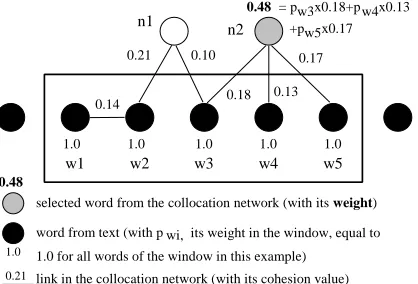
selected word from the collocation network (with its weight)
1.0
word from text (with p its weight in the window, equal to
0.21 link in the collocation network (with its cohesion value) 1.0 1.0 1.0 1.0 1.0
wi,
n1
n2
1.0 for all words of the window in this example) 0.48
Figure 1 – Selection and weighting of words from the collocation network
The building of the collocation vector for the win-dow’s context comes from the procedure presented in (Ferret, 1998) for evaluating the lexical cohe-sion of a text. It consists in selecting words of the collocation network that are topically close to those in the window. We assume that this close-ness is related to the number of links that exist between a word of the network and the words of the window. Thus, a word of the network is
2 In our case, this is the corpus used for building the collocation network.
lected if it is linked to at least wst (3 in our ex-periments) words of the window. A collocation vector may also contain some words of the win-dow as they are generally part of the collocation network and may be selected as its other words. Each selected word from the network is then as-signed a weight. This weight is equal to the sum of the contributions of the window words to which it is linked to. The contribution of a word of the window to the weight of a selected word is equal to its weight in the window, given by (1), modu-lated by the cohesion measure between these two words in the network (see Figure 1). More pre-cisely, the combination of these two factors is achieved by a geometric mean:
∑
⋅where coh(w,wi) is the measure of the cohesion
between w and wi in the collocation network.
4.1.2 Topic context of a segment
The topic context of a segment results from the fusion of the contexts associated to the focus win-dow when it was inside the segment. The fusion is achieved as the segment is extended: the context associated to each new position of the segment is combined with the current context of the segment. This combination, which is done separately for text vectors and collocation vectors, consists in merging two lists of weighted words. First, the words of the window context that are not in the segment context are added to it. Then, the weight of each word of the resulting list is computed ac-cording to its weight in the window context and its previous weight in the segment context:
))
from the window context that are not part of the segment context, wghtx(w,Cs,t-1) is equal to 0.
to be stable because if it follows too narrowly the topical evolution of the window context, topic shifts could not be detected. However, it must also adapt itself to small variations in the way a topic is expressed when progressing in the text in order not to detect false topic shifts.
4.1.3 Similarity between contexts
In order to determine if the content of the focus window is topically coherent or not with the cur-rent segment, the topic context of the window is compared to the topic context of the segment. This comparison is performed in two stages: first, a similarity measure is computed between the vec-tors of the two contexts; then, the resulting values are exploited by a decision procedure that states if the two contexts are similar.
As (Choi, 2000) or (Kaufmann, 1999), we use the cosine measure for evaluating the similarity be-tween a vector of the context window (Vw) and the equivalent vector in the segment context (Vs):
∑
As we assume that the most significant words of a segment context are the most recurrent ones, the similarity measure takes into account only the words of a segment context whose the recurrence3 is above a fixed threshold. This one is higher for text vectors than for collocation vectors. This fil-tering is applied only when the context of a seg-ment is considered as stable (see 4.2).
The decision stage takes root in work about com-bining results of several systems that achieve the same task. In our case, the evaluation of the simi-larity between Cs and Cw at each position is based on a vote that synthesizes the viewpoint of the text vector and the viewpoint of the collocation vector. First, the value of the similarity measure for each vector is compared to a fixed threshold and a
3 The recurrence of a word in a segment context is gi-ven by the ratio between the number of window contexts in which the word was present and the number of window contexts gathered by the segment context.
tive vote in favor of the similarity of the two con-texts is decided if the value exceeds this threshold. Then, the global similarity of the two contexts is rejected only if the votes for the two vectors are negative.
4.2
Topic segmentation
The algorithm for detecting topic shifts is taken from (Ferret and Grau, 2000) and basically relies on the following principle: at each text position, if the similarity between the topic context of the focus window and the topic context of the current segment is rejected (see 4.1.3), a topic shift is as-sumed and a new segment is opened. Otherwise, the active segment is extended up to the current position.
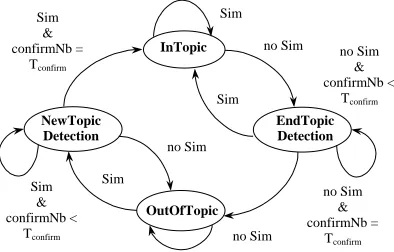
This algorithm assumes that the transition between two segments is punctual. As TOPICOLL only oper-ates at word level, its precision is limited. This imprecision makes necessary to set a short delay before deciding that the active segment really ends and similarly, before deciding that a new segment with a stable topic begins. Hence, the algorithm for detecting topic shifts distinguishes four states:
– the NewTopicDetection state takes place when a
new segment is going to be opened. This opening is then confirmed provided that the content of the focus window context doesn’t change for several positions. Moreover, the core of the segment con-text is defined when TOPICOLL is in this state; – the InTopic state is active when the focus win-dow is inside a segment with a stable topic;
– the EndTopicDetection state occurs when the
focus window is inside a segment but a difference between the context of the window and the context of the current segment suggests that this segment could end soon. As for the NewTopicDetection
state, this difference has to be confirmed for sev-eral positions before a change of state is decided;
– the OutOfTopic state is active between two
segments. Generally, TOPICOLL stays in this state no longer than 1 or 2 positions but when neither the words from text nor the words selected from the collocation network are recurrent, i.e. no stable topic can be detected according to these features, this number of positions may be equal to the size of a segment.
– its current state;
– the similarity between the context of the focus window and the context of the current segment:
Sim or no Sim;
– the number of successive positions of the focus window for which the current state doesn’t change: confirmNb. It must exceed the Tconfirm
threshold (equal to 3 in our experiments) for leav-ing the NewTopicDetection or the EndTopicDe-tection state.
NewTopic Detection
EndTopic Detection
OutOfTopic InTopic
Sim
Sim
Sim
no Sim
no Sim no Sim
no Sim & confirmNb =
Tconfirm no Sim
& confirmNb <
Tconfirm Sim
& confirmNb =
Tconfirm
Sim & confirmNb <
Tconfirm
Figure 2 – Automaton for topic shift detection
The processing of a segment starts with the Ou-tOfTopic state, after the end of the previous seg-ment or at the beginning of the text. As soon as the context of the focus window is stable enough be-tween two successive positions, TOPICOLL enters into the NewTopicDetection state. The InTopic
state can then be reached only if the window con-text is found stable for the next confirmNb-1 posi-tions. Otherwise, TOPICOLL assumes that it is a false alarm and returns to the OutOfTopic state. The detection of the end of a segment is symmetri-cal to the detection of its beginning. TOPICOLL goes into the EndTopicDetection state as soon as the content of the window context begins to change significantly between two successive posi-tions but the transition towards the OutOfTopic
state is done only if this change is confirmed for the next confirmNb-1 next positions.
This algorithm is completed by a specific mecha-nism related to the OutOfTopic state. When TOPICOLL stays in this state for a too long time (this time is defined as 10 positions of the focus window in our experiments), it assumes that the topic of the current part of text is difficult to char-acterize by using word recurrence or selection from a collocation network and it creates a new segment that covers all the concerned positions.
4.3
Link detection
The algorithm of TOPICOLL for detecting identity links between segments is closely associated to its algorithm for delimiting segments. When TO -PICOLL goes from the NewTopicDetection state to the InTopic state, it first checks whether the cur-rent context of the new segment is similar to one of the contexts of the previous segments. In this case, the similarity between contexts only relies on the similarity measure (see (5)) between their col-location vectors. A specific threshold is used for the decision. If the similarity value exceeds this threshold, the new segment is linked to the corre-sponding segment and takes the context of this one as its own context. In this way, TOPICOLL assumes that the new segment continues to develop a pre-vious topic. When several segments fulfills the condition for link detection, TOPICOLL selects the one with the highest similarity value.
5
Experiments
5.1
Topic segmentation
For evaluating TOPICOLL about segmentation, we applied it to the “classical” task of discovering boundaries between concatenated texts. TOPICOLL was adapted for aligning boundaries with ends of sentences. We used the probabilistic error metric
Pk proposed in (Beeferman et al., 1999) for
meas-uring segmentation accuracy4. Recall and precision was computed for the Le Monde corpus to com-pare TOPICOLL with older systems5. In this case, the match between a boundary from TOPICOLL and a document break was accepted if the boundary was not farther than 9 plain words.
5.1.1 Le Monde corpus
The evaluation corpus for French was made up of 49 texts, 133 words long on average, from the Le
4 P
k evaluates the probability that a randomly chosen
pair of words, separated by k words, is wrongly classi-fied, i.e. they are found in the same segment by
TOPICOLL while they are actually in different ones (miss of a document break) or they are found in different segments by TOPICOLL while they are actually in the same one (false alarm).
5 Precision is given by N
t / Nb and recall by Nt / D, with D the number of document breaks, Nb the number of
boundaries found by TOPICOLL and Nt the number of
Monde newspaper. Results in Tables 1 and 2 are average values computed from 10 different se-quences of them. The baseline procedure consisted in randomly choosing a fixed number of sentence ends as boundaries. Its results in Tables 1 and 2 are average values from 1,000 draws.
Systems Recall Precision F1-measure
baseline 0.51 0.28 0.36
SEGCOHLEX 0.68 0.37 0.48 SEGAPSITH 0.92 0.52 0.67
TextTiling 0.72 0.81 0.76
TOPICOLL1 0.86 0.74 0.80
TOPICOLL2 0.86 0.78 0.81
TOPICOLL3 0.66 0.60 0.63
Table 1 – Precision/recall for Le Monde corpus
TOPICOLL1 is the system described in section 4.
TOPICOLL2 is the same system but without its link detection part. The results of these two variants show that the search for links between segments doesn’t significantly debase TOPICOLL’s capabili-ties for segmentation. TOPICOLL3 is a version of
TOPICOLL that only relies on word recurrence. SEGCOHLEX and SEGAPSITH are the systems de-scribed in (Ferret, 1998) and (Ferret and Grau, 2000). TextTiling is our implementation of Hearst’s algorithm with its standard parameters.
Systems Miss False alarm Error
baseline 0.46 0.55 0.50
TOPICOLL1 0.17 0.24 0.21
TOPICOLL2 0.17 0.22 0.20
Table 2 – Pk for Le Monde corpus
First, Table 1 shows that TOPICOLL is more accu-rate when its uses both word recurrence and collo-cations. Furthermore, it shows that TOPICOLL gets better results than a system that only relies on a collocation network such as SEGCOHLEX. It also gets better results than a system such as TextTiling that is based on word recurrence and as TOPICOLL, works with a local context. Thus, Table 1 confirms the fact reported in (Jobbins and Evett, 1998) that using collocations together with word recurrence is an interesting approach for text segmentation. Moreover, TOPICOLL is more accurate than a sys-tem such as SEGAPSITH that depends on topic
rep-resentations. Its accuracy is also slightly higher than the one reported in (Bigi et al., 1998) for a system that uses topic representations in a prob-abilistic way: 0.75 as precision, 0.80 as recall and 0.77 as f1-measure got on a corpus made of Le Monde’s articles too.
5.1.2 C99 corpus
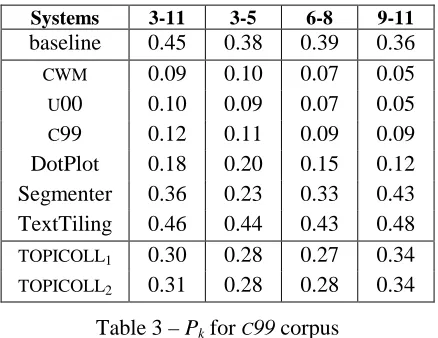
For English, we used the artificial corpus built by Choi (Choi, 2000) for comparing several segmen-tation systems. This corpus is made up of 700 samples defined as follows: “A sample is a con-catenation of ten text segments. A segment is the first n sentences of a randomly selected document for the Brown corpus”. Each column of Table 3 states for an interval of values for n.
Systems 3-11 3-5 6-8 9-11
baseline 0.45 0.38 0.39 0.36
CWM 0.09 0.10 0.07 0.05
U00 0.10 0.09 0.07 0.05 C99 0.12 0.11 0.09 0.09
DotPlot 0.18 0.20 0.15 0.12
Segmenter 0.36 0.23 0.33 0.43
TextTiling 0.46 0.44 0.43 0.48
TOPICOLL1 0.30 0.28 0.27 0.34
TOPICOLL2 0.31 0.28 0.28 0.34
Table 3 – Pk for C99 corpus
The first seven lines of Table 3 results from Choi’s experiments (Choi, 2001). The baseline is a proce-dure that partitions a document into 10 segments of equal length. CWM is described in (Choi, 2001), U00 in (Utiyama and Isahara, 2001), C99 in (Choi, 2000), DotPlot in (Reynar, 1998) and Segmenter in (Kan et al., 1998).
Table 3 confirms first that the link detection part of TOPICOLL doesn’t debase its segmentation ca-pabilities. It also shows that TOPICOLL’s results on this corpus are significantly lower than its results on the Le Monde corpus. This is partially due to our collocation network for English: its density,
context whereas these systems rely on the whole text they process. As a consequence, they have a global view on texts but are more costly than TOPICOLL from an algorithmic viewpoint. Moreo-ver, link detection makes TOPICOLL functionally richer than they are.
5.2
Global evaluation
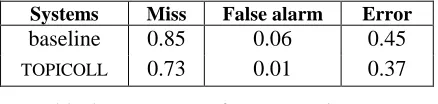
The global evaluation of a system such as TOPICOLL faces a problem: a reference for link detection is relative to a reference for segmenta-tion. Hence, mapping it onto the segments delim-ited by a system to evaluate is not straightforward. To bypass this problem, we chose an approach close the one adopted in TDT for the link detection task: we evaluated the probability of an error in classifying each couple of positions in a text as being part of the same topic (Cpsame) or belonging
to different topics (Cpdiff). A miss is detected if a
couple is found about different topics while they are about the same topic and a false alarm corre-sponds to the complementary case.
Systems Miss False alarm Error
baseline 0.85 0.06 0.45
TOPICOLL 0.73 0.01 0.37
Table 4 – Error rates for Le Monde corpus
As the number of Cpdiff couples is generally much
larger than the number of Cpsame couples, we
ran-domly selected a number of Cpdiff couples equal to
the number of Cpsame couples in order to have a
large range of possible values. Table 4 shows the results of TOPICOLL for the considered measure and compares them to a baseline procedure that randomly set a fixed number of boundaries and a fixed number of links between the delimited seg-ments. This measure is a first proposition that should certainly be improved, especially for bal-ancing more soundly misses and false alarms.
6
Conclusion
We have proposed a method for achieving both topic segmentation and link detection by using collocations together with word recurrence in texts. Its evaluation showed the soundness of this approach for working with a local context. We plan to extend it to methods that rely on the whole text they process. We also aim at extending the evaluation part of this work by improving the
global measure we have proposed and by com-paring our results to human judgments.
References
Beeferman D., Berger A. and Lafferty J. (1999) Statis-tical Models for Text Segmentation, Machine Learn-ing, 34/1, pp. 177–210.
Bigi B., de Mori R., El-Bèze M. and Spriet T. (1998)
Detecting topic shifts using a cache memory, 5th In-ternational Conference on Spoken Language Proc-essing, pp. 2331–2334.
Church K. W. and Hanks P. (1990) Word Association Norms, Mutual Information, And Lexicography. Computational Linguistics, 16/1, pp. 22–29.
Choi F., Wiemer-Hastings P. and Moore J. (2001) La-tent Semantic Analysis for Text Segmentation, NAACL’01, pp. 109–117.
Choi F. (2000) Advances in domain independent linear text segmentation, NAACL’00, pp. 26–33.
Ferret O. and Grau B. (2000) A Topic Segmentation of Texts based on Semantic Domains, ECAI 2000, pp. 426–430.
Ferret O. (1998) How to thematically segment texts by using lexical cohesion?, ACL-COLING’98, pp. 1481–1483.
Fiscus J., Doddington G., Garofolo J. and Martin A. (1999) NIST’s 1998 Topic Detection and Tracking Evaluation,DARPA Broadcast News Workshop. Hearst M. (1997) TextTiling: Segmenting Text into
Multi-paragraph Subtopic Passages, Computational Linguistics, 23/1, pp. 33–64.
Jobbins A. and Evett L. (1998) Text Segmentation Us-ing Reiteration and Collocation, ACL-COLING’98, pp. 614–618.
Kan M-Y., Klavans J. and McKeown K. (1998) Linear segmentation and segment significance, 6th Workshop on Very Large Corpora, pp. 197–205.
Kaufmann S. (1999) Cohesion and Collocation: Using Context Vectors in Text Segmentation, ACL’99, pp. 591–595.
Kozima H. (1993) Text Segmentation Based on Simi-larity between Words, ACL’93, pp. 286–288.
Passonneau R. and Litman D. (1997) Discourse Seg-mentation by Human and Automated Means, Com-putational Linguistics, 23/1, pp. 103–139.
Reynar R. (1998) Topic segmentation: Algorithms and applications, Ph.D. thesis, Computer and Information Science, University of Pennsylvania.