Deriving Consensus for Multi-Parallel Corpora: an English Bible Study
Patrick Xia and David Yarowsky
Center for Language and Speech Processing, Johns Hopkins University {paxia, yarowsky}@jhu.edu
Abstract
What can you do with multiple noisy ver-sions of the same text? We present a method which generates a single consen-sus between multi-parallel corpora. By maximizing a function of linguistic fea-tures between word pairs, we jointly learn a single corpus-wide multiway alignment: a consensus between 27 versions of the English Bible. We additionally produce English paraphrases, word-level distribu-tions of tags, and consensus dependency parses. Our method is language indepen-dent and applicable to any multi-parallel corpora. Given the Bible’s unique role as alignable bitext for over 800 of the world’s languages, this consensus alignment and resulting resources offer value for multilin-gual annotation projection, and also shed potential insights into the Bible itself.
1 Introduction
Noisy or heterogeneous copies of the same text are prevalent in religious and literary texts (Resnik et al.,1999;Koppel et al.,2016), machine transla-tionn-best lists (Kumar and Byrne,2004;Papineni et al.,2002), comparable corpora (Barzilay and Lee,
2003), and social media (Xu et al.,2015). While copies can be analyzed independently or together in a pairwise manner, information can be lost by not using them all jointly.
We view these copies of text asmulti-parallel corpora, which consist of multiple sets of compa-rable or partially aligned documents. This contrasts with parallel corpora, which are usually between only two. The goal of this work is to produce word alignments for multi-parallel corpora (Fig.1).
We approach this problem by tying the multi-parallel corpora together using features such as
Consensus newsimplified montgomery lexham Then (Then, 0) (Thereupon, 0) (Then, 0) Herod (Herod, 1) (Herod, 1) (Herod, 1) secretly (secretly, 2) (secretly, 3) (secretly, 2) called (called, 3) (sent, 2) (summoned, 3)
for (for, 4)
the (the, 4) (the, 5) (the, 4)
wise (wise, 5)
men (astrologers, 5) (Magi, 6) (men, 6) Figure 1: A sample of Fig.3, in which different words with a similar meaning are aligned. Each entry contains the word and its index in the original sentence.
pairwise word alignments, dependency parses, and POS tags. Our method jointly learns word align-ments and annotations for these features in the En-glish Biblical multi-parallel corpora. We produce multiway word alignments, complete dependency parses, and POS tag annotations for the English Bible. While our resources and choice of features are catered for our specific domain, the method can be applied more broadly for aligning and establish-ing consensus in any domain.
The English Bible is a literary religious text with multiple authors, disputed authorship structure, and multiple revisions for language modernization.1
While there is existing computational work in Bib-lical analysis (Lee,2007), our contribution of auto-matically generated consensus annotations for all verses allows future research to efficiently investi-gate across all English Bibles. As the Bible is avail-able in electronic form in over 800 of the world’s languages (Mayer and Cysouw,2014), the Bible may be the only parallel corpus for low-resource languages, and our in-domain resources can be a valuable reference.2
1The unresolved Synoptic Problem questions the order and
dependencies of the the Synoptic Gospels.
2Available atgithub.com/pitrack/monolign.
2 Method
The consensus consists of aligned tokens between the corpora. Assuming each corpus consists of par-tially aligned documents (e.g. verses of the Bible), we first target the word alignments at the document level. We then use a bootstrapping approach to produce the final corpus-wide alignment. By using a majority vote, the final alignments can produce additional consensus resources.
2.1 Document-level alignment
To create document-level alignments, documents from each corpus are processed sequentially. Sup-poseL={D1, D2, ..., Dk}is a set of parallel
doc-uments wheredi,j is thejth token inDi. A
match-ingMLis a document-level alignment which
con-sists of a set of relations,R1, ..., Rr. For example,
if|L| = 2, thenMLis a one-to-one word
align-ment between two lines of text. Its relations are either an aligned pair of tokens or an unaligned singleton token.
In Algorithm 1, ML is generated by adding
the next document to an existing matching and weighing the edges between tokens and relations according to Equation1. Edges are pruned to both speed up the solver and avoid conflating separate or weakly related tokens. The maximum weighted matching is then used to decide which relations are expanded.
W(di,j, Rk) = X
d∈Rk
f(d, di,j). (1)
Algorithm 1Document-level alignment functionALIGNDOCUMENTS(L)
L=D1, D2, ..., Dk .Assume fixed ordering M={{d1,j}:d1,j∈D1}
.Initialize matching with singletons relations
forDi=D2, ..., Dkdo
(V, E) = (Di∪ M, Di× M)
G= (V, E, W(E)) . Wis defined by Eqn.1
G0=PRUNE(G) .Remove small edges
A=MAXWEIGHTMATCHING(G0) for(d, R)∈Ado
R←R∪ {d}
M ← M ∪ {{di,j}:di,j∈Di\A}
.Update existing relations or create new singletons
returnM
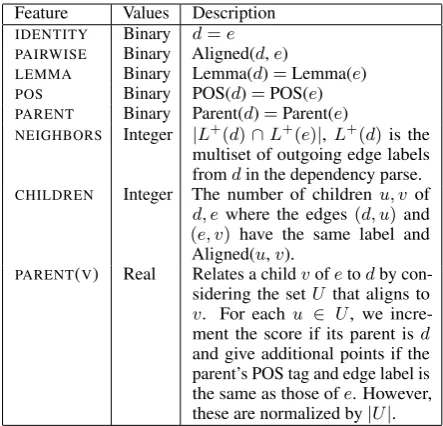
The scoring function, f, is a weighted sum of the features described in Table1. While a feasible weight function could be normalized by|Rk|, we
instead choose to sum. If two different relations have a similar meaning but are not initially placed
Feature Values Description IDENTITY Binary d=e PAIRWISE Binary Aligned(d,e)
LEMMA Binary Lemma(d)=Lemma(e) POS Binary POS(d)=POS(e) PARENT Binary Parent(d)=Parent(e)
NEIGHBORS Integer |L+(d)∩L+(e)|, L+(d)is the multiset of outgoing edge labels fromdin the dependency parse. CHILDREN Integer The number of childrenu, v of
d, ewhere the edges(d, u)and
(e, v) have the same label and Aligned(u,v).
PARENT(V) Real Relates a childvofetodby con-sidering the setU that aligns to
v. For eachu ∈ U, we incre-ment the score if its parent isd
[image:2.595.306.528.61.274.2]and give additional points if the parent’s POS tag and edge label is the same as those ofe. However, these are normalized by|U|. Table 1: These specific features are used inf(d, e). Aligned(d,
e) is determined by the bitext aligner, andPARENT(V) is a feature for each childvofe. All features have weight 1, except forIDENTITY, which has weight 3. The pruning threshold is 4. These values could be further tuned.
together, both will grow as tokens from new tokens would have a similar score to both. By using total score, the bigger relation will dominate. On the other hand, taking the sum could lead large rela-tions matching with unrelated tokens. For ease of future analysis, errors of this type were preferred.
F(M) = X
Ri∈M
X
d,e∈Ri
f(d, e) (2)
A matching is scored by summing pairwise scores in all of its relations (Equation 2). Ideally, we would directly maximize F(M), but that is NP-hard.3 Instead, we match each document greedily.
2.2 Creating a corpus alignment
Suppose the documents in the multi-parallel cor-poraC = C1, C2, . . . , Ccare already aligned, so for any document, we can find its counterpart in eachCi, if it exists. This is the case for the
Bibli-cal data since the verse numbers act as document labels.
Given an existing document-level alignment, we can improve the accuracy of individual features. For example, tokens within the same relation are synonymous, and so they are used to recompute thePAIRWISEfeature. Algorithm1depends on the
initial ordering ofL. This motivates Algorithm2,
3With just three documents, this is a weighted variant of
which both recomputes the feature values and shuf-fles the documents between each of theT = 10 iterations.
Algorithm 2Corpus alignment
Input:Multi-parallel corporaC=C1, C2, ...Cc Parse and tag eachCi∈ C4
fort= 1. . . T do
Recompute corpus statistics Align every pairCi, Cj∈ C
C.shuffle() .Choose a new order for the documents
for alldocumentsL∈ Cdo
ML,t=ALIGNDOCUMENTS(L)
Output:{argmaxML,tF(ML,t) :L∈ C}
2.3 Dataset and tools
The corpus of Bibles were collected byMayer and Cysouw(2014) and contains 27 English versions. 23 contain just the New Testament (~8K verses, ~200K words), while four also include the Old Testament (~31K verses, ~900K words).
We use fast_align (Dyer et al., 2013), a greedy, transition-based dependency parser ( Honni-bal and Johnson,2015), and an averaged perceptron POS tagger with Brown cluster features (Collins,
2002;Koo et al.,2008) for feature computation.5
3 Results
3.1 Analysis of alignments
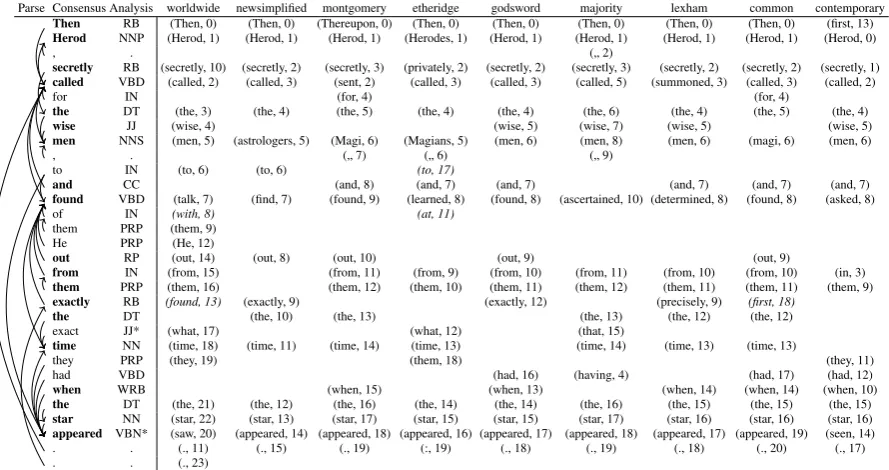
Fig.3shows an example of an alignment produced by our system.6 There are a few misalignments due
to both literary divergence and our design choices, such as the sum in Equation1and targeting one-to-one alignments.
The visualization of the matchings simplifies analysis of literary variation. Relations with only a few or different members are easy to spot. These anomalies can be indicators of different choices in translation, unclean source text, or use of older language. For example, unlike “wise men" and “magi," “astrologers" only appears once across the rowswise menin Fig.3, so the word choice may be a deliberate. Small or singleton relations prompt further investigation into the source.7Since some
of our features are independent of meaning, we correctly align non-English (e.g. Hebrew) words.
4If parsing or tagging is improved by the alignments from
the previous iteration, it could be rerun every iteration.
5Implemented byhttps//spacy.io. 6More examples in Appendix Tables7and8
7In Matthew 8:22 (diaglot version), an error in the source
was discovered by an extraneous singleton relation:{“The”}.
1 2 3 4 5 6 7 8 9 10 Iteration
1.00 1.05
[image:3.595.333.500.68.197.2]1.10
Relative improvement to iteration 1
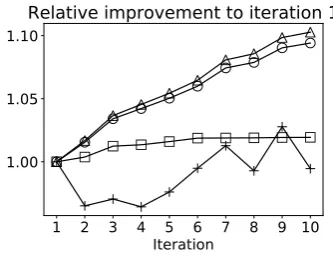
Figure 2: Relative change in total score with respect to the first iteration: Entire text (#); Old Testament (); New Testament (4); per iteration (+). Since the feature weights are fixed, the absolute score is not meaningful.
Word indices in each of the columns also show the degree of reordering, which itself is a measure of divergence.
3.2 Improvements across iterations
Fig. 2 tracks the relative change in total score summed across all the documents. The Old Tes-tament plateaus early, possibly because there are only four sources. The high variance in per itera-tion score shows the large effect of the ordering.
3.3 Limitations
Since there are no gold-standard annotations for this task, it is difficult to perform a meaningful quantitative evaluation on the alignments directly. Empirical evaluation is also challenging due to the scale of even a single multiway alignment.
Because the tools used are not trained specifi-cally for historical English religious texts, it is pos-sible for the features themselves to be imprecise or noisy. For this predominantly modern English cor-pora, tokens with incorrectly preprocessed features can still be placed in the correct relation due to the correct features. For an even better alignment, ad-ditional features or a looser definition ofIDENTITY
would encourage improved alignments.
The proposed method assumes a one-to-one map-ping between tokens and relations. Multi-word ex-pressions in the consensus, likewise men, can be viewed as a multi-relation expression. It is chal-lenging to generalize our method to many-to-many alignments.
4 Additional Biblical Resources
Parse Consensus Analysis worldwide newsimplified montgomery etheridge godsword majority lexham common contemporary Then RB (Then, 0) (Then, 0) (Thereupon, 0) (Then, 0) (Then, 0) (Then, 0) (Then, 0) (Then, 0) (first, 13) Herod NNP (Herod, 1) (Herod, 1) (Herod, 1) (Herodes, 1) (Herod, 1) (Herod, 1) (Herod, 1) (Herod, 1) (Herod, 0)
, . („ 2)
secretly RB (secretly, 10) (secretly, 2) (secretly, 3) (privately, 2) (secretly, 2) (secretly, 3) (secretly, 2) (secretly, 2) (secretly, 1) called VBD (called, 2) (called, 3) (sent, 2) (called, 3) (called, 3) (called, 5) (summoned, 3) (called, 3) (called, 2)
for IN (for, 4) (for, 4)
the DT (the, 3) (the, 4) (the, 5) (the, 4) (the, 4) (the, 6) (the, 4) (the, 5) (the, 4)
wise JJ (wise, 4) (wise, 5) (wise, 7) (wise, 5) (wise, 5)
men NNS (men, 5) (astrologers, 5) (Magi, 6) (Magians, 5) (men, 6) (men, 8) (men, 6) (magi, 6) (men, 6)
, . („ 7) („ 6) („ 9)
to IN (to, 6) (to, 6) (to, 17)
and CC (and, 8) (and, 7) (and, 7) (and, 7) (and, 7) (and, 7) found VBD (talk, 7) (find, 7) (found, 9) (learned, 8) (found, 8) (ascertained, 10) (determined, 8) (found, 8) (asked, 8) of IN (with, 8) (at, 11)
them PRP (them, 9) He PRP (He, 12)
out RP (out, 14) (out, 8) (out, 10) (out, 9) (out, 9)
from IN (from, 15) (from, 11) (from, 9) (from, 10) (from, 11) (from, 10) (from, 10) (in, 3) them PRP (them, 16) (them, 12) (them, 10) (them, 11) (them, 12) (them, 11) (them, 11) (them, 9) exactly RB (found, 13) (exactly, 9) (exactly, 12) (precisely, 9) (first, 18)
the DT (the, 10) (the, 13) (the, 13) (the, 12) (the, 12) exact JJ* (what, 17) (what, 12) (that, 15)
time NN (time, 18) (time, 11) (time, 14) (time, 13) (time, 14) (time, 13) (time, 13)
they PRP (they, 19) (them, 18) (they, 11)
had VBD (had, 16) (having, 4) (had, 17) (had, 12)
[image:4.595.71.524.60.299.2]when WRB (when, 15) (when, 13) (when, 14) (when, 14) (when, 10) the DT (the, 21) (the, 12) (the, 16) (the, 14) (the, 14) (the, 16) (the, 15) (the, 15) (the, 15) star NN (star, 22) (star, 13) (star, 17) (star, 15) (star, 15) (star, 17) (star, 16) (star, 16) (star, 16) appeared VBN* (saw, 20) (appeared, 14) (appeared, 18) (appeared, 16) (appeared, 17) (appeared, 18) (appeared, 17) (appeared, 19) (seen, 14) . . (., 11) (., 15) (., 19) (:, 19) (., 18) (., 19) (., 18) (., 20) (., 17) . . (., 23)
Figure 3: A matching for documentD=Matthew 2:7. For space reasons, nine versions are shown in the same order they were aligned. Each row is a relation; the row header is its most common word. Each cell(r, c)is a member of the relationRrand contains a token and an index from documentDc. The relations are arranged by the consensus index. Consensus POS tags and edges to the head token are shown in the analysis column. For presentation purposes, row headers areboldedif the majority of the documents in this table had a word in the relation. * indicates that there existed an equally competitive tag. Misalignments areitalicized.
tokens in that relation. This can be extended on the corpus-level to word types by considering all relations represented by or containing that type.
4.1 In-domain paraphrases
We create a Bible-specific set of paraphrases. To obtain a distribution of similar words to a specific typew, we consider either all tokens in all relations that containw(finer) or just the majority type of relations containingw(coarser) (Fig.4).
Fine-grained paraphrases:
HEROD:Herod(0.90),Herodes(0.04),he(0.01). . . SECRET: secret (0.59),mystery(0.19),private (0.04). . .
Coarse-grained paraphrases:
HEROD:Herod(0.95),Herods(0.05) SECRET:secret(1.00)
Figure 4: Each word is followed by possible paraphrases and their proportions, which are computed from the consensus.
The domain specific paraphrases demonstrate the linguistic variation across the Bible, which can be further analyzed. Fig.5 explores some of the variations that occur in our specific domain.
4.2 Consensus distributions
We can compute both the majority values (Fig.3) and the entire distributions (Fig.6) of specific fea-tures such as POS tags and head words. Aggregat-ing each corpus independently before alignment,
HYMENAEUS: Hymenaeus(0.82),Hymenius(0.04),
Hymeneus(0.04),Humenaios(0.04). . .
BLAZES: burns (0.48), burning (0.33) burneth
(0.10),blazes(0.04). . .
CHALLENGED: said(0.15),opposed(0.13),urged (0.12),tested(0.10),tempted(0.06),tried(0.05),
asked(0.04).
Figure 5: These examples demonstrate spelling variation, lan-guage modernization, and unexpected domain-specific distri-butions.
we can compute the possible tags for a word type. By using the alignments, the distribution of tags is softer. This could be useful as a prior in cross-lingual tag projection, since bitexts in the Bible are often not exact translations.
For each possible head of a token, we compute consensus edge labels. By taking the most frequent edges, this results in a consensus dependency parse. If the proportions are used instead of the consensus, the result is a distribution over possible parses.
5 Discussion and Related Work
While monolingual insights like paraphrases have potential applications in semantic textual similarity (Agirre et al., 2012), there exist bigger corpora for those tasks, such as PPDB (Ganitkevitch et al.,
[image:4.595.72.517.62.297.2]POS tags
Before corpus alignments: TIME: NN (1.00)
SECRET: NN (0.54), JJ (0.46) With corpus alignments: TIME: NN (0.94), NNS (0.05). . .
SECRET: JJ (0.51), NN (0.47), NNS (0.01). . .
Head words
Before corpus alignments:
TIME:at(0.23),for(0.09),in(0.07),is(0.06). . .
SECRET: in (0.28), is (0.06) kept (0.04) places
(0.04). . .
With corpus alignments:
TIME:at(0.17),in(0.09),for(0.09),is(0.05). . . SECRET:in(0.32),place(0.05),mystery(0.04),is (0.04). . .
Figure 6: A comparison of the POS tags (above) and head words (below) distributions fortimeandsecretwith and with-out the consensus alignment.
resources created here have value for annotation projection to low-resource languages.
The Bible has been productively used as a key resource for cross-lingual knowledge transfer (Yarowsky et al.,2001;Agi´c et al.,2015). Specif-ically,Johannsen et al.(2016) suggests a method for projecting POS tags and dependency parses onto a target language. Our approach can be mod-ified in a similar way. By restricting the scoring function to use entirely language-independent fea-tures (e.g. pairwise alignments), our algorithm still maximizes the score of the matching by relearning an improved dictionary between iterations. The corpus alignment may also be desirable over sep-arate alignments for multi-source projection tasks in noisier data because a word or phrase may only align with only a subset of the sources.
By generating resources specifically for the Bible, we hope to foster future computational meth-ods for studying religious texts. Current Biblical visualization (Zhang et al.,2016) and authorship (Moritz et al.,2016) works use a small subset of the translations to perform their analysis. Our re-sources would encourage analysis across all ver-sions of the Bible, which would be less biased than picking a small set. By weighing the votes cast by each token in a relation, it is even possible to emphasize a specific corpus.
The algorithms described in Section 2 can be applied to any parallel corpora. The scoring func-tion is simple and accommodates arbitrary fea-tures. While our approach specifically assumes the documents (verses) within the corpora are al-ready aligned, knowing which documents are simi-lar (e.g. through clustering) is sufficient – perhaps
at the cost of quality – to align and generate the subsequent resources.
6 Conclusion
We present a method for analyzing noisy multi-parallel text on significant multi-multi-parallel corpora: 27 versions of the English Bible. The algorithm maximizes a flexible heuristic scoring function, so it is language-independent and applicable to any multi-parallel corpora. We produce a corpus-wide word alignment and use its consensus to create additional in-domain resources.
Given the Bible’s unique role as the primary or only significant bitext for many of the world’s lan-guages, the robustly induced consensus analyses and associated alignments offer particular value to annotation projection in low-resource languages. In addition, these results shed insight into the un-derlying semantics of very widely studied source texts via both consensus and divergence of their multiple distinct translations.
Acknowledgments
This material is based upon work supported in part by DARPA LORELEI. Any opinions, findings and conclusions or recommendations expressed in this material are those of the authors and do not neces-sarily reflect the views of DARPA.
References
Željko Agi´c, Dirk Hovy, and Anders Søgaard. 2015.If all you have is a bit of the Bible: Learning POS
tag-gers for truly low-resource languages. In
Proceed-ings of the 53rd Annual Meeting of the Association for Computational Linguistics and the 7th Interna-tional Joint Conference on Natural Language Pro-cessing (Volume 2: Short Papers), pages 268–272, Beijing, China. Association for Computational Lin-guistics.
Eneko Agirre, Daniel Cer, Mona Diab, and Aitor Gonzalez-Agirre. 2012. SemEval-2012 task 6: A pilot on semantic textual similarity. In*SEM 2012: The First Joint Conference on Lexical and Compu-tational Semantics – Volume 1: Proceedings of the main conference and the shared task, and Volume 2: Proceedings of the Sixth International Workshop on Semantic Evaluation (SemEval 2012), pages 385– 393, Montréal, Canada. Association for Computa-tional Linguistics.
of the Association for Computational Linguistics on Human Language Technology - Volume 1, pages 16– 23.
Michael Collins. 2002. Discriminative training meth-ods for hidden Markov models: Theory and experi-ments with perceptron algorithms. InProceedings of the 2002 Conference on Empirical Methods in Natural Language Processing, pages 1–8.
Chris Dyer, Victor Chahuneau, and Noah A. Smith. 2013. A simple, fast, and effective
reparameter-ization of IBM model 2. In Proceedings of the
2013 Conference of the North American Chapter of the Association for Computational Linguistics: Hu-man Language Technologies, pages 644–648, At-lanta, Georgia. Association for Computational Lin-guistics.
Juri Ganitkevitch, Benjamin Van Durme, and Chris Callison-Burch. 2013. PPDB: The paraphrase
database. InProceedings of the 2013 Conference of
the North American Chapter of the Association for Computational Linguistics: Human Language Tech-nologies, pages 758–764, Atlanta, Georgia. Associa-tion for ComputaAssocia-tional Linguistics.
Matthew Honnibal and Mark Johnson. 2015. An im-proved non-monotonic transition system for
depen-dency parsing. In Proceedings of the 2015
Con-ference on Empirical Methods in Natural Language Processing, pages 1373–1378, Lisbon, Portugal. As-sociation for Computational Linguistics.
Anders Johannsen, Željko Agi´c, and Anders Søgaard. 2016. Joint part-of-speech and dependency
projec-tion from multiple sources. InProceedings of the
54th Annual Meeting of the Association for Compu-tational Linguistics (Volume 2: Short Papers), pages 561–566, Berlin, Germany. Association for Compu-tational Linguistics.
Terry Koo, Xavier Carreras, and Michael Collins. 2008. Simple semi-supervised dependency
pars-ing. In Proceedings of ACL-08: HLT, pages 595–
603, Columbus, Ohio. Association for Computa-tional Linguistics.
Moshe Koppel, Moty Michaely, and Alex Tal. 2016. Reconstructing ancient literary texts from noisy manuscripts. InProceedings of the Fifth Workshop on Computational Linguistics for Literature, pages 40–46.
Shankar Kumar and William Byrne. 2004. Minimum bayes-risk decoding for statistical machine transla-tion. InIn Proceedings of the NAACL 2004, pages 169–176.
John Lee. 2007. A computational model of text reuse in ancient literary texts. InProceedings of the 45th Annual Meeting of the Association of Computational Linguistics, pages 472–479.
Thomas Mayer and Michael Cysouw. 2014. Creating a massively parallel Bible corpus. InProceedings of the Ninth International Conference on Language Resources and Evaluation (LREC’14).
Maria Moritz, Andreas Wiederhold, Barbara Pavlek, Yuri Bizzoni, and Marco Büchler. 2016. Non-literal text reuse in historical texts: An approach to identify reuse transformations and its application to Bible
reuse. In Proceedings of the 2016 Conference on
Empirical Methods in Natural Language Process-ing, pages 1849–1859, Austin, Texas. Association for Computational Linguistics.
Kishore Papineni, Salim Roukos, Todd Ward, and Wei-Jing Zhu. 2002. BLEU: A method for automatic evaluation of machine translation. In Proceedings of the 40th Annual Meeting on Association for Com-putational Linguistics, ACL ’02, pages 311–318. Philip Resnik, Mari Broman Olsen, and Mona Diab.
1999. The Bible as a parallel corpus: Annotating the ‘Book of 2000 Tongues’. Computers and the Humanities, 33(1):129–153.
Wei Xu, Chris Callison-Burch, and Bill Dolan. 2015. Semeval-2015 task 1: Paraphrase and semantic sim-ilarity in twitter (pit). InProceedings of the 9th In-ternational Workshop on Semantic Evaluation (Se-mEval 2015), pages 1–11, Denver, Colorado. Asso-ciation for Computational Linguistics.
David Yarowsky, Grace Ngai, and Richard Wicen-towski. 2001. Inducing multilingual text analysis tools via robust projection across aligned corpora. In
Proceedings of the First International Conference on Human Language Technology Research, pages 1–8, San Diego. Association for Computational Linguis-tics.
Ken Zhang, Carlos Folgar, and Jess McCuan. 2016. Decoding the Bible. https://quid.com/