Capturing Long-range Contextual Dependencies with
Memory-enhanced Conditional Random Fields
Fei Liu Timothy Baldwin Trevor Cohn
School of Computing and Information Systems The University of Melbourne
Victoria, Australia
[email protected] [email protected] [email protected]
Abstract
Despite successful applications across a broad range of NLP tasks, conditional ran-dom fields (“CRFs”), in particular the linear-chain variant, are only able to model local features. While this has important benefits in terms of inference tractabil-ity, it limits the ability of the model to capture long-range dependencies between items. Attempts to extend CRFs to cap-ture long-range dependencies have largely come at the cost of computational com-plexity and approximate inference. In this work, we propose an extension to CRFs by integrating external memory, taking in-spiration from memory networks, thereby allowing CRFs to incorporate informa-tion far beyond neighbouring steps. Ex-periments across two tasks show substan-tial improvements over strong CRF and LSTM baselines.
1 Introduction
While long-range contextual dependencies are prevalent in natural language, for tractability rea-sons, most statistical models capture only local features (Finkel et al., 2005). Take the sentence in Figure1, for example. Here, while it is easy to determine thatInterfaxin the second sentence is a named entity, it is hard to determine its semantic class, as there is little context information. The us-age in the first sentence, on the other hand, can be reliably disambiguated due to the post-modifying phase news agency. Ideally we would like to be able to share such contexts across all usages (and variants) of a given named entity for reliable and consistent identification and disambiguation.
A related example is forum thread discourse analysis. Previous work has largely focused on
linear-chain Conditional Random Fields (CRFs) (Wang et al., 2011; Zhang et al., 2017), framing the task as one of sequence tagging. Although CRFs are adept at capturing local structure, the problem does not naturally suit a linear sequen-tial structure, i.e. , a post may be a reply to ei-ther a neighbouring post or one posted far earlier within the same thread. In both cases, contextual dependencies can be long-range, necessitating the ability to capture dependencies between arbitrarily distant items. Identifying this key limitation, Sut-ton and McCallum(2004) andFinkel et al.(2005) proposed the use of CRFs with skip connections to incorporate long-range dependencies. In both cases the graph structure must be supplied a pri-ori, rather than learned, and both techniques incur the need for costly approximate inference.
Recurrent neural networks (RNNs) have been proposed as an alternative technique for encoding sequential inputs, however plain RNNs are unable to capture long-range dependencies (Bengio et al.,
1994; Hochreiter et al., 2001) and variants such as LSTMs (Hochreiter and Schmidhuber, 1997), although more capabable of capturing non-local patterns, still exhibit a significant locality bias in practice (Lai et al.,2015;Linzen et al.,2016).
In this paper, taking inspiration from the work of Weston et al. (2015) on memory networks (MEMNETs), we propose to extend CRFs by
in-tegrating external memory mechanisms, thereby enabling the model to look beyond localised fea-tures and have access to the entire sequence. This is achieved with attention over every try in the memory. Experiments on named en-tity recognition and forum thread parsing, both of which involve long-range contextual dependen-cies, demonstrate the effectiveness of the proposed model, achieving state-of-the-art performance on the former, and outperforming a number of strong baselines in the case of the latter. A full
Interfax B-ORG
· · ·
news O
agency O
said
O · · ·
Interfax B-ORG
quoted O
Russian B-MISC
military O · · ·
Figure 1: A NER example with long-range contextual dependencies. The vertical dash line indicates a sentence boundary.
mentation of the model is available at: https: //github.com/liufly/mecrf.
The paper is organised as follows: after review-ing previous studies on capturreview-ing long range con-textual dependencies and related models in Sec-tion 2, we detail the elements of the proposed model in Section 3. Section 4 and5 present the experimental results on two different datasets: one for thread discourse structure prediction and the other named entity recognition (NER), with anal-yses and visualisation in their respective sections. Lastly, Section6concludes the paper.
2 Related Work
In this section, we review the different families of models that are relevant to this work, in captur-ing long-range contextual dependencies in differ-ent ways.
Conditional Random Fields (CRFs). CRFs (Lafferty et al., 2001), in particular linear-chain CRFs, have been widely adopted and applied to sequence labelling tasks in NLP, but have the crit-ical limitation that they only capture local struc-ture (Sutton and McCallum, 2004; Finkel et al.,
2005), despite non-local structure being common in structured language classification tasks. In the context of named entity recognition (“NER”), Sut-ton and McCallum (2004) proposed skip-chain CRFs as a means of alleviating this shortcom-ing, wherein distant items are connected in a se-quence based on a heuristic such as string identity (to achieve label consistency across all instances of the same string). The idea of label consistency and exploiting non-local features has also been ex-plored in the work ofFinkel et al.(2005), who take long-range structure into account while maintain-ing tractable inference with Gibbs samplmaintain-ing ( Ge-man and GeGe-man, 1984), by performing approxi-mate inference over factored probabilistic models. While both of these lines of work report impres-sive results on information extraction tasks, they come at the price of high computational cost and
incompatibility with exact inference.
Similar ideas have also been explored by Kr-ishnan and Manning(2006) for NER, where they apply two CRFs, the first of which makes pre-dictions based on local information, and the sec-ond combines named entities identified by the first CRF in a single cluster, thereby enforcing label consistency and enabling the use of a richer set of features to capture non-local dependencies. Liao and Grishman(2010) make a strong case for go-ing beyond sentence boundaries and leveraggo-ing document-level information for event extraction.
While we take inspiration from these earlier studies, we do not enforce label consistency as a hard constraint, and additionally do not sacrifice inference tractability: our model is capable of in-corporating non-local features, and is compatible with exact inference methods.
Recurrent Neural Networks (RNNs). Re-cently, the broad adoption of deep learning meth-ods in NLP has given rise to the prevalent use of RNNs. Long short-term memories (“LSTMs”:
Hochreiter and Schmidhuber(1997)), a particular variant of RNN, have become particularly popu-lar, and been successfully applied to a large num-ber of tasks: speech recognition (Graves et al.,
2013), sequence tagging (Huang et al., 2015), document categorisation (Yang et al.,2016), and machine translation (Cho et al., 2014; Bahdanau et al., 2014). However, as pointed out by Lai et al. (2015) and Linzen et al.(2016), RNNs — including LSTMs — are biased towards immedi-ately preceding (or neighbouring, in the case of bi-directional RNNs) items, and perform poorly in contexts which involve long-range contextual de-pendencies, despite the inclusion of memory cells. This is further evidenced by the work ofCho et al.
(2014), who show that the performance of a basic encoder–decoder deteriorates as the length of the input sentence increases.
Memory networks (MEMNETs). More
networks and showed that the augmentation of memory is crucial to performing inference re-quiring long-range dependencies, especially when document-level reasoning between multiple sup-porting facts is required. Of particular interest to our work are so-called “memory hops” in memory networks, which are guided by an attention mech-anism based on the relevance between a question and each supporting context sentence in the mem-ory hop. Governed by the attention mechanism, the ability to access the entire sequence is similar to the soft alignment idea proposed byBahdanau et al.(2014) for neural machine translation. In this work, we borrow the concept of memory hops and integrate it into CRFs, thereby enabling the model to look beyond localised features and have access to the whole sequence via an attention mechanism.
3 Methodology
In the context of sequential tagging, we assume the input is in the form of sequence pairs: D =
{x(n),y(n)}N
n=1 where x(n) is the input of the
n-th example in dataset D and consists of a se-quence: {x(1n), x(2n), . . . , x(Tn)}. Similarly, y(n)is of the same length asx(n)and consists of the cor-responding labels{y1(n), y2(n), . . . , y(Tn)}. For nota-tional convenience, hereinafter we omit the super-script denoting then-th example.
In the case of NER, eachxtis a word in a
sen-tence withytbeing the corresponding NER label.
For forum thread discourse analysis,xtrepresents
the text of an entire post whereasytis the dialogue
act label for thet-th post.
The proposed model extends CRFs by integrat-ing external memory and is therefore named a Memory-Enhanced Conditional Random Field (“ME-CRF”). We take inspiration from Memory Networks (“MEMNETs”: Weston et al. (2015))
and incorporate so-called memory hops into CRFs, thereby allowing the model to have unre-stricted access to the whole sequence rather than localised features as in RNNs (Lai et al., 2015;
Linzen et al.,2016).
As illustrated in Figure2, ME-CRF can be di-vided into two major parts: (1) the memory layer; and (2) the CRF layer. The memory layer can be further broken down into three main components: (a) the input memory m1:t; (b) the output mem-oryc1:t; and (c) the current inputut, which rep-resents the current step (also known as the “ques-tion” in the context of MEMNET). The input and
output memory representations are connected via an attention mechanism whose weights are deter-mined by measuring the similarity between the in-put memory and the current inin-put. The CRF layer, on the other hand, takes the output of the memory layer as input. In the remainder of this section, we detail the elements of ME-CRF.
3.1 Memory Layer 3.1.1 Input memory
Every element (word/post) in a sequencexis en-coded with xt = Φ(xt), where Φ(·) can be any
encoding function mapping the input xt into a
vector xt ∈ Rd. This results in the sequence {x1, . . . ,xT}. While this new sequence can be seen as the memory in the context of MEMNETs,
one major drawback of this approach, as pointed out by Seo et al. (2017), is the insensitivity to temporal information between memory cells. We therefore follow Xiong et al. (2016) in inject-ing temporal signal into the memory usinject-ing a bi-directional GRU encoding (Cho et al.,2014):
−→
mt=−−→GRU(xt,−m→t−1) (1)
←−
mt=←−−GRU(xt,←m−t+1) (2) mt= tanh(−→Wm−m→t+←−Wm←m−t+bm) (3)
where −→Wm, ←−Wm andbm are learnable
parame-ters.
3.1.2 Current input
This is used to represent the current stepxt, be it
a word or a post. As in MEMNETs, we want to
enforce the current input to be in the same space as the input memory so that we can determine the attention weight of each element in the memory by measuring the relevance between the two. We denote the current input byut=mt.
3.1.3 Attention
To determine the attention value of each element in the memory, we measure the relevance between the current step ut and mi for i ∈ [1, t] with a softmax function:
pt,i =softmax(u>tmi) (4)
where softmax(ai) = e ai P
ut m1:t
p1:t c1:t
Input
Attention
Output
Current
input
softmax Weighted sum
Inner product
ot Σ
ut+1 m1:t+1
p1:t+1 c1:t+1
Input
Attention
Output
Current
input
softmax Weighted sum
Inner product
ot+1 Σ
Memory layer
yt yt+1
· · · ·
CRF layer
Figure 2: Illustration of ME-CRFs with a single memory hop, showing the network architecture at time steptandt+ 1.
3.1.4 Output memory
Similar to mt, ct is the output memory, and is calculated analogously but with a different set of parameters in the GRUs andtanhlayers of Equa-tions (1), (2) and (3). The output memory is used to generate the final output of the memory layer and fed as input to the CRF layer.
3.1.5 Memory layer output
Once the attention weights have been computed, the memory access controller receives the re-sponseoin the form of a weighted sum over the output memory representations:
ot=X
i
pt,ici (5)
This allows the model to have unrestricted access to elements in previous steps as opposed to a sin-gle vector ht in RNNs, thereby enabling ME-CRFs to detect and effectively incorporate long-range dependencies.
3.1.6 Extension
For more challenging tasks requiring complex rea-soning capabilities with multiple supporting facts from the memory, the model can be further ex-tended by stacking multiple memory hops, in
which case the output of thek-th hop is taken as input to the(k+ 1)-th hop:
ukt+1 =okt +ukt (6)
where uk+1
t encodes not only information at the
current step (uk
t) but also relevant knowledge from
the memory (ok
t). In the scope of this work, we
limit the number of hops to 1.
3.2 CRF Layer
Once the representation of the current stepuKt +1 is computed — incorporating relevant information from the memory (assuming the total number of memory hops isK) — it is then fed into a CRF layer:
s(x,y) =XT
t=0
Ayt,yt+1+ T X
t=1
Pt,yt (7)
whereA∈R|Y|×|Y|is the CRF transition matrix,
|Y|is the size of the label set, andP∈RT×|Y|is a linearly transformed matrix fromuKt +1 such that P>
t,: =WsuKt +1 whereWs ∈ R|Y|×h withh
be-ing the size ofmt. Here,Ai,jrepresents the score
Using the scoring function in Equation (7), we cal-culate the score of the sequenceynormalised by the sum of scores of all possible sequencesy˜, and this becomes the probability of the true sequence:
p(y|x) = P exp(s(x,y))
˜
y∈YXexp(s(x,y˜))
(8)
We train the model to maximise the probability of the gold label sequence with the following loss function:
L=XN
n=1
logp(y(n)|x(n)) (9)
where p(y(n)|x(n)) is calculated using the forward–backward algorithm. Note that the model is fully end-to-end differentiable.
At test time, the model predicts the output se-quence with maximum a posteriori probability:
y∗ = arg max
˜
y∈Yx
p(˜y|x) (10)
Since we are only modelling bigram interactions, we adopt the Viterbi algorithm for decoding. 4 Thread Discourse Structure Prediction In this section, we describe how ME-CRFs can be applied to the task of thread discourse structure prediction, wherein we attempt to predict which post(s) a given post directly responds to, and in what way(s) (as captured by dialogue acts). This is a novel approach to this problem and capable of natively handling both tasks within the same net-work architecture.
4.1 Dataset and Task
In this work, we adopt the dataset of Kim et al. (2010),1 which consists of 315 threads and
1,332 posts, collected from the Operating System, Software, Hardware and Web Development sub-forums of CNET.2 Every post has been manually
linked to preceding post(s) in the thread that it is a direct response to (in the form of “links”), and the nature of the response for each link (in the form of “dialogue acts”, or “DAs”). In this dataset, it is not uncommon to see messages respond to posts which occur much earlier in the thread (based on the chronological ordering of posts). In fact, 18%
1http://people.eng.unimelb.edu.au/ tbaldwin/resources/conll2010-thread/
2http://forums.cnet.com/
of the posts link to posts other than their immedi-ately preceding post.
The task is defined as follows: given a list of preceding postsx1, . . . , xt−1 and the current post
xt, to classify which posts it links to (lt) and the
dialogue act (yt) of each such link. In the scope
of this work, ME-CRFs are capable of modelling both tasks natively, and therefore a natural fit for this problem.
4.2 Experimental Setup
In this dataset, in addition to the body of text, each post is also associated with a title. We therefore use two encoders,Φtitle(·) andΦtext(·), to process them separately and then concatenate xt = [Φtitle(xt); Φtext(xt)]>. Here,Φtitle(·) and
Φtext(·)take word embeddings as input, process-ing each post at the word level, as opposed to the post-level bi-directional GRU in Equations (1) and (2), and the representation of a postxt(either title or text) is obtained by transforming the last and first hidden states of the forward and backward word-level GRU, similar to Equation (3). Note that Φtitle(·) and Φtext(·) do not share parame-ters. As inTang et al.(2016), we further restrict mk
i =cki to curb overfitting.
In keeping with Wang (2014), we comple-ment the textual representations with hand-crafted structural featuresΦs(xt)∈R2:
• initiator: a binary feature indicating whether the author of the current post is the same as the initiator of the thread,
• position: the relative position of the current post, as a ratio over the total number of posts in the thread;
Also drawing on Wang (2014), we incorporate punctuation-based features Φp(xt) ∈ R3: the
number of question marks, exclamation marks and URLs in the current post. The resultant feature vectors are projected into an embedding space by Ws andWp and concatenated withxi, resulting
in the newx0
i. Subsequently,x0iis fed into the
bi-directional GRUs to obtainmi.
For link prediction, we generate a supervision signal from the annotated links, guiding the atten-tion to focus on the correct memory posiatten-tion:
LLNK=XN
n=1
T X
t=1
CrossEntropy(lt(n),p(tn)) (11)
andp(tn) ={pt,1, . . . , pt,t}is the predicted
distri-bution of attention over thetposts in the memory. To accommodate the first post in a thread, as it points to a virtual “head” post, we set a dummy post, m0 = 0, of the same size as mi. While the dataset contains multi-headed posts (posts with more than one outgoing link), following Wang
(2014), we only include the most recent linked post during training, but evaluate over the full set of labelled links.
For this task, ME-CRF is jointly trained to pre-dict both the link and dialogue act with the follow-ing loss function:
L0=αL
DA+ (1−α)LLNK (12)
whereLDAis the CRF likelihood defined in
Equa-tion (9), andαis a hyper-parameter for balancing the emphasis between the two tasks.
Training is carried out with Adam (Kingma and Ba, 2015) over 50 epochs with a batch size of 32. We use the following hyper-parameter set-tings: word embedding size of20,Wp ∈R100×3,
Ws ∈ R50×2, α = 0.5, hidden size ofΦtitle and
Φtext is20, hidden size of −−→GRU and←−−GRU is 50. Dropout is applied to all GRU recurrent units on the input and output connections with a keep rate of0.7.
Lastly, we also explore the idea of curriculum learning (Bengio et al.,2009), by fixing the CRF transition matrix A = 0 for the first e = 20
epochs, after which we train the parameters for the remainder of the run. This allows the ME-CRF to learn a good strategy for DA and link prediction, as independent “maxent” type classifier, before at-tempting to learn sequence dynamics. We refer to this variant as “ME-CRF+”.
4.3 Evaluation
Following Wang (2014), we evaluate based on post-level micro-averaged F-score. All experi-ments were carried out with10-fold cross valida-tion, stratifying at the thread level.
We benchmark against the following previous work: the feature-rich CRF-based approach of
Kim et al.(2010), where the authors trained inde-pendent models for each of link and DA classifica-tion (“CRFKIM”); the feature-rich CRF-based
ap-proach of Wang(2014), where the author further extended the feature set ofKim et al. (2010) and jointly trained a CRF over the link and DA pre-diction tasks (“CRFWANG”); and the dependency
Model Link DA Joint
CRFKIM 86.3 75.1 —
CRFWANG 82.3 73.4 66.5
DEPPARSER 85.0 75.7 70.6
MEMNET 85.8 76.0 69.5
ME-CRF 86.4 77.5 70.9
ME-CRF+ 86.3 77.4 71.2
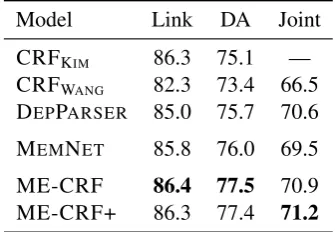
Table 1: Post-level Link and DA F-scores. Per-formance for ME-CRF and ME-CRF+ is marco-averaged over 5 runs.
parser-based approach ofWang(2014), where the author treated the discourse structure prediction task as a constrained dependency parsing problem, with posts as nodes in the dependency graph, and the constraint that links must connect to preced-ing posts in the thread (“DEPPARSER”).3 In
ad-dition to the CRF/parser-based systems, we also build a MEMNET-based baseline (named MEM
-NET) where MEMNET shares the architecture of
the memory layer in ME-CRF but excludes the use of the CRF layer. Instead, MEMNET,
follow-ing the work ofSukhbaatar et al.(2015), predicts the final answer by:
ˆ
y=softmax(WDA(uK+1)) (13)
whereyˆ is the predicted DA distribution,WDA∈
R|Y|×d is a parameter matrix for the model to
learn, andK= 1is the total number of hops. This is equivalent to classifying link and DA indepen-dently at each time step t without taking transi-tions between DA labels into account.
4.4 Results
The experimental results are presented in Table1, wherein the first three rows are the three baseline systems.
State-of-the-art post-level results. ME-CRFs achieve state of the art results in terms of joint post-level F-score, substantially better than the baselines. While ME-CRF slightly outperforms the current state-of-the-art (DEPPARSER),
ME-CRF+ improves the performance and achieves a further 0.3% absolute gain.
[1,2] [3,4] [5,6] [7,8] [9,)
0 20 40 60 80 100
Post depth
Link&D
A
Joint
F-score
Link&DA Joint
CRFWANG
DEPPARSER ME-CRF+
Figure 3: Breakdown of post-level Joint F-scores by post depth, where e.g. “[1,2]” is the joint F-score over posts of depth 1–2, i.e. the first or second post in the thread. Note that we take the reported performance of CRFWANG and DEP
-PARSERfromWang(2014).
Curriculum learning improves joint prediction. Despite the slight performance drop on the DA and link prediction tasks, ME-CRF+, with the CRF transition matrix frozen for the first 20 epochs, achieves a ∼0.3% absolute gain in joint F-score over ME-CRF. This suggests that the sequence dynamics between posts, while difficult to capture, are beneficial to the overall task (resulting in more coherent DA and link predictions) if trained with proper initialisation.
MEMNET vs. ME-CRFs. We see consistent
gains across all three tasks when the CRF layer is added. Although not presented in Table1, the dif-ference is most notable at the thread-level (i.e. a thread is correct iff all posts are tagged correctly), highlighting the importance of sequential transi-tional information between posts.
CRF vs. ME-CRFs. Note that CRFKIM is not
trained jointly on the two component tasks, but in-dividually on each task. Without additional data, jointly training on the two tasks generates results that are comparable or substantially better over the individual tasks. This highlights the effectiveness of ME-CRF, especially with the link prediction performance comparable to that of a single-task model CRF, and surpassing it in the case of DA.
[1,2] [3,4] [5,6] [7,8] [9,)
40 60 80 100
Post depth
Link
F-score
Link
CRFSGD MALTPARSER ME-CRF+
[1,2] [3,4] [5,6] [7,8] [9,)
40 60 80 100
Post depth
D
A
F-score
DA
Figure 4: Breakdown of post-level Link and DA F-scores by post depth.
4.5 Analysis
We break the performance down by the depth of each post in a given thread, and present the re-sults in Figure 3. Although below the baselines for the interval[1,2], ME-CRF+ consistently out-performs CRFWANGfrom depth3onwards, and is
superior to DEPPARSER for depths [7,).
Break-ing down the performance further to the individual tasks of Link and DA prediction, as displayed in Figure4, we observe a similar trend. In line with the findings in the work ofWang(2014), this con-firms that prediction becomes progressively more difficult as threads grow longer, which is largely due to the increased variability in discourse struc-ture. Despite the escalated difficulty, ME-CRF+ is substantially superior to the baselines when classifying deeper posts.
Between the CRF-based models, it is worth noting that despite the lower performance for
[1,2], ME-CRF+ benefits from having global ac-cess to the entire sequence, and consistently out-performs CRFWANG for depths [3,),
ME-CRFs.
5 Named Entity Recognition
In this section, we present experiments in a sec-ond setting: named entity recognition, over the CoNLL 2003 English NER shared task dataset (Tjong Kim Sang and De Meulder,2003). Our in-terest here is in evaluating the ability of ME-CRF to capture document context, to aid in the identifi-cation and disambiguation of NEs.
5.1 Dataset and Task
The CoNLL 2003 NER shared task dataset consists of 14,041/3,250/3,453 sentences in the training/development/test set, resp., extracted from946/216/231Reuters news articles from the period 1996–97. The goal is to identify individ-ual token occurrences of NEs, and tag each with its class (e.g. LOCATION or ORGANISATION). Here, we use the IOB tagging scheme. In terms of tagging schemes, while some have shown improvements with a more expressive IOBES marginally (Ratinov and Roth, 2009; Dai et al.,
2015), we stick to the BIO scheme for simplicity and the observation of little improvement between these schemes byLample et al.(2016).
5.2 Experimental Setup
We chooseΦ(xt)to be a lookup function,
return-ing the correspondreturn-ing embeddreturn-ingxt of the word
xt. In addition to the word features, we employ a
subset of the lexical features described in Huang et al.(2015), based on whether the word:
• starts with a capital letter;
• is composed of all capital letters;
• is composed of all lower case letters;
• contains non initial capital letters;
• contains both letters and digits;
• contains punctuation.
These features are all binary and refered to as
Φl(xt). Similar to the thread structure
predic-tion experiments, we concatenateΦl(xt) withxt
to generate the new inputx0 to the bi-directional GRUs in Equations (1) and (2).
In order to incorporate information in the docu-ment beyond sentence boundaries, we encode ev-ery word sequentially in a document withΦ and
−−→
GRU and←−−GRU, and store them in the memorymi andci for i ∈ [1, t0], wheret0 is the index of the current wordtin the document.
Training is carried out with Adam, over 100
epochs with a batch size of 32. We use the fol-lowing hyper-parameter settings: word embed-ding size =50; hidden size of−−→GRU and←−−GRU =50;
−→
Wmand←−Wm ∈R50×50; andbm∈R50. Dropout
is applied to all GRU recurrent units on the in-put and outin-put connections, with a keep rate of
0.8. We initialise ME-CRF with pre-trained word embeddings and keep them fixed during training. While we report results only on the test set, we use early stopping based on the development set.
5.3 Evaluation
Evaluation is based on span-level NE F-score, based on the official CoNLL evaluation script.4
We compare against the following baselines: 1. a CRF over hand-tuned lexical features
(“CRF”:Huang et al.(2015))
2. an LSTM and bi-directional LSTM (“LSTM” and “BI-LSTM”, resp.: Huang
et al.(2015))
3. a CRF taking features from a convolutional neural network as input (“CONV-CRF”:
Col-lobert et al.(2011))
4. a CRF over the output of either a sim-ple LSTM or bidirectional LSTM (“LSTM-CRF” and “BI-LSTM-CRF”, resp.: Huang
et al.(2015))
Note that for our word embeddings, while we ob-serve better performance with GLOVE (
Penning-ton et al., 2014), for fair comparison purposes, we adopt the same SENNAembeddings (Collobert
et al.,2011) as are used in the baseline methods.5
5.4 Results
The experimental results are presented in Table2. Results for the baseline methods are based on the published results ofHuang et al.(2015) and Col-lobert et al. (2011). Note that none of the sys-tems in Table 2 use external gazetteers, to make the comparison fair. As can be observed, ME-CRF achieves the best performance, beating all the baselines.
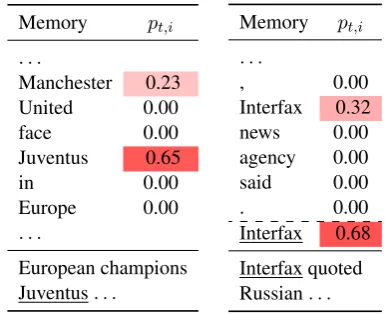
To gain a better understanding of what the model has learned, Table3presents two examples
4http://www.cnts.ua.ac.be/conll2000/ chunking/conlleval.txt
Model F-score
CRF 86.1
LSTM 83.7
BI-LSTM 85.2
CONV-CRF 88.7
LSTM-CRF 88.4
BI-LSTM-CRF 88.8
ME-CRF 89.5
Table 2: NER performance on the CoNLL 2003 English NER shared task dataset.
where ME-CRF focuses on words beyond the cur-rent sentence boundaries. In the example on the left, where the target word is Juventus (an Ital-ian soccer team), ME-CRF directs the attention mainly to the occurrence of the same word in a previous sentence and a small fraction to Manch-ester (a UK soccer team, in this context). Note that it does not attend to the other NE (Europe) in that sentence, which is of a different NE class. In the example on the right, on the other hand, ME-CRF allocates attention to the same words as the target word in the current sentence. Note that the second occurrence ofInterfaxin the mem-ory is the same occurrence as the first word in the current sentence. While more weight is placed on the second Interfax, close to one third of the attention is also asigned to the first occurrence. Given that the memory, mi and ci, is encoded with bi-directional GRUs, the firstInterfaxshould, to some degree, capture the succeeding neighbour-ing elements:news agency.
This is reminiscent of label consistency in the works ofSutton and McCallum(2004) andFinkel et al. (2005), but differs in that the consistency constraint is soft as opposed to hard in previous studies, and automatically learned without the use of heuristics.
6 Conclusion
In this paper, we have presented ME-CRF, a model extending linear-chain CRFs by including external memory. This allows the model to look beyond neighbouring items and access long-range context. Experimental results demonstrate the ef-fectiveness of the proposed method over two tasks: forum thread discourse analysis, and named entity recognition.
Memory pt,i
. . .
Manchester 0.23 United 0.00
face 0.00
Juventus 0.65
in 0.00
Europe 0.00 . . .
European champions Juventus. . .
Memory pt,i
. . .
, 0.00
Interfax 0.32 news 0.00 agency 0.00 said 0.00
. 0.00
Interfax 0.68 Interfax quoted Russian. . .
Table 3: An NER example showing learned atten-tion to long-range contextual dependencies. The last row is the current sentence. The underlined words indicate the target wordxt, and the dashed
line indicates a sentence boundary.
Acknowledgments
We thank the anonymous reviewers for their valuable feedback, and gratefully acknowledge the support of Australian Government Research Training Program Scholarship and National Com-putational Infrastructure (NCI Australia). This work was also supported in part by the Australian Research Council.
References
Dzmitry Bahdanau, Kyunghyun Cho, and Yoshua Ben-gio. 2014. Neural machine translation by jointly
learning to align and translate. In Proceedings of
the 3rd International Conference on Learning Rep-resentations (ICLR 2015). San Diego, USA. Yoshua Bengio, J´erˆome Louradour, Ronan Collobert,
and Jason Weston. 2009. Curriculum learning. In
Proceedings of the 26th Annual International Con-ference on Machine Learning (ICML 2009). Mon-treal, Canada, pages 41–48.
Yoshua Bengio, Patrice Simard, and Paolo Frasconi. 1994. Learning long-term dependencies with gradi-ent descgradi-ent is difficult. IEEE Transactions on Neu-ral Networks5(2):157–166.
Kyunghyun Cho, Bart Van Merri¨enboer, Dzmitry Bah-danau, and Yoshua Bengio. 2014. On the properties of neural machine translation: Encoder-decoder
ap-proaches. InProceedings of SSST-8, Eighth
Work-shop on Syntax, Semantics and Structure in Statisti-cal Translation. Doha, Qatar, pages 103–111. Ronan Collobert, Jason Weston, L´eon Bottou, Michael
scratch. Journal of Machine Learning Research
12:2493–2537.
Hong-Jie Dai, Po-Ting Lai, Yung-Chun Chang, and
Richard Tzong-Han Tsai. 2015. Enhancing of
chemical compound and drug name recognition us-ing representative tag scheme and fine-grained
tok-enization.Journal of Cheminformatics7(1):S14.
Jenny Rose Finkel, Trond Grenager, and Christopher Manning. 2005. Incorporating non-local informa-tion into informainforma-tion extracinforma-tion systems by gibbs
sampling. InProceedings of the 43rd Annual
Meet-ing of the Association for Computational LMeet-inguistics (ACL 2005). Ann Arbor, USA, pages 363–370. Stuart Geman and Donald Geman. 1984.
Stochas-tic relaxation, Gibbs distributions, and the Bayesian restoration of images.IEEE Transactions on Pattern Analysis and Machine Intelligence6:721–741. Alex Graves, Abdel-rahman Mohamed, and Geoffrey
Hinton. 2013. Speech recognition with deep
recur-rent neural networks. In 2013 IEEE International
Conference on Acoustics, Speech and Signal Pro-cessing (ICASSP 2013). Vancouver, Canada, pages 6645–6649.
Sepp Hochreiter, Yoshua Bengio, Paolo Frasconi, and J¨urgen Schmidhuber. 2001. Gradient flow in recur-rent nets: the difficulty of learning long-term depen-dencies.
Sepp Hochreiter and J¨urgen Schmidhuber. 1997.
Long short-term memory. Neural computation
9(8):1735–1780.
Zhiheng Huang, Wei Xu, and Kai Yu. 2015.
Bidirec-tional lstm-crf models for sequence tagging. arXiv
preprint arXiv:1508.01991.
Su Nam Kim, Li Wang, and Timothy Baldwin. 2010.
Tagging and linking web forum posts. In
Proceed-ings of the Fourteenth Conference on Computational Natural Language Learning (CoNLL 2010). Associ-ation for ComputAssoci-ational Linguistics, Uppsala, Swe-den, pages 192–202.
Diederik Kingma and Jimmy Ba. 2015. Adam: A
method for stochastic optimization. In
Proceed-ings of the 3th International Conference on Learn-ing Representations (ICLR 2015). San Diego, USA. Vijay Krishnan and Christopher D. Manning. 2006. An effective two-stage model for exploiting non-local
dependencies in named entity recognition. In
Pro-ceedings of the 21st International Conference on Computational Linguistics and 44th Annual Meet-ing of the Association for Computational LMeet-inguistics (ACL 2006). Sydney, Australia, pages 1121–1128. John D. Lafferty, Andrew McCallum, and Fernando
C. N. Pereira. 2001. Conditional random fields: Probabilistic models for segmenting and labeling se-quence data. InProceedings of the Eighteenth Inter-national Conference on Machine Learning (ICML 2001). San Francisco, USA, pages 282–289.
Siwei Lai, Liheng Xu, Kang Liu, and Jun Zhao. 2015. Recurrent convolutional neural networks for text
classification. In Proceedings of the 29th AAAI
Conference on Artificial Intelligence (AAAI 2015). Austin, USA, volume 333, pages 2267–2273.
Guillaume Lample, Miguel Ballesteros, Sandeep Sub-ramanian, Kazuya Kawakami, and Chris Dyer. 2016. Neural architectures for named entity recognition. InProceedings of the 2016 Conference of the North American Chapter of the Association for Computa-tional Linguistics: Human Language Technologies (NAACL 2016). San Diego, USA, pages 260–270.
Shasha Liao and Ralph Grishman. 2010. Using doc-ument level cross-event inference to improve event extraction. InProceedings of the 48th Annual Meet-ing of the Association for Computational LMeet-inguistics (ACL 2010). Uppsala, Sweden, pages 789–797.
Wang Ling, Yulia Tsvetkov, Silvio Amir, Ramon Fer-mandez, Chris Dyer, Alan W Black, Isabel Tran-coso, and Chu-Cheng Lin. 2015. Not all contexts are created equal: Better word representations with variable attention. InProceedings of the 2015 Con-ference on Empirical Methods in Natural Language Processing (EMNLP 2015). Lisbon, Portugal, pages 1367–1372.
Tal Linzen, Emmanuel Dupoux, and Yoav Goldberg. 2016. Assessing the ability of lstms to learn
syntax-sensitive dependencies. Transactions of the
Asso-ciation for Computational Linguistics (TACL 2016)
4:521–535.
Jeffrey Pennington, Richard Socher, and Christopher Manning. 2014. GloVe: Global vectors for word
representation. In Proceedings of the 2014
Con-ference on Empirical Methods in Natural Language Processing (EMNLP 2014). Doha, Qatar, pages 1532–1543.
Lev Ratinov and Dan Roth. 2009. Design challenges and misconceptions in named entity recognition. In Proceedings of the Thirteenth Conference on Computational Natural Language Learning (CoNLL 2009). Boulder, USA, pages 147–155.
Minjoon Seo, Sewon Min, Ali Farhadi, and Hannaneh
Hajishirzi. 2017. Query-reduction networks for
question answering. InProceedings of the 5th Inter-national Conference on Learning Representations (ICLR 2017). Toulon, France.
Sainbayar Sukhbaatar, Arthur Szlam, Jason Weston, and Rob Fergus. 2015. End-to-end memory
net-works. InProceedings of Advances in Neural
Infor-mation Processing Systems (NIPS 2015). Montr´eal, Canada, pages 2440–2448.
Duyu Tang, Bing Qin, and Ting Liu. 2016. Aspect level sentiment classification with deep memory
net-work. In Proceedings of the 2016 Conference on
Empirical Methods in Natural Language Processing (EMNLP 2016). Austin, USA, pages 214–224. Erik F Tjong Kim Sang and Fien De Meulder.
2003. Introduction to the conll-2003 shared task: Language-independent named entity recognition. In
Proceedings of the seventh conference on North American Chapter of the Association for Com-putational Linguistics (NAACL 2003). Edmonton, Canada, pages 142–147.
Li Wang. 2014. Knowledge discovery and extraction
of domain-specific web data. Ph.D. thesis, The Uni-versity of Melbourne.
Li Wang, Marco Lui, Su Nam Kim, Joakim Nivre, and Timothy Baldwin. 2011. Predicting thread discourse structure over technical web forums. InProceedings of the 2011 Conference on Empirical Methods in Natural Language Processing (EMNLP 2011). Ed-inburgh, UK, pages 13–25.
Jason Weston, Sumit Chopra, and Antoine Bordes.
2015. Memory networks. InProceedings of the 3rd
International Conference on Learning Representa-tions (ICLR 2015). San Diego, USA.
Caiming Xiong, Stephen Merity, and Richard Socher. 2016. Dynamic memory networks for visual and
textual question answering. In Proceedings of the
33rd International Conference on Machine Learning (ICML 2016). New York, USA, pages 2397–2406. Zichao Yang, Diyi Yang, Chris Dyer, Xiaodong He,
Alex Smola, and Eduard Hovy. 2016. Hierarchi-cal attention networks for document classification. InProceedings of the 2016 Conference of the North American Chapter of the Association for Computa-tional Linguistics — Human Language Technologies (NAACL HLT 2016). San Diego, USA, pages 1480– 1489.
Amy Zhang, Bryan Culbertson, and Praveen Paritosh. 2017. Characterizing online discussion using coarse
discourse sequences. In Proceedings of the 11th


![Figure 3: Breakdown of post-level Joint F-scoresby post depth, where e.g. “[ 1, 2] ” is the joint F-score over posts of depth 1–2, i.e](https://thumb-us.123doks.com/thumbv2/123dok_us/799600.1094066/7.595.309.526.60.324/figure-breakdown-level-joint-scoresby-depth-joint-depth.webp)