A State of the Art of Thai Language Resources
and
Thai Language Behavior Analysis and Modeling
Asanee Kawtrakul, Mukda Suktarachan, Patcharee Varasai,
Hutchatai Chanlekha
Department of Computer Engineering,
Faculty of Engineering, Kasetsart University, Bangkok, Thailand 10900.
E-mail: ak, mukda, pom, [email protected],
Abstract
As electronic communications is now increasing, the term Natural Language Processing should be considered in the broader aspect of Multi-Language processing system. Observation of the language behavior will provide a good basis for design of computational language model and alsocreating cost-effective solutions to the practical problems. In order to have a good language modeling, the language resources are necessary for the language behavior analysis.
This paper intended to express what we have and what we have done by the desire to make a bridge between the languages and to share and make maximal use of the existing lexica, corpus and the tools. Three main topics are, then, focussed: A State of the Art of Thai language Resources, Thai language behaviors and their computational models.
1.
Introduction
As electronic communications are now increasing, the term Natural Language Processing should be considered in the broader aspect of Multi- Language Processing system. An important phase in the system development process is requirement engineering, which can define as the process of analyzing the problems in a certain language. An essential part of the requirement-engineering phase is computational language modeling which is an abstract representation of the behavior of the language. In order to have a good language model for creating cost-effective solutions to the practical problems, the language resources are necessary for the language behavior analysis.
This paper intended to express what we
have and what we have done by the desire to
make a bridge between the languages and to
share and make maximal use of the existing
lexica, corpus and the tools. Three main topics
are, then, focussed:
•
A State of the Art of Thai language
Resources that will
give an overview of what we have in Corpus, Lexicon and tools for corpus processing and analysis.•
Thai language behaviors (only in word
and phrase level) analyzed from the varieties
of corpus which consist of
Lexicon growth, New word formation and Phrase/Sentence construction,and
•
The computational models providing
for
those behaviors, which consist of Unknown Word Extraction and Name Entities identification, New word generation and Noun phrase recognition.The remainder of the paper is organized as follows. In section 2, we give the gateway of Thai language resources. Thai Language behaviors are discussed in section 3. In section 4, then, provides Thai Language Computational Modeling as a basis for creating cost-effective solutions to those practical problems.
2.
A State of the Art of Thai Language
Resource
2.1 Corpus
The existing Thai corpus is divided into 2 types; speech and text corpus developed by many Thai Universities. Thai Language Audio Resource Center of Thammasart University (ThaiARC) (http:// thaiarc.ac.th) developed speech corpus aimed to provide digitized audio information for dissemination via Internet. The project pioneers the production and collection of various types of audio information and various styles of Thai speech, such as royal speeches, academic lectures, oral literature, etc.
[image:2.595.303.535.84.198.2]For Text corpus, originally, the goal of the corpus collecting is used only inside the laboratory. Until 1996, National Electronics and Computer Technology Center (NECTEC) and Communications Research Laboratory (CRL) had a collaboration project with the purpose of preparing Thai language corpus from technical proceedings for language study and application research. It named ORCHID corpus (NECTEC, 1997). NAiST Corpus began in 1996 with the primary aim of collecting document from magazines for training and testing program in Written Production Assistance (Asanee, 1995). The existing corpus can be summarized as shown in Table 1.
Table 1: The List of Thai Corpus
List Corpus Type Amount Status
NECTEC Orchid
Corpus POS-Tagged Text 2,560,000words Online Kasetsart
Univ.
NAiST
Corpus Text
60,511,974
words Online
Thammasart Univ.
Thai ARC
Digitized audio
4000
words++ online
2.2
Lexicon
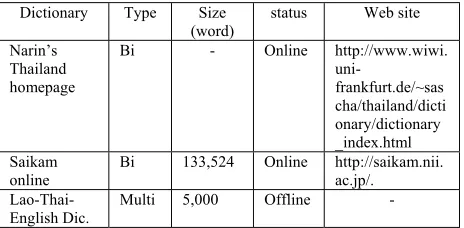
There are a number of Thai lexicons, which has been developed as shown in Table 2.
Table 2: The List of Thai Dictionaries
Dictionary Type Size
(word) status Web site
Royal Institute Dictionary
Mono 33,582 Online http://rirs3.royin.
go.th/riThdict/loo kup.html
Lexitron Bi 50,000 Online http://www.links.
nectec.or.th/lexit/ lex_t.html NaiST
Lexibase
Mono 15,000 Online http://beethoven.
cpe.ku.ac.th/ So
Sethaputra Dictionary
Bi - 48,000
Eng words - 38,000 Thai words
Online http://www.thais oftware.co.th/
Dictionary Type Size
(word) status Web site
Narin’s Thailand homepage
Bi - Online http://www.wiwi.
uni-frankfurt.de/~sas cha/thailand/dicti onary/dictionary _index.html Saikam
online
Bi 133,524 Online http://saikam.nii.
ac.jp/.
Lao-Thai-English Dic.
Multi 5,000 Offline
-From the table 2, Only Lexitron (from NECTEC) and NAiST Lexibase (from Kasetsart University) that were applied to NLP. NAiST Lexibase has been developed based on relational model for managing and maintaining easily in the future. It contains 15,000 words list with their syntax and the semantic concept information in the concept code.
2.3
Corpus and Language Analysis
Tools
Corpus is not only the resource of Linguistic Knowledge but is used for training, improving and evaluating the NLP systems. The tools for corpus manipulation and knowledge acquisition become necessary.
NAiST Lab. has developed the toolkit for sharing via the Internet. It has been designed for corpus collecting, annotating, maintaining and analyzing. Additionally, it has been designed as the engine, which the end user could use with their data. (See a service on http://naist.cpe.ku.ac.th).
3. Thai Language Behavior Analysis
In order to have a good language model for creating cost-effective solutions to the practical problems in application development, language behavior must be observed. Next is Thai language behavior analysis based on NAiST corpus consisting of Lexicon growth, Thai word formation and Phrase construction.
3.1 Lexicon Growth
[image:2.595.64.302.439.514.2]c3c4c5 c1c2c3c4c5
c1c2
c4c5 c1c2c3
words but not being proper names or colloquial words. The unknown or new words occur much in the real document such as Proper names, Colloquial words, Abbreviations, and Foreign words.
The lexicon growth is observed from corpus size, 400,000, 2,154,700 and 60,511,974 words from Newspaper, Magazine and Agriculture text. We found that common word lists increased from 111,954 to 839,522 and 49,136,408 words according to the corpus size, while the unknown word lists increased from 288,046 to 1,315,178 and 11,375,566 words respectively as shown in table3.
Table 3 : Lexicon-growth
Size of Corpus/ words Common words Unknown
words
400,000 111,954 288,046
2,154,700 839,522 1,315,178
60,511,974 49,136,408 11,375,566
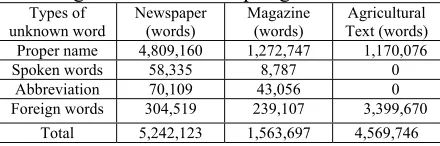
[image:3.595.321.527.349.411.2] [image:3.595.72.292.436.509.2]Regarding to 60,511,974 words corpus in the table 3, it composes of 35,127,012 words from Newspaper, 18,359,724 words from Magazine and 7,025,238 words from Agricultural Text. Unknown words occur in each category as shown in table 4.
Table 4: The Categories of Unknown words according to the various corpus genres
Types of
unknown word Newspaper(words) Magazine(words) Text (words)Agricultural
Proper name 4,809,160 1,272,747 1,170,076
Spoken words 58,335 8,787 0
Abbreviation 70,109 43,056 0
Foreign words 304,519 239,107 3,399,670
Total 5,242,123 1,563,697 4,569,746
According to table 3 and 4, we could observe that not only unknown words increase but common words also increase and the main categories of increasing unknown word are proper names and foreign words. Consequently, a computational model of unknown word extraction and name entity identification has been developed and also of new word construction.
3.2 New Word Formation and Core
Noun
Regarding to the growth of common word shown in table 3, we studied how the new words come from.
3.2.1 Basic Information about Thai
Thai words are multi-syllabic words which stringing together could form a new word. Since Thai has no inflection and no word delimiters, Thai morphological processing is mainly to recognize word boundaries instead of recognizing a lexical form from a surface form as in English. Let C be a sequence of characters
C = c1c2c3…cn : n>=1 Let W be a sequence of words
W = w1w2w3…wm : m>=1 Where wi = c1ic2i…ci r: i>=1, r>=2
Since Thai sentences are formed with a sequence of words with a stream of characters, i.e., c1c2c3…cn mostly without explicit delimiters, the word boundary in “c1c2c3c4c5“ pattern as shown below could have two ambiguous forms. One is “c1c2“ and “c3c4c5“. The other one is “c1c2c3“ and “c4c5“ (Kawtrakul, 1997)
Stream of characters
Figure 1: Word Boundary Ambiguity
From the figure 1, if characters were grouped differently, the meaning of words will be changed too. For example, “กอดอก” can be grouped to “กอด -อก(fold one's arms across the chest)” and “กอ-ดอก(a clump of flower)”. From our corpus, we found that the sentence with 45 characters has 30 combinations of words sequence.
3.2.2 New word construction
Almost all-Thai new words are formed by means of compounding and nominalization, by using a set of prefixes.
3.2.2.1 Nominalization
Nominalization is a process by which a word can be formed as a noun by using prefixes added. Noun words formed by using prefixes “การ(ka:n)” and “ความ(khwa:m)”are nouns which signal state or
action. Words formed by using prefixes “ผู(phu:)”
“ชาว(tha:w)” and “นัก(nak)”are nouns which signal
human or profession.
Prefix “ การ(ka:n)” “ ความ(khwa:m)” are used in
phrase and sometimes from noun (Nominalization). การ(ka:n) that co-occur with noun, represents the meaning about duty or function of noun it relates to. การ(ka:n) that co-occur with verbs, always co-occur with action verbs.
ความ(khwa:m) always co-occur with state verbs.
Prefix “ ผู(phu:) “ “ นัก(nak)” and “ชาว(tha:w)”
are used in the process of new word formation. ผู (phu:) and นัก(nak) co-occur with verb phrase. นัก
(nak) sometimes can occur with a few fields of nouns, such as sport and music. So at the first time we kept words, which constructed from prefix “นัก (nak)” plus noun in the lexicon for solving the problem. Prefix “ชาว(tha:w)” can co-occur with
noun only.
3.2.2.2 Compounding
Thai new words can, also, be combined to form compound nouns and are invented almost daily. They normally have at least two parts. The first part represents a pointed object or person such as คน(man), หมอ(pot), หาง(tail), พืช(plant). The second part identifies what kind of object or person it is, or what its purpose is like ขับรถ(drive a car), หุงขาว(cook rice), เสือ(tiger), นํ้า(water). Table 5 shows the examples of compound noun in Thai. Table 5: The Examples of Thai Compound Noun
What or who What type / what purpose
คน(man) ขับรถ(drive a car),
หมอ(pot) หุงขาว(cook rice)
หาง(tail) เสือ(tiger)
[image:4.595.71.298.566.755.2]พืช(plant) นํ้า(water)
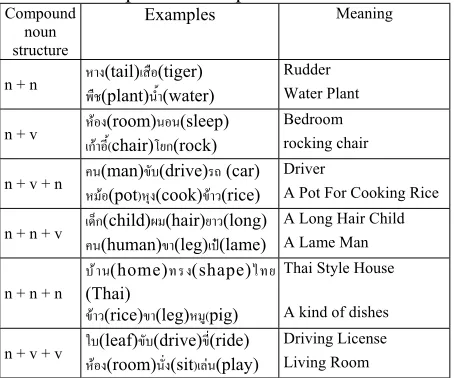
Table 6 shows the patterns of compound noun. Table 6: Compound noun pattern
Compound noun structure
Examples Meaning
n + n หาง(tail)เสือ(tiger)
พืช(plant)นํ้า(water)
Rudder Water Plant
n + v หอง(room)นอน(sleep)
เกาอี้(chair)โยก(rock)
Bedroom rocking chair
n + v + n คน(man)ขับ(drive)รถ (car)
หมอ(pot)หุง(cook)ขาว(rice)
Driver
A Pot For Cooking Rice
n + n + v เด็ก(child)ผม(hair)ยาว(long)
คน(human)ขา(leg)เป(lame)
A Long Hair Child A Lame Man
n + n + n
บาน(home)ทรง(shape)ไทย
(Thai)
ขาว(rice)ขา(leg)หมู(pig)
Thai Style House
A kind of dishes
n + v + v ใบ(leaf)ขับ(drive)ขี่(ride)
หอง(room)นั่ง(sit)เลน(play)
Driving License Living Room
From Table 6, it has shown that some compound nouns maintain some parts of those primitive word meaning but some changed to a new meaning. In this paper, we are only interested in compound noun grouping from primitive words which were changed the meaning to more abstract but still maintain some parts of those primitive word meanings, e.g. “คนรถ(driver) คนครัว(cooker) etc.” The word “คน” maintains its meaning which has a concept of human, but when it was compounded with “รถ(car)” and “ครัว(kitchen)”, their meanings have changed to the occupation by the word relation in the equivalent level. In case of compound noun that change a whole meaning such as “ลูกเสือ (a boy scout)”, it will be kept in the lexicon.
3.2.2.3 Compound noun extraction problems There are three non-trivial problems
• Compound Noun VS Sentence Distinction • Compound Noun Boundary Ambiguity • Core noun Detection
Compound Noun VS Sentence
Several NP structures have the same pattern as sentences. Since Thai language is flexible and has no word derivation, including to preposition in compound noun can be omitted, etc. This causes a compound noun having the same pattern as sentence. Thus, Thai NP analysis in IR system is more difficult than English. (See Figure 2)
Figure 2: The comparison of noun phrase and sentence structure
In figure 2, compound noun “โตะกินขาว” (a dining table) actually omit the preposition “สําหรับ (for)”, which is a relation that point to the purpose of the first noun “โตะ(table)”.
The Compound Noun Boundary Ambiguity
After we have extracted noun phrase aiming for enhancing the IR system, we have to segment
Sentence: นกกินผลไม (birds eat fruit) In Thai: นก กิน ผลไม
Birds eat fruit Syntactic cn tv cn
Category
Compound Noun: โตะกินขาว (a dining table) In Thai: โตะ(สําหรับ) กิน ขาว
table eat rice Syntactic cn tv cn
that noun phrase into sub noun phrase or compound noun in order to specify the core noun as index and its modifier as sub-index. For example, compound noun with “noun + noun + verb” structure: เด็ก(child/N)ผม(hair/N)ยาว (long/V) etc. In this case, the second noun and verb have to be grouped firstly since it behaves similarly to a modifier by omitting the relative pronoun that represents its purpose, i.e., “who has”.
Another case of Compound Noun Boundary Ambiguity is word combination. Consider the sequence of words as the example of NP that composes of four words as follows:
NP = N1N2N3N4
There are 8 word combinations of compound noun as shown in figure 3.
In figure 3, word string has to be grouped correctly for the correct meaning.
The ambiguity of noun phrase boundary has also directly effected the efficiency of text retrieval.
Core Noun detection
Due to the Information Retrieval, a head or core of noun phrase detection is necessary. In this paper, core noun refers to the most important and specific word that the information retrieval and extraction can directly retrieve or extract without over generating candidate words. However, by the observation, the core of noun phrase needs not to be the initial words. Some of them are at the final position and some have word relation in the equivalent level (As shown in Table 7).
Table 7: The examples of core noun in NP Noun phrase(NP) Core noun W1 W2
โครงสราง + ประโยค structure + sentence W1 W2 รอย + วงป stain annual ring W1 W2 W3 ผล + มะละกอ + ดิบ fruit papaya green
be W1 located at the initial position
be W2 located at the final position
be W2 located at the second position
As mentioned above, the models of New Word Generation and Noun Phrase Recognition become one of the interesting works in Thai processing.
3.3 Phrase and Sentence Construction
Next, we will indicate the main problems that influence to MT, IE and IR system. These are constituent movement, zero anaphora and iterative relative clause.
3.3.1 Constituent Movement
Constituent is the relationship between lexicon units, which are parts of a larger unit. Constituency is usually shown by a tree diagram or by square brackets:
Ex. [[การประชุมคณะกรรมการ] [อยางราบรื่น]] [[meeting committee] [very smoothly]].
Constituent acts as a chunk that can be moved together and it often occurs in Thai language (see Fig. 4). The constituents can be moved to the front, the middle or the end of the sentence.
[image:5.595.82.260.290.404.2]S =
Figure 4 The movements of constituent Ex.: ตอนเชา ชาวประมง ออกเรือ หาปลา
In the morning, the fisherman goes to catch the fish ชาวประมง ออกเรือ หาปลา ตอนเชา
The fisherman goes to catch the fish in the morning. ชาวประมง ออกเรือ ตอนเชา หาปลา
The fisherman goes to in the morning, catch the fish ตอนเชา หาปลา ชาวประมง ออกเรือ
In the morning, catch the fish, the fisherman goes to.
Noun, adverb, and prepositional phrase are often move while verb phrases are.
3.3.2 Zero Anaphora
To make the cohesion in the discourse, the anaphora is used as a reference to “point back” to some entities called referent or antecedent, given in the preceding discourse. Halliday, M.A.K. and Hasan, Rugaiya (1976) divided cohesion in English into 5 categories as shown in Table 8: Table 8: Categories of anaphora
Reference - Personal Reference, Demonstrative
Reference, Comparative Reference
Substitution - Nominal Substitution, Verbal Substitution, Causal Substitution
Ellipsis - Nominal Ellipsis, Verbal Ellipsis, Causal
Ellipsis
Conjunction - Additive, Adversative, Casual, Temporal Lexical Cohesion - Reiteration(Repetition, Synonym or Near
Synonym, Super ordinate, General word) - Collocation
Figure 3: Patterns of noun phrase analysis
Observing from the corpus in: news, magazine and agricultural text, there are 4 types of anaphora. Ellipsis or zero anaphora was found most frequently in Thai documents and other anaphora happened as show in table 9.
Table 9: Types of reference
Type of Anaphora Magazine news agriculture Zero anaphora 49.88% 52.38% 50.04% repetition 32.04% 27.78% 34.49% personal reference 12.18% 12.70% 1.87% nominal substitution 5.90% 6.08% 13.60%
Zero anaphora is the use of a gap, in a phrase or clause that has an anaphoric function similar to a pro-form. It is often described as “referring back” to an expression that supplies the information necessary for interpreting the gap
The following is a sentence that illustrates zero anaphora:
มีถนนสองสายที่ตองไป ตรงแตแคบและกวางแตคดเคี้ยว
• There are two roads to eternity, straight
but narrow, and broad but crooked.
In this sentence, the gaps in straight but
narrow [gap], and broad but crooked [gap] have
a zero anaphoric relationship to two roads to eternity.
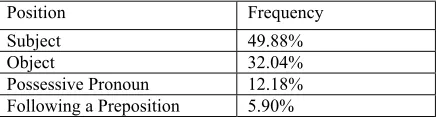
[image:6.595.310.535.125.357.2]Table 10 also shows the occurrence of zero anaphora in various parts of a sentence.
Table 10: Position of reference in sentences
Position Frequency Subject 49.88%
Object 32.04%
Possessive Pronoun 12.18% Following a Preposition 5.90%
It is noticeable that zero anaphora in the position of the subject occurs with high frequency (49.88%). It shows that in Thai language, the position of subject is the most commonly replaced.
3.3.3 Iterative Relative Clause
Thai relative pronouns
“
ที่” (thi)”
ซึ่ง(sung)”
and”
อัน
(un)”
relate to group of nouns or other pronouns
(The student
“
ที่” (thi) studies hardest usually doesthe best.). The word
“
ที่” (thi) connects or relatesthe subject, student, to the verb within the dependent clause (studies). Generally, we use
“
ที่” (thi) and”
”
ซึ่ง(
sung)”
to introduce clauses that areparenthetical in nature (i.e., that can be removed from the sentence without changing the essential meaning of the sentence. The pronoun
“
ที่” (thi)and
”
ซึ่ง(
sung)”
refers to things and people and”
อัน(
un)”
usually refers to things, but it can also refer to event in general.
The relative pronoun is sometimes omitted because it makes the sentence more efficient and elegant.
•
หนังสือ ที่/ซึ่ง คุณ สั่งซื้อ จาก รานนั้น มาถึงแลวเมื่อ 2
วันกอน
The book that you ordered from that shop arrived two days later.
Sometimes relative pronoun refers to an event that takes place repeatedly in a phrase.
Figure 5 The structure of relative clause
Ex
. [พอครัว]N [(ที่) ชนะการแขงขันทํ
าอาหาร]Rel Cl.
[The chef] [who won the cooking competition]
[(ซึ่ง) จัดขึ้นที่ประเทศฝรั่งเศส] Rel Cl. [(ที่) ฉันจางมา] Rel Cl.
[which compete at France] [that I employ]
Although a sentence, which has several clauses inside, will be grammatical, but it is not a good style in writing and always causes a problem for parser and noun phrase recognition.
4. The Computational Model
The computational models in word and phrase level are developed according to the phenomena mentioned in section 3.
4.1 Unknown Word Extraction
Unknown word extraction model composes of 2 sub-modules: unknown word recognition and name entity identification.
4.1.1 Unknown word recognition
The hybrid model approach has been used for unknown word recognition. The approach is the combination of a statistical model and a set of context based rules. A statistical model is used to identify unknown word’s boundary. The set of context based rules, then, will be used to extract the unknown word’s semantic concept. If the unknown word has no context, a set of unknown word information, which has defined through corpus analysis, will be generated and the best one will be selected, as its semantic concept, by using the semantic tagging model. Unknown word recognition process is shown in figure 6.
[image:6.595.73.293.446.505.2]Probabilistic Semantic
Tagging Model
w1w2UNK1w3UNK2
Extract and Record a Newword(or error)
STOP
• Lexi Base
• Heuristic Rule Base
Domain Specific Dictionary
START
Unknown Word Recognition Process
Guessing the boundary of Unk
Generating information and replace it to Unk
[image:7.595.57.293.80.280.2]Computing probabilist semantic chain
Figure 6: Unknown word recognition process
4.1.2
Name Entity Identification
After unknown words have been extracted, Named Entity (NE) Identification will define the category of unknown word. The model based on heuristic rules and mutual information. Mutual information or statistical analysis of word collocation is used to solve boundary ambiguity when names were composed with known and unknown words. We use Knowledge based such as list of known name (such as country names), clue word list (such as person’s title) to support the heuristic rules. Using clue word or common noun that precedes the name can specify NE categorization. Based on the case grammar, NE categories can also defined. Moreover, the lists of the names from predefined NE Ontology can be used for predicting category too. The overview of our system is shown in figure 7. More detail sees (Chanlekha, H. et al, 2002)
4.2 New Word Generation
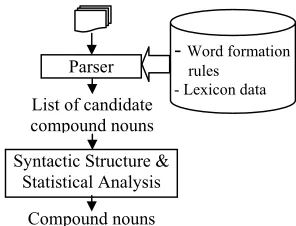
[image:7.595.323.471.278.391.2]Word formation is proposed to reduce the lexicon size by constructing new words or compound noun from the existing words. Based on word formation rules and common dictionary, the shallow parser will extract a set of candidate compound nouns. Then probabilistic approach based on syntactic structure and statistical data is used to solve the problem of over- and under-generation of new word construction and prune the erroneous of compound noun from the candidate set. The process of new word construction is shown in figure 8. See more detail in (Pengphon, N. et al, 2002)
Figure 8 : New Word Construction process
4.3 Noun Phrase Recognition
Entities or concepts are usually described by noun phrases. This indicates that text chunks like noun phrases play an important role in human language processing. In order to analyze NP, both statistical and linguistic data are used. The model of NP analysis system is shown in figure 9. More detail sees (Pengphon, N. et al, 2002)
Raw text
Morphological Analysis
Word formation
Relation extraction NP boundary identification
NP segmentation
Knowledge Base
•
Dictionary•
Prohibit pattern•
Heuristic rule•
Word formation rules•
probabilistic•
NP Rules•
Ignore word lists•
Clue wordOutput
Figure 9 The architecture of system
Compound nouns List of candidate compound nouns
Parser
Syntactic Structure & Statistical Analysis
- Word formation rules
- Lexicon data
Figure 7 : Named Entity Recognition System NE recognition
Word tokenization & POS tagging
NE identification and boundary detection
[image:7.595.317.530.529.727.2] [image:7.595.79.271.588.732.2]Figure 11: Noun phrase relation
Head modifier ; f1 > f2, f3, f4
w1w2w3w4
f1 f2 f3 f4
w1 w2w3w4
Compound ; f1 = f2 = f3 = f4
w1w2w3w4
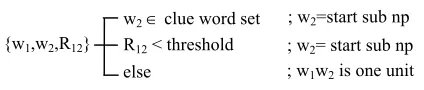
The first step is morphological analysis for word segmentation and POS tagging. At the second step, the compound word is grouped into one word by using word formation module (see 4.2). The third step, statistical-based technique is used to identify phrase boundary. This step was provided for identifying the phrase boundary by using NP rules. Next step is Noun Phrase Segmentation. The condition of noun phrase segmentation is shown in figure 10.
After noun phrase is correctly detected, the relation in noun phrases will be extracted. There are 2 types of relation: head-head noun phrase and head-modifier noun phrase. The process is based on statistical techniques by considering the frequency (fi) of each word (wi) in the document
(See figure 11).
5. Conclusion
The computational language models for Thai in word and phrase level, consisting of Unknown Word Extraction and Name Entities identification, New word generation and Noun phrase recognition, are studied on the basis of their behavior analysis from the varieties of corpus. We expected that it could create cost-effective solutions to the practical problems in the application developments especially in Thai Information Retrieval and Information extraction system. We also give the gateway to access Thai language resources with hoping that it could be the bridge of the international collaboration for developing Multi-Language Processing applications.
Acknowledgement
This project has been supported by NECTEC.
Reference
[1] Bourigault, D.“Surface Grammatical Analysis for the Extraction of Terminological Noun Phrases”. Proc. COLING 1992, 1992.
[2] Chen Kuang-hua and Chen Hsin-His, “Extracting Noun Phrases from large-scale Texts: A Hybrid Approach and Its Automatic Evaluation”, Proc. of the 32nd ACL Annual Meeting, 1994.
[3] Chanlekha, H. et al, “ Statistical and
Heuristic Rule Based Model for Thai Named Entity Recognition”, Proc. of SNLP 2002, 2002.
[4] G. Salton, “Automatic Text Processing. The Transformation, Analysis, and Retrieval of Information by Computer”, Singapore: Addison-Wesley Publishing Company, 1989. [5] Halliday,M.A.K and Hasan,Rugaiya.
“Cohesion in English”. Longman Group, London, 1976.
[6] Kawtrakul, A.et.al., “Automatic Thai Unknown Word Recognition”, Proc.of the Natural Language Processing Pacific Rim Symposium, Phuket,1997.
[7] Kawtrakul, A.et.al.,“Backward Transliteration for Thai Document Retrieval”, Proc.of The1998 IEEE Asia-Pacific Conference on Circuits and Systems, Chiangmai, 1998. [8] Kawtrakul, A. et.al., “Toward Automatic
Multilevel Indexing for Thai Text retrieval System”, In Proceedings of The 1998 IEEE Asia-Pacific Conference on Circuits and Systems, Chiangmai, 1998.
[9] Kawtrakul, A.“A Lexibase Model for Writing Production Assistant System” Proc.SNLP’95, 1995.
[10] Kawtrakul, A.“Anaphora Resolution Based On Context Model Approach In Database-Oriented Discourse”. A Doctoral Thesis to The Department of Information Engineering, School of Engineering, Nagoya University, Japan, 1991.
[11] Pengphon, N. et al, “Word Formation Approach and Noun Phrase Analysis for Thai” ”, Proc. of SNLP 2002, 2002. [12] Sornlertlamvanich, V. et.al., “ORCHID:
[image:8.595.74.286.229.274.2]THAI Part of Speech Tagged Corpus. Technical Report of NECTEC, 1997. [13] WEBSITE :http:// thaiarc.ku.ac.th Figure 10 Noun phrase Segmentation
{w1,w2,R12}
w2∈ clue word set
R12 < threshold
; w2=start sub np
; w2= start sub np