Coping with problems in grammars automatically extracted from treebanks
Carlos A. Prolo
Computer and Information Science Department University of Pennsylvania
Suite 400A, 3401 Walnut Street Philadelphia, PA, USA, 19104-6228
Abstract
We report in this paper on an experiment on auto-matic extraction of a Tree Adjoining Grammar from the WSJ corpus of the Penn Treebank. We use an automatic tool developed by (Xia, 2001) properly adapted to our particular need. Rather than address-ing general aspects of the automatic extraction we focus on the problems we have found to extract a linguistically (and computationally) sound grammar and approaches to handle them.
1 Introduction
Much linguistic research is oriented to finding general principles for natural language, classify-ing lclassify-inguistic phenomena, buildclassify-ing regular mod-els (e.g., grammars) for the behaved (or well-understood) part of languages and studying remain-ing “interestremain-ing” problems in a compartmentalized way. With the availability of large natural language corpora annotated for syntactic structure, the tree-banks, e.g., (Marcus et al., 1993), automatic gram-mar extraction became possible (Chen and Vijay-Shanker, 2000; Xia, 1999). Suddenly, grammars started being extracted with an attempt to have “full” coverage of the constructions in a certain lan-guage (of course, to the extent that the used corpora represents the language) and that immediately poses a question: If we do not know how to model many
phenomena grammatically how can that be that we are extracting such a wide-coverage grammar?.
To answer that question we have to start a new thread at the edge of linguistics and computational linguistics. More than numbers to express coverage, we have to start analyzing the quality of automat-ically generated grammars, identifying extraction problems and uncovering whatever solutions are be-ing given for them, however interestbe-ing or ugly they might be, challenging the current paradigms of lin-guistic research to provide answers for the problems on a “by-need” basis.
In this paper we report on a particular experi-ence of automatic extraction of an English grammar from the WSJ corpus of the Penn Treebank (PTB) (Marcus et al., 1994)1using Tree Adjoining Gram-mar (TAGs, (Joshi and Schabes, 1997)). We use an automatic tool developed by (Xia, 2001) properly adapted to our particular needs and focus on some problems we have found to extract a linguistically (and computationally) sound grammar and the so-lutions we gave to them. The list of problems is a sample, far from being exhaustive2 Likewise, the solutions will not always be satisfactory.
In Section 2 we introduce the method of grammar extraction employed. The problems are discussed in Section 3. We conclude in Section 4.
2 The extracted grammar
2.1 TAGs
A TAG is a set of lexicalized elementary trees that can be combined, through the operations of tree
ad-junction and tree substitution, to derive
syntac-tic structures for sentences. We follow a common approach to grammar development for natural lan-guage using TAGs, under which, driven by local-ity principles, each elementary tree for a given lex-ical head is expected to contain its projection, and slots for its arguments (e.g., (Frank, 2002)). Figure 1 shows typical grammar template trees that can be selected by lexical items and combined to generate the structure in Figure 2. The derivation tree, to the right, contains the history of the tree grafting pro-cess that generated the derived tree, to the left.3
1
We assume some familiarity with the basic notations in the PTB as in (Marcus et al., 1994).
2
(Prolo, 2002) includes a more comprehensive and detailed discussion of grammar extraction alternatives and problems.
3For a more comprehensive introduction to TAGs and
NP
N
S
NP
V NP
VP
VP
VP PP
P NP
DT NP
* NP*
[image:2.612.75.295.68.138.2]np vt ppright det
Figure 1: An example of Tree Adjoining Grammar
DT NP
NP*
N PP
P * VP
V NP
N NP
N
VP S
[John] [saw]
[Mary] [from]
[image:2.612.326.521.154.336.2] [image:2.612.73.308.173.323.2][the]
[window]
Derived tree Derivation tree vt[saw]
np[John] np[Mary] pp[from]
np[window]
det[the]
Figure 2: Derivation ofJohn saw Mary from the window
2.2 LexTract
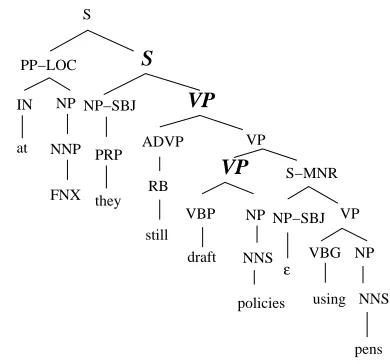
Given an annotated sentence from the PTB as in-put Xia’s LexTract tool (Xia, 1999; Xia, 2001) first executes a rebracketing. More precisely, additional nodes are inserted to separate arguments and mod-ifiers and to structure the modifying process as bi-nary branching. A typical rebracketed PTB tree is shown in Figure 3,4in which we have distinguished the tree nodes inserted by LexTract.
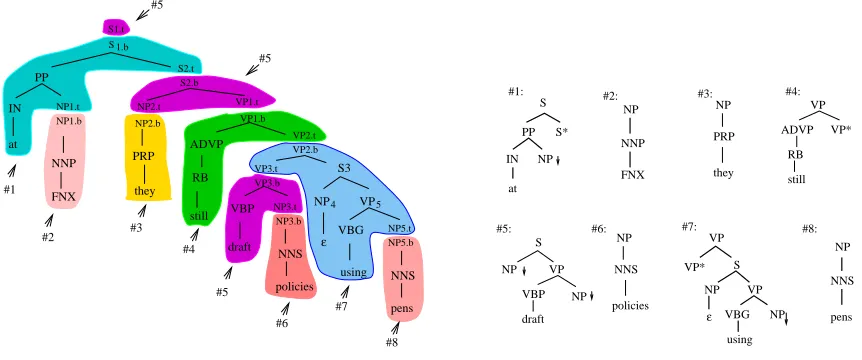
The second stage is the extraction of the grammar trees proper shown in Figure 4. In particular, re-cursive modifier structures have to be detected and factored out of the derived tree to compose the aux-iliary trees, the rest becoming an initial tree. The process is recursive also in the sense that factored subtree structures still undergo the spinning off pro-cess until we have all modifiers with their own trees, all the arguments of a head as substitution nodes of the tree containing their head, and the material un-der the argument nodes defining additional initial trees for themselves. Auxiliary trees are extracted from parent-child pairs with matching labels if the child is elected the parent’s head and the child’s sib-ling is marked as modifier: the parent is mapped into a root of an auxiliary tree, the head-child into its
4
Figures 3 and 4 are thanks to Fei Xia. We are also grateful to her for allowing us to use LexTract and make changes to its source code to customize to our needs.
foot, with the sibling subtree (after being recursively processed) being carried together into the auxiliary tree. Notice that the auxiliary trees are therefore ei-ther strictly right or left branching, the foot always immediately under the root node. Other kinds of auxiliary trees are therefore not allowed.
VBP
draft NP
NNS
policies VBG
using
ε NP
NNS
pens VP
S
IN
at NP
NNP
FNX PRP
they RB
still PP−LOC
NP−SBJ
ADVP
S−MNR
VP NP−SBJ VP
S
VP
Figure 3: LexTract rebracketing stage
To extract a grammar with Xia’s tool one has to define tables for finding: the head child of a con-stituent expansion; which of the siblings of a head are acceptable arguments; and which constituent la-bels are plausible modifiers of another. Special pro-visions are made for handling coordination. For ad-ditional information see (Xia, 2001). In this paper we refer to (Xia, 1999)’s table settings and extracted grammar, which we used as our starting point, as Xia’s sample. We used a customized version of Lex-Tract, plus additional pre-processing of the PTB in-put and post-processing of the extracted trees.
3 Extraction Problems
Extraction problems arise from several sources, in-cluding: (1) lack of proper linguistic account,5 (2) the (Penn Treebank) annotation style, (3) the (Lex-Tract) extraction tool, (4) possible unsuitability of the (TAG) model, and (5) annotation errors. We refrained from making a rigid classification of the problems we present according to these sources. In particular it is often difficult to decide whether to blame sources (1), (3), or (5) for a certain problem. We will not discuss in this paper problems due to annotation errors. As for the PTB style problems we only discuss one, the first listed below.
5Here included the (occasional) inability on the part of
#7 #5
#6 PP
IN
at
S
still
S2.t
RB ADVP
draft VBP
NNS
NP3.b VP3.t
VP2.t
VBG S3
VP
NP1.t
FNX NNP
NP1.b NP2.b
PRP
VP3.b
NP5.t NP5.b VP1.b
VP1.t S2.b 1.b
NP2.t
NP3.t VP2.b
NP4
ε
5
#5
#2 #3 #4 #1
S1.t
#5
they
policies
using NNS
pens #8
#5:
policies
NNS S
VP
VP* NP ε VBG
using VP
NP #7:
#1: S
S* PP IN NP
at
NP
NNP
FNX #2:
#6: #8:
NP
NNS
pens NP
S VP
NP VBP draft
NP
NP
PRP #3:
they #4:
ADVP VP* RB still
VP
[image:3.612.77.508.72.252.2]a) Input tree decomposition b) Extracted elementary trees
Figure 4: LexTract extraction stage
(S-3 (NP-SBJ (PRP We)) (VP (VBP make)
(SBAR-NOM (WHNP-1 (WP what)) (S we know
how to make))))
a) As a sentential clause in the PTB
(S-3 (NP-SBJ (PRP We)) (VP (VBP make)
(NP (NP (WP what))
(SBAR (WHNP-1 (-NONE- 0)) (S we know ...)))))
b) As a Noun phrase after pre-processed
Figure 5: Free relatives in the Treebank
3.1 Free Relatives
Free relatives are annotated in the Penn Treebank as sentential complements as in Figure 5.a. The extracted tree corresponding to the occurrence of “make” would be of a verb that takes a sentential complement (SBAR). This does not seem to be cor-rect6, as the proper subcategorization of the verb oc-currence is transitive.
In fact, free relatives may occur wherever an NP argument may occur. So, the only reasonable ex-traction account consistent with maintaining them as SBARs would be one in which every NP sub-stitution node in an extracted tree would admit the
6
In both standard accounts for free relatives, the Head count (e.g., (Bresnan and Grimshaw, 1978)) and the Comp Ac-count (e.g., (Groos and von Riemsdijk, 1979)), commonly dis-cussed in the literature, the presence of the NP (or DP) is clear.
existence of a counterpart tree, identical to the first, except that the NP argument label is replaced with an SBAR. Instead we opted to reflect the NP char-acter of the free relatives by pre-processing the cor-pus (using the Head-analysis, for practical conve-nience). The annotated example is then automat-ically replaced with the one in Figure 5.b. Other cases of free-relatives (non-NP) are rare and not likely to interfere with verb subcategorization.
3.2 Wh percolation up
In the Penn Treebank the same constituent is anno-tated with different syntactic categories depending on whether it possesses or not the wh feature. For instance, a regular noun phrase has the syntactic category NP, whereas when the constituent is wh-marked, and is in the landing site of wh-movement, it carries the label WHNP.7 While that might look appealing since the two constituents seem to have distinct distributional properties, it poses a design problem. While regular constituents inherit their syntactic categorial feature (i.e. their label) from their heads, wh projections are often formed by in-heritance from their modifiers. For instance: “the father” is an NP, but modified by a wh expression (“the father of whom”, “whose father”, “which fa-ther”), it becomes a WHNP. The only solution we see is to allow for nouns and NPs to freely project up to WHNPs during extraction.8 On the other hand, in
7
When the constituent is not wh-moved, it is correctly pre-served as an NP, as “what” in “Who ate what?”.
8Of course another simple solution would be merging the
(NP (UCP (NN construction) (CC and)
(JJ commercial)) (NNS loans))
a) NP modifiers
(VP (VB be)
(UCP-PRD (NP (CD 35)) (CC or)
(ADJP (JJR older))))
b) non-verbal Predicates
(VP (VB take)
(NP (NN effect))
(UCP-TMP (ADVP 96 days later) (, ,)
(CC or)
(PP in early February)))
[image:4.612.88.284.70.303.2]c) adverbial modifiers
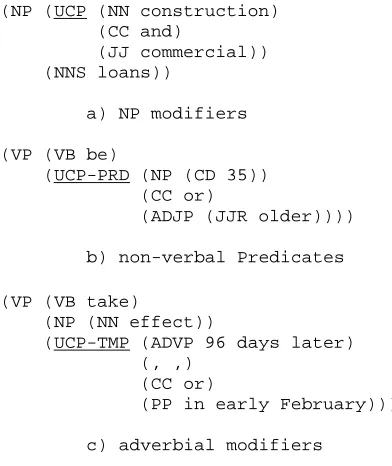
Figure 6: “Unlike Coordinated Phrases”
cases when the wh constituent is in a non-wh posi-tion, we need the opposite effect: a WHNP (or wh-noun POS tag) is allowed to project up to an NP.
3.3 Unlike Coordinated Phrases (UCP)
This is the expression used in the PTB to denote coordinated phrases in which the coordinated con-stituents are not of the same syntactic category. The rationale for the existence of such constructions is that the coordinated constituents are alternative re-alizations of the same grammatical function with respect to a lexical head. In Figure 6.a, both a noun and an adjective are allowed to modify another noun, and therefore they can be conjoined while re-alizing that function. Two other common cases are: coordination of predicates in copular constructions (Figure 6.b) and adverbial modification (Figure 6.c). We deal with the problem as follows. First, we al-low for a UCP to be extracted as an argument when the head is a verb and the UCP is marked predica-tive (PRD function tag) in the training example; or whenever the head is seen to have an obligatory argument requirement (e.g., prepositions: “They come from ((NP the house) and (PP behind the tree))”). Second, a UCP is allowed to modify (ad-join to) most of the nodes, according to evidence in the corpus and common sense (in the first and third examples above we had NP and VP modification). With respect to the host tree, when attached as an ar-gument they are treated like any other non-terminal: a substitution node. The left tree in Figure 7 shows
Figure 7: Extracted trees for UCP
the case where the UCP is treated as a modifier. In fact the trees are both for the example in Figure 6.a. Notice that the tree is non-lexicalized to avoid ef-fects of sparseness. The UCP is then expanded as in the right tree in Figure 7: an initial tree anchored by the conjunction (the tree attaches either to a tree like the one in the left or as a true argument – the latter would be the case for the example in Figure 6.b).
Now, the caveats. First, we are giving the UCP the status of an independent non-terminal, as if it had some intrinsic categorial significance (as a syn-tactic projection). The assumption of independence of expansion, that for context-free grammars is in-herent to each non-terminal, in TAGs is further re-stricted to the substitution nodes. For example, when an NP appears as substitution node, in a sub-ject or obsub-ject position, or as an argument of a prepo-sition or a genitive marker, we are stating that any possible expansion for the NP is licensed there. The same happens for other labels in argument positions as well. While that is an overgenerating assumption (e.g. the expletive “there” cannot be the realization of an NP in object position), it is generally true. For the UCP, however, we know that its expansion is in fact strongly dependent on where the substitu-tion node is, as we have argued before. In fact it is lexically dependent (cf. “I know ((the problem) and (that there is no solution to it))”, where the con-juncts are licensed by the subcategorizations of the verb “know”). On the other hand, it does not seem reasonable to expand the UCP node at the hosting tree – a cross product explosion. A possible way of alleviating this effect could be to expand only the auxiliary trees (a UCP modifying a VP is distinct from a UCP modifying an NP, and moreover they are independent of lexical items). But for true argu-ment positions there seems to be no clear solution.
Second, the oddity of the UCP as a label becomes apparent once again when there are multiple con-juncts, as in Figure 8: it is enough for one of them to be distinct to turn the entire constituent into a UCP. Recursive decomposition in the grammar in these situations clearly leads to some non-standard trees.
(NP (UCP (JJ electronic) (, ,)
(NN computer) (CC and)
(NN building)) (NNS products))
Figure 8: UCP with multiple conjuncts
(S (NP-SBJ-1 The Series 1989 B bonds) (VP (VBP are)
(VP (VBN rated)
(S *-1 double-A))))
(S (NP-SBJ-1 The Series 1989 B bonds) (VP (VBP are)
(UCP-PRD (ADJP-PRD (JJ uninsured)) (CC and)
(VP (VBN rated)
(S *-1 double-A)))))
Figure 9: UCP involving VP argument of the copula
is the natural head-child of some node. Under some accounts of grammar development this never hap-pens: we have observed that UCP does not appear as head child in the account where the head is the
syntactic head of a node. We have not always
fol-lowed this rule. With respect to the VP head, so far we have followed one major tendency in the com-putational implementation of lexicalized grammars, according to which lexical verbs are prefered to
aux-iliary verbs to head the VP. Now, consider the pair
of sentences in Figure 9.
Under the lexical verb paradigm, in the first sen-tence the derivation would start with an initial tree anchored by the past participle verb (“rated”). But then we have an interesting problem in the second sentence, for which we do not currently have a neat solution. Following Xia’s sample settings of Lex-Tract parameters, in these cases the extraction is rescued by switching to the other paradigm: the ini-tial tree is extracted anchored by the auxiliary verb with a UCP argument, and the VP is accepted as a possible conjunct. A systematic move to the
syn-tactic head paradigm, which we may indeed try,
would have important consequences in the locality assumptions for the grammar development.
3.4 VP topicalization
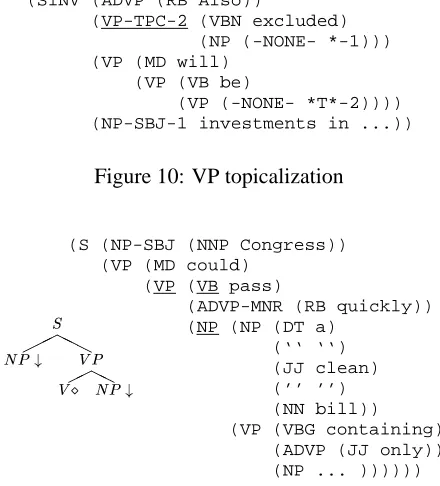
Another problem with the lexical verb paradigm (see also discussion under UCP above) is the VP topicalization as in the sentence in Figure 10. The solution currently adopted (again, inherited from
(SINV (ADVP (RB Also))
(VP-TPC-2 (VBN excluded) (NP (-NONE- *-1))) (VP (MD will)
(VP (VB be)
[image:5.612.318.538.75.318.2](VP (-NONE- *T*-2)))) (NP-SBJ-1 investments in ...))
Figure 10: VP topicalization
(S (NP-SBJ (NNP Congress)) (VP (MD could)
(VP (VB pass)
(ADVP-MNR (RB quickly)) (NP (NP (DT a)
(‘‘ ‘‘) (JJ clean) (’’ ’’) (NN bill)) (VP (VBG containing)
(ADVP (JJ only)) (NP ... ))))))
Figure 11: The extraposition problem
Xia’s sample settings) is as above: the paradigm is switched and the auxiliary verb (“be”) is chosen as the anchor of the initial tree.
3.5 Extraposition and Verb Subcategorization
One of the key design principles that have been guiding grammar development with TAGs is to keep verb arguments as substitution slots local to the tree anchored by the verb. It is widely known that the Penn Treebank does not distinguish verb ob-jects from adjuncts. So some sorts of heuristics are needed to decide, among the candidates, which are to be taken as arguments (Kinyon and Prolo, 2002); the rest is extracted as separate VP modifier trees. However, this step is not enough for the trees to correctly reflect verb subcategorizations. The oc-currence of discontinuous arguments, frequently ex-plained as argument extraposition (the argument is raised past the adjunct) creates a problem. In the sentence in Figure 11 the verb “pass” should anchor a tree with one NP object.
However in such a tree it would be impossible to adjoin the tree for the intervening ADVP “quickly” as a VP modifier and still have it between the verb and the NP.9LexTract then would instead extract an
9
(NP (NP the 3 billion New Zealand dollars) (PRN (-LRB- -LRB-)
(NP US$ 1.76 billion *U*) (-RRB- -RRB-)))
a) A parenthetical NP attached to another NP
(S (NP-SBJ The total relationship) (PRN (, ,)
(SBAR-ADV as Mr. Lee sees it) (, ,))
(VP (VBZ is) ...))
b) A parenthetical S between subject and verb
Figure 12: Parentheticals
intransitive tree for the VB “pass”, onto which the ADVP modifier tree would adjoin. The second odd-ity is that the NP object would also be extracted as a VP modifier tree. In a nutshell, objects in extracted trees are restricted to those which are not extraposed and hence the trees may not truly reflect the proper domain of locality. One view is that the set of trees for a certain subcategorization frame would include these degenerate cases. LexTract has an option to allow limited discontinuity, i.e., a non-argument se-quence between the verb and the first object (but not between two objects). The non-arguments would then be adjoined to the V node.10 So far we have used only the latter alternative.
It is worth mentioning two other cases of extra-position. Subject extraposition is handled by having the extraposed subject, usually a sentential form, ad-join at the VP of which it is the logical subject (the original position is still occupied by an NP with the expletive pronoun “it”). Relative clause extraposi-tion is modeled by a relative clause tree, only it ad-joins at a VP, instead of at an NP as is usual.
3.6 Parentheticals
Parenthetical expressions are ubiquitous in lan-guage: they may appear almost everywhere in a sen-tence and can be of almost any category (Fig. 12).
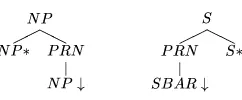
We model them as adjoining, either to the left or right of the constituent they are dominated by, de-pending on whether they are to the left or right of the head child of the parent’s node. Occasionally such trees can also be initial. The respective trees for the examples of Figure 12 are drawn in Figure 13. It
10
Of course, although the solution covers most of the occur-rences, and apart of any linguistic concern, there are still un-covered cases, e.g., when a parenthetical expression intervenes between the first and the second argument.
[image:6.612.372.493.81.131.2]
Figure 13: Extracted trees for parentheticals
is always the case that the label PRN dominates a single substitution node. Whenever this was not the case in the training corpus, heuristics based on ob-servation were used to enforce that, by inserting an appropriate missing node.
3.7 Projection labels
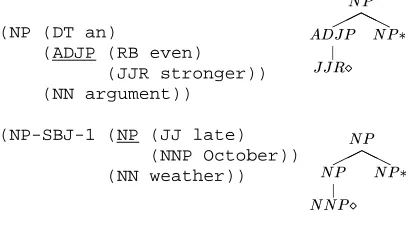
LexTract extracts trees with no concern for the ap-propriate projective structure of constituents when not explicitly marked in the PTB. Figure 14 shows two examples of NP modification where the modi-fiers are single lexical items. The extracted modifier trees, shown on the right, do not have the projec-tion for the modifiers JJR “stronger” and the NNP “October” (which should be, respectively, an ADJP and an NP). That is so, because those nodes are not found in the annotation.
(NP (DT a)
(JJR stronger) (NN argument))
(NP-SBJ-1 (NNP October) (NN weather))
!"
#
$
Figure 14: Simple modification annotation and ex-tracted trees
spec-(NP (DT an)
(ADJP (RB even) (JJR stronger)) (NN argument))
(NP-SBJ-1 (NP (JJ late) (NNP October)) (NN weather))
% "
&
[image:7.612.87.294.76.190.2]
$
Figure 15: Complex modification annotation and extracted trees
ify for the insertion of “obligatory” projections we had to accomplish this through a somewhat compli-cated post-processing step using a projection table. Some of our current projections are: nouns, per-sonal pronouns and the existential expletive to NP; adjectives to ADJP; adverbs to ADVP; sentences ei-ther to SBAR (S, SINV) or to SBARQ (SQ); Cardi-nals (CD) to Quantifier Phrases (QP) which them-selves project to NP. Notice that not all categories are forcefully projected. For instance, verbs are not, allowing for simple auxiliary extraction. IN is also not projected due to its double role as PP head (true preposition) and subordinate conjunc-tion, which should project onto SBARs.
4 Conclusion
We discussed an experiment in grammar extraction from corpora with focus on problems arising while trying to give an adequate account for naturally oc-curing phenomena. Without being exhaustive in our list, we expect to have brougt some attention to the need to discuss solutions for them which are as rea-sonable as possible given the current state-of-the-art of the linguistic research, computational grammar development and automatic extraction, and given the current corpus resources at our disposition.
ACKNOWLEDGEMENTS: Thanks to Tonia
Bleam, Erwin Chan, Alexandra Kinyon, Rashmi Prasad, Beatrice Santorini, Fei Xia and the XTAG Group for valuable discussions along the realization of this work and/or comments on this paper or re-lated material.
References
Joan Bresnan and Jane Grimshaw. 1978. The syn-tax of free relatives in english. Linguistic Inquiry, 9(3):331–391.
John Chen and K. Vijay-Shanker. 2000. Automated extraction of TAGs from the Penn Treebank. In
Proceedings of the 6th International Workshop on Parsing Technologies, Trento, Italy.
David Chiang. 2000. Statistical parsing with an automatically-extracted Tree Adjoining Gram-mar. In Proceedings of the 38th Annual Meeting
of the Association for Computational Linguistics,
Hong Kong, China.
Robert Frank. 2002. Phrase Structure Composition
and Syntactic Dependencies. MIT Press,
Cam-bridge, MA, USA.
Anneke Groos and Henk von Riemsdijk. 1979. The matching effects in free relatives: a parameter of core grammar. In Theory of Markedness in
Gen-erative Grammar. Scuola Normale Superiore di
Pisa, Italy.
Aravind K. Joshi and Yves Schabes. 1997. Tree-Adjoining Grammars. In Handbook of Formal
Languages, volume 3, pages 69–123.
Springer-Verlag, Berlin.
Alexandra Kinyon and Carlos A. Prolo. 2002. Identifying verb arguments and their syntactic function in the Penn Treebank. In Proc. of the
Third LREC, pages 1982–87, Las Palmas, Spain.
Mitchell Marcus, Beatrice Santorini, and Mary Ann Marcinkiewicz. 1993. Building a large annotated corpus of English: The Penn Treebank.
Compu-tational Linguistics, 19(2):313–330.
Mitchell Marcus, Grace Kim, Mary Ann Marcinkiewicz, Robert MacIntyre, Ann Bies, Mark Ferguson, Karen Katz, and Britta Schas-berger. 1994. The Penn Treebank: Annotating predicate argument structure. In Proceedings
of the 1994 Human Language Technology Workshop.
Carlos A. Prolo. 2002. LR parsing for Tree Adjoin-ing Grammars and its application to corpus-based natural language parsing. Ph.D. Dissertation Pro-posal, University of Pennsylvania.
Fei Xia. 1999. Extracting tree adjoining gram-mars from bracketed corpora. In Proceedings of
the 5th Natural Language Processing Pacific Rim Symposium(NLPRS-99), Beijing, China.
Fei Xia. 2001. Investigating the Relationship
be-tween Grammars and Treebanks for Natural Lan-guages. Ph.D. thesis, Department of Computer