Design And Ansylsis Of A Multipurpose Jig In Machine Tool
1 Telkar Mahesh, 2 Lakshmigalla Sunil Kumar, 3Jagilam Kumar Chandra,1 Assistant Professor, 2 Assistant professor, 3 Assistant professor Department of ME, NNRG, Hyderabad
Abstract:It is a work holding device that holds, supports and locates the work piece and guides the cutting tool for a specific
operation. Jigs are usually fitted with hardened steel bushings for guiding or other cutting tools. A jig is a type of tool used to control the location and/or motion of another tool.
A jig's primary purpose is to provide repeatability, accuracy, and Interchangeability in the manufacturing of products. A device that does both functions (holding the work and guiding a tool) is called a jig.
The project deals with the design of jig suitable for operation like drilling, boring and slotting which can be used in machine tools lab. The model will be designed using Catia v5 software and structural analysis in Ansys software.Fabrication would be done later with a suitable material.
1. JIGS
1.1.Introduction
The successful running of any mass production depends upon the interchangeability to facilitate easy assembly and reduction of unit cost. Mass production methods demand a fast and easy method of positioning work for accurate operations on it.
Jigs and fixtures are production tools used to accurately manufacture duplicate and interchangeable parts. Jigs and fixtures are specially designed so that large numbers of components can be machined or assembled identically, and to ensure interchangeability of components
It is a work holding device that holds, supports and locates the work piece and guides the cutting tool for a specific operation. Jigs are usually fitted with hardened steel bushings for guiding or other cutting tools. a jig is a type of
tool used to control the location and/or motion of another tool.
A jig's primary purpose is to provide repeatability, accuracy, and interchangeability in the manufacturing of products. A device that does both functions (holding the work and guiding a tool) is called a jig.
An example of a jig is when a key is duplicated; the original is used as a jig so the new key can have the same path as the old one.
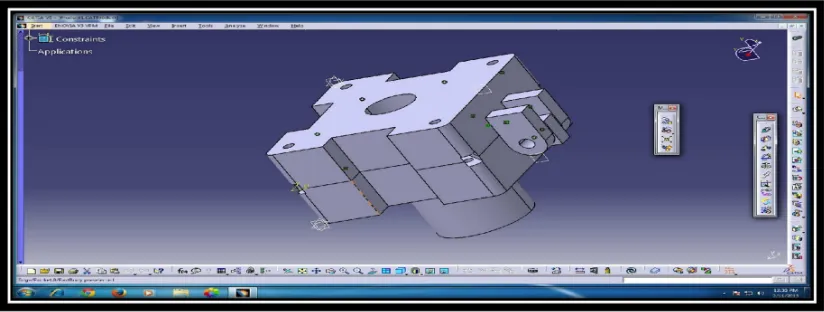
Figure: 01:- JIG The most-common jigs are drill and boring jigs. These tools
are fundamentally the same. The difference lies in the size, type, and placement of the drill bushings. Boring jigs usually have larger bushings. These bushings may also have
In the shop, drill jigs are the most-widely used form of jig. Drill jigs are used for drilling, tapping, reaming, chamfering, counter boring, countersinking, and similar operations. Occasionally, drill jigs are used to perform assembly work also. In these situations, the bushings guide pins, dowels, or other assembly elements.
Jigs are further identified by their basic construction. The two common forms of jigs are open and closed. Open jigs carry out operations on only one, or sometimes two, sides of a work piece. Closed jigs, on the other hand, operate more than two sides.
Specialized industry applications have led to the development of specialized drill jigs. For example, the need to drill precisely located rivet holes in aircraft fuselages and wings led to the design of large jigs, with bushings and liners installed, contoured to the surface of the aircraft. A portable air-feed drill with a bushing attached to its nose is inserted through the liner in the jig and drilling is accomplished in each location.
Fixtures
Fixtures have a lot more extensive extent of uses than jigs. These work holders are intended for applications where the cutting devices can't be guided as effectively as a drill. With fixtures, an edge finder, center finder, or gage blocks position the cutter. Examples of the more-common fixtures include milling fixtures, lathe fixtures, sawing fixtures, and grinding fixtures. Moreover, a fixture can be used in almost any operation that requires a precise relationship in the position of a tool to a work piece.
1.2. Overview/ Background
One of the most time-consuming and labor extensive processes in the manufacturing of a mechanical part is the process of work holding or fixturing. It is often remarked that only approximately 10-15% of the overall time required to produce a part is spent actually on cutting or drilling a work piece; the other time is spent primarily planning for executing part setup or work holding which is still performed by highly skilled machinists based on their experience.
Recently, industries have begun to experience difficulty finding highly skilled machinists because the number of apprentices is decreasing and it is likely that the situation will worsen in the future.
1.3. Problem Statements
Manufacturing in its broadest sense is the process of converting raw material into products. It encompasses the design of the product, the selection of raw materials and the sequence of processes through which the product will be manufactured. Manufacturing is the backbone of any industrialized nation. Its importance is Emphasized by the fact that, as an economic activity, it comprises approximately 20% to 30% of the value of all goods and services produced.
1.4. Literature Review
J. C. Trappey and C. R. Liu- This paper gives a review of fixture-design research, most of it done
in the 1980s. the major topics of the review are the featuring principals (supporting ,locating and
clamping), automated fixtures design (configuration, assembly and verification) and fixtures hardware design (dedicated, modular and electric /magnetic type).
Taufik, R.S.*, Hirmanto, S., Sivarao, Hambali, A., and Tajul, A.-This paper presents the design of jigs and fixtures for hydraulic press machine in manufacturing industries. The current problem in industry is facing the utilization of design concepts were generated and simulated to analyze using ANSYS software. The design parameters such as maximum deformation, maximum shear stress, number of contact faces, and maximum holding force were presented. Based on the simulation result, the improvement of new jigs and fixtures design for hydraulic press machine was achieved.
Elements Of Jigs And Fixtures:
The commonly used clamping devices are follows:
Clamping Screws
Important Considerations While Designing Jigs
Designing of jigs and fixtures depends upon so many
(c) Provision of locating devices in the machine. (d) Available clamping arrangements in the machine. (e) Available indexing devices, their accuracy.
(f) Evaluation of variability in the performance results of the machine.
(g) Rigidity and of the machine tool under consideration. (h) Study of ejecting devices, safety devices, etc. General Rules For Designing
devices as quick acting as possible Make the jig fool proof Make some locating points adjustable
Avoid complicated clamping arrangements
Round all corners Provide handles wherever these will make handling easy Provide abundant clearance Provide holes on escapes for chips Locate clamps so that they will be in best position to resist the pressure of the cutting tool when at work Place all clamps as nearly as possible opposite some bearing point of the work to avoid springing action. Before using in the shop, test all jigs as soon as made
Materials Used
Jigs and Fixtures are made of variety of materials, some of which can be hardened to resist wear.
Materials generally used:
High speed Steel: Cutting tools like drills, reamers and milling cutters.
Die steels: Used for press tools, contain 1% carbon, 0.5 to 1% tungsten and less quantities of silicon and manganese. Carbon steels: Used for standard cutting tools.
Colet steels: Spring steels containing 1% carbon, 0.5% manganese and less of silicon.
Non shrinking tool steels:High carbon or high chromium Very little distortion during heat treatment. Used widely for fine, intricate press tools.
.Nickel chrome steels: Used for gears.
High tensile steels: Used for fasteners like high tensile Screws
. Mild steel:Used in most part of Jigs and Fixtures Cheapest material
Contains less than 0.3% carbon
Cast Iron:Used for odd shapes to some machining and laborious fabrication
CI usage requires a pattern for casting Contains more than 2% carbon Has self lubricating properties Can withstand vibrations and suitable for base
Nylon and Fiber: Used for soft lining for clamps to damage to work piece due to clamping pressure
Phosphor bronze:
Used for nuts as have high tensile strength Used for nuts of the lead screw
Factors To Be Considered For Design Of Jigs
1. Component-Design to be studied carefully Ensure work is performed in proper sequence Maximum operations should be performed on a machine in single setting
2. Capacity of the machine-Careful consideration to be performed on type and capacity of machine.
3. Production requirements-Design to be made on basis of actual production requirements. Then comes decision on manual and automatic tooling arrangements.
Specifications, Drafting Of Multi Purpose Jig
Figure: 03: - JIG BOTTOM PART
Figure : 04 : - JIG ASSEMBLY
1.5.
Modelling
CATIA (Computer Aided Three-Dimensional Interactive Application) started as an in-house development in 1977 by French aircraft manufacturer Avions Marcel Dassault, at
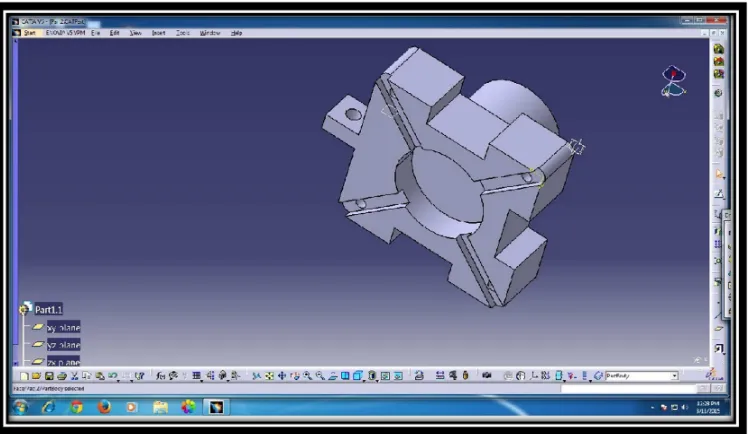
Figure :06 :- BOTTAM PART CATIA MODEL
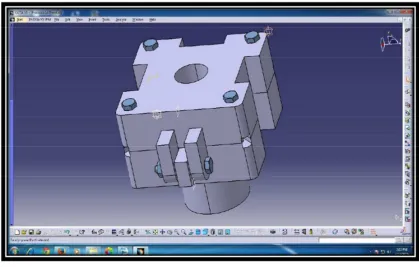
Figure : 08 :- FINAL ASSEMBLY JIG CATIA MODEL
1.6.CALCULATIOS
Mass of a jig = 4.2294 kg Pressure applied of jig =10pa
Bolt Selections and Design
• Dimensions of standard threads (UNF/UNC)
• Strength specifications (grades) of bolts
CLAMPING FORCES
The bolt force is
Where Kb and KC are the bolt and the clamping material stiffness and Fi is the initial bolt tensioning. Calculating
Kb and Kc are relatively difficult and exam problems often give you theses stiffness’s or their ratio.
Recommended initial tension (for reusable bolts) Fi = (0.75 to 0.90) SpAt
Where Sp is the proof strength and At is the tensile area of the bolt.
Recommended tightening torque (based on power screw formulas):
T = 0.20 Fid
Where d is the nominal bolt size Fi=0.75 for temporary joint
Fi=0.90 for permanent joint We taken bolt is M6x30mm Diameter =6
2. FINITE ELEMENT METHOD
2.1 Introduction
The limitations of the mind are such that it cannot grasp the behavior of its complex surrounding and creation in one operation. Thus the purpose of sub dividing all systems into their individual components or elements whose behavior is readily understood and the re building the original system from such components to study its behavior is natural way in which a engineer, the scientist or even the economist proceeds. Finite element method, which is a powerful tool for analyzing various engineering problems, owes is origin to the above mentioned way in which a human mind works
J.N.Reddy.
The basic idea in the FEM is to find the solution of complicated problems by replacing it by a simpler one. Since the actual problem is replaced by a simpler one in finding solution , be will be able to find only an approximate solution rather than the exact solution. The existing mathematical tools will not be sufficient to find the exact solutions (and some times, even an approximate solutions) of most of the practical problems. Thus in the absence of any other covenant method to find even the
approximate solution of given problem, we have to prefer the FEM. the FEM basically consists of thus following procedure. First, a given physical or mathematical problems is modeled by dividing it into small inter connecting fundamental parts called “Finite element”. Next, an analysis of the physical or mathematics of the problem is made on these elements: Finally, the elements are re-assembled into the whole with the solution to the original problem obtain through this assembly procedure.
The finite element method has developed simultaneously with the increasing use of high speed electronic digital computers and with the growing emphasis on numerical method for engineering analysis. Although the method was original developed for structural analysis the general nature of the theory on which it is based has also made possible us successful application for so of problem in other fields of engineering.
2.2
Structural Analysis:Structural analysis is probably the most common application of the finite element method. The term structural (or structure) implies not only civil engineering structures such as ship hulls, aircraft bodies, and machine housings, as well as mechanical components such as pistons, machine parts, and tools.
Types of Structural Analysis:
Different types of structural analysis are:
• Static analysis loads. A static analysis can, however, include steady inertia loads (such as gravity and rotational velocity), and time-varying loads that can be approximated as static equivalent loads (such as the static equivalent wind arid seismic loads commonly defined in many building codes).
Static analysis is used to determine the displacements, stresses, strains, and forces in structural components caused by loads that do not induce significant inertia and damping effects. Steady loading and response are assumed to vary slowly with respect to time.
A static analysis can be either linear or non-linear. All types of non-linearities are allowed-large deformations, plasticity, creep, stress, stiffening, contact (gap) elements, hyper elastic elements, and so on.
Over-view of steps in a static analysis:
The procedure for a modal analysis consists of three main steps:
1. Build the model.
Pre-Processing (Defining the Problem): The major steps in pre-processing are given below
Define key points/lines/ areas/volumes.
Define element type and material/geometric properties
Mesh lines/ areas/volumes as required. The amount of detail required will depend on the dimensionality of the analysis (i.e., 1D, 2D, axi-symmetric, 3D).
Solution (Assigning Loads, Constraints, And Solving): Here the loads (point or pressure), constraints (translational and rotational) are specified and finally solve the resulting set of equations.
Post Processing: In this stage, further processing and viewing of the results can be done such as:
Lists of nodal displacements
Element forces and moments
Deflection plots
Stress contour diagram Elements used for analysis:
BEAM3 is a uniaxial element with tension, compression, and bending capabilities. The element has three degrees of freedom at each node: translations in the nodal x and y directions and rotation about the nodal z-axis. Other 2-D beam elements are the plastic beam.
ANSYS Mechanical Solutions - Simulation Environment Details:
Mechanical Simulation with ANSYS Workbench
The ANSYS Workbench platform is an environment that offers an efficient and intuitive user interface, superior CAD integration, automatic meshing, and access to model parameters as well as to the functionality available within the ANSYS Mechanical products.
Mechanical simulation with ANSYS Workbench builds upon the core ANSYS solver technology the industry has recognized and offers the following benefits for advanced analysis:
• High-end desktop environment for all ANSYS technologies from static linear analysis to nonlinear rigid/flexible dynamics, from steady state thermal analyses to coupled thermo-mechanical transient studies
• Tight integration with other ANSYS solutions (Geometry defeaturing & modeling, Design Exploration, Fatigue Analysis, Computational Fluid Dynamics, ANSYS Meshing Technologies)
• Faster “Initial CAD to final design” process with less effort
• Bi-directional associatively with CAD packages
• Fully automated connection detection and creation (contact, joints)
• Increased meshing robustness & flexibility
• Access to ANSYS functionality (including legacy APDL)
• Process automation opportunity like report generation and customization wizards
From Concept to Robust Design using ANSYS Workbench Native CAD Import
With ANSYS you can use your existing native CAD geometry directly with no translations, no IGES, and no middle geometry formats. ANSYS provides native, bi-directional, integration with the most popular CAD systems since more than 10 years and also provides integration directly into the CAD menu bar making it simple to launch the ANSYS world class simulation directly from your CAD system. Inventor / MDT, Autodesk Inventor Professional Stress, CATIA v4 and v5, Pro/ENGINEER, Solid Edge, Solid Works, Unigraphics, Co CREATES. ANSYS Workbench also supports neutral format files: IGES, Para solid, ACIS® (SAT), STEP – enabling the use of any CAD system able to export to any of these formats.
2.3. Parameter and Dimension Control
The ANSYS Workbench Environment uses a unique plug-in architecture to maintain associatively with the CAD systems for any model, allowing you to make design changes to your CAD model without having to reapply loads and/or supports. You can either pick the CAD dimension to change
directly, or enhance your design iterations with ANSYS Design Explorer
Disfeaturing the geometry:
Some details of the CAD model might not be relevant for the simulation. ANSYS Design Modeler will give you the
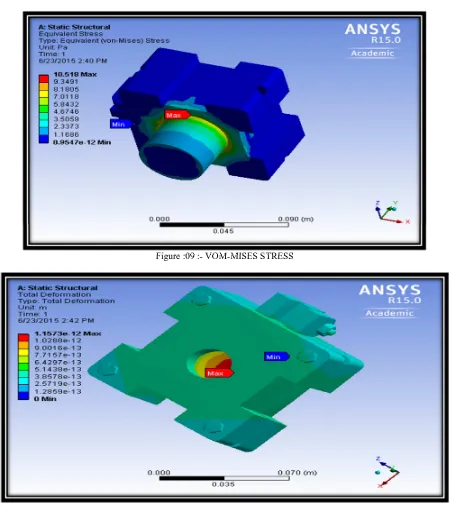
Figure :09 :- VOM-MISES STRESS
Figure :10 :- TOTAL DEFORMATION
3. CONCLUSION
Jigs are manufacturing tools that are employed to produce interchangeable and identical components. They are unique tool-guiding and work-holding devices designed specifically for machining and assembling large number of parts
The design of jigs are dependent on numerous factors which are analyzed to achieve an optimum output that they should be made of rigid light materials to facilitate easy handling in multiple operations.
REFERENCES:
[1] Joshi, P. (2010). “Jigs and Fixtures” Tata McGraw Hill Education, New Delhi, India.
[2] Nanthakumar, K. and Prabakaran, V. (2014). “Design and Fabrication Testing of Combined Multipurpose Jig and Fixture” IOSR Journal of Mechanical and Civil Engineering.
[3] . [Lin, Q., Burdick, J., and Rimon, E. (2006). “Constructing Minimum Deflection Arrangements Using Invariant Norms” IEEE Transactions on Automation Science and Engineering, Vol. 3, No. 3. Science Research 2015; 3
[4] 213-219 219 [4] Blogspot (2010). “Introduction to Jigs and Fixtures” [Online]
engineeringhut.blogspot.com/2010/11/jigs-andfixtures.html[Accessed 5 May 2015].
[5] Spogel (2014). “Mini project on Jigs and Fixtures” [Online] http://files.spogel.com/miniprojectsin-mech/p-0027--Jigs-andFixtures.pdf[Accessed 18 May 2015].