A Simple but Powerful Automatic Term Extraction Method
Hiroshi Nakagawa
Information Technology Center, The University of Tokyo
7-3-1, Bunkyo, Hongo Tokyo, Japan, 113-0033 [email protected]
Tatsunori Mori
Yokohama National University 79-5, Tokiwadai,Hodogaya Yokohama, Japan,240-0085
Abstract
In this paper, we propose a new idea for the automatic recognition of domain specific terms. Our idea is based on the statistics between a compound noun and its component single-nouns. More precisely, we focus basically on how many nouns adjoin the noun in question to form compound nouns. We propose several scoring methods based on this idea and experimentally evaluate them on the NTCIR1 TMREC test collection. The results are very promising especially in the low recall area.
Introduction
Automatic term recognition, ATR in short, aims at extracting domain specific terms from a corpus of a certain academic or technical domain. The majority of domain specific terms are compound nouns, in other words, uninterrupted collocations. 85% of domain specific terms are said to be compound nouns. They include single-nouns of the remaining 15% very frequently as their components, where “single-noun” means a noun which could not be further divided into several shorter and more basic nouns. In other words, the majority of compound nouns consist of the much smaller number of the remaining 15% single-noun terms and other single-nouns. In this situation, it is natural to pay attention to the relation among single-nouns and compound nouns, especially how single-noun terms contribute to make up compound noun terms.
Another important feature of domain
specific terms is termhood proposed in (Kageura & Umino 96) where “termhood” refers to the degree that a linguistic unit is related to a domain-specific concept. Thus, what we really have to pursue is an ATR method which directly uses the notion of termhood.
Considering these factors, the way of making up compound nouns must be heavily related to the termhood of the compound nouns. The first reason is that termhood is usually calculated based on term frequency and bias of term frequency like inverse document frequency. Even though these calculations give a good approximation of termhood, still they are not directly related to termhood because these calculations are based on superficial statistics. That means that they are not necessarily meanings in a writer's mind but meanings in actual use. Apparently, termhood is intended to reflect this type of meaning. The second reason is that if a certain single-noun, say N, expresses the key concept of a domain that the document treats, the writer of the document must be using N not only frequently but also in various ways. For instance, he/she composes quite a few compound nouns using N and uses these compound nouns in documents he/she writes. Thus, we focus on the relation among single-nouns and compound nouns in pursuing new ATR methods.
term, Nakagawa and Mori proposed a scoring function for term candidates. Their term extraction method however is just one example of employing the relation among single-nouns and compound nouns. Note that this relation is essentially based on a noun bigram. In this paper, we expand the relation based on noun bigrams that might be the components of longer compound nouns. Then we experimentally evaluate the power of several variations of scoring functions based on the noun bigram relation using the NTCIR1 TMREC test collection. By this experimental clarification, we could conclude that the single-noun term’s power of generating compound noun terms is useful and essential in ATR. In this paper, section 1 gives the background of ATR methods. Section 2 describes the proposed method of the noun bigram based scoring function for term extraction. Section 3 describes the experimental results and discusses them.
1 Background
1.1 Candidates Extraction
The first thing to do in ATR is to extract
term candidates from the given text
corpus. Here we only focus on nouns, more precisely a single-noun and a compound noun, which are exactly the targets of the NTCIR1 TMREC task(Kageura et al 1999). To extract compound nouns which are promising term candidates and at the same time to exclude undesirable strings such as “is a”
or “of the”, the frequently used method is
to filter out the words that are members of a stop-word-list. More complex structures like noun phrases, collocations and so on, become focused on (Frantzi and Ananiadou 1996). All of these are good term candidates in a corpus of a specific domain because all of them have a strong unithood (Kageura&Umino96) which refers to the degree of strength or stability of syntagmatic combinations or collocations. We assume the following about compound nouns or collocations:
Assumption Terms having complex structure a e t be made of xisting
simple terms r o e
The structure of complex terms is another important factor for automatic term candidates extraction. It is expressed syntactically or semantically. As a syntactic structure, dependency structures that are the results of parsing are focused on in many works. Since we focus on these complex structures, the first task in extracting term candidates is a morphological analysis including part of speech (POS) tagging. For Japanese, which is an agglutinative language, a morphological analysis was carried out which segmented words from a sentence and did POS tagging (Matsumoto et al. 1996).
After POS tagging, the complex structures mentioned above are extracted as term candidates. Previous studies have proposed many promising ways for this purpose, Hisamitsu(2000) and Nakagawa (1998) concentrated their efforts on compound nouns. Frantzi and Ananiadou (1996) tried to treat more general structures like collocations.
1.2 Scoring
2 Single-Noun Bigrams as Components of Compound Nouns
2.1 Single-Noun Bigrams
The relation between a single-noun and complex nouns that include this single-noun is very important. Nevertheless, to our knowledge, this relation has not been paid enough attention so far. Nakagawa and Mori (1998) proposed a term scoring method that utilizes this type of relation. In this paper, we extend our idea comprehensively. Here we focus on compound nouns among the various types of complex terms. In technical documents, the majority of domain-specific terms are noun phrases or compound nouns consisting of a small number of single nouns. Considering this observation, we propose a new scoring method that measures the importance of each single-noun. In a nutshell, this scoring method for a single-noun measures how many distinct compound nouns contain a particular single-noun as their part in a given document or corpus. Here, think about the situtation where single-noun N occurs with other single-nouns which might be a part of many compound nouns shown in Figure 1 where [N M] means bigram of noun N and M.
[LN1 N] (#L1) [N RN1](#R1) : : [LNn N](LN) [N RNm](#Rm)
Figure 1. Noun Bigram and their Frequency
In Figure 1, [LNi N] (i=1,..,n) and [N RNj] (j=1,...,m) are single-noun bigrams which constitute (parts of) compound nouns. #Li and #Rj (i=1,..,n and j=1,..,m) mean the frequency of the bigram [LNi N] and [N RNj] respectively. Note that since we depict only bigrams, compound nouns like [LNi N RNj] which contains [LNi N] and/or [N RNj] as their parts might actually occur in a corpus. Again this noun trigram might be a part of longer compound nouns.
Let us show an example of a noun bigram. Suppose that we extract compound nouns including “trigram” as candidate terms from a corpus shown in the following example.
Example 1.
trigram statistics, word trigram, class trigram, word trigram, trigram acquisition, word trigram statistics, character trigram
Then, noun bigrams consisting of a single-noun “trigram” are shown in the following where the number bewteen ( and ) shows the frequency.
word trigram (3) trigram statistics (2) class trigram (1) trigram acquisition (1)
character trigram(1) Figure 2. An example of noun bigram
We just focus on and utilize single-noun bigrams to define the function on which scoring is based. Note that we are concerned only with single-noun bigrams and not with a single-noun per se. The reason is that we try to sharply focus on the fact that the majority of domain specific terms are compound nouns. Compound nouns are well analyzed as noun bigram.
2.2 Scoring Function
2.2.1 The direct score of a noun bigram
Since a scoring function based on [LNi N] or [N RNj] could have an infinite number of variations, we here consider the following simple but representative scoring functions.
#LDN(N) and #RDN(N) : These are the number of distinct single-nouns which directly precede or succeed N. These are exactly “n” and “m” in Figure 1. For instance, in an example shown in Figure 2, #LDN(trigram)=3, #RDN(trigram)=2
For instance, if we use LN(N,1) and RN(N,1) in example 1, GM(trigram,1) =
)
1
5
(
)
1
3
(
+
×
+
= 4.90. In (3), GM doesnot depend on the length of a compound noun that is the number of single-nouns within the compound noun. This is because we have not yet had any idea about the relation between the importance of a compound noun and a length of the compound noun. It is fair to treat all compound nouns, including single-nouns, equally no matter how long or short each compound noun is.
∑
= =
LDN(N) #
1 i
k Li) (# k)
LN(N, (1)
∑
= =
RDN(N) #
1 j
k Rj) (# k)
RN(N, (2)
We can find various functions by varying parameter k of (1) and (2). For instance, #LDN(N) and #RDN(N) can be defined as LN(N,0) and RN(N,0). LN(N,1) and RN(N,1) are the frequencies of nouns that directly precede or succeed N. In the example shown in Figure 2, for example, LN(trigram,1)=5, and RN(trigram,1)=3. Now we think about the nature of (1) and (2) with various value of the parameter k. The larger k is, the more we take into account the frequencies of each noun bigram. One extreme is the case k=0, namely LN(N,0) and RN(N,0), where we do not take into account the frequency of each noun bigram at all. LN(N,0) and RN(N,0) describe how linguistically and domain dependently productive the noun N is in a given corpus. That means that noun N presents a key and/or basic concept of the domain treated by the corpus. Other extreme cases are large k, like k=2 , 4, etc. In these cases, we rather focus on frequency of each noun bigram. In other words, statistically biased use of noun N is the main concern. In the example shown in Figure 2, for example, LN(trigram,2)=11, and RN(trigram,2)=5. If k<0, we discount the frequency of each noun bigram. However, this case does not show good results of in our ATR experiment.
2.2.3 Combining Compound Noun Frequency
Information we did not use in the bigram based methods described in 2.2.1 and 2.2.2 is the frequency of single-nouns and compound-nouns that occur independently, namely left and right adjacent words not being nouns. For instance, “word patterns” occurs independently in “… use the word patterns occurring in … .” Since the scoring functions proposed in 2.2.1 are noun bigram statistics, the number of this kind of independent occurrences of nouns themselves are not used. If we take this information into account, a new type of information is used and better results are expected.
In this paper, we employ a very simple method for this. We observe that if a single-noun or a compound noun occurs independently, the score of the noun is multiplied by the number of its independent occurrences. Then GM(CN,k) of the formula (3) is revised. We call this new GM FGM(CN,k) and define it as follows.
2.2.2 Score of compound nouns
The next thing to do is to extend the scoring functions of a single-noun to the scoring functions of a compound noun. We adopt a very simple method, namely a geometric mean. Now think about a compound noun : CN = N1 N2…N L. Then
a geometric mean: GM of CN is defined as follows.
if N occurs independently
then FGM(CN,k)=GM(CN,k)×f(CN) where f(CN) means the number of independent occurrences of noun CN
) 3 ( 1) k) , 1)(RN(N k)
, (LN(N
k) GM(CN,
L 2 1 L
1 i
i
i −
+ +
=
∏
=
3 (3 +
For instance, in example 1, if we find independent “trigram” three times in the corpus, FGM(trigram,1)= × 1)×(5+1)=14.70
2.2.4 Modified C-value
We compare our methods with the C-value based method(Frantzi and Ananiadou 1996) because 1) their method is very powerful to extract and properly score compound nouns., and 2) their method is basically based on unithood. On the contrary, our scoring functions proposed in 2.2.1 try to capture termhood. However the original definition of C-value can not score a single-noun because the important part of the definition C-value is:
)
c(a)
t(a)
-1)(n(a)
-length(a)
(
value(a)
-C
=
--- (5) where a is compound noun, length(a) is the number of single-nouns which make up a, n(a) is the total frequency of occurrence of a on the corpus, t(a) is the frequency of occurrence of a in longer candidate terms, and c(a) is the number of those candidate terms.
As known from (5), all single-noun’s C-value come to be 0. The reason why the first term of right hand side is (length(a)-1) is that C-value originally seemed to capture how much computational effort is to be made in order to recognize the important part of the term. Thus, if the length(a) is 1, we do not need any effort to recognize its part because the term a is a single-word and does not have its part. But we intend to capture how important the term is for the writer or reader, namely its termhood. In order to make the C-value capture termhood, we modify (5) as follows.
)
c(a)
t(a)
-n(a)
length(a)(
value(a)
-MC
=
(6)Where “MC-value” means “Modified C-value.”
3 Experimental Evaluation
3.1 Experiment
In our experiment, we use the NTCIR1 TMREC test collection (Kageura et al 1999). As an activity of TMREC, they have provided us with a Japanese test
collection of a term recognition task. The goal of this task is to automatically recognize and extract terms from a text corpus which contains 1,870 abstracts gathered from the computer science and communication engineering domain corpora of the NACSIS Academic Conference Database, and 8,834 manually collected correct terms. The TMREC text corpus is morphologically analyzed and POS tagged by hand. From this POS tagged text, we extract uninterrupted noun sequences as term candidates. Actually 16,708 term candidates are extracted and several scoring methods are applied to them. All the extracted term candidates CNs are ranked according to their GM(CN,k), FGM(CN,k) and MC-value(CN) in descending order. As for parameter k of (1) and (2), we choose k=1 because its performance is the best among various values of k in the range from 0 to 4. Thus, henceforth, we omit k from GM and FGM, like GM(CN) and FGM(CN). We use GM(CN) as the baseline.
In evaluation, we conduct experiments where we pick up the highest ranked term candidate down to the PNth highest ranked term candidate by these three scoring methods, and evaluate the set of selected terms with the number of correct terms, we call it CT, within it. In the following figures, we only show CT because recall is CT/8834, where 8834 is the number of all correct terms, precision is CT/PN.
Another measure NTCIR1 provides us with is the terms which include the correct term as its part. We call it “longer term” or LT. They are sometimes valued terms and also indicate in what context the correct terms are used. Then we also use the number of longer terms in our evaluation.
3.2 Results
0 1000 2000 3000 4000 5000
0
500 1000 1500 2000 2500 3000
PN
Extracted correct
terms
[image:6.595.85.283.97.422.2]GM GM - longer term
Figure 3. CT and LT of GM(CN) for each PN
-50 0 50 100 150 200 250 300 350
0
400 800
1200 1600 2000 2400 2800
PN
Diffrence of corrent terms
FGM-GM MCvalue-GM
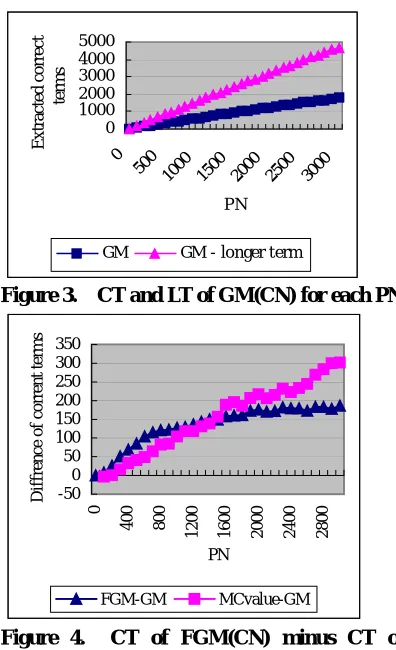
Figure 4. CT of FGM(CN) minus CT of GM(CN), and CT of MC-value(CN) minus CT of GM(CN) for each PN
-600 -400 -200 0
0
500
1000 1500 2000 2500 3000
PN
Diffrence of longer
terms
MCvalue-GM FGM-GM
Figure 5. LT of GM(CN) minus LT of FGM(CN) , and LT of GM(CN) minus LT of MC-value(CN) for each PN
In Figure 3, the Y-axis represents CT in other words the number of correct terms picked up by GM(CN) and the number of longer terms picked up by GM(CN) for each PN. They are our baseline. The Figure 4 shows the difference between CT of FGM(CN) and CT of GM(CN) and the
difference between CT of MC-value(CN) and CT of GM(CN) for each PN. Figure 5 shows the difference between LT of GM(CN) and LT of FGM(CN) or LT of MC-value(CN) for each PN. As known from Figure 4, FGM based method outperforms MC-value up to 1,400 highest ranked terms. Since in the domains of TMREC task that are computer science and communication engineering, 1,400 technical terms are important core terms, FGM method we propose is very promising to extract and recognize domain specific terms. We also show CT of each method for larger PN, say, from 3000 up to 15000 in Table 1 and 2.
Table 1. CT of each ranking method for PN larger than 3000
[image:6.595.329.482.511.601.2]PN GM FGM MC- value 3000 1784 1970 2111 6000 3286 3456 3671 9000 4744 4866 4930 12000 6009 6090 6046 15000 7042 7081 7068
Table 2. LT of each ranking method for PN larger than 3000
PN GM FGM MC- Value 3000 2893 2840 2531 6000 5644 5576 5011 9000 8218 8152 7578 12000 10523 10488 9852 15000 12174 12186 12070
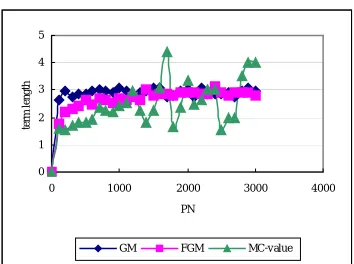
of term is favored by each method. For this, we show the average length of the highest PN ranked terms of each method in Figure 6 where length of CN means the number of single-words CN consists of. Clearly, GM prefers longer terms. So does FGM. On the contrary, MC-value prefers shorter terms. However, as shown in Figure 6, the average length of the MC-value is more fluctuating. That means GM and FGM have more consistent tendency in ranking compound nouns. Finally we compare our results with NTCIR1 results (Kageura et al 1999). Unfortunately since (Kageura et al 1999) only provides the number of the all extracted terms and also the number of the all extracted correct terms, we could not directly compare our results with other NTCIR1 participants. Then, what is important is the fact that we extracted 7,082 correct terms from top 15,000 term candidates with the FGM methods. This fact is indicating that our methods show the highest performance among all other participants of NTCIR1 TMREC task because 1) the highest number of terms within the top 16,000 term candidates is 6,536 among all the participants of NTCIR1 TMREC task, and 2) the highest number or terms in all the participants of NTCIR1 TMREC task is 7,944, but they are extracted from top 23,270 term candidates, which means extremely low precision.
0 1 2 3 4 5
0 1000 2000 3000 4000
PN
te
rm l
engt
h
GM FGM MC-value
[image:7.595.311.488.98.230.2]
Figure 6. The average length of extracted terms by GM(CN), FGM(CN) and MC-value(CN) for each PN
References
Frantzi, T.K. and Ananiadou, S. 1996. “Extracting nested collocations”. In
Proceedings of 16th International
Conference on Compu ational
Linguistics, 41-46. t
e
t
e
z
e
Frantzi, T.K. and Ananiadou, S. 1999. “The c-value/nc-value method for atr”.
Journal of Natural Language
Processing 6(3), 145-179.
Hisamitsu, T, 2000. “A Method of Measuring Term Representativeness”.
In Proce dings of 18th International
Conference on Compu ational
Linguistics, 320-326.
Kageura, K. and Umino, B. 1996. “Methods of automatic term recognition: a review”. Terminology 3(2), 259-289.
Conclusion
Kageura, K. et al, 1999. “TMREC Task:Overview and Evaluation”. In
Proceedings of the First NTCIR
Workshop on Research in Japanese
T xt Retrieval and Term Recognition,
411-440. In this paper, we introduce a new
ngle-noun bigram based statistical methods for ATR, which capture how many nouns adjoin the single-noun in question to form compound nouns. Through experimental evaluation using the NTCIR1 TMREC test collection, the FGM method we proposed showed the best performance in selecting up to 1,400 domain specific terms.
Matsumoto, Y., Kurohashi, S., Yamaji, O., Taeki, H. and Nagao, M. 1996.
Instruction Manual of Japanese
Morphological Analy er JUMAN3.1.
Nagao Lab. at Kyoto University.
Nakagawa, H. and Mori, T. 1998. “Nested Collocation and Compound Noun for Term Recognition”. In Proceedings of the First Workshop on Computational
T rminology COMPTERM’98, 64-70.
Acknowledgements