1
A Comparative Approach for Human Motion Detection
& Tracking System
Moiz A. Hussain
1, Govind U. Kharat
Department of ENTC, AEC, Chikhli1, Asst. Prof.1Email: [email protected]1 [email protected]2
Abstract- Today, security of human being is the most active research area. In this paper, we review the two different techniques of video surveillance system based on motion segmentation and tracking. The first system is based on dual frame differencing method followed by the morphological operations & Kalman filtering. The second technique is the use of visual background subtraction combined with illumination insensitive template matching algorithm. This paper explores the different methods of visual tracking & their experimentation results to enhance the study in the field of image processing.
Index Terms-Motion Detection, Video Surveillance, Frame subtraction,
1. INTRODUCTION
Ensuring the security at the public places is in general the most challenging task. In recent years [1, 2] there are numerous approaches proposed in this area. Today’s security system acts like video storage anything that comes under the surveillance area is recorded in the computer system. Their basic concern is on the video compression and the frame retrieval. Such kind of surveillance system serves two important functions: First, assisting the human operator by providing the footage of the incident taken place for identifying the danger and second capturing the evidence for investigation purpose. Although these are the initial steps in surveillance system yet they could not be applied to detect crime in the real time and take necessary action against it.
In this paper we begin with the survey of related techniques for video surveillance system. Then present the methods of motion segmentation and tracking. After that the result of the system are presented. Finally the paper ends with the conclusion.
2. RELATED WORK
There is an enormous literature in the field of motion detection & object tracking. Here we discuss the relevant object tracking system.
Fan Yang et al. [3, 2014], proposed a super pixel tracking system in which the structural information is captured to make a tracker distinguish the target from the background. The method is also capable of dealing with occlusion and drift problems. An online object tracking method described by Wang et al. [4, 2013], with sparse prototypes, using principal component analysis (PCA) to train the appearance models. The tracking task is accomplished by online trained sparse
prototypes. This algorithm is effective on motion blur & occlusion handling.
Olivier Barnich et al. [5, 2011], presented an innovative technique of adapting the pixel to the background based on its resemblance to the stored pixel. If the value of pixel matches with the stored pixel at the same location or in neighborhood location the pixel is considered to be the part of background otherwise foreground. Peng Cui et al. [6, 2012], proposed an action representation system using unsupervised categorization. In this video decomposition is done where videos are considered to be spatially distributed pixel and after replacing these pixels with their prototype multi action is recognized using duality between pixel clustering and action clustering.
2 3. SYSTEM METHODOLOGY
3.1 Dual Frame Differencing Method
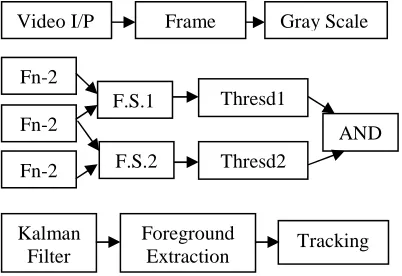
Human Motion detection & tracking algorithms have to deal with various challenges as described earlier. To overcome these problems the system, consists of three frame differences and morphological blob analysis to avoid false motion detection.
The proposed system works in three stages. At first stage gray scale frames are extracted from video & frame difference between frame Fn-2 and Fn-1 and second frame difference between the frame Fn-1 and current frame Fn are taken. It is different than other algorithms where only the difference between the current and previous frame is considered. In second phase, morphological operation is performed on the resultant frame difference to suppress the remaining errors. Then the background regions are extracted, holes are filled and small regions are removed. It gives, two background masks, after morphological operations which are then compared with the threshold calculated followed by the AND operation applied to eliminate the false motion detection. Finally, the Kalman filter [11] is used to remove the noise and other changes in pixel due to illumination or any other reason. Extracted foreground is then tracked by the rectangle around it. The system is depicted as figure 1 below.
Figure 1: Dual Frame difference System Stages
3.2 Visual background & Template Matching Method
A method for accurate detection & tracking of human motion in an image sequence by combining visual background extraction technique [12] for motion detection and illumination intensity minimization based on template matching technique for object tracking is proposed.
Figure 2: Visual Background & Template Matching System Stages.
The system will take care of illumination changes in real images caused due to automatic exposure alterations of the camera, adjustment of light cause irradiance, appearance of shadows or movement of the tracked objects. The objective of research is to provide a robust and improved method to find the moving visual background extraction model to which morphological operation is applied to fill the gaps and nullify the small blobs present due to error. Extracted foreground is then tracked by rectangle for which centroid calculation is done. Simultaneously, illumination insensitivity hyperplane method [13] for template matching is also applied to perfectly track the object.
3.3 Motion Database
3 Eli Walk Lyova Run Ido Side
Denis Jump Lyova Wave Eli Bend
Figure 4: Images from the Weizmann data set. Running Boxing Clapping
Jogging Handwaving Walking
Figure 5: Images from the “KTH data set”.
Jump Run Side
Handwaving Jogging Walking
Figure 6: Images from the “Self data set”.
4. RESULTS & DISCUSSION
The algorithms are implemented in MATLAB 7.10.0 (R2010a) on Windows 7.0 platform. The PC is equipped with Pentium corei3, 2.13 GHz processor and 4 GB RAM Memory. The experimental result of the dual frame background subtraction algorithm is shown in figure 7.
4.1 Dual Frame Differencing Method
Original Frame Grayscale conversion
Segmented Foreground
Frame #11 Frame #14 Frame #16
Frame #13 Frame #79 Frame #83 Figure 7: Experimental result of the background subtraction model on Database videos.
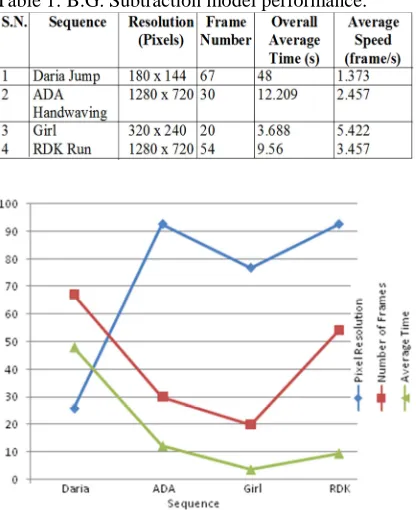
The computational difficulty for computing each difference is only (| | for the local context region of M x N pixels, thereby resulting in a fast method (100 FPS in MATLAB on an i3 machine). More importantly, the algorithm achieves robust results as shown in figures above. The summary of processing time and average speed of processing the video is given in the table 1 below.
Table 1: B.G. Subtraction model performance.
Figure 8: Graphical representation of performance.
4 the processing speed of the method. Moreover, this
method takes less than 1s to compute the image difference, while the image scan takes less than 0 to 5s depending on the specific configuration.
4.2 Visual background & Template Matching Method
The Visual background & Template Matching Method results are compared with the other background subtraction processes as depicted in figure 9. In few numbers of video sequences the gradient mask is not accurately observed due to radiance variation & other problems.
Figure 9: Image from database sequence, grayscale conversion, “Adaptive mixture models” [14], “Haritaoglu” [15]. “Romain” [16], and described technique. (Read row-wise).
Table 2: Tracking window variation for change in element σ performance.
Sr. No.
Run Scale
Parameter
σ
Target Scale
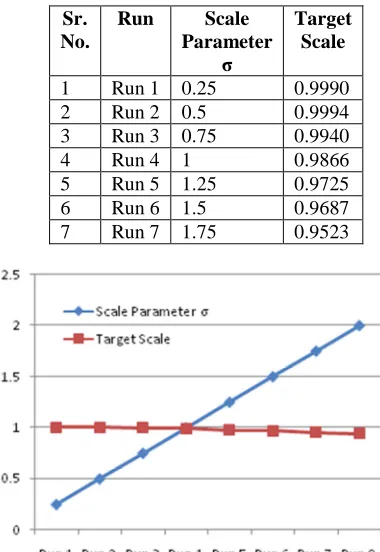
1 Run 1 0.25 0.9990 2 Run 2 0.5 0.9994 3 Run 3 0.75 0.9940 4 Run 4 1 0.9866 5 Run 5 1.25 0.9725 6 Run 6 1.5 0.9687 7 Run 7 1.75 0.9523
Figure 9: Graphical representation of table 2.
The target tracking efficiency is increased through the weighted context region of the last target location. Furthermore, the size of the object also changes with time depending on whether the object is approaching nearer to the camera or going away from the camera. Hence, the scale element σ should be updated accordingly. Table 2 represents the variation of tracking rectangle when the element σ is changed for
various values.
5. CONCLUSION
In this paper, we have analyzed two methods of human motion segmentation & tracking. First method is the use of three frame subtraction which overcomes the disadvantage of simple frame differencing algorithm. This method achieves accurate segmentation of moving pixels. The second method is combination of visual background extraction and illumination insensitive template matching technique. Experimentation result of the model shows its effectiveness against motion changes due to camera movement, and cluttered background. Method also reduces false alarm triggering due to noise and illumination changes. Our future direction of study includes the study of surveillance system for the prediction of the speed & distance of the object in the scene. This would be useful in vehicle safety & sports activity analysis & applications.
REFERENCES
[1] Wei Zhong, Huchuan Lu et al., “Robust Object Tracking via Sparse Collaborative Appearance Model”, IEEE Transactions on Image Processing, Vol. 23, No. 5, May 2014.
[2] Furat N. Tawfeeq, “Real Time Motion Detection in Surveillance Camera Using MATLAB”,
International Journal of Advanced Research in Computer Science and Software Engineering,
Vol. 3, Issue 9, September 2013.
[3] Fan Yang et al., “Robust Superpixel Tracking”,
IEEE Transactions on Image Processing, Vol. 23,
No. 4, April 2014.
[4] Dong Wang et al., “Online Object Tracking with Sparse Prototypes”, IEEE Transactions on Image
Processing, Vol. 22, No. 1, January 2013.
[5] Olivier Barnich et al., “ViBe: A universal background subtraction algorithm for video sequences”, IEEE Transactions on Image
5 [6] Peng Cui et al., “A Matrix-Based Approach to
Unsupervised Human Action Categorization”,
IEEE Transactions on Multimedia, Vol. 14, No.
1, February 2012.
[7] Yuji Tachizaki et al., “A DCT Coefficient Sign-Based Background Model For Moving Objects Detection From Motion JPEG Coded Movies”,
International Symposium on Intelligent Signal
Processing and Communication Systems
December 7-9, 2009.
[8] Tudor Barbu, “Novel Approach For Moving Human Detection And Tracking In Static Camera Video Sequences”, Proceedings Of The Romanian Academy, Series A, Volume 13,
Number 3Pp. 269–277, 2012.
[9] Tal Ben-Zvi et al., “Intruder Detection: An Optimal Decision Analysis Strategy”, IEEE
Transactions on Systems, Man, and Cybernetics— Part C: Applications and Reviews, Vol. 42, No. 2,
March 2012.
[10]Jianguo Lu et al., “A Detection-Aided Multi-target Tracking Algorithm”, International Conference on Machine Vision and Human-machine Interface, 2010.
[11]Li Ying-hong, et al., “An intelligent tracking technology based on Kalman and mean shift algorithm”, IEEE Second Intl. Conf. on Computer
Modelling and Simulation, 2010.
[12]Olivier Barnich et al., “A universal background subtraction algorithm for video sequences”, IEEE
Transactions on Image Processing,
20(6):1709-1724, June 2011.
[13]Christoph Gr¨aßl et al., “Illumination Insensitive Template Matching with Hyperplanes”, Pattern
Recognition, 25th DAGM Symposium,
Magdeburg, Germany, pages 273-280, September 2003.
[14]C. Stauffer and W. Grimson, “Adaptive background mixture models for real-time tracking,” in Proc. IEEE Conf. Computer Vision
and Pattern Recognition, vol. 2, pp. 246–252,
1999.
[15]I.Haritaoglu, D.Harwood, L.Davis, “A Fast
Background Scene Modeling and Maintenance for
Outdoor Surveillance”, ICPR, pp.179-183,
Barcelona, 2000.
[16]Romain Marie, Alexis Potelle, “Dynamic Background Subtraction Using Moments”, In
Proceedings of the IEEE International
Conference on Image Processing, pp. 2369 -
2372, 2011.
[17]T. Brox, A. Bruhn, N. Papenberg, and J. Weickert. High accuracy optical flow estimation
based on a theory for warping. European
Conference on Computer Vision (ECCV), 2004.
[18]Jean-Yves Bouguet, “Pyramidal Implementation of the Lucas Kanade Feature Tracker Description of the algorithm”, Intel Corporation Microprocessor Research Labs, 2000.
[19]X. Mei and H. Ling, “Robust visual tracking using L1 minimization,” In Proc. IEEE Int. Conf.
Comput. Vision, Sep.–Oct. pp. 1436–1443, 2009.
[20]A. Adam, E. Rivlin, and I. Shimshoni, “Robust fragments-based tracking using the integral histogram”, In Proc. IEEE Conf. Computer Vision