E X P E R I M E N T S U S I N G S T O C H A S T I C S E A R C H F O R T E X T P L A N N I N G Chris Mellish, Alistair K n o t t , J o n Oberlander and Mick O'Donnell
D e p a r t m e n t of Artificial Intelligence a n d H u m a n C o m m u n i c a t i o n Research Centre, University of E d i n b u r g h 1
A b s t r a c t
• Marcu has characterised an i m p o r t a n t a n d difficult problem in text planning: given a set of facts to convey a n d a set of rhetorical r e l a t i o n s t h a t can be used to link t h e m together, how can one arrange this material so as to yield t h e best possible text? We describe e x p e r i m e n t s with a n u m b e r
of heuristic Search m e t h o d s for this task. '
1 • I n t r o d u c t i o n :
T e x t P l a n n i n g
1.1 T h e T a s k
T h i s p a p e r presents some initial e x p e r i m e n t s u s i n g stochastic search m e t h o d s for aspects of text planning. T h e work was m o t i v a t e d by t h e needs of t h e ILEX system for generating descriptions of m u s e u m artefacts (in particular, 20th C e n t u r y jewellery) [Mellish e t al 98]. We present results on examPles semi-automatically generated from datastructures t h a t exist within ILEX.
F o r m i n g a s e t of facts a b o u t a piece of jewellery into a structure t h a t yields a coherent text is a non-trivial problem. Rhetorical S t r u c t u r e T h e o r y [ M a n n and T h o m p s o n 87] claims t h a t a text i s c o h e r e n t just in case it can be analysed hierarchically in terms of relations between text spans. Much work in NLG makes the a s s u m p t i o n t h a t constructing something like an RS tree is a necessary step in t h e planning of a text. T h i s work takes as its starting point Marcu's [Marcu 97] excellent • formalisation of R S T a n d the p r o b l e m of building legal R S T trees, a n d for the purposes of this p a p e r t h e phrase "text planning" will generally denote the task characterised by him. In this task, one is given a set of facts all of which should b e included in a text a n d a set of relations between facts, s o m e of which c a n b e included in t h e text. T h e task is to p r o d u c e a legal RS tree using the facts a n d some relations (or t h e "best" such tree).
Following t h e original work on R S T a n d assumptions t h a t have been commonly made in sub- sequent work, we wil ! assume t h a t there is a fixed set of possible relations (we include "joint" as a second-class relation which can be applied to any two facts, b u t whose use is not preferred). Each relation has a nucleus and a satellite (we d o n ' t consider multiple nuclei or satellites here, apart from t h e case of "joint", which is essentially multinuclear). Each relation may be indicated by a distinctive "cue p h r a s e " , with t h e nucleus a n d satellite being realised in some fashion a r o u n d it. Each relation has applicability conditions which can be tested between two atomic facts. For two complex text spans, a relation holds exactly w h e n that relation holds between the nuclei of those spans. Relations can thus hold between text spans Of arbitrary size.
Figure 1 shows a n example of t h e form of t h e i n p u t that is used for the experiments •reported here. E a c h primitive "fact" is represented in terms of a subject, verb a n d complement (as well as a u n i q u e identifier). T h e "subject" is assumed t o be the entity t h a t t h e fact is "about". T h e approaches reported here have n o t yet been linked to a realisation component, a n d so the e n t i t i e s
a 80 S o u t h Bridge, Edinburgh EH1 1HN. Email: {chrism, micko}~dai, ed. ac. u k , { a l i k , j on}ecogsc£, ed. a c . uk
• 9 8
I
I
I
I
I
I
•(!|
:!
I
' " I
I
I
fact( fact( fact( fact( fact(
'this item','is','a figurative jewel',f6). bleufort,'was','a french designer',f3). shiltredge,'was','a british designer',fT).
'this item','was made by',bleufort,f8). titanittm,'is','a refractory metal',f4).
rel (contrast, f7, f3, [] ). rel(elab,Fi,F2, []) :-
mentions (FI, O), mentions (F2, O) , \+ FI=F2.
Figure 1: Example Input
are represented Simply by canned phrases for readability (it is assumed that each entity in the domain has a fixed distinctive phrase that is always used for it). Relations are represented in terms Of the relation name, the nucleus and satellite facts and a list (in this example, empty) of precondition facts which need to have been assimilated before the :relation can be used (this represents an extension to Marcu's chcracterisation). This example uses the definition of (object- attribute) "elaboration" that we will be using consistently, namely that one fact can elaborate another if they have an entity in common (of course, there are other kinds of elaborations, b u t we would want to model them differently).
1.2 C o n t r o l l i n g S e a r c h i n T e x t P l a n n i n g
There seem to be three main approaches to controlling the search for a good RS tree (or something similar). One is to restrict what relations can appear in t h e nucleus and satellite of others (for instance, using Hovy's [Hovy 90] idea of "growth points"): This is astep towards creating "schemas" for larger pieces of t e x t . It can therefore be expected that it will produce very good results in restricted domains where limited text patterns are used, but that it will be hard to extend it to freer text types. The second idea is to use information about goals to limit possibilities. This is an element of Hovy's work but is more apparent i n the planning work of Moore and Paris [Moore and Paris 93]. This second approach will work well if there are strong goals in the domain which really can influence textual decisions. This is not always the case. For instance, in our ILEX domain [Mellish et al 98] the system's goal is something very general like "say interesting things about item X / s u b j e c t to length and coherence constraints".
The third approach, most obviously exemplified by [Marcu 97], is to Use some form o f explicit search through possible trees, guided by heuristics about tree quality. Marcu first of all attempts to find the best ordering of the facts. For every relation that could be indicated, constraints are generated saying what the order of the two facts involved should be and t h a t the facts should be adjacent. The constraints a r e weighted according t o attributes o f rhetorical relations that have been determined empirically. A standard constraint satisfaction algorithm is used to find the linear sequence such that the total weight of the satisfied constraints is maximal. Once the sequence of facts is known, a general algorithm [Marcu 96] is used to construct all possible RS trees based on those facts. It is not clear how the best such tree is selected, though clearly t h e a d j a c e n c y and order constraints-could in principle be reapplied in some way (possibly with other heuristics that Marcu has used in rhetorical parsing) to select a tree.
We are interested i n further developing the ideas of Marcu, but seek to address the following problems:
1. It is not clear howscalable the approach is. C o n s t r a i n t satisfaction in general is intractable,
a n d having weighted constraints seems to make matters worse. E n u m e r a t i n g all RS trees t h a t can be built on a given sequence of facts also has combinatorical problems. Marcu's approach m a y n o t be much b e t t e r t h a n one that builds all possible trees. Yet if there are e n o u g h relations to link any pair of facts (which, given the existence of elaboration, may often be nearly t h e case), the n u m b e r of trees whose top nucleus are a specified'fact grows f r o m 336 to • 5040 to 95040 as the n u m b e r of facts grows from 5 to 6 to 7. In our examples, we have more like 20-30 facts.
2. As Marcu p o i n t s out, the constraints on linear order only indirectly reflect requirements on t h e tree (becaus e r e l a t e d facts need n o t a p p e a r consecutively). T h o u g h in fact we will use - t h e idea of p l a n n i n g via a linear sequence later, we would like to experiment using measures o f quality t h a t are applied directly t o t h e t r e e s . We also have a n u m b e r of factors t h a t w e
would llke to take account of in the evaluation (see section 3 below).
2 S t o c h a s t i c S e a r c h
Building a good R S tree is a search problem. Stochastic search m e t h o d s a r e a form of heuristic s e a r c h t h a t use the following generic algorithm:
i . C o n s t r u c t a set of r a n d o m candidate Solutions. 2. Until some t i m e limit is reached,
R a n d o m l y pick one or more items from the set, in such a way as to prefer items with t h e best "scores".
Use these to generate one or more new r a n d o m variations.
A d d these t o t h e set, possibly removing less preferred items in order to keep the size constant.
Examples Of stochastic search approaches are stochastic hillclimbing, simulated annealing and evol- u t i o n a r y algorithms. T h e approaches differ according to factors like the size of the population of possible solutions, t h a t is maintained, the operations for generating new possibilities and any spe- cial mechanisms for avoiding local maxima. T h e y are similar t o o n e another (and different from constraint satisfaction a n d e n u m e r a t i o n approaches) in that they are heuristic (not guaranteed to find optimal solutions) and t h e y are "anytime". T h a t is, such an algorithm can be s t o p p e d at any•point and it will be able to yield at t h a t p o i n t a result which is the best it has found so far. This is i m p o r t a n t for• NLG applications where interface considerations m e a n t h a t texts have to be p r o d u c e d within a limited time.
3 E v a l u a t i n g R S T trees•
•A key requirement for t h e use of any stochastic search approach is the ability to: assess the quality o f a possible solution. T h u s we are forced to c o n f r o n t •directly the task of evaluating R S T trees.
W e assign a c a n d i d a t e tree a score which is the s u m of scores for particular features the tree m a y have. A positive score here indicates a good feature and a negative one indicates a bad one.
We cannot make a n y claims to have the best w a y of evaluating RS trees. T h e problem is far too complex a n d o u r knowledge of t h e issues involved so meagre that only a token gesture can be m a d e
i00 -
I
i
',I
at this point. We offer the following evaluation scheme merely so that the basis of our experiments is clear and because we believe that some of the ideas are starting in the right direction. Here are the features that we score for:
T o p i c a n d I n t e r e s t i n g n e s s We assume that the entity that the text is " a b o u t " i s specified with the input. It is highly desirable that the "top nucleus" (most important nucleus) of the text be about this entity. Also we prefer texts that use interesting relations. We score as follows:
-10 for a t o p nucleus not mentioning the subject of the text -30 for a joint relation
+21 for a relation other than joint and elaboration
• Size o f S u b s t r u c t u r e s - Scott and de Souza [Scott and de Souza 90] say that the greater t h e amount of intervening text between the propositions of a relation, the more difficult it will be to reconstruct its message. We score as follows:
-4 for each fact that will come textually between a satellite and its nucleus
C o n s t r a i n t s o n I n f o r m a t i o n O r d e r i n g Our relations have preconditions which are facts that should be conveyed before them. w e score as follows:
-20 for an unsatisfied precondition for a relation
F o c u s M o v e m e n t We do n o t h a v e a complex model of focus development through the text, though development of such a model would be worthwhile. As McKeown and others have done, we prefer certain transitions over others. If consecutive facts mention the same entities or verb, the prospects for aggregation are greater, and this is usually desirable. We score a s follows:
-9 for a f a c t (apart from the first) not mentioning any previously mentioned entity -3 for a fact not mentioning any entity in the previous fact, but whose subject is a
previously mentioned entity
• +3 for a fact retaining the subject of the last fact as its subject • +3 for a fact using the same verb as the previous one
O b j e c t I n t r o d u c t i o n When an entity is first introduced as the subject of a fact, it is usual for that to be a very general statement about the entity. Preferring this introduces a mild schema-like influence to the system. We score as follows:
+3 for the first fact with a given entity as subject having verb "is"
4
Using Stochastic Search for Text Planning
Using the above evaluation metric for RS trees, we have experimented with a range• of stochastic search methods. Space does not permit us to discuss more than one initial experiment in this section. In the next section, we describe a Couple of methods based on genetic algorithms which proved more productive.
4.1 S u b t r e e S w a p p i n g
The subtree swapping approach produces new trees by swapping random subtrees in a candidate solution. It works as follows:
1. Initialise with a tree for each combination of interesting (non-elaboration) relations, with any fact only appearing in one. Make into a complete tree by combining together these relations and any unused facts with "joint" relations (or better ones if available).
2. Repeatedly select a random tree and swap over two random subtrees, repairing all relations. Add the new tree to the population.
W h e n two subtrees are swapped over i n an RS tree, some of the relations indicated in the tree n o longer apply (i:e. those higher relations t h a t make use of the nuclei of the subtrees). These are "repaired" by in each case selecting the "best" valid relation that really relates the top nuclei (i.e. a non-elaboration relation is chosen if possible, otherwise an elaboration if that is valid, with "joint" as a last r e s o r t ) .
We investigated variations on this algorithml including having initial random balanced trees (including the "best" relation at each point) and focussing the subtree swapping On subtrees that contributed to bad scores, :but the above algorithm was the one that seemed most successful.
4 . 2 I n i t i a l R e s u l t s • . . . . : :
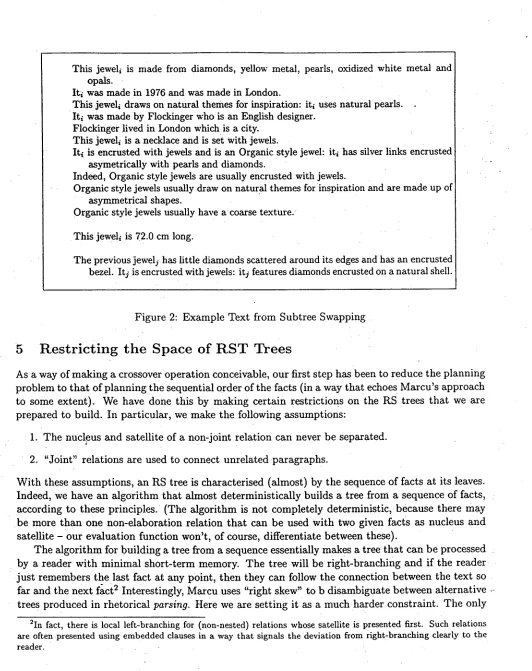
Figure 2 shows an example tex t generated by subtree swapping. Note that we have taken liberties in editing by hand the surface text (for instance, by introducing better referring expressions and aggregation). For clarity, coreference has been indicated by subscripts. The ordering of the material and the use of rhetorical relations "are the only things which are determined by the algorithm.
Results for subtree swapping are shown together with later results in Figure 5 (the example text shown for subtree swapping is for the item n a m e d j-342540). The most obvious feature of these results is t h e huge variability of the results , which suggests that there are many local maxima in the search space. Looking at the texts produced, we can see a number of problems. If there is only • one way smoothly to include a fact in the text, the chance of finding it by random subtree swapping is very low. The Same goes for fixing other local problems in the text. The introduction of "the previous jewel" is an example of this. This entity can only be introduced elegantly through the fact that it, like the current item, is encrusted with jewels. The text is also still suffering from material getting between a satellite and its n u c l e u s . For instance, there is a relation (indicated by the colon) between "It is encrusted with jewels" and "it has silver links encrusted asymmetrically...", but this is weakened by the presence of "and is an Organic style jewel" in the middle).
T h e trouble is that subtree swapping needs incrementally to acquire all good features not present in whichever initial tree develops into the best solution. It can only acquire these features "acCidentally" a n d the chances of stumbling on them are small. Different initial trees will contain • different good fragments, and i t seems desirable t o be able to combine the good parts of different • solutions. This motivates using some sort of
Crossover
operation that can combine elements of two solutions into a new one [Goldberg 89]. But it is not immediately clear how crossover could work on two RS trees, tn particular, two chosen trees will rarely have non-trivial subtrees with equal fringes. Their way of breaking up the material may be so different t h a t it is hard to imagine how one could combine elements of b o t h .i .- ! ! i
I
• : 'i
I
,I
I
I
[l
!1
I
I
I
i
I
This jewel/ is made from diamonds, yellow metal, pearls, oxidized white metal and opals.
It~ was made in 1976 and was made in London.
This jewe4 draws on natural themes for inspiration: itl uses natural pearls. I t i was made by Flockinger who is an English designer.
Flockinger lived in London which is a city. This jeweli is a necklace and is set with jewels.
Iti is encrusted with jewels and is an Organic style jewel: iti has silver links encrusted asymetrically with pearls and diamonds.
Indeed, Organic style jewels are usually encrusted with jewels.
Organic style jewels usually draw On natural themes for inspiration and are made up of asymmetrical shapes.
Organic style jewels usually have a coarse texture. • This jewel/is 72.0 cm long.
The previous ]ewelj has little diamonds scattered around its edges and has an encrusted bezel. Itj is encrusted with jewels: itj features diamonds encrusted on a natural shell.
Figure 2: E x a m p l e Text from S u b t r e e Swapping
5
R e s t r i c t i n g t h e Space of R S T Trees
As a way of making a crossover operation conceivable, our first step has been to reduce the planning p r o b l e m to t h a t of planning the sequential order of the facts (in a way that echoes M a r c u ' s approach to some extent). We h a v e done this by making certain restrictions on the RS trees t h a t we a r e prepared to build. In particular, we make the following assumptions:
• 1. The nucleus and satellite of a non-joint relation can never b e separated. 2. "Joint" relations are used to connect unrelated paragraphs.
W i t h these a s s u m p t i o n s , an RS tree is characterised (almost) by the sequence of facts at its leaves. Indeed, we have an algorithm that almost deterministically builds a tree from a sequence of facts, according to these principles. • (The algorithm is not completely deterministic, • b e c a u s e there m a y b e more t h a n one non-elaboration relation t h a t can b e used with two given facts as nucleus a n d
satellite - our evaluation function won't, of course, differentiate between these).
T h e algorithm for building a tree from a sequence essentially makes a tree t h a t can b e processed by a reader w i t h minimal s h o r t - t e r m memory. T h e tree will be right-branching a n d if the reader j u s t r e m e m b e r s t h e last fact at any point, then they can follow the connection b e t w e e n the text so
far and the next fact 2 Interestingly, Marcu uses "right skew" to b disambiguate b e t w e e n alternative ~- tree s p r o d u c e d in rhetorical
parsing.
Here we are setting it as a much harder constraint. T h e only2In fact, there is local left-branching for (non-nested) relations whose satellite is presented first. Such relations are often presented using embedded clauses in a way that signals the deviation from right-branching clearly to the reader.
[image:6.612.42.574.51.722.2]exception is "joint" relations, which can join together texts of any size, but since there is no r e a l relation involved in t h e m there is no m e m o r y load in interpreting them.
T h e first two a s s u m p t i o n s above make fundamental use of the order in which facts will a p p e a r i n t h e text. For simplicity, we assume t h a t every relation has a fixed order Of nucleus a n d satellite ( t h o u g h this a s s u m p t i o n could be relaxed). T h e a p p r o a c h i s controversial in t h a t it takes into account realisati0n order in t h e criterion for a legal tree. It is likely t h a t the above assumptions will not apply equally well to all types of text. Still, they mean t h a t t h e p l a n n i n g p r o b l e m can :be reduced t o t h a t of planning a sequence. T h e next experiments were an a t t e m p t to evaluate this idea.
•
6
U s i n g a G e n e t i c A l g o r i t h m
T h e genetic algorithm we used takes the following form:
1. E n u m e r a t e a set of r a n d o m initial sequences by loosely following sequences of facts w h e r e consecutive facts m e n t i o n t h e same entity.
2. Evaluate sequences by evaluating t h e trees they give rise to.
- 3. P e r f o r m m u t a t i o n a n d crossover on the sequences, with m u t a t i o n • having a relatively small probability.
4. W h e n t h e "best'/ sequence has not changed for a time, invoke m u t a t i o n r e p e a t e d l y until it does.
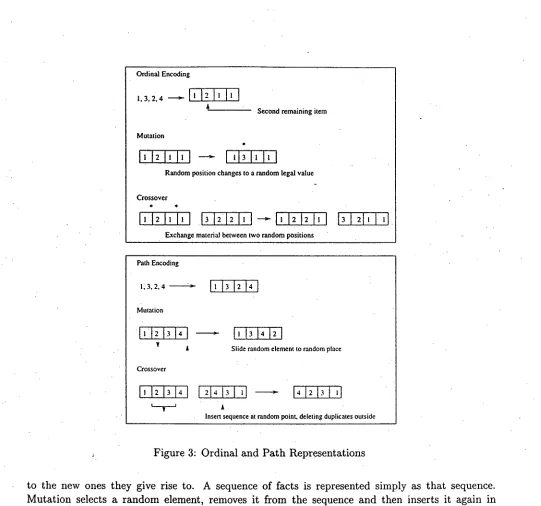
5. Stop after a given n u m b e r of iterations, and r e t u r n the tree for the "best"• sequence. Notice t h a t a l t h o u g h the algorithm m a n i p u l a t e s sequences, the evaluation is one that operate s on trees. M u t a t i o n is a unary operation which, given one sequence, generates a new one. Crossover is binary in t h a t it generates new solution(s ) b a s e d on two existing ones. T h e choice of m u t a t i o n a n d crossover operations depends on how t h e sequences are internally represented and should facilitate t h e exchange of useful subparts of solutions. Two different representations have been tried so far.
T h e relevant features are summariSed in Figure 3. 6 . 1 O r d i n a l R e p r e s e n t a t i o n
T h e ordinal r e p r e s e n t a t i o n [Michalewicz 92] assumes t h a t ~ there is a n initial canonical sequence of facts (in t h e figure, this is assumed to be 1,2,3,4). A given sequence is represented by a sequence of numbers, where the i t h element indicates the position of the i t h element of the sequence in t h a t canonical sequence with all previous elements deleted. So the i t h element is always a n u m b e r b e t w e e n 1 a n d n + 1 - i, w h e r e n is t h e length of the sequence. M u t a t i o n is i m p l e m e n t e d by a change of a r a n d o m element to a r a n d o m legal value. •Crossover (here) is i m p l e m e n t e d by two-point crossover - t h e material between two r a n d o m points •of the sequences (the same points for b o t h ) i s swapped over, yielding two new sequences. T h e ordina ! representation has been used extensively for tasks s u c h a s t h e travelling salesman p r o b l e m , and it has the advantage t h a t t h e c r o s s o v e r operation is particulariy simple.
6 . 2 P a t h R e p r e s e n t a t i o n
in m a n y ways, this is a more obvious encoding, t h o u g h t h e operations are chosen t o reflect the. ' intuition t h a t order and adjacency information should generally be m a i n t a i n e d from old solution(s)
.104
I
i
I
I
I
I
!1
it
!1
!1
|
Ordinal Encoding
1.3.2.,
, I112 II I1 I
Second remaining item
Mutation
111211111 " li1311111
Random position changes to a random legal value
Crossover
. e,,
I112 I1 I1 I •1312•12 I1 I--'-I11212 II I
Exchange material between two random positions
131211
II
Path Encoding
I;3,2,4
Mutation
111213 I, I
v
A
Crossover
•
Ill 1312t,1
II 13 It 12 I
Slide random element to random place
121~ 13 I11
"
I~ 12 13 Ill
1
Insert sequence at random point, deleting duplicates outside
Figure 3: Ordinal and P a t h Representations
to the new ones they give rise to. A sequence of facts is represented simply as that sequence. Mutation selects a r a n d o m element, removes it from the sequence and then inserts it again in a r a n d o m place. Crossover inserts a r a n d o m subsequence of one solution into another, d e l e t i n g duplicates t h a t occur outside the inserted subsequence.
6 . 3 R e s u l t s
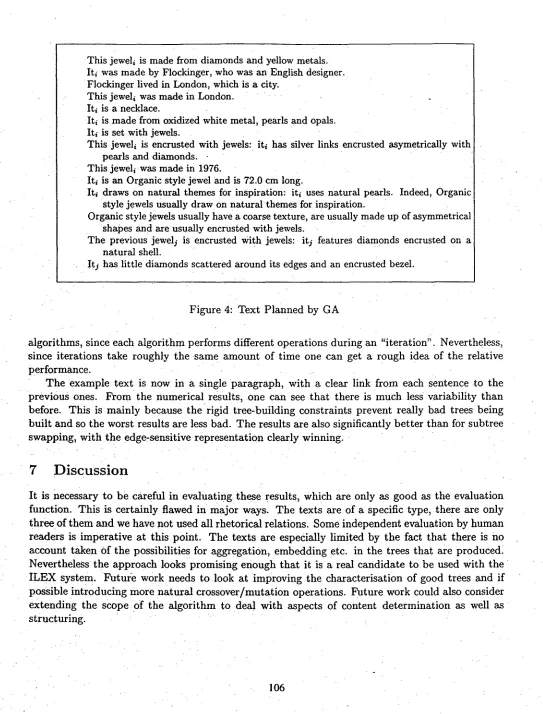
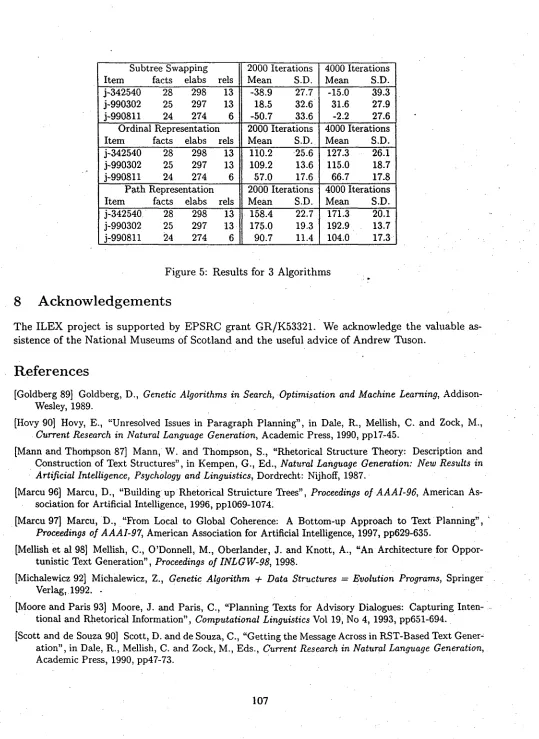
• Figure 4 shows an example text produced using the p a t h encoding operations (for j - 3 4 2 5 4 0 , after 2000 iterations, j u s t under 2 minutes, score I80). T h e same remarks about hand editing apply as before. Figure 5 summarises the results for subtree swapping and the two genetic algorithms on a set of examples. These results summarise the mean a n d standard deviations of the scores of t h e system r u n 10 times. T h e system was tried with a limit of 2000 and 4000 •iterations around the main l o o p of the algorithm. These took about 2 and 4 minutes respectively. W i t h each example problem we have specified the number of facts, the n u m b e r of elaboration relations and the n u m b e r of non-elaboration relations. Note t h a t there is not a very clear basis for comparison between
[image:8.612.37.578.36.542.2]T h i s jewel/is made from diamonds and yellow metals. I t / w a s made by Flockinger, who was an •English designer. • Flockinger lived in London, which is a city.
This jeweli was made in London. I t / i s a necklace.
Iti is made from oxidized white metal, pearls and opals. I t / i s set with jewels.
This jewel/ is encrusted with jewels: it/ has silver links encrusted asymetrically with pearls and diamonds. -
This jewel/was made in 1976.
Iti is an Organic style jewel and is 72.0 cm long.
Iti draws on natural themes for inspiration: it/ uses natural pearls. Indeed, Organic style jewels usually d r a w on natural themes for inspiration.
Organic style jewels usually have • a coarse texture, are usually made up of asymmetrical • shapes and are usually encrusted with jewels.
The • previous jewelj is encrusted With jewels: itj features diamonds encrusted on a natural shell.
. Itj has little diamonds scattered around its edgesand an encrusted bezel.
Figure 4: Text P l a n n e d by GA
algorithms, since each a l g o r i t h m p e r f o r m s different operations during an "iteration". Nevertheless, since iterations take roughly t h e s a m e a m o u n t of time one can get a rough idea of t h e relative
performance.
T h e •example t e x t is now in a single p a r a g r a p h , w i t h a clear link from each sentence t o t h e • previous ones. F r o m t h e numerical results, o n e can see t h a t there is imuch less variability t h a n before. This is m a i n l y because t h e rigid tree-building constraints prevent really bad trees • being built a n d so t h e worst results are less bad. T h e results are also significantly b e t t e r t h a n for s u b t r e e swapping, w i t h t h e edge-sensitive r e p r e s e n t a t i o n clearly winning. •
7
D i s c u s s i o n
I t is necessary to be careful in e v a l u a t i n g : t h e s e results, which are 0nly as g o o d as t h e evaluation function. This is c e r t a i n l y flawed in m a j o r ways. T h e texts are of a specific type, t h e r e are only t h r e e of t h e m a n d we have not used all rhetorical relations. Some i n d e p e n d e n t evaluation by h u m a n r e a d e r s is i m p e r a t i v e at this point. T h e t e x t s a r e especially limited by t h e fact t h a t t h e r e is no a c c o u n t taken Of t h e possibilities for aggregation , •embedding etc. in t h e trees t h a t are produced: NevertheleSs • t h e a p p r o a c h looks promising e n o u g h t h a t it is a real c a n d i d a t e t o be used with t h e I L E X syste m. F u t u r e work n e e d s to l o o k at i m p r o v i n g t h e c h a r a c t e r i s a t i o n o f good trees a n d if possible •introducing m o r e n a t u r a l c r o s s o v e r / m u t a t i o n operations. F u t u r e work could also consider e x t e n d i n g t h e scope o f t h e a l g o r i t h m to deal w i t h aspects of content d e t e r m i n a t i o n as well as• s t r u c t u r i n g .
106
I
I
!l
i
il
,I
i
i
!
]
! . ~
!
it
[image:9.612.31.574.51.765.2]Subtree Swapping 2000 Iterations 4000 Iterations Item facts elabs rels Mean S.D. Mean S.D.
j-342540 28 298 13 -38.9 27.7 -15.0 39.3
j-990302 25 297 13 18.5 32.6 31.6 27.9
j-990811 24 274 6 -50.7 33.6 -2.2 27.6
Ordinal Representation 2000 Iterations 4000 Iterations Item facts elabs rels Mean S.D. Mean S.D.
j-342540 28 298 13 110.2 25.6 127.3 26.1
j-990302 25 297 13 109.2 13.6 115.0 18.7
j-990811 24 274 6 57.0 17.6 66.7 17.8
Path Representation 2000 Iterations 4000 Iterations Item facts elabs rels Mean S.D. Mean S.D.
j-342540 28 298 13 158.4 22.7 171.3 20.1
j-990302 25 297 13• 175.0 19.3 192.9 13.7
j:990811 24 274 6 90.7 11.4 104.0 17.3
Figure 5: Results for 3 Algorithms •.
8
A c k n o w l e d g e m e n t s
T h e ILEX project is supported by E P S R C grant GR/K53321. We acknowledge the valuable as- sistence of the National Museums of Scotland and the useful advice of Andrew Tuson.
References
[Goldberg 89] Goldberg, D., Genetic Algorithms in Search, Optimization and Machine Learning, Addison- Wesley, 1989.
[Hovy 90] Hovy, E., "Unresolved Issues in Paragraph Planning", in Dale, R., Mellish, C. and Zock, M.,
• Current Research in Natural Language Generation, Academic Press, 1990, pp17.45.
[image:10.612.43.582.36.775.2][Mann and Thompson 87] Mann, W. and Thompson, S., "Rhetorical Structure Theory: Description and Construction of Text Structures", in Kempen, G., Ed., Natural Language Generation: New Results in Artificial Intelligence, Psychology and Linguistics, Dordrecht: Nijhoff, 1987. •
[Marcu 96] Marcu, D., "Building up Rhetorical Struicture Trees", Proceedings of AAAI-96, American As- sociation for Artificial Intelligence, 1996, pp1069-1074:
[Marcu 97] Marcu, D . , "From Local to Global Coherence: A Bottom-up Approach to Text •Planning",
Proceedings of AAAI-97, American Association for Artificial Intelligence, 1997, pp629-635.
[Mellish et a198] Mellish, C., O'Donnell, M., Oberlander, J. and Knott, A., "An Architecture for Oppor- tunistic Text Generation", Proceedings of INLGW-98, 1998.
[Michalewicz 92] Michalewicz, Z., Geneti c Algorithm 4- Data Structures = Evolution Programs, Springer Verlag, 1992. -
[Moore and Paris 93] Moore, J. and Paris, C., "Planning Texts for Advisory Dialogues: Capturing Inten .... tional and Rhetorical Information", Computational Linguistics Vol 19, No 4, 1993, pp651-694.
[Scott and de Souza 90] Scott, D. and de Souza, C., "Getting the Message Across in RST-Based Text Gener- ation", in Dale, R., Mellish, C. and Zock, M., Eds., Current Research in Natural Language Generation,
Academic Press, 1990, pp47-73.