This qualitative exploratory case study examined follower perceptions of leader behaviors in the pharmaceutical and biotechnology industry. An existing model (Smollan and Parry, 2011) was used to understand how employees construct their perceptions of leader emotions, and how those emotions enhance or detract from the workplace. The study
contributes a qualitative analysis to the research on Emotional Intelligence, which is predominately quantitative in nature. There are no quantitative studies regarding follower perception and most quantitative studies have heavily relied upon self-reported measures.
Emotional Intelligence, the ability to monitor and discriminate between one’s own and others’ emotions, and to use the information to guide one’s thinking and actions (Salovey
and Mayer, 1990, p. 189) is a construct which has evolved since the 1920’s. While the area of Emotional Intelligence (EI) has evolved, currently, little exists in the form of qualitative research. Furthermore, specific research tailored towards leadership lacks within the pharmaceutical and biotechnology industry.
The research participants included four individuals in non-leadership roles within the pharmaceutical and biotechnology industries. In-depth interviews were conducted to better understand how individuals form perceptions regarding leadership EI. A qualitative model constructed by Smollan and Parry (2011) was adapted to include elements related to
communication (both verbal and non-verbal), accountability, and behavioral patterns. Colleague support and relationships along with reflection were additional themes uncovered through the open coding process.
Overall, employees preferred to engage with leaders whom they perceived to be emotionally intelligent. Perceptions were formed through interaction and observing outward behavioral patterns. Through better understanding current employee perceptions on
by
Lisa Marie Smith
A thesis submitted to the Graduate Faculty of North Carolina State University
in partial fulfillment of the requirements for the degree of
Master of Science
Human Resource Development
Raleigh, North Carolina 2013
APPROVED BY:
_______________________________ ______________________________ Dr. Bradley Mehlenbacher Dr. Diane Chapman
Committee Member Committee Member
DEDICATION
I am dedicating this work to my family and the faculty at North Carolina State for their support. My parents and husband always had a profound commitment to my
BIOGRAPHY
Lisa Marie Smith graduated from Penn State Behrend with a B.A. in Communication and Media Studies in 2008. Since graduating, she has served in progressive human resource development roles which have allowed her to create and implement new strategies to
increase organizational effectiveness. Currently, she serves as an Organizational
Development Manager at Pharmaceutical Calibrations and Instrumentation, LLC in Raleigh, North Carolina.
Since going back in the summer of 2010 to work towards an M.S. in Human
Resource Development, Lisa has been heavily involved in developing her current work team and organization as well as becoming more involved in national HRD conference events. Lisa’s contributions range from presentations and research on 21st
century leaders, mental models, social capital, and emotional intelligence. Furthermore, she serves on North Carolina State University’s board for the Golden Key International Honor Society.
TABLE OF CONTENTS
LIST OF TABLES ... vii
LIST OF FIGURES ... viii
CHAPTER ONE: INTRODUCTION ...1
Background and Context ...1
Statement of Problem and Purpose ...3
Study Context ...5
Research Questions ...5
Significance ...6
Theoretical Framework ...6
Method Overview ...8
Definition of Key Terms ...10
CHAPTER TWO: LITERATURE REVIEW ...12
Evolution of EI ...12
Leadership and EI Competencies ...14
Empirical Work: A Historical View ...23
Summary ...37
CHAPTER THREE: METHODS ...40
Overview of Methods ...40
Data Collection Methods ...41
CHAPTER FOUR: FINDINGS ...48
Participant Recruitment ...48
Findings ...49
Mechanism #1: Perception of Leader Competence ...52
Mechanism #2: Perception of Leader Communication ...54
Mechanism #3: Perception of Leader Accountability and Support ...57
Emergent Themes: Mechanisms of Employee Reflection and Team Orientation ...62
The Role of Reflection in Perception of Leaders ... 63
The Role of Team Members ...65
Valuable Approaches ...66
Summary ...68
CHAPTER FIVE: DISCUSSION AND RECOMMENDATIONS ...71
Overview ...71
Recommendations for Future Research ...73
Recommendations for Practice ...75
Summary ...77
REFERENCES ...79
APPENDICES ...84
Appendix A: Recruitment Email ...85
LIST OF TABLES
Table 2.1. A Framework of Emotional Competencies ...17
Table 2.2. Core Value in Successful Leadership ...19
Table 2.3. Emotional Intelligence Studies with Corresponding Context and Methods ...38
Table 4.1. Participant Demographics ...49
Table 4.2. A Priori Coding Results ...51
Table 4.3. Mechanisms of Employee Perception Formation ...62
LIST OF FIGURES
CHAPTER 1: INTRODUCTION Background and Context
There has been a growing awareness that emotions are an important leadership quality (Callahan, 2008). Take, for example, a real situation described by Ruderman, Hannum, Leslie and Steed (2001) in their study on emotional intelligence. In this situation, Stuart (the name was changed to protect the employee), possessed intelligence and strategic thinking abilities that got him promoted into a leadership position at a top pharmaceutical company. However, despite his cognitive attributes, his work was suffering. Stuart, as perceived by those he leads, lacked empathy and compassion. He often lashed out at his direct reports, and he was not able to build trusting relationships with them. According to Ruderman et. al (2001), Stuart lacks the ability to understand himself and those around him; he lacks emotional intelligence. A term coined by Salovey and Mayer (1990), EI, or
emotional intelligence, is “the ability to monitor one’s own and others’ emotions, to
discriminate between them, and to use the information to guide one’s thinking and actions”
(p. 189).
well as EI, is of interest as these top employees influence the entire organization (Ryback, 1998).
According to Cherniss (2001), effective leaders are in control of their emotions that in turn allows employees to trust them and want to work with them. Daily events can trigger emotions which then flow throughout organizational networks. Emotions and moods are at the center of leader-follower relationships (Smollan & Parry, 2011). What is arguably needed is mutual loyalty—this derives from being emotionally intelligent (Ryback, 1998). According to Dearborn (2002), leaders need to understand how they are perceived by others in order to compare those perceptions to how they view themselves. Leaders, who are committed to adjusting their approach, engage and want to learn to become a better leader in order to build connectedness within the organization (Dearborn, 2002).
Leaders serve as the emotional guide for a group where they facilitate the positive emotions and clear “the smog created by toxic emotions” (Goleman, Boyatzis, & McKee,
2002, p.5). Leaders can engage in resonance, which brings out positive emotions by bringing out the best in people, or dissonance, where they engage in displaying negative emotions which undermines that which allows individuals to shine (Goleman et al., 2002). When leaders are able to manage and distinguish their emotions, they are able to engage in better decision making processes (George, 2000).
emotional intelligence and social intelligence. While organizations aspire to have adaptable and inspiring leaders, these leaders need ongoing development. The challenge is that leaders need to be accepting of EI due to how critical it proves to be for individual, team and
organizational development (Dearborn, 2002). Furthermore, training programs tend to be traditional in their approach and result in a dedication to new ways of leading but usually generate short spurts of energy followed by reverting to previous ways of operating (Dearborn, 2002).
Statement of Problem and Purpose
Most current research on EI has been conducted in educational contexts. Research on EI has generally not been focused on the pharmaceutical/biotechnology industry. One closely related study on leadership was identified, however. Speechly (2005) examined an
intervention in a global pharmaceutical company as a response to the realization that traditional leadership approaches were unable to equip leaders with the skills needed in today’s complex environment. Speechly (2005) came to understand that leadership
competencies and relationship building impact leadership competencies and effectiveness.. From this study it was clear that relationship building was a key indicator of an effective leader in a pharmaceutical company.
pharmaceutical/biotech industry being largely ignored in the EI research, as well as
leadership research, little is known about employee perceptions of leadership competencies in pharmaceutical/biotechnology organizations. This study will contribute to that gap.
Furthermore, previous studies on EI predominantly use quantitative approaches. There are very few qualitative studies in this area. While the quantitative measurements help explain how EI may impact leadership effectiveness, a qualitative approach would allow a researcher to understand a follower’s social interpretations of EI, rather than cognitive. Many researchers have called for a more nuanced examination of the different aspects of EI. For example, Mayer, Salovey, and Caruso (2008) suggested that EI is a prominent area to study but significant gaps remain in relation to understanding mental abilities which
contribute to identifying, understanding, managing, and using emotions. Most important for this study, Smollan and Parry (2011) acknowledged that current research has seldom
addressed the viewpoints subordinates have with regard to leadership EI. These researchers created a leader-follower model that compliments the quantitative instruments as one way to understand and delve deeper into EI. Taken together, it is clear that gaps exist in qualitative studies and leader-follower perceptions of EI. This qualitative study seeks to contribute to these gaps.
EI model in order to better understand employee perceptions of how leaders deal with emotion and how employees respond to the emotions exhibited by these leaders. Study Context
The Biotechnology industry is with a fast growing with growth rates totaling $63 billion in 2005 and projections showing $250 billion by the year 2015 in the United States (Bradfield & El-Sayed, 2009). The pharmaceutical and biotechnology industries are growing but are not without its own set of challenges. Previous and current research has focused on external challenges including more related to product development, liability, competition and public opinion (Bradfield & El-Sayed, 2009). However, despite the growth and research on external challenges, one organization’s CEO, Ralph Larson of Johnson & Johnson, said “Leadership is the biggest single constraint to growth at Johnson and Johnson and it is the most critical issue we face” (deMovile, 2007). A leadership session conducted by deMovile
(2007) which included top organizations such as Amgen, GSK, Pfizer, and Johnson & Johnson depicted that retention and development are key focus areas as companies are discovering a labor shortage with talent being traded from one company to another. Such pressures make current and future leadership development essential (deMovile, 2007). Research Questions
Research questions will help to guide and uncover the connections between employees, leadership and EI. The research questions are as follows:
Significance
In addition to contributing to the gaps identified earlier, this study can contribute to HRD practice and scholarship in a variety of ways. Smollan and Parry (2011) believe exploring what influences follower perceptions needs to be further studied to connect the underlying factors which contribute to employee/leader relationships. Uncovering employee perceptions and understanding how they are influenced will allow for specific training programs to be designed to support EI development initiatives.
While leaders realize they must manage their emotions the process can be difficult as it requires them to decide which emotional response to exhibit for varying circumstances and how the right level of expressiveness leads to desired effects (Humphrey, 2008). The ability to manage emotions may prove to be a key for success in the 21st century’s ever-changing environment (Callahan, 2008). A leader being aware of their emotions is a critical
determinant of how that leader will perform and how effective they are (Humphrey, 2008). Having employees reflect on their encounters with their own leaders will allow organizations to better understand the significance of EI and how to foster environments which support the development and execution of EI competencies.
Theoretical Framework
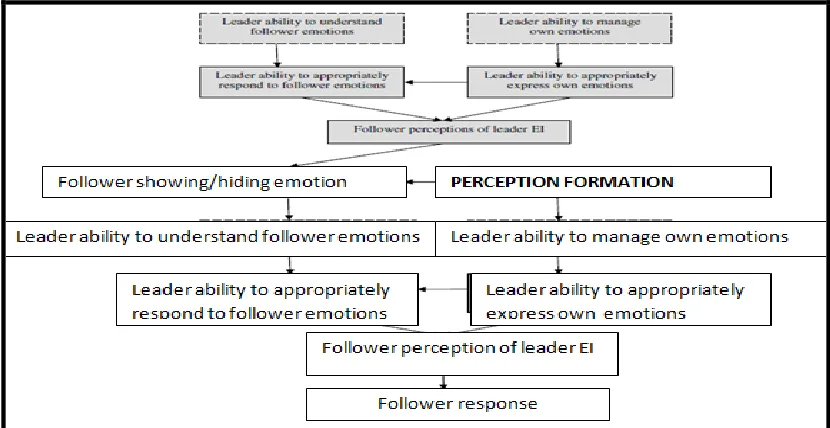
leader emotions (Figure 1.1). In Smollan and Parry’s (2011) research, the researchers focused on examining how perceptions were generated during a change.
This study focuses on how perceptions were generated during interactions at work. Specifically, this study adds eight elements to the Smollan and Parry (2011) model, as
illustrated in Figure 1.1 below. The white boxes have been re-constructed so they apply to EI and perception; not change. Figure 2.1 displays Smollan and Parry’s (2011) which includes a change event, follower showing/hiding emotion during change, leader ability to understand follower emotions during change, and leader ability to appropriately respond to follower emotions during change. The model also includes leader ability to manage own emotions during change, leaders ability to appropriately express own emotions during change, follower perception of leader EI during change, and follower responses to change (Smollan and Parry, 2011). These eight elements have been altered and change has been replaced with perception formation. Boxes that contained the word ‘change’ were reconfigured by removing the word ‘change’ and solely focusing on general words contained in the box. For example, Smollan and Parry’s (2011) follower ‘showing/hiding emotions during change’ now reads as
‘follower showing/hiding emotion.’ Also, Smollan and Parry’s (2011) main box within the model displaying ‘change event’ was changed to ‘perception formation’ for this study.
Figure 1.1 Model created focusing on how follower perceptions are formed with regard to leadership and emotional intelligence. White boxes indicate researcher additions as adapted from Smollan and Parry (2011).
Method Overview
proximity to the researcher’s place of employment which is convenient for gathering
participants. Also, individuals taking courses at BTEC are employed at pharmaceutical and biotechnology firms across the Raleigh Triangle area.
A case study approach will be employed to research a bounded system through detailed, in-depth interviews (Creswell, 2007). The purpose of interviewing is to be able to generate themes based on participant responses as to what competencies they find valuable in leaders and how these competencies can be tied back to EI. The intent of the study is not to generalize beyond the case (Creswell, 2007). Data will be collected through semi-structured interviews, and each participant will be considered a unique case for cross-case comparison. Data will be analyzed using two accepted qualitative methods. First, a priori coding will take place so findings from interviews can be tied back to the elements of the qualitative model. Here, the data will be coded using a select set of criteria as adapted from Smollan and Parry’s
2011 model created to explore follower perceptions of leaders during change. This analysis will help us understand the degree to which pharmaceutical and biotechnology employees understand EI in the same way the model describes EI. The second coding will contribute to the existing literature by adding to unexplored research areas and further Smollan and Parry’s model which focused solely on EI and change. The second coding scheme, open coding, will be used to understand from the participant’s own perceptions, how participants view EI
As with any study, situations of bias can be present. While many organizations exist to study in the Raleigh, NC area, the BTEC was selected because the researcher has utilized the organization in the past for employee training on FDA compliance and industry
knowledge. Furthermore, the researcher has established professional contacts working at the organization which help facilitate entry into the establishment. In an attempt to separate out personal bias, participants will be selected based on the first four to six participants who volunteer and meet the study criteria. The sample selection will be purposeful as to obtain the population of pharmaceutical/biotechnology employees who report to a leader in the industry.
Definition of Key Terms
Competency: A capability or ability; A behavioral approach to emotional social and cognitive intelligence (Boyatzis, 2008)
Dissonance: “Undermining the emotional foundations that let people shine” (Goleman et al., 2002)
Emotions: Intense feelings triggered by certain stimuli (Morris, 1989) Emotional Intelligence (EI): “The ability to monitor one’s own and others’
emotions, to discriminate between them, and to use the information to guide one’s thinking and actions” (Salovey and Mayer, 1990, p. 189)
Intelligences: Mental abilities (Mayer et al., 2008)
Self-awareness: A deep understanding of one’s emotions, strengths, weaknesses and drives (Goleman, 2004)
Self-regulation: Mastering emotions by choosing words carefully instead of rushing to emotion infused decisions (Goleman, 2004)
Social Intelligence: Ability to understand, manage and act wisely in human relations (Goleman, 2001)
Moods: Generalized feelings not tied to circumstances (Morris, 1989) Motivation: The desire to achieve (Goleman, 2004)
Empathy: Thoughtfully considering others feelings during the decision making process (Goleman, 2004)
Social skill: Friendliness with a purpose (Goleman, 2004)
Communication: Formal and informal means of sharing information; Creates links between people and processes (Callahan, 2008)
CHAPTER TWO: LITERATURE REVIEW Evolution of EI
One of the leading scholars on EI is Daniel Goleman. In his groundbreaking 2001 best seller, Dr. Goleman described the evolution of the concept of EI and its importance to today's business environment. Goleman (2001) traced the history of EI back to E.L.
Thorndike, an educational psychology professor who coined the term 'social intelligence' in the 1920s which he defined as the ability to understand, manage, and “act wisely” in human relations (Goleman, 2001). Thorndike, being the first to identify social intelligence, an aspect of EI, reviewed the George Washington Social Intelligence Test which measured individual judgment in social situations and the ability of one to identify emotion and
expression (Goleman, 2001). What Thorndike went on to find out was that trying to measure how individuals deal with and interact with one another failed due to the complexity of abilities, habits and attitudes (Goleman, 2001). Following Thorndike, Howard Gardner in 1983 looked at multiple intelligence which incorporated personal, interpersonal and
intrapersonal domains and helped to further the role of EI (Goleman, 2001). Gardner (2000) believes all human beings have eight to nine intelligences but no two people share the same strengths and weaknesses. For example, linguistic, logical, kinesthetic, and intrapersonal can be intelligences but no two people will have the same strength and weakness level; not even identical twins (Gardner, 2000). Gardner’s multiple intelligence theory contributes to EI as it
In 1988, Reuven Bar-On first measured well-being in relation to EI and expanded previous studies by defining it as emotional and social knowledge that influence our ability to cope with the demands of our environment (Goleman, 2001). EI went on to include the ability to be aware of oneself, relate to others, deal with emotion and adapt to change, and solve problems (Goleman, 2001). Goleman helped to establish the importance of EI as a basic component for the effective use of one’s IQ (Lantieri & Nambiar, 2012). Peter Salovey
Leadership and EI Competencies
Goleman (2004), a critical scholar in the field of EI, believes while leaders differ in their approach, the most effective leaders are alike in that they all have a high degree of emotional intelligence. Through his studies, he determined that while IQ is important, five components EI leaders acquire is beginning to be linked directly to company success. Self-awareness, the first component of EI, means having a deep understanding of one’s emotions,
strengths, weaknesses and drives (Goleman, 2004). Identifying one’s own feelings is the foundation for effectively managing these emotions (Callahan, 2008). Individuals who have a high degree of self-awareness understand how their feelings affect them, their performance on the job and others around them. Self-aware people are comfortable and accepting of constructive criticism and have a grasp on what they are capable of and when to ask for help. The second construct, self-regulation, helps individuals choose their words carefully instead of rushing to emotion infused decisions. Goleman (2004) feels self-regulation often follows a trickle down pattern because if fewer bad moods and hasty decisions are made at the top, there will be fewer throughout the organization. Furthermore, people who master their emotions by applying self-regulation are able to more readily accept change by listening and researching before jumping to a conclusion.
decision making process. Empathy begins with listening to establish a connection between individuals (Magnat, 2012). Empathy is important as many organizations are becoming more team oriented and teams must be able to fully understand and be open-minded when
individual viewpoints are shared. Finally, social skill, is “friendliness with a purpose,” and it is used to build relationships and contribute to effectively managing teams (p. 102). Formal and informal systems of communication are needed for organizations to function effectively and it is the key to bringing people together (Callahan, 2008). Self-awareness,
self-regulation and motivation are self-managed skills and empathy and social skill deal with an individual’s ability to manage relationships. Collectively, all are not just desired but needed
in conjunction with EI.
Empathy can be achieved in a variety of ways but the most common is through sensitivity training where people learn to be more aware of the feelings, needs and concerns of others (Cherniss & Goleman, 2001). Finally, social skills can be achieved through engaging in role-plays, receiving feedback on one’s performance in the role play, and obtaining assistance
with improving on any noticeable problems (Cherniss & Goleman, 2001). Listening, communicating clearly, and making an effort to forge strong relationships helps support the development of social and relationship skills (Lantieri & Nambiar, 2012). While there is not a one size fits all approach to furthering an individual’s EI abilities, techniques can be
utilized to enhance the core competencies of leaders.
Table 2.1 A framework of emotional competencies by D. Goleman, 2001, Issues in Paradigm Building, p. 28. Copyright 2001 by Jossey-Bass.
Self
Personal Competence
Other
Social competence Recognition Self-Awareness
Emotional self-awareness Accurate self-assessment Self-confidence Social Awareness Empathy Service orientation Organizational awareness
Regulation Self-Management Self-control Trustworthiness Conscientiousness Adaptability Achievement drive Initiative Relationship Management Developing others Influence Communication Conflict management Leadership Change catalyst Building bonds
Teamwork & collaboration
standards and drive but often critique those who do not meet the standards (Goleman, 2001). Combining leadership styles interweaves a range of EI competencies which has a prominent affect on organizational climate and performance (Goleman, 2001).
Empirical research has shown IQ is limited in predicting the success of individuals but there is little good research which exists on comparing the power of IQ and EI (Cherniss, 2001). According to Goleman (2001) early studies measuring IQ and EI range from 0 to .36 depending on measures used and IQ is best used to help determine what type of job an individual obtains. EI is responsible for approximately 80 to 90 percent of competencies that distinguish outstanding leaders from those who are average (Goleman et al., 2002). EI goes beyond the surface to uncover meaning and direction throughout organizations.
The case for strong leadership with high levels of emotional intelligence in the 21st century is present and studies must be done to ensure leaders, especially in the
pharmaceutical/biotech industry are equipped for the shifting corporate landscape. As the corporate landscape shifts due to outsourcing, competition and the acceleration of
technology, the mind can no longer be seen as the main quality of leadership because as Ryback (1998) states, “What we need is a finely tuned combination of mind and heart” (p. 2).
Social and psychological processes are evoked in subordinates which in turn affects their assessment of their leader so leaders need to be aware of how they exhibit their own emotions affects emotions with those they encounter (Rajah, Song & Arvey, 2011).
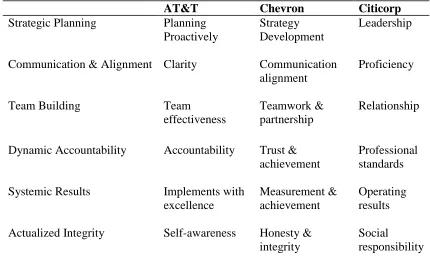
Citicorp, G.E., Honeywell and Pepsi have established seven core qualities for leadership (Table 2.2). Strategic planning, communication and alignment (individual empowerment), team building, continuous learning, accountability, systemic results and actualized integrity (customer awareness and values) have positioned leaders to operate beyond IQ (Ryback, 1998). In order for executive leadership to impact their organization and employees in a meaningful way, certain attributes need to be showcased. Each attribute can be further connected to Goleman’s EI competencies of self-awareness, self-regulation, motivation,
empathy and social skill.
Table 2.2 Core values in successful leadership by D. Ryback, 1998, Putting Emotional Intelligence to Work, p. 7. Copyright 1998 by Butterworth-Heinemann.
AT&T Chevron Citicorp
Strategic Planning Planning Proactively
Strategy Development
Leadership
Communication & Alignment Clarity Communication alignment
Proficiency
Team Building Team
effectiveness
Teamwork & partnership
Relationship
Dynamic Accountability Accountability Trust & achievement
Professional standards Systemic Results Implements with
excellence
Measurement & achievement
Operating results Actualized Integrity Self-awareness Honesty &
integrity
Social
Table 2.2 Continued
The first attribute, a nonjudgmental attitude, means that leaders look at each person for who they are as they showcase respect, openness and support (Ryback, 1998).
Additionally, Ryback (1998) believes perceptiveness, or helping others understand
themselves, is a needed competency as it allows leaders to see how others view them through listening. Another component which supports leader authenticity is sincerity, or honesty through articulating feelings, which helps to resolve conflict through thoroughly
understanding facts. Leaders can gain support by being aware of how their employees feel and engaging in EI as positive EI will result in mirroring of positive emotions from both
G.E. Honeywell Pepsi
Strategic Planning Initiative/speed Strategic Thinking Thinking outside the box
Communication & Alignment Communication/ influence
Communication Alignment
Team Building Team builder Teamwork &
cooperation
Team leadership Continuous Learning Knowledge/expe
rtise
Personal mastery Intellectual curiosity Dynamic Accountability Accountability/c
ommitment
High professional standards
Professional maturity
Systemic Results Influence Execution Organizatio
leaders and employees (George, 2000). Openness and accepting personal responsibility is the fourth trait and leaders who display such qualities are available to deal with pressing issues, listen to individuals involved and facilitate to come to an effective and quick resolution (Ryback, 1998). The fifth concept, relevance, focuses on challenges at hand and bringing individuals together to surface the truths in a situation (Ryback, 1998).
Expressiveness encourages a strong group identity by selectively sharing personal feelings and emitting a warm presence to engage others and supportiveness, where leaders make employees feel significant by acknowledging their own attributes and value are additional competencies (Ryback, 1998). Feelings of anger should also be expressed when necessary so leaders are not undermined and are seen as insincere but show loyalty and support to come through to others as a figure who understands (Ryback, 1998). In a
quantitative study conducted by Ford and Tamir (2012), they found people who prefer to feel useful emotions, even when they are unpleasant, are higher in EI. Anger, while typically labeled as a negative emotion, can serve leaders well as wanting to feel good at all times does not always prove to be an intelligent choice (Ford & Tamir, 2012). Boldness, the eighth element, issues are addressed before other notice them, nonsense is avoided, and responses are clearly described to those involved (Ryback, 1998). Following Boldness is zeal. Zeal is exhibited by leadership to show their subordinates that they are involved and enjoy making things happen, even when times are challenging (Ryback, 1998). Boldness and zeal are two emotions which are positive or negative emotions resulting from a cognitive thought
helps the leader gain credibility and support when it comes to executing corporate goals (Ryback, 1998). Self-assurance is the final element and leaders who exhibit this quality is confident in their approaches, communicate effectively and support others Ryback, 1998). Leaders who address their own emotions through self-regulation first are better able to manage subordinate and group emotions (Rajah et al., 2011).
Collectively, these ten qualities make emotionally intelligent leaders who are respected and successful in the minds of their peers and employees. Though not easy, as leaders reflect on themselves and their approaches, EI constructs can be further developed and present in their everyday lives. Organizations today value leaders who foster
relationships and make well-rounded decisions infused with applicable emotion and energy (Ruderman et al. 2001). Studies conducted which examine leadership and emotions helps to understand how to better construct quality leader-member relationships through the
regulating of emotions (Rajah et al., 2011).
The hierarchal model of leadership is no longer effective and leaders must focus on forming relationships, controlling impulses and better understanding their own strengths and weaknesses (Ruderman et al., 2001). Leadership abilities are often questioned if one does not surface opinions other than their own and makes those around them feel uncomfortable or inferior and today’s organizations need people who lead with the group’s needs at the
Empirical Work: A Historical View
Emotional Intelligence has evolved over the years to include a multitude of instruments and empirical research. Emotional intelligence looks at people’s cognitive
capabilities and how these competencies are influenced and managed by emotions (George, 2000). As EI has evolved, so has the connection between EI and leadership. As a study done at Massachusetts General Hospital at Harvard Medical School suggests, if leaders showcase positive moods, it spreads to others and enhances performance while those leaders who exhibit negative moods contribute to suffering performances (Goleman, 2011). According to Goleman (2011), when leaders and employees interact, the spreading of moods operates “Automatically, instantly, unconsciously and outside of our intentional control” (p. 56). The
Massachusetts General Hospital study videotaped doctors and patients during a
psychotherapy session and instructed patients to distinguish those moments where they believed empathy was present (Goleman, 2011). The results determined that patients felt connections with their doctor when their physiologies were synchronized and doctors established rapport with their patient (Goleman, 2011). Rapport was established by paying attention and avoiding distractions, being non-verbally in synch, and interpersonal positive feelings (Goleman, 2011).
studied to determine what happens as people interact (Goleman, 2011). Mirror neurons, or those which map sensations throughout the body has been compared to something similar to ‘Wifi’ which connects two brains together (Goleman, 2011, p. 54). In a study done where
negative performance feedback was given but in a warm manner, employees came out of the review feeling good overall (Goleman, 2011). On the other hand, when employees were given positive feedback in a cold manner, employees left the meeting feeling negative due to the emotions exhibited during the interaction (Goleman, 2011).
Ultimately, the brain activates neurons which shape how we see a person’s emotions,
movements and intentions (Goleman, 2011). Previous psychology studies have been done where two strangers stare at one another in a lab, sit in silence, and fill out a mood checklist for a two minute period (Goleman, 2011). The result: Emotions of the most expressive person are transmitted to the other person even without words being spoken (Goleman, 2011).
An empirical study conducted by Sosik and Megerian contribute to the research pool by measuring leadership behavior. Sosik and Megerian (1999) received 255 questionnaires back which they sent to 294 individuals. 192 subordinate and 63 manager surveys were reviewed to assess leader behavior and subordinate perceptions (Sosik & Megerian, 1999). Nine measures of EI were included such as self-awareness, self-motivation, empathy, relationship management, and self-monitoring (Sosik & Megerian, 1999). Each was
monitored using a variety of different scales constructed over the years such as Crumbaugh’s
the Multifactor Leadership Questionnaire (Sosik & Megerian, 1999). While their results were more focused on transformational leadership, or leaders who arouse feelings using emotion in their followers, they also were able to connect significant outcomes to emotional intelligence. The results showed self-awareness to be the basis on EI and leaders with higher levels of self-awareness have more self-confidence and are better able to effectively lead their followers (Sosik & Megerian, 1999). Sosik and Megerian (1999) suggest for human resource professionals to consider EI competencies when determining promotions into leadership roles and training programs should be implemented to enhance current and future leader’s EI as they impact subordinate perceptions and relationships.
showed a correlation between a leader’s ability to perceive and understand emotion (Rosete
& Ciarrochi, 2005).
Through a regression analysis, perceiving emotion emerged as the strongest predictor of leadership effectiveness and EI is separate from personality factors, as indicated in one of their hypotheses (Rosete & Ciarrochi, 2005). Overall, their findings suggest that executives with high levels of EI are more EIuipped to achieve business goals and be considered as effective by their subordinates and manager (Rosete & Ciarrochi, 2005). While they note a potential limitation is their small sample size, the implications are important because if a leader only develops outputs but is ineffective at managing their subordinates,
underperformance and turnover will be the result (Rosete & Ciarrochi, 2005).
Another striking finding was that the executives studied had higher IQs than the average adult population which may help to initially get into a leadership position but that IQ does not determine whether they will be successful or not (Rosete & Ciarrochi, 2005). Rosete and Ciarrochi’s point can be further supported by Goleman et al. (2002) who noted
Emotional Intelligence and Organizational Learning in Work Teams by Rajashi Ghosh, Brad Shuck and Joseph Petrosko (2012) state that through their research on prominent scholars like Goleman, Salovey and Nafukho, EI is described as a strategy for improving work behavior, human interaction and leadership. Their focus is on the ability of individuals to manage their emotions while respecting, being aware and managing other team member emotions (Ghosh et al., 2012). Based on the fact emotionally intelligent people can regulate their emotions, the researchers undertake a study of forty-eight people currently engaged in projects within their organization spread across non-profit, construction, real estate, marketing and banking industries (Ghosh et al., 2012). The majority of respondents had more than 10 years of work experience and held a Bachelor or Master’s Degree (Ghosh
et al., 2012). The Workgroup Emotional Intelligence Profile (WEIP-3), a sixteen item tool, was used to measure individual EI perceptions on situated work teams and by running a correlation, Ghosh et al., (2012) determined there was a significant relationship between EI and team learning. Furthermore, EI was associated with being able to manage emotions, being more reflective of other’s emotions and helped build an open environment where members could freely share their feelings (Ghosh et al., 2012).
While Ghosh et al., (2012) provide research on EI and its impact on individuals and teams, they believe a longitudinal study may be able to dive deeper into uncovering key contributors of EI. The author’s limitations are the convenience sample they used and
while this may be a valid concern, they note that EI is a key component for organizations as it helps promote learning and relationship building within organizations (Ghosh et al., 2012). Furthermore, encouraging dialogue and exploring negative behavior exhibited by individuals as a collective will help individuals master how to operate and control emotions (Ghosh et al., 2012). The result: emotions playing in favor of the strategic advantage of the
organization.
Among other industries today, educational institutions have gotten a range of attention when it comes to studying EI. South Africa in the 21st century like most other places in the world has education systems being restructured and where strong leadership is needed (Herbst, Maree & Sibanda 2006). Leaders face emotional demands from their peers, students, their community and through changing times, emotional demands are on the rise (Herbst et al., 2006). While the concept of EI has received more attention recently as a prime component of effective leadership little empirical research has been conducted and published to examine the relationship between the two (Herbst et al., 2006). The researchers conducted a study in order to see whether EI competencies can be tied to effective leadership and more specifically, transformational leadership (Herbst et al., 2006).
al., 2006). In addition to the LPI, the MSCEIT was administered to all 138 managers due to its validity and overall reliability and ability to capture and solve emotional problems (Herbst et al., 2006).
A regression analysis and paired t-test was used to analyze the results and they found a positive correlation between EI ability, managing emotions, and leadership abilities (Herbst et al., 2006). When comparing manager’s self scores and subordinate scores, the average of
self scores was significantly higher than those observed by others (49.03 compared to 44.68) (Herbst et al., 2006). Also, a leader’s ability to understand and manage their emotions was
found to be the best predictor of inspiring a shared vision and leadership ability (Herbst et al., 2006). Overall, the results provide evidence that those with high EI and who are well versed in being aware of and monitoring emotions are predicted to be better leaders (Herbst et al., 2006). However, more research is needed since all corresponding EI and transformational leadership elements did not have strong relationships (Herbst et al., 2006). Advancing studies which find consistent outcomes will help in strengthening the connection between EI and leadership competencies.
Wong and Law (2002) undertook a study which examined various sectors of EI and constructed eleven hypotheses with one related to employee work satisfaction being connect to emotional intelligence exhibited by leadership. Their purpose was to develop an
instrument (using a Likert scale) to better determine the impact of EI on job outcomes in order to add to leadership research (Wong & Law, 2002). Two key hypotheses are that high EI in leaders should result in positive job performance for their subordinates and higher job satisfaction (Wong & Law, 2002). Their study consisted of 146 mid-level administrators (mean age of 28.9 and 61.9% female) who evaluated their own EI and subordinates in 16 categories which included job satisfaction, job characteristics, education, and tenure (Wong & Law, 2002). The exploratory study results showed that leadership EI has an effect on subordinate job satisfaction and having high levels of emotional intelligence is beneficial to organizations (Wong & Law, 2002). While not all expected correlations were present, the researchers acknowledge more studies need to be done in the field in order to accurately identify the role of leader and follower EI (Wong & Law, 2002).
Another quantitative study situated in education conducted by Kobe, Reiter-Palmon and Rickers (2001) surveyed one hundred ninety-two undergraduate students at a
emotional intelligence and self-reported leadership experiences were all interconnected (Kobe et. al., 2001). While social intelligence accounted for the most encountered leadership experiences, both social and emotional intelligence are directly related to leadership (Kobe et. al., 2001). Even though the measures were self-reported which could be an area of bias, strong correlations were present which presents a solid case for the interconnectedness between each variable.
Waples and Connelly (2008) undertook a study to examine the effects of leader emotions on the perception of the leader as past empirical research has shown positive emotions in leadership results in higher trust in the leader and more positive emotions being expressed by those who follow them. On the other hand, negative emotions are said to show dissatisfaction, and followers tend to have negative responses to leaders when their messages are not congruent with the emotions they display (Waples & Connelly, 2008). By looking at emotions, hypotheses were generated stating that leadership emotions will have a strong effect on vision-related follower performance, transformational leadership and trust (Waples & Connelly, 2008).
One hundred sixty-three undergraduate students (96 female, 64 male, 3 unreported) from a psychology class in a large southwestern university were requested to participate in the study (Waples & Connelly, 2008). Trust in leaders was evaluated by the 6-item
Podsakoff Leader Trust/Loyalty Scale, transformational leadership was measured though the Multifactor Leadership Questionnaire and emotional competence through Cameron’s 84-item
results depicted that active (challenge, responsibility, anger, frustration) opposed to passive emotions (anxiety, powerlessness, happiness, optimism) produced better performance within the subordinate group (Waples & Connelly, 2008). The study was impactful because it considers how negative emotions can play a positive role between leaders and followers if used properly and trust was actually enhanced when leaders presented clear messages matched with clear emotions (Waples & Connelly, 2008). While the sample chosen limits the ability to generalize the findings, it provides similar and opposing conclusions to previous studies done and therefore acknowledges the need for further research.
Psychologist Lisa Feldman Barrett undertook a study which included 53
undergraduate students who kept a daily diary to rate the intensity of the emotions they experienced for a two week period (Grewal & Salovey, 2005). The results showed
correlations between negative emotion and negative states and positive emotion and positive states (Grewal & Salovey, 2005). The study concluded with a questionnaire to look at the extent to which participants regulated emotion and how they regulated these emotions
(Grewal & Salovey, 2005). Individuals who were able to specify what negative emotion they were feeling were better able to remedy situations by managing their emotions through talking with others and engaging in other strategies which helped them diminish the negative feelings being exhibited (Grewal & Salovey, 2005).
associated with leadership excellence. The team at CCL utilized a tool called Benchmarks which is a 360 degree feedback assessment instrument used to measure leadership strengths and development areas (Ruderman et al. 2001). The study consisted of 302 managers surveyed with the sample being 73 percent male and an average age of forty-three years old (Ruderman et al. 2001). The scores resulting from the feedback assessment were similar to those from the BarOn Emotional Quotient Inventory and correlations showed listening to others, creating and maintaining strong relationships and fully understanding how behaviors affect others were essential leader EI competencies (Ruderman et al. 2001). To subordinates, intellect and technical skills were not important if managers were not able to handle pressure, control impulses and take into account feelings of those around them (Ruderman et al. 2001). Benchmarking proved to be beneficial in this study to determine where leadership in the organization currently fell with respect to emotional intelligence levels.
Palmer, Walls, Burgess, and Stough (2001) surveyed forty-three participants (33 males, mean age of 37.5, and average tenure of 36 months) who were past and present students at Swinburne University Center for Innovation and Enterprise Programs (CIE) to examine the relationship between EI and effective leadership. The sample consisted of thirty-three percent of people in high management positions, thirty percent in middle
management positions, and twenty-seven percent in lower management positions (Palmer et al., 2001). The Trait Meta Mood Scale (TMMS), a self-report measure developed by Salovey, was utilized to understand individual differences in one’s ability to monitor and
categories and questions into 41 likert scale items and the Multifactor Leadership Questionnaire (MLQ) consisting of 45 items was also used to understand the range of behaviors exhibited by leaders (Palmer et al., 2001).
The results of the study showed leaders who considered themselves to motivate subordinates reported that they monitored and managed emotions within themselves and others thought there was no significance shown for higher EI levels being present in
transformational leaders (Palmer et al., 2001). Sensing when subordinates require feedback is one important attribute that requires understanding emotions which the subordinate exhibits (Palmer et al., 2001). While their results showed a connection between EI and leadership abilities, transformational leadership more importantly, is the overall congruency found between EI and effective leadership (Palmer et al., 2001). The competencies identified for effective leaders can be integrated into training and development programs and used to identify effective leaders who will positively enhance the organizational landscape (Palmer et al., 2001).
Parry, 2011). Followers who have viewed leaders as unable to understand emotions in themselves and others show no difference in their viewpoints during times of change (Smollan & Parry, 2011).
Figure 2.1 Core values in successful leadership by R. Smollan and K. Parry, 2011, Follower perceptions of the emotional intelligence of change leaders: A qualitative study, p. 443. Copyright 2011 by SAGE Publications, Inc.
training and other interventions may prove to be useful in improving follower responses to change and improve the relationship between followers and their leaders (Smollan & Parry, 2011).
Summary
Examining previous research helps current researchers further add to the field of Human Resource Development. The previous studies have focused mainly on educational institutions but other areas include information technology, public service, non-profit, banking and more. Various instruments such as the MSCEIT, Multi-Factor Leadership Questionnaire, LPI, Bar-On’s Emotional Quotient Inventory as well as many others have been employed to measure EI in a quantitative, numerical fashion. While the studies have demonstrated established connections between EI and leadership and emotion can be identified and regulated, most acknowledge that more studies need to be done. While a multitude of instruments exist and they vary in popularity, there is no one instrument which all researchers utilize to measure EI. The shifting 21st century landscape opens the door to further exploration as organizational directions have changed and the need for strong leaders is no longer a desire, but required for success.
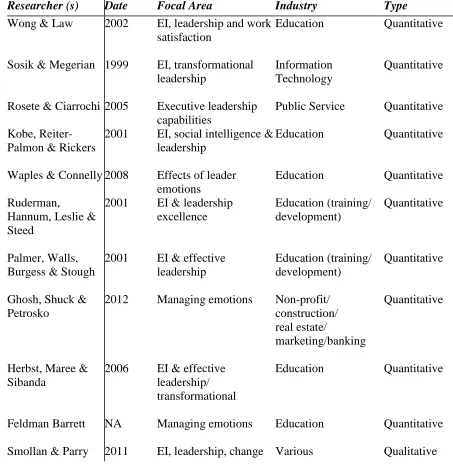
of quantitative data currently in existence on the topic needs to be expanded to include diversity in method and context (Table 2.3).
Table 2.3 Emotional Intelligence studies with corresponding context and methods
Researcher (s) Date Focal Area Industry Type
Wong & Law 2002 EI, leadership and work satisfaction
Education Quantitative
Sosik & Megerian 1999 EI, transformational leadership
Information Technology
Quantitative
Rosete & Ciarrochi 2005 Executive leadership capabilities
Public Service Quantitative Kobe,
Reiter-Palmon & Rickers
2001 EI, social intelligence & leadership
Education Quantitative
Waples & Connelly 2008 Effects of leader emotions
Education Quantitative
Ruderman,
Hannum, Leslie & Steed
2001 EI & leadership excellence
Education (training/ development)
Quantitative
Palmer, Walls, Burgess & Stough
2001 EI & effective leadership
Education (training/ development)
Quantitative
Ghosh, Shuck & Petrosko
2012 Managing emotions Non-profit/ construction/ real estate/
marketing/banking
Quantitative
Herbst, Maree & Sibanda
2006 EI & effective leadership/ transformational
Education Quantitative
Diving deeper into employee perceptions will in turn help to make more
CHAPTER THREE: METHODS Overview of Methods
Qualitative research was undertaken to explore and understand the meaning individuals or groups assign to a social or human issue (Creswell, 2009). A case study, or “The study of an issue explored through one or more cases within a bounded system”
(Creswell, 2007, p. 73) was utilized to gather in-depth data to generate themes. Generalization was not the intention as uncovering rich data through interviews with
pharmaceutical and biotechnology employees was essential to connect employee perceptions of leadership emotional intelligence within a specific context. Internal validity or the
congruency between findings and reality, can be heightened due to the closeness of the research situated in the study (Merriam, 2002). With the researcher as the primary
instrument, more detailed data could be acquired through the process of interviewing. For this particular case, the purpose was to uncover employee perceptions of emotional
intelligence in leadership. Face-to-face interviews allowed for deeper understandings to be generated.
responses of participants; a missing element of quantitative survey instruments. Quantitative instruments, as noted in the review of the literature, are common and repeatable. However, the intention of undertaking a qualitative approach was not to generalize across all
populations. The intention was to seek a method which provides more detail and one which is able to accurately display the expressive viewpoints of employees.
Data Collection Methods
The Biomanufacturing Training and Education Center (BTEC) located in Raleigh, NC, teach training courses for biotechnology and pharmaceutical professionals at all career stages. The location was chosen for convenience. I currently utilize the center as a resource for employees in order to enhance their professional capabilities. The BTEC has a well-known reputation and attracts a diverse population of individuals within this industry. Access and established rapport were factors in the selection of where and who to study. While some may see the training center as a possible limitation because the study was not conducted at one particular organization, the intended outcome was to compile feedback at a neutral location. A neutral location helped understand general employee perceptions
regarding leader EI.
A research sample in qualitative research is selected purposefully to yield the most information possible about a particular phenomenon (Merriam, 2002). For this exploratory study, participants were in the pharmaceutical or biotechnology industry, not in a leadership role, and had direct experiences reporting to managers and leaders within their organization. Participant selection was purposeful as the intention was to gain perspectives from those who are not in leadership positions.
personal email addresses, the participant and researcher were able to communicate in a more confidential manner. A time and location for an interview was determined based on the preference of the participant. Participants were taken based on the first four to six individuals who responded to the follow up email.
Interview questions are created to uncover the meaning individuals assign to their experiences with leadership and situations of emotional intelligence. In this case, semi-structured interviews were conducted. Semi-semi-structured interviews were chosen because this method contains specific questions to guide the interview, but it follows the respondent’s lead during (Hesse-Biber & Leavy, 2011). The interview protocol (Appendix C) was designed to be general so as to not lead the interviewee and allow for follow-up probing questions to be asked as well. General interview questions which were asked focused on the individual’s current job role and organizational structure. These questions were asked in
order to obtain information about their background and to make the participant comfortable. Obtaining specific demographic information helps determine if additional themes can be generated. Also, it helps determine if future areas of study should be explored within a particular demographic.
The following questions were designed to uncover the skills needed by today’s leaders. Questions center on how they have personally experienced leadership effectiveness and ineffectiveness with regard to emotional intelligence competencies. One question such as “If you could talk to a leader whom you’ve worked with about what you found valuable in
employee experienced leadership and what they personally valued from their interactions with that leader. Additional questions are designed so the participant can reflect on their own experiences and share how their organization equips leaders with the competencies and skills needed in today’s organizations. The questions are meant to tap into the thought process of
followers to determine how they form perceptions of their leaders.
The appropriate mixture of questions allowed for the participant to feel comfortable with the researcher and reflect on their experiences. It helped them to be candid in their responses about what they feel leaders need and how they have positively and negatively experienced leadership. The interview protocol allowed for free-flowing conversation to occur between the researcher and participant. A non-rigid instrument allowed for open-ended questions to be asked which helped surface detail which may not have been possible through a quantitative measure. While the protocol was not a rigid instrument, it was broken down to show the concise connections to each element of the qualitative model.
Informed consent is critical in the research process. The aim of informed consent is to disclose what the study is about, known risks in participating and to let participants know their participation is voluntary (Hesse-Biber & Leavy, 2011). The Institutional Review Board’s (IRB) process of informed consent, which requires the researcher to disclose
supervisors. In order to minimize risk, participants were required to submit a personal email address. The researcher recorded all interviews via the Notability application on a personal password protected iPad. Furthermore, everyone partaking in the interview process was assigned a pseudo name to minimize risk and uphold confidentiality.
Acknowledging researcher bias is important in any study. In this particular case, while I was familiar with the organization, I did not have any direct connections with the participants nor was aware of who they were prior to interviewing. However, as an
individual involved in the service side of the industry, preconceived notions of leadership and EI competencies do exists. Literature does support the need for EI in today’s leadership
though little research currently exists within the industry. Data Analysis and Reporting Methods
Ensuring the accuracy of data is essential in order to generate valid findings. After all interview data was collected, interviews were transcribed verbatim. Member checking, or taking data back to participants to ensure accuracy (Swanson and Holton, 2005) was used to confirm all transcriptions were accurately depicted. The personal email address participants provided was used so the researcher could email the transcriptions to participants. Emailing the transcriptions helped confirm all passages captured by the researcher were accurate before moving further in the process.
model. Following this coding, open coding was employed as it is the best measure to separate data into categories (Creswell, 2007).
Theme generation based is upon commonalities and differences between employee perceptions of leadership’s EI competencies. Themes start large then narrow down through
careful reflection and analysis. The process of theme generation grouped responses together through a common label yet allowed for outliers to be identified. Various colors are used to highlight participant statements through each interview transcription to visually see where statements fall in relation to theme generation. A password protected computer was used to house the data and all data was erased as well as communication with participants to protect confidentiality once conclusive findings were generated. While technology exists to code data and speed up the transcription and coding process, programs can be costly and allow room for error. For those reasons, all responses were analyzed line by line and coded directly by the researcher.
Data analysis involves collecting open-ended data based on asking general questions to participants and includes continuous reflection around the data and how to best interpret it (Creswell, 2009). Through this careful analysis and cross-checking, additional measures were taken to ensure accuracy. To supplement the researcher’s own reflections, member checks, which were discussed previously, were used to compare researcher findings with those of others to uncover possible discrepancies.
descriptions given directly from participants within the interview process. Clear and concise tables were also used as a way to summarize the detailed descriptions into comprehensive summary.
Overall, the qualitative research design was intended to elicit meaning from
participant experiences with leadership through semi-structured interviews. As Smollan and Parry (2011) describe; follower perceptions of leader EI have seldom been examined and followers are not able to assess many leader competencies. The hope was that asking open-ended questions would allow for employees to reflect on needed competencies in
CHAPTER FOUR: FINDINGS
This qualitative exploratory case study examined perception of leadership EI from the follower’s perspective based upon exhibited outward behavior. Participant responses were
examined to understand if connections existed between responses and the adapted model that was used. Participant recruitment is discussed first. Following participant recruitment, findings are presented. The findings are determined based on the criteria in the qualitative model and the research questions which guided the study.
Participant Recruitment
Table 4.1 Participant Demographics
Participant Gender Industry
Experience
Role Level
1 Male Six Years Mid-level
2 Male Eight Years Mid-Level
3 Male Twenty Years Senior-Level
4 Female Six Years Entry/Mid-Level
All recordings were transcribed directly by the researcher and sent to each participant’s personal email address as a part of the member checking/trustworthiness
assessment. No further steps were taken until transcriptions were confirmed by each
participant. Once emails were received confirming the accuracy of the transcription, a priori coding was employed. Smollan and Parry’s (2011) model was adapted to include elements
related to employee perceptions and leadership EI (Figure 2.1). Findings
The findings answer two research questions. The first question was:
1. How does a leader control and express emotion as perceived by the employees? Participants indicated that a leader’s outward behaviors contribute to how perceptions are formulated. Leaders utilized verbal and non-verbal communication to indicate how they were feeling.
The second research question was:
Participants described avoiding organizational leaders that displayed negative emotions. When leaders exhibited positive behaviors participants described that they were more likely to interact with the leader.
This section elaborates on the findings to illuminate how the participants in this study described how they perceived their leader’s emotions. Unsurprisingly, the a priori coding
analysis confirmed that all participant interview responses were aligned with the model. All four respondents included statements describing the leader’s ability to manage their own emotions, leader’s ability to appropriately express own emotions, followers showing/hiding emotions, leader’s ability to understand follower emotions, leader ability to appropriately
Table 4.2 A Priori Coding Results Participant Follower
showing/hiding emotion
Leader Ability to Understand
Follower Emotions
Leader Ability to Appropriately Respond to
Follower Emotions
1 X X X
2 X X X
3 X X X
4 X X X
Participant Leader Ability to Manage Own Emotions
Leader Ability to Appropriately Express Own Emotions Follower Perception of Leader EI Follower Response
1 X X X X
2 X X X X
3 X X X X
4 X X X X
A priori coding helped determine if participant responses were connected to all areas of the model. Since this was confirmed, it was important to uncover further details about how these perceptions were formed and the deeper constructs within each category of the model. The largest frequency of responses found within the data was in the category of perception formation of follower perceptions of leader EI. In the area of perception
generated through four mechanisms. The mechanisms are listed in Table 4.3. The study found that perceptions were formed based on a leader’s competence, which included knowledge and experience, were the most mentioned. Communication (verbal and non-verbal), reliability, and accountability/support were other areas which contributed to follower perception of leader EI. Details about these mechanisms are described below.
Mechanism #1: Perception of Leader Competence
In this study, competence was the first area identified which impacted participant perception. Participant three shared his experience with a leader who wasn’t familiar with chromatography yet was overseeing the area. The experience connected to perception formation based on leadership’s job knowledge and experience. He said:
“We were loading a chromatography column and I noticed that the color of the material that was being loaded into the column was…very uncharacteristic...So, then
something is out of the ordinary, you stop and you make a phone call. I called my supervisor and um, she wasn’t familiar a lot with chromatography and it seemed like I
somebody, you know? It just made me feel like okay, you’re not somebody I can count on when a decision needs to be made.”
In this instance, the employee felt that the leader was not ‘there’ for him and received the signal that he was bothering his leader. This is an example of a leader not being able to appropriately respond to follower emotions.
Participant two described how a lack of experience left a negative lasting impression on those around him. He shared that:
“I had a supervisor that came from finance to manufacturing and was like this person
has no idea what they are doing because the things that they were saying made no sense in the manufacturing department, you know…There was a lot of discussion behind that person’s back. I think they were just clueless, clueless to people’s emotions about how they felt about their ability to operate within that job role…You
have managers who can help you and assist you, you don’t feel like that person can do that because they wouldn’t understand the process or they wouldn’t understand exactly what you are working on.”
In this situation, the participant described that ‘talking behind the back’ type of negative
behaviors that can be generated when leaders are perceived to not be competent. This situation is an example of a leader who lacked the ability to understand follower emotions.
“I wasn’t getting a lot of response from talking to this individual, I did go ask my manager hey how can I get this person motivated….He had a better understanding of this person’s ways or working. You know, I started to see more responsiveness after
that. I try to manager things myself initially but you know, like I said, it was good having him there as a resource because a lot of times they’ve been in a similar
situation that I haven’t been in yet because they have been at the company longer than I have been.”
In this instance, the leader had a “better understanding,” and showed that he was competent.
In turn, this demonstrated that he could appropriately respond to the situation through appropriately expressing emotion.
Along with experience, communication was another large area which connected to a leader’s ability to appropriately express their own emotions, appropriately respond to
follower emotions, ability to understand follower emotions, ability to manage emotions, and follower showing/hiding emotion.
Mechanism #2: Perception of Leader Communication
Both verbal and non-verbal communication patterns were mentioned by all
participants. The impact of these communication patterns ultimately determined the level of interaction between employee and leader and how leader behaviors affected employee perception.