Copyright 0 1991 by the Genetics Society of America
Selection for TnlO Tet Repressor Binding to
tet Operator in Escherichia coli:
Isolation of Temperature-Sensitive Mutants and Combinatorial
Mutagenesis in the DNA Binding Motif
A. Wissmann,' L. V. Wray,
Jr.,'
U. Somaggio, R. Baumeister, M. Geissendorfer' and W. Hillen
Lehrstuhl f u r Mikrobiologie, Friedrich Alexander Universitat ErlangenlNurnberg, 0-8520 Erlangen, Federal Republic
of
Germany
Manuscript received July 13, 1990
Accepted for publication February 8, 199 1
ABSTRACT
We have constructed a genetic assay which selects positively for a functional interaction between
Tet repressor and its cognate operator in
Escherichia coli.
In this strain Tet repressor blocks expression
of
lacl
and
lacZ.
This leads to derepression of a
lacPO
controlled
galK
gene. The strain can be selected
by growth on galactose as the sole carbon source and screened for the @-galactosidase
phenotype.
These features allow the identification of one candidate among 10' false clones on a single plate. The
assay was applied to select mutants with a ts DNA binding phenotype and to screen oligonucleotide
generated
Tetrepressor mutants. Analysis of these mutations revealed that they affect DNA and
inducer binding and possibly the dimerization domains. These mutations are located at residues 2 1,
48, 49, 89 and at the
C terminus of the protein (1 93), respectively.
T
H E tet
determinant on transposon TnlO confers
high level resistance
to tetracycline in
Esche-
richia coli
and other enteric bacteria
(FOSTER,
HOWE
and
RICHMOND
1975;
KLECKNER
et
al.
1975). Expres-
sion of resistance is regulated very tightly at the level
of transcription
(BECK
et
al.
1982). The regulatory
region contains the
tet
promoters as well as two
tet
operators
O1
and
0 2(BERTRAND
et
al.
1983) which
are bound by Tet repressor preventing transcription
(HILLEN
et al.
1983;
WRAY
and
REZNIKOFF
1983;
MEIER, WRAY
and
HILLEN
1988). The inducer tetra-
cycline binds to Tet repressor leading to the loss of
DNA binding activity.
A
special feature of this system
is
the opposite orientation of the
tetR
gene encoding
Tet repressor relative to the resistance gene.
tetR
is
transcribed by promoters within the
tet
regulatory
region and is subject to autoregulation
(BERTRAND
et
al.
1983; HILLEN,
SCHOLLMEIER
and
GATZ
1984).
These features are summarized in Figure 1.
Three essential Tet repressor functions are de-
picted in the figure: dimerization to form the active
DNA binding form, DNA recognition and induction
by tetracycline.
tet
operator binding probably makes
use
of an a-helix-turn-a-helix supersecondary struc-
ture
(ISACKSON
and
BERTRAND
1985) and several mu-
tants lacking inducibility by tetracycline have been
mapped between amino acids
64
and 107 of the 207
amino acid primary structure
(POSTLE, NGUYEN
and
Cambridge Massachusetts.
'
Present address: BASF Bioresearch Cooperation, 195 Albany Street,'
Present address: Department of Microbiology, Boston University, 80 h s t Concord Street, Boston Massachusetts 021 18-2394.Present address: Chemotherapeutisches Forschungsinstitut Georg Speyer Haus, Paul Ehrlich Strasse 42-44, 6000 Frankfurt/M.70, Federal Republic of Germany.
Cknetics 128: 225-232 (June, 1991)
BERTRAND
1984;
SMITH
and
BERTRAND
1988). We
are interested in studying the functional basis
of
Tet
repressor activities and describe in this
article the
construction, efficiency and application of an
E. coli
strain that allows positive selection for functional Tet
repressor-tet operator binding. Similar approaches
have been used to analyze other protein-DNA recog-
nition reactions (for example see
ELLEDGE
et
al.
1989).
MATERIALS AND METHODS
226
-
A. Wissmann et
al.
“
-ore=
f
IeGR
DNA
sequence analyses:
Single-stranded
M 13 DNA and
double-stranded plasmid DNA were sequenced according
to the method of SANGER,
NICKLEN and COULSON (1977)
and HATTORI
and SAKAKI
(1 986).
Determination of &galactosidase activities:
Assays were
done exactly as described by
MILLER (1972), except that
cultures were grown in LB supplemented with the appro-
priate antibiotics. For induction studies overnight cultures
were grown in the presence of 0.1 pg/ml tetracycline,
whereas 0.2 pg/ml were added to log cultures. All measure-
ments were repeated at least twice.
Media, enzymes and chemicals:
Media and general
phage techniques have been described (MILLER 1972; MAN-
IATIS,FRITSCH
and SAMBROOK
1982). Antibiotics and
o-nitrophenyl-B-&galactoside
were obtained from Sigma, St.
Louis. Restriction endonucleases,
E . coli DNA polymerase
I
large fragment, T 7 polymerase, calf intestine alkaline phos-
phatase and T 4 DNA ligase were
purchased either from
New England Biolabs (Schwalbach), Pharmacia (Freiburg),
Boehringer (Mannheim)
or
BRL (Dreieich). ATP, deoxyri-
bonucleoside triphosphates and dideoxyribonucleoside tri-
phosphates were obtained from Boehringer (Mannheim).
[a-”PIdATP (400
Ci/mmol) was purchased from Amersham
(Braunschweig). Oligonucleotides were synthesized using an
Applied Biosystems
automated DNA synthesizer model
381A.
Molecular techniques:
Mutagenesis of Tet repressor po-
sitions 46 to 49 was accomplished by mutually primed syn-
thesis of degenerate oligonucleotides as detailed by HILL
(1989). The sequence of the oligonucleotide was 5’
ACGCGTCGAGC 3’. Bold letters (bases shown are wild
type) indicate that 6-7% each of the three non-wild-type
bases were added at these positions during synthesis of the
oligonucleotide.
Plasmids:
Plasmid pWH410 contains a fusion of the
tet
regulatory region to the
lac operon (tetA-lac2 fusion). It was
derived from pMC1403 (CASADABAN,
CHOU and COHEN
1980) and allows Alac
E . coli strains to grow on lactose as
the sole carbon source. Plasmid pWH414 differs in two
aspects from pWH410. First,
itcarries a
tetR-lacl
fusion
(Figure
2).
Second,
itcontains a one base pair frameshift
mutation at the fusion of
tetA and
l a d .
This renders Alac
E. coli
strains unable to grow on lactose. Nevertheless,
phenotypical detection of B-galactosidase activity with X-Gal
is still possible.Transdominance was analyzed in
strains containing
pWH853. This plasmid is a pBR322 derivative in which the
GCCAGCATGTAAAAAATAAGCGGGCCCTGCTCG-
FIGURE 1.-Regulation of gene expression of the transposon TnlO- encoded tetracycline-resistance de-
terminant. Both genes tetA (encoding
the resistance protein) and tetR (en-
coding the Tet repressor) are indi- cated. Their divergent expression is symbolized by wavy lines correspond- ing to the respective mRNAs. The
central tet regulatory region consists
of several promoters (not shown) and
the two tet operators 0, and 0 2 rep-
resented by hatched boxes. Tetracy- cline is indicated by the small rectan- gle which binds to and induces Tet repressor. The Figure was adapted
from WISMANN and HILLEN (1 989).
tet regulatory region was deleted yielding pWH806 and the
promoterless TnlO tetR gene was inserted resulting in low
level constitutive expression ( M ~ L E R - H I L L ,
CRAPO
and GIL-
BERT1968).
Plasmid pWH 14 1 1
was used for the cassette mutagenesis
and as a derivative of pACYC 177 (CHANG and
COHEN
1978)
is compatible to plasmids derived from pBR322. It confers
resistance to chloramphenicol and contains a constitutively
expressed tetR gene. T o allow cloning of short oligonucleo-
tide cassettes between singular restriction sites, the sequence
of the tetR
gene was altered without changing the encoded
protein sequence. pRT240 is similar to pWH1411, except
that it confers resistance to kanamycin and contains a wild-
type tetR
gene (BERTRAND
et al.
1984; MEIER, WRAY and
HILLEN
1988).
The pACYC177 derivatives pWH1200 and pWH1201
(ALTSCHMIED
et al.
1988), pUCl9 (YANISCH-PERRON,
VIEIRA
and
MESSING 1985), pWH483 (MEIER,
WRAY and
HILLEN 1988) and pMc5-8 (STANSSENS
etal.
1989) have
been described. Plasmid pWH1012 (SIZEMORE
et al.
1990)
with divergent tetR-galK and tetA-lac2 transcriptional fusions
was used for quantitative analyses of Tet repressor binding
to tet operator in vivo.
Phage constructions and crosses:
pWH483 was digested
with NdeI
and SmaI yielding a 1950-bp fragment with the
entire
galK
gene. In addition, this fragment contains a
segment of 180 bp
with translational stops in all
three
reading frames 5’ of the gene and a
At
Oterminator following
the 3‘-end of galK. After filling in the protruding ends the
fragment was cloned into HincIl
linearized M13mp9. A
candidate with
lac
dependent transcription of
galK
was
named mWH22. A second
lacoperator with the proposed
ideal binding sequence for Lac repressor (SADLER,
SASMOR
and BETZ 1983) was cloned 19 bp upstream of the start
codon for
galK
into the single NruI
site of mWH22 yielding
mWH25. In this construction palindromic centers
of thetwo lac operators are separated by 233 bp. The galK
con-
struct from mWH25 was recombined into the
lac sequences
present on Xplac5 to yield XWH25
(Yu and REZNIKOFF
1984). Since this phage carries the c1857
allele from Xplac5,
E . colistrains lysogenized with this phage were grown at
temperatures below 33
O.
The construction
ofphage Xtet5O has been described
(SMITH
and BERTRAND
1988).
E.
coliNK5031(Xtet50) was
treated with mitomycin C and the
resulting phage lysate
used to lysogenize
E .
coliWH207.
Tet Repressor Mutants
227
WH207 containing pWH410 and grown to saturation at
42" in minimal medium with lactose. Since pWH410 con-
tains a fusion of the tet regulatory region to the
lac operon
this step represents a selection against binding of Tet re-
pressor to tet operator. Afterward pRT240 derivatives were
isolated and retransformed to WH207(XWH25) containing
pWH414. Transformants were grown to saturation at 28"
in minimal medium with galactose.
Here, cells containing
tet
operator bound
by Tet repressor are selected. The
pRT240 derivatives were isolated
and retransformed to
WH207 with pWH410. Again cells were grown to satura-
tion at 42" in minimal medium using lactose. The pRT240
derivatives were isolated, transformed
to WH207 with
pWH410 and plated on glucose minimal medium supple-
mented with ampicillin, kanamycin and X-Gal. Plates were
incubated at 42" for
2
days and blue colonies transferred
to fresh plates containing the identical medium.
lac2
phe-
notypes were scored after incubation at 28" for
2 days. tetR
genes were recloned as HincII fragments in pUCl9. From
derivatives
withlac promoter tet
fusions, EcoRI/SphI DNA
fragments containing
tetR
were then inserted into the re-
spective sites of pWH 1200 and pWH 120 1.
This yielded two
sets of plasmids with pWH1200 derivatives
directing a
"high," and pWH1201 derivatives directing
a ''low'' level
constitutive expression of
tetR
in
vivo(BERTRAND
et
al.
1984).
RESULTS
Selection
of
Tet repressor binding to
tet operator:T h e selection makes use of the
tet
directed expression
of divergently arranged
lacZ
and
lacl
genes. Binding
of repressor to the
tet operators turns off transcription
of both genes resulting
in
lacZ-
E.
coli
colonies. At the
same time,
the absence of Lac repressor allows expres-
sion of a galactokinase gene driven by the the
lac
regulatory region. This enables the
E . coli
strain to
use galactose as the sole carbon source. In the absence
of Tet repressor binding to
tet
operators,
lacZ
as
well
as
lacl
are expressed. Lac repressor binds to the
lac
operators and prevents transcription
of
g d K .
T h e cell
cannot utilize galactose as the sole carbon source for
growth and displays a
lacZ-
phenotype.
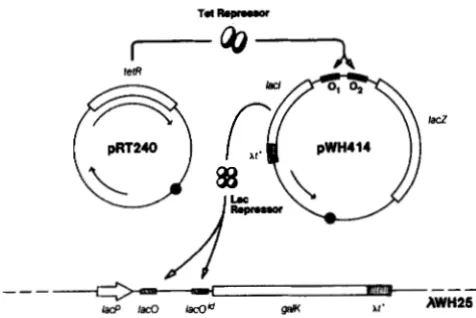
T h e selection system consists of two plasmids and a
X
prophage and
is depicted in Figure
2.
pWH414
makes use of the divergent
tet
regulatory region in
that both a
tetR-lacl
transcriptional fusion as well as a
tetA-lac2
fusion are present on the same plasmid. Tet
repressor is supplied in
trans
by a second compatible
plasmid (pRT240). T h e third component of the sys-
tem is the prophage XWH25 which provides a single
copy
lacPO-galK
fusion. T h e host strain is
E. coli
WH207 and
has a
gal
operon with the
galK2
mutation
(see
MATERIALS AND METHODS).A qualitative analysis of this system shows that all
components behave as anticipated (see Table 1, lines
1 and
2).
In the presence of Tet repressor, the strain
is
gal'
and
l a d -
(line
2,
galactose alone). In the
absence of Tet repressor, the strain is
gal-
(line 1,
galactose
2
tetracycline; line
2,
galactose
+
tetracy-
cline). In the absence of Tet repressor,
lacI
repression
FIGURE 2.--Selection of Tet repressor binding to tet operator.
DNA is indicated by thin lines, relevant genes as open boxes, the
At" terminators as stippled boxes, the lac operators as hatched
boxes, the tet operators as filled boxes and the lac promoter on
XWH25 as an open arrow. Filled circles mark the origins of repli-
cation of both plasmids. The arrow expanding through the tetR
gene in pRT240 indicates the transcript originating from the bla
promoter, whereas the other arrow defines the kanamycin resist-
ance gene. The arrow in pWH414 indicates the bla gene. Tet
repressor is shown as a dimer and Lac repressor as a tetramer.
TABLE 1
Tet repressor and Lac repressor dependent expression of galactokinase in E. coli WH207(XWH25)
Growth and phenotype of strains on
Plasmid repressor cose tose
+
IPTG tetracyclineTet Glu- Galac- Galactose Galactose
+
pWH414 - +b
-
+/-b-
pWH414
+
+w +w +W -pWH414-2A
+
+ b-
+/-b-
pWH414-2A - + b - +/-b
-
Strains of E . coli WH207(XWH25) with the indicated plasmids
were streaked on minimal plates containing the indicated carbon source and inducer, as well as ampicillin, kanamycin and X-Gal.
Plates were incubated at 30" for 3 days and scored for colony
growth and color. Abbreviations used are
"+"
large single colonies,"+/-"
small single colonies,"-"
no single colonies but very thin bacterial film visible, "w" white colonies and "b" blue colonies. Thepresence of Tet repressor is indicated by
"+"
(pRT240), whereasthe absence is indicated br ''-- (pWH1200). The final concentra-
tions of inducers were 10- M for IPTG and 0.5 pg/ml (correspond-
ing to subinhibitory amounts) for tetracycline.
can be partially alleviated by addition of isopropyl
thiogalactoside (IPTG)
(line
1 ,
galactose
+
IPTG);
complete derepression
is
probably not achieved be-
cause Lac repressor is present
in
such a high amount
that it is never fully induced at the IPTG concentra-
tion used (1
0-'
M).228
Wissmannthree orders of magnitude. The phenotypes in the
presence and absence of wild-type Tet repressor are
as anticipated (see Table 1, lines 3 and 4). Growth on
glucose yields
lacZ+
phenotypes while growth on ga-
lactose does not occur irrespective of the presence of
Tet repressor. In the presence of galactose and IPTG
this strain grows and is
l a d +
(see above).
For a quantitative determination of the selection
efficiency, mixtures of strains were grown on selective
plates. These contained cells with
the components
shown in Figure 2, and an excess of cells in which
either the repressor encoding plasmid pRT240 was
replaced by the vector without
tetR,
or the wild type
operators (pWH414) were replaced by their constitu-
tive mutants (pWH414-2A). The results demonstrate
that 30 cells with wild-type
Tet repressor and
tet
operator can be efficiently selected on a single plate
among 10’ cells with either no Tet repressor or the
tet
operator mutation. No white colonies
indicating
repression of
lac2
by Tet repressor are selected as
false positives from 1
O s
cells. The appearance of a few
blue colonies might be due to spontaneous mutations
of the
lac1
gene. It is the advantage of the divergent
tet
regulatory region that these candidates can be
easily identified and discarded.
Temperature-sensitive Tet repressor mutants:
Temperature-sensitive Tet repressor mutations were
selected by their ability to confer growth on lactose at
42” and growth on galactose at 28” in appropriate
E .
coli
strains (see
MATERIALS ANDMETHODS). Seven
par-
allel selections using individual
preparations of
pRT240 from the
E.
coli
mutator strain KD1067
(DEGNEN
and
COX
1974) were carried through. Five
of
these selections yielded colonies which were
blue
at 42” and white at 28
Owith frequencies ranging
from 2 to
85%.
The
tetR
genes from one candidate of
each of the seven selections were
sequenced. The
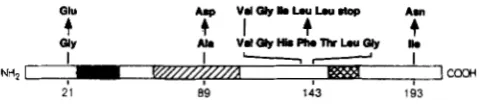
obtained mutations are displayed in Figure 3.
Temperature-sensitive Tet repressor mutants con-
tained either a glycine to glutamic acid exchange at
position
2
1 (GE2 1) or an an isoleucine to asparagine
exchange at position 193 (IN193). The latter was
independently selected four times. Another mutant
(see Figure 3) isolated
by a different approach contains
an alanine to aspartic acid exchange at position 89
(AD89) and was included in the further
in
vivoanal-
yses. The two mutants without a temperature
sensitive
phenotype were identical and had a C-terminal dele-
tion (A141). The wild-type and mutant
tetR
genes
were recloned resulting in two sets of plasmids
direct-
ing either “high” or “low” level expression of
tetR.
The mutants were assayed in
vivo
for repression of
a
tetA-lacZ
fusion at 28
O,
37
Oand 42
”
.
Furthermore,
inducibility by tetracycline and transdominance over
wild type was tested. The results are presented in
Table 2. Tet repressor mutants GE21, AD89 and
IN 193
display a clear temperature dependency of
lacZ
O b Asp VdQlYY.L.uL.u.(op A m
WY
I
A* V~lQlYHbF’hoThrLruOly I*
4
4
1
4
4
NHZ
I
1
COOHI ” I
,
21 89 143 193
FIGURE 3.-Sequences of mutant Tet repressor proteins ob- tained from the selection for temperature sensitive variants. The Tet repressor protein with a total length of 207 amino acid residues
is represented by a linear bar with both the N- and C-terminal ends
indicated. The solid portion defines the potential a-helix-turn-a-
helix motif, which is thought to be involved in DNA binding (amino
acid residues 26 to 47; ISACKSON and BERTRAND 1985). The region
of the protein for which mutants have been obtained that are
defective for induction by tetracycline is hatched (amino acid resi-
dues 64 to 107; SMITH and BERTRAND 1988). Finally, a region of
the protein that shows a high degree of variability when sequences of Tet repressor proteins from the five known resistance classes A through E are compared has been marked by crosshatching (amino
acid residues 151 to 166; TOVAR, ERNST and HILLEN 1988). The
glycine to glutamic acid exchange at position 21 is due to a transition
of G to A, the exchange of isoleucine to asparagine at position 193
is the result of a T to A transversion and the deletion of one G in
a run of four Gs leads to a frameshift resulting in a C-terminally
deleted Tet repressor protein with a total length of 141 residues.
Another temperature sensitive mutant which was isolated by a
slightly different procedure (mutagenized pRT240 was trans-
formed to E. coli X7029 containing plasmid pWH410 and resulting
transformants analysed for their lacZ phenotype on X-Gal plates at
28” and 42”; M. GEISSEND~RFER and W. HILLEN, unpublished
results) was also included in the study. This mutant contains an exchange of alanine to aspartic acid at position 89 as the result of a
C to A transversion.
repression, as evident from the ratios, whereas mutant
A14 1 does not show repression in this system at all.
At
28” and a “high” level of
tetR
expression
IN
193
shows almost wild-type activity
and is clearly more
active than AD89. On the contrary at a “low” level of
tetR
gene expression IN193 is not as effective as wild
type and is even less active
than AD89. The repression
efficiencies encoded by the “high” expression plasmids
are 95- and 900-fold higher for AD89 and IN193,
respectively, than the ones found in the “low” expres-
sion plasmids. AD89
is
only partially inducible
by
tetracycline, whereas the other mutants can be fully
induced. GE2 1 and AD89 are transdominant.
Combinatorial mutagenesis at the
C
terminus of
the putative
DNA
recognition a-helix
of Tet repres-
sor:
Assuming that Tet repressor contains an a-helix-
turn-a-helix motif for operator recognition (POSTLE,
NGUYEN
and
BERTRAND1984; PABO and SAUER 1984;
ISACKSON
and BERTRAND
1985),
it
is very likely that
position
46
is part of the a-helix, whereas the second-
ary structures of residues 47 to 49 remain unclear.
T o gain information about their possible participation
in operator binding a combinatorial cassette mutagen-
esis (REIDHAAR-OLSON
and SAUER
1988) of Tet re-
pressor was performed (see
MATERIALS AND METHODS)as shown in
Figure
4.
Mutant plasmids were trans-
formed to
E .
coli
strains that either do or do not allow
selection for
tet
operator binding of Tet repressor.
Tet
Repressor
Mutants
TABLE 2
In vivo analysis of mutant Tet repressors
229
Repression
l’er
repressor
None Wild type
GE2 1
AD89 IN193 A141
Wild type
GE2 1 AD89 IN193
tetR
expres- sion
High High High High High Low Low Low Low
2 8 ” 100.0 ( f 2 . 5 )
0.0 (fO.0) 18.4 ( f 2 . 1 )
0.8 (k0. 1) 0.1 (kO.1) 99.4 (f 1.9) 29.7 (k3.0) 96.0 (f2.7) 76.3 (k0.7)
89.4 (k1.1)
3 7 ” 4 2 “ 100.0 (k3.4) 100.0 (k5.9)
0.1 ( fO.l) . 0.2 (fO.l)
86.2 (f8.2) 99.3 (f1.2) 43.2 (k3.1) 73.2 (k3.6) 20.3 (f1.8) 6 9 . 2 ( f 1 . 3 ) 104.4 ( f 6 . 8 ) 100.0 (k0.4) 51.7 ( f 1.9) 62.8 (f6.1)
88.3 (k6.9) 93.7 (k0.7)
96.1 (k7.8) 97.4 (f4.1) 100.1 (*I.]) 100.8 (k5.9)
37”/28” Ratio
1
4.7 54.0
20.3 1 . 1 1.7 1
.o
1.2 1 . 1Tetracycline induction Transdominance
Ratio +wt TetR/
-Tc +Tc -wt TetR +wt TetR 2.9
100.0 ( f 5 . 1 ) 100.0 (k4.5) 100.0 (k4.1) 2.9 (kO.l) 1.0 1.3 ( f 0 . 2 ) 96.7 (f2.8) 1 . 1 (kO.0) 1 . 1 (20.0) 0.4
48.6 (22.9) 104.8 (f4.7) 94.3 (f1.5) 18.5 ( f 1 . 5 ) 6 . 4 4 . 6 ( + 1 . 3 ) 1 6 . 6 ( k l . l ) 7 3 . 4 ( + 0 . 2 ) 5.7 (k0.3) 2.0
1.3 (k0.3) 98.7 (k2.4) 9.4(&0.2) 1.6 (kO.0) 0.6 9 7 . 2 ( f 4 . 5 ) 2.5 ( f 0 . 2 ) 0 . 9
~
@-Galactosidase determinations were performed in E . coli WH207 containing tetA-lac2 fusions and plasmids encoding the given Tet
repressors. It is indicated whether the “high” or the “low” expression system for Tet repressor was used (see MATERIALS AND METHODS for
details). @-Galactosidase values obtained in strains lacking Tet repressor were defined as 100%. “Repression” was measured using plasmid
pWH1012 for the tetA-lacZ fusion. Actual values obtained were 275.8 (f8.7) units at 2 8 “ , 386.1 ( f l 1 . 0 ) units at 37” and 341.7 (k15.7)
units at 4 2 ” . Overnight cultures used for the inoculation of log cultures were also grown at the temperatures indicated, except for
measurements at 4 2 ” , where overnight cultures were grown at 37”. When overnight cultures of strains containing mutants AD89 and IN193
in the “high” in vivo expression system were grown at 28” and log cultures were then grown at 4 2 ” , the percentages obtained for AD89
were 37.4% (+3.4%), whereas 2.7% (fO.l%) were obtained for IN193. “Tetracycline induction” was assayed using the prophage Xtet50 for
the tefA-lac2 fusion. Overnight and log cultures were grown at 28”. Actual values obtained in the absence of Tet repressor without addition
of tetracycline were 4970 (k385) units and 4125 (k190) units in the presence of tetracycline. “Transdominance” was also determined using
the prophage Xtet50 as a tetA-luc2 fusion. In addition to the indicated plasmids, cells contained a second compatible plasmid which either was
pWH806 (indicated by “-wt TetR”) or pWH853 (indicated by “+wt TetR”). Details on both plasmids are given in MATERIALS A N D METHODS.
Overnight and log cultures were grown at 37”. Percentages are related to the 100% value defined by the strain lacking both wildtype and
lnutant Tet repressors. Typically, 3895 (k160) units were obtained in the absence of Tet repressor.
Nsp(7524)l Mlu I
Q A Q CAQ CCT ACA T T Q T A T TQG CAT Q T A A A A A A T AAQ CQQ QCC CTQ C T C QAC OCQ I T A
C T C QTC GGA TQT AAC A T A ACC G T A CAT T T T T T A T T C GCC CQQ QAC QAQ CTO COC A A T
Q l u G l n P r o T h r L o u T y r T r p H I . V a l L y a A a n L y a A r e A l a L a u L a u A a p A l a L o u
.
I4 0
-
50DNA recognition ahelix
1
FIGURE 4,“Cassette mutagenesis of positions 46 to 49 of Tet repressor. The DNA of plasmid pWH1411 (see MATERIALS AND METHODS)
is shown as a circle with the tetR gene emphasized by the open box. The origin of replication is depicted as a filled circle, the chloramphenicol
acetyltransferase gene is indicated by the shorter arrow and the transcription originating from the bla promoter which leads to constitutive
expression of tetR is marked by the longer arrow. The orientation of the tetR gene is indicated by the XbaI site (this restriction site is localized
at the 5’ end of the gene). At the top of the figure, part of the DNA sequence of the tetR gene is shown together with the respective protein
sequence. The localization of the potential DNA recognition a-helix is indicated by the open box below the sequence. Amino acid residues
at positions 46 to 49 that were altered are underlined by a black bar. Singular restriction sites used for cloning are indicated above the DNA
sequence.
different mutants
with either single
or
multiple ex- mutant
which showed a significant derepression of
changes at
positions
46
to
49
were obtained and
l a d .
At
28”,
which was the temperature
used for
analyzed in
vivo
for repression of a
tetA-lac2
fusion at mutant
selection, this candidate also displayed wild-
28”
and
37”
and for
tetracycline induction.
type activity.
All mutants isolated with selection for Tet repressor
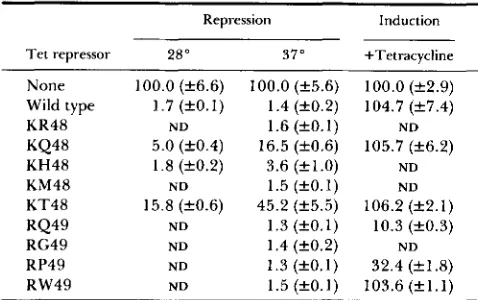
Single amino acid exchanges at positions
46
and
47
TABLE 3
Mutational analysis of Tet repressor positions 46 to 49
Repression Induction
T e t repressor 28" 37" +Tetracycline
None 100.0 (f6.6) 100.0 (f5.6) 100.0 (f2.9)
Wild type 1.7 (20.1) 1.4 (f0.2) 104.7 ( f 7 . 4 )
KR48 N D 1.6 (fO.1)
KQ48
N D
5.0 (k0.4) 16.5 ( f 0 . 6 ) 105.7 (f6.2)
KH48 1.8 ( f 0 . 2 ) 3.6 (f1.0) ND
KM48 N D 1.5 ( f 0 . 1) N D
KT48 15.8 (f0.6) 45.2 (f5.5) 106.2 (f2.1)
RQ49 ND 1.3 ( f O . l ) 10.3 ( f 0 . 3 )
RG49 N D 1.4 (f0.2)
RP49
RW49 ND 1.5 (f0.1) 103.6 (fl.1)
ND N D 1.3 ( f O . l ) 32.4 (f1.8)
&Galactosidase determinations were performed in E. coli
WH207 (Xtet50) with plasmids encoding the given Tet repressors.
Values are given as percentages with regard to the amount of
p-
plactosidase measured for this strain containing plasmid pMc5-8 under the specific experimental conditions (specified as "none" in the table). Measurements were carried out with strains grown at
28" and 3 7 " , with the respective overnight cultures grown at the same temperatures. Induction with tetracycline was also done at
37" (for details see MATERIALS AND METHODS).
showed a lower than wild-type repression activity
(Table
3).
The mutants at position
49
did not affect
repression efficiencies but two candidates displayed
only partial inducibility by tetracycline. Multiple
amino acid exchanges at positions
46
to
49
influenced
the repression activity only if position
48
was altered
and the tetracycline inducibility only if position
49
was altered (data not shown).
DISCUSSION
Selection
of
Tet repressor binding
to
tet
operator:
T h e selection described above is
very efficient, be-
cause single cells with wild-type Tet repressor binding
to wild-type
tet
operator are found among
a vast excess
of up to
l o 8
cells with either no or reduced binding
of Tet repressor to
tet
operator on one
plate. T h e
results with the
2A tet
operator mutation show that
T e t repressors must have an association constant of
greater than
4
X10'
M"to
tetoperator in order to
be selectable in this system.
Temperature-sensitive Tet repressor mutants:
As
depicted in Figure
3, GE21
is located in close prox-
imity to the prcjposed a-helix-turn-a-helix element. It
is the weakest
DNA
binder and shows the strongest
transdominant phenotype of all the mutants analysed
in this study. This mutant has been isolated previously
by
ISACKSON
and
BERTRAND
(1985),
but the authors
did not describe the temperature dependent
effect we
have observed. We speculate that this mutation may
interfere with the positioning of the
DNA
binding
motif.
AD89
is located in a region where noninducible
mutants have been mapped
previously
(SMITH
and
BERTRAND
1988).
In agreement with these results it
shows only partial induction by tetracycline but also a
transdominant phenotype.
At the same position
SMITH
and
BERTRAND
(1988)
have also isolated a
mutant (alanine to glycine) which allows only partial
induction by tetracycline. Since the residue at position
89
affects both the
DNA-
and the inducer-binding
domain it may be involved in structurally transmitting
the signal of inducer binding to the
DNA
recognition
domain.
Mutant
IN 193
is located in the
C
terminus, to which
no function has been assigned
so
far. It gives rise to
the strongest temperature-dependent effect observed
in the course of this study. Tetracycline inducibility
as far as detectable in
our system is not affected and
transdominance cannot be observed.
When overnight
cultures for
@-galactosidase determinations were
grown at
28"
and log cultures were incubated at
42"
mutant
IN 193
retains a much higher
efficiency in
lac2
repression than
AD89
(see footnotes to Table
2).
This
phenotype corresponds to the
tss("temperature-sen-
sitive synthesis") mutants first described
by
SADLER
and
NOVICK
( 1
965),
where the oligomerized protein
retains function upon shifting the culture to the
non-
permissive temperature. Assembly of new dimers is
inhibited at the
nonpermissive temperature due to
either a defect in folding of the monomer
or
inhibition
of dimer formation
(GOLDENBERG
1988).
This might
indicate that
IN 193
dimers already formed
at
28
Oare
not inactivated upon raising the temperature to
42
O.
On the contrary,
it has been shown
in
vitro
for mutant
AD89
that shifting the temperature to
42"
clearly
inactivates the protein
(B.
STADE
and
W. HILLEN,
unpublished results). Western blot analyses have
shown identical levels of
wild type and
IN193
when
grown at
28
Owhile at
37"
no
IN193
protein is de-
tectable
( C . BERENS
and
w.
HILLEN,
manuscript to be
published). Taken together with the large increase in
repression with concentration (see Table
2)
this leads
us
to speculate that position
193 of
Tet repressor
might be involved in dimer formation. T h e
C
termini
of Tet repressor proteins from five resistance classes
are rather homologous. They are preceded by a hy-
pervariable region (amino acid residues
15 1
to
166
of
TnlU Tet repressor; see Figure
3
and
TOVAR,
ERNST
and
HILLEN 1988)
which could indicate
a
possible
C-
terminal dimerization domain of
Tet
repressor.
Tet Repressor
Mutants23
1binding of inducer;
(ii)
interference with the confor-
mational change needed
to transmit the signal
of
inducer binding
to
the DNA binding domain
or
(iii)
increased affinity for operator resulting in a superre-
pressor. This effect is not found at the three other
positions. T h e result is particularly surprising, since
previously identified mutations in Tet repressor with
a
noninducible phenotype map between positions
64
and
107 (SMITH and
BERTRAND
1988), in a region
clearly distinct from the proposed DNA recognition
a-helix. T h e large number of mutants, and a demon-
stration that some show reduced binding
of
tetracy-
cline
in
vitro
suggest that this region contains
the
binding site for tetracycline. Thus, Arg4’
of
Tet re-
pressor might be located at the “DNA side” of the
switch mediating inducer binding
to the DNA binding
site. However, superrepression as a result
of additional
interactions either stabilizing the repressor-operator
or
destabilizing repressor-nonoperator complexes
(HECHT
and
SAUER
1985) is also possible. In conclu-
sion, the combinatorial mutagenesis suggests that
Lys4’ may be involved in operator binding and Arg4’
could be active in induction while no functions can be
detected for Lys4‘j and Asn4?.
We thank B. RAK for plasmids, E. coli strains and his advice
i n strain construction. We also thank L. SMITH for E. coli
NK5031(Xtet50). We are grateful to G . HOFHAUS for help with
some plasmid constructions and A. SERWOTKA for excellent tech-
nical assistance. This work was supported by the Humboldt Stiftung (L.V.W.), the Deutsche Forschungsgemeinschaft and the Fonds der chemischen Industrie.
LITERATURE
CITED
ALTSCHMIED, L., R. BAUMEISTER, K. PFLEIDERER and W. HILLEN,
1988 A threonine to alanine exchange at position 40 of Tet repressor alters the recognition of the sixth base pair of tet
operator from GC to AT. EMBO J. 7: 401 1-401 7.
BECK, C. F., R. MUTZEL, J. BARB^ and W. MULLER, 1982 A
multifunctional gene ( t e t R ) controls TnlO-encoded tetracycline
resistance. J. Bacteriol. 1 5 0 633-642.
BECKWITH, J. R., and E. R. SIGNER, 1966 Transposition ofthe lac
region of Escherichia coli. I . Inversion of the lac operon and
transduction of lac by 680. J. Mol. Biol. 1 9 254-265.
BERTRAND, K. P., K. POSTLE, L. V. WRAY, JR., and W. S. REZNI-
KOFF, 1983 Overlapping divergent promoters control expres-
sion of TnlU tetracycline resistance. Gene 23: 149-156.
BERTRAND, K. P., K. POSTLE, L. V. WRAY, JR., and W. S. REZNI-
KOFF, 1984 Construction of a single-copy promoter vector
and its use in analysis of regulation of the transposon TnlU
tetracycline resistance determinant. J. Bacteriol. 158: 910-919.
CASADABAN, M. J.,
J.
CHOU and S. N. COHEN, 1980 In vitro genefusions that join an enzymatically active B-galactosidase seg-
ment to amino-terminal fragments of exogenous proteins: Esch-
erichia coli plasmid vectors for the detection and cloning of
translational initiation signals. J. Bacteriol. 143: 971-980.
(:HANG, A. C. Y., and S. N. COHEN, 1978 Construction and
characterization ofamplifiable multicopy DNA cloning vehicles
derived from the PI 5A cryptic miniplasmid. J. Bacteriol. 134:
1141-1 156.
DEGNEN, G. E., and E. C. COX, 1974 Conditional mutator gene
i n Escherichia coli: isolation, mapping and effector studies. J.
Bacteriol. 117: 477-487.
ELLEDGE, S. E., P. SUGIONO, L. GUARENTE and R. W. DAVIS,
1989 Genetic selection for genes encoding sequence-specific
DNA-binding proteins. Proc. Natl. Acad. Sci. USA 86: 3689-
3693.
FOSTER, T . J., T . G . B. HOWE and K. M. V. RICHMOND,
1975 Translocation of the tetracycline resistance determinant
from R100-1 to the Escherichia coli K-12 chromosome. J.
Bacteriol. 124: 1 153-1 158.
GOLDENBERC, D. P.,1988 Genetic studies of protein stability and
mechanisms of folding. Annu. Rev. Biophys. Biophys. Chem. 17: 481-507.
HATTORI, M., and Y. SAKAKI, 1986 Dideoxy sequencing method
using denatured plasmid templates. Anal. Biochem. 152: 232-
238.
HECHT, M. H., and R. T. SAUER, 1985 Phage lambda repressor
revertants. Amino acid substitutions that restore activity to
mutant proteins. J. Mol. Biol. 1 8 6 53-63.
HILL, D. E., 1989 Mutagenesis with degenerate oligonucleotides:
creating numerous mutations in a small DNA sequence, pp.
8.2.1-8.2.7 in Current Protocols in Molecular Biology, Vol. 1,
edited by F. M. AUSUBEL, R. BRENT, R. E. KINGSTON, D. D.
MOORE, J. G. SEIDMAN, J. A. SMITH and K. STRUHL.John Wiley
& Sons, New York.
HILLEN, W., K. SCHOLLMEIER and C. GATZ, 1984 Control of
expression of the TnlO-encoded tetracycline resistance operon.
11. Interaction of RNA polymerase and T E T repressor with
the tet operon regulatory region. J. Mol. Biol. 172: 185-201.
HILLEN, W., C. GATZ, L. ALTSCHMIED, K. SCHOLLMEIER and 1.
MEIER, 1983 Control of expression of the TnlO-encoded
tetracycline resistance genes. I. Equilibrium and kinetic inves-
tigations of the regulatory reactions. J. Mol. Biol. 169: 707-
721.
IPPEN, K., J. A. S H A P I R O ~ ~ ~ J. R. BECKWITH, 1971 Transposition
of the lac region to the gal region of the Escherichia coli
chromosome: isolation of Xlac transducing bacteriophages. J.
Bacteriol. 108 5-9.
ISACKSON, P. J., and K. P. BERTRAND, I985 Dominant negative
mutations in the TnIU tet repressor: evidence for use of the
conserved helix-turn-helix motif in DNA binding. Proc. Natl.
Acad. Sci. USA 82: 6226-6230.
KLECKNER, N., R. K. CHAN, B.-K. TYE and D. BOTSTEIN,
1975 Mutagenesis by insertion of a drug-resistance element
carrying an inverted repetition. J. Mol. Biol. 97: 561-575.
MANIATIS, T., E. F. FRITSCH and J. SAMBROOK, 1982 Molcular
Cloning-A Laboratory Manual. Cold Spring Harbor Laboratory, Cold Spring Harbor, N.Y.
MCKENNEY, K., H. SHIMATAKE, D. COURT, U. SCHMEISSNER, C.
BRADY and M. ROSENBERG, 1981 Gene amplification and
analysis, p. 383-415 in Structural Analysis of Nucleic Acids,
edited by
J.
G. CHIRIKJIAN and T. S. PAPAS. Elsevier/North-Holland, New York.
MEIER, I . , L. V. WRAY and W. HILLEN, 1988 Differential regu-
lation of the TnlU-encoded tetracycline resistance genes tetA
and tetR by the tandem tet operators O1 and 02. EMBO J. 7:
567-572.
MILLER, J. H., 1972 Experiments in Molecular Genetics. Cold Spring
Harbor Laboratory, Cold Spring Harbor, N.Y.
MILLER, J. H., D. GANEM, P. LU and A. SCHMITZ, 1977 Genetic
studies of the Lac repressor. I . Correlation of mutational sites
with specific amino acid residues: construction of a colinear
gene-protein map. J . Mol. Biol. 1 0 9 275-301.
MULLER-HILL, B., L. CRAPO and W. GILBERT, 1968 Mutants that
make more lac repressor. Proc. Natl. Acad. Sci. USA 59: 1259-
1264.
PABO, C. O., and
R.
T. SAUER, 1984 Protein-DNA recognition,POSTLE, K., T . T. NCUYEN and K . P. BERTRAND, 1984 Nucleotide
sequence of the repressor gene of the TnlU tetracycline resist-
ance determinant. Nucleic Acids Res. 12: 4849-4863.
REIDHAAR-OLSON, J. F., and R. T. SAUER, 1988 Combinatorial
cassette mutagenesis as a probe of the informational content of
protein sequences. Science 241: 53-57.
RUTHER, U., 1982 pUR250 allows rapid chemical sequencing of
both DNA strands of its inserts. Nucleic Acids Res. 1 0 5765-
5772.
SADLER, J. R., and A. NOVICK, 1965 The properties of repressor
and the kinetics of its action. J. Mol. Biol. 12: 305-327.
SADLER, J. R., H. SASMOR and J. L. BETZ, 1983 A perfectly
symmetric lac operator binds the lac repressor very tightly.
Proc. Natl. Acad. Sci. USA 8 0 6785-6789.
SANGER, F., S. NICKLEN and A. R. COULSON, 1977 DNA sequenc-
ing with chain-terminating inhibitors. Proc. Natl. Acad. Sci.
USA 74: 5463-5467.
SIZEMORE, C., A. WISSMANN, U. GULLAND and W. HILLEN,
1990 Quantitative analysis of TnlU Tet repressor binding to
a complete set of tet operator mutants. Nucleic Acids Res. 18:
SMITH, L. D., and K. P. BERTRAND, 1988 Mutations in the TnlO
tet repressor that interfere with induction; location of the
tetracycline-binding domain. J. Mol. Biol. 203: 949-959.
STANSSENS, P., C. OPSOMER, Y. M. MCKEOWN, W. KRAMER, M.
2875-2880.
ZABEAU and H.-J. FRITZ, 1989 Efficient oligonucleotidedi- rected construction of mutations in expression vectors by the gapped duplex DNA method using alternating selectable mark-
ers. Nucleic Acids Res. 17: 4441-4454.
TOVAR, K., A. ERNST and W. HILLEN, 1988 Identification and
nucleotide sequence of the class E tet regulatory elements and
operator and inducer binding of the encoded purified tet re-
pressor. Mol. Gen. Genet. 215: 76-80.
WILSON, G. G., K. K. Y. YOUNG, G. J. EDLIN and W. KONIGSBERG,
1979 High-frequency generalised transduction by bacterio-
phage T 4 . Nature 280: 80-82.
WISSMANN, A , , and W. HILLEN, 1989 Tetracyclin-Resistenzdeter-
minanten: Mechanismen der Resistenz und Regulation ihrer
Expression. Forum Mikrobiol. 12: 292-299.
WRAY, L. V., JR., and W. S. REZNIKOFF, 1983 Identification of
repressor binding sites controlling expression of tetracycline
resistance encoded by TnlO. J. Bacteriol. 1 5 6 1188-1 191.
YANISCH-PERRON, C., J. VIEIRA and J. MESSING, 1985 Improved
M I 3 phage cloning vectors and host strains: nucleotide se-
quences of the M 13mpl8 and pUCl9 vectors. Gene 33: 103-
119.
Yu, X. M., and W. S. REZNIKOFF, 1984 Deletion analysis of the
CAP-CAMP binding site of the E. coli lactose promoter. Nucleic
Acids Res. 12: 5449-5464.