Selection, Generalized Transmission and the Evolution of Modifier Genes.
I. The Reduction Principle
Lee
Altenberg* and Marcus
W.
Feldmant
*Department of Statistics, North Carolina State University, Raleigh, North Carolina 27695-8203 and ?Department of Biological Sciences, Stanford University, Stanford, CaEi,fornia 94305-5020
Manuscript received March 19, 1987
Revised copy accepted July 16, 1987
ABSTRACT
Modifier gene models are used to explore the evolution of features of organisms, such as the genetic system, that are not directly involved in the determination of fitness. Recent work has shown that a general “reduction principle” holds in models of selectively neutral modifiers of recombination, mutation, and migration. Here we present a framework for models of modifier genes that shows these reduction results to be part of a more general theory, for which recombination and mutation are special cases.-The deterministic forces that affect the genetic composition of a population can be partitioned into two categories: selection and transmission. Selection includes differential viabilities, fertilities, and mating success. Imperfect transmission occurs as a result of such phenomena as recombination, mutation and migration, meiosis, gene conversion, and meiotic drive. Selectively neutral modifier genes affect transmission, and a neutral modifier gene can evolve only by generating association with selected genes whose transmission it affects.-We show that, in randomly mating populations at equilibrium, imperfect transmission of selected genes allows a variance in their marginal fitnesses to be maintained. This variance in the marginal fitnesses of selected genes is what drives the evolution of neutral modifier genes. Populations with a variance in marginal fitnesses at equilibrium are always subject to invasion by modifier genes that bring about perfect transmission of the selected genes. It is also found, within certain constraints, that for modifier genes producing what we call “linear variation” in the transmission processes, a new modifier allele can invade a population at equilibrium if it reduces the level of imperfect transmission acting on the selected genes, and will be expelled if it increases the level of imperfect transmission. Moreover, the strength of the induced selection on the modifier gene is shown to range up to the order of the departure of the genetic system from perfect transmission.
ODELS of modifier genes have been developed
M
over the last 20 y r to extend the synthetic theory of evolution to features of organisms which fall outside of the classical purview of heritable variation for fitness. T h e biological phenomena encompassed in modifier gene models are diverse, and include features of the genetic system such as recombination and mutation, features of the mating system such as selfing, and ecological features such as migration rates.A principle for the evolution of neutral modifier genes, the “reduction principle,” has been developed by FELDMAN, CHRISTIANSEN and BROOKS (1980), LI- BERMAN and FELDMAN (1 986a,b; 1987) and FELDMAN and LIBERMAN (1 986). In models of recombination, mutation and migration modification in which the modifying gene is multiallelic, LIBERMAN and FELD- MAN have shown that there is a reduction principle that holds under a wide variety of conditions, and they suggest that complete reduction of each of these has the property of “evolutionary genetic stability”
Dedicated to Luca Cavalli-Sforza on his 65th birthday.
(ESHEL and FELDMAN 1982). The possibility that these parallel results reflect an underlying unity among modifier gene models is the motivation for the current work.
We introduce here a theoretical approach to the evolution of modifier genes that partitions the forces of evolution, other than drift, into two classes, selec- tion and transmission. Transmission is the determi- nation of offspring types by parental types. Imperfect transmission occurs whenever the gametes in off- spring are different from those in their parents. Selec- tion occurs when different types in the population differ in their relative contributions to the next gen- eration. A large class of modifier gene models can be unified once they are seen to involve genetic variation for transmission processes. In contrast to genes that produce differences in fitness, neutral modifier genes produce differences in transmission processes. Modi- fiers of recombination, mutation, segregation distor- tion, and migration are in this class.
We investigate the initial increase properties of modifier alleles introduced into randomly mating dip- loid populations near genetic equilibrium for a set of
560 L. Altenberg and M. W. Feldman
polymorphic loci undergoing viability selection and generalized transmission. T h e main results can be summarized as follows. First, selection for or against the modifier requires that there be a variance in the equilibrium marginal fitnesses of the selected loci. This in turn requires that the selected loci be imper- fectly transmitted. We obtain two results that gener- alize the reduction principle. First, we show that a population that maintains an equilibrium variance in the marginal fitnesses, due to imperfect transmission of loci under selection, can always be invaded by a new modifier allele that produces perfect transmis- sion. Second, we show that when the modifier and major loci are tightly linked, a new modifier allele that produces “linear” variation in the transmission process can invade if and only if it reduces the level of imperfect transmission. We also obtain results on the possible strength of selection induced on a tightly linked neutral modifier, and show that it is on the order of the variation in equilibrium marginal fit- nesses, which is bounded by the extent of imperfect transmission characteristic of the genetic system.
G E N E R A L I Z E D T R A N S M I S S I O N
T h e term haplotype will be used to mean a gamete’s genotype, or a gamete’s contribution to a diploid genotype. Perfect transmission occurs when a diploid individual’s two haplotypes, as originally derived from its parents, are transmitted unchanged to its gametes, and in equal proportions. For a multilocus parental haplotype to be perfectly transmitted, the whole hap- lotype must behave as a Mendelian unit. Imperfect transmission occurs when gamete haplotypes differ from the parental haplotypes as a consequence of mutation, recombination, gene conversion, translo- cation, etc.
To represent the transmission relations between parental and gamete haplotypes, we first enumerate all of the possible haplotypes, {i, j,
k,
.
). T h e trans- mission can be represented by the set of probabilitiesT(i c j ,
k)
that a gamete produced by a parent with haplotypes j and k has haplotype i;T(i c j ,
k)
2: 0 ,1
T(i c j ,k)
= 1(1)
i
for all j ,
k.
For simplicity we restrict our analysis here to autosomal systems so that there is symmetry in
T:
T(i + j , k ) = T(ik, j ) .
If there are n possible haplotypes, then the genetic transmission system can be represented as an n by n2 matrix:T = IIT(i + j i , j 2 ) l l & , j 2 = i - (2)
This matrix is just the “segregation table” for all of the genotypes in the population. Matrices satisfying ( 1) are called biparental transmission matrices.
Varieties of transmission processes: Models of one locus without mutation or segregation distortion are examples of perfect transmission. T h e transmission probabilities with perfect transmission are
T i d
(i
tj,
k)
= Y2(6ij+
a&),
where 6, is the Kronecker delta (6) function,
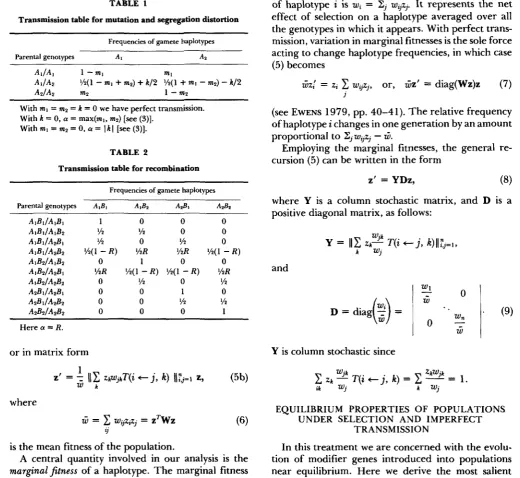
Different genetic systems may produce different levels of imperfect transmission during reproduction. A quantity that plays a central role in our analysis is the level of perfect transmission that is guaranteed by the genetic system for all possible parental genotypes. This upper bound (over all genotypes) on the proba- bility of imperfect transmission we refer to as a. Any transmission matrix can be written in the form,
which involves a mixture of the perfect transmission matrix, T i d and a transmission matrix,
P.
T h e value a is the minimum value for which the elements of the matrixT
-
(1-
c~)T;,j L 0(4)
are non-negative, so that 1
-
a is a measure of the degree of perfect transmission present in T.Tables 1,
2
and 3 show the transition probabilities for several standard models of mutation, segregation distortion, and recombination, and an example of a model of gene conversion at two loci. T h e value of a for each of these models is given.E V O L U T I O N OF H A P L O T Y P E S U N D E R S E L E C T I O N A N D G E N E R A L I Z E D T R A N S M I S S I O N
Here we formulate a general model of evolution for a diploid population undergoing random mating, viability selection, and transmission of haplotypes from zygote to gamete. Let z be the vector represent- ing the frequencies of all gametic haplotypes in the population. Let
w
=llwyll&,
where w,, is the viability of a genotype composed of haplotypes i and j. We assume sex symmetry so that
WI,12 = W,p,.
With a life cycle consisting of random union of gametes, viability selection, and generalized transmis- sion, the recursion on the frequencies of gamete hap- lotypes is
zik: = n n
1
Z J Z J ( ic j ,
K)W$1=1 k = l
Evolution of Modifier Genes
TABLE 1
Transmission table for mutation and segregation distortion
Frequencies of gamete haplotypes Parental genotypes Ai
With m l = mp = k = 0 w e have perfect transmission. With k = 0, (Y = max(m,, mz) [see (3)].
With ml = m2 = 0 , (Y =
I
k 1 [see (3)].TABLE 2
Transmission table for recombination
Frequencies of gamete haplotypes Parental genotypes AIBl A i & AnBl AS&
AiBiIAIBI 1 0 0 0
A iBi/Ai Bz %J ‘/s 0 0
AiBiIAzBi YZ 0 % 0
AiBzIAiBz 0 I 0 0
AiBz/AzBz 0 % 0 Y2
AzBIIAdi 0 0 1 0
AzBiIAzBz 0 0 L/n %
AzBzIAzBz 0 0 0 1
A I B I / A ~ B ~ %(1 - R ) %R %R %(1 - R ) AiBzIAnBi %R %(1 - R ) %(I
-
R ) %RHere (Y = R .
or in matrix form
1
Z’ = 1
1
1
1
LkwjhT(i t j ,k)
11tj-1 2,(5b)
w k
where
G = w+zjzj = zTwz (6)
ij
is the mean fitness of the population.
A central quantity involved in our analysis is the marginal j t n e s s of a haplotype. T h e marginal fitness
of haplotype a is w, = ZJ wyzy It represents the net effect of selection on a haplotype averaged over all the genotypes in which it appears. With perfect trans- mission, variation in marginal fitnesses is the sole force acting to change haplotype frequencies, in which case
( 5 ) becomes
Gz:
= L, w,,zJ, or, Gz’ = diag(Wz)z(7)
(see EWENS 1979, pp. 40-4 1). T h e relative frequency of haplotype
i
changes in one generation by an amount proportional to ZJ wyz,-
i.
Employing the marginal fitnesses, the general re- cursion (5) can be written in the form
J
z’ = YDz, (8)
where Y is a column stochastic matrix, and D is a positive diagonal matrix, as follows:
and
Y
is column stochastic sincewjk rkwjk
zk
-
T(i t j ,k)
=-
= 1.ik wj k Wj
EQUILIBRIUM PROPERTIES OF POPULATIONS UNDER SELECTION AND IMPERFECT
TRANSMISSION
In this treatment we are concerned with the evolu- tion of modifier genes introduced into populations near equilibrium. Here we derive the most salient
TABLE 3
Transmission table for unbiased gene conversion at two loci
Frequencies of gamete haplotypes Parental genotypes
~ ~~
562 L. Altenberg and M. W. Feldman
property of populations at equilibrium, which is the relation between imperfect transmission and variation in marginal fitnesses.
Consider a population that is at an equilibrium for the frequencies of the haplotypes. Recursion (8) pro- duces the equilibrium identity
i
= ?Di. (10)With perfect transmission 2 =
Di,
so that..
*
and z& = ZZI for all haplotypes i such that
zi
>
0. This is true regardless of any frequency dependence of the w’s. Hence, we have the well knownResult 1: With perfect transmission, all the haplotypes present in the population have equal marginal jtnesses at equilibrium.
In the presence of imperfect transmission, there can be differences at equilibrium in the marginal fitnesses of the haplotypes present. Moreover, the potential magnitude of the variation in the equilibrium mar- ginal fitnesses can be shown to depend on the maxi- mum level of imperfect transmission, a , characteristic of the genetic system. On substituting the expressions (3) into the equilibrium equations (lo), since P 2 0 we easily deduce that
z&/k
5 (1-
a)-’ for all i .Later we show that the strength of selection on the modifier gene depends quantitatively on the magni- tude of the difference between the maximal marginal fitness in the population and the mean fitness. This quantity is a variant on the genetic load defined by CROW (1 958), and we call it the “selection potential”:
Definition 1: T h e selection potential, V , present in a population is defined as
-
(1 1)max(wJ
- 1 =-
V = -
W 1 - L ’
L
i
where L is the genetic load, 1
-
(z3/maxi(wi)), as defined by CROW (1958).T h e upper bound to the equilibrium selection po- tential is
(12)
a V 5 -
1
-
a’which increases without limit as a increases toward 1, and approaches 0 as a tends to 0. This definition of selection potential corresponds to the less common definition of genetic load used by EWENS (1979, p. 66).
G E N E R A L M O D I F I E R G E N E M O D E L
T h e general modifier gene model is a special case of formulation (5) with haplotypes undergoing both selection and imperfect transmission. T h e haplotype
is partitioned so that one part, the set of selected loci, A , undergoes selection and generalized transmission, while the other part, the modifier locus M , controls the transmission of the first part. Thus haplotypes are indexed with two subscripts, so that
MaAz
represents the haplotype with modifier allele a and multilocus haplotype i for the set of loci under selec- tion. Its frequency is zut. We assume that the modifier alleles have no effect on the fitness of their carriers. Thus, the fitness of genotype MaAJ/MJk will be WJk
for all a, b . We use the notation A, for haplotypes that consist of alleles Gl,G21G3t 1
.
with the subscripts 1, 2, 3, etc., indicating the selected gene locus. It will be assumed throughout that the location of modifier locus is external to the A haplotype. If G I is the selected locus nearest the modifier locus, we denote by r the probability of recombination between M andG I .
We assume that the modifier alleles are perfectly transmitted regardless of the processes acting on the selected haplotypes, so that the only force acting on the modifier locus is the induced selection resulting from its effect on the transmission of the other loci. To take account of recombination between M and G I we introduce two new transmission matrices, T* and
?*,
which describe the transmission of the complete system of modifier and selected genes and also keep track of each modifier allele during transmission.T*(ai t aj
I
bk) is the probability that haplotype M,A,is produced from haplotype M A in genotype M,AJ/ M J k , given that no recombination has occurred be- tween M and GI. F*(ai + ak
I
bj) is the probability that haplotype M,A, is produced from haplotype MaAk in genotype M,A,/Mt.& given that recombination has occurred between M and G I . Conditioning in this way on recombination between M and G I takes ac- count of any possible interference between crossovers in the region between M and GI and the transmission of the A haplotype. In the absence of interference, T*(ai t u jI
bk) = f * ( a i taj
I
bk) for all a, b, i, j , K .T h e recursion (8) for the general modifier model with random mating can then be rewritten as
a . J
W cjk
In terms of T* and
?*
can be written1
2 T(ai t u j , bk) = - (1
-
r
+ -
2
(13)
+
rF*(bi t bk1
c j ) ~ .the original T defined in (1)
Modifier Genes
T(ai t u j , ah) ing notation:
1 2
=
-
(1-
r)[T*(ai c ujI
ak)+
T*(ai t akI
a j ) ]r
2
+
-[F*(ai
t aklaj)+
T*(ai + ajlak)],and T(ai t bj, ck) = 0 if b # a and c # a, where Z,
T(ai t ajlbk) = 1 for all a, b, j ,
K,
and T(ci t ajl bk) = Q c i e- ajI
bk) =o
if cz
a.T h e original T‘s are not used after this point, so for convenience the asterisks from the new sets of T’s are suppressed. T h e new T’s can be represented in matrix form as
T a b = IIT(ai ajl
I
b j Z ) l l ! ~ ~ ~ 2 = 1and
+ab = IIF(ai aj1
I
bj2)11:J]J2=1*In the absence of interference Tab =
‘kab.
It will beassumed that there are no position effects between M and A . That is, the linkage phase between M and A within the diploid genotype does not affect the trans- mission of A . This is expressed as:
T(ai t aj
I
bk) =T(bi
t bjI
ah) andq u i
t aj1
bk) = q b i c bjI
ak),* *
o r in matrix form, Tab = Tba and Tab = Tbo. This excludes the possibility that the modifier controls transmission processes that occur during the haploid phase of the life cycle.
Segregation distortion acting on the modifier locus is excluded here because this would constitute imper- fect transmission of the modifier. This entails Z,
~ ( a i c a j ~ b k ) = 1, Z, Q u i t a j l b k ) = 1 for all a, b , j ,
k.
This restriction is actually necessary to ensure thatT and
?’
satisfy condition (1) in the original definition of transmission matrices.If the selected haplotypes are perfectly transmitted in an organism of modifier genotype Ma/Mb, then
(14) T&i t aj
I
bk) = F,&i t ajI
bk) = 6,0 if
i # j
= i
1 if i = j 7 Only if r = 0, however, will this constitute perfect transmission of the entire haplotype of both modifier and selected loci.ANALYSIS OF THE RECURSIONS
In this section we investigate the fate of new modi- fier alleles introduced into the population in the neighborhood of a stable equilibrium.
The equilibrium identity: We introduce the follow-
and
D = d i a g e ) ,
as in (9). Qb are column stochastic matrices.
must be satisfied:
- 1
At any equilibrium for (1 3), the following identity
f b i = ibji&wjk[( 1
-
r)T(bi t bjI
ck)(16) w cjk
+
@(bi t b k l c j ) ] .i b = QbDib. (17)
This can be written in a vector form analogous to (8):
The “external stability” of equilibria: T o investi- gate the long-term evolutionary fate of the modifier locus, we need to know those characteristics of new modifier alleles that determine whether they will in- crease in the population when introduced near an equilibrium. Let a new modifier allele, M a , be intro- duced into the population near
i,
with f a , the fre-quency of haplotype MaAi. From (1 3 ) the vector form of the linearized recursion for the cui’s, ignoring terms of order t:i, is
..
e’ = Q,De. (18)
Assuming that the polymorphic equilibrium
i
is locally stable to perturbations in the frequencies of the hap- lotypes already present, the initial increase of the new modifier allele is determined by the spectral radius of the stability matrix,p(Q,@. (1 9)
If p(QaD)
>
1, the new modifying {llele increases. If p(QaD)<
1, it decreases and if p(QaD) = 1, the modi- fying allele cannot change at a geometric rate. We call these the “external stability” properties of the equilib- rium.REDUCTION PRINCIPLE
564 L. Altenberg and M. W. Feldman
fitnesses of the selected haplotypes at equilibrium. Thus, when a population is near an equilibrium, se- lection cannot act on a newly introduced modifier allele to change its frequency at a geometric rate unless there is an equilibrium selection potential.
In this section we present the main results about the initial increase properties of a new modifier allele introduced to the randomly mating population at a polymorphic equilibrium. These results concern exter- nal stability of the equilibria with respect to changes in the direction of the modifier frequencies. Although the assumption of the existence of the equilibria may entail constraints on the selection regimes and trans- mission probabilities, in none of the results d o these constraints or closed form solutions of the equilibrium frequencies appear. T h e only generic assumptions made are as follows: ( 1 ) There is polymorphism in the selected haplotypes, and
(2)
new modifier alleles d o not cause the selected haplotypes present at equilib- rium to be transformed into haplotypes not present.Our results regarding the evolution of reduced levels of imperfect transmission fall into two cases according to the effect of the new modifier allele on transmission:
Case 1. Imperfect transmission eliminated at the selected loci
Result
2:
a) A population at equilibrium with a nonzero selection potential can always be invaded by a new modijer allele that eliminates imperfect transmission at the selected loci, f o r any amount of linkage of the modijier to these loci. b) In particular, for a modijier locus that is absolutely linked to the selected loci (which are absolutely linked in the presence of the new modajier allele), the spectral radiusof the external local stability matrix equals one plus the equilibrium selection potential, i.e.,
c) Moreover, for all r 5 1/2, the spectral radius of the
external local stability matrix is always greater than one by at least the equilibrium marginaljtness variance, i.e.,
d) For a given set of equilibriumjtnesses and haplotype frequencies, the selective advantage of a new mod$er allele that eliminates imperfect transmission decreases with looser linkage to the selected haplotypes.
e) The selection potential is always greater than the population variance in the marginal jtnesses.
T h e proofs of this and subsequent results are given in the APPENDIX.
Remarks: (i) Result e) does not require that the population be at equilibrium, but holds for popula- tions in the transient phase of their dynamics as well.
(ii) In principle, because the frequency vector v and the fitness matrix W are the only facts about the polymorphic equilibria that are relevant to the fate of the new modifier allele, Result
2
can be shown to hold no matter what linkage arrangements obtain for those modifier alleles and selected loci segregating at the polymorphism. Moreover, the modifier alleles present at the polymorphism may even control their own linkage to the selected loci without changing this result. T h e new modifier allele, however, must fit the assumptions given earlier (that it be external to the selected haplotype and have a single recombination rate r with the nearest selected locus) for the proof of Result2
to hold.Case
2.
Linear variation in the transmissionSo far we have considered only modifier alleles that produce large reductions in the imperfect transmis- sion acting on a set of selected loci. Now we consider modifiers that can change the level of imperfect trans- mission over a continuous range of values. Here, the way changes in T reflect variation at the modifier locus is critical in the evolution of modification.
T h e simplest kind of variation in transmission con- stitutes a basic “building block” of variation for more complex systems. Suppose that each selected haplo- type, A,, has a certain probability, m , of being “hit” by some transforming process, and given that it is hit, it is transformed into various other selected haplo- types with different probabilities. These probabilities, T l ( i c j
I
k), include possible dependence on both haplotypes A, and Ak in the diploid genotype. If the effect of the modifier gene is to scale the “hit” rate, m, up or down equally for all haplotypes, it will be said to produce “linear” variation in the transmission.Definition
2:
For linear variation, the transmission matrix for modifier genotype MJMb can be repre- sented as a weighted average,T(mab) = (1
-
mab)Ttd+
mabT1,where T I is a transmission matrix that is independent of the allelic configuration at the M locus, and the modifier’s sole effect to determine the parameters mab. Examples are discussed after Result 3.
We consider here the initial increase properties of a new modifier allele that produces linear variation in the transmission. Attention is restricted to the intro- duction of new modifier alleles into populations that are fixed at the modifier locus, but all of the initial increase results extend to a class of modifier poly-
morphisms discussed in LIBERMAN and FELDMAN
( 1 986a,b; 1987).
and
Evolution of Modifier Genes
and
T1 = Ili;(li c lj21 1 j l ) l l y j , j 2 = l .
Denote the total frequency of each selected haplo- type by
vi = %hi.
b
In this case i l k = 6 k
>
0 for all k. At equilibrium, from( 1 6 ) the selected haplotype frequencies must satisfy
the identity
i
= I t l D ) f = [ ( l-
r)*l+
T $ ~ ] D ; , ( 2 0 )where
and D is the diagonal matrix of relative marginal fitnesses defined in (15).
4,
and Y are both column stochastic.Reduction principle for linear variation in transmission
A new modifier allele
Mz,
yielding transmission matrices T 2 and?‘z
as a heterozygote with M1 is introduced into the population. A general way to represent linear variation between TI and T2, andbetween
Tl and
T 2 uses (14), and Definition 2, as follows:( 2 3 4
T(2i t 2jl l k ) = ( 1
-
m21)c5ji+
mnlT(1i t l j l l k )is the relation between T 1 and T 2 , and
f ( 2 i c 2kl l j ) = ( 1
-
mZ1)&(23b)
is the relation between ? I and
‘ f z .
Here mZ1 representsthe parameter for MzIMl.
Remark: Recall from the characterization of linear variation that ml1 and m21 are interpreted as being the overall probability that the selected haplotypes are “hit” by a transforming process. T h e above definitions of T2 and f‘2 in terms o f
T1
and‘k,
require that mll be scaled to 1 . Thus mZ1 is the “hit” rate for modi- fier genotype MJM1 relative to modifier genotypeM I / M I . We will refer to mzl as the value of the “modified parameter” for modifier genotype M2/Ml.
+
m21f(li c 1 k J l j )Define
Therefore,
where
From ( 1 8), the recursion on the frequencies of haplotypes containing the new modifier allele is
E’ = Q2De = [(l
-
r)?,+
r$p]De. ( 2 6 )M2 will increase when rare if and only if
p ( ~ 2 D ) = p ( [ ( l
-
r)+2+
r921D)>
1 .Result 3: A new allele at a modijier locus that is
absolutely linked to a set of selected loci is introduced into a population near an equilibrium in which the modijier is f i e d , with a nonzero selection potential for the selected
haplotypes. If the new modijier allele produces linear variation in the transmission of the selected loci, then
if
Q2 is irreducible (reducible)
a) the new modijier allele will increase (not decrease) in frequency at a geometric rate
if
it brings the transmissioncloser to perfect transmission, i.e.,mnI/mll
<
1 andb)
it
will decrease (not increase) in frequency at a geometric rateif
it takes the transmission further away from perfect transmission, i.e., m21/m11>
1 .Moreover,
c) the asymptotic rate of change in the frequency of the modijier allele
is
an increasing function of the change it makes in the transmission probabilities.Remarks: (i) T h e result is proven for r = 0 but will hold also for sufficiently small positive values of r
(KARLIN and MCGRECOR 1972) when Y2 is irreduci- ble.
(ii) T h e proof of this result employs Theorem 5.2
of KARLIN (1982) and is included in the APPENDIX.
566 L. Altenberg a n d M. W. Feldman
and, setting r = 0, the recursion for the new modifier allele M2 is
Set positive constants m l l , f i l , f 1 2 , f21, f22 such that
wherefll + f 2 1 = f i 2
+
f22 = 1; then linear variationrequires that p12 and v12 satisfy
which entails v I l/pl 1 = v12/p12, i.e., there exists b such
that uy = bp, for all
i, j .
This is the assumption under which Liberman and Feldman obtain the reduction result, namely N = b M . T h e definition of linear vari- ation here includes the previous models of recombi- nation modification by NEI (1 967), FELDMAN (1972), FELDMAN and BALKAU (1 973) as well as the migration and mutation modification models of BALKAU and FELDMAN (1 973), KARLIN and MCGREGOR (1 974) and TEAGUE (1 977).Linear variation embodies the fourth condition given in LIBERMAN and FELDMAN (1986a) for the reduction principle to hold for modifiers of recombi- nation, mutation, and migration, namely, that besides viability selection, the only evolutionary force in the system is that feature of the genetic system subject to genetic modification. This requirement is illustrated in the models of recombination modification in FELD-
MAN, CHRISTIANSEN and BROOKS (1980). In their
Model I, which produces the reduction result, with r = 0 the stability recursion on the new modifier allele is
c‘ = (1
-
r2)De *I
31Wll+
33w13 31Wl2+
33w23I
0 00 0
0 0
c
3iw13
+
33w3, 6 I W 1 4+
33w3432w23
+
34w34 32w24+
34w44where r2 is the recombination rate produced by the new modifier heterozygote. This again fits the form for linear variation, and Result 3 can be seen to apply.
Strength of selection on modifiers
Previous treatments of modifier gene evolution have generally not examined the magnitude of the selective forces that act on modifier genes, one excep- tion being the work on inversions by CHARLESWORTH and CHARLESWORTH (1 973). WRIGHT (1964) stressed that pleiotropic effects of modifier genes could cause them to have intrinsic fitness differences. It has gen- erally been felt that such selection on the modifier locus would overwhelm any selection due to its effects on transmission (e.g., KARLIN and MCGREGOR 1974).
Here we show that the selection on modifier genes due to their effects on transmission can be quite strong.
From Result 2b, in the case of an absolutely linked modifier allele that eliminates all imperfect transmis- sion, its induced marginal selective advantage is equal to the equilibrium selection potential. This advantage decreases with looser linkage of the modifier but is always greater than the population variance in the equilibrium marginal fitnesses (Results 2c and 2d).
For one special case of transmission, we can derive an estimate of the amount of selection on a new modifying allele that yields linear variation in the transmission. It will be a function of how far the new value of the modified parameter deviates from the parameter value of the population at the original equilibrium. T h e transmission for which this estimate can be obtained is the “house of cards” mutation distribution defined by KINGMAN (1980). This is sim- ply a mutation process which has no memory; all haplotypes mutate at the same frequency, and the probability that the mutant is a given haplotype does not depend on what the original haplotype was. There are several familiar analogs to “house of cards” (i.e., memoryless) distributions for models of migration, including the Wright island model, the Levene model, and the Deakin model (see KARLIN, 1982).
With linear variation in the transmission, and no interference between the mutation process and re- combination between M and A , the general form for the transmission matrix with a memoryless distribu- tion is
T(ai t uj
I
bk) = (1-
mab)c$,+
ma&. (27)where m,b is the overall mutation rate and
p ,
is theprobability of producing selected haplotype
i
given that there is a mutation, and T =T.
T h e modifier, therefore, may change the overall rate but not the relative distribution of mutations.Suppose that the population is at an equilibrium, with a modified parameter of ml Substitution of (27) into (21) yields
?I
= (1-
m l l ) I+
m l l P , and = YIQ, (28)Evolution of Modifier Genes 567
the n by n matrix of ones. T h e equilibrium value
G
solves the identity
i
= [(l-
m11)I+
m l l P ] DG(29)
= (1
-
ml1)DC+
m l l pfor any r , which emerges from (20) using the identity QDG =
DG.
A new modifier allele, M 2 , is now introduced into the population with mZ1 as the value of the modified parameter in the M 2 / M 1 heterozygotes. From (26) the linearized recursion on the frequencies of the haplo- types bearing M2 is
t’ = +2[(1
-
r)I+
r ~ l D twhere mZ1 has been substituted for m11 in (28) to produce
9,.
Since there is assumed to be no interfer- ence,G z
= ?2Q. Then we have the followingResult 4: Consider the case of linear variation in transmission with a memoryless distribution specijied by
(ZS), with
p ,
>
0 f o r all i. For a tightly linked modafaer,the spectral radius of the stability matrix f o r a new modi- j j i n g allele with parameter m21 as a heterozygote, with mZ1
close to ml
>
0 , is approximately:p ( e 2 D ) r 1
+
(mil-
m21)*
.(Dm:]
P;’$GJ-’
P;~$(G,
-
$1‘.
Remarks: T h e spectral radius is the actual value for the asymptotic relative marginal fitness of the new modifier allele, i.e.,
I :
W M ,
- -
- P ( 9 2 D ) .W
Consistent with Result 3, a new modifier allele can increase if and only if it reduces the amount of mu- tation. T h e term
p;1qZii
-
i ) 2 (30)i
is of the same order as the marginal fitness variance and is zero if and only if the variance of the marginal fitnesses is zero. Therefore, for small modifications of the transmission process the selection for o r against the new modifier allele will be on the order of the equilibrium fitness variance in the population times the deviation of the value of its modified parameter from the equilibrium value before its introduction.
T h e selective force on the modifier may be inter- preted as a consequence of the selection on the major genes rather than imperfect transmission. By substi- tuting from an alternative form of the equilibrium identity (29), namely
(30) becomes
i2m:l(1
-
mil)-'
-
pi)’. (31)i
If no selection were acting then under mutation) alone the equilibrium haplotype frequencies would all be
4.
=p .
2 1.
Thus the squared term is the deviation of the selected haplotype frequencies from what they would be under pure mutation. T h e effect of adding selection to a system of pure mutation is to create selection for decreased mutation.
Selection on inversions
A new chromosomal inversion is formally the same as a new modifier allele that eliminates recombination between the loci flanking the inversion, and is tightly linked to them. If we consider the two flanking loci in isolation, a rate f of recombination between them, prior to the introduction of the inversion, permits a maximum selection potential of f / ( 1
-
f ) when there is a two-locus polymorphic equilibrium [see (1 2 ) ] . Re- sult 2b can therefore be used to give an upper bound for the selective force on an inversion in terms of the map length alone. T h e expression for the selectiveforce given by CHARLESWORTH and CHARLESWORTH
(1973) requires in addition an estimate of the linkage disequilibrium.
Result 5: The relative amount of induced selective advantage on a chromosomal inversion can range up to
1 - f ’
where f is the map length of the inversion, in units of crossover frequency.
Remark: In the examples of CHARLESWORTH and CHARLESWORTH (1 973), the strength of selection on the inversion is seen to approach f / ( 1
-
f ) as epistasis and f become smaller. From the case in Table 1 of KARLIN and CARMELLI (1975), where the initial in- crease of an appropriate new inversion violates the“mean fitness principle” (KARLIN and MCGREGOR
1974), the strength of selection on inversions bor- dered by two loci that are 2.5 to 3 centimorgans apart can be seen to be more than 98.8% of f / ( 1
-
f ) .DISCUSSION
568 L. Altenberg and M. W. Feldman
variation in marginal fitnesses), and the evolution of transmission under the control of modifier genes. T h e “selection potential” we have defined enters quanti- tatively into the strength of selection acting on modi- fier genes by providing an upper bound for the poten- tial relative rate of increase in frequency of any hap- lotype in the population due to selection. With perfect transmission, this value vanishes at any equilibrium. In the presence of imperfect transmission, equilibria may be reached where the selection potential is kept above zero by an amount dependent on the level of imperfect transmission. This balance occurs because haplotypes that are depleted by selection are replen- ished from other haplotypes by imperfect transmis- sion, and conversely, haplotypes whose numbers are augmented by selection are depleted by imperfect transmission.
Selective forces on modifier genes: When the mod- ifier locus is perfectly transmitted, as we have assumed throughout, the only force changing the frequencies of its alleles is selection, manifested as differences in the alleles’ marginal fitnesses. When the modifier locus is selectively neutral, the marginal fitness of each modifier allele is simply the average of the fitnesses of the selected haplotypes with which it is associated. Summing over
i
in ( 1 3) shows thatwhere xb is the total frequency of modifier allele Mb, and
wMb = zbjwjlxb
is its marginal fitness.
These marginal fitnesses would clearly be the same for all of the modifier alleles if they were randomly associated with the selected haplotypes. Evolution of modifier genes occurs because, through their effects on transmission, they may be able to create linkage disequilibrium between themselves and the selected haplotypes. Those modifier alleles that occur more frequently with the fitter types in the population in- crease in freqyency. This is known as “hitchhiking,” and is the fundamental mechanism by which neutral, perfectly transmitted modifier genes evolve.
T h e dynamics of hitchhiking in populations that are in a transient phase of their evolution differ greatly from the dynamics in populations that are near equi-
librium (CHARLESWORTH, 1976; STROBECK, MAY-
NARD SMITH and CHARLESWORTH, 1976). Hitchhiking is usually thought of as a process whereby an allele at one locus increases in frequency by being linked to an allele at another locus that is increasing in frequency due to selection (EWENS 1979, p. 205). It might be expected that at an equilibrium, because there are no changes in the frequencies, there could be no hitch-
hiking effects at all. But to the contrary, Result 2a demonstrates that in fact hitchhiking can occur in the absence of linkage between the modifier locus and the selected loci, and when the alleles of the selected loci are very close to equilibrium.
This paradox is resolved by noting that when im- perfect transmission permits a positive selective poten- tial at equilibrium, there is a constant net “flow,” by imperfect transmission, from the fitter haplotypes to the less fit. By altering this “flow,” a modifier allele can come to be in disequilibrium with the selected haplotypes, and may therefore acquire a marginal fitness different from the mean of the population. For Result 2a, the linkage disequilibrium between the modifier and the selected loci that causes hitchhiking is generated by selection every generation, and even free recombination can no more than halve this dis- equilibrium by the next phase of selection. It should be noted that any continuous dependence of T
p-
W on allele frequencies does not enter into Q,D, so provided that p(Q,D) # 1 neither the magnitude nor direction of selection on a new modifier allele are affected by frequency dependence.What d o the estimates from Results 2 and 4 for the strength of selection on a new modifier allele suggest for the order of magnitude of selection on modifiers in nature? T h e selection potential is the maximum possible rate of increase for modifier alleles, as well as selected alleles, and is exploited to its fullest by a modifier that stops all imperfect transmission and is tightly linked to the selected haplotype.
As the guaranteed level of perfect transmission of the haplotypes decreases, i.e., as the value of a in- creases, the upper bound on the equilibrium selection potential, a / ( l
-
a), increases without limit (as a goes to one). T h e typical values of a in nature depend on the particular imperfect transmission process. In the case of mutation, even though per-locus mutation rates are quite small, per-haplotype rates can be quite high, of order 1 . Similarly, per-chromosome recom- bination rates can be on this order (VON WETTSTEIN, RASMUSSEN and HOLM 1984, p. 399). Therefore, the selection potentials that may be typical of natural populations at equilibrium, which are the potential strengths of selection that can be induced on neutral modifier genes, may be quite strong. So we may consider what happens when selection acts directly on the modifier locus, which may be a biologically more reasonable assumption given the ubiquity of pleio- tropy (WRIGHT 1964). We see that the induced selec- tion on a modifier due to its effect on transmission can overwhelm considerable direct selection acting on the modifier. If direct selection gives modifier geno- type M1/M2 a selective valuefi2, and interacts multi- plicatively with selection on the major loci, then the fitness of genotype MIA,/M2A, will befi2w8, and the rate of change in the frequency of modifier allele M2Evolution of Modifier Genes 569
Reduction principle: In Result
2,
the condition for the invasion of a new modifier allele was that it elim- inate imperfect transmission acting on the selected loci provided a nonzero selection potential is main- tained at equilibrium by imperfect transmission. This is seen to be true for all viability regimes, and all polymorphisms at the modifier and selected loci. Re- sult 3, for the case of linear variation, is more re- stricted in scope, applying only for tightly linked mod- ifier genes that produce linear variation in the trans- mission, with the population fixed on the modifier gene. In this case, a new modifier allele introduced into a population bearing a selection potential induced by imperfect transmission can increase if and only if it takes the transmission closer to perfect transmission, and is excluded if it takes the transmission further away. We conjecture that our results for linear varia- tion will hold for arbitrary levels of linkage between the modifier and selected genes.Result 3 has several implications. In previous treat- ments of recombination modification, only two loci under selection with two alleles each were allowed, and it was assumed that both double heterozygotes at the selected loci had the same fitness, and had the same crossover frequencies for any given modifier genotype. None of these assumptions enters Result 3: there may be multiple alleles at each selected locus and there may be multiple loci under selection. If there are more than two selected loci, however, for the variation of the transmission to be linear, there must be complete interference between crossover events among the loci, and the modifier must simul- taneously control every crossover event for the set of loci. Different fitnesses are allowed for the different linkage phases in the multiple heterozygotes at the selected loci (i.e., position effects on fitness are al- lowed). For any given modifier genotype, different recombination rates for the different double hetero- zygotes at the selected loci are also allowed. For mul- tiple loci under selection, the crossover frequency distribution among the loci need not be equal for the different heterozygotes. All that is required is that the modifier gene affect the crossover rates linearly.
Most of the basic models of modification in the literature treat linear variation, including models of
mutation modification (LIBERMAN and FELDMAN
1986b; HOLSINCER and FELDMAN 1983b; KARLIN
and MCGREGOR 1974), recombination modification
(FELDMAN, CHRISTIANSEN and BROOKS 1980; TEACUE
1976; CHARLESWORTH 1976) and migration modifi- cation (BALKAU and FELDMAN 1973; KARLIN and
MCGRECOR 1974; TEACUE 1977; LIBERMAN and
FELDMAN 1988). Several factors cause a model to deviate from linear variation, including nonrandom mating, and the involvement of more than one imper- fect transmission process during the life cycle. Also, the modifier may not simply vary the overall chance that a selected haplotype is “hit” by an imperfect
transmission event, but may change the distribution of gametic haplotypes produced by a given parental gen- otype, and this also produces deviations from linear variation.
Examples of nonlinear variation include models of recombination modification in the presence of muta-
tion (FELDMAN, CHRISTIANSEN and BROOKS 1980),
models such as recombination modification in the
presence of migration (CHARLESWORTH and CHARLES-
WORTH 1979b), the model of CHRISTIANSEN and FELDMAN (1975) where a modifier controls either recombination or migration in a population undergo- ing recombination and migration, and the model of a modifier acting o n recombination between multiple
loci by CHARLESWORTH and CHARLESWORTH (1 979a).
In the next section we discuss some examples of non- linear variation that lead to increases in the modified parameter.
Evolutionary genetic stability of perfect transmis- sion: ESHEL and FELDMAN (1 982) developed “evolu- tionary genetic stability” of a phenotype as a first order criterion for establishing that the long-term tendency of evolution is toward this phenotype. In their papers on the* general reduction principle in the cases of mutation, recombination, and migration modifica- tion, LIBERMAN and FELDMAN (1986a,b; 1988) con- jecture that for the models they consider, the pheno- types of zero mutation, zero recombination, and zero migration have evolutionary genetic stability given four conditions:
1. T h e selection of the major locus (or loci) is at the level of differential genotypic viabilities.
2.
These viabilities d o not change over time. 3. There is random mating.4, Besides viability selection, the only evolutionary force operating is that feature of the genetic system subject to genetic modification.
In the cases analyzed here, we would expect that after its initial increase a new modifying allele would change in fTequency until a new equilibrium is ap- proached at which the population average parameter value is less than that at the initial equilibrium. In other words, perfect transmission should be the state towards which evolution proceeds in these cases. T h e proof of this result, analogous to that of KARLIN and LESSARD (1984), appears to be significantly more dif- ficult than that of our results here.
Because perfect transmission is not the norm in nature, with the ubiquity of mutation and the preva- lence of different kinds of recombination, it is impor- tant to ask whether there are ever conditions under which a new modifier allele that increases the level of imperfect transmission in the population can invade. In fact, there are cases where it can. When selection fluctuates, recombination rates (CHARLESWORTH
570 L. Al t e n b e r g and M. W. Feldman
crease. When the population is of finite size and random genetic drift is included in the model, GIL- LESPIE (1 98 1 b) has shown that mutation rates may increase and the same has been shown for recombi- nation by FELSENSTEIN (1 974) and FELSENSTEIN and YOKOYAMA (1976). When one gene controls the seg- regation pattern at another locus, which is also subject to viability selection, the recombination between the pair is not necessarily reduced (PROUT, BUNGAARD
and BRYANT 1973; THOMSON and FELDMAN 1974).
Another example is provided by the case of recombi- nation modification analyzed by FELDMAN, CHRIS- TIANSEN and BROOKS (1980), where the loci whose linkage is controlled by the modifier also undergo mutation. In this case there are conditions where a new modifier allele can invade the population if it increases the frequency of recombination between the loci.
How is this latter result possible in light of Result 3 on modifiers producing linear variation in transmis- sion? T h e answer is that in the presence of mutation, the variation produced by a modifier of recombina- tion is not linear. In this example, condition 4 in the conjecture of LIBERMAN and FELDMAN (1 986a,b), above, is violated. In other cases where increases in imperfect transmission can evolve in populations near equilibrium, the variation in the transmission again does not fit the form for linear variation. This is the case, for example, when recombination can evolve to increase in the presence of migration (CHARLES- WORTH and CHARLESWORTH, 1979b), o r selfing (CHARLESWORTH, CHARLESWORTH and STROBECK 1979; HOLSINCER and FELDMAN 1983a), o r mutation can increase in the presence of fertility selection (HOL- SINGER, FELDMAN and ALTENBERC 1986) o r selfing (HOLSINGER and FELDMAN 1983b). T h e generalized reduction results we obtain here show that it is the nature of the variation in the transmission process that determines the direction of its evolution. Factors in- fluencing the functional form of this variation should therefore be the focus for developing further under- standing of the evolution of genetic transmission.
We wish to thank FREDDY CHRISTIANSEN, URI LIBERMAN, LUIGI CAVALLI-SFORZA, JOSEPH OLICER, S H R ~ P A D TULJAPURKAR, KENT HOLSINGER and JOEL PECK for their helpful comments, and RICH-
ARD LEWONTIN for the idea (in the context of cultural evolution) that selection and transmission form a useful dichotomy.
This research was supported in part by research grants GM 28016, GM 10452, GM 07181 and FD 2589-9414L from the National Institutes of Health.
LITERATURE CITED
BALKAU, B. J., and M. W. FELDMAN, 1973 modification. Genetics 7 4 171-174.
CHARLESWORTH, B, 1976
tuating environment. Genetics 83: 181-195.
Selection for migration
Recombination modification in a fluc-
CHARLESWORTH, B., and D. CHARLESWORTH, 1973 Selection of new inversions in multi-locus genetic systems. Genet. Res., 21:
167-1 83.
CHARLESWORTH, D., and B. CHARLESWORTH, 1979a Selection on recombination in a multi-locus system. Genetics 91: 575-580.
CHARLESWORTH, D., and B. CHARLESWORTH, 1979b Selection on recombination in clines. Genetics 91: 58 1-589.
CHARLESWORTH, D., B. CHARLESWORTH and C. STROBECK,
1979 Selection for recombination in partially self-fertilizing populations. Genetics 93: 237-244.
CHRISTIANSEN, F. B., and M. W. FELDMAN, 1975 Subdivided populations: a review of one- and two-locus deterministic the- ory. Theor. Popul. Biol. 7: 13-38.
CROW, J. F., 1958 Some possibilities for measuring selection in- tensities in man. Hum. Biol. 3 0 1-13.
ESHEL, I . , and M. W. FELDMAN, 1982 O n evolutionary genetic stability of the sex ratio. Theor. Popul. Biol. 21: 430-439.
EWENS, W. J., 1979 Mathematical Population Genetics. Springer- Verlag, Berlin.
FELDMAN, M. W., 1972 Selection for linkage modification. I. Random mating populations. Theor. Popul. Biol. 3: 324-346.
FELDMAN, M. W., and B. BALKAU, 1973 Selection for linkage modification. 11. A recombination balance for neutral modi- fiers. Genetics 74: 71 3-726.
An evolutionary re- duction principle for genetic modifiers. Proc. Natl. Acad. Sci. USA 83: 4824-4827.
FELDMAN, M. W., F. B. CHRISTIANSEN and L. D. BROOKS,
1980 Evolution of recombination in a constant environment. Proc. Natl. Acad. Sci. USA 77: 4838-4841.
T h e evolutionary advantage of recombi- nation. Genetics 78: 737-756.
The evolutionary ad- vantage of recombination. 11. Individual selection for recom- bination. Genetics 83: 845-859.
GILLESPIE, J. H . , 1981a Mutation modification in a random envi- ronment. Evolution 35: 468-476.
GILLESPIE, J. H . , 1981b Evolution of the mutation rate at a heterotic locus. Proc. Natl. Acad. Sci. USA 78: 2452-2454.
HOLSINGER, K. E., and M. W. FELDMAN, 1983a Linkage modifi- cation with mixed random mating and selfing: a numerical study. Genetics 103: 323-333.
HOLSINGER, K. E., and M. W. FELDMAN, 1983b Modifiers of mutation rate: Evolutionary optimum with complete selfing. Proc. Natl. Acad. Sci. USA 80: 6732-6734.
HOLSINGER, K., M. W. FELDMAN and L. ALTENBERG,
1986 Selection for increased mutation rates with fertility differences between matings. Genetics 112: 909-922.
KARLIN, S., 1982 Classifications of selection-migration structures and conditions for a protected polymorphism. Evol. Biol. 14:
61-204.
KARLIN, S., and D. CARMELLI, 1975. Numerical studies on two loci selection models with general viab es. Theor. Popul. Biol. 7:
399-421.
O n the optimal sex ratio: a stability analysis based on a characterization for one locus multiallele viability models. J. Math. Biol. 2 0 15-38.
Polymorphisms for genetic and ecological systems with weak coupling. Theor. Popul. Biol.
Towards a theory of the evolution of modifier genes. Theor. Popul. Biol. 5: 59-103.
Mathematics of Genetic Diversity. Society for Industrial and Applied Mathematics, Philadelphia.
A general reduction principle for genetic modifiers of recombination. Theor. Popul. Biol. 30: 341-371.
Modifiersof mutation
FELDMAN, M. W., and U. LIBERMAN, 1986
FELSENSTEIN, J., 1974
FELSENSTEIN, J., and S. YOKOYAMA, 1976
KARLIN, S., and S. LFSSARD, 1984
KARLIN, S., and J. MCGREGOR, 1972
3: 210-238.
KARLIN, S., and J. MCGRECOR, 1974
KINGMAN, J. F. C., 1980
LIBERMAN, U., and M. W. FELDMAN, 1986a