Copyright 0 1988 by the Genetics Society of America
Transposon Tagging Using Ty Elements
in Yeast
David
J. Garfinkel, Molly F. Mastrangelo,’ Nancy J. Sanders, Brenda
K.Shafer and
Jeffrey N. Strathern
Bionetics Research, Inc., Basic Research Program, National Cancer Institute-Frederick Cancer Research Facility, Frederick, Maryland 21 701
Manuscript received March 9, 1988
Accepted June 2, 1988
ABSTRACT
We have used the ability to induce high levels of Ty transposition to develop a method for transposon mutagenesis in Saccharomyces cereuisiae. To facilitate genetic and molecular analysis, we
have constructed CALI-promoted TyH3 or Ty917 elements that contain unique cloning sites, and marked these elements with selectable genes. These genes include the yeast HIS3 gene, and the
plasmid PiAN7 containing the Tn903 N E 0 gene. The marked T y elements retain their ability to
transpose, to mutate the LYS2, LYSS, or STEP genes, and to activate the promoterless his3A4 target gene. Ty elements containing selectable genes are also useful in strain construction, in chromosomal
mapping, and in gene cloning strategies.
M
OBILE genetic elements have been used as pow- erful genetic tools in such diverse organisms as bacteria (KLECKNER, ROTH and BOTSTEIN 1977), maize (MCCLINTOCK 1965), Drosophila (RUBIN and SPRADLING 1982), mice (reviewed by GRIDLEY, SORI- ANO and JAENISCH 1987), and nematodes (EIDE and ANDERSON 1985). We have developed a method for transposon mutagenesis in Saccharomyces cerevisiae us-ing the native yeast transposon T y for two reasons. These elements cause interesting and novel mutations (reviewed by ROEDER and FINK 1983), and T y pro- vides an alternative to the Tn3- and TnlO-based shut- tle mutagenesis systems (SEIFERT et al. 1986; HUISMAN
et al. 1987). The bacterial systems require that inser- tional mutagenesis of cloned yeast sequences occur in
Escherichia coli. The mutagenized clones are then in- troduced into yeast for further analysis. In contrast,
T y element mutagenesis can be directly incorporated into mutant searches in yeast without any intermediate steps.
There are two related families of yeast T y elements,
T y l and Ty2, which share extensive homology at the nucleotide and amino acid sequence level (WARMING- TON et al. 1985; FULTON et al. 1985; STUCKA, HAUBER and FELDMANN 1986), and have similar properties. Recently, a third T y element group, called T y 3 or sigma composite elements, has been found in
S.
cere- visiae (CLARK et al. 1988). For T y l elements, it has been shown that transposition proceeds via an RNA intermediate, and resembles the process of retroviral reverse transcription and integration (BOEKE et al. 1985; GARFINKEL, BOEKE and FINK 1985; MELLOR et al. 1985). Ty2 and T y 3 elements also show the struc-Cumberland, Maryland 21502.
Genetics 140: 95-108 (September, 1988)
’
Current address: Allegany Community College, Willowbrook Road,tural features of retrotransposons (WARMINGTON et al. 1985; CLARK et al. 1988), and therefore, it is likely that the mechanisms of T y l , Ty2, and T y 3 transpo- sition are similar overall.
Insertion of a T y l or Ty2 element within the coding sequence of a gene usually disrupts its function. These mutations are generally quite stable and do not revert. However, T y element insertions in the promoter re- gion of yeast genes have novel effects on gene expres- sion and are generally unstable mutations. Some Ty-
induced mutations, called ROAM mutations, overpro- duce their corresponding gene product and respond to mating-type signals (ERREDE et al. 1980). T y se- quences appear to be responsible for the ROAM effect (ERREDE et al. 1985; ERREDE, COMPANY and HUTCH- ISON 1987; ROEDER, ROSE and PERLMAN 1985; RATHJEN, KINGSMAN and KINGSMAN 1987). T y inser- tion into a promoter can also result in gene inactiva- tion (CHALEFF and FINK 1980; ROEDER and FINK 1980). Reversion events that alter gene function usu- ally involve rearrangement of the inserted T y or mutations in extragenic suppressor genes (CIRIACY and WILLIAMSON 1981; WINSTON et al. 1984). There- fore, Ty-induced promoter mutations can give insight into both the regulation and function of a particular gene.
Two major obstacles had to be overcome before T y
J.
haploid genome (CAMERON, LOH and DAVIS 1979;
KINGSMAN et al. 1981; D. GARFINKEL and J. BOEKE,
unpublished results). Therefore, if a gene is mutated by T y insertion, the relevant T y must be identified against a background of numerous other copies of the element.
A system for studying T y transposition has been developed that overcomes these problems (BOEKE et
al. 1985). When a genetically marked T y l element
(TyH3) is fused to the controllable yeast GAL1 pro- moter on a high copy plasmid (pGTyH3), addition of galactose induces high levels of transposition of both the marked TyH3 element and genomic T y elements. Markers ranging in size from a 40-bp lac0 (BOEKE et
al. 1985) fragment to selectable genes of 1 kb (BOEKE, Xu and FINK 1988) have been used successfully in TyH3.
In the present work, the GALl-promoted-Ty deliv- ery system has been modified for transposition muta- genesis in yeast. We have constructed pGTy plasmids containing either a T y l (H3) or a T y 2 (Ty917) ele- ment that contain a unique cloning site. These T y
elements are easier to tag with foreign sequences than earlier derivatives. Marked T y elements retain their ability to transpose, and to mutate various target genes. If a T y element contains a bacterial replicon, transpositions can be directly recovered from yeast. Further genetic and molecular analysis of strains con- taining marked transpositions indicate that T y tagging is a useful technique.
MATERIALS AND METHODS
Yeast strains, general genetic methods and media: The yeast strains used in this study are described in Table 1. T o describe the genotypes of strains carrying marked transpo- sitions, we adopted the nomenclature used for bacterial transposable elements. For example, the designation lys2- 941 ::TyH3HIS3 refers to a strain carrying a particular TyH3HIS3-induced mutation at the LYS2 locus. Additional marked transpositions in the genome will be designated as ::TyH3HIS3. Standard yeast genetic procedures for cross- ing, sporulation, tetrad analysis, and complementation test- ing were followed as described previously (MORTIMER and HAWTHORNE 1969; SHERMAN, FINK and HICKS 1986). All media were made as described previously (SHERMAN, FINK and HICKS 1986).
Construction of the marked pGTy plasmids: T h e plas- mid pGTyH3 was described previously (BOEKE et al. 1985) and is diagrammed in Figure 1. To construct pGTyH3CLA, the single ClaI site present at nucleotide 3580 of the TyH3 coding sequence (BOEKE et al. 1988) was removed by oligo- nucleotide-directed mutagenesis. A restriction fragment containing TyH3 sequence from a KpnI site at nucleotide 3505 to a Hind111 site at nucleotide 4627 was subcloned into a derivative of pZ152 (ZAGURSKY and BERMAN 1984) that has its EcoRI site replaced by a KpnI site (kindly pro- vided by C. MCGILL). T o induce the mutation, an oligo- nucl otide d(TTCACCTTCAATTGATGCTTCTCCAC) lacki g the ClaI site (the mutated site is underlined, and contains a T instead of a C in the third position of the ClaI recognition sequence) was synthesized (PRI, NCI-Frederick
7
Cancer Research Facility, Frederick, MD). TyH3 encoded proteins remain unchanged because the mutation was made in the third position of a codon, ATC, that specifies isoleu- cine. ATT and ATC codons are each used numerous times in the T y coding sequence. Standard procedures for oligo- nucleotide phosphorylation, annealing, DNA synthesis, and subsequent screening of clones were used to produce the desired C+T transition (ZOLLER and SMITH 1983). The loss of the ClaI site was confirmed by DNA sequencing (SANGER, NICKLEN and COUWN 1977), and the 1122 bp KpnI- Hind111 segment was subcloned back into pGTyH3. We then introducedaBglI1-ClaI adapterd(GATCTATCGATA) into the BglII site (nucleotide 5561) of the Clal-minus pGTyH3 derivative to generate pGTyH3CLA.
The plasmid pGTy917 contains the T y element that causes the his4-917 mutation (ROEDER et al. 1980). The construction of this plasmid will be described elsewhere (M. CURCIO, N. SANDERS and D. GARFINKEL, unpublished data). The pGTy917 plasmid has many of the same features as pGTyH3, except it has a unique BglII site in a position where foreign DNA can be introduced without affecting transposition (Figure 1).
Three markers were cloned into pGTyH3 or pGTy917 (Figure 1); the NE0 gene from Tn903 (OKA, SUGISAKI and TAKANAMI 1981), the miniplasmid PiAN7 (SEED 1983) con- taining the NE0 gene (rN), or the yeast HIS3 gene (STRUHL
1985). The NE0 gene, originally from the plasmid pGH54 (generously provided by N. GRINDLEY), contains nucleotides 1082-2038 and is flanked by BamHI sites (JOYCE and GRINDLEY 1984). T h e plasmid pGTyH3NEO (formal plas- mid designation is pJEFllO5) (BOEKE, XU and FINK 1988) was generously provided by J. BOEKE. T o construct r N , the BamHI fragment containing the NE0 gene was subcloned into the BamHI site of PiAN7. T o construct pGTy917rN, the r N plasmid was linearized with BglII, and cloned into the BglII site of pGTy917. In the plasmid pGTy917rND, both Ty917 and NE0 are transcribed in the same direction. In plasmid pGTy917rNI, Ty917 and NE0 are transcribed in opposite directions. During the construction of r N and pGTy917rN, we noticed that E. coli cells harboring these plasmids formed small colonies. This was not pursued fur- ther, but it is possible that the expression of the PiAN7 supF gene on a high copy plasmid is deleterious to cells.
In an attempt to remove sequences that might inhibit T y
transposition, such as transcriptional terminators, the yeast HIS3 gene was modified in two ways. First, an artificial BamHI site was introduced at nucleotide -170 of the PET56-HIS3-DEDl gene region (STRUHL 1985). The details of this oligonucleotide-directed mutagenesis will be given elsewhere (C. MCGILL and J. STRATHERN, unpublished data). Second, the HIS3 gene was subcloned as a BamHI to PstI segment into the adapter plasmid pCLA 12, which con- tains the pUC12 polylinker flanked by ClaI sites (HUGHES et al. 1987). These manipulations resulted in a HIS3 gene with only small amounts of flanking sequence. T h e plasmid pGTyH3HIS3 was constructed by subcloning the ClaI frag- ment containing HIS3 from pCLA12HIS3 into pGTy- H3CLA. In plasmid pGTyH3HIS3, transcription of TyH3 and HIS3 is in the same direction.
Nucleic acid manipulations: Rapid plasmic isolation, standard cloning meth dologies, restriction enzyme analy- sis, agarose gel electro horesis, and DNA filter hybridiza- tions (SOUTHERN 1975) were done as described by MANIA- TIS, FRITSCH and SAM ROOK (1982). Intact yeast chromo- somal DNA was isolated by the method of CARLE and OLSON
T y Elements as Insertional Mutagens 97
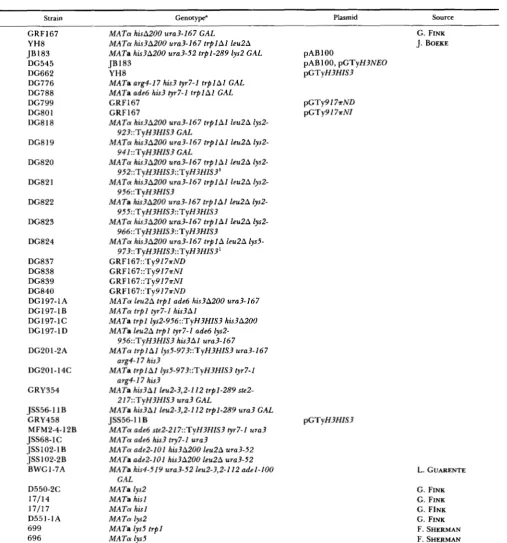
TABLE 1
Yeast strains
Strain Genotype" Plasmid Source
GRF167 YH8 JB183
DG545 DG662 DG776 DG788 DG799 DG80 1 DG8 18
DG819
DG820
DG821
DG822
DG823
DG824
DG837 DG838 DG839 DG840 DGI97-1A DGI97-1B DG 197-1 C DG 197-1 D
DG201-2A
DG201-14C
CRY354
JSS56-11B CRY458 MFM2-4-12B
JSS102-IB JSS68-1 C
JSS 102-2B BWGI-7A
D550-2C 17/14 17/17 D551-1A 699 696
M A T a hisA200 ura3-167 GAL
M A T a his3A200 ura3-167 trplAl leu2A MATa his3A200 ura3-52 trpl-289 lys2 GAL JB183
YH8
MATa arg4-17 his3 tyr7-1 trplA1 GAL MATa ade6 his3 tyr7-1 trplAl GAL GRF167
GRF167
M A T a his3A200 ura3-167 trplAl leu2A lys2-
M A T a his3A200 ura3-167 trplAl leu2A lys2-
M A T a his3A200 ura3-167 trplAl leu2A lys2-
M A T a his3A200 ura3-167 trplAl leu2A lys2-
MATa his3A200 ura3-167 trplAl leu2A lys2-
M A T a his3A200 ura3-167 trplAl leu2A lys2-
M A T a his3A200 ura3-167 trplA leu2A lys5-
GRF167::Ty917?rND GRF167::Ty917?rNI GRF167::Ty917?rNl GRF167::Ty917?rND
M A T a leu2A trpl ade6 his3A200 ura3-167 MAT& trpl tyr7-I his3Al
M A T a trpl lys2-956::TyH3HIS3 his3A200 M A T a leu2A trpl tyr7-1 ade6 lys2-
M A T a trpIAl lys5-973::TyH3HIS3 ura3-167
MATa trplAl lys5-973::TyH3HIS3 tyr7-1
MATa his301 leu2-3,2-112 trpl-289 ste2-
MATa his3A1 leu2-3,2-112 trpl-289 ura3 GAL
M A T a ade6 ste2-217::TyH3HIS3 tyr7-1 ura3 M A T a ade6 his3 try7-1 ura3
M A T a ade2-101 his3A200 leu2A ura3-52 M A T a ade2-101 his3A200 leu2A ura3-52 M A T a his4-519 ura3-52 leu2-3,2-112 adel-100
GAL MATa lys2 MATa hisl M A T a hisl M A T 0 lys2 MATa lys5 trpl M A T a lys5
923::TyH3HIS3 GAL
941::TyH3HIS3 GAL
952::TyH3HISr)::TyH3HlS3'
956::TyH3HlS3
955::TyH3HIS3::TyH3HIS3
966::TyH3HlS3::TyH3HlS3
973::TyH3HIS3::TyH3HIS3'
956::TyH3HIS3 his3A1 ura3-167
argl-17 his3
argl-17 his3
21 7::TyH3HIS3 ura3 GAL
JSS56-11 B
G . FINK J. BOEKE pAB 100
pAB 100, pGTyH3NEO pGTyH3HIS3
pGTy9177~ND pGTy917rNI
pGTyH3HIS3
L. GUARENTE
G . FINK G . FINK G . FINK G . FINK
F. SHERMAN F. SHERMAN
a T h e designation ::TyH3HlS3 refers to a strain carrying a TyH3HIS3 transposition. When appropriate, the number of additional TyH3HlS3 copies in the genome are designated by a superscripted number.
40 h at 1 1
'.
The switching time was 82 sec. The CHEF DNA was introduced into competent E . coli strain HBlOl system was made by CBS Scientific Co. (Del Mar, California). (MANDEL and HICA 19'70). Plasmids were introduced into Prior to transfer, the gels were placed over a shortwave UV yeast by the spheroplast transformation procedure of HIN-source for 5 min. NEN, HICKS and FINK ( 1 978), or the lithium acetate proce-
al.
recovered from yeast, and analyzed for a set of restriction sites diagnostic for TyH3, TyH3CLA, or Ty917. This mini- mized the chance of losing the relevant T y as a result of homologous recombination with a chromosomal element. These events can occur during or soon after yeast transfor- mation
(J.
BOEKE and D. GARFINKEL, unpublished results). T h e TyH3 restriction sites checked were BglII, FnudII, HhaI, HindIII, HpaI, SalI, ScaI, S'aNI andXhoI. The Ty917 restriction sites checked were ClaI, DraI, HindIII, NdeI,NheI, ScaI, SphI and XhoI. T h e exact position of these sites
is known from the DNA sequence of TyH3 (BOEKE et al. 1988) and Ty917 (P. FARABAUGH, personal communica- tion). '*P-Labeled hybridization probes were made by ran- domly primed DNA synthesis of purified restriction frag- ments (FEINBERG and VOGELSTEIN 1984).
Recovery of Ty917rN transpositions from yeast: Total DNA isolated from strains containing either the Ty9Z 77rND or the Ty917aNZ transpositions was cleaved using PstI or
Sad, the DNA was ligated under conditions to promote
recircularization, and plasmids were recovered as kanamycin resistant transformants in E. coli. Usually, the cells from an entire transformation were plated on one or two LB plates containing 25 r g of kanamycin (Sigma, St. Louis, Missouri) per ml.
T o aid in cloning Ty-induced mutations caused by T y - HIS3 or TyNE0 elements, we constructed URA3-based in- tegrating vectors containing the N E 0 or HIS3 genes.
Transposition assay: T h e transposition assay using TyH3 or Ty917 marked with selective genes was a modification of the original (BOEKE et al. 1985; BOEKE, Xu and FINK 1988). Yeast cells containing the relevant URA3-based plasmid were induced for transposition by growth on SC-ura plates con- taining galactose (Sigma) at 2% final concentration for 5 days (BOEKE et al. 1985) at 22" (PAQUIN and WILLIAMSON
1984). Colonies from the induction plates were restreaked for single colonies on SC-ura plates containing glucose (the GALZ promoter is strongly catabolite repressed in the pres- ence of glucose), and then a single colony was grown non- selectively on YPD plates to allow for loss of the plasmid. Ura- segregants were identified by replica plating to SC-ura plates or to media containing 5-fluoroorotic acid (BOEKE, LACROUTE and FINK 1984). Transposition events were de- tected by the ability of the Ura- segregants to grow on SC- his plates if HIS3 was the marker, or YPD plates containing the antibiotic G418 (GIBCO Laboratories, Grand Island, New York) at a final concentration of 100 or 200 rg/ml if NE0 was the marker. T h e correct G418 concentration required for selection must be determined empirically for each strain. Transpositions were scored after 1 day of incu- bation at 30" if HIS3 is the T y marker, or after 2 days if
N E 0 is the marker. T h e transposition efficiency is defined
as the number of G418R or His+, Ura- segregants divided by the total number of Ura- segregants.
Selections for Ty-induced mutations at specific target genes: (1) his3A4: His+ revertants caused by activation of the promoterless his3A4 gene were selected as described previously (BOEKE et al. 1985). (2) LYSZ or LYSS: Selection of L-a-aminoadipate (Sigma) resistant mutants (CHATTOO et al. 1979) was done as described previously (BOEKE et al.
1985), except cells were induced for transposition for 5 days at 22' before the colonies were printed to selective medium. (3) STE genes: Selection for mutants resistant to a-phero- mone was done essentially as described (HARTWELL 1980). After transposition-induction, cells were washed from the plates, 0.15 ml of the suspension (about 1 O6 cells) was spread onto several YPD plates containing 1 wg of a-pheromone (Sigma) per ml, and the plates were incubated at 30". T h e resulting mutants were analyzed for marked Ty-induced
A TyH3 URA3 2 r
I R
Tv917
x c
F53
Plasmid Class Restriction Site Used for Marking(*)
pGTyH3 TY 1 Bgfll (3 sites present)
pGTyH3CLA T Y ~ Clal (unique site)
pGTy917 T Y ~ Bglll (unique site)
0
c "
supF N E 0
G,Xb,H e s , P . G
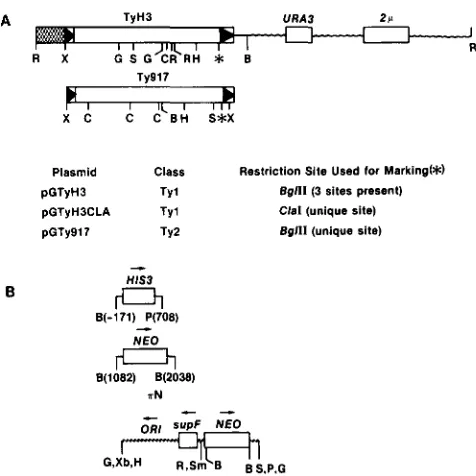
FIGURE 1 .-Restriction maps of the pCTyH3 and pGTy917 plasmids (A), and marker genes (B) (the maps are not drawn to scale). Boxed segments represent yeast or bacterial genes; the arrows point in the direction of transcription. The marker genes and the T y elements are drawn in the same transcriptional orien- tation. The wavy line represents pBR322 sequences. Restriction sites are abbreviated as follows (not all restriction sites are pre- sented): B, BamHI; C, ClaI; G , BglII; H, HindII1; P, PstI; R, EcoRI; S, SalI; Sm, SmaI; X, XhoI; Xb, Xbal. (A) Organization of pGTyH3 and pGTy917. The hatched box represents the GAL1 promoter sequence. The boxed arrows are the T y LTR sequences. In the pGTy plasmids, either TyH3 and Ty917 is fused to the GAL1 promoter at a XhoI site within the 5' LTR. The TyH3 segment is
derived from a T y transposition into plasmid pNN162 (BOEKE et
al. 1985). The TyH3CLA segment is derived from pGTyH3 using oligonucleotide-directed mutagenesis (refer to MATERIALS A N D
METHODS). The Ty917 segment is derived from plasmid phis917
(kindly provided by G . FINK). The 2p plasmid origin-containing segment is designated by a box. The (*) represents the restriction site just inside the 3' LTR where the marker genes are inserted. (B) The marker genes used to construct the plasmids pGTyH?HlS?, pGTyH3NEO (BOEKE, Xu and FINK 1988). and pGTy917nN. The numbers in parentheses indicate the nucleotide positions in the HIS3 gene (STRUHL 1985), or in the Tn903 element for the NE0 gene (OKA, SUCISAKI and TAKANAMI 1981; JOYCE and GRINDLEY
1984). The plasmid aN contains the Tn903 NE0 gene. The arrows above the HIS?, NEO, and supF genes indicate the direction of transcription. The arrow above the origin of replication (ORI) in the plasmid TN indicates the direction of DNA replication. mutations as described in the text. A detailed description of this mutant analysis will be presented elsewhere (M. MAS-
TRANGELO, K. WEINSTOCK, B. SHAFER, D. GARFINKEL and J. STRATHERN, unpublished data).
RESULTS AND DISCUSSION
T y Elements as Insertional Mutagens 99
5561 was of little value. Instead, we constructed the plasmid pGTyH3CLA, which contains a unique ClaI restriction site placed at the BglII site. A ClaI site was chosen because we could remove the only ClaI site in the plasmid without changing the T y protein se- quence, and a ClaI adaptor plasmid pCLAl2 has been developed as an intermediate vector (HUGHES et al.
1987). This plasmid is useful because it contains the polylinker array from pUCl2 flanked by ClaI sites. Virtually any segment of DNA can be converted to a fragment with ClaI ends, and then inserted into the ClaI site of pGTyH3CLA.
T h e second pGTy plasmid contains the Ty9 17 ele- ment. This element is the causative agent of the his+ 917 promoter mutation (ROEDER et al. 1980). We chose Ty917 as an additional mutagen for several reasons. When overexpressed, marked Ty9 17 deriv- atives transpose with a higher efficiency than a simi- larly marked TyH3 element (M. CURCIO, N. SANDERS and D. GARFINKEL, unpublished data). Ty917 belongs to the Ty2 structural class of T y elements, whereas TyH3 is a T y l element. Although T y l and Ty2 elements share homology at the nucleotide and amino acid sequence level (WARMINGTON et al. 1985; FUL-
TON et al. 1985; STUCKA, HAUBER and FELDMANN 1986), they persist as separate retrotransposon fami- lies in yeast. It is possible that TyH? and Ty917 have different functional properties, such as different in- sertion site specificities, or different mutagenic effects
on target genes (ROEDER, ROSE and PERLMAN 1985). Furthermore, the pGTy917 plasmid is easy to tag with foreign sequences because it contains a single BglII site in the correct position.
We marked the T y elements with a truncated yeast HIS3 gene (pGTyH3HIS?), or the Escherichia coli min- iplasmid 7rN (pCTy9177rN) (Figure 1). We also used a marked version of pGTyH3 containing the NE0 gene (pGTyH3NEO) that recently has been shown to tranpose in yeast (BOEKE, Xu and FINK 1988). T h e yeast HIS3 gene present in TyH3HZS3 allowed direct selection in his3 mutant strains. The NE0 gene confers dominant resistance to the antibiotic G418 in yeast
UIMENEZ
and DAVIES 1980), and to neomycin and kanamycin in E. coli. T h e Ty9I 77rN element could be used to recover any Ty9177rN-induced mutation di- rectly, since it contains sequences required for selec- tion and replication in E. coli.Experimental approach: Most of the T y tagging experiments presented here were done with Ty-
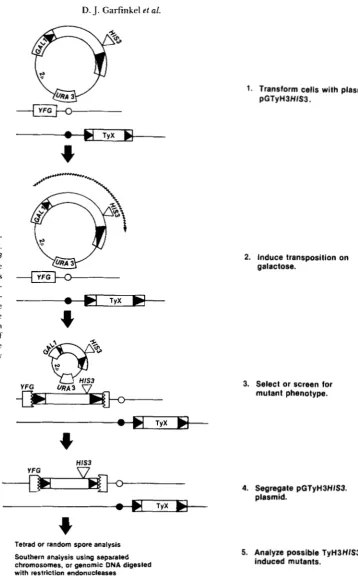
H3HZS3. T h e generalized protocol shown here can be adapted to a variety of mutant selections and screens (Figure 2). T h e plasmid pGTyH3HZS3 was introduced into yeast cells by transformation (HINNEN, HICKS and FINK 1978; IT0 et al. 1983). For T y mutagenesis using pGTyH3HZS3, the recipient strain must be GAL be- cause TyH3HZS3 is fused to the GAL1 promoter, and
mutant at the u m ? and his? loci in order to maintain the pGTyH3HZS3 plasmid and to detect marked trans- positions. T h e transformant was grown in the pres- ence of galactose to induce TyH?HZS? transposition, and then the relevant mutant screen or selection was done. T h e plasmid pGTyH?HZS3 was segregated from the putative mutants, and the mutants were
analyzed for marked transpositions into the relevant loci. Strains containing a marked transposition re- mained His+ (or resistant to the antibiotic G418 if NE0 is the marker gene) after loss of the pGTy plasmid. A useful first step in the characterization of mutants has been to cross the putative TyH?HZS?- induced mutants with an appropriate strain, and then do tetrad or random spore analysis. This cross indi- cates if the mutant contains multiple marked trans- positions, and if the mutant phenotype is linked to a TyH?HZS3 insertion. If multiple marked mutations are present, backcrosses are done to isolate the marked Ty-induced mutation.
Mutations can be caused by unmarked T y elements and by other spontaneous events as well as by T y -
H3HZS3. T h e background of unwanted mutations de- pends on the particular screen or selection. In the limited number of tests we have done, it appears that the highest fraction of Ty-induced mutations occur in selections for gene activation.
Transposition of
Ty
elements carrying selectable markers: T h e transposition efficiencies of TyH?HZS3 and Ty9177rN were initially determined using ran- domly selected colonies (Table 2). In strain DG662, 50% of the cells contained at least one TyH?HZS? transposition in the genome. Hybridization analysis using a radiolabeled HIS3 probe showed that ran- domly selected His+ derivatives of strain DG662 con- tained from 1 to 4 copies of TyH?HZS? per cell with an average number of 1.9. Similar results were ob- tained if the HIS? gene was inserted into pGTyH3CLA in the opposite orientation (data not shown). T h e hybridization patterns suggested that TyH?HZS trans- posed into many different sites in the genome. T h e relative efficiency of TyH3HZS3 transposition was also determined in cells that were induced for transposi- tion, and then selected for mutations in the LYS2 or LYSS genes (CHATTOO et al. 1979), or in certain STE genes involved in the response to a-factor (HARTWELL1980). Using either selection, about 40% of the mu- tants contained at least one TyH3HZS3 transposition (Table 2).
T h e transposition efficiency of Ty917 containing the 1830-bp 7rN plasmid was determined. These plas- mids were introduced into strain GRF167, and the resulting transformant strains DG799 and DG801
D. J. Garfinkel al.
FIGURE 2.--General steps for mu- tagenesis using marked T y elements. T h e symbols for the pGTyH3HIS3 plasmid and its structure are the same as in Figure 1. Yeast chromosomes are represented below the pGTy- H3HIS3 plasmid. On the chromo- somes is a hypothetical target gene YFG, and a native element TyX. T h e wavy line represents the transcription of TyH3HIS3 after the addition of galactose. Mutations in YFG can be caused by TyH3HIS3, TyX or by other spontaneous events.
r\
W
1. Transform cells with plasmid pGTyH3HIS3.
2. Induce transposition on galactose.
3. Select or screen for mutant phenotype.
HIS3
4. Segregate pGTyH3HIS3. plasmid.
Tetrad or random spore analysis Southern analysis using separated chromosomes, or genomic DNA digested with restriction endonucleases
5. Analyze possible TyH3HIS3- induced mutants.
(Table
2).
Hybridization analysis of total genomic DNA isolated from G418 resistant strains indicated that no gross rearrangements of 7rN or Ty917 oc- curred during transposition (data not shown).Recovery of
Ty9177rN
transpositions: To deter- mine if Ty9177rN-induced mutations can be cloned directly, we used the 7rN replicon present on Ty917 to recover several random Ty9177rN transpositions inE. coli. Total DNA isolated from strains containing
T y Elements as Insertional Mutagens 101
TABLE 2
Transposition efficiency of marked Ty elements
~~ ~~
Marker length
Transposition efficiency
Strain Plasmid Selection' (nucleotides) (%Y genome'
Copies per
DG662 pGTyH3HIS3 None 750 26/52 (50) 1.9 (2811 5)
DG662 pCTyH3HIS3 a-aa 750 6011 50 (40) 1.6 (31119)
CRY458 pGTyH3HIS3 a-Factor 750 26/60 (43) ND
DG799 pGTy917rND None 1830 38/42 (88) 2.3 (1 617)
DG80 1 D G T v ~ . I I 7uNI None 1830 40146 (87) . . . 1 .O (414) . .
a None: after transposition-induction, random colonies were analyzed. a-aa: after transposition-induction, cells resistant to L-a-aminoadipate
'
The transposition efficiency is the number of G41 8R or His+, Ura- segregants divided by the total number of Ura- segregants analyzed.' Measured as the number of bands hybridizing with an appropriate probe on a genomic Southern filter. T h e fraction in parenthesis is the were selected for analysis. a-Factor: after transposition-induction, cells resistant to a-factor were selected for analysis.
The transposition efficiency of TyH3HIS3 is about the same in colonies that were chosen randomly or if a mutant selection was done first. total number of bands counted, divided by the total number of His+ or G4 1 8R, Ura- colonies analyzed. N D not determined.
within Ty917, yeast sequences on either side of the A. B. integration site were recovered in E. coli. As expected,
Ty9177rND transpositions from strains DG837 and
DG840 yielded 7rN plasmids containing almost all of
the marked Ty, and genomic sequences 5' to the 23.1
-
transposition. Ty9177rNZ transpositions from strainsDG838 and DG839 yielded plasmids containing the 9.5
-
0 3' T y long terminal repeat (LTR), and 3' flanking 6.7-
'sequences.
T o determine whether rearrangements occurred during the cloning of the Ty9177rN transpositions,
DNA blots were prepared using PstIdigested genomic
DNA from strains containing Ty9177rN element trans- positions and PstIdigested plasmids recovered from the relevant insertions. A '*P-labeled NE0 probe hy-
2.0
-
. _."bridized with a transposition specific PstI fragment of ..$ i' .,:
the same size in both the genomic and plasmid blots (Figure 3). This result suggests that the rescued plas- mids are accurate circular forms of the genomic DNA.
Restriction analysis of the recovered plasmids with
1 213243 4 5 6 7 8 9 1 0
Y L
4.3
-
2.3
-
,-...
~ . .~ I.*
". .a . ,:
- 5 - . ,
-.
,L+. <-..l".ci. ' n " ' 2.- -I .'.:...? t
,r ,...y.#. .
0.56
-
, .
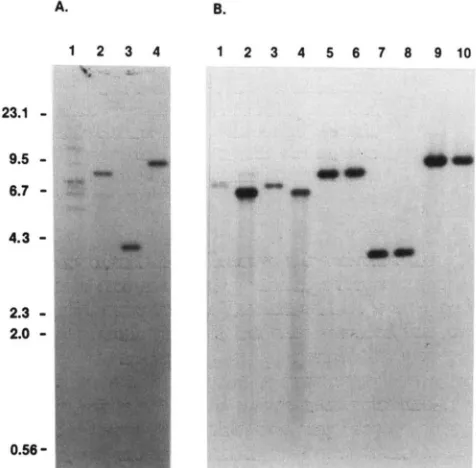
Pst1 and "'I also suggests the rescued Ty9177rN transpositions in the yeast genome. Total genomic DNA was iso- FIGURE 3.-Hybridization of plasmids recovered from Ty9177rN
sequences are not rearranged (data not shown). Pst1 lated from strains DG837 and DG840, which contain Ty917rND digests resulted in a single unique fragment, indicating transpositions, and strains DG838 and DG839, which contain
that no additional PstI fragments above about 500 bp Ty917rNI transpositions (panel A). Plasmid DNA was isolated from
were present in a clone. xhol digests produced
frag-
various E. coli transformants harboring rescued T y insertions (panelmentS Of the sizes expected from the positions Of the separated by electrophoresis under identical conditions on 0.7% B). Total DNA and plasmid DNA samples were digested with PsfI,
X h I sites in the T y LTRs, and in the NEo gene Of gels, and transferred to nitrocellulose filters according to the
We recovered the single transpositions present in with a radiolabeled NE0 probe from plasmid pCH54 UOYCE and strains ~ ~ 8 3 8 , ~ ~ 8 3 9 , and ~ ~ 8 4 0 ( ~3). F~~~ i ~GRINDLEY ~ 1984). ~The faint 6.3-kb band is caused by hybridization ~
between the plasmid pBR322, which is present in the NE0 probe
the severa1 insertions present in "IXin DG837, tWo and the endogenous yeast plasmid 2~ (data not shown). (A) Southern
Were recovered in bacteria. We would expect to re- hybridization of yeast DNA isolated from strains DG837 (lane l ) ,
cover the other insertions if more E. coli colonies were DG840 (lane 2), DG838 (lane 3). and DG839 (lane 4). (B) Southern
analyzed. H ~it
is
possible ~ SOme ~ insertions ~ will ~ hybridization of ~ ,plasmid DNA isolated from various E. coli trans- formants harboring rescued T y insertions of strain DG837 (lanessuggest that the same manipulations can be used to (lanes 9 and 10). Bacteriophage X DNA digested with Hind111 was
rescue genes tagged by Ty9177rN. included as a size marker alongside the blots.
cific target genes: T o determine the usefulness of analyzed marked transpositions into the following tar-
TyH3HZS3 and TyH3NEO elements as mutagens, we get genes: a plasmid-borne promoterlesss HIS3 gene Ty9177rN. method of S ~ U T H E R N (1975). The resulting filters were annealed
be difficult to reScue
by
this technique' These results 1-4). DG840 (lanes 5 and 6), DG838 (lanes 7 and 8), and DG839102 D. J. Garfinkel et al. TABLE 3
Transpositions of marked Ty elements into specific target genes
Number of
marked T
elements)'
Target fractlon Strain Marker gene ( W
number T elements ( d ' b
=e
totalDG545 N E 0 his3A4 54/54 (100) 8/54 (1 5) DG662 HIS3 LYSP 17/52(33) 6/17 (35)
DG662 HIS3 LYSS ND 111
CRY458 HIS3 STEP" 2/26 (7.7) 112
a The total number of mutants that are caused by a marked or unmarked T y insertion divided by the total number of mutants analyzed. ND = not determined.
The total number of mutants caused by a marked transposition divided by the total number of Ty-induced mutants at the locus.
' a-Pheromone resistance. Note that Ty-induced mutations can occur at a variety of genes involved in the response to a-pheromone. In this experiment, only the STEP gene was monitored for inser- tions.
(his3A4), the LYSB or LYS5 genes, and genes involved in the response to a-pheromone.
his3A4: Reversion of a plasmid-borne promoterless HIS3 gene can occur by T y insertions that restore HIS3 expression (SCHERER, MANN and DAVIS 1982), thus creating a ROAM mutation. In the present work, we wanted to determine whether TyH3 marked with the 956 bp NE0 gene could activate his3A4 with the same efficiency as TyH3 marked with the much shorter 40 nucleotide lac0 sequence (BOEKE et al.
1985). T h e plasmid pGTyH3NEO was introduced into the same parental strain, JB183, that was used in the earlier studies (BOEKE et al. 1985), and the result- ing transformant DG545 was induced for transposi- tion by addition of galactose. Plasmid DNA from 54
His+ revertants was analyzed in E. coli, and all of the revertants were found to be caused by T y insertional activation of his3A4 (Table 3). Fifteen percent of the
T y insertions (8/54) were marked with NEO. This percentage of TyH3NEO transpositions is similar to the 22% (8/37) (BOEKE et al. 1985), and 16% (40/
247) (BOEKE, STYLES and FINK 1986) obtained with TyH3lacO in earlier studies.
LYS2: To demonstrate TyH3HZS3 insertional mu-
tagenesis into a chromosomal target, we induced transposition in strain DG662 and then selected 150
L-a-aminoadipate resistant colonies. We expected to obtain mostly lys2 mutants (=go%), and a few lys5
mutants (CHATTOO et al. 1979). This positive selection has been used successfully to recover T y insertions at
LYSZ (EIBEL and PHILIPPSEN 1984; SIMCHEN et al.
1984) in normal cells (1-5% are Ty-induced muta- tions), and in cells induced for transposition (about 30-40% are Ty-induced, see below) (BOEKE et al.
1985). Of the 60 His', L-a-aminoadipate resistant mutants we isolated, 52 failed to complement a lys2
tester strain. T o detect insertions at LYS2, filter hy- bridizations were done with DNA isolated from these
52 mutants using the cloned LYS2 gene as a probe
(data not shown). DNA from 17 of the 5 2 lys2 mutants (33%) showed characteristic alterations that were in- dicative of T y insertions (Table 3). T h e percentage of
T y insertions at LYS2 in His- cells was not determined because we were specifically looking for mutants caused by TyH3HZS3. In similar studies with cells overexpressing pGTyH3lac0, T y transposition causes about 36% (8/22) of the lys2 mutations picked at random (BOEKE et al. 1985).
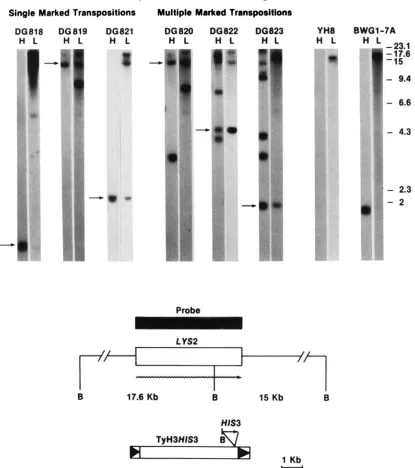
T o identify lys2 mutations caused by TyH3HZS3, duplicate DNA blots were prepared from the 17 strains described above. If TyH3HZS3 transposed into
LYS2, both a HIS3 and LYSB probe should hybridize with the same BamHI junction fragment. Six of 17 mutants (35%) showed this type of hybridization pat- tern, indicating that TyH3HZS3 caused the mutation (Figure 4). This compares favorably with the 20% efficiency obtained in earlier studies with TyH3lacO
0.
BOEKE, C. STYLES, D. GARFINKEL and G. FINK unpublished results).Chromosomal assignment of TyH3HZS3-induced
lys2 mutations: An advantage of T y mutagenesis is that the mutation is physically and genetically tagged with a unique sequence. This feature, coupled with the rapid development of electrophoretic systems that separate yeast chromosomes, should allow any muta- tion caused by a marked transposition to be assigned to a chromosome. To test this application, we analyzed the chromosomes from the parental strain YH8 and from two strains containing single TyH3HZS3 inser- tions at LYS2 using DNA filter hybridization (Figure 5). In the lys2 mutants DG8 19 and DG82 1, a HIS3 or a LYS2 specific probe hybridized with a chromosome band of the same mobility. Since the LYSB gene has been genetically mapped, this band should be chro- mosome
ZZ
(MORTIMER and SCHILD 198 1). CHU, VOLL-RATH and DAVIS (1986) also have assigned chromo- some ZZ to this band using the same CHEF electropho- retic system (contour-clamped Homogeneous Electric
-
Field) as is shown in Figure 5.LYS5: Of the 60 His+, L-a-aminoadipic acid resistant mutants we isolated, 8 failed to complement a lys5
tester strain. Hybridization analysis indicated that at least half of these mutants contained multiple T y -
H3HZS3 transpositions (data not shown), but a LYSS
probe was not available to aid us in checking for insertions at LYS5. T o determine if a TyH3HZS3 in- sertion occurred at LYS5 in any of these mutants, we looked at the segregation of the marked TyH3HZS3 transpositions, and the lys5 mutation in crosses (see below).
T y Elements as Insertional Mutagens 103
Single Marked Transpositions Multiple Marked Transpositions
DG818 DG819 06821 DG820 DG822 DO823 YH8 BWGl-7A
-
4.3- D *
'
-
2.3 - 2Probe
I
I
B 17.6 Kb B 15 Kb B
HISS
TyH3HIS3
857
"1 Kb
FIGURE 4.-Cenomic hybridization of TyH3HISPinduced lys2 mutants. Strains DG818-DG823 are lys2 mutants made in strain YH8. Strain BWGl-7A is a HIS3 control strain. Total DNA was prepared from these strains, and digested with BamHI (BamHI restriction sites are abbreviated as B). T h e samples were split in half and separated by electrophoresis on two 0.7% agarose gels under identical conditions, and then blotted. T h e resulting filters were annealed with a radiolabeled HIS3 (H) or LYS2 (L) specific probe. The LYS2 hybridization probe, represented by the solid rectangle, is from plasmid pSL42-2 (kindly provided by C. FALCO). The HIS3 probe is the ClaI fragment isolated from the plasmid pl2CLAHIS3. There is a single B Q ~ H I site in the LYS2 gene (EIBEL and PHILIPPSEN 1984), and a single EamHI site that defines 5' end of the HIS3 gene inserted in TyH3HIS3 (shown at the bottom). If TyH3HIS3 mutated LYS2, both probes should hybridize with a novel B Q ~ H I fragment that results from the transposition event. The arrows point to TyH3HIS3ILYS2 junction fragments that hybridize with both probes. Three of the Ty-induced mutants contain a single TyH3HIS3 transposition (strains DG8 18, DG819 and DG821), and three have additional TyH3HIS3 transpositions elsewhere in the genome (strains DG82O. DG822 and DG823). In strain DG818, the T y insertion is within 200 nucleotides of the BamHI site in LYS2, and as a result, the BnmHI junction fragment weakly hybridizes with a LYS2 probe. Size standards appear alongside the blots. The 17.6- and 15-kb EamHI fragments are from the LYS2 gene; the rest of the fragments are Hind111 fragments from bacteriophage X. The LYS2 gene is represented by the open rectangle, and the wavy line shows the direction of LYS2 transcription.
ant mutants that were exposed to the novel mutagen lyzed by DNA filter hybridization using a STE2-spe-
HIS3 G RY 354 JSS56-11 B
H S H S
DG DG YH 819 821 8
LYSP
DO DG YH 3
-
I1FIGURE 5.-Chrornosomal assignment of TyH3HIS3-induced
lys2 mutants. Yeast chromosomal DNA was prepared from the lys2
mutants DG819 and DG821, and the parental strain YH8. Dupli- cate samples of chromosomal DNA were separated on a 1 % agarose gel using a CHEF electrophoretic system. DNA from the gel whose ethidium bromide staining pattern is shown on the right was trans- ferred to nitrocellulose, and the resulting blots were cut into two strips. One strip was hybridized with a HIS3 specific probe, and the other with a LYS2 probe as described in Figure 4. Strain YH8 contains a complete deletion of the HIS3 gene, his3A200 (STRUHL
1985). The position of chromosome 11, which contains the LYS2 gene, is indicated alongside the gel.
induced mutation, duplicate filters were prepared us- ing BamHI digests of total DNA isolated from the mutant GRY354 and the parental strain JSS56-11B (Figure 6). Each filter was hybridized with either a HIS3 or a STEP specific probe. Two fragments hy- bridized with a '*P-labeled HIS3 probe; a 1.6-kb frag- ment containing the mutant chromosomal his3Al al- lele, and a 2.4 kb fragment corresponding to the TyH3HZS3 transposition. A 2.4-kb fragment also hy- bridized with a STEP probe, suggesting this BamHI fragment contains a TyH3HIS3ISTE2 junction from the transposition.
Since T y insertion is known to turn-on genes, a mechanism for producing an a-pheromone resistant mutant would be activating the silent HMLa locus.
To determine if this type of mutant was present in the collection, we screened a-pheromone resistant ste mutants for insertions into HMLa, and found that several were caused by TyH3HZS3 insertions (data not shown). Therefore, TyH3HZS3 can activate a re-
pressed gene. The molecular and genetic analysis of this interesting mutant class will appear elsewhere (M. MASTRANGELO, K. WEINSTOCK, B. SHAFER,
D.
GAR- FINKEL, and J. STRATHERN, unpublished data).Genetic analysis of TyH3HZS3-induced mutants:
1
r
-
9.4'
-
6.6P r O b
B
B
HIS3 7 fyH3HIS3
1 Kb
H
FIGURE 6.-Cenomic hybridization of a TyH3HlS34nduced sfe2 mutant. Strain CRY354 is a ste2 mutant made in strain JSS56-11 B. Total DNA was prepared from these strains, and digested with BamHI (BamHI restriction sites are abbreviated as B). The samples were split in half and separated by electrophoresis on two 0.7% agarose gels under identical conditions, and then blotted. The resulting filters were hybridized with a radiolabeled HIS3 (H) probe described in Figure 4, or a STE2 ( S ) probe from plasmid YCpSTE2B (NAKAYAMA, MIYAJIMA and ARAI 1985). The STE2 gene occupies approximately 1.4 kb of a 4.2-kb BamHI restriction fragment, and
a single BomHI site defines the 5' end of the HIS3 gene inserted in TyH3HIS3 (shown at the bottom). If a TyH3HIS3 insertion mutated
STEP, both probes should hybridize with a common BamHI junction
fragment containing HIS3 and STE2 specific sequences. The arrow points to a TyH3HIS3ISTE junction fragment that hybridizes with both probes. The his3AI mutation is present on a 1.6-kb BamHI fragment. Size standards appear alongside the blots. The solid rectangle is the STE2 probe. T h e STE2 gene is represented by the open rectangle, and the wavy line shows the direction of STE2 transcription.
T y Elements as Insertional Mutagens 105
TABLE 4
Tetrad analysis of single TyHjlHIS transpositions
A. Cross
Target
gene Gene pair
Ascus type"
PD NPD T
DGX 195 (DG788 X DG8 19) LYSZ ly~2-941/HIS3 20 0 0
DGX197 (DG788 X DG821) L YS2 ly~Z-956/HIS3 18 0 0
DGX227 (DG776 X DG818) LYSZ ly~2-923/HIS3 14 0 0
DGX211 (JSS102-2B X DG201-2A) LYS5 ly~5-973lHIS3 8 0 0
DGX215 (DG201-14C X ISS102-1B) LYS5 1 ~ ~ 5 - 9 7 3 / H I S 3 10 0 0
B.
Crossb gene analyzed' a,His+ a,His- a,His+ a,His- Ste-,His+ Ste-,His- Spore phenotype
Target Tetrads
MFM2-1 STEP 16 0 16 16 16 16 0
MFM2-4 STE2 15 0 17 17 13 13 0
MFM92 STEP 21 0 23 23 19 19 0
a PD, Parental ditype; NPD, nonparental ditype; T, tetratype. Only tetrads with four viable spores were included. These asci showed 2:2
'
The diploid strains MFM2-1 and -4 were obtained from different rare matings between strains CRY354 and JSS68-lC. The parental' Only tetrads with four viable spores were included. Three tetrad types were observed in these crosses. A total of 5 tetrads were 2 a,His-: segregation for both markers.
strains in cross MFM92 were JSS56-llB X MFM2-4-12B.
0 a: 2 Ste-,His+, 9 tetrads were 2 a,His+: 2 a,His-: 0 Ste-, and 38 tetrads were 1 a,His+ and 1 a,His-: 1 a,His-: 1 Ste-,His+.
linked to the new mutation. T o determine if Ty-
H3HZS3 was tightly linked to the mutated target gene, tetrad analysis was done with Ty-induced mutants. Two types of strains were investigated: one where the marked-Ty was the only copy of TyH3HZS3 in the genome, and another where there were two copies of TyH3HZS3 in the genome.
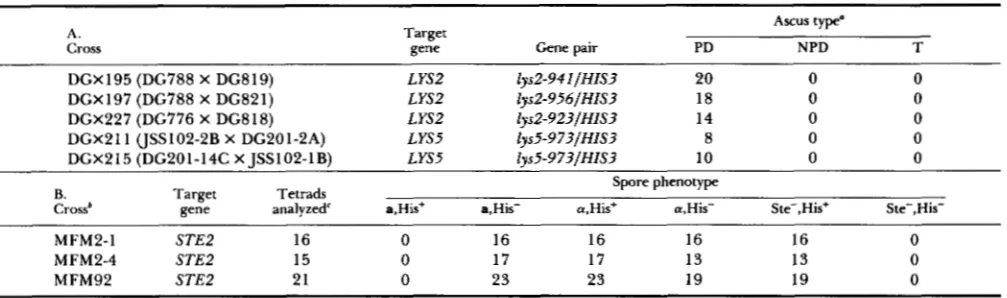
Single transpositions of TyH3HZS3: Three inde- pendent TyH3HZS3-induced mutants at LYS2, and the TyH3HZS3-induced mutant at STE2, were mated with the appropriate his3 mutant strains and the resulting diploids were sporulated (Table 4). As expected, the HIS3 gene now segregated as a gene tightly linked to the mutated lys2 target gene (Table 4A). Also, the structure of several TyH3HZS3 transpositions at LYS2
and STE2 remained unchanged throughout meiosis
(data not shown).
Segregation of the marked ste2 mutation was fol- lowed in two sets of crosses (Table 4B). In the first cross, rare diploids were selected in matings between the a, TyH3HZS3-induced ste2 mutant and an appro- priate a-strain. In two independently selected diploids (Table 4B, crosses MFM2-1 and MFM2-4), an a-spe- cific sterile segregated among the progeny [a-specific sterility is a characteristic of ste2 mutants (HARTWELL 1980)l. All of the sterile segregants were His+, indi- cating that the a-specific sterile cells were the result of a TyH3HZS3 insertion. Furthermore, the absence of His+, a-maters in the progeny suggests that a sup- pressor mutation was not selected in the rare matings needed to form the diploids.
A second cross was done where an a, ste2 mutant (obtained in cross MFM2-4 described above) was mated with an appropriate a strain (Table 4B, cross MFM92). Diploids were formed at a normal frequency
in the cross because STE2 is an a-specific gene. No a, His+ segregants appeared in the progeny, and all a- specific steriles were His+. These results confirm that the HZS3 gene was tightly linked to the ste2- 2 1 7::TyH3HZS3 mutation.
Multiple transpositions of TyH3HZS3: Multiple unlinked TyH3HZS3 transpositions should assort in- dependently during meiosis. As a result, the ratio of His+:His- segregants should increase as the number of unlinked TyH3HIS3 transpositions increases. For example, if two unlinked copies of TyH3HZS3 are present in the genome, the ratio of His+:His- progeny should be 3:1, if three copies are present the ratio should be 7:1, etc. T o test these predictions, we ana- lyzed the segregation pattern of the lys2 mutant DG820, which appeared to contain two TyH3HZS3 transpositions; one at LYS2 and another elsewhere in the genome (Figure 4). Strains DG820 and DG788 were crossed, and the resulting diploid was sporulated (Table 5, cross DGX198). In 13 tetrads, the ratio of His+:His- segregants approached 3:l (38: 14), and there were no His-, Lys- segregants. These results suggest there are two unlinked TyH3HIS3 insertions in the genome, and one of these is the lys2-
952::TyH3HZS3 mutation.
In the absence of a hybridization probe, the lys5
J. et
TABLE 5
Tetrad analysis of TyH3HIS3-induced Iys2 or lys5 mutants that contain an additional marked transposition
Spore phenotype Target Tetrads
Cross” gene analyzedb His+,Lys+ His+,Lys- His-Lys+ His-Lys- His+:His-
DGX 198 LYS2 13 12 26 14 0 38:14 (2.7:l)
DGX20 1 LYS5 32 33 64 31 0 97:31 (3.1:l)
a The parental strains used in cross DGX198 were DG788 and DG820. The parental strains used in cross DGX201 were DG788 and DG824.
*
Only tetrads with four viable spores were included. The two TyH3HIS3 insertions in strains DG820 and DG824 were unlinked. The parental ditype (2 His+: 2 His-): nonparental ditype (4 His’: 0 His-): tetratype (3 His+: 1 His-) ratios were 2: 1:lO in cross DGX198 and 4:5:23 in DGx20 1.‘ The total number of His+:His- spores present.
between the lys5 mutation and one copy of the HIS3 gene. Southern analysis of strain DG824 also indicated it had suffered two TyH3HIS3 transpositions (data not shown). T o isolate the Zys5-973::TyH3HZS3 mu- tation from the other marked transposition, several His+, Lys- progeny were chosen from tetrads where His+:His- segregated 3: 1 (tetratype pattern), and these cells were put through a second cross. The 2:2 segregation in crosses involving strains DG20 1 -2A and DG201-14C (Table 4A, crosses DGX211 and DGX215) confirms that TyH3HZS3 caused the lys5- 973::TyH3HZS3 mutation in the absence of another TyH3HZS3 transposition. The ability to tag the LYS5 gene with TyH3HZS3 demonstrates that we can iden- tify a marked mutation by genetic analysis alone.
Other applications and modifications: We con- structed and tested pGTy plasmids containing a unique cloning site. A variety of sequences can now be used to genetically tag an element as long as the markers do not inhibit transposition. This feature should be useful in strain constructions, and for ge- netic mapping. pGTy plasmids that are easy to manip- ulate can also simplify the construction of sophisti- cated T y element vectors, which stably amplify and express useful genes in yeast (BOEKE, Xu and FINK
1988).
Using the pGTy system, Ty-induced mutations are caused by both native chromosomal elements and by marked elements. It would be advantageous to reduce the background created by unmarked T y elements. In this study, about 12% (6/52) of the Zys2 mutants are caused by TyH3HZS3, and about
2
1 % (1 1/52) are caused by unmarked chromosomal T y elements. It should be possible to decrease the number of chro- mosomal T y transpositions by inducing transposition in an spt3 mutant background. The SPT3 gene is required for transposition of chromosomal elements, but transposition of the GAL.1-promoted T y elements is unaffected (BOEKE, STYLES and FINK 1986).Although many new T y insertions appear in the genome after transposition induction, little is known about their location. T y elements marked with a se- lectable gene and a bacterial replicon can be used to
recover these “random” transpositions. By choosing a restriction endonuclease that does not cleave the marked T y , we should be able to recover complete transpositions along with the Ty target site. DNA sequence analysis of the target site can then be carried out by using oligonucleotide primers homologous to the termini of the Ty. The properties of the flanking yeast sequences may help us understand what se- quences and regions of the genome make good tar- gets.
Research sponsored by the National Cancer Institute, Depart- ment of Health and Human Services, under Contract No. N 0 1 - CO-74101 with Bionetics Research, Inc. The contents of this pub- lication do not necessarily reflect the view or policies of the De- partment of Health and Human Services, nor does mention of trade names, commercial products, or organizations imply endorsement by the U.S. Government.
We are grateful to M. CURCIO, R. FISHEL, A. HINNEBUSCH, and S. HUGHES for helpful comments on this manuscript; to M. POWERS (PRI, NCI-Frederick Cancer Research Facility, Frederick, Mary- land) for synthesizing the oligonucleotides; and to N. COPELAND,
N. JENKINS and C. SILAN for use of the CHEF electrophoretic
apparatus.
LITERATURE CITED
BOEKE, J. D., F. LACROUTE and G. R. FINK, 1984 A positive selection for mutants lacking orotidine 5”phosphate decarbox- ylase activity in yeast: 5-fluoroorotic acid resistance. Mol. Gen. Genet. 197: 345-346.
BOEKE, J. D., C. A. STYLES and G . R. FINK, 1986 Saccharomyces cerevisiae SPT3 gene is required for transposition and transpo- sitional recombination of chromosomal T y elements. Mol. Cell. Biol. 6 3575-3581.
BOEKE, J. D., H . Xu and G . R. FINK, 1988 A general method for the chromosomal amplification of genes in yeast. Science 239
280-282.
BOEKE, J. D., D. J. GARFINKEL, C. A. STYLES and G . R. FINK, 1985 T y elements transpose through an RNA intermediate. Cell 40: 491-500.
BOEKE, J. D., D. EICHINGER, D. CASTRILLON and G. R. FINK, 1988 The yeast genome contains functional and nonfunc- tional copies of transposon T y l . Mol. Cell. Biol. 8: 1432-1442. CAMERON, J. R., E. Y. LOH and R. W. DAVIS, 1979 Evidence for
transposition of dispersed repetitive DNA families in yeast. Cell
CARLE, G . F., and M. V. OUON, 1985 An electrophoretic kary-
CHALEFF, D. T., and G . R. FINK, 1980 Genetic events associated
1 6 739-75 1.
T y Elements as Insertional Mutagens 107
with an insertion mutation in yeast. Cell 21: 227-237. CHATTOO, B. B., F. SHERMAN, D. A. AZUBALIS, T. A. FJELLSTEDT,
D. MEHVERT and M. OGUR, 1979 Selection of lys2 mutants in the yeast Saccharomyces cerevisiae by the utilization of a- amino-adipate. Genetics 93: 5 1-65.
CHU, G., D. VOLLRATH and R. W. DAVIS, 1986 Separation of large DNA molecules by contour-clamped homogeneous elec- tric fields. Science 2 3 4 1582-1585.
CIRIACY, M., and V. M. WILLIAMSON, 1981 Analysis of mutations affecting Ty-mediated gene expression in Saccharomyces cerevis- iae. Mol. Gen. Genet. 182: 159-163.
CLARK, D. J., V. W. BILANCHONE, L. J. HAYWOOD, S. L. DILDINE and S. B. SANDMEYER, 1988 A yeast composite element, T y j , has properties of a retrotransposon. J. Biol. Chem. 263: 1413- 1423.
EIBEL, H., and P. PHILIPPSEN, 1984 Preferential integration of yeast transposable element T y l into a promoter region. Nature
EIDE, D., and P. ANDERSON, 1985 Transposition of T c l in the nematode Caenorhabditis elegans. Proc. Natl. Acad. Sci. USA
ERREDE, B., M. COMPANY and C. A. HUTCHISON, 1987 T y l se- quence with enhancer and mating-type-dependent regulatory activities. Mol. Cell. Biol. 7: 258-265.
ERREDE, B., T. S. CARDILLO, F. SHERMAN, E. DUBOIS, J. DESCHAMPS and J. M. WIAME, 1980 Mating signals control expression of mutations resulting from insertion of a transposable repetitive element adjacent to diverse yeast genes. Cell 22: 427-436. ERREDE, B., M. COMPANY, J. D. FERCHAK, C. A. HUTCHISON and
W. S. YARNELL, 1985 Activation regions in a yeast transposon have homology to mating type control sequences and to mam- malian enhancers. Proc. Natl. Acad. Sci. USA 8 2 5423-5427. FEINBERG, A. P., and B. VOGELSTEIN, 1983 A technique for
radiolabeling DNA restriction endonuclease fragments to high specific activity. Anal. Biochem. 132: 6-13.
FULTON, A. M., J. MELLOR, M. J. DOBSON, J. CHESTER, J. R. WARMINGTON, K. J. INDGE, S. G. OLIVER, P. DE LA PAZ, W. WILSON, A. J. KINCSMAN and S. M. KINGSMAN, 1985 Variants within the yeast T y sequence family encode a class of structur- ally conserved proteins. Nucleic Acids Res. 13: 4097-41 12. GARFINKEL, D. J., J. D. BOEKE and G. R. FINK, 1985 T y element
transposition: reverse transcriptase and virus-like particles. Cell
GIROUX, C. N., J. R. A. MIS, M. K. PIERCE, S. E. KOHALMI and B. A. KUNZ, 1988 Mutations in the SUP4-0 gene of Saccharo- myces cerevisiae. Mol. Cell. Biol. 8 978-981.
GRIDLEY, T., P. SORIANO and R. JAENISCH, 1987 Insertional mu- tagenesis in mice. Trends Genet. 3: 162-166.
HARTWELL, L. H., 1980 Mutants of S. cerevisiae unresponsive to cell division control by polypeptide mating pheromone. J. Cell Biol. 85: 81 1-823.
HINNEN, A., J. B. HICKS and G. R. FINK, 1978 Transformation of yeast. Proc. Natl. Acad. Sci. USA 75: 1929-1933.
HOLM, C., D. W. MEEKS-WAGNER, W. L. FANGMAN and D. BOT-
STEIN, 1986 A rapid, efficient method for isolating DNA from
yeast. Gene 4 2 169-173.
HUGHES, S. H., J. J. GREENHOUSE, C. J. PETROPOULOS and P. SUTRAVE, 1987 Adaptor plasmids simplify the insertion of foreign DNA into helper-independent retroviral vectors. J. Virol. 61: 3004-3012.
HUISMAN, O . , W. RAYMOND, K. U. FROEHLICK, P. ERRADA, N. KLECKNER, D. BOTSTEIN and M. A. HOYT, 1987 A T n l 0 - lad-kanR-LIRA3 gene fusion transposon for insertion mutagen- esis and fusion analysis of yeast and bacterial genes. Genetics
116: 191-199.
ITO, H., Y. FUKUDA, K. MURATA and A. KIMURA,
1983 Transformation of intact yeast cells treated with alkali cations. J. Bacteriol. 153: 163-168.
307: 386-388.
82: 1756-1760.
42: 507-5 17.
JENNFSS, D. D., A. C. BURKHOLDER and L. H. HARTWELL, 1983 Binding of a-factor pheromone to yeast a cells: chemical and genetic evidence for an a-factor receptor. Cell 35: 521- 529.
JIMENEZ, A., and J. DAVIES, 1980 Expression of a transposable antibiotic resistance element in Saccharomyces cercvisiae: a po- tential selection for eukaryotic cloning vectors. Nature 287:
JOYCE, C. M., and N. D. F. GRINDLEY, 1984 Methods for deter- mining whether a gene of Escherichia coli is essential: application to the polA gene. J. Bacteriol. 158: 636-643.
KINGSMAN, A. J., R. L. GIMLICH, L. CLARK, A. C. CHINAULT and J. A. CARBON, 1981 Sequence variation in dispersed repetitive sequences in Saccharomyces cereoisiae. J. Mol. Biol. 145: 619- 632.
KLECKNER, N., J. ROTH and D. BOTSTEIN, 1977 Genetic engi- neering in vivo using translocatable drug-resistance elements. New methods in bacterial genetics. J. Mol. Biol. 1 1 6 125-159. MANDEL, M., and A. HIGA, 1970 Calcium dependent bacterio-
phage DNA infection. J. Mol. Biol. 53: 159-162.
MANIATIS, T., E. F. FRITSCH and J. SAMBROOK, 1982 Molecular Cloning. Cold Spring Harbor Laboratory, Cold Spring Harbor, N.Y.
MCCLINTOCK, B., 1965 The control of gene action in maize. Brookhaven Symp. Biol. 1 8 162-184.
MELLOR, J., M. H. MALIM, K. GULL, M. F. TUITE, S. M. MCCREADY, T. FINNSYSESN, S. M. KINGSMAN and A. J. KINGSMAN,
1985 Reverse transcriptase activity and T y RNA are associ- ated with virus-like particles in yeast. Nature 318: 583-586. MORTIMER, R. K., AND D. C. HAWTHORNE, 1969 Yeast genetics.
pp. 385-460. In: The Yeasts, Vol. 1, Edited by A. H. ROSE and J. S. HARRISON. Academic Press, New York.
MORTIMER, R. K., and D. SCHILD, 1981 Genetic map of Saccha- romyces cerevisiae. pp. 641-652. In: The Molecular Biology of the Yeast Saccharomyces. Lqe Cycle and Inheritance, Edited by J. N. STRATHERN, E. W. JONES and J. R. BROACH. Cold Spring Harbor Laboratory, Cold Spring Harbor, N.Y.
NAKAYAMA, M., A. MIYAJMA and K. ARAI, 1985 Nucleotide se- quence of STEP and STE3, cell-type-specific sterile genes of Saccharomyces cereoisiae. EMBO. J. 4: 2643-2648.
OKA, A., H. SUGISAKI and M. TAKANAMI, 1981 Nucleotide se-
quence of the kanamycin resistance transposon Tn903. J. Mol. Biol. 147: 2 17-226.
PAQUIN, C. E., and V. M. WILLIAMSON, 1984 Temperature effects of the rate of T y transposition. Science 226: 53-55.
RATHJEN, P. D., A. J. KINGSMAN and S. M. KINGSMAN, 1987 The yeast ROAM mutation-identification of the sequences media- ting host gene activation and cell-type control in the yeast retrotransposon, T y . Nucleic Acids Res. 15: 7309-7324. ROEDER, G. S., and G. R. FINK, 1980 DNA rearrangements asso-
ciated with a transposable element in yeast. Cell 21: 239-249. ROEDER, G. S., and G. R. FINK, 1983 Transposable elements in
yeast. pp. 300-328. In: Mobile Genetic Elements, Edited by J. A. SHAPIRO. Academic Press, New York.
ROEDER, G. S., A. B. RosE and R. E. PERLMAN, 1985 Transposable element sequences involved in the enhancement of yeast gene expression. Proc. Natl. Acad. Sci. USA 82: 5428-5432. ROEDER, G. S., P. J. FARABAUGH, D. T. CHALEFF and G. R. FINK,
1980 The origin of gene instability in yeast. Science 209: 1375-1380.
RUBIN, G . M., and A. C. SPRADLING, 1982 Genetic transformation of Drosophila with transposable element vectors. Science 218:
SANGER, F., S. NICKLEN and A. R. COULSON, 1977 DNA sequenc- ing with chain-terminating inhibitors. Proc. Natl. Acad. Sci.
SCHERER, S., C. MANN and R. W. DAVIS, 1982 Reversion of a 869-87 1.
348-353.
USA 74: 5463-5467.
SEED, B., 1983 Purification of genomic sequences from bacterio- phage libraries by recombination and selection in vivo. Nucleic Acids Res. 11: 2427-2445.
SEIFERT, H. S., E. Y. CHEN, M. SO and F. HEFFRON, 1986 Shuttle mutagenesis: a method of transposon mutagenesis for Saccha- romyces cerqisiae. Proc. Natl. Acad. Sci. USA 83: 735-739.
SHERMAN, F., G. R. FINK and J. B. HICKS, 1986 Laboratory Course Manual for Methods in Yeast Genetics. Cold Spring Harbor Laboratory, Cold Spring Harbor, N.Y.
SIMCHEN, G., F. WINSTON, C. A. STYLES and G. R. FINK, 1984 Ty- mediated expression of the LYS2 and HIS4 genes of Saccharo- myces cerevisiae is controlled by the same SPT genes. Proc. Natl. Acad. Sci. USA 81: 2431-2434.
SOUTHERN, E. M., 1975 Detection of specific sequences among DNA fragments separated by gel electrophoresis. J. Mol. Biol.
STRUHL, K., 1985 Nucleotide sequence and transcriptional map- ping of the yeast PET56-HIS3-DEDl gene region. Nucleic Acids Res. 13: 8587-8601.
98: 503-5 17.
STUCKA, R., J. HAUBER and H. FELDMANN, 1985 Conserved and non-conserved features among the yeast T y elements. Curr. Genet. 11: 193-200.
WARMINGTON, J. R., R. B. WARING, C. S. NEWLON, K. J. INDGE and S. G. OLIVER, 1985 Nucleotide sequence of Tyl-17, a class I1 transposon of yeast. Nucl. Acids. Res. 13: 6679-6693.
WHITEWAY, M., and J. SZOSTAK, 1985 The ARDl gene of yeast functions in the switch between the mitotic cell cycle and alternative developmental pathways. Cell 43: 483-492.
WINSTON, F., D. T. CHALEFF, B. VALENT and G. R. FINK,
1984 Mutations affecting Ty-mediated expression of the HIS4 gene of Saccharomyces cerevisiae. Genetics 107: 179-197.
ZAGURSKY, R. J., and M. L. BERMAN, 1984 Cloning vectors that yield high levels of single-stranded DNA for rapid DNA se- quencing. Gene. 27: 183-191.
ZOLLER, M. J., and M. SMITH, 1983 Oligonucleotide-directed mutagenesis of DNA fragments cloned into M 13 vectors. Meth- ods Enzymol. 1 0 0 468-500.