Cloning of
a
Mutable
bx2
Allele of Maize by Transposon Tagging and
Differential Hybridization
Margaret McLaughlin and Virginia Walbot
Department of Biological Sciences, Stanford University, Stanford, Calijornia 94305 Manuscript received June 15, 1987
Accepted August 14, 1987
ABSTRACT
Sequences of Bronze2 ( B z ~ ) , a maize gene which is required for the synthesis of the purple pigment anthocyanin, have been cloned by combining the techniques of transposon tagging and differential hybridization. First, a mutable br2 allele (br2-mul) was recovered from a Mutator line. T h e mutation was assumed to result from an insertion of the transposable element Mututor (Mu), which is found in 10-60 copies in Mutator lines. A library was prepared using DNA isolated from br2-mu1, and a small bank of Mu-specific candidate clones was selected. Because much is known about the genetic requirements for the synthesis of anthocyanin in different tissues, we were able to identify the br2 clone based on its hybridization to RNA isolated from different br2 mutants. Only one clone hybridized to RNA isolated from the husks of purple (Bz2, B, PI) plants but not to RNA isolated from the husks of green (an-bz2-6923, b, p l ) plants. Further confirmation was provided by the hybridization pattern of the clone on blots containing DNA from other br2 mutants. We present a restriction map of the clone, indicating the location and orientation of the 1 .+kbp Mu insert. We identify the transcribed region, the direction of transcription and the location of the 1 .4-kbp Mu insert in an independently isolated mutant, bz2-mu2.
HE transposable element family Mutator
(Mu)
T
was identified in the Mutator line of maize originally characterized by D. S. ROBERTSON (1978). Unlike other maize transposable element lines, the Mutator line is characterized by non-Mendelian trans- mission of the Mutator phenotype to nearly all of the progeny, and by a 20-50-fold increase in the sponta- neous mutation rate (ROBERTSON and MASCIA 198 1). T h e high rate of recovery of new mutants is a great advantage of the Mutator system. Like insertions of other maize transposable elements, Mu insertions are often somatically unstable. Mutable alleles of the genes affecting the synthesis of the purple pigment anthocyanin revert late during kernel development, resulting in spots of anthocyanin-containing cells on a background of unpigmented cells. Because of the ease with which such mutants can be identified, the genes involved in pigmentation have been studied exten- sively, and the genetic requirements for pigmentation of many tissues is well characterized. T h e product of one of these genes, Bronze2 (Bz2), is involved in the final steps of anthocyanin synthesis (REDDY and COE 1962).In an effort to characterize the Mutator family of transposable elements, Mu-induced mutations have recently been isolated in a number of maize loci. One of these, an unstable allele of Alcohol dehydrogenase1 (STROMMER et al. 1982), contained an insert of 1.4 kbp, called Mu1 (BENNETZEN et al. 1984), which was shown to interrupt transcription. A homologous 1.7-
Genetics 117: 771-776 (December, 1987)
kbp insert (Mu1.7) was identified in an unstable Bronze1 allele (TAYLOR, CHANDLER and WALBOT
1986). Sequences homologous to the internal region of Mu1 and Mul.
7 have been shown to exist in 10-60
copies in Mutator lines (ALLEMAN and FREELING1986; V. WALBOT, unpublished data) and in 1-3 copies in lines of maize that have a normal low muta- tion rate (CHANDLER, RIVIN and WALBOT 1986). T h e terminal repeats of Mu1 and Mul.7, however, show less specificity. They are found in about 60-70 copies in Mutator lines and in about 40 copies in non-Muta- tor lines (CHANDLER, RIVIN and WALBOT 1986).
T w o independent mutants in the Bz2 gene were recovered from Mutator stocks (WALBOT 1986). T h e original mutant kernels exhibited the spotted pheno- type characteristic of transposable element-induced mutations, but many of their progeny varied in the timing and frequency of somatic reversion. Some lines showed a progressive loss of the spotted phenotype in 1-3 generations. This loss has been shown to correlate with an overall increase in DNA modification of the Mu elements present in these lines (CHANDLER and WALBOT 1986). Further characterization of this phe- nomenon required probes specific to the 822 gene.
Cloning techniques which require knowledge of protein sequence cannot be used to isolate the Bz2 gene because the product of this gene is unknown. Transposon tagging (BINGHAM, LEVIS and RUBIN
772
Workers using other maize transposable elements have been able to take advantage of the large differ- ences in DNA modification o r in the restriction pat- terns among the homologous elements present in the genome to identify the active element responsible for the mutant phenotype (FEDOROFF, FURTEK and NEL- SON 1984; O'REILLY et al. 1985; CONE, BURR and
BURR 1986; WIENAND et al. 1986). Because Mutator lines have so many similar active elements, however, a different method of identifying a 622 clone must be used.
Differential hybridization is a useful technique for clone identification when a pattern of hybridization can be predicted. It can be easily adapted to geneti- cally well-characterized alleles, like those involved in anthocyanin biosynthesis, whose expression in various tissues or genetic backgrounds is well understood. In the case of Bz2, this technique was facilitated by the existence of a viable, well-characterized bz2 deletion mutant, an-bz2-6923 (COE and NEUFFER 19'77). This mutant, recovered from material irradiated in atomic bomb tests, has a deletion on the long arm of chro- mosome 1, encompassing both the anther ear locus (map position 104) and the bronze2 locus (map position 106). A Mu-specific phage clone which contains bz2 sequences would be expected to hybridize to RNA isolated from plants expressing all the genes required for anthocyanin production, but it would not be ex- pected to hybridize to RNA isolated from the an-6923 plants. Additional confirmation of bz2 sequences can be provided by the hybridization pattern of the clone with DNA isolated from other bz2 mutants.
We report here the identification of a bz2 clone by a two-step procedure: we used a Mu-specific probe to screen a genomic library prepared with DNA isolated from a Mu-induced bz2 mutant, bz2-mul, establishing a small collection of Mu-specific clones. T h e hybridi- zation pattern of these clones to different RNA species was used to identify the presence of bz2 sequences in one clone. We present a restriction map of the bz2 region, identify the section of the map that hybridizes to the transcript, and indicate the direction of tran- scription. We also show the location of the Mu inser- tion in an independently isolated mutant, bz2-mu2.
MATERIALS AND METHODS
Stocks: T h e original Mutator stock used to isolate the bz2 mutants was a gift from D. S. ROBERTSON; the line contained all of the genes required for anthocyanin pigmentation of
the aleurone and is referred to by ROBERTSON as a purple Mutator line (ROBERTSON et al. 1985). T h e bz2 tester in hybrid W23/K55 background was a gift of E. H. COE. T h e bz2-Ds mutant (bz2-m) (NUFFER 1953) and revertant were gifts of DREW SCHWARTZ. T h e anther ear bronze2 deletion stock an-bz2-6923 was obtained from the Maize Genetics Cooperative. T h e bz2-mu1 mutant was selected as a spotted kernel (Figure 1 ) by crossing the purple Mutator stock to the bz2 tester (WALBOT, BRIGGS and CHANDLER 1985). This
1 9 8 2 bz2 x 8 1 3 9 - 7 (purple Mutator)
W1982 bz2 x BB2 (bz2-mu7 )
1 9 8 3 bz2 x C 2 3 0 - 7
W1983 CF48(x)
1 9 8 4 D379-14 x bz2
FIGURE 1 .--Isolation and propagation of the 612-mu1 allele. In 1982, the purple Mutator plant B139-7 was crossed onto a bz2
tester. A spotted kernel resulting from this cross was planted in the winter of 1982 as BB2 and was crossed onto a bz2 tester. A spotted kernel from this ear was planted in the summer of 1983 as C230-7 and backcrossed to bz2 tester; progeny were selfed. A spotted kernel from this cross was planted in the summer of 1984 as D379-14 and backcrossed by bz2 tester. Twenty spotted kernels from this ear were germinated, their DNA was isolated, and it was used to prepare a library.
mutant was subsequently crossed onto a bz2 tester stock as a test for allelism. Further crosses shown in Figure 1 were
performed in order to propagate the stock. A second mu- tant, bz2-mu2, was not recognized in the original screen because of the heavy spotting pattern on the crown. It was found in 1986 when the ears were shelled. O n propagation it showed fine spotting, identical to bz2-mul. Thus the corrected mutation frequency is 3 per IO5 gametes for Bz2 in this experiment.
DNA probes and vectors: BamHI-digested X J 1 arms (MULLINS et al. 1984) were the gift of VICKI CHANDLER. T h e pA/B5 probe contains the internal 650-bp AvaIIBstNI fragment of Mu1 (CHANDLER, RIVIN and WALBOT 1986). A Bzl coding region probe, pMBZl PI (FEDOROFF, FURTEK and NELSON 1984) and a sea urchin actin cDNA, pSA38 (MERLINO et al. 1980), were provided by DOUG FURTEK and KENT PETERS, respectively. M 13 subclones of pP420 were prepared by KEN LUEHRSEN.
Reagents: Restriction enzymes, T 4 DNA Ligase, DNA Polymerase I and DNA Polymerase Large Fragment were obtained from either BRL or New England Biolabs and used according to the manufacturers' recommendations.
Isolation of plasmid, phage and plant DNA: Plasmids and phage DNAs were isolated by standard procedures (ISH- HOROWICZ and BURKE 198 1 ; MANIATIS, FRITSCH and SAM-
BROOK 1982; HELMS et al. 1985). Maize genomic DNA was
prepared from individual 5-day etiolated seedlings (DELLA-
PORTA, WOOD and HICKS 1983) o r from immature cobs by
centrifugation in CsCl/ethidium bromide (RIVIN, ZIMMER and WALBOT 1982).
Southern blot analysis: Southern blots (MEINKOTH and WAHL 1984) were done using either nitrocellulose (Schleicher & Schuell), Genetran (Plasco) o r Hybond-N (Amersham). In the case of nylon membranes, the blots were washed (60°, 30 min) in 0.1% SDS, 0.1 X SSC ( 1 X SSC = 150 mM NaCI, 15 mM sodium citrate) after baking and before prehybridization. Nick-translated probes (RIGBY
et al. 1977) and random primer labeled probes (FEINBERG and VOGELSTEIN 1983) were separated from unincorpo- rated nucleotides by spin dialysis (NEAL and FLORINI 1973).
Cloning of Mutable bz2 Allele
A
pNB5Mu1
A
I
N
I I
f
g
..
-1.9
-1.1
I I 0
f . f \ Mu1.7
H
200 bpB
1 2 3 4 5 6 7 8
1.6
1.3
-
FIGURE 3.-Specific hybridiz~tion of clone #15 to husk R N A .
TWO micrograms of poly(A) R N A were electrophoresed through 1.5% agarose formaldehyde gels and blotted and hybridized as
described. Lanes 1 , 3. 5 and 7: R N A isolated from purple husks
(Rr2, E . Pf); lanes 2, 4. 6 and 8: R N A isolated from green husks
(an-bz2-6923, b, pf). T h e probes were: lanes I and 2: clone # 15: lanes 3 and 4: pP300, a subclone of ## 1 5 ; lanes 5 and 6: pB% 1 PI, a
Rr/ coding region probe: lanes 7 and 8: pSA38, a sea urchin actin cDNA. Size standards are marked in kilobase pairs.
FIGURE 2.-Hybridi~ation of 12 Mu-specific phage clones with the pA/B5 probe. (A) simplified map of the endogenous Mu ele-
ments Mu/ and Mu1.7 and the clone pA/B5. The restriction en- zymes used in this study are: A, Aval; N, BsfNI; H. Hinfl. (B) phage DNA digested with Hinfl, electrophoresed through 1% agarose, transferred to nitrocellulose and hybridized to pA/B5 as described in MATERIALS A N D METHODS. Each lane contains DNA from a unique clone; the fifth lane contains DNA isolated from clone #15. T h e variation in hybridimion intensity reflects the variation in the amounts of DNA loaded on the gel.
(MANIATIS, FRITSCH and SAMRROOK 1982)and used to infect Escherichia coli A575. T h e resulting 1.5 million plaques were screened by filter hybridization (BENTON and DAVIS 1977) using the pA/B5 probe.
RNA isolation and Northern blot analysis: R N A was isolated from freshly harvested husks (CHIRGWIN et al. 1979) and enriched for poly(A) R N A (AVIV and LEDER 1972) using oligo(dT)-cellulose chromatography (Collaborative Research). Two micrograms were electrophoresed through formaldehyde agarose gels (POITER et al. 1981). T h e gels were washed in 40 mM NaOH, SO min. followed by 2 M
ammonium acetate (pH 7), SO min. After blotting onto Genetran (Plasco) using 20 X SSC, the Northern blots were probed (MEINKOTH and WAHL 1984).
RESULTS
T h e 622 mutants we had isolated were likely to contain Mu insertions because they showed the char- acteristic unstable phenotype and were derived from a known Mutator stock. In order to simplify the later identification of the clone, the Mu copy number in many progeny of the original 622-mu1 kernel was estimated by Southern blot analysis, using a Mu-spe-
31)
1 2 3
FIGURE 4.-Hybridi~ition of subclone pP300 to DNA from bz2
mutants. Five micrograms per lane of genomic DNA prepared from immature cobs was digested to completion with Bgfll, electropho- resed through 1 % agarose. blotted to Genetran and hybridized to
probe pP300. Lane 1: an-6923 DNA; lane 2: bz2-m DNA and lane
3: bz2-m revertant DNA. Sizes are marked in kilobase pairs.
cific sequence, pA/B5 (Figure 2), as a probe. DNA isolated from those with the fewest copies of Mu was pooled and used to prepare a library (20 etiolated seedlings grown from sibling spotted kernels, ear
D379-14 X 386, Figure 1). T h e Mu copy number in these genomic DNAs was approximately 12- 15.
Twenty-five clones which strongly hybridized to the pA/B5 probe were selected from a library of 1.5 million plaques. Of these, the 20 clones which grew well were chosen for further analysis. DNA was ex- tracted from the purified phages, digested with H i n f l , and subjected to Southern blot analysis with the PA/ B5 probe. Fach of the phage clones had a hybridizing band at 1.3 or 1.6 kbp characteristic of Mu elements (Figure 2).
774
E B EB X E~
I I I I I I I I
...--
1 I...--
-..--
.-..-*A
#15
B
I I I I I I 1 I I. * . + a
...-.'
.."'
/--..--
-. .e I
I I I I 1 1 ' '
E P B G P P P F O C F G G C E B
H
C
-
P420 P300 PB135400 bp
FIGURE 5.-Restriction map of clone #15 and subclones. (A) A simplifedmap of the 13-kbp insert in clone #15 (not drawn to scale). (B)
An expansion of the region of #15 which includes the Mu insertion (represented by the heavy line) and the region which hybridizes to purple husk RNA. The orientation of the Mu insert is marked by the asymmetric sites NotI and Ncol. (C) The subclones which hybridize to the 850 base RNA in purple husk. The restriction enzymes used in the study are: B, EamHI; C, NcoI; E, EcoRI; F, H i n f f ; G, EglII; 0, NotI; and P,
PstI.
mu2 mu1
v v
1
;
;
;
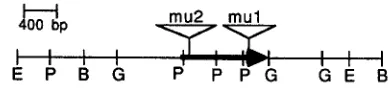
E P B G p PPbG G E B FIGURE 6.-A map of the Er2 region, showing locations of the 1.4-kbp Mu insertions and direction of transcription. The insertion in bz2-mu2 was determined by genomic Southern blots using the subclones shown in Figure 5 as probes. The direction of transcrip tion was determined by parallel Northern blots using single- stranded complementary probes from the coding region (pP420).
(Insertions not drawn to scale.)
J I I 1
I I 1
preparation (Figure 3, lanes 1 , 3 , 5 and 7) was isolated from the purple husks of plants which contained all the genes required for anthocyanin production in plant tissues (COE and NEUFFER 1977). T h e second RNA preparation (Figure 3, lanes 2, 4, 6 and 8) was isolated from husks of plants carrying alleles which do not permit the synthesis of anthocyanin in husks (b, p l ) in addition to carrying a deletion in the Bz2 locus
(an-bz2-6923). This RNA preparation, therefore, was not expected to contain Bz2 sequences. Six of the nick-translated phage DNAs hybridized to neither RNA species; seven hybridized to both (data not shown). DNA from only one of the tested phage clones, #15, hybridized to the RNA from purple husks but not to the RNA from husks of the deletion mutant (Figure 3, lanes 1 and 2). When a restriction fragment (pP300, Figure 5) adjacent to the Mu insertion in #15 was used as a probe, the same differential pattern of hybridization was obtained (Figure 3, lanes 3 and 4). A control probe containing B z l coding sequences, pMBZ 1 P 1, also hybridized differentially to the RNA preparations, confirming that the regulatory alleles B and
PZ
are required for transcription of B z l (lanes 5 and 6). A second control probe, a sea urchin actin cDNA probe, pSA38, hybridized equally to both husk RNA preparations (lanes7
and 8). On the basis of the pattern of differential hybridization, we identified clone # 15 as a bz2 clone.Further evidence that clone #15 contains b z 2 se- quences is provided by its hybridization pattern to
DNA isolated from a bz2-Ds mutant (bz2-m) and its revertant. T h e reversion presumably results from the excision of the
Ds
transposable element present in the bz2-m allele. A probe containing bz2 sequences should detect this size difference on a Southern blot. Indeed the pP300 probe hybridizes to a 4.3-kbp BglII frag- ment in the DNA isolated from bz2-m and to a 3.0- kbp BgZII fragment in the DNA isolated from the revertant (Figure 4, lanes 2 and 3). In addition the pP300 probe does not hybridize to DNA isolated from the an-bz2-6923 deletion mutant (Figure 4, lane 1).T h e only RNA species detected by this probe is approximately 850 bases long. Several subclones (Fig- ure 5 ) adjacent to the Mu insert in clone #15 hybridize to this RNA (data not shown). Flanking subclones do not hybridize. T h e direction of transcription was in- ferred by the hybridization of single-stranded coding region probes (pP420, subcloned in both directions in M13mp19).
Another Mu insertion into the Bz2 locus, bz2-mu2, has been mapped using the subclones shown in Figure 5 as probes on genomic Southern blots. This mutant also has a 1.4-kbp insertion within the transcribed region, about 700 bp upstream from the insertion in the bz2-mu1 isolate (Figure 6). Both insertions are in the same orientation.
DISCUSSION
of 775
mutants. One of these mutant alleles, the bz2-Ds allele, has also been recently cloned (THERES, SCHEELE and STARLINCER 1987).
Clone #15 contains at least part, and perhaps all, of the bz2 transcribed region. Three adjacent subclones hybridize to the 850 base RNA, while flanking sub- clones do not. The 1.4-kbp Mu1 elements inserted in bz2-mu1 and bz2-mu2 are 700 bp apart and both are found within the transcribed region. Although the insertions are in different locations, they are in the same orientation and upon propagation result in an identical phenotype of fine dark spots. Interestingly, the Mu element orientation is the same relative to transcription initiation in these bz2 mutable alleles as in the four other Mu-induced mutables examined thus far (BENNETZEN et al. 1984; O’REILLY et al. 1985;
TAYLOR, CHANDLER and WALBOT 1986).
Differential hybridization has been used to clone many genes whose expression is well characterized. Usually, a library is screened in duplicate and probed with two cDNA preparations, only one of which con- tains copies of the transcript of interest. The method has been extended to low abundance messages through the use of subtractive probes (DAVIS 1986). These techniques could be easily adapted to the clon- ing of genes for which developmentally regulated or null mutants exist. But if another technique can be used as an initial screen, e.g., transposon tagging, the resulting collection of clones is small enough that their hybridization properties may be examined by North- ern analysis. This allows the technique to be extended to genes for which the available mutants are not so well characterized. Any change in the level of tran- scription or the pattern of transcripts will be detected. All 20 of the phage clones which hybridized to the Mu-specific probe contained either a 1.3- or 1.6-kbp homologous HinfI fragment characteristic of Mu1 and
Mu1.7 elements. Of the 14 unique clones used as probes on Northern blots, eight (including #15, the bz2 clone) hybridized to RNA. This is a surprisingly high proportion. It may be that Mutator elements (at least those elements homologous to the 650-bp inter- nal region of
Mu)
preferentially transpose to actively transcribed regions. Such a mechanism has already been proposed (BENNETZEN 1984) to account for the high mutation rate in Mutator lines of maize.We would like to thank V. CHANDLER, L. TAYLOR and J. EBER-
WINE for helpful discussions, C. WARREN for technical assistance and A. BLOOM for manuscript preparation. This research was supported by a grant from the National Institutes of Health (GM
32422). M.M. was supported by a National Science Foundation Postdoctoral Fellowship in Plant Biology.
LITERATURE CITED
ALLEMAN, M., and M. FREELING, 1986 The M u transposable elements of maize: evidence for transposition and copy number regulation during development. Genetics 112: 107-1 19.
AVIV, H., and P. LEDER, 1972 Purification of biologically active globin messenger RNA by chromatography on oligothymidylic acid-cellulose. Proc. Natl. Acad. Sci. USA 6 9 1408-1412.
Transposable element M u l is found in multiple copies only in Robertson’s Mutator maize lines. J. Mol. Appl. Genet. 2: 519-524.
BENNETZEN, J. L., J. SWANSON, W. C. TAYLOR and M. FREELING,
1984 DNA insertion in the first intron of maize Adhl affects message levels: cloning of progenitor and mutant Adhl alleles. Proc. Natl. Acad. Sci. USA 81: 4125-4128.
BENTON, W. D., and R. W. DAVIS, 1977 Screening X gt recombi- nant clones by hydridization to single plaques in situ. Science
Cloning of BENNETZEN, J. L., 1984
196 180-182.
BINGHAM, P. M., R. LEVIS and G . M. RUBIN, 1981
DNA sequences from the white locus of D. melanogaster by a novel and general method. Cell 45: 693-704.
DNA modification of a maize transposable element correlates with loss of activity. Proc. Natl. Acad. Sci. USA 83: 1767-1771.
CHANDLER, V. L., C. J. RIVIN and V. WALBOT, 1986 Stable non- Mutator stocks of maize have sequences homologous to the
Mu1 transposable element. Genetics 114 1007-1021.
RUTTER, 1979 Isolation of biologically active ribonucleic acid from sources enriched in ribonuclease. Biochemistry 18: 5294- 5299.
The genetics of corn. pp. 1 1 1-223. In: Corn and Corn Improvement, Edited by G. F. SPRAGUE. American Society of Agronomy, Madison, Wiscon- sin.
Molecular analysis of the maize anthocyanin regulatory locus C I . Proc. Natl. Acad. Sci. USA 83: 9631-9635.
Subtractive cDNA hybridization and the T
cell receptor genes. pp. 76.1-76.13. In: Handbook of Experinaen- tal Immunology, Vol. 2. Cellular Immunology, Ed. 4, Edited by D.
M. WEIR, L. A. HERTZENBERG, C. C. BLACKWELL and L. A.
HERTZENBERG. Blackwell Scientific Publications, Oxford. DELLAPORTA, S. L., J. WOOD and J. B. HICKS, 1983 A plant DNA
minipreparation: version 11. Plant Mol. Biol. Rep. l(4): 19-21.
FEDOROFF, N. V., D. B. FURTEK and 0. E. NELSON, JR.,
1984 Cloning of the bronze locus in maize by a simple and generalizable procedure using the transposable element Acti- vator (Ac). Proc. Natl. Acad. Sci. USA 81: 3825-3829.
FEINBERG, A. P., and B. VOGELSTEIN, 1983 A technique for radiolabeling DNA restriction endonuclease fragments to high specific activity. Anal. Biochem. 132: 6-13.
HELMS, C., M. Y. GRAHAM, J. E. DUTCHIK and M. V. OWN, 1985 A new method for purifying lambda DNA from phage lysates. DNA 4: 39-49.
ISH-HOROWICZ, D., and V. F. BURKE, 1981 Rapid and efficient cosmid cloning. Nucleic Acids Res. 9 2989-2998.
MANIATIS, T., E. F. FRITSCH and J. SAMBROOK, 1982 Molecular Cloning: A Laboratory Manual. Cold Spring Harbor Laboratory, Cold Spring Harbor, N.Y.
MEINKOTH, J., and G. WAHL, 1984 Hybridization of nucleic acids immobilized on solid supports. Anal. Biochem. 138 267-284.
CHANDLER, V. L., and V. WALBOT, 1986
CHIRGWIN, J. M., A. E. PRZYBYLA, R. J. MACDONALD and W. J.
COE, E. H., JR., and M. G . NEUFFER, 1977
CONE, K. C., F. A. BURR and B. BURR, 1986
DAVIS, M. M., 1986
MERLINO, G . T., R. D. WATER, J. P. CHAMBERLAIN, D. A. JACKSON, Cloning of
M. R. EL-GEWELY and L. J. KLEINSMITH, 1980
sea urchin actin gene sequences for use in studying the regu- lation of actin gene transcription. Proc. Natl. Acad. Sci. USA
MULLINS, J. I., D. S. BRODY, R.
c.
BINARI,JR., and S. M. C O ~ E R ,1984 Viral transduction of c-myc gene in naturally occurring feline leukemias. Nature 3 0 8 856-858.
A rapid method for desalting small vclumes of solution. AMI. Biochem. 55: 328- 330.
77: 765-769.
776 V.
NUFFER, M. G., 1953 A new pale aleurone gene. Maize Newslett.
27: 68.
O'REILLY, C., N. S. SHEPHERD, A. PEREIRA, Z. SCHWARZ-SOMMER,
I. BERTRAM, D. S. ROBERTSON, P. A. PETERSON and H. S ~ E - DLER, 1985 Molecular cloning of the a1 locus of Zea mays using the transposable elements En and Mul. EMBO J. 4: 877- 882.
POTTER, E., A. K. NICOLAISEN, E. S. ONG, R. M. EVANS and M. G. ROSENFELD, 198 1 Thyrotropin-releasing hormone exerts rapid nuclear effects to increase production of the primary prolactin mRNA transcript. Proc. Natl. Acad. Sci. USA 78:
Inter-tissue complemen- tation: a simple technique for direct analysis of gene-action sequence. Science 138: 149-150.
RIGBY, P. W., M. DIECKMANN, C. RHODES and P. BERG.
1977 Labeling of deoxyribonucleic acid to high specific activ- ity in vitro by nick translation with DNA polymerase. J. Mol. Biol. 113: 237-251.
Isolation of DNA and DNA recombinants from maize. pp. 161-164. In: Maizefor Biological Research, Edited by W. F. SHERIDAN. Uni- versity Press, University of North Dakota, Grand Forks, N.D.
Characterization of a mutator system in maize. Mutat. Res. 51: 21-28.
Tests of 4 controlling- element systems of maize for mutator activity and their inter- action with Mu mutator. Mutat. Res. 84: 283-289.
ROBERTSON, D. S., P. S. STINARD, J. G. WHEELER, and D. W.
6662-6666.
REDDY, G. M., and E. H. COE, JR., 1962
RIVIN, C. J., E. A. ZIMMER and V. WALBOT, 1982
ROBERTSON, D. S., 1978
ROBERTSON, D. S., and P. N. MASCIA, 1981
MORRIS. 1985 Genetic and molecular studies on germinal and somatic instability in Mutator-induced aleurone mutants of maize, pp. 3 17-33 1 . In: Plant Genetics, UCLA Symposium on Molecular and Cellular Biology, Vol. 35, Edited by M. FREELING. Alan R. Liss, New York.
STROMMER, J. N., S. HAKE, J. BENNETZEN, W. C. TAYLOR and M. FREELING, 1982 Regulatory mutants of the maize Adhl gene caused by DNA insertions. Nature 300: 542-544.
Insertion of 1.4 kb and 1.7 kb Mu elements into the Bronze1 gene of Zea mays L. Maydica 31: 31-45.
THERES, N., T. SCHEELEand P. STARLINGER, 1987 Cloning of the
Bz2 locus of Zea mays using the transposable element Ds as a gene tag. Mol. Gen. Genet. 2 0 9 193-197.
Inheritance of mutator activity in Zea mays as assayed by somatic instability of the bzBmul allele. Genetics
114: 1293-1312.
Properties of mutable alleles recovered from mutator stocks of Zea mays L. pp. 115-142. In: Genetics, Development, and Evolution, Edited by J. P. GUSTAFSON, G. L. STEBBINS and F. J. AYALA. Plenum, New York.
WIENAND, U., U. WEYDEMANN, U. NIESBACH-KLOESGEN, P. A. PETERSON and H. SAEDLER, 1986 Molecular cloning of the c2 locus of Zea mays, the gene coding for chalcone synthase. Mol. Gen. Genet. 203: 202-207.
TAYLOR, L. P., V. L. CHANDLER and V. WALBOT, 1986
WALBOT, V., 1986
WALBOT, V., C. P. BRIGGS and V. CHANDLER. 1966